Distanza percorsa da un ciclista a velocita costante
Un ciclista che viaggia alla velocità costante di 5 m/s quanti chilometri percorre in 3 ore?
- (A) 15 km
- (B) 18 km
- (C) 50 km
- (D) 54 km
- (E) nessuna delle precedenti.
Topic: Teoria dei Numeri Abilita: traduzione del testo Area: Aritmetica e Teoria dei Numeri Risposta: D Fonte: apri PDF p.1
Distance travelled by a cyclist at constant speed
A cyclist traveling at a constant speed of 5 m/s, how many miles does he travel in three hours?
- (A) 15 km
- (B) 18 km
- (C) 50 km
- (D) 54 km
- (E) None of the previous ones.
Answer: D src_archimede_1996_biennio__Q01
Percentuale di matematici dato un rapporto su abitanti
Se in una città c’è un matematico ogni 320 abitanti, qual è la percentuale di matematici?
- (A) 3,2%
- (B) 0,32%
- (C) 3,125%
- (D) 0,3125%
- (E) nessuna delle precedenti.
Topic: Teoria dei Numeri Abilita: traduzione del testo Area: Aritmetica e Teoria dei Numeri Risposta: D Fonte: apri PDF p.1
Proportion of mathematicians given a population ratio
If there’s one mathematician in a city for every 320 people, what’s the percentage of mathematicians?
- (A) 3,2%
- (B) 0,32%
- (C) 3,125%
- (D) 0,3125%
- (E) None of the previous ones.
Answer: D src_archimede_1996_biennio__Q02
Misura di un angolo dati altri angoli e allineamento
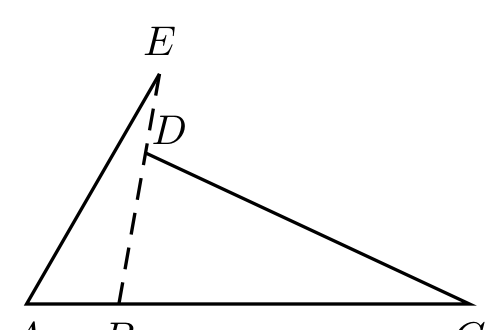
Si sa che nella figura a fianco = 60°, = 20°, = 25°. I punti E, D, B sono allineati. Qual è la misura di ?
- (A) 75°
- (B) 85°
- (C) 90°
- (D) 105°
- (E) le informazioni sono insufficienti.
Topic: Geometria piana Abilita: Ragionamento geometrico Area: Geometria Risposta: A Fonte: apri PDF p.1
Measurement of an angle data other angles and alignment
It is known that in the figure next to = 60°, = 20°, = 25°. The points E, D, B are aligned. What is the measurement of ?
- (A) 75°
- (B) 85°
- (C) 90°
- (D) 105°
- (E) the information is insufficient.
Answer: A src_archimede_1996_biennio__Q03
Peso del secchio vuoto da sistema lineare sulla sabbia
Un secchio pieno di sabbia pesa complessivamente 9 kg, riempito per metà di sabbia pesa 5 kg. Quanto pesa il secchio vuoto?
- (A) 0,5 kg
- (B) 1 kg
- (C) 2 kg
- (D) 2,5 kg
- (E) il peso del secchio non può essere determinato.
Topic: Algebra Abilita: Manipolazione algebrica Area: Algebra e Analisi Risposta: B Fonte: apri PDF p.1
Weight of linear system empty bucket on the sand
A bucket full of sand weighs a total of 9 kg, and half-filled with sand weighs 5 kg. How much does the empty bucket weigh?
- (A) 0,5 kg
- (B) 1 kg
- (C) 2 kg
- (D) 2,5 kg
- (E) the weight of the bucket cannot be determined.
Answer: B src_archimede_1996_biennio__Q04
Ora di accensione del forno per cuocere il pesce
Per cuocere il pesce sono necessari 15 minuti (fissi) per scaldare il forno, più 12 minuti di cottura per ogni 1/2 kg di pesce. Michele compra un branzino dal peso di 2,5 kg e vuole che sia cotto esattamente per le ore 20:00. A che ora Michele deve accendere il forno?
- (A) 18:00
- (B) 18:45
- (C) 18:50
- (D) 18:57
- (E) 19:00.
Topic: Teoria dei Numeri Abilita: traduzione del testo Area: Aritmetica e Teoria dei Numeri Risposta: B Fonte: apri PDF p.1
Time of setting the oven to cook the fish
It takes 15 minutes (fixed) to heat the oven to cook the fish, plus 12 minutes of cooking for every 1/2 kg of fish. Michele buys a two-and-a-half-pound candy bar and wants it to be cooked by exactly 8:00. What time does Michele have to light the oven?
- (A) 18:00
- (B) 18:45
- (C) 18:50
- (D) 18:57
- (E) 19:00.
Answer: B src_archimede_1996_biennio__Q05
Confronto fra aree di tre figure in quadrati uguali
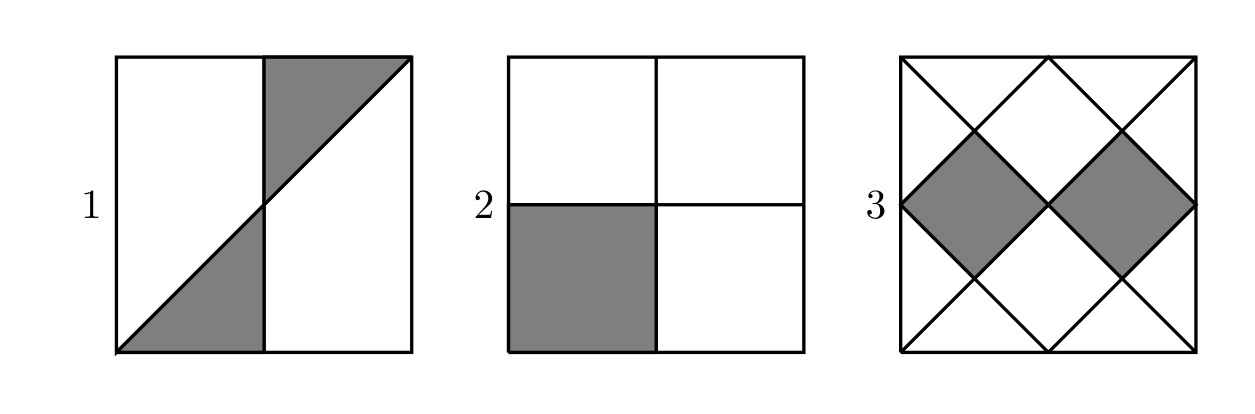
I tre quadrati del disegno hanno lo stesso lato. In che rapporto stanno le aree delle tre figure ombreggiate? 1 2 3
- (A) La prima area è maggiore delle altre due
- (B) la seconda area è maggiore delle altre due
- (C) la terza area è maggiore delle altre due
- (D) la prima area è uguale alla seconda, ed entrambe sono maggiori della terza
- (E) le tre aree sono uguali.
Topic: Geometria piana Metodo: Sfruttamento della simmetria Abilita: Ragionamento geometrico Area: Geometria Risposta: E Fonte: apri PDF p.1
Comparison between areas of three figures in equal squares
The three squares of the drawing have the same side. What is the relationship between the areas of the three shaded figures? 1 2 3
- (A) The first area is larger than the other two.
- (B) The second area is larger than the other two.
- (C) The third area is larger than the other two.
- (D) The first area is equal to the second, and both are greater than the third.
- (E) The three areas are the same.
Answer: E src_archimede_1996_biennio__Q06
Quale frase logica e compatibile con i fatti dati
Ieri non ho fatto colazione e sono andato a scuola, mentre l’altro ieri ho fatto colazione e sono andato a scuola. Quali delle frasi seguenti posso pronunciare senza essere bugiardo?
- (A) Quando faccio colazione non vado mai a scuola
- (B) tutte le volte che vado a scuola non faccio colazione
- (C) ogni volta che vado a scuola faccio colazione
- (D) talvolta vado a scuola senza fare colazione
- (E) quando non faccio colazione non vado mai a scuola.
Topic: Logica, giochi, strategie Abilita: Lettura attenta del testo Area: Combinatoria, Logica e Probabilita Risposta: D Fonte: apri PDF p.1
Which sentence is logical and consistent with the facts
Yesterday I didn’t have breakfast and went to school, while the other day I had breakfast and went to school. Which of the following phrases can I say without lying?
- (A) When I eat breakfast I never go to school
- (B) Every time I go to school I don’t eat breakfast.
- (C) Every time I go to school I eat breakfast
- (D) Sometimes I go to school without breakfast.
- (E) When I don’t have breakfast, I never go to school.
Answer: D src_archimede_1996_biennio__Q07
Rapporto AD/AB da similitudine di rettangoli
Nel rettangolo ABCD (vertici indicati in senso antiorario), E ed F sono i punti medi dei lati maggiori AD e BC rispettivamente. Sapendo che ABFE è simile a ABCD, quanto vale AD/AB?
- (A) 7 5
- (B) 3 2
- (C) √ 3
- (D) 2 √ 2
- (E) le precedenti risposte sono tutte sbagliate.
Topic: Geometria piana Abilita: Ragionamento geometrico Area: Geometria Risposta: E Fonte: apri PDF p.1
AD/AB ratio from rectangular similarities
In the rectangle ABCD (vertices indicated in the anti-clockwise direction), E and F are the midpoints of the major sides AD and BC respectively. Knowing that ABFE is similar to ABCD, how much is AD/AB worth?
- (A) 7 5
- (B) 3 2
- (C) √ 3
- (D) 2 √ 2
- (E) The previous answers are all wrong.
Answer: E src_archimede_1996_biennio__Q08
Tempo sui 200 m di uno sprinter a velocita costante
Uno sprinter molto regolare quando corre i 100 metri impiega 2,4 secondi per i primi 20 metri e corre i restanti 80 m a velocità costante, concludendo la gara in 10 secondi netti. Se proseguisse per altri 100 m senza modificare la sua velocità che tempo otterrebbe sui 200 m?
- (A) 18,8 s
- (B) 19 s
- (C) 19,5 s
- (D) 19,6 s
- (E) 20 s.
Topic: Teoria dei Numeri Abilita: traduzione del testo Area: Aritmetica e Teoria dei Numeri Risposta: C Fonte: apri PDF p.1
Time on 200 m of a steady speed sprinter
A very regular sprinter when running the 100 meters takes 2.4 seconds for the first 20 meters and runs the remaining 80 meters at a constant speed, completing the race in 10 net seconds. If it went on for another 100 meters without changing its speed what time would it get on the 200 meters?
- (A) 18,8 s
- (B) 19 s
- (C) 19,5 s
- (D) 19,6 s
- (E) 20 s.
Answer: C src_archimede_1996_biennio__Q09
Lato dell’ottagono regolare ottenuto da un quadrato
\begin{document}
\begin{tikzpicture}[scale=1.2]
  \draw[dashed] (0,0) rectangle (4,4);
  \def\a{1.1715}
  \draw[thick]
    (\a,0) -- (4-\a,0) -- (4,\a) -- (4,4-\a) --
    (4-\a,4) -- (\a,4) -- (0,4-\a) -- (0,\a) -- cycle;
\end{tikzpicture}
\end{document}
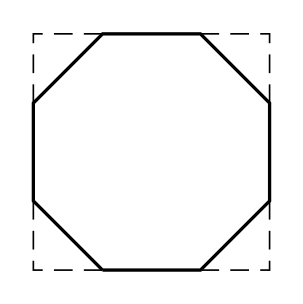
Da un quadrato di lato 10 cm si tagliano i quattro angoli in modo da ottenere un ottagono regolare. Il lato dell’ottagono è lungo
- (A) 4 cm
- (B) 10 · ( √ 2 −1) cm
- (C) 3 √ 2 cm
- (D) 5 cm
- (E) le precedenti risposte sono tutte sbagliate.
Topic: Geometria piana Abilita: Ragionamento geometrico Area: Geometria Risposta: B Fonte: apri PDF p.2
Side of the regular octagon obtained from a square
\begin{document}
\begin{tikzpicture}[scale=1.2]
  \draw[dashed] (0,0) rectangle (4,4);
  \def\a{1.1715}
  \draw[thick]
    (\a,0) -- (4-\a,0) -- (4,\a) -- (4,4-\a) --
    (4-\a,4) -- (\a,4) -- (0,4-\a) -- (0,\a) -- cycle;
\end{tikzpicture}
\end{document}
Cut the four corners of a 10 cm side square to obtain a regular octagon. The side of the octagon is long.
- (A) 4 cm
- (B) 10 · ( √ 2 −1) cm
- (C) 3 √ 2 cm
- (D) 5 cm
- (E) The previous answers are all wrong.
Answer: B src_archimede_1996_biennio__Q10
Peso finale delle angurie dopo evaporazione
Una partita di angurie del peso iniziale di 500 kg viene stoccata per una settimana in un magazzino. All’inizio la percentuale di acqua contenuta nelle angurie è il 99% del loro peso, alla fine dello stoccaggio, a causa dell’evaporazione, tale percentuale è scesa al 98%. Quanto pesano alla fine le angurie?
- (A) 250 kg
- (B) 400 kg
- (C) 480 kg
- (D) 490 kg
- (E) 495 kg.
Topic: Teoria dei Numeri, Algebra Abilita: traduzione del testo Area: Algebra e Analisi, Aritmetica e Teoria dei Numeri Risposta: A Fonte: apri PDF p.2
Final weight of anguries after evaporation
A batch of anguries of an initial weight of 500 kg is stored for one week in a warehouse. At the beginning, the water content of anguries was 99% by weight. At the end of storage, due to evaporation, this percentage dropped to 98%. How much do the watermelons weigh in the end?
- (A) 250 kg
- (B) 400 kg
- (C) 480 kg
- (D) 490 kg
- (E) 495 kg.
Answer: A src_archimede_1996_biennio__Q11
Lato di un rombo date area e rapporto fra diagonali
In un rombo di area 80 cm2, una diagonale è lunga il doppio dell’altra. Quanto è lungo il lato del rombo?
- (A) 8 cm
- (B) √ 80 cm
- (C) 10 cm
- (D) 20 cm
- (E) non si può determinare.
Topic: Geometria piana Abilita: Ragionamento geometrico Area: Geometria Risposta: C Fonte: apri PDF p.2
Side of a rim given area and diagonal ratio
In an area of 80 cm2, one diagonal is twice as long as the other. How long is the side of the rim?
- (A) 8 cm
- (B) √ 80 cm
- (C) 10 cm
- (D) 20 cm
- (E) It’s impossible to determine.
Answer: C src_archimede_1996_biennio__Q12
Quale persona indovina data fra settimana giorno mese
Cinque persone non si trovano d’accordo sulla data. – Carlo dice che oggi è lunedì 16 agosto – Franco dice che oggi è martedì 16 agosto – Marco dice che oggi è martedì 17 settembre – Roberto dice che oggi è lunedì 17 agosto – Tullio dice che oggi è lunedì 17 settembre. Uno ha ragione, ma nessuno ha “completamente” torto, nel senso che ciascuno dice correttamente almeno una cosa (o il giorno della settimana, o il giorno del mese, o il mese). Chi ha ragione?
- (A) Carlo
- (B) Franco
- (C) Marco
- (D) Roberto
- (E) Tullio.
Topic: Logica, giochi, strategie Metodo: Analisi per casi Abilita: Casework accurato Area: Combinatoria, Logica e Probabilita Risposta: D Fonte: apri PDF p.2
Who can guess the date from week to month
Five people disagree on the date. Carlo says today is Monday 16 August Franco says today is Tuesday 16 August Marco says today is Tuesday 17 September Roberto says today is Monday 17 August Tullio says today is Monday 17 September. One is right, but no one is completely wrong, in the sense that everyone says at least one thing correctly (or the day of the week, or the day of the month, or the month). Who’s right?
- (A) Charles
- (B) French
- (C) Mark
- (D) This is not a problem.
- (E) - What?
Answer: D src_archimede_1996_biennio__Q13
Numero di cifre del prodotto di due numeri ripetitivi
Sia m = 999 … 99 il numero formato da 77 cifre tutte uguali a 9 e sia n = 777 … 77 il numero formato da 99 cifre tutte uguali a 7. Il numero delle cifre di m · n è
- (A) 175
- (B) 176
- (C) 177
- (D) 7692
- (E) 7693.
Topic: Teoria dei Numeri Abilita: Riconoscimento di pattern Area: Aritmetica e Teoria dei Numeri Risposta: B Fonte: apri PDF p.2
Number of product figures of two repeating numbers
It ‘s m = 999 … 99 is the number of 77 digits all equal to 9 and is n = 777 … 77 is the 99-digit number, all equal to 7. The number of digits of m · n is
- (A) 175
- (B) 176
- (C) 177
- (D) 7692
- (E) 7693.
Answer: B src_archimede_1996_biennio__Q14
Probabilita che una squadra vinca tutte le partite
Quattro squadre di pallacanestro di pari forza disputano un torneo con girone unico all’italiana (ogni squadra incontra ogni altra squadra una sola volta). Qual è la probabilità che ci sia una squadra che alla fine del torneo ha vinto tutte le sue partite? (le partite di pallacanestro non possono finire con un pareggio).
- (A) 1 6
- (B) 1 π
- (C) 1 3
- (D) 1 2
- (E) 2 3.
Topic: Probabilita e statistica Metodo: Conteggio combinatorio Abilita: Conteggio sistematico Area: Combinatoria, Logica e Probabilita Risposta: D Fonte: apri PDF p.2
The probability of one team winning all matches
Four basketball teams of equal strength compete in a single round-robin tournament in Italy (each team meets every other team only once). What are the odds of a team winning all their games at the end of the tournament? (Basketball matches cannot end in a draw).
- (A) 1 6
- (B) 1 π
- (C) 1 3
- (D) 1 2
- (E) 2 3.
Answer: D src_archimede_1996_biennio__Q15
Rapporto fra aree di triangoli equilateri inscritti
\begin{document}
\begin{tikzpicture}[scale=2]
  \coordinate (A) at (0,0);
  \coordinate (B) at (2,0);
  \coordinate (C) at (1,1.732);
  \coordinate (E) at (1,0);
  \coordinate (D) at (0.5,0.866);
  \coordinate (F) at (1.5,0.866);
  \draw[thick] (A)--(B)--(C)--cycle;
  \draw[thick] (D)--(E)--(F)--cycle;
  \foreach \p/\n in {A/below left,B/below right,C/above,D/left,E/below,F/right}
    \node[\n] at (\p) {$\p$};
\end{tikzpicture}
\end{document}
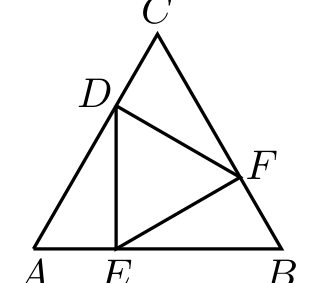
Sia ABC un triangolo equilatero e DEF un altro triangolo equilatero in esso inscritto con AB perpendicolare a ED. Il rapporto fra le aree di ABC e di DEF è
- (A) √ 3
- (B) 2
- (C) 5 2
- (D) 3
- (E) 3 √ 2.
Topic: Geometria piana Metodo: Sfruttamento della simmetria Abilita: Ragionamento geometrico Area: Geometria Risposta: D Fonte: apri PDF p.2 Anche in triennio: apri PDF p.2
Ratio between areas of equilateral triangles inscribed
\begin{document}
\begin{tikzpicture}[scale=2]
  \coordinate (A) at (0,0);
  \coordinate (B) at (2,0);
  \coordinate (C) at (1,1.732);
  \coordinate (E) at (1,0);
  \coordinate (D) at (0.5,0.866);
  \coordinate (F) at (1.5,0.866);
  \draw[thick] (A)--(B)--(C)--cycle;
  \draw[thick] (D)--(E)--(F)--cycle;
  \foreach \p/\n in {A/below left,B/below right,C/above,D/left,E/below,F/right}
    \node[\n] at (\p) {$\p$};
\end{tikzpicture}
\end{document}
Either ABC is an equilateral triangle and DEF is another equilateral triangle inscribed with AB perpendicular to ED. The ratio between the ABC and DEF areas is
- (A) √ 3
- (B) 2
- (C) 5 2
- (D) 3
- (E) 3 √ 2.
Answer: D src_archimede_1996_biennio__Q16
Numero di cuciture di un pallone esagoni e pentagoni
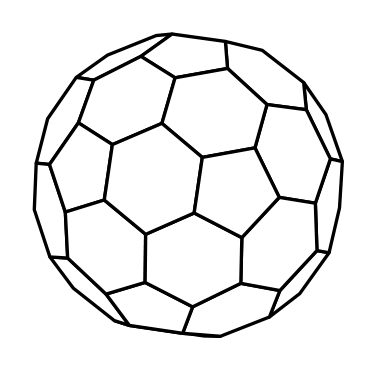
Un pallone di cuoio è ottenuto cucendo 20 pezzi di cuoio a forma esagonale e 12 pezzi di cuoio a forma pentagonale. Una cucitura unisce i lati di due pezzi adiacenti. Allora il numero totale delle cuciture è
- (A) 90
- (B) 172
- (C) 176
- (D) 180
- (E) i dati del problema sono insufficienti.
Topic: Combinatoria Metodo: Doppio conteggio Abilita: Conteggio sistematico Area: Combinatoria, Logica e Probabilita Risposta: A Fonte: apri PDF p.2 Anche in triennio: apri PDF p.2
Number of seams of a ball hexagons and pentagons
A leather ball is obtained by sewing 20 hexagonal leather and 12 pentagonal leather. A seam joins the sides of two adjacent pieces. So the total number of seams is
- (A) 90
- (B) 172
- (C) 176
- (D) 180
- (E) The data on the problem is insufficient.
Answer: A src_archimede_1996_biennio__Q17
Quanti angoli maggiori di 90 gradi in un quadrilatero
Quanti angoli maggiori di 90°può avere un quadrilatero (non intrecciato)?
- (A) Ne ha sempre almeno uno
- (B) ne ha al più uno
- (C) ne ha al più due
- (D) ne ha al più tre
- (E) può averne quattro.
Topic: Geometria piana Metodo: Analisi per casi Abilita: Ragionamento geometrico Area: Geometria Risposta: D Fonte: apri PDF p.2 Anche in triennio: apri PDF p.2
How many angles greater than 90 degrees in a quadrilateral
How many angles greater than 90° can a quadrilateral (unwoven) have?
- (A) He always has at least one .
- (B) He has at most one.
- (C) He has two at most.
- (D) He has three at most.
- (E) You can have four.
Answer: D src_archimede_1996_biennio__Q18
Quale sacchetto piu probabile data pallina bianca
In una scatola vi sono quattro sacchetti: il primo sacchetto contiene 4 palline bianche e 3 nere, il secondo 2 palline bianche e 4 nere, il terzo 6 palline bianche e 9 nere, il quarto 5 palline bianche e 10 nere. Si estrae un sacchetto a caso, e da questo, sempre a caso, si estrae una pallina. Sapendo che è stata estratta una pallina bianca, quale sacchetto è più probabile che sia stato scelto?
- (A) Il primo
- (B) il secondo
- (C) il terzo
- (D) il quarto
- (E) tutti i sacchetti hanno la stessa probabilità di essere stati estratti.
Topic: Probabilita e statistica Abilita: Conteggio sistematico Area: Combinatoria, Logica e Probabilita Risposta: A Fonte: apri PDF p.2
Which bag is most likely given the white ball
In a box there are four bags: the first bag contains 4 white and 3 black balls, the second 2 white and 4 black balls, the third 6 white and 9 black balls, the fourth 5 white and 10 black balls. You extract a random bag, and from it, every time, you extract a ball. Knowing that a white ball was extracted, which bag is more likely to have been picked?
- (A) The first
- (B) The second
- (C) the third
- (D) The fourth
- (E) All the bags have the same probability of being extracted.
Answer: A src_archimede_1996_biennio__Q19
Angolo ECD in un pentagono regolare con triangolo equilatero
\begin{document}
\begin{tikzpicture}[scale=1.8]
  \coordinate (A)   at (-0.5878,-0.8090);
  \coordinate (B)   at (0.5878,-0.8090);
  \coordinate (D)   at (0.9511,0.3090);
  \coordinate (top) at (0,1.0);
  \coordinate (E)   at (-0.9511,0.3090);
  \coordinate (C)   at (0,0.2093);
  \draw[thick] (A)--(B)--(D)--(top)--(E)--cycle;
  \draw[thick] (A)--(C)--(B);
  \draw[dashed] (E)--(C)--(D);
  \foreach \p/\n in {A/below,B/below,D/right,E/left}
    \node[\n] at (\p) {$\p$};
  \node[above right] at (C) {$C$};
\end{tikzpicture}
\end{document}
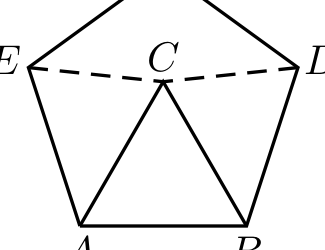
Nel pentagono regolare disegnato a fianco, il triangolo ABC è equilatero. Quanto vale l’angolo convesso ?
- (A) 120°
- (B) 144°
- (C) 150°
- (D) 168°
- (E) 170°.
Topic: Geometria piana Abilita: Ragionamento geometrico Area: Geometria Risposta: D Fonte: apri PDF p.2 Anche in triennio: apri PDF p.2
ECD angle in a regular pentagon with equilateral triangle
\begin{document}
\begin{tikzpicture}[scale=1.8]
  \coordinate (A)   at (-0.5878,-0.8090);
  \coordinate (B)   at (0.5878,-0.8090);
  \coordinate (D)   at (0.9511,0.3090);
  \coordinate (top) at (0,1.0);
  \coordinate (E)   at (-0.9511,0.3090);
  \coordinate (C)   at (0,0.2093);
  \draw[thick] (A)--(B)--(D)--(top)--(E)--cycle;
  \draw[thick] (A)--(C)--(B);
  \draw[dashed] (E)--(C)--(D);
  \foreach \p/\n in {A/below,B/below,D/right,E/left}
    \node[\n] at (\p) {$\p$};
  \node[above right] at (C) {$C$};
\end{tikzpicture}
\end{document}
In the regular pentagon drawn side by side, the ABC triangle is equilateral. How much is the convex angle ?
- (A) 120°
- (B) 144°
- (C) 150°
- (D) 168°
- (E) 170°.
Answer: D src_archimede_1996_biennio__Q20