Quanti numeri AB con 12xAB = 21xBA
In alcuni casi, coppie di numeri di due cifre hanno lo stesso prodotto dei due numeri letti al contrario (ad esempio 13 × 62 = 31 × 26). Quanti sono i numeri di due cifre AB (A e B sono le cifre decimali) tali che 12 × AB = 21 × BA?
- (A) 1
- (B) 2
- (C) 3
- (D) 4
- (E) 9.
Topic: Teoria dei Numeri Abilita: Conteggio sistematico Area: Aritmetica e Teoria dei Numeri Fonte: apri PDF p.1
How many AB numbers with 12xAB = 21xBA
In some cases, pairs of two-digit numbers have the same product of the two numbers read backwards (e.g. 13 × 62 = 31 × 26). How many numbers of two digits AB (A and B are the decimal digits) such that 12 × AB = 21 × BA?
- (A) 1
- (B) 2
- (C) 3
- (D) 4
- (E) 9.
src_archimede_2002_triennio__Q01
Percentuale di aumento per recuperare prezzo originario
Una merce è stata scontata del 20% del suo prezzo originario. Di quale percentuale deve essere aumentata per riottenere il prezzo originario?
- (A) 16%
- (B) 20%
- (C) 25%
- (D) 50%
- (E) 60%.
Topic: Algebra Abilita: Manipolazione algebrica Area: Algebra e Analisi Fonte: apri PDF p.1
Percentage increase to recover the original price
A commodity was discounted by 20% of its original price. What percentage must be increased to recover the original price?
- (A) 16%
- (B) 20%
- (C) 25%
- (D) 50%
- (E) 60%.
src_archimede_2002_triennio__Q02
Quale dei numeri dati non e razionale
Quale dei numeri seguenti non è razionale?
- (A) −2002
- (B) 8 2 3
- (C) √0, 49
- (D) 1000,5
- (E) 10000,1.
Topic: Teoria dei Numeri Abilita: Riconoscimento di pattern Area: Aritmetica e Teoria dei Numeri Fonte: apri PDF p.1
Which of the data numbers is not rational
Which of the following numbers is not rational?
- (A) −2002
- (B) 8 2 3
- (C) √0, 49
- (D) 1000,5
- (E) 10000,1.
src_archimede_2002_triennio__Q08
Volume di due oggetti dati densita e differenza peso
Due oggetti omogenei, fatti di due materiali diversi, hanno lo stesso volume, ma il primo pesa 242 g più del secondo. Sapendo che il materiale di cui è fatto il primo oggetto ha densità 8,9 g/cm3 e quello di cui è fatto il secondo oggetto ha densità 7,8 g/cm3, qual è il volume di ciascuno degli oggetti?
- (A) 120 cm3
- (B) 150 cm3
- (C) 220 cm3
- (D) 300 cm3
- (E) i dati forniti sono insufficienti.
Topic: Algebra Metodo: manipolazione algebrica Abilita: traduzione del testo Area: Algebra e Analisi Fonte: apri PDF p.1
Volume of two data objects density and weight difference
Two identical objects, made of two different materials, have the same volume, but the first weighs 242 g more than the second. Knowing that the material of which the first object is made has a density of 8,9 g/cm3 and the material of which the second object is made has a density of 7,8 g/cm3, what is the volume of each of the objects?
- (A) 120 cm3
- (B) 150 cm3
- (C) 220 cm3
- (D) 300 cm3
- (E) the data provided are insufficient.
src_archimede_2002_triennio__Q09
Numero commensali da resti e divisibilita per 7
Il direttore di un ristorante con capienza di 600 posti non ricorda quante erano le persone da lui servite in occasione di un grande pranzo collettivo. Ricorda però che volendole sistemare in tavoli da 3 ne restava fuori esattamente una, e lo stessa cosa accadeva sistemandoli in tavoli da 4, da 5 o da 6. Invece, sistemandoli in tavoli da 7 non ne rimaneva fuori nessuna. Quanti erano i commensali?
- (A) 61
- (B) 121
- (C) 175
- (D) 301
- (E) 574.
Topic: Teoria dei Numeri Metodo: congruenze Abilita: Conteggio sistematico Area: Aritmetica e Teoria dei Numeri Fonte: apri PDF p.1
Remains and divisibility by 7
The manager of a 600-seat restaurant does not remember how many people he served at a large lunch. But remember, if you wanted to put them in tables of 3, you would have exactly one left out, and the same thing happened if you put them in tables of 4, 5, or 6. Instead, by placing them in tables of seven, none of them were left out. How many were the diners?
- (A) 61
- (B) 121
- (C) 175
- (D) 301
- (E) 574.
src_archimede_2002_triennio__Q10
Per quali interi a/b + c/d = (a+c)/(b+d)
Per quali interi positivi a, b, c, d si può avere a b + c d = a + c b + d?
- (A) Quando a b = c d
- (B) quando ad2 = cb2
- (C) quando b · d = b + d
- (D) mai
- (E) sempre.
Topic: Algebra, Teoria dei Numeri Metodo: manipolazione algebrica Abilita: Manipolazione algebrica Area: Algebra e Analisi, Aritmetica e Teoria dei Numeri Fonte: apri PDF p.2
*For which integers a/b + c/d = (a+c)/(b+d) *
For which positive integers a, b, c, d can we have a b + c d = a + c b + d?
- (A) When a b = c d
- (B) where a2 = cb2
- (C) when b · d = b + d
- (D) Never
- (E) I always do.
src_archimede_2002_triennio__Q11
Probabilita primo dado minore del secondo
Si lanciano due dadi; la probabilità che il punteggio del primo dado sia strettamente minore di quello del secondo è:
- (A) 1 6
- (B) 1 3
- (C) 5 12
- (D) 1 2
- (E) 7 12.
Topic: Probabilita e statistica Metodo: Doppio conteggio Abilita: Conteggio sistematico Area: Combinatoria, Logica e Probabilita Fonte: apri PDF p.2
Probability of first digit less than second digit
Two dice are thrown; the probability that the score of the first dice is narrowly less than that of the second dice is:
- (A) 1 6
- (B) 1 3
- (C) 5 12
- (D) 1 2
- (E) 7 12.
src_archimede_2002_triennio__Q12
Area figura grigia con arco tangente in triangolo equilatero
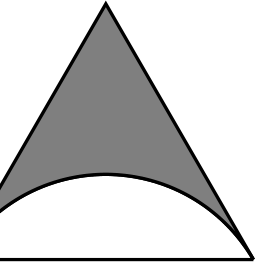
\begin{document}
\begin{tikzpicture}[scale=1.4]
  \coordinate (A) at (0,0);
  \coordinate (B) at (3,0);
  \coordinate (C) at (1.5,2.598);
  \fill[gray!60] (A) -- (C) -- (B) arc (30:150:1.732) -- cycle;
  \draw[thick] (A) -- (B) -- (C) -- cycle;
  \draw[thick] (B) arc (30:150:1.732);
\end{tikzpicture}
\end{document}
Sapendo che il triangolo equilatero in figura ha lato 3 e che l’arco di circonferenza è tangente a due lati, qual è l’area della figura in grigio?
- (A) √ 3 −π 6
- (B) π − √ 3
- (C) 2 √ 3 −π
- (D) √ 3 + π 6
- (E) 3 √ 3 −π.
Topic: Geometria piana Metodo: Tecniche trigonometriche Abilita: Ragionamento geometrico Area: Geometria Fonte: apri PDF p.2
A grey area with a tangent arc in an equilateral triangle
\begin{document}
\begin{tikzpicture}[scale=1.4]
  \coordinate (A) at (0,0);
  \coordinate (B) at (3,0);
  \coordinate (C) at (1.5,2.598);
  \fill[gray!60] (A) -- (C) -- (B) arc (30:150:1.732) -- cycle;
  \draw[thick] (A) -- (B) -- (C) -- cycle;
  \draw[thick] (B) arc (30:150:1.732);
\end{tikzpicture}
\end{document}
Knowing that the equilateral triangle in the figure has side 3 and that the arc of circumference is tangent on two sides, what is the area of the figure in gray?
- (A) √ 3 −π 6
- (B) π − √ 3
- (C) 2 √ 3 −π
- (D) √ 3 + π 6
- (E) 3 √ 3 −π.
src_archimede_2002_triennio__Q13
Probabilita due femmine in parto gemellare
La percentuale di femmine che nascono nei parti gemellari è del 48,5%. Supponendo che nei parti gemellari la probabilità che i due nati siano di sesso differente sia del 33%, qual è la probabilità che in un parto gemellare nascano due femmine?
- (A) 32%
- (B) 33%
- (C) 33,33%
- (D) 35%
- (E) 50%.
Topic: Probabilita e statistica Metodo: Analisi per casi Abilita: traduzione del testo Area: Combinatoria, Logica e Probabilita Fonte: apri PDF p.2
Probability of two females giving birth to twins
The percentage of females born in the twin parts is 48.5%. Assuming that in twin parts the probability of two births being of different sex is 33 percent, what is the probability of two females being born in a twin birth?
- (A) 32%
- (B) 33%
- (C) 33,33%
- (D) 35%
- (E) 50%.
src_archimede_2002_triennio__Q14
Velocita seconda meta per media complessiva 30 km/h
Un ciclista vuole percorrere un tratto di strada. A metà del percorso si rende conto di aver viaggiato solo alla media di 15 km/h; decide quindi di accelerare in modo da poter percorrere l’intero tragitto alla media più dignitosa di 30 km/h. A quale velocità deve percorrere la seconda metà del percorso?
- (A) a 40 km/h
- (B) a 45 km/h
- (C) a 60 km/h
- (D) non può farcela
- (E) dipende dalla lunghezza del tratto di strada.
Topic: Algebra Abilita: traduzione del testo Area: Algebra e Analisi Fonte: apri PDF p.2
Second target speed for an overall average of 30 km/h
A cyclist wants to ride a stretch of road. Halfway through the route he realizes that he has travelled only at an average of 15 km/h; he then decides to accelerate so that he can travel the entire route at the most dignified average of 30 km/h. How fast should the second half of the route go?
- (A) a 40 km/h
- (B) a 45 km/h
- (C) a 60 km/h
- (D) He can ‘t do it .
- (E) depending on the length of the road.
src_archimede_2002_triennio__Q15
Quante affermazioni vere su numeri dispari consecutivi
Quante delle seguenti affermazioni riguardanti i numeri naturali sono vere? (i) Presi due numeri dispari consecutivi qualsiasi, almeno uno è primo. (ii) Presi tre numeri dispari consecutivi qualsiasi, almeno due sono primi. (iii) Presi quattro numeri dispari consecutivi qualsiasi, almeno uno non è primo. (iv) Presi cinque numeri dispari consecutivi qualsiasi, almeno due non sono primi.
- (A) Nessuna
- (B) una
- (C) due
- (D) tre
- (E) quattro.
Topic: Teoria dei Numeri, Logica, giochi, strategie Metodo: Analisi per casi Abilita: Casework accurato Area: Aritmetica e Teoria dei Numeri, Combinatoria, Logica e Probabilita Fonte: apri PDF p.2
How many true statements on consecutive odd numbers
How many of the following statements about natural numbers are true? (i) If any two consecutive odd numbers are taken, at least one is prime. (ii) If any three consecutive odd numbers are taken, at least two are prime. (iii) If any four consecutive odd numbers are taken, at least one is not prime. (iv) If any five consecutive odd numbers are taken, at least two are not prime.
- (A) None of them .
- (B) One .
- (C) two
- (D) three
- (E) Four of them.
src_archimede_2002_triennio__Q16
Quale terna non e progressione geometrica
Nella lista che segue, una sola terna di numeri non può rappresentare termini di una progressione geometrica (i termini non sono necessariamente consecutivi). Qual è questa terna?
- (A) 3; 6; 96
- (B) 3; 1; 1 81
- (C) 3; 3,3; 3,993
- (D) 3; 6; 48
- (E) 3; 5; 9.
Topic: successioni, Algebra Metodo: Analisi per casi Abilita: Riconoscimento di pattern Area: Algebra e Analisi Fonte: apri PDF p.2
Which trunk is not geometrical progression
In the following list, a single set of numbers cannot represent terms of a geometric progression (the terms are not necessarily consecutive). What’s with the tern?
- (A) 3; 6; 96
- (B) 3; 1; 1 81
- (C) 3; 3,3; 3,993
- (D) 3; 6; 48
- (E) 3; 5; 9.
src_archimede_2002_triennio__Q18
Somma cifre del quadrato di un grande numero
La somma delle cifre del quadrato di 999 999 999 999 999 995 è:
- (A) 150
- (B) 160
- (C) 170
- (D) 180
- (E) 190.
Topic: Teoria dei Numeri Metodo: manipolazione algebrica Abilita: Riconoscimento di pattern Area: Aritmetica e Teoria dei Numeri Fonte: apri PDF p.2
Summary of digits in the square of a large number
The sum of the digits in the square of 999 999 999 999 999 999 995 is:
- (A) 150
- (B) 160
- (C) 170
- (D) 180
- (E) 190.
src_archimede_2002_triennio__Q20
Numero alunni del liceo da frazioni di classi
In un liceo scientifico ci sono meno di 1000 studenti, di cui 230 frequentano le classi del triennio; gli alunni che frequentano la classe seconda sono i 13 46 di tutti i rimanenti; inoltre, se si iscrivessero ancora 10 alunni alla prima, allora gli studenti di prima diventerebbero i 2 5 del totale. Il numero di alunni della scuola è:
- (A) 500
- (B) 590
- (C) 625
- (D) 700
- (E) 825.
Topic: Algebra, Teoria dei Numeri Metodo: congruenze Abilita: Manipolazione algebrica Area: Algebra e Analisi, Aritmetica e Teoria dei Numeri Fonte: apri PDF p.2
Number of high school pupils by class fractions
In a science high school there are less than 1000 students, of whom 230 attend the three-year classes; the second-year pupils are 13 46 of all remaining pupils; furthermore, if 10 more pupils were enrolled in the first one, then the first-year pupils would become 2 5 of the total. The number of pupils at the school is:
- (A) 500
- (B) 590
- (C) 625
- (D) 700
- (E) 825.
src_archimede_2002_triennio__Q22
Quanti cavalieri tra quattro abitanti dalle risposte
In un’isola di furfanti (che mentono sempre) e cavalieri (che dicono sempre la verità) un esploratore incontra quattro abitanti del luogo, e chiede loro di che tipo sono. Le risposte che ottiene sono le seguenti: (i) “siamo tutti e quattro dei furfanti”; (ii) “no, fra noi c’è un solo cavaliere”; (iii) “no, ce ne sono esattamente due”; (iv) “io sono un cavaliere”. Quanti dei quattro sono cavalieri?
- (A) 1
- (B) 2
- (C) 3
- (D) 4
- (E) non è possibile dedurlo.
Topic: Logica, giochi, strategie Metodo: Analisi per casi Abilita: Casework accurato Area: Combinatoria, Logica e Probabilita Fonte: apri PDF p.2
How many knights out of four inhabitants from the answers
On an island of thieves (who always lie) and knights (who always tell the truth) an explorer meets four locals, and asks them what kind of people they are. The answers he gets are as follows: (i) We’re all four of the thieves; (ii) No, there’s only one knight among us; (iii) No, there’s exactly two; (iv) I’m a knight. How many of the four are knights?
- (A) 1
- (B) 2
- (C) 3
- (D) 4
- (E) There’s no way to deduce that.
src_archimede_2002_triennio__Q23
Esistono tetraedri con base equilatera e volume razionale
È ben noto che l’area di un triangolo equilatero di lato unitario non può essere espressa come numero razionale (cioè come rapporto di interi). Esistono tetraedri che hanno come base tale triangolo e il cui volume si esprime come numero razionale?
- (A) Non ne esistono
- (B) ne esistono infiniti
- (C) solo il tetraedro regolare
- (D) solo i tetraedri con altezza pari a 6 √ 3
- (E) solo se il tetraedro è retto.
Topic: Geometria solida Abilita: generalizzazione Area: Geometria Fonte: apri PDF p.2
There are tetrahedra with equilateral base and rational volume
It is well known that the area of an equilateral triangle on the unit side cannot be expressed as a rational number (i.e. as a ratio of integers). Are there tetrahedra that have this triangle as their basis and whose volume is expressed as a rational number?
- (A) There are none.
- (B) There are infinitesimal numbers.
- (C) Only the regular tetrahedron
- (D) only tetrahedra with a height of 6 √ 3
- (E) Only if the tetrahedron is straight.
src_archimede_2002_triennio__Q24
Massima cifra non pagabile con monete da 8 e 11
L’Orue è una valuta che dispone di due sole monete, da 8 e da 11 centesimi. Qual è la massima cifra che non può essere pagata esattamente?
- (A) 58 centesimi
- (B) 61 centesimi
- (C) 87 centesimi
- (D) esistono cifre arbitrariamente grandi che non sono pagabili esattamente
- (E) nessuna delle precedenti risposte è corretta.
Topic: Teoria dei Numeri Metodo: congruenze Abilita: Conteggio sistematico Area: Aritmetica e Teoria dei Numeri Fonte: apri PDF p.2
*Maximum amount not payable with coins of 8 and 11 *
LOrue is a currency that has only two coins, 8 and 11 cents. What is the maximum amount that cannot be paid exactly?
- (A) 58 cents
- (B) 61 cents
- (C) 87 cents
- (D) There are arbitrarily large figures that are not exactly payable
- (E) None of the above answers are correct.