Divisore di 3^54^45^3 tra opzioni date
Quale dei seguenti numeri è un divisore di 35 · 44 · 53?
- (A) 42,
- (B) 45,
- (C) 52,
- (D) 85,
- (E) 105.
Topic: Teoria dei Numeri Abilita: Manipolazione algebrica Area: Aritmetica e Teoria dei Numeri Risposta: B Fonte: apri PDF p.1 Anche in triennio: apri PDF p.1
Diverter of 3^54^45^3 between options given
Which of the following numbers is a divisor of 35 · 44 · 53?
- (A) 42,
- (B) 45,
- (C) 52,
- (D) 85,
- (E) 105.
Answer: B src_archimede_2009_biennio__Q01
Giri ruota posteriore data ruota anteriore e raggi
La ruota anteriore della bicicletta di Chiara ha il raggio di 28 cm, mentre la ruota posteriore ha il raggio di 16 cm. Al termine di una gita in bicicletta la ruota anteriore ha fatto 10000 giri; quanti ne ha fatti la ruota posteriore nella stessa gita?
- (A) 12000,
- (B) 14500,
- (C) 17500,
- (D) 19000,
- (E) 21000.
Topic: Geometria piana, Algebra Abilita: traduzione del testo Area: Algebra e Analisi, Geometria Risposta: C Fonte: apri PDF p.1 Anche in triennio: apri PDF p.1
Rear wheel gears given front wheel and beams
The front wheel of Chiara’s bicycle has a radius of 28 cm, while the rear wheel has a radius of 16 cm. At the end of a bicycle ride, the front wheel has made 10,000 laps; how many have the rear wheel made in the same ride?
- (A) 12000,
- (B) 14500,
- (C) 17500,
- (D) 19000,
- (E) 21000.
Answer: C src_archimede_2009_biennio__Q02
Caramelle date a Delia per egual distribuzione
La nonna ha un sacchetto di caramelle che vuol dare alle sue nipoti: Ada, Bice, Clelia e Delia. Ada prende sette caramelle e lo stesso fanno Bice e Clelia; a questo punto nel sacchetto restano alcune caramelle, che vengono prese da Delia, ma sono meno di sette. Allora Ada, Bice e Clelia danno alcune delle loro caramelle a Delia (ciascuna lo stesso numero) in modo che tutte e quattro abbiano lo stesso numero di caramelle. Quante caramelle riceve Delia da ciascuna delle altre tre?
- (A) 1,
- (B) 2,
- (C) 3,
- (D) 4,
- (E) 5.
Topic: Teoria dei Numeri, Algebra Abilita: traduzione del testo Area: Algebra e Analisi, Aritmetica e Teoria dei Numeri Risposta: A Fonte: apri PDF p.1
Caramels given to Delia for equal distribution
Grandma has a bag of candy she wants to give to her grandchildren, Ada, Bice, Clelia and Delia. Ada takes seven candies and the same goes for Bice and Clelia; at this point in the bag, some candies remain, which are taken from Delia, but they are less than seven. Then Ada, Bice, and Clelia give some of their candy to Delia (each the same number) so that all four have the same number of candy. How many candies does Delia get from each of the other three?
- (A) 1,
- (B) 2,
- (C) 3,
- (D) 4,
- (E) 5.
Answer: A src_archimede_2009_biennio__Q03
Scelte di n perche pulce torni al 12 dopo 12 salti
Una pulce si trova sul numero 12 del quadrante di un orologio. Sceglie un numero naturale n compreso tra 1 e 12, estremi inclusi, e comincia a fare salti di n numeri sul quadrante, in senso orario (se ad esempio n = 3, dopo il primo salto è sul 3, dopo il secondo è sul 6 e così via). Dopo 12 salti, per la prima volta si ritrova sul numero 12 del quadrante. In quanti modi distinti può aver scelto n?
- (A) 1,
- (B) 2,
- (C) 4,
- (D) 6,
- (E) 12.
Topic: Teoria dei Numeri Metodo: congruenze Abilita: Riconoscimento di pattern Area: Aritmetica e Teoria dei Numeri Risposta: C Fonte: apri PDF p.1 Anche in triennio: apri PDF p.1
Select n because the fly returns to 12 after 12 jumps
A flea is on the number 12 of a watch’s dial. Choose a natural number n between 1 and 12, extremes included, and start to make jumps of n numbers on the dial, in the clockwise direction (if for example n = 3, after the first jump is on 3, after the second is on 6 and so on). After 12 jumps, he finds himself on the number 12 of the dial for the first time. How many different ways can you have chosen n?
- (A) 1,
- (B) 2,
- (C) 4,
- (D) 6,
- (E) 12.
Answer: C src_archimede_2009_biennio__Q04
Rapporto aree triangolo equilatero ed esagono inscritti
Disegno un triangolo equilatero e un esagono regolare inscritti nella stessa circonferenza. Qual è il rapporto tra l’area del triangolo e quella dell’esagono?
- (A) 1 2,
- (B) 1 3,
- (C) √ 3 2 ,
- (D) √ 3 3 ,
- (E) 1
Topic: Geometria piana Abilita: Ragionamento geometrico Area: Geometria Risposta: A Fonte: apri PDF p.1 Anche in triennio: apri PDF p.1
Report of equilateral triangle and hexagonal areas inscribed
I draw an equilateral triangle and a regular hexagon inscribed in the same circumference. What is the relationship between the area of the triangle and that of the hexagon?
- (A) 1 2,
- (B) 1 3,
- (C) √ 3 2 ,
- (D) √ 3 3 ,
- (E) 1
Answer: A src_archimede_2009_biennio__Q05
Valore x in griglia con somme uguali
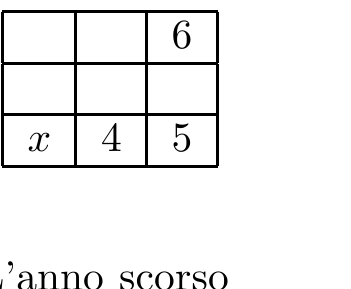
Nella griglia a fianco x è un numero da determinare. Si sa che è possibile scrivere un numero in ogni cella vuota della griglia in modo che la somma dei tre numeri che si trovano su qualunque riga, colonna o diagonale, sia sempre la stessa. Allora x vale:
- (A) 0,
- (B) 1,
- (C) 3,
- (D) 6,
- (E) 9. 6 x 4 5
Topic: Algebra, Logica, giochi, strategie Abilita: Casework accurato Area: Algebra e Analisi, Combinatoria, Logica e Probabilita Risposta: A Fonte: apri PDF p.1
Value x in the grid with equal sums
In the grid next to x is a number to be determined. You know you can write a number in every empty cell on the grid so that the sum of the three numbers on any line, column or diagonal is always the same. So x is:
- (A) 0,
- (B) 1,
- (C) 3,
- (D) 6,
- (E) 9. 6 x 4 5
Answer: A src_archimede_2009_biennio__Q06
Latterie l’anno scorso da rapporti tabaccherie-latterie
Nella città di Nonfumo gli unici negozi sono tabaccherie e latterie. L’anno scorso le tabaccherie erano i 2/3 delle latterie; quest’anno due tabaccherie sono diventate latterie cosicchè ora le tabaccherie sono solo i 9/16 delle latterie (dall’anno scorso a quest’anno il numero complessivo dei negozi di Nonfumo è rimasto lo stesso). Quante latterie c’erano l’anno scorso a Nonfumo?
- (A) 12,
- (B) 16,
- (C) 20,
- (D) 30,
- (E) 60.
Topic: Algebra Abilita: traduzione del testo Area: Algebra e Analisi Risposta: D Fonte: apri PDF p.1
Last year’s report on tobacco-farm relations
In the town of Nonfum, the only shops are tobacco shops and lumber shops. Last year tobacco factories accounted for two thirds of the market; this year two tobacco factories have become factories, so that now only 9/16 of the factories are tobacco factories (from last year to this year the total number of Nonfum shops has remained the same). How many lasts were there last year in Nonfum?
- (A) 12,
- (B) 16,
- (C) 20,
- (D) 30,
- (E) 60.
Answer: D src_archimede_2009_biennio__Q07
Colorazioni vertici pentagono senza asse di simmetria
Ciro ha davanti a s´e un foglio con disegnato un pentagono regolare ABCDE, e due pennarelli di colori diversi. Vuole colorare tutti i vertici del pentagono usando solo i due pennarelli che ha, in modo che la colorazione finale non abbia nessun asse di simmetria. In quanti modi distinti può farlo?
- (A) Uno,
- (B) due,
- (C) quattro,
- (D) cinque,
- (E) nessuno.
Topic: Combinatoria, Geometria piana Metodo: Sfruttamento della simmetria Abilita: Casework accurato Area: Combinatoria, Logica e Probabilita, Geometria Risposta: E Fonte: apri PDF p.1
Vertical pentagon colours without axis of symmetry
Cyrus has a sheet of paper in front of him with a regular ABCDE pentagon and two different-colored pencils. He wants to color all the vertices of the pentagon using only the two pincers he has, so that the final coloring has no axis of symmetry. How many different ways can you do that?
- (A) One of them.
- (B) two,
- (C) four,
- (D) five,
- (E) I don’t know.
Answer: E src_archimede_2009_biennio__Q08
Angolo ADC in triangolo isoscele con bisettrice
ABC è un triangolo isoscele con AB = AC. D è un punto del lato AB tale che CD sia la bisettrice dell’angolo d ACB. Sapendo che CB = CD, quanto misura l’angolo d ADC?
- (A) 90°,
- (B) 108°,
- (C) 120°,
- (D) 144°,
- (E) 155°.
Topic: Geometria piana Abilita: Ragionamento geometrico Area: Geometria Risposta: B Fonte: apri PDF p.1
AAC angle in an isosceles triangle with a beam
ABC is an isosceles triangle with AB = AC. D is a point on the AB side such that CD is the angle of the ACB angle. Knowing that CB = CD, what is the angle of ADC?
- (A) 90°,
- (B) 108°,
- (C) 120°,
- (D) 144°,
- (E) 155°.
Answer: B src_archimede_2009_biennio__Q09
Quadrati perfetti che dividono 1600
Quanti quadrati perfetti dividono 1600? [Un quadrato perfetto è un numero del tipo n2, con n numero naturale. 1, 4, 9, 16, sono esempi di quadrati perfetti.]
- (A) 2,
- (B) 4,
- (C) 8,
- (D) 10,
- (E) 12.
Topic: Teoria dei Numeri Metodo: Conteggio combinatorio Abilita: Conteggio sistematico Area: Aritmetica e Teoria dei Numeri Risposta: C Fonte: apri PDF p.1 Anche in triennio: apri PDF p.1
Perfect squares dividing 1600
How many perfect squares divide 1600? [A perfect square is a number of the type n2, with n as a natural number. 1, 4, 9, 16, are examples of perfect squares.]
- (A) 2,
- (B) 4,
- (C) 8,
- (D) 10,
- (E) 12.
Answer: C src_archimede_2009_biennio__Q10
Somma differenze cifre per numeri da 10 a 99
La piccola Rita fa questo gioco: per ogni numero intero compreso tra 10 e 99, estremi inclusi, sottrae la cifra delle unità da quella delle decine e scrive il risultato su un foglio (ad esempio per 21 scrive 1, cioè 2 −1, mentre per 37 scrive −4, cioè 3 −7). Alla fine somma tutti i numeri che ha scritto sul foglio; quale risultato trova?
- (A) 0,
- (B) −30,
- (C) 45,
- (D) −50,
- (E) 100.
Topic: Teoria dei Numeri, Combinatoria Metodo: Doppio conteggio Abilita: Riconoscimento di pattern Area: Aritmetica e Teoria dei Numeri, Combinatoria, Logica e Probabilita Risposta: C Fonte: apri PDF p.1 Anche in triennio: apri PDF p.1
Sum of numerical differences for numbers from 10 to 99
Little Rita plays this game: for every whole number between 10 and 99, including extremes, she subtracts the number of units from the number of tens and writes the result on a sheet (for example, for 21 she writes 1, i.e. 2 −1, while for 37 she writes −4, i.e. 3 −7). In the end, he adds up all the numbers he wrote on the paper; what does he find?
- (A) 0,
- (B) −30,
- (C) 45,
- (D) −50,
- (E) 100.
Answer: C src_archimede_2009_biennio__Q11
Modi di disegnare tre triangoli da P senza staccare penna
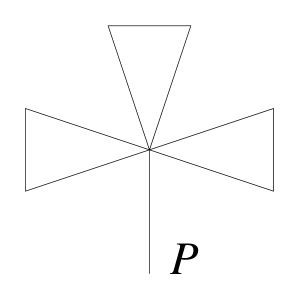
In quanti modi distinti posso disegnare la figura a fianco partendo da P, senza mai staccare la penna dal foglio e senza passare più di una volta da nessun punto eccettuato il vertice comune ai tre triangoli?
- (A) 24 3,
- (B) 23 3,
- (C) 24,
- (D) 22 33,
- (E) 33. P
Topic: Combinatoria Metodo: Teoria dei grafi Abilita: Conteggio sistematico Area: Combinatoria, Logica e Probabilita Risposta: A Fonte: apri PDF p.2
Mode of drawing three triangles from P without removing a pen
How many distinct ways can I draw the figure side by side starting from P, without ever pulling the pen off the sheet and without passing more than once from any point except the common triangle vertex?
- (A) 24 3,
- (B) 23 3,
- (C) 24,
- (D) 22 33,
- (E) 33. P
Answer: A src_archimede_2009_biennio__Q12
Area coperta da rombo ruotato di 60 gradi
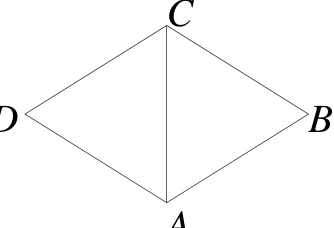
\begin{document}
\begin{tikzpicture}
  \coordinate (A) at (0,0);
  \coordinate (C) at (0,2);
  \coordinate (D) at (-1.732,1);
  \coordinate (B) at (1.732,1);
  \draw (D)--(C)--(B)--(A)--cycle;
  \draw (A)--(C);
  \node[below] at (A) {$A$};
  \node[above] at (C) {$C$};
  \node[left] at (D) {$D$};
  \node[right] at (B) {$B$};
\end{tikzpicture}
\end{document}
Nel rombo in figura, i triangoli ABC e ACD sono equilateri ed hanno lato di lunghezza 1 m. Se ruotiamo il rombo di 60° rispetto al vertice A, qual è l’area della superficie coperta dal rombo nella rotazione?
- (A) π 2 m2,
- (B) 1 m2,
- (C) π m2,
- (D) π 3 m2,
- (E) 2 m2.
Topic: Geometria piana Abilita: Ragionamento geometrico Area: Geometria Risposta: A Fonte: apri PDF p.2 Anche in triennio: apri PDF p.1
Area covered by 60 degree rotated rubber
\begin{document}
\begin{tikzpicture}
  \coordinate (A) at (0,0);
  \coordinate (C) at (0,2);
  \coordinate (D) at (-1.732,1);
  \coordinate (B) at (1.732,1);
  \draw (D)--(C)--(B)--(A)--cycle;
  \draw (A)--(C);
  \node[below] at (A) {$A$};
  \node[above] at (C) {$C$};
  \node[left] at (D) {$D$};
  \node[right] at (B) {$B$};
\end{tikzpicture}
\end{document}
In the figure, the triangles ABC and ACD are equilateral and have sides 1 m long. If we rotate the wheel of 60° with respect to vertex A, what is the area of the surface covered by the wheel in rotation?
- (A) π 2 m2,
- (B) 1 m2,
- (C) π m2,
- (D) π 3 m2,
- (E) 2 m2.
Answer: A src_archimede_2009_biennio__Q13
Numero corde rotte data spesa con prezzi a potenze di due
Ziggy ha rotto alcune delle nove corde della sua chitarra marziana. Le corde sono numerate da 1 a 9; la prima costa una Sterlina Marziana e ciascuna delle altre costa il doppio di quella che ha il numero precedente. Dopo un rapido conto, Ziggy calcola che dovrà spendere 158 Sterline Marziane per comprare le corde nuove. Quante sono le corde rotte?
- (A) Una,
- (B) tre,
- (C) quattro,
- (D) cinque,
- (E) sette.
Topic: Teoria dei Numeri, Combinatoria Abilita: Casework accurato Area: Aritmetica e Teoria dei Numeri, Combinatoria, Logica e Probabilita Risposta: D Fonte: apri PDF p.2
Number of rope routes spent with prices at power of two
Ziggy broke some of the nine strings on his Martian guitar. The strings are numbered from 1 to 9; the first one costs a Martian pound, and each one costs twice as much as the previous one. After a quick count, Ziggy calculates that he will have to spend 158 Martian pounds to buy the new ropes. How many strings are broken?
- (A) One of them.
- (B) three,
- (C) four,
- (D) five,
- (E) Seven of them.
Answer: D src_archimede_2009_biennio__Q14
Studenti con n primo e n^3+3 primo
La professoressa di Italiano entra in una classe di 24 studenti, tutti presenti, per un’ora di interrogazione. Decide di interrogare gli studenti a cui corrisponde sul registro un numero n che sia primo e tale che anche n3 + 3 sia primo. Quanti studenti interroga?
- (A) Uno,
- (B) tre,
- (C) quattro,
- (D) sette,
- (E) nove.
Topic: Teoria dei Numeri Metodo: congruenze Abilita: Manipolazione algebrica Area: Aritmetica e Teoria dei Numeri Risposta: A Fonte: apri PDF p.2
Students with n first and n^3+3 first
The Italian teacher enters a class of 24 students, all present, for one hour of questioning. He decides to question the students to whom he corresponds on the register a number n that is prime and such that n3 + 3 is also prime. How many students are you interviewing?
- (A) One of them.
- (B) three,
- (C) four,
- (D) seven,
- (E) I’ll give you nine.
Answer: A src_archimede_2009_biennio__Q15
Rapporto raggi moneta oro e monete argento tangenti
Una moneta d’oro è circondata da quattro monete d’argento uguali tra loro. Ogni moneta d’argento è tangente alla moneta d’oro e a due monete d’argento. Trovare il rapporto tra il raggio della moneta d’oro e quello delle monete d’argento.
- (A) 1 4,
- (B) √ 2 −1,
- (C) 1 2,
- (D) √ 2 2 ,
- (E) 1.
Topic: Geometria piana Abilita: Ragionamento geometrico Area: Geometria Risposta: B Fonte: apri PDF p.2 Anche in triennio: apri PDF p.2
*Report of tangent gold and silver coins *
A gold coin is surrounded by four equal silver coins. Each silver coin is equivalent to the gold coin and to two silver coins. Find the ratio of the gold coin radius to that of the silver coins.
- (A) 1 4,
- (B) √ 2 −1,
- (C) 1 2,
- (D) √ 2 2 ,
- (E) 1.
Answer: B src_archimede_2009_biennio__Q16
Ordine tra a, b e 1 data disuguaglianza cubica
a e b sono due numeri maggiori o uguali a zero. Sappiamo che: a3 + a < b −b3. Qual è l’ordine corretto tra i tre numeri a, b e 1?
- (A) b < a < 1,
- (B) a = b = 1,
- (C) a < 1 < b,
- (D) a < b < 1,
- (E) 1 < a < b.
Topic: Disuguaglianze, Algebra Metodo: Disuguaglianze classiche Abilita: Manipolazione algebrica Area: Algebra e Analisi Risposta: D Fonte: apri PDF p.2 Anche in triennio: apri PDF p.2
Orders between a, b and 1 given cubic inequality
a and b are two numbers greater than or equal to zero. We know that: a3 + a < b − b3. What is the correct order between the three numbers a, b and 1?
- (A) b < a < 1,
- (B) a = b = 1,
- (C) a < 1 < b,
- (D) a < b < 1,
- (E) 1 < a < b.
Answer: D src_archimede_2009_biennio__Q17
Conteggio password con vocali maiuscole e minuscole
Carla si è dimenticata la password di accensione del suo nuovissimo computer! Si ricorda però che è una sequenza di 4 vocali, non necessariamente distinte, di cui due sono maiuscole e due sono minuscole. Quante password diverse deve provare Carla, al massimo, per accendere il computer?
- (A) 3 · 54,
- (B) 55,
- (C) 6 · 54,
- (D) 56,
- (E) 3 · 56.
Topic: Combinatoria Metodo: Conteggio combinatorio Abilita: Conteggio sistematico Area: Combinatoria, Logica e Probabilita Risposta: C Fonte: apri PDF p.2 Anche in triennio: apri PDF p.2
Password counting with capital and diminutive vowels
Carla forgot the power password of her new computer! However, it should be remembered that it is a sequence of 4 vowels, not necessarily distinct, of which two are capital letters and two are diminutive. How many different passwords does Carla have to test, at most, to turn on the computer?
- (A) 3 · 54,
- (B) 55,
- (C) 6 · 54,
- (D) 56,
- (E) 3 · 56.
Answer: C src_archimede_2009_biennio__Q18
Area ombreggiata con rettangolo, cerchio e semicirconferenze
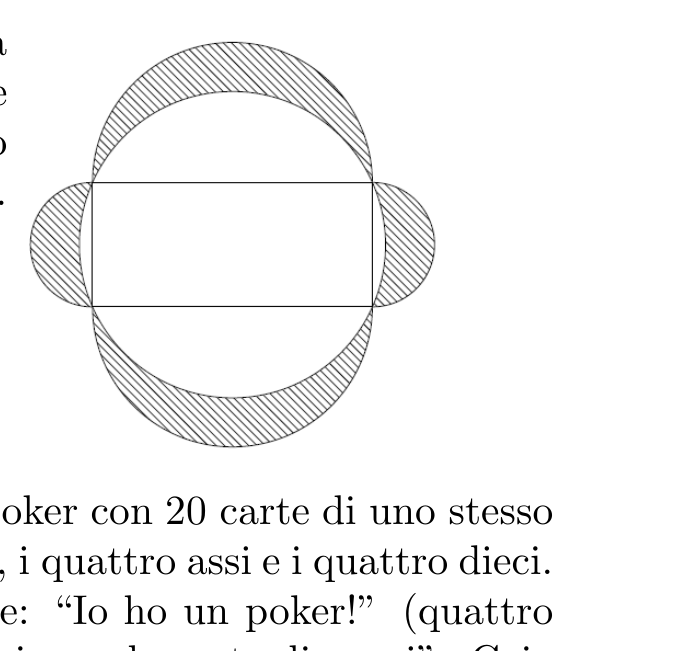
Disegniamo un rettangolo di lati 5 cm e 12 cm, la circonferenza in cui è inscritto e le semicirconferenze che hanno per diametro i lati del rettangolo e sono esterne ad esso, come indicato nella figura a fianco. Qual è l’area della parte ombreggiata?
- (A) 45 cm2,
- (B) 13π cm2,
- (C) 19π cm2,
- (D) 60 cm2,
- (E) 20π cm2.
Topic: Geometria piana Abilita: Ragionamento geometrico Area: Geometria Risposta: D Fonte: apri PDF p.2
*Shaded area with rectangle, circle and semicircular *
We draw a rectangle with sides of 5 cm and 12 cm, the circumference in which it is inscribed and the semicirculars having the sides of the rectangle in diameter and are external to it, as shown in the figure next to it. What is the area of the shaded part?
- (A) 45 cm2,
- (B) 13π cm2,
- (C) 19π cm2,
- (D) 60 cm2,
- (E) 20π cm2.
Answer: D src_archimede_2009_biennio__Q19
Chi mente tra quattro giocatori di poker
Quattro amici, Anna, Bea, Caio e Dino, giocano a poker con 20 carte di uno stesso mazzo: i quattro re, le quattro regine, i quattro fanti, i quattro assi e i quattro dieci. Vengono distribuite cinque carte a testa. Anna dice: “Io ho un poker!” (quattro carte dello stesso valore). Bea dice: “Io ho tutte e cinque le carte di cuori”. Caio dice: “Io ho cinque carte rosse”. Infine Dino dice: “Io ho tre carte di uno stesso valore e anche le altre due hanno tra loro lo stesso valore”. Sappiamo che una e una sola delle affermazioni è falsa; chi sta mentendo?
- (A) Anna,
- (B) Bea,
- (C) Caio,
- (D) Dino,
- (E) non è possibile determinarlo.
Topic: Logica, giochi, strategie Metodo: Analisi per casi Abilita: Casework accurato Area: Combinatoria, Logica e Probabilita Risposta: B Fonte: apri PDF p.2 Anche in triennio: apri PDF p.2
Who lies between four poker players
Four friends, Anna, Bea, Caius, and Dino, play poker with 20 cards of the same deck: the four kings, the four queens, the four fanciers, the four axes, and the four ten. Five cards are dealt each. Anna says, “I have a poker! Bea says, “I’ve got all five of the cards”. Caius says, “I have five red cards”. Finally, Dino says: I have three cards of the same value and the other two are also of the same value. We know that all of these statements are false; who is lying?
- (A) Anna, what are you doing?
- (B) Bea, what are you doing?
- (C) Caius,
- (D) Dino, what are you doing?
- (E) There’s no way to tell.
Answer: B src_archimede_2009_biennio__Q20