Litri di vernice per linea tra 16 coni a 10 m
16 coni stradali sono messi in linea retta a distanza di 10 metri uno dall’altro. Si vuole dipingere sulla strada una linea continua che vada dal primo all’ultimo cono. Sapendo che per dipingere 100 metri di linea continua sono necessari 6 litri di vernice, quanti litri di vernice sono necessari per completare questo lavoro?
- (A) 8,4
- (B) 9
- (C) 9,6
- (D) 10
- (E) nessuna delle precedenti.
Topic: Teoria dei Numeri Abilita: Lettura attenta del testo Area: Aritmetica e Teoria dei Numeri Risposta: B Fonte: apri PDF p.6
Litres of paint per line between 16 cones at 10 m
16 road cones are placed in a straight line at a distance of 10 metres from each other. You want to paint a continuous line on the road that goes from the first to the last cone. Knowing that to paint 100 meters of continuous line it takes six liters of paint, how many liters of paint are needed to complete this work?
- (A) 8,4
- (B) 9
- (C) 9,6
- (D) 10
- (E) None of the previous ones.
Answer: B src_archimede_2010_2livello__Q01
Area comune ai triangoli ABC e DEF (simmetrici di O)
Sia ABC un triangolo equilatero di centro O e area 1. Siano D, E, F i punti simmetrici di O rispetto ai tre lati del triangolo. Quanto vale l’area in comune ai triangoli ABC e DEF?
- (A) 1 3
- (B) 2 √ 3 9
- (C) √ 2 3
- (D) √ 3 3
- (E) 2
Topic: Geometria piana Metodo: Sfruttamento della simmetria Abilita: Ragionamento geometrico Area: Geometria Risposta: E Fonte: apri PDF p.6
*Area common to triangles ABC and DEF (O symmetrical) *
Whether ABC is an equilateral triangle of center O and area 1. Let D, E, F be the symmetrical points of O with respect to the three sides of the triangle. How much is the area shared by the ABC and DEF triangles?
- (A) 1 3
- (B) 2 √ 3 9
- (C) √ 2 3
- (D) √ 3 3
- (E) 2
Answer: E src_archimede_2010_2livello__Q02
Quanti cavalieri tra quattro abitanti con affermazioni date
In un’isola ci sono due tipi di abitanti: i cavalieri, che dicono sempre la verità, e i furfanti, che mentono sempre. Abbiamo incontrato su quest’isola un gruppo di quattro abitanti che, interrogati sulla loro identità, hanno risposto: A: “C’è almeno un furfante tra noi.” B: “Ci sono al massimo due cavalieri tra noi.” C: “Ci sono almeno tre furfanti tra noi.” D: “Non ci sono cavalieri tra noi.” Quanti cavalieri ci sono in questo insieme di quattro abitanti?
- (A) Nessuno
- (B) 1
- (C) 2
- (D) 3
- (E) tutti.
Topic: Logica, giochi, strategie Metodo: Analisi per casi Abilita: Casework accurato Area: Combinatoria, Logica e Probabilita Risposta: C Fonte: apri PDF p.6
How many knights among four inhabitants with given statements
On an island there are two kinds of people: the knights, who always tell the truth, and the cunning ones, who always lie. We met on this island a group of four inhabitants who, when asked about their identity, replied: A: There is at least one cheater among us. B: There are at most two cheaters among us. C: There are at least three cheaters among us. D: There are no cheaters among us. How many cheaters are there in this set of four inhabitants?
- (A) No one .
- (B) 1
- (C) 2
- (D) 3
- (E) I mean, everybody.
Answer: C src_archimede_2010_2livello__Q03
Chi è più probabile abbia il 7 di denari
Antonio, Beppe, Carlo e Duccio si distribuiscono casualmente le 40 carte di un mazzo, 10 a testa. Antonio ha l’asso, il due e il tre di denari. Beppe ha l’asso di spade e l’asso di bastoni. Carlo ha l’asso di coppe. Chi è più probabile che abbia il 7 di denari?
- (A) Antonio
- (B) Beppe
- (C) Carlo
- (D) Duccio
- (E) due o più giocatori hanno la stessa probabilità di averlo.
Topic: Probabilita e statistica Abilita: Conteggio sistematico Area: Combinatoria, Logica e Probabilita Risposta: D Fonte: apri PDF p.6
Who is most likely to have 7 denarii?
Antonio, Beppe, Carlo and Duccio randomly hand out the 40 cards of a deck, 10 each. Antonio has the ace, the second and the third of the denarii. Beppe has the axe of swords and the axe of sticks. Carlo has a cup of tea. Who’s more likely to have the seven denarii?
- (A) The Commission shall adopt implementing acts.
- (B) Beep
- (C) Charles
- (D) I’m not sure.
- (E) Two or more players are equally likely to have it.
Answer: D src_archimede_2010_2livello__Q04
Per quanti interi n il valore 3n/(n+5) è intero multiplo di 4
Per quanti interi relativi n si ha che 3n n + 5 è intero e divisibile per 4?
- (A) 1
- (B) 2
- (C) 4
- (D) 8
- (E) più di 8.
Topic: Teoria dei Numeri Metodo: congruenze Abilita: Casework accurato Area: Aritmetica e Teoria dei Numeri Risposta: C Fonte: apri PDF p.6
For integers n the value 3n/(n+5) is an integer multiple of 4
How many integers relative to n do we have that 3n n + 5 is integer and divisible by 4?
- (A) 1
- (B) 2
- (C) 4
- (D) 8
- (E) more than eight.
Answer: C src_archimede_2010_2livello__Q05
Distanza minima sul cono per raggiungere porta dell’Inferno
La casa di Dante si trova nel punto D ai piedi di una montagna conica con il diametro di base di 4 km e cima nel punto C. Si sa che D dista da C 4 km in linea retta e che, detto P il punto diametralmente opposto a D rispetto alla base della montagna, la porta dell’Inferno si trova a 3/4 del segmento CP, più vicino a P. Quale distanza deve percorrere Dante al minimo (camminando sulle pendici della montagna) per poter raggiungere la porta dell’Inferno da casa sua?
- (A) π + 1 km
- (B) 5 km
- (C) 2π km
- (D) 7 km
- (E) 2π + 1 km.
Topic: Geometria solida Abilita: Ragionamento geometrico Area: Geometria Risposta: B Fonte: apri PDF p.6
Minimum distance on the cone to reach the door of Hell
Dante’s house is located in point D at the foot of a conical mountain with a base diameter of 4 km and peak at point C. It is known that D is 4 km from C in a straight line and that, said P the point diametrically opposite to D with respect to the base of the mountain, the gate of Inferno is 3/4 of the CP segment, closest to P. What distance must Dante travel at the minimum (walking on the slopes of the mountain) to reach the door of Hell from his home?
- (A) π + 1 km
- (B) 5 km
- (C) 2π km
- (D) 7 km
- (E) 2π + 1 km.
Answer: B src_archimede_2010_2livello__Q06
Seconda cifra del prodotto (10^16+1)…(10+1)
Qual è la seconda cifra (partendo da sinistra) del numero (1016+1)(108+1)(104+1)(102+1)(10+1)?
- (A) 0
- (B) 1
- (C) 2
- (D) 3
- (E) 4.
Topic: Algebra Metodo: Somme telescopiche Abilita: Manipolazione algebrica Area: Algebra e Analisi Risposta: B Fonte: apri PDF p.6
*Second figure of the product (10
What is the second digit (from left) of the number (1016+1)(108+1)(104+1)(102+1)(10+1)?
- (A) 0
- (B) 1
- (C) 2
- (D) 3
- (E) 4.
Answer: B src_archimede_2010_2livello__Q07
Minimo alunni date medie 4,6 e 7,1 di insuff. e suff.
Nella classe di Sergio, dopo la correzione dell’ultimo compito di matematica, al quale tutti gli alunni erano stati presenti, la media aritmetica delle insufficienze è risultata 4,6, mentre la media aritmetica delle sufficienze è risultata 7,1. Sapendo che il professore ha dato soltanto voti interi, quanti alunni ci sono al minimo nella classe di Sergio?
- (A) 10
- (B) 12
- (C) 15
- (D) 24
- (E) 30.
Topic: Teoria dei Numeri Metodo: congruenze Abilita: traduzione del testo Area: Aritmetica e Teoria dei Numeri Risposta: C Fonte: apri PDF p.6
Minimum average pupils with 4.6 and 7.1 insuff. and suffix.*
In Sergio’s class, after the correction of the last mathematics task, to which all the pupils had been present, the arithmetic mean of the insufficiencies was 4.6, while the arithmetic mean of the sufficiencies was 7.1. Knowing that the professor only gave full grades, how many students are there in Sergio’s class at least?
- (A) 10
- (B) 12
- (C) 15
- (D) 24
- (E) 30.
Answer: C src_archimede_2010_2livello__Q08
Area al sicuro dentro base triangolare equilatera lato 8
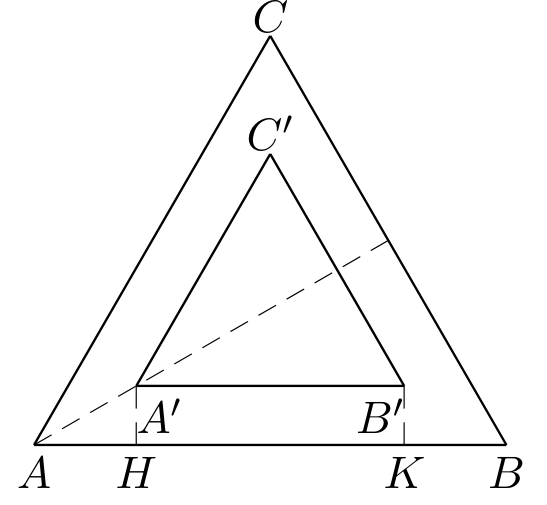
\begin{document}
\begin{tikzpicture}[scale=0.6]
  \coordinate (A) at (0,0);
  \coordinate (B) at (8,0);
  \coordinate (C) at (4,6.928);
  \coordinate (Ap) at (1.732,1);
  \coordinate (Bp) at (6.268,1);
  \coordinate (Cp) at (4,4.928);
  \coordinate (H) at (1.732,0);
  \coordinate (K) at (6.268,0);
  \draw (A)--(B)--(C)--cycle;
  \draw (Ap)--(Bp)--(Cp)--cycle;
  \draw[dashed] (A)--(Cp);
  \draw (Ap)--(H);
  \draw (Bp)--(K);
  \node[below left] at (A) {$A$};
  \node[below right] at (B) {$B$};
  \node[above] at (C) {$C$};
  \node[below] at (Ap) {$A'$};
  \node[below] at (Bp) {$B'$};
  \node[above] at (Cp) {$C'$};
  \node[below] at (H) {$H$};
  \node[below] at (K) {$K$};
\end{tikzpicture}
\end{document}
I rossi e i verdi stanno facendo una battaglia a gavettoni. La base dei rossi è un’area a forma di triangolo equilatero di lato 8 metri. I verdi non possono entrare nella base dei rossi, ma possono lanciare i loro proiettili nella base stando comunque fuori dal perimetro. Sapendo che i verdi riescono a colpire un bersaglio fino ad una distanza massima di 1 metro, quanto è grande (in metri quadrati) la zona all’interno della base dei rossi al sicuro dalla portata di tiro dei verdi?
- (A) 19 √ 3 −24
- (B) 4 √ 3
- (C) 3 √ 3
- (D) 19 −8 √ 3
- (E) ogni punto dell’area rossa è a portata di tiro dei verdi.
Topic: Geometria piana, Trigonometria Abilita: Ragionamento geometrico Area: Geometria Risposta: A Fonte: apri PDF p.6
Safe area within triangular equilateral base side 8
\begin{document}
\begin{tikzpicture}[scale=0.6]
  \coordinate (A) at (0,0);
  \coordinate (B) at (8,0);
  \coordinate (C) at (4,6.928);
  \coordinate (Ap) at (1.732,1);
  \coordinate (Bp) at (6.268,1);
  \coordinate (Cp) at (4,4.928);
  \coordinate (H) at (1.732,0);
  \coordinate (K) at (6.268,0);
  \draw (A)--(B)--(C)--cycle;
  \draw (Ap)--(Bp)--(Cp)--cycle;
  \draw[dashed] (A)--(Cp);
  \draw (Ap)--(H);
  \draw (Bp)--(K);
  \node[below left] at (A) {$A$};
  \node[below right] at (B) {$B$};
  \node[above] at (C) {$C$};
  \node[below] at (Ap) {$A'$};
  \node[below] at (Bp) {$B'$};
  \node[above] at (Cp) {$C'$};
  \node[below] at (H) {$H$};
  \node[below] at (K) {$K$};
\end{tikzpicture}
\end{document}
The reds and the greens are fighting a hawkish battle. The base of the reds is an area in the shape of an equilateral triangle with a side of 8 meters. The Greens can’t get into the base of the Reds, but they can fire their bullets into the base, still outside the perimeter. Knowing that the greens can hit a target up to a maximum distance of 1 meter, how large (in square meters) is the area inside the base of the reds safe from the range of the greens?
- (A) 19 √ 3 −24
- (B) 4 √ 3
- (C) 3 √ 3
- (D) 19 −8 √ 3
- (E) Every dot of the red area is within the green’s range.
Answer: A src_archimede_2010_2livello__Q09
Minimo a4 con MCD a coppie >1 ma MCD globale 1
Quattro interi positivi a1 < a2 < a3 < a4 sono tali che, dati due qualunque di essi, il loro massimo comun divisore è maggiore di 1, ma mcd(a1, a2, a3, a4) = 1. Qual è il minimo valore che può assumere a4?
- (A) 10
- (B) 12
- (C) 15
- (D) 30
- (E) 105.
Topic: Teoria dei Numeri Metodo: Principio di estremalita Abilita: Casework accurato Area: Aritmetica e Teoria dei Numeri Risposta: C Fonte: apri PDF p.7
Minimum a4 with pairs MCD >1 but global MCD 1
Four positive integers a1 < a2 < a3 < a4 are such that, given two of them, their maximum common divisor is greater than 1, but mcd(a1, a2, a3, a4) = 1. What is the minimum value that a4 can assume?
- (A) 10
- (B) 12
- (C) 15
- (D) 30
- (E) 105.
Answer: C src_archimede_2010_2livello__Q10
Minimo palline da estrarre per prodotto multiplo di 12
In una scatola ci sono venti palline numerate da 1 a 20. Ciascun numero è presente in una e una sola di queste palline. Quante palline diverse dobbiamo estrarre come minimo, per essere sicuri che il prodotto dei loro numeri sia un multiplo di 12?
- (A) 7
- (B) 11
- (C) 12
- (D) 15
- (E) 18.
Topic: Teoria dei Numeri Metodo: Principio dei cassetti Abilita: Casework accurato Area: Aritmetica e Teoria dei Numeri Risposta: D Fonte: apri PDF p.7
Minimum balls to be extracted per product multiple of 12
In a box, there are 20 balls numbered from 1 to 20. Each number is present in one and only one of these balls. How many different balls do we have to extract at least, to be sure that the product of their numbers is a multiple of 12?
- (A) 7
- (B) 11
- (C) 12
- (D) 15
- (E) 18.
Answer: D src_archimede_2010_2livello__Q11
Massimo grado di p(x-1)-3p(x)+3p(x+1)-p(x+2)
Sia p(x) un polinomio di grado 2010. Qual è il massimo grado che può avere il polinomio p(x −1) −3p(x) + 3p(x + 1) −p(x + 2)?
- (A) È sempre il polinomio nullo
- (B) 0
- (C) 1
- (D) 2007
- (E) 2010 Problemi a risposta numerica – 5 punti
Topic: Algebra Metodo: manipolazione algebrica Abilita: generalizzazione Area: Algebra e Analisi Risposta: D Fonte: apri PDF p.7
Most degree of p(x-1)-3p(x)+3p(x+1)-p(x+2)
Whether p(x) is a polynomial of degree 2010. What is the maximum degree that the polynomial p(x −1) −3p(x) + 3p(x + 1) −p(x + 2) can have?
- (A) It’s always the zero polynomial.
- (B) 0
- (C) 1
- (D) 2007
- (E) 2010 Problems with a numerical answer 5 points
Answer: D src_archimede_2010_2livello__Q12
Codice numero massimo con ogni sottosequenza prima
Per rubare un prezioso gioiello, un ladro deve scoprire il codice che permette di aprire la porta della cassaforte. Le informazioni che è riuscito a carpire sono le seguenti: – il codice è un numero – qualsiasi sottosequenza di cifre consecutive del codice (dunque sia ogni cifra presa singolarmente, che ogni coppia di cifre, etc. fino a tutto il numero) rappresenta un numero primo (ad esempio, 217 non va bene, perch´e 1 non è un primo e 21 non è un primo) – il codice è il numero più grande che abbia questa proprietà. Qual è il codice segreto per aprire la cassaforte?
Topic: Teoria dei Numeri Metodo: Analisi per casi Abilita: Casework accurato Area: Aritmetica e Teoria dei Numeri Risposta: 373 Fonte: apri PDF p.7
Maximum number code with each subsection first
To steal a precious jewel, a thief must discover the code that allows him to open the safe door. The information that he managed to find is as follows: the code is a number any subsequence of consecutive digits of the code (so either each digit taken individually, or each pair of digits, etc.). up to the whole number) is a prime number (for example, 217 is not good, because 1 is not a prime and 21 is not a prime) the code is the largest number that has this property. What’s the secret code to open the safe?
Answer: 373 src_archimede_2010_2livello__Q13
Area minima dell’ombra della piramide al sole a 45°
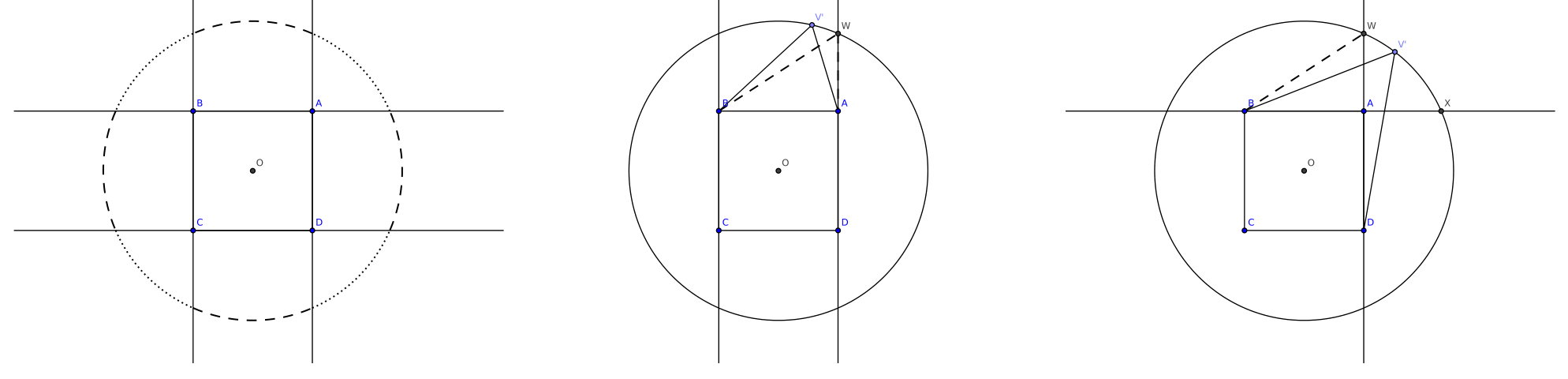
Il monumento a Mathenkamen è a forma di piramide che poggia sulla sua base quadrata di lato 18 m. La sua altezza misura 15 m, e il piede dell’altezza cade nel centro del quadrato. La piramide è orientata in modo che, quando i raggi del sole arrivano da sud inclinati di 45°rispetto al suolo, l’area della parte di terreno su cui essa spande la sua ombra sia la più piccola possibile. Quanto vale quest’area espressa in m2? (Nota: il terreno coperto dalla base della piramide non va contato come terreno in ombra.)
Topic: Geometria solida Metodo: Metodo delle coordinate Abilita: Ragionamento geometrico Area: Geometria Risposta: 27 Fonte: apri PDF p.7
Minimum area of the pyramid shadow in the sun at 45°
The monument at Mathenkamen is in the shape of a pyramid which rests on its 18 m square side base. Its height is 15 m, and the foot of height falls in the center of the square. The pyramid is oriented so that, when the sun’s rays come from the south inclined by 45° towards the ground, the area of the ground on which it spreads its shadow is as small as possible. What is the value of this area in m2? (Note: the ground covered by the base of the pyramid is not to be counted as shady ground.)
Answer: 27 src_archimede_2010_2livello__Q14
Terne (p,q,n) primi con p^2+q^2 = pqn+1
ESERCIZIO DIMOSTRATIVO Trovare tutte le terne ordinate di numeri interi positivi (p, q, n) tali che p, q siano primi e p2 + q2 = pqn + 1.
Topic: Teoria dei Numeri Metodo: Analisi per casi, congruenze Abilita: Manipolazione algebrica Area: Aritmetica e Teoria dei Numeri Risposta: (2,3,2) e (3,2,2) Fonte: apri PDF p.8
Term (p,q,n) prime with p^2+q^2 = pqn+1
DEMOSTRATIVE EXERCISE Find all the ordered sets of positive integers (p, q, n) such that p, q are prime and p2 + q2 = pqn + 1.
Answer: (2,3,2) e (3,2,2) src_archimede_2010_2livello__Q15
CBN=BAM e CM+MN=BN nel triangolo isoscele
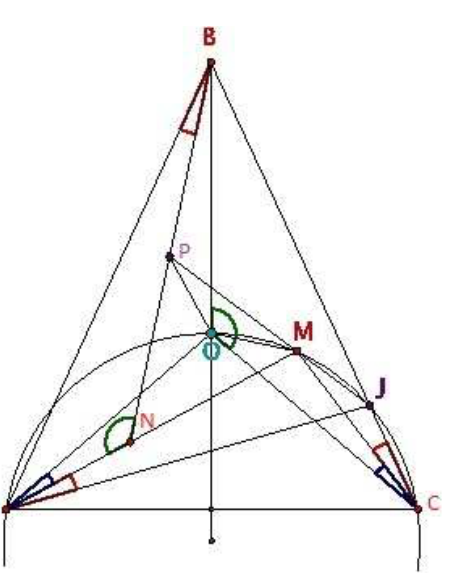
ESERCIZIO DIMOSTRATIVO È dato un triangolo acutangolo isoscele ABC di base AC. All’interno di tale triangolo sono dati un punto M, dalla parte di C rispetto all’asse di AC e tale che C c MA = 2, e un punto N all’interno del segmento AM tale che B b NM = . – Dimostrare che = . – Dimostrare che CM + MN = BN.
Topic: Geometria piana Metodo: Tecniche trigonometriche Abilita: Ragionamento geometrico Area: Geometria Risposta: dimostrazione Fonte: apri PDF p.9
CBN=BAM and CM+MN=BN in the isosceles triangle
A triangle isosceles ABC of base AC is given. Within this triangle, a point M is given on the side of C with respect to the AC axis, such that C c MA = 2, and a point N within the segment AM, such that B b NM = . Demonstrate that = . Demonstrate that CM + MN = BN.
Answer: dimostrazione src_archimede_2010_2livello__Q16
Ordinamenti di {21..81} con somme di 4 consecutivi divisibili per 3
ESERCIZIO DIMOSTRATIVO In quanti modi diversi si possono mettere in fila i numeri {21, 31, 41, 51, 61, 71, 81} in modo che, comunque se ne scelgano quattro in posti consecutivi, la loro somma sia divisibile per tre?
Topic: Combinatoria Metodo: congruenze, Conteggio combinatorio Abilita: Conteggio sistematico Area: Combinatoria, Logica e Probabilita Risposta: 144 Fonte: apri PDF p.10
Orders of {21..81} with sums of 4 consecutive digits divisible by 3
How many different ways can the numbers {21, 31, 41, 51, 61, 71, 81} be arranged so that, however, if four of them are chosen in successive places, their sum is divisible by three?
Answer: 144 src_archimede_2010_2livello__Q17