resto 1 per 7 e resto 2 per 10
Federico ha una collezione di soldatini; sa di averne un po’ meno di 100, ma certamente almeno 30. Li dispone in fila per 7 e gli avanza un soldatino; poi li dispone in fila per 10 e stavolta gli avanzano 2 soldatini. Quanti soldatini ha in tutto?
- (A) 32
- (B) 50
- (C) 62
- (D) 71
- (E) 92
Topic: Teoria dei Numeri Metodo: congruenze Area: Aritmetica e Teoria dei Numeri Risposta: E Fonte: apri PDF p.1
residual 1 to 7 and remaining 2 to 10
Frederick has a collection of soldiers; he knows he has a little less than 100, but certainly at least 30. He puts them in line by 7 and a soldier advances; then he puts them in line by 10 and this time 2 soldiers advance. How many soldiers does he have in all?
- (A) 32
- (B) 50
- (C) 62
- (D) 71
- (E) 92
Answer: E src_archimede_2013_biennio__Q01
Giorno della conversazione tra due matematici bugiardi
In una conversazione tra due matematici il primo dice al secondo: “Ieri ho mentito”. L’altro risponde: “Anch’io ieri ho mentito”. Sapendo che uno dei due mente il lunedì, il martedì e il mercoledì (e solo in questi giorni), mentre l’altro mente il giovedì, il venerdì e il sabato (e solo in questi giorni), in quale giorno della settimana è avvenuta la conversazione?
- (A) lunedì
- (B) giovedì
- (C) domenica
- (D) una tale conversazione non può essere avvenuta
- (E) non è possibile determinare il giorno in modo univoco.
Topic: Logica, giochi, strategie Metodo: Analisi per casi Abilita: Casework accurato Area: Combinatoria, Logica e Probabilita Risposta: B Fonte: apri PDF p.1
Day of conversation between two lying mathematicians
In a conversation between two mathematicians, the first says to the second, “I lied yesterday”. The other replies, “I lied yesterday too”. Knowing that one of the two lies on Monday, Tuesday and Wednesday (and only on these days), while the other lies on Thursday, Friday and Saturday (and only on these days), on what day of the week did the conversation take place?
- (A) Monday
- (B) Thursday
- (C) Sundays
- (D) Such a conversation cannot have taken place .
- (E) It is not possible to determine the day uniquely.
Answer: B src_archimede_2013_biennio__Q02
Probabilita di testa al lancio successivo di moneta
Leo lancia 7 volte una moneta (non truccata) ottenendo due volte testa e cinque volte croce. Se la lancia ancora una volta, con quale probabilità otterrà testa?
- (A) 1 8
- (B) 1 7
- (C) 1 −1 27
- (D) 35 27
- (E) 1 2
Topic: Probabilita e statistica Abilita: Lettura attenta del testo Area: Combinatoria, Logica e Probabilita Risposta: E Fonte: apri PDF p.1 Anche in triennio: apri PDF p.1
Probability of head at the next coin toss
Leo throws a coin 7 times (unmade) and gets twice the head and five times the cross. If he throws it one more time, what are the odds of getting his head?
- (A) 1 8
- (B) 1 7
- (C) 1 −1 27
- (D) 35 27
- (E) 1 2
Answer: E src_archimede_2013_biennio__Q03
Crittaritmetica TRE+TRE=SEI, proprieta delle cifre
Andrea scrive la somma di due numeri a tre cifre con il relativo risultato. Poi sostituisce a ciascuna cifra una lettera, facendo corrispondere lettera uguale a cifra uguale e usando lettere diverse per cifre diverse. In questo modo ottiene: TRE + TRE = SEI. Allora:
- (A) la lettera E corrisponde necessariamente a un numero pari
- (B) la lettera S corrisponde necessariamente a un numero pari
- (C) la lettera E corrisponde necessariamente a un numero dispari maggiore di 4
- (D) la lettera E corrisponde necessariamente a un numero pari minore di 5
- (E) nessuna delle precedenti affermazioni è vera
Topic: Teoria dei Numeri Metodo: Analisi per casi Area: Aritmetica e Teoria dei Numeri Risposta: E Fonte: apri PDF p.1
*Rhythmic criterion TRE+TRE=SEI, property of the digits *
Andrea writes the sum of two three-digit numbers with the corresponding result. He then replaces each digit with a letter, matching the same letter to the same digit and using different letters for different digits. This way you get: TRE + TRE = SEI. So, what?
- (A) the letter E must correspond to an equal number
- (B) The letter S is necessarily an equal number.
- (C) the letter E necessarily corresponds to a odd number greater than 4
- (D) the letter E necessarily corresponds to a number less than 5
- (E) None of the above statements are true
Answer: E src_archimede_2013_biennio__Q04
Diminuzione percentuale androidi dopo aumento popolazione
Fino al 2013, nella colonia penale di Zoranel la popolazione era costituita per il 60% da androidi, dei quali il 5% adibiti a vigilanza; diciamo q la percentuale di androidi di vigilanza sul totale della popolazione in quell’ anno. Nel 2014 la popolazione aumentò del 10% per l’arrivo di N umani esiliati. Di quanto diminuì la percentuale di androidi di vigilanza sulla popolazione totale?
- (A) non cambiò
- (B) di meno di un decimo di q
- (C) di più di un decimo di q
- (D) dipende da N
- (E) dipende da quanto era numerosa la popolazione iniziale.
Topic: Algebra Area: Algebra e Analisi Risposta: B Fonte: apri PDF p.1 Anche in triennio: apri PDF p.1
Reduction in the percentage of androids after population increase
Until 2013, in the Zoranel penal colony the population was 60% androids, of which 5% were supervised; say q the percentage of supervised androids over the total population in that year. In 2014 the population increased by 10% due to the arrival of N human exiles. How much has the percentage of surveillance androids decreased over the total population?
- (A) He didn ‘t change .
- (B) less than one tenth of q
- (C) more than one tenth of q
- (D) depends on N
- (E) It depends on how large the initial population was.
Answer: B src_archimede_2013_biennio__Q05
Numero di matematici a un convegno con vincoli
Ad un convegno partecipano 30 scienziati ciascuno dei quali è un matematico, o un fisico, o un chimico o un biologo. I fisici e i biologi, insieme, sono la metà dei matematici; i fisici e i chimici, insieme, sono il doppio dei biologi. Inoltre, di fisici ce n’è almeno uno. Quanti sono i matematici?
- (A) 6
- (B) 10
- (C) 12
- (D) 15
- (E) 18
Topic: Algebra Abilita: Manipolazione algebrica Area: Algebra e Analisi Risposta: E Fonte: apri PDF p.1
Number of mathematicians at a meeting with constraints
A conference is attended by 30 scientists, each of whom is a mathematician, or a physicist, or a chemist or a biologist. Physicists and biologists, together, are half the mathematicians; physicists and chemists, together, are twice the biologists. Besides, there’s at least one physicist. How many mathematicians are there?
- (A) 6
- (B) 10
- (C) 12
- (D) 15
- (E) 18
Answer: E src_archimede_2013_biennio__Q06
Coppie in tabella dove la riga 2 e multipla della 1
Data una tabella con 2 righe e 1007 colonne, scriviamo tutti i numeri da 1 a 1007 sulla prima riga in ordine crescente, e i numeri da 1008 a 2014 sulla seconda, sempre in ordine crescente. Guardiamo ora la tabella come 1007 coppie di numeri sovrapposti in verticale: in quante di esse il numero che compare nella seconda riga è un multiplo di quello che gli sta sopra?
- (A) 2
- (B) 3
- (C) 4
- (D) 5
- (E) 6
Topic: Teoria dei Numeri Metodo: congruenze Area: Aritmetica e Teoria dei Numeri Risposta: C Fonte: apri PDF p.1 Anche in triennio: apri PDF p.1
Table pairs where row 2 and multiples of 1
Given a table with 2 rows and 1007 columns, we write all the numbers from 1 to 1007 on the first row in increasing order, and the numbers from 1008 to 2014 on the second, always in increasing order. Now let’s look at the table as 1007 pairs of numbers overlapping vertically: how many of them is the number that appears in the second row multiple of what’s above it?
- (A) 2
- (B) 3
- (C) 4
- (D) 5
- (E) 6
Answer: C src_archimede_2013_biennio__Q07
Ciliegie mangiate da Alberto, divisione e resi
Alberto ha raccolto 756 ciliegie dall’albero del nonno, e le divide equamente tra s´e e alcuni suoi amici. Tre di loro però non hanno molta fame e restituiscono ad Alberto un quarto delle ciliegie che hanno ricevuto. Alberto, con uno stomaco di ferro, oltre alle sue divora anche quelle; alla fine, si accorge di aver mangiato non meno di 150 ciliegie. Quante ne ha mangiate esattamente?
- (A) 150
- (B) 189
- (C) 210
- (D) 231
- (E) 270
Topic: Teoria dei Numeri Metodo: manipolazione algebrica Abilita: Casework accurato Area: Aritmetica e Teoria dei Numeri Risposta: B Fonte: apri PDF p.1
Chilies eaten by Alberto, split and returned
Alberto collected 756 cherries from his grandfather’s tree, and divided them equally between himself and some of his friends. Three of them, however, are not very hungry and return to Alberto a quarter of the cherries they received. Alberto, with an iron stomach, besides his own devours those too; in the end, he realizes that he has eaten no less than 150 cherries. How many did you eat, exactly?
- (A) 150
- (B) 189
- (C) 210
- (D) 231
- (E) 270
Answer: B src_archimede_2013_biennio__Q08
Divisori di n^2 se n ha 6 divisori
Se n è un numero naturale con 6 divisori interi positivi, quanti divisori interi positivi ha n2? N.B.: tra i divisori di un numero contiamo anche 1 ed il numero stesso.
- (A) 11
- (B) 12
- (C) 15
- (D) 36
- (E) la risposta dipende da n
Topic: Teoria dei Numeri Metodo: Analisi per casi, manipolazione algebrica Area: Aritmetica e Teoria dei Numeri Risposta: E Fonte: apri PDF p.1 Anche in triennio: apri PDF p.2
N2 dividers if n has 6 dividers
If n is a natural number with 6 positive integers, how many positive integers does n have? N.B.: Among the divisors of a number, we also count 1 and the number itself.
- (A) 11
- (B) 12
- (C) 15
- (D) 36
- (E) The answer depends on n
Answer: E src_archimede_2013_biennio__Q09
Rapporto area triangolo CDE e trapezio
\begin{document}
\begin{tikzpicture}
  \coordinate (A) at (0,0);
  \coordinate (B) at (6,0);
  \coordinate (D) at (2,2.6);
  \coordinate (C) at (4,2.6);
  \coordinate (E) at (4,1.3);
  \fill[gray!50] (C) -- (D) -- (E) -- cycle;
  \draw (A) -- (B) -- (C) -- (D) -- cycle;
  \draw (B) -- (D);
  \draw (D) -- (E);
  \fill (E) circle (1.5pt);
  \node[above left] at (D) {$D$};
  \node[above right] at (C) {$C$};
  \node[below left] at (A) {$A$};
  \node[below right] at (B) {$B$};
  \node[below right] at (E) {$E$};
\end{tikzpicture}
\end{document}
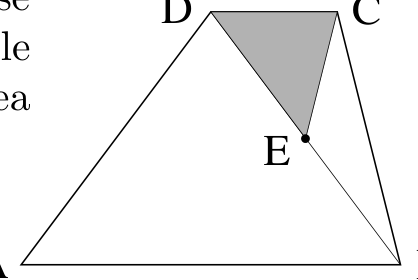
In un trapezio ABCD la base maggiore AB è tripla della base minore CD. Indicato con E il punto medio della diagonale BD, qual è il rapporto fra l’area del triangolo CDE e l’area del trapezio?
- (A) 1/3
- (B) 1/6
- (C) 1/8
- (D) 1/12
- (E) non può essere determinata dai dati forniti
Topic: Geometria piana Abilita: Ragionamento geometrico Area: Geometria Risposta: C Fonte: apri PDF p.2 Anche in triennio: apri PDF p.1
*Report area CDE triangle and trapezoid *
\begin{document}
\begin{tikzpicture}
  \coordinate (A) at (0,0);
  \coordinate (B) at (6,0);
  \coordinate (D) at (2,2.6);
  \coordinate (C) at (4,2.6);
  \coordinate (E) at (4,1.3);
  \fill[gray!50] (C) -- (D) -- (E) -- cycle;
  \draw (A) -- (B) -- (C) -- (D) -- cycle;
  \draw (B) -- (D);
  \draw (D) -- (E);
  \fill (E) circle (1.5pt);
  \node[above left] at (D) {$D$};
  \node[above right] at (C) {$C$};
  \node[below left] at (A) {$A$};
  \node[below right] at (B) {$B$};
  \node[below right] at (E) {$E$};
\end{tikzpicture}
\end{document}
In an ABCD trapezoid the major base AB is triple the minor base CD. Indicated by E the middle point of the BD diagonal, what is the ratio between the area of the CDE triangle and the area of the trapezoid?
- (A) 1/3
- (B) 1/6
- (C) 1/8
- (D) 1/12
- (E) cannot be determined by the data provided
Answer: C src_archimede_2013_biennio__Q10
Percorso piu corto per i vertici di un cubo
Quanto è lungo il percorso più corto che passa per tutti i vertici di un cubo di lato 1 m? N.B. il percorso può anche passare all’interno del cubo.
- (A) 6 m
- (B) 7 m
- (C) (6 + √ 2) m
- (D) (6 + √ 3) m
- (E) 8 m
Topic: Geometria solida Metodo: Principio di estremalita Area: Geometria Risposta: B Fonte: apri PDF p.2 Anche in triennio: apri PDF p.1
Shorter route for the vertices of a cube
How long is the shortest path that passes through all the vertices of a 1 m side cube? N.B. The path can also pass inside the cube.
- (A) 6 m
- (B) 7 m
- (C) (6 + √ 2) m
- (D) (6 + √ 3) m
- (E) 8 m
Answer: B src_archimede_2013_biennio__Q11
Area cerchio non coperta da triangolo equilatero
\begin{document}
\begin{tikzpicture}
  \coordinate (A) at (-1.414,0);
  \coordinate (B) at (1.414,0);
  \coordinate (T) at (0,2.449);
  \draw (0,1.2247) circle (1.2247);
  \draw (A) -- (B) -- (T) -- cycle;
\end{tikzpicture}
\end{document}
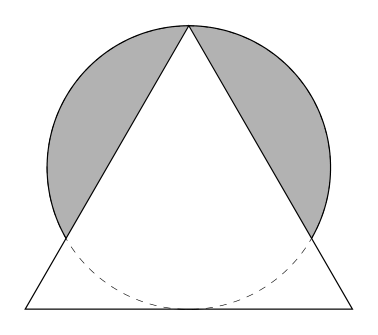
In una scultura d’arte moderna è rappresentato un cerchio nascosto in parte da un triangolo equilatero, come in figura: il cerchio ha il diametro lungo quanto l’altezza del triangolo, la quale misura √ 6 m. Quanto vale l’area della parte del cerchio non coperta dal triangolo ?
- (A) ( 3 2π−8 √ 3) m2
- (B) π 2 m2
- (C) (π−3 √ 3 4 ) m2
- (D) ( 3 2π−9 √ 3 8 ) m2
- (E) 3 2π m2
Topic: Geometria piana Area: Geometria Risposta: C Fonte: apri PDF p.2 Anche in triennio: apri PDF p.1
A circular area not covered by an equilateral triangle
\begin{document}
\begin{tikzpicture}
  \coordinate (A) at (-1.414,0);
  \coordinate (B) at (1.414,0);
  \coordinate (T) at (0,2.449);
  \draw (0,1.2247) circle (1.2247);
  \draw (A) -- (B) -- (T) -- cycle;
\end{tikzpicture}
\end{document}
In a modern art sculpture, a circle is represented partially concealed by an equilateral triangle, as shown in the figure: the circle has a diameter as long as the height of the triangle, which measures √ 6 m. How much is the area of the part of the circle not covered by the triangle ?
- (A) ( 3 2π−8 √ 3) m2
- (B) π 2 m2
- (C) (π−3 √ 3 4 ) m2
- (D) ( 3 2π−9 √ 3 8 ) m2
- (E) 3 2π m2
Answer: C src_archimede_2013_biennio__Q12
Probabilita due palline dello stesso colore
In un’urna ci sono 8 palline blu e 7 palline rosse. Mirco estrae due palline, una dopo l’altra (senza rimettere nell’urna la prima pallina estratta, prima di estrarre la seconda). Qual è la probabilità che le due palline estratte siano dello stesso colore?
- (A) 1/4
- (B) 1/2
- (C) 7/15
- (D) 8/15
- (E) nessuna delle precedenti
Topic: Probabilita e statistica Metodo: Conteggio combinatorio Area: Combinatoria, Logica e Probabilita Risposta: C Fonte: apri PDF p.2
The probability of two balls of the same color
There are eight blue balls and seven red balls in a day. Mirco extracts two balls, one after the other (without putting the first extracted ball back into the urn, before extracting the second). What is the probability that the two balls extracted are of the same color?
- (A) 1/4
- (B) 1/2
- (C) 7/15
- (D) 8/15
- (E) None of the preceding
Answer: C src_archimede_2013_biennio__Q13
Quale porta scegliere per il cammino piu breve
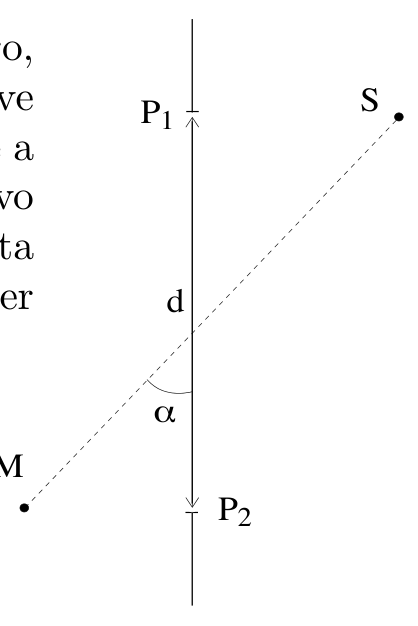
Salvo e Maria (S ed M in figura) sono separati da un lungo muro, inclinato di un angolo α rispetto alla retta che li congiunge (dove 0 < α < 90°). Nei due punti P1 e P2 del muro più vicini a Salvo e a Maria vi sono due porte, distanti tra loro d > 0; sapendo che Salvo e Maria si trovano rispettivamente a 10 metri e 8 metri dalla porta a loro più vicina, quale delle due porte deve attraversare Salvo per raggiungere Maria percorrendo il cammino più breve possibile?
- (A) la porta P1
- (B) la porta P2
- (C) è indifferente
- (D) dipende dalla distanza d tra le porte
- (E) dipende dall’inclinazione α del muro P1 P2 S M d _
Topic: Geometria piana Metodo: Sfruttamento della simmetria Area: Geometria Risposta: B Fonte: apri PDF p.2
Which port to choose for the shortest route
Salvo and Maria (S and M in figure) are separated by a long wall, inclined at an angle of α relative to the straight line joining them (where 0 < α < 90°). In the two points P1 and P2 of the nearest wall to Salvo and Maria there are two doors, distant from each other d > 0; knowing that Salvo and Maria are respectively 10 meters and 8 meters from the door to their nearest, which of the two doors must Salvo cross to reach Mary by taking the shortest path possible?
- (A) the door P1
- (B) the P2 door
- (C) He ‘s indifferent .
- (D) depends on the distance d between the doors
- (E) depends on the slope α of the wall P1 P2 S M d _
Answer: B src_archimede_2013_biennio__Q14
Coefficiente di x^199 in (x^2+x+1)^100
Qual è il coefficiente di x199 in (x2 + x + 1)100?
- (A) 100
- (B) 298
- (C) 4950
- (D) 5050
- (E) 992
Topic: Combinatoria Metodo: Conteggio combinatorio Area: Combinatoria, Logica e Probabilita Risposta: A Fonte: apri PDF p.2
Coefficient of x^199 in (x^2+x+1)^100
What is the coefficient of x199 in (x2 + x + 1)100?
- (A) 100
- (B) 298
- (C) 4950
- (D) 5050
- (E) 992
Answer: A src_archimede_2013_biennio__Q15
Area parte ombreggiata a stella nel quadrato
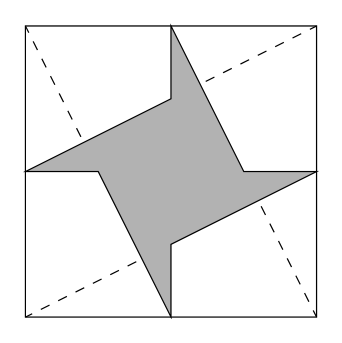
Calcolare l’area della parte ombreggiata in figura sapendo che il lato del quadrato è lungo 2 m e che le punte della stella cadono nei punti medi dei lati del quadrato.
- (A) 1 m2
- (B) 2 m2
- (C) 1 2 m2
- (D) π m2
- (E) 2 √ 2 m2
Topic: Geometria piana Abilita: Ragionamento geometrico Area: Geometria Risposta: A Fonte: apri PDF p.2
Area part shaded with stars in the square
Calculate the area of the shaded part in the figure knowing that the side of the square is 2 m long and that the points of the star fall in the middle points of the sides of the square.
- (A) 1 m2
- (B) 2 m2
- (C) 1 2 m2
- (D) π m2
- (E) 2 √ 2 m2
Answer: A src_archimede_2013_biennio__Q16