Trovare alpha con 2^alpha=4^(4^4)
Trovare α in modo che 2α = 444. A α = 512 B α = 8 C α = 128 D α = 256 E α = 232 F α = 216
Topic: Algebra Abilita: Manipolazione algebrica Area: Algebra e Analisi Risposta: A Fonte: apri PDF p.1
*Finding alpha with 2^alpha=4^(4^4) *
Find α so that 2α is 444. A α = 512 B α = 8 C α = 128 D α = 256 E α = 232 F α = 216
Answer: A src_archimede_2015_classiprime__Q01
Interpretazione di frazione a piani come divisioni annidate
Il valore di x è il seguente: x = A B C D . Allora: A x = A : (B : C : D) B x = A : (B : (C : D)) C x = A : B : C : D D x = A : B : (C : D) E x = A : (B : C) : D F nessuna delle altre risposte è esatta
Topic: Algebra Abilita: Lettura attenta del testo Area: Algebra e Analisi Risposta: A Fonte: apri PDF p.1
Interpretation of flat fraction as nested divisions
The value of x is as follows: x = A B C D . Then: A x = A: (B: C: D) B x = A: (B: (C: D) C x = A: B: C: D D x = A: B: (C: D) And x = A: (B: C) D F None of the other answers are accurate
Answer: A src_archimede_2015_classiprime__Q02
Lato CB di triangolo isoscele dato rapporto altezze e perimetro
Nel triangolo ABC, isoscele sulla base AB, l’altezza relativa ad AB è il doppio di quella relativa al lato CB. Se il perimetro del triangolo è 120cm quanto misura il lato CB? A 48cm B 36cm C 24cm D 50cm E 45cm F 42cm
Topic: Geometria piana Abilita: Ragionamento geometrico Area: Geometria Risposta: A Fonte: apri PDF p.1
CB side of isosceles triangle given height and perimeter ratio
In the triangle ABC, isosceles on the base AB, the height relative to AB is twice that relative to the side CB. If the perimeter of the triangle is 120 cm, how big is the CB side? A 48cm B 36cm C 24cm D 50cm E 45cm F 42cm
Answer: A src_archimede_2015_classiprime__Q03
Cifra mancante in frase con divisione 71/17 resto 14*
Nella seguente frase (presa da una nota canzone dell’isola Kenoncè) una cifra non è leggibile ed è sostituita da un asterisco: 71∗gatti, in fila per 17, col resto di 14 Sapendo che la frase è corretta dal punto di vista matematico, trovare la cifra mancante. A 1 B 2 C 6 D 0 E 3 F i dati sono insufficienti a rispondere
Topic: Teoria dei Numeri Metodo: congruenze Abilita: Lettura attenta del testo Area: Aritmetica e Teoria dei Numeri Risposta: A Fonte: apri PDF p.1
Full figure in sentence with division 71/17 remaining 14*
In the following sentence (taken from a well-known Kenoncè song) a figure is unreadable and is replaced by an asterisk: 71 gatti, in line for 17, with the rest of 14 Knowing that the sentence is correct from a mathematical point of view, find the missing figure. A 1 B 2 C 6 D 0 E 3 F data are insufficient to answer
Answer: A src_archimede_2015_classiprime__Q04
Minima media dei 5 voti ignoti data media finale arrotondata
La professoressa Facciocomemipare di solito non dice agli alunni i voti delle interrogazioni, per cui Claudia conosce i voti di solo 2 delle 7 interrogazioni che ha fatto: sono un 7 e un 9. Inoltre sa che i voti delle interrogazioni sono sempre dei numeri interi e che la prof. mette il voto in pagella facendo la media aritmetica dei voti e arrotondando all’intero più vicino. Se alla fine in pagella prende 8, qual è il minimo valore che può avere la media dei 5 voti che non conosce? A 7, 4 B 7, 2 C 7, 5 D 7, 6 E 7, 8 F nessuna delle altre risposte è esatta
Topic: Algebra Abilita: traduzione del testo Area: Algebra e Analisi Risposta: A Fonte: apri PDF p.1
Minimum average of 5 unknown final rounded average data
Professor Facciocomipare doesn’t usually tell the students the grades of the questions, so Claudia only knows the grades of two of the seven questions she asked: they’re a 7 and a 9. You also know that questions are always numbered and that Prof. It puts the score on the page by doing the arithmetic mean of the scores and rounding it to the nearest integer. If he ends up with eight on the page, what’s the minimum value that he can have on the average of five not-knowing votes? A 7, 4 B 7, 2 C 7, 5 D 7, 6 E 7, 8 F None of the other answers are correct
Answer: A src_archimede_2015_classiprime__Q05
Altezza del primo recipiente dopo travaso (volumi prismi)
Un recipiente a forma di prisma retto con base quadrata è alto e stretto ed è pieno d’acqua fino al bordo. Se si travasa tutta l’acqua in un altro recipiente di forma identica, ma avente la base quadrata con il lato di misura tripla, nel nuovo recipiente il livello dell’acqua raggiunge la quota di 12mm. Quanto era alto il primo recipiente? A 108mm B 36mm C 48mm D 324mm E 144mm F Non è determinabile se non si conoscono i lati delle basi
Topic: Geometria solida Abilita: Ragionamento geometrico Area: Geometria Risposta: A Fonte: apri PDF p.1
*Height of the first container after welding (volumes of prisms) *
A rectangular prism-shaped vessel with a square base is tall and narrow and full of water up to the edge. If all the water is poured into another container of the same shape, but with a square base with the three-dimensional side, the water level in the new container reaches the height of 12 mm. How tall was the first container? A 108mm B 36mm C 48mm D 324mm E 144mm F It cannot be determined if the sides of the bases are not known
Answer: A src_archimede_2015_classiprime__Q06
Area del piu piccolo triangolo equilatero che contiene esagono
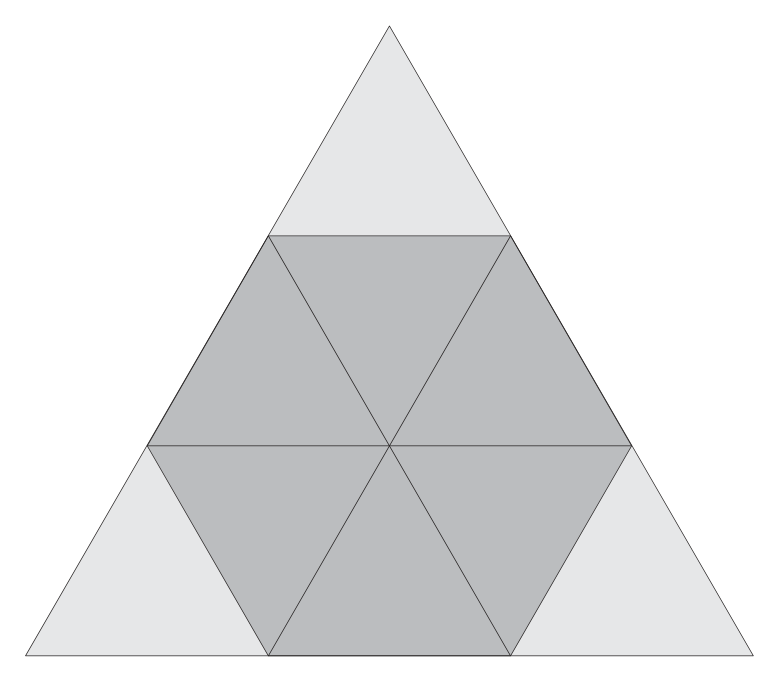
\begin{document}
\begin{tikzpicture}[scale=0.9]
  \coordinate (A) at (0,0);
  \coordinate (B) at (6,0);
  \coordinate (C) at (3,5.196);
  \coordinate (P1) at (2,0);
  \coordinate (P2) at (4,0);
  \coordinate (P3) at (5,1.732);
  \coordinate (P4) at (4,3.464);
  \coordinate (P5) at (2,3.464);
  \coordinate (P6) at (1,1.732);
  \fill[gray!40] (P1)--(P2)--(P3)--(P4)--(P5)--(P6)--cycle;
  \fill[gray!15] (A)--(P1)--(P6)--cycle;
  \fill[gray!15] (B)--(P2)--(P3)--cycle;
  \fill[gray!15] (C)--(P4)--(P5)--cycle;
  \draw (A)--(B)--(C)--cycle;
  \draw (P1)--(P2)--(P3)--(P4)--(P5)--(P6)--cycle;
  \draw (P6)--(P3);
  \draw (P1)--(P4);
  \draw (P2)--(P5);
\end{tikzpicture}
\end{document}
Un esagono regolare ha l’area di 144cm2. Qual è l’area del più piccolo triangolo equilatero che lo contiene? A 216cm2 B 192cm2 C 288cm2 D 180cm2 E 240cm2 F 256cm2
Topic: Geometria piana Abilita: Ragionamento geometrico Area: Geometria Risposta: A Fonte: apri PDF p.1
Area of the smallest equilateral triangle containing hexagon
\begin{document}
\begin{tikzpicture}[scale=0.9]
  \coordinate (A) at (0,0);
  \coordinate (B) at (6,0);
  \coordinate (C) at (3,5.196);
  \coordinate (P1) at (2,0);
  \coordinate (P2) at (4,0);
  \coordinate (P3) at (5,1.732);
  \coordinate (P4) at (4,3.464);
  \coordinate (P5) at (2,3.464);
  \coordinate (P6) at (1,1.732);
  \fill[gray!40] (P1)--(P2)--(P3)--(P4)--(P5)--(P6)--cycle;
  \fill[gray!15] (A)--(P1)--(P6)--cycle;
  \fill[gray!15] (B)--(P2)--(P3)--cycle;
  \fill[gray!15] (C)--(P4)--(P5)--cycle;
  \draw (A)--(B)--(C)--cycle;
  \draw (P1)--(P2)--(P3)--(P4)--(P5)--(P6)--cycle;
  \draw (P6)--(P3);
  \draw (P1)--(P4);
  \draw (P2)--(P5);
\end{tikzpicture}
\end{document}
A regular hexagon has an area of 144 cm2. What is the area of the smallest equilateral triangle that contains it? A 216cm2 B 192cm2 C 288cm2 D 180cm2 E 240cm2 F 256cm2
Answer: A src_archimede_2015_classiprime__Q07
Modi di suddividere 6 giorni tra istituti senza giorni consecutivi
Nell’isola Kenoncè ci sono gravissimi problemi di edilizia scolastica: 2 scuole su 3 sono inutilizzabili. Per risolvere il problema, il primo ministro ha decretato: (a) Ogni istituto comprimerà il suo orario in due soli giorni della settimana, in ciascuno dei quali si svolgeranno 15 ore di lezione. (b) Ogni edificio scolastico sano verrà utilizzato da 3 istituti, ciascuno dei quali ne disporrà per due giorni la settimana. In quanti modi diversi tre istituti possono suddividersi i giorni dal lunedì al sabato, in modo che i giorni occupati dallo stesso istituto non siano mai consecutivi? A 30 B 89 C 10 D 12 E 24 F 18
Topic: Combinatoria Metodo: Conteggio combinatorio Abilita: Conteggio sistematico Area: Combinatoria, Logica e Probabilita Risposta: A Fonte: apri PDF p.1
How to divide 6 days between institutions without consecutive days
In Kenoncè there are serious problems with school building: 2 out of 3 schools are unusable. To solve the problem, the Prime Minister has decreed: (a) Each institution will reduce its hours to just two days a week, each of which will be 15 hours of lessons. (b) Each healthy school building will be used by 3 institutions, each of which will have two days a week. How many different ways can three institutions divide the days from Monday to Saturday so that the days of the same institution are never consecutive? A 30 B 89 C 10 D 12 E 24 F 18
Answer: A src_archimede_2015_classiprime__Q08
Colorazioni distinte di un cubo bianco/nero a meno di rotazioni
In quanti modi diversi posso dipingere un cubo, colorando ciascuna faccia di bianco o di nero? (due colorazioni sono da considerare identiche, e quindi vanno contate una sola volta, se si possono ottenere l’una dall’altra ruotando il cubo nello spazio) A 10 B 6 C 8 D 9 E 24 F 16
Topic: Combinatoria, Geometria solida Metodo: Sfruttamento della simmetria Abilita: Casework accurato Area: Combinatoria, Logica e Probabilita, Geometria Risposta: A Fonte: apri PDF p.1
Distinct colours of a white/black cube without rotations
How many different ways can I paint a cube, coloring each face white or black? (two colours are to be considered identical, and therefore counted only once, if one can be obtained from the other by rotating the cube in space) A 10 B 6 C 8 D 9 E 24 F 16
Answer: A src_archimede_2015_classiprime__Q09
Valore di prodotto di interi vicini (differenza di prodotti)
Dire quanto vale l’espressione: 1234567896·1234567894−1234567899·1234567891. A 15 B 0 C 10 D 6 E 5 F 31
Topic: Algebra Metodo: manipolazione algebrica Abilita: Manipolazione algebrica Area: Algebra e Analisi Risposta: A Fonte: apri PDF p.1
*Value of the product of neighbouring integers (difference of products) *
The value of the expression: 1234567896·1234567894−1234567899·1234567891. A 15 B 0 C 10 D 6 E 5 F 31
Answer: A src_archimede_2015_classiprime__Q10
Scomposizione del polinomio di sesto grado in fattori interi
Quando si scompone il polinomio p(x) = x6+3x5+3x4+9x3+24x2+24x+8 come prodotto di polinomi a coefficienti interi di grado più basso, non ulteriormente scomponibili, si ottengono: A 4 polinomi di 1°grado e uno di 2°grado B 6 polinomi di 1°grado C 3 polinomi di 1°grado e uno di 3°grado D 2 polinomi di 1°grado e 2 di 2°grado E 2 polinomi di 1°grado e uno di 4°grado F nessuna delle altre risposte è esatta
Topic: Algebra Metodo: manipolazione algebrica Abilita: Manipolazione algebrica Area: Algebra e Analisi Risposta: A Fonte: apri PDF p.1
Composition of the sixth degree polynomial into integers
When the polynomial p(x) = x6+3x5+3x4+9x3+24x2+24x+8 is broken down as the product of polynomials with lower integer coefficients, not further broken down, we get: A 4 polynomials of 1°grade and one of 2°grade B 6 polynomials of 1°grade C 3 polynomials of 1°grade and one of 3°grade D 2 polynomials of 1°grade and 2 of 2°grade E 2 polynomials of 1°grade and one of 4°grade F none of the other answers is accurate
Answer: A src_archimede_2015_classiprime__Q11
Quanti primi distinti dividono 1122221100
Quanti diversi numeri primi dividono il numero 1122221100? (si ricorda che 1 NON è un numero primo) A 8 B 7 C meno di 7 D 9 E 10 F più di 10
Topic: Teoria dei Numeri Metodo: manipolazione algebrica Abilita: Manipolazione algebrica Area: Aritmetica e Teoria dei Numeri Risposta: A Fonte: apri PDF p.1
What are the distinct prime numbers dividing 1122221100
How many different prime numbers divide the number 1122221100? (remember that 1 is NOT a prime number) A 8 B 7 C less than 7 D 9 E 10 F more than 10
Answer: A src_archimede_2015_classiprime__Q12
cubo di cubetti suddiviso in cubi uguali
Ad una scuola materna dell’isola Kenoncè sono iscritti 23 bimbi, e sono raggruppati tutti insieme nella stessa aula. Un giorno Luca, per passare il tempo, costruisce un grosso cubo utilizzando esattamente tutti i cubetti di legno che ci sono a scuola. Allora la maestra, per far fare lo stesso gioco anche ai suoi compagni, suddivide la totalità dei cubetti in parti uguali tra tutti i bimbi (Luca compreso) e ordina a ciascuno di loro di costruire un cubo usando esattamente tutti i cubetti che ha ricevuto. Sapendo che i bimbi riescono a portare a termine il compito assegnato, dire quanti erano quel giorno gli assenti. A 15 B 7 C 10 D 3 E 9 F i dati forniti sono insufficienti
Topic: Teoria dei Numeri Metodo: congruenze Abilita: traduzione del testo Area: Aritmetica e Teoria dei Numeri Risposta: A Fonte: apri PDF p.1
cube of cubes divided into equal cubes
In a nursery school on Kenoncè Island, 23 children are enrolled, all in the same classroom. One day, Luca, to pass the time, builds a big cube using exactly all the wooden cubes in school. Then the teacher, in order to make her companions play the same game, divides the entire cubes into equal parts among all the children (including Luke) and orders each of them to build a cube using exactly all the cubes they have received. Knowing that the children are able to complete the assignment, counting the number of absentees that day. A 15 B 7 C 10 D 3 E 9 F the data provided are insufficient
Answer: A src_archimede_2015_classiprime__Q13
Quota turisti stranieri data crescita percentuale totale
Finita la Grande Crisi, nell’isola Kenoncè i turisti sono tornati a crescere. Rispetto all’anno precedente i turisti stranieri sono cresciuti del 5% mentre quelli nazionali dell’1%. Questo ha determinato una crescita del 2, 5% del numero totale di turisti. Qual era l’anno prima la quota di turisti stranieri rispetto al totale dei turisti? A 3 8 B 1 3 C 1 2 D 2 5 E 3 7 F non determinabile in modo univoco dai soli dati forniti
Topic: Algebra Abilita: traduzione del testo Area: Algebra e Analisi Risposta: A Fonte: apri PDF p.1
Foreign tourist share given total percentage growth
After the Great Depression, tourists have returned to the island of Kenoncè. Compared to the previous year, foreign tourists grew by 5% and domestic tourists by 1%. This led to a 2.5% increase in the total number of tourists. What was the share of foreign tourists compared to the total number of tourists in the previous year? A 3 8 B 1 3 C 1 2 D 2 5 E 3 7 F not uniquely determinable from the data provided
Answer: A src_archimede_2015_classiprime__Q14
Studente con maggior probabilita data scelta pagina e somma cifre
In un liceo dell’isola Kenoncè, per scegliere chi interrogare dei suoi 21 alunni, la professoressa Bocciotutti fa in questo modo: (a) Apre a caso un libro di 288 pagine (numerate da 1 a 288), sceglie a caso una delle due pagine su cui lo ha aperto e ne controlla il numero N. (b) Se N ≤21 prende dalla lista del registro lo studente contrassegnato col numero N, altrimenti sostituisce N con la somma delle sue cifre e ripete l’operazione (b). Qual è il numero dello studente che ha la maggior probabilità di essere scelto? A 10 B 9 C 11 D 8 E 12 F tutti gli studenti hanno la stessa probabilità di essere scelti
Topic: Probabilita e statistica Metodo: Conteggio combinatorio Abilita: Conteggio sistematico Area: Combinatoria, Logica e Probabilita Risposta: A Fonte: apri PDF p.1
Student most likely given page choice and number sum
In a high school on Kenoncè Island, Professor Bocciotutti chooses who to interview from among her 21 pupils. (a) She randomly opens a 288-page book (numbered 1 to 288), chooses one of the two pages on which she opened it and checks the number N. (b) If N ≤21 takes the student marked with the number N from the register list, otherwise it replaces N with the sum of its digits and repeats operation (b). What is the number of students most likely to be selected? A 10 B 9 C 11 D 8 and 12 F all students are equally likely to be selected
Answer: A src_archimede_2015_classiprime__Q15
lista di interi con somma m e prodotto 720
Trovare il più piccolo intero positivo m tale che esiste una lista di numeri interi positivi la cui somma sia m e il cui prodotto sia 720. A m = 19 B m = 16 C m = 17 D m = 18 E m = 20 F m = 21
Topic: Teoria dei Numeri Metodo: Principio di estremalita, manipolazione algebrica Abilita: Conteggio sistematico Area: Aritmetica e Teoria dei Numeri Risposta: A Fonte: apri PDF p.1
list of integers with sum m and product 720
Find the smallest positive integer m such that there is a list of positive integers whose sum is m and whose product is 720. A m = 19 B m = 16 C m = 17 D m = 18 E m = 20 F m = 21
Answer: A src_archimede_2015_classiprime__Q16
Quanti tornei all’italiana possono finire tutti a pari punteggio
In un torneo all’italiana di tennis ogni giocatore gioca con ciascuno degli altri esattamente una volta e guadagna 1 punto se vince e 0 punti se perde. Ovviamente una partita a tennis non può finire pari. Sull’isola Kenoncè ogni anno si giocano 5 tornei ai quali partecipano rispettivamente: 8, 5, 17, 15 e 16 giocatori. Quanti di essi, al massimo, possono terminare con tutti i giocatori allo stesso punteggio? A 3 B 1 C 2 D nessuno E 4 F tutti
Topic: Combinatoria Metodo: congruenze Abilita: Conteggio sistematico Area: Combinatoria, Logica e Probabilita Risposta: A Fonte: apri PDF p.1
How many Italian tournaments can all end up with equal scores?
In an Italian tennis tournament each player plays each other exactly once and earns 1 point if he wins and 0 points if he loses. Obviously, a tennis match can’t end evenly. On Kenoncè Island every year there are 5 tournaments, with 8, 5, 17, 15 and 16 players participating. How many of them, at most, can end up with all the players on the same score? A 3 B 1 C 2 D none E 4 F all
Answer: A src_archimede_2015_classiprime__Q17
Massimo N rappresentabile con due ottaedri di cifre
Sulle 6 facce di un cubo distribuisco le cifre da 1 a 6. Su quelle di un altro cubo distribuisco le cifre 0, 1, 2, 7, 8 e 9. In questo modo, usando i due cubi per le cifre, posso rappresentare tutti i numeri da 1 a 32, ma non 33. Se invece di cubi si usassero degli ottaedri con le cifre distribuite in modo opportuno sulle facce, qual è il più grande numero N di 2 cifre tale che tutti i numeri interi da 1 a N sono rappresentabili usando per le cifre i due ottaedri? A 76 B 43 C 54 D 65 E 97 F 80 1
Soluzioni
Topic: Combinatoria Metodo: Conteggio combinatorio Abilita: Conteggio sistematico Area: Combinatoria, Logica e Probabilita Risposta: A Fonte: apri PDF p.1
Maximum N represented by two octahedra of digits
On the six faces of a cube, I’ll distribute the numbers from 1 to 6. On those in another cube, I’ll distribute the digits 0, 1, 2, 7, 8, and 9. This way, using the two cubes for the numbers, I can represent all the numbers from 1 to 32, but not 33. If instead of cubes we use octahedra with the digits appropriately distributed on the faces, what is the largest number N of 2 digits such that all integers from 1 to N are represented by using the two octahedra for the digits? A 76 B 43 C 54 D 65 E 97 F 80 1
Solutions
Answer: A src_archimede_2015_classiprime__Q18