x e x+312 palindromi, x di 4 cifre, somma delle cifre di x
Un numero naturale si dice palindromo se è uguale al numero che si ottiene leggendo le cifre della sua scrittura in base dieci da destra verso sinistra (ad esempio, 68386 e 44 sono palindromi, 220 non lo è). Sappiamo che il numero naturale x e il numero x + 312 sono entrambi palindromi; x ha quattro cifre, mentre x + 312 ne ha cinque. Quanto vale la somma delle cifre di x?
- (A) 30
- (B) 31
- (C) 32
- (D) 33
- (E) 34
Topic: Teoria dei Numeri Metodo: Analisi per casi Abilita: Casework accurato Area: Aritmetica e Teoria dei Numeri Risposta: E Fonte: apri PDF p.3
x and x+312 palindromes, x of 4 digits, sum of digits of x
A natural number is called a palindrome if it is equal to the number obtained by reading the digits of its writing in base ten from right to left (e.g., 68386 and 44 are palindroms, 220 are not). We know that the natural number x and the number x plus 312 are both palindromes; x has four digits, while x plus 312 has five. How much is the sum of the digits of x?
- (A) 30
- (B) 31
- (C) 32
- (D) 33
- (E) 34
Answer: E src_archimede_2015_febb_2livello__Q01
Somma di 100 termini con media di consecutivi pari all’indice
Una sequenza a1, … , a100 di numeri reali è tale che la media aritmetica fra due termini consecutivi sia sempre uguale all’indice del secondo termine (ad esempio, si ha a4+a5 2 = 5); quanto vale la somma dei 100 numeri della sequenza? (A) 2550 (B) 5050 (C) 5100 (D) 10100 (E) Non si può determinare: dipende da a1.
Topic: successioni, Algebra Metodo: Somme telescopiche Abilita: Manipolazione algebrica Area: Algebra e Analisi Risposta: C Fonte: apri PDF p.3
*Summary of 100 terms with mean consecutive values of *
A sequence of a1… , a100 of real numbers is such that the arithmetic mean between two consecutive terms is always equal to the index of the second term (e.g., we have a4+a5 2 = 5); what is the sum of the 100 numbers in the sequence? (A) 2550 (B) 5050 (C) 5100 (D) 10100 (E) It cannot be determined: it depends on a1.
Answer: C src_archimede_2015_febb_2livello__Q02
Lunghezza PC con P intersezione diagonali del pentagono
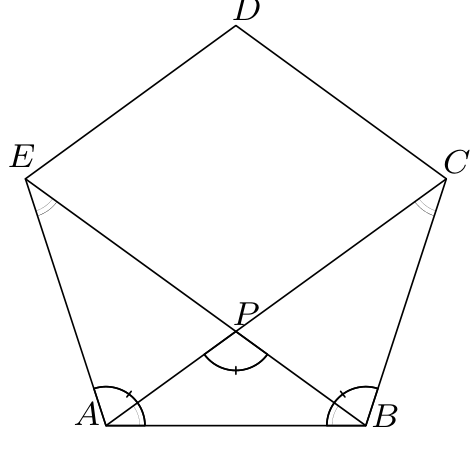
\begin{document}
\begin{tikzpicture}[scale=2.2]
  \coordinate (A) at (0,0);
  \coordinate (B) at (1,0);
  \coordinate (C) at (1.309,0.9511);
  \coordinate (D) at (0.5,1.5388);
  \coordinate (E) at (-0.309,0.9511);
  \coordinate (P) at (0.5,0.3633);
  \draw (A)--(B)--(C)--(D)--(E)--cycle;
  \draw (A)--(C);
  \draw (B)--(E);
  \foreach \pt in {A,B,C,D,E,P}{\fill (\pt) circle (0.7pt);}
  \node[below left] at (A) {$A$};
  \node[below right] at (B) {$B$};
  \node[right] at (C) {$C$};
  \node[above] at (D) {$D$};
  \node[left] at (E) {$E$};
  \node[below] at (P) {$P$};
\end{tikzpicture}
\end{document}
Sia ABCDE un pentagono regolare di lato 1 e sia P l’intersezione tra le diagonali AC e BE. Quanto misura il segmento PC?
- (A) 1
- (B) √ 5 2
- (C) √ 5 −1
- (D) 4( √ 5 −2)
- (E) Nessuna delle precedenti.
Topic: Geometria piana Metodo: Tecniche trigonometriche Abilita: Ragionamento geometrico Area: Geometria Risposta: A Fonte: apri PDF p.3
PC length with P diagonal intersection of the pentagon
\begin{document}
\begin{tikzpicture}[scale=2.2]
  \coordinate (A) at (0,0);
  \coordinate (B) at (1,0);
  \coordinate (C) at (1.309,0.9511);
  \coordinate (D) at (0.5,1.5388);
  \coordinate (E) at (-0.309,0.9511);
  \coordinate (P) at (0.5,0.3633);
  \draw (A)--(B)--(C)--(D)--(E)--cycle;
  \draw (A)--(C);
  \draw (B)--(E);
  \foreach \pt in {A,B,C,D,E,P}{\fill (\pt) circle (0.7pt);}
  \node[below left] at (A) {$A$};
  \node[below right] at (B) {$B$};
  \node[right] at (C) {$C$};
  \node[above] at (D) {$D$};
  \node[left] at (E) {$E$};
  \node[below] at (P) {$P$};
\end{tikzpicture}
\end{document}
Either ABCDE is a regular pentagon on side 1 and P is the intersection between the AC and BE diagonals. How big is the PC segment?
- (A) 1
- (B) √ 5 2
- (C) √ 5 −1
- (D) 4( √ 5 −2)
- (E) None of the above.
Answer: A src_archimede_2015_febb_2livello__Q03
Formica sul tastierino, quante affermazioni su n sono vere
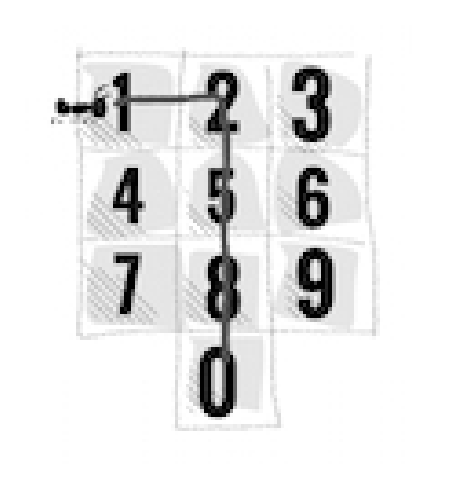
Una formica cammina sul tastierino numerico di un cellulare, composto da 10 pulsanti disposti come in figura. La formica si sposta sempre dal tasto su cui si trova ad un tasto adiacente in orizzontale o in verticale; parte dal tasto 1 e passeggia per un po’ sul tastierino, fermandosi infine sul tasto 0, che non aveva mai visitato prima. Consideriamo il numero n ottenuto concatenando le cifre dei tasti su cui è passata la formica, nell’ordine in cui li ha visitati (ad esempio, il percorso in figura corrisponderebbe al numero 12580). Dire quante delle quattro affermazioni seguenti sono certamente vere:
“n non è multiplo di 3”;
“n non è multiplo di 8”;
“n è composto da un numero dispari di cifre”;
“n non è un quadrato”.
(A) 0
(B) 1
(C) 2
(D) 3
(E) 4
Topic: Teoria dei Numeri, Logica, giochi, strategie Metodo: parita, congruenze Abilita: Casework accurato Area: Aritmetica e Teoria dei Numeri, Combinatoria, Logica e Probabilita Risposta: D Fonte: apri PDF p.3
Form on the keyboard, how many statements on n are true
An ant walks on a cell phone’s numeric keyboard, made up of 10 buttons arranged as shown in the figure. The ant always moves from the button on which it is at an adjacent button horizontally or vertically; it starts from the button 1 and walks for a while on the keyboard, finally stopping on the button 0, which it had never visited before. Consider the number n obtained by concatenating the numbers of the keys on which the ant passed, in the order in which it visited them (for example, the path in the figure would correspond to the number 12580). Say how many of the following four statements are certainly true: - n is not a multiple of 3; - n is not a multiple of 8; - n is composed of an odd number of digits; - n is not a square.
- (A) 0
- (B) 1
- (C) 2
- (D) 3
- (E) 4
Answer: D src_archimede_2015_febb_2livello__Q04
Polinomi monici con MCD e mcm dati, scelte di p(x)
Due polinomi monici (cioè con coefficiente di grado massimo uguale a 1) a coefficienti interi p(x) e q(x) sono tali che il loro massimo comun divisore sia (x −1)(x −2), il loro minimo comune multiplo sia (x −1)2(x −2)3(x −3)(x + 1) e il grado di p(x) sia minore o uguale al grado di q(x). In quanti modi può essere scelto p(x)?
- (A) 4
- (B) 5
- (C) 8
- (D) 10
- (E) 12
Topic: Algebra Metodo: Conteggio combinatorio Abilita: Conteggio sistematico Area: Algebra e Analisi Risposta: C Fonte: apri PDF p.3
*Monic polynomials with MCD and mcm data, p(x) *
Two monic polynomials (i.e. with a maximum degree coefficient equal to 1) with integer coefficients p(x) and q(x) are such that their maximum common divisor is (x −1)(x −2), their minimum common multiple is (x −1) 2(x −2) 3(x −3)(x + 1) and the degree of p(x) is less than or equal to the degree of q(x. In how many ways can p ((x) be chosen?
- (A) 4
- (B) 5
- (C) 8
- (D) 10
- (E) 12
Answer: C src_archimede_2015_febb_2livello__Q05
Rapporto aree triangolo dei simmetrici ed esagono
Dato un triangolo ABC, sia A′ il simmetrico di A rispetto a C, A′′ il simmetrico di A rispetto a B, B′ il simmetrico di B rispetto a A, B′′ il simmetrico di B rispetto a C, C′ il simmetrico di C rispetto a B e C′′ il simmetrico di C rispetto a A. Determinare il rapporto tra l’area di A′B′C′ e quella dell’esagono A′A′′C′C′′B′B′′.
- (A) 6 13
- (B) 7 13
- (C) 3 7
- (D) 1 2
- (E) Dipende dal triangolo iniziale.
Topic: Geometria piana Metodo: Metodo delle coordinate Abilita: Ragionamento geometrico Area: Geometria Risposta: B Fonte: apri PDF p.3
Report of triangle areas of symmetries and hexagons
Given a triangle ABC, be A′ the symmetric of A with respect to C, A′′ the symmetric of A with respect to B, B′ the symmetric of B with respect to A, B′′ the symmetric of B with respect to C, C′ the symmetric of C with respect to B and C′′ the symmetric of C with respect to A. Determine the ratio between the A′B′C′ and that of the A′A′′C′C′′B′B′′.
- (A) 6 13
- (B) 7 13
- (C) 3 7
- (D) 1 2
- (E) Depends on the starting triangle.
Answer: B src_archimede_2015_febb_2livello__Q06
Quaterne con a^2-c^2=b^2-d^2=ab+bc+cd+da=1024
Per quante quaterne (a, b, c, d) di numeri interi non negativi le tre espressioni a2 −c2, b2 −d2 e ab + bc + cd + da sono tutte uguali a 1024?
- (A) 0
- (B) 1
- (C) 4
- (D) 9
- (E) 11
Topic: Algebra, Teoria dei Numeri Metodo: Conteggio combinatorio, manipolazione algebrica Abilita: Manipolazione algebrica Area: Algebra e Analisi, Aritmetica e Teoria dei Numeri Risposta: B Fonte: apri PDF p.3
Quaternary with a^2^c^2=b^2^d^2=ab+bc+cd+da=1024
For how many quadrants (a, b, c, d) of nonnegative integers are the three expressions a2 −c2, b2 −d2 and ab + bc + cd + da all equal to 1024?
- (A) 0
- (B) 1
- (C) 4
- (D) 9
- (E) 11
Answer: B src_archimede_2015_febb_2livello__Q07
Area di ABC dato quadrato sull’ipotenusa e aree di ABE, ACD
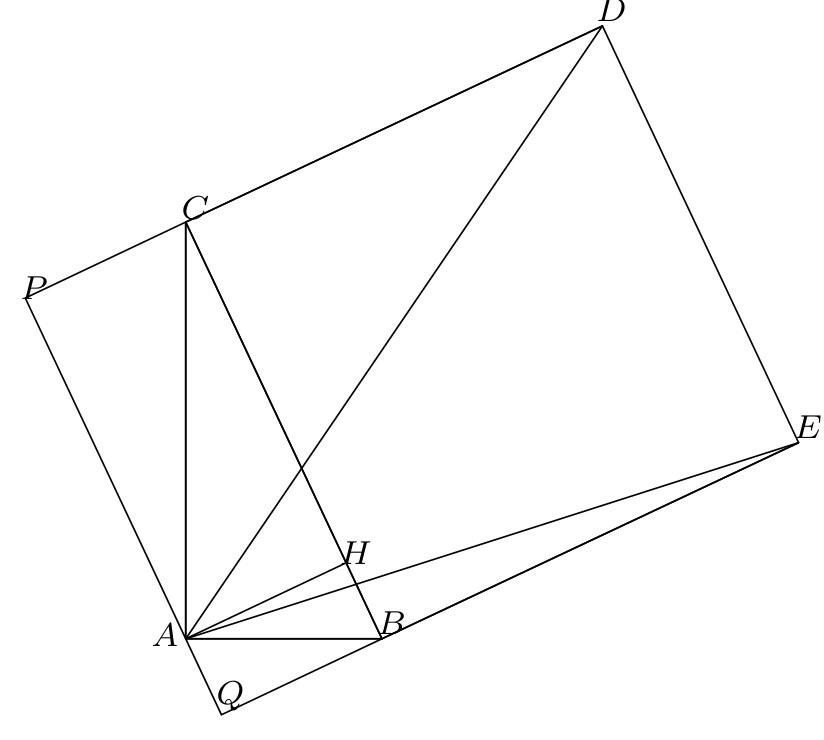
Dato il triangolo ABC rettangolo in A costruiamo sull’ipotenusa il quadrato BCDE (con D, E dalla parte opposta di A rispetto a BC). Sapendo che le aree dei triangoli ABE e ACD valgono rispettivamente 6 m2 e 27 m2, quanto vale l’area del triangolo ABC?
- (A) 3 √ 2 m2
- (B) 6 m2
- (C) 12 m2
- (D) 9 √ 2 m2
- (E) 18 m2
Topic: Geometria piana Metodo: Metodo delle coordinate Abilita: Ragionamento geometrico Area: Geometria Risposta: D Fonte: apri PDF p.3
Area of ABC given square on the hypotenuse and areas of ABE, ACD
Given the triangle ABC rectangle in A we build on the hypotenuse the square BCDE (with D, E on the opposite side of A versus BC). Knowing that the areas of the triangles ABE and ACD are worth 6 m2 and 27 m2 respectively, what is the area of the triangle ABC worth?
- (A) 3 √ 2 m2
- (B) 6 m2
- (C) 12 m2
- (D) 9 √ 2 m2
- (E) 18 m2
Answer: D src_archimede_2015_febb_2livello__Q08
Probabilita pedina in un angolo dopo 12 passi diagonali
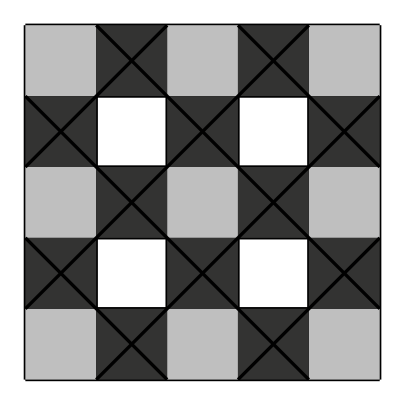
Una pedina si trova inizialmente sulla casella centrale di una scacchiera 5 × 5. Un passo della pedina consiste nello spostarsi in una casella scelta a caso fra quelle che hanno esattamente un vertice in comune con la casella su cui si trova. Qual è la probabilità che dopo 12 passi la pedina si trovi in uno qualunque degli angoli della scacchiera?
- (A) 1 3
- (B) 4 25
- (C) 1 6
- (D) 4 13
- (E) 1 4
Topic: Probabilita e statistica Metodo: monovarianti Abilita: Riconoscimento di pattern Area: Combinatoria, Logica e Probabilita Risposta: E Fonte: apri PDF p.4
Probability of footing at an angle after 12 diagonal steps
A pedal is initially located on the central box of a chessboard 5 × 5. One step of the pedina consists of moving in a randomly chosen box between those that have exactly one vertex in common with the box on which it is located. What is the probability that after 12 steps the pawn will be in any corner of the chessboard?
- (A) 1 3
- (B) 4 25
- (C) 1 6
- (D) 4 13
- (E) 1 4
Answer: E src_archimede_2015_febb_2livello__Q09
Gradini speciali verdi dopo i salti dei canguri
Caboyara, famoso circense australiano, si esibisce anche quest’anno in un gran trucco. Predispone una scala spettacolare con N = p1 · p2 · … · p2015 gradini, dove p1, p2, … , p2015 sono numeri primi distinti; i gradini che corrispondono a divisori di N (compresi il primo e l’N-esimo gradino) sono speciali e sono inizialmente illuminati di verde. Durante lo spettacolo, 2015 canguri ammaestrati salgono uno dopo l’altro la scala; per i = 1, 2, … , 2015, l’i-esimo canguro salta pi gradini alla volta, partendo ai piedi della scala (salta sul gradino pi, poi sul 2pi, e così via finch´e non raggiunge il gradino N). Ogni volta che un canguro salta su un gradino speciale, questo cambia colore: da verde diventa rosso, da rosso verde. Quanti saranno i gradini speciali illuminati di verde alla fine dell’esibizione?
- (A) 22015 −21008
- (B) 22014
- (C) 22014 −21007
- (D) 22013
- (E) 2015 · 21008
Topic: Teoria dei Numeri, Combinatoria Metodo: congruenze, Conteggio combinatorio Abilita: generalizzazione Area: Aritmetica e Teoria dei Numeri, Combinatoria, Logica e Probabilita Risposta: B Fonte: apri PDF p.4
Special green grass after the kangaroo jumps
Caboyara, a famous Australian circus performer, is performing again this year in a big make-up. It ‘s a spectacular scale with N = p1 · p2 · … · p2015 steps, where p1, p2, … , p2015 are distinct prime numbers; the steps corresponding to N divisors (including the first and lN-eighth step) are special and are initially illuminated in green. During the show, 2015 mastered kangaroos climb the ladder one after the other; for i = 1, 2, … , 2015, the eighth kangaroo jumps steps at a time, starting at the foot of the ladder (jumps step pi, then step 2pi, and so on until it reaches step N). Every time a kangaroo jumps on a special ladder, it changes color: green to red, green to red. How many special steps will be lit up in green at the end of the exhibition?
- (A) 22015 −21008
- (B) 22014
- (C) 22014 −21007
- (D) 22013
- (E) 2015 · 21008
Answer: B src_archimede_2015_febb_2livello__Q10
Modi di ripassare segmenti del 9-agono con un lato per triangolo
Giovanni disegna a matita un 9-agono regolare e collega ciascuno dei suoi vertici al centro, tracciando un totale di 18 segmenti e ottenendo in questo modo nove triangoli. Ripassa quindi a penna alcuni dei segmenti tracciati, facendo in modo che alla fine ognuno dei nove triangoli abbia esattamente un lato ripassato a penna. In quanti modi Giovanni può scegliere l’insieme dei segmenti da ripassare? (Nota: due insiemi di segmenti che si ottengano l’uno dall’altro per rotazione o per simmetria sono da considerarsi distinti.)
- (A) 49
- (B) 65
- (C) 74
- (D) 76
- (E) 85
Topic: Combinatoria Metodo: Conteggio combinatorio Abilita: Conteggio sistematico Area: Combinatoria, Logica e Probabilita Risposta: D Fonte: apri PDF p.4
Mode of passing segments of the 9-agon with one side per triangle
John draws a regular 9-axis pencil and connects each of its vertices to the center, drawing a total of 18 segments and thus obtaining nine triangles. It then pencils some of the traced segments, making sure that at the end each of the nine triangles has exactly one penciled side. In how many ways can John choose the whole of the segments to go through? (Note: two sets of segments obtained from each other by rotation or symmetry are to be considered separate.)
- (A) 49
- (B) 65
- (C) 74
- (D) 76
- (E) 85
Answer: D src_archimede_2015_febb_2livello__Q11
Lunghezza AC nel quadrilatero ciclico dati i lati e BD
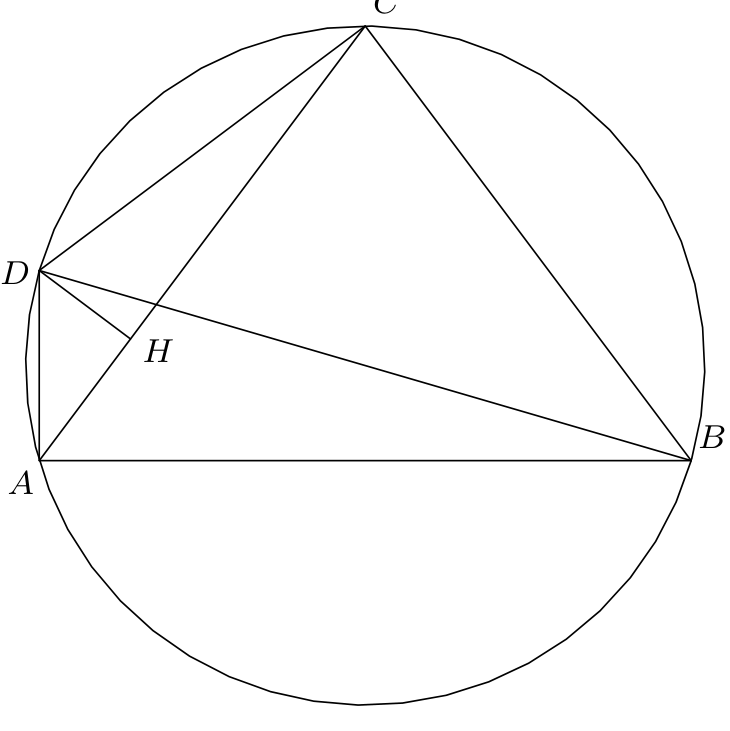
Sia ABCD un quadrilatero tale che AB = 24, BC = 20, CD = 15, DA = 7, BD = 25. Quanto è lungo AC?
- (A) 18
- (B) 14 √ 2
- (C) 20
- (D) 21
- (E) 24 Problemi a risposta numerica – 5 punti
Topic: Geometria piana Metodo: Metodo delle coordinate Abilita: Ragionamento geometrico Area: Geometria Risposta: C Fonte: apri PDF p.4
AC length in the cyclic quadrilateral given sides and BD
Whether ABCD is a quadrilateral such that AB = 24, BC = 20, CD = 15, DA = 7, BD = 25. How long is AC?
- (A) 18
- (B) 14 √ 2
- (C) 20
- (D) 21
- (E) 24 Problems with a numerical answer 5 points
Answer: C src_archimede_2015_febb_2livello__Q12
Radice quarta di una somma di potenze di 2
Quanto vale 4p 220 + 227 + 231 + 232 + 237 + 240 ?
Topic: Algebra, Teoria dei Numeri Metodo: manipolazione algebrica Abilita: Riconoscimento di pattern Area: Algebra e Analisi, Aritmetica e Teoria dei Numeri Risposta: 1056 Fonte: apri PDF p.4
Fourth root of a power sum of 2
How much is 4p 220 + 227 + 231 + 232 + 237 + 240 ?
Answer: 1056 src_archimede_2015_febb_2livello__Q13
Pulce su 2015-agono, primo salto su vertice gia visitato
Una pulce si trova inizialmente su un vertice di un poligono regolare di 2015 lati; compie una sequenza di salti in senso antiorario: al primo salto si sposta di un vertice (da quello iniziale al vicino), al secondo di tre, al terzo di cinque, e così via, di modo che all’n-esimo parte da un vertice e atterra 2n −1 vertici più in là, sempre in senso antiorario. Dopo quanti salti accadrà per la prima volta che la pulce atterri su un vertice che aveva già visitato?
Topic: Teoria dei Numeri Metodo: congruenze Abilita: Manipolazione algebrica Area: Aritmetica e Teoria dei Numeri Risposta: 48 Fonte: apri PDF p.4
Pulse on 2015 action, first jump to the summit already visited
A flea is initially located on a top of a regular 2015-sided polygon; it performs a sequence of anti-clockwise jumps: at the first jump it moves from a top (from the initial to the nearest), to the second of three, to the third of five, and so on, so that atn-eighth it starts from a top and lands 2n −1 vertices further up, always in anti-clockwise direction. After how many jumps will it be the first time the fleas land on a summit they’ve already visited?
Answer: 48 src_archimede_2015_febb_2livello__Q14
vittorie con mosse -3 o meta
ESERCIZIO DIMOSTRATIVO Camilla ha una scatola che contiene 2015 graffette. Ne prende un numero positivo n e le mette sul banco di Federica, sfidandola al seguente gioco. Federica ha a disposizione due tipi di mosse: può togliere 3 graffette dal mucchio che ha sul proprio banco (se il mucchio contiene almeno 3 graffette), oppure togliere metà delle graffette presenti (se il mucchio ne contiene un numero pari). Federica vince se, con una sequenza di mosse dei tipi sopra descritti, riesce a togliere tutte le graffette dal proprio banco. (a) Per quanti dei 2015 possibili valori di n Federica può vincere? (b) Le ragazze cambiano le regole del gioco e decidono di assegnare la vittoria a Federica nel caso riesca a lasciare sul banco una singola graffetta. Per quanti dei 2015 valori di n Federica può vincere con le nuove regole?
Topic: Teoria dei Numeri, Logica, giochi, strategie Metodo: Ragionamento all’indietro, monovarianti Abilita: generalizzazione Area: Aritmetica e Teoria dei Numeri, Combinatoria, Logica e Probabilita Fonte: apri PDF p.5
winnings with moves -3 or meta
Camilla has a box containing 2015 graffiti. He takes a positive number n and puts them on Federica’s bench, challenging her to the next game. Federica has two types of moves: she can remove 3 graffiti from the pile she has on her bench (if the pile contains at least 3 graffiti), or she can remove half of the graffiti present (if the pile contains an equal number). Federica wins if, with a sequence of moves of the types described above, she manages to remove all the graffiti from her desk. (a) For how many of the 2015 possible values of n can Federica win? (b) The girls change the rules of the game and decide to award the victory to Federica in case she manages to leave a single graffiti on the bench. For how many of the 2015 values can Federica win with the new rules?
src_archimede_2015_febb_2livello__Q15
ciclicita e similitudine
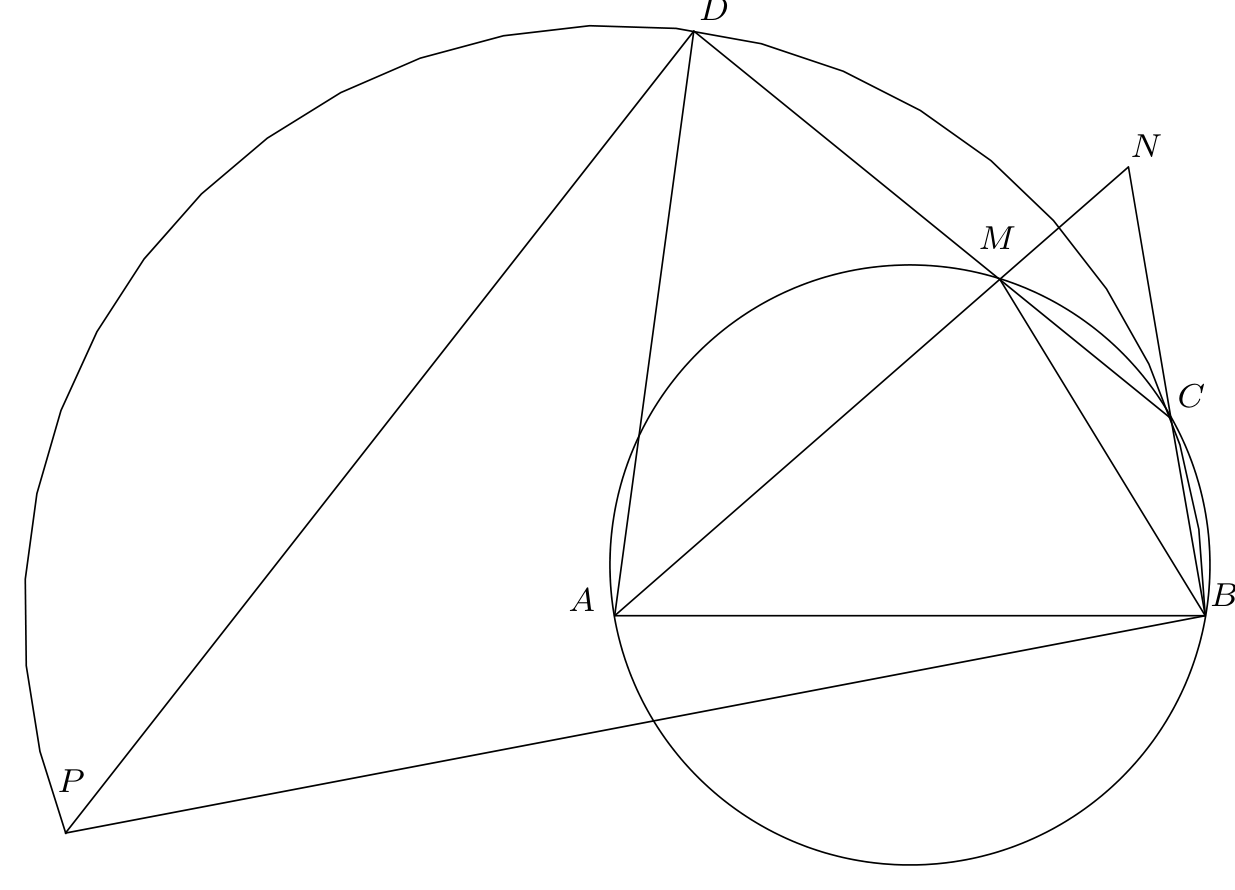
ESERCIZIO DIMOSTRATIVO Sia ABCD un quadrilatero convesso tale che AB = AC = AD e BC < CD. La bisettrice dell’angolo
BAD interseca internamente CD in M e il prolungamento di BC in N. Dimostrare che (a) il quadrilatero ABCM è inscrittibile in una circonferenza; (b) i triangoli ANB e ABM sono simili.
Topic: Geometria piana Metodo: Sfruttamento della simmetria Abilita: Ragionamento geometrico Area: Geometria Fonte: apri PDF p.6
cyclicity and similarities
Demonstrative Exercise Whether ABCD is a convex quadrilateral such that AB = AC = AD and BC < CD. The intersection of the angle \ BAD intersects internally the CD in M and the BC extension in N. Demonstrate that (a) the ABCM quadrilateral is inscribed in a circumference; (b) the ANB and ABM triangles are similar.
src_archimede_2015_febb_2livello__Q16
valori di k e di n
ESERCIZIO DIMOSTRATIVO Sia n un intero positivo e siano 1 = d1 < d2 < d3 < … < dk = n i suoi divisori positivi, ordinati per grandezza. Si sa che k ≥4 e che d2 3 + d2 4 = 2n + 1. (a) Trovare tutti i possibili valori di k. (b) Trovare tutti i possibili valori di n.
Topic: Teoria dei Numeri Metodo: congruenze, manipolazione algebrica Abilita: Casework accurato Area: Aritmetica e Teoria dei Numeri Fonte: apri PDF p.7
*value of k and n *
Demonstrative Exercise Whether n is a positive integer and whether 1 = d1 < d2 < d3 < … < dk = n of its positive divisors, ordered by size. We know that k ≥4 and that d2 3 + d2 4 = 2n + 1. (a) Find all possible values of k. (b) Find all possible values of n.