Minuti in campo per giocatore, 16 su 11
Una squadra di 16 persone partecipa ad un torneo sportivo. Il regolamento prevede che in campo siano presenti sempre 11 giocatori per squadra e che, nel corso di ogni partita (la cui durata è di 90 minuti) i 16 componenti di ogni squadra devono giocare tutti lo stesso numero di minuti. Per quanti minuti sarà in campo ciascun giocatore durante la partita? (A) meno di 57 (B) tra 57 e 60 (C) tra 60 e 63 (D) tra 63 e 66 (E) più di 66
Topic: Algebra Area: Algebra e Analisi Risposta: C Fonte: apri PDF p.1
Minutes on the pitch per player, 16 out of 11
A team of 16 people takes part in a sporting tournament. The rules stipulate that 11 players per team are always present on the pitch and that, during each match (during 90 minutes), all 16 members of each team must play the same number of minutes. How many minutes will each player be on the field during the game? (A) less than 57 (B) between 57 and 60 (C) between 60 and 63 (D) between 63 and 66 (E) more than 66
Answer: C src_archimede_2016_triennio__Q01
Dismutazioni di 4 portachiavi
Quattro amici si sono stancati dei loro portachiavi e decidono di ridistribuirseli, in modo tale che ciascuno di loro ne abbia uno differente da quello che aveva prima. In quanti modi diversi possono scambiarsi i portachiavi?
- (A) 9
- (B) 11
- (C) 7
- (D) 10
- (E) 8
Topic: Combinatoria Metodo: Conteggio combinatorio Abilita: Conteggio sistematico Area: Combinatoria, Logica e Probabilita Risposta: A Fonte: apri PDF p.1
Disambiguations of 4 keypads
Four friends have grown tired of their keys and decide to redistribute them, so that each of them has one different from the one he had before. How many different ways can keys be exchanged?
- (A) 9
- (B) 11
- (C) 7
- (D) 10
- (E) 8
Answer: A src_archimede_2016_triennio__Q02
Massimo MCD di due numeri con prodotto 600000
Il prodotto di due numeri naturali è 600000. Quale può essere, al massimo, il loro Massimo Comune Divisore?
- (A) 100
- (B) 3000
- (C) 1
- (D) 200
- (E) 600
Topic: Teoria dei Numeri Metodo: manipolazione algebrica Area: Aritmetica e Teoria dei Numeri Risposta: D Fonte: apri PDF p.1
Maximum two-digit MCD with product 600000
The product of two natural numbers is 600000. What can be their maximum common divider?
- (A) 100
- (B) 3000
- (C) 1
- (D) 200
- (E) 600
Answer: D src_archimede_2016_triennio__Q03
chi vince
Alberto, Barbara, Carlo e Daria partecipano a un gioco. All’inizio, con un sorteggio, ad ognuno viene assegnato un numero: ad Alberto 2101 + 2121 + 2180, a Barbara 2100 + 2202 + 2400, a Carlo 2101 + 2109, a Daria 2100 + 2108. Poi si svolgono vari turni: in ogni turno, ciascun giocatore dimezza il proprio numero (se esso è pari), oppure esce dal gioco (se è dispari). Vince chi esce per ultimo dal gioco (può darsi che più giocatori vincano ex aequo). Chi vincerà la sfida?
- (A) solo Alberto
- (B) Alberto e Carlo
- (C) solo Barbara
- (D) Carlo e Daria
- (E) Barbara e Daria
Topic: Teoria dei Numeri Metodo: congruenze Abilita: Riconoscimento di pattern Area: Aritmetica e Teoria dei Numeri Risposta: B Fonte: apri PDF p.1
The winner of the contest
Alberto, Barbara, Carlo and Daria are playing a game. At the beginning, with a lottery, each is assigned a number: to Alberto 2101 + 2121 + 2180, to Barbara 2100 + 2202 + 2400, to Carlo 2101 + 2109, to Daria 2100 + 2108. Then several rounds are played: in each round, each player halves their number (if it is even), or exits the game (if it is odd). The winner is the last person out of the game (most players may win ex aequo). Who will win the challenge?
- (A) It ‘s only Alberto .
- (B) Albert and Charles
- (C) Just Barbara .
- (D) Charles and Daria
- (E) Barbara and Daria
Answer: B src_archimede_2016_triennio__Q04
Tre coppie con maglie di colore diverso
Sei persone (due con una maglia rossa, due con una maglia azzurra, due con una maglia gialla), per giocare a briscola, vogliono suddividersi in tre squadre di due persone ciascuna. In quanti modi possono effettuare la suddivisione, facendo sì che i due di ciascuna squadra abbiano maglie di colori differenti?
- (A) 24
- (B) 8
- (C) 11
- (D) 4
- (E) 15
Topic: Combinatoria Metodo: Conteggio combinatorio Area: Combinatoria, Logica e Probabilita Risposta: B Fonte: apri PDF p.1
Three pairs of different coloured knitted or crocheted fabrics
Six people (two in a red shirt, two in a blue shirt, two in a yellow shirt), to play briscola, want to divide themselves into three teams of two people each. In how many ways can they divide, so that the two in each team have different colored jerseys?
- (A) 24
- (B) 8
- (C) 11
- (D) 4
- (E) 15
Answer: B src_archimede_2016_triennio__Q05
x-y tra gare con n e n^2 partecipanti
Ogni anno si svolge la gara a squadre delle Olimpiadi di Grammatica. Una regola impone che ciascuna squadra sia formata da tanti membri quante sono le squadre partecipanti quell’anno. Inoltre, si è notato che ogni anno il numero di squadre partecipanti aumenta esattamente di 1. Indicando con x il numero complessivo di persone partecipanti alla gara del 2016 e con y il numero di persone partecipanti alla gara del 2000, cosa si può affermare con sicurezza riguardo al valore di x −y?
- (A) che è divisibile per 32
- (B) che è un quadrato perfetto
- (C) che è un numero primo
- (D) che è divisible per 101
- (E) che è dispari
Topic: Algebra Metodo: manipolazione algebrica Abilita: generalizzazione Area: Algebra e Analisi Risposta: A Fonte: apri PDF p.1
x-y between races with n and n2 participants
Each year the team competition of the Grammar Olympics takes place. A rule requires each team to be made up of as many members as the participating teams that year. In addition, it has been noted that each year the number of participating teams increases exactly by 1. By indicating with x the total number of people participating in the 2016 race and with y the number of people participating in the 2000 race, what can be safely said about the value of x −y?
- (A) Which is divisible by 32.
- (B) That’s a perfect square.
- (C) That’s a prime number.
- (D) Which is divisible by 101
- (E) Which is odd.
Answer: A src_archimede_2016_triennio__Q06
punti da reti segnate/subite
Ad un torneo di calcio partecipano solo 4 squadre, chiamate A, B, C, D. Ad ogni giornata, ciascuna squadra gioca una partita e, nel corso del torneo, ciascuna squadra incontra ogni altra precisamente una volta. Dopo le prime due giornate, la squadra A ha subito 1 rete e ne ha segnate 3, la squadra B ha segnato 4 reti senza subirne, la squadra C ha segnato 1 rete senza subirne, la squadra D ha subito 7 reti senza segnarne. Tenendo conto che si guadagnano 3 punti per ogni vittoria, 1 punto per ogni pareggio e nessun punto in caso di sconfitta, indicare quanti punti hanno realizzato, rispettivamente, le squadre A, B, C, D (in questo ordine) nelle prime due giornate.
- (A) 4, 6, 1, 0
- (B) 4, 4, 2, 0
- (C) 4, 3, 2, 1
- (D) 1, 6, 4, 0
- (E) 3, 4, 4, 0
Topic: Combinatoria Metodo: Analisi per casi Abilita: Casework accurato Area: Combinatoria, Logica e Probabilita Risposta: E Fonte: apri PDF p.1
network points marked/submitted
A football tournament involves only 4 teams, called A, B, C, D. Each team plays a match each day, and during the tournament, each team meets each other precisely once. After the first two days, Team A suffered 1 net and scored 3, Team B scored 4 net without suffering, Team C scored 1 net without suffering, Team D suffered 7 net without scoring. Taking into account that 3 points are earned for each win, 1 point for each draw and no points in the event of defeat, indicate how many points, respectively, the teams A, B, C, D (in this order) have scored in the first two days.
- (A) 4, 6, 1, 0
- (B) 4, 4, 2, 0
- (C) 4, 3, 2, 1
- (D) 1, 6, 4, 0
- (E) 3, 4, 4, 0
Answer: E src_archimede_2016_triennio__Q07
Area regione formata da 4 archi raggio 1
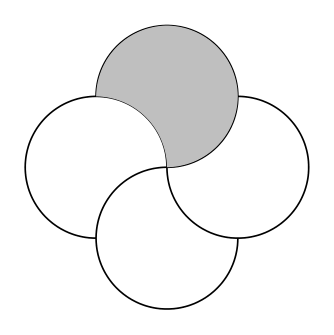
La figura qui a lato è formata da 4 archi tra loro congruenti di circonferenze aventi raggio 1. Qual è l’area della regione ombreggiata?
- (A) 3 −π/4
- (B) 1 + π/2
- (C) π −1/2
- (D) 2 + π/4
- (E) 4 −π/2
Topic: Geometria piana Abilita: Ragionamento geometrico Area: Geometria Risposta: B Fonte: apri PDF p.2
Area region consisting of 4 arcs radius 1
The figure on this side is made up of 4 arcs with congruent circumferences of radius 1. What is the area of the shaded region?
- (A) 3 −π/4
- (B) 1 + π/2
- (C) π −1/2
- (D) 2 + π/4
- (E) 4 −π/2
Answer: B src_archimede_2016_triennio__Q09
Giorni liberi comuni di Romeo e Giulietta
Romeo è libero dal lavoro tutte le domeniche (e nessun altro giorno). Giulietta lavora su una nave da crociera: rimane in mare per 10 giorni, poi ha due giorni liberi prima di imbarcarsi di nuovo per altri 10 giorni, e così via. Oggi, mercoledì 23 novembre 2016, Giulietta è a terra e s’imbarcherà domani. Quante giornate potranno trascorrere insieme Romeo e Giulietta fino al 23 novembre 2017?
- (A) 9
- (B) 8
- (C) 10
- (D) 7
- (E) 5
Topic: Teoria dei Numeri Metodo: congruenze Abilita: Casework accurato Area: Aritmetica e Teoria dei Numeri Risposta: A Fonte: apri PDF p.2
Common days off of Romeo and Juliet
Romeo is off work every Sunday (and no other day). Giulietta works on a cruise ship: she stays at sea for 10 days, then has two days off before boarding again for another 10 days, and so on. Today, Wednesday, November 23, 2016, Giulietta is ashore and will disembark tomorrow. How many days will Romeo and Juliet be able to spend together until November 23, 2017?
- (A) 9
- (B) 8
- (C) 10
- (D) 7
- (E) 5
Answer: A src_archimede_2016_triennio__Q10
Piu grande fattore primo di 3^12-1
Qual è il più grande fattore primo di 312 −1?
- (A) 73
- (B) 36 + 1
- (C) 107
- (D) 13
- (E) 949
Topic: Teoria dei Numeri Metodo: manipolazione algebrica Area: Aritmetica e Teoria dei Numeri Risposta: A Fonte: apri PDF p.2
Most large prime factor of 3^12-1
What’s the largest prime factor of 312 minus 1?
- (A) 73
- (B) 36 + 1
- (C) 107
- (D) 13
- (E) 949
Answer: A src_archimede_2016_triennio__Q11
Probabilita somma dadi rossi uguale dado azzurro
Si lanciano due dadi da gioco di colore rosso e un dado azzurro. Qual è la probabilità che la somma dei punteggi dei dadi rossi sia uguale al punteggio del dado azzurro?
- (A) 1/12
- (B) 2/27
- (C) 1/15
- (D) 1/18
- (E) 5/72
Topic: Probabilita e statistica Metodo: Conteggio combinatorio Area: Combinatoria, Logica e Probabilita Risposta: E Fonte: apri PDF p.2
Probability sum of red dice equal to blue dice
Two red dice and one blue dice are thrown. What is the probability that the sum of the red dice scores is equal to the blue dice score?
- (A) 1/12
- (B) 2/27
- (C) 1/15
- (D) 1/18
- (E) 5/72
Answer: E src_archimede_2016_triennio__Q12
Confronto di radici n/(n-1) minimo
Quale tra questi numeri è il più piccolo?
- (A) √ 2018 2017
- (B) √ 2016 2015
- (C) √ 2019 2018
- (D) √ 2017 2016
- (E) √ 2020 2019
Topic: Disuguaglianze Metodo: Disuguaglianze classiche Abilita: Manipolazione algebrica Area: Algebra e Analisi Risposta: E Fonte: apri PDF p.2
*Minimum root comparison n/(n-1) *
Which of these numbers is the smallest?
- (A) √ 2018 2017
- (B) √ 2016 2015
- (C) √ 2019 2018
- (D) √ 2017 2016
- (E) √ 2020 2019
Answer: E src_archimede_2016_triennio__Q13
Ampiezza angolo APC con angolo esterno
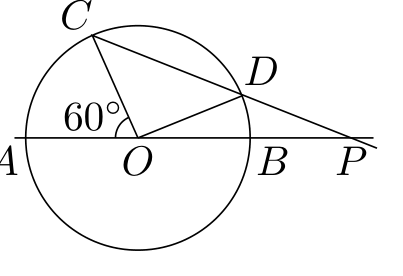
Data un circonferenza γ avente centro O e diametro AB lungo 12 cm, sia C un punto di γ tale che A“ OC = 60°, e sia P un punto sul prolungamento del diametro AB, dalla parte di B, tale che OD = DP (dove D è il punto d’intersezione tra PC e γ compreso tra C e P). Qual è l’ampiezza dell’angolo A“ PC?
- (A) 15°
- (B) 45° 2
- (C) 20°
- (D) 18°
- (E) 24° O A B 60° C D P
Topic: Geometria piana Metodo: Tecniche trigonometriche Abilita: Ragionamento geometrico Area: Geometria Risposta: C Fonte: apri PDF p.2
Agreement of the APC angle with the outer angle
Given a circumference γ with a centre O and a diameter AB of 12 cm, either C is a point of γ such that A OC = 60°, and either P is a point on the extension of the diameter AB, on the part of B, such that OD = DP (where D is the point of dintersection between PC and γ between C and P). What is the width of the angle A PC?
- (A) 15°
- (B) 45° 2
- (C) 20°
- (D) 18°
- (E) 24° O A B 60° C D P
Answer: C src_archimede_2016_triennio__Q14
Anni multipli di 12 ma non di 60
Osservando il calendario, Chiara si è accorta che l’anno corrente 2016 ha una particolarità: posto x = 2016 il numero dell’anno, allora x + 1 è multiplo di 1, x + 2 è multiplo di 2, x + 3 è multiplo di 3 e x + 4 è multiplo di 4, ma x + 5 non è multiplo di 5. Quanti altri numeri interi positivi, minori di 2016, hanno la stessa particolarità?
- (A) 141
- (B) 83
- (C) 167
- (D) 134
- (E) 149
Topic: Teoria dei Numeri Metodo: congruenze Area: Aritmetica e Teoria dei Numeri Risposta: D Fonte: apri PDF p.2
*Multiple years of 12 but not of 60 *
Observing the calendar, Chiara realized that the current year 2016 has a peculiarity: place x = 2016 the number of the year, then x + 1 is multiple of 1, x + 2 is multiple of 2, x + 3 is multiple of 3 and x + 4 is multiple of 4, but x + 5 is not multiple of 5. How many other positive integers, smaller than 2016, have the same peculiarity?
- (A) 141
- (B) 83
- (C) 167
- (D) 134
- (E) 149
Answer: D src_archimede_2016_triennio__Q15
Raggio circonferenza da bisettrice e arco medio
Dato un triangolo EFG, sia C la circonferenza ad esso circoscritta. Indichiamo con X il punto d’intersezione (diverso da F) della bisettrice dell’angolo E“ FG con la circonferenza C e con Y il punto medio dell’arco ˜ EG contenente F. Sapendo che FX = 12 e FY = 5, quanto misura il raggio della circonferenza C?
- (A) 9
- (B) 13/2
- (C) 7
- (D) 8
- (E) 11/2
Topic: Geometria piana Metodo: Tecniche trigonometriche Abilita: Ragionamento geometrico Area: Geometria Risposta: B Fonte: apri PDF p.2
Blink of the circumference of the beam and medium arc
Given an EFG triangle, both C and the circumference to it circumscribed. We indicate with X the point of intersection (other than F) of the intersection of the angle E FG with the circumference C and with Y the middle point of the arc EG containing F. Knowing that FX is 12 and FY is 5, how much does the radius of the circumference C measure?
- (A) 9
- (B) 13/2
- (C) 7
- (D) 8
- (E) 11/2
Answer: B src_archimede_2016_triennio__Q16
Parte di perimetro piu vicina ad A che a C
Le misure dei lati di un triangolo ABC sono: AC = BC = 10 cm, AB = 12 cm. Quanti cm misura la parte di perimetro di ABC formata dai punti per i quali la distanza da A è minore della distanza da C?
- (A) 27/2
- (B) 16
- (C) 12
- (D) 25/2
- (E) 40/3
Topic: Geometria piana Metodo: Metodo delle coordinate Abilita: Ragionamento geometrico Area: Geometria Risposta: E Fonte: apri PDF p.2
Part of the perimeter closer to A than to C
The sides of an ABC triangle are: AC = BC = 10 cm, AB = 12 cm. How many centimetres does the perimeter part of ABC consist of points for which the distance from A is less than the distance from C?
- (A) 27/2
- (B) 16
- (C) 12
- (D) 25/2
- (E) 40/3
Answer: E src_archimede_2016_triennio__Q17
Area quadrilatero ABCD doppio di BEDF
Del quadrilatero convesso ABCD si conoscono le misure dei lati AB, BC, CD e DA, che sono, nell’ordine, 4, 9, 6 e 11 cm. Indicati con E e F i punti medi dei lati AB e CD, si sa inoltre che l’area del quadrilatero BEDF è di 18 cm2. Di quanti cm2 è l’area del quadrilatero ABCD?
- (A) 27
- (B) 36
- (C) 24
- (D) più di 50
- (E) un valore tra 40 e 50
Topic: Geometria piana Metodo: Sfruttamento della simmetria Abilita: Ragionamento geometrico Area: Geometria Risposta: B Fonte: apri PDF p.2
A quadrilateral area ABCD double of BEDF
For the convex quadrilateral ABCD, the dimensions of the sides AB, BC, CD and DA are known, which are in the order of 4, 9, 6 and 11 cm. If the median points of the sides AB and CD are indicated by E and F, it is also known that the area of the BEDF quadrilateral is 18 cm2. How many cm2 is the area of the quadrilateral ABCD?
- (A) 27
- (B) 36
- (C) 24
- (D) more than 50
- (E) a value between 40 and 50
Answer: B src_archimede_2016_triennio__Q19
trovare n
Dati dei numeri interi n e k, con 1 ≤k ≤n, definiamo un polinomio, di grado n −1, nel modo seguente: p(x) = (x + 1)(x + 2)…(x + n) (x + k) . Ad esempio, se fosse n = 5 e k = 2, si avrebbe p(x) = (x + 1)(x + 3)(x + 4)(x + 5). Supponiamo che, per una certa scelta di n e k, il coefficiente di xn−2 nel polinomio p(x) sia uguale a 67. Qual è, in tal caso, il valore di n?
- (A) 68
- (B) 10
- (C) 12
- (D) 11
- (E) 69 T2 Unione Matematica Italiana PROGETTO OLIMPIADI DI MATEMATICA Ministero dell’Istruzione, dell’Università e della Ricerca Scuola Normale Superiore I Giochi di Archimede - Gara Triennio 23 novembre 2016 • La prova è costituita da 20 problemi. Ogni domanda è seguita da cinque risposte indicate con le lettere (A) , (B) , (C) , (D) , (E) : una sola di queste risposte è corretta, le altre 4 sono errate. • Ogni risposta corretta vale 5 punti, ogni risposta sbagliata vale 0 punti, ogni problema lasciato senza risposta vale 1 punto. • Per ciascuno dei problemi, devi trascrivere la lettera corrispondente alla risposta che ritieni corretta nella griglia riportata qui sotto. Non sono ammesse cancellature o correzioni sulla griglia. Non è consentito l’uso di alcun tipo di calcolatrice o di strumenti di comunicazione. Il tempo che hai a disposizione per svolgere la prova è di 110 minuti. Buon lavoro e buon divertimento! NOME COGNOME classe: 1 2 3 4 5 6 7 8 9 10 11 12 13 14 15 16 17 18 19 20
Topic: Algebra Metodo: manipolazione algebrica Abilita: Manipolazione algebrica Area: Algebra e Analisi Risposta: C Fonte: apri PDF p.2
find n
Given the integers n and k, with 1 ≤k ≤n, we define a polynomial, of degree n −1, as follows: p(x) = (x + 1)(x + 2)…(x + n) (x + k) . For example, if it was n = 5 and k = 2, we would have p(x) = (x + 1)(x + 3)(x + 4)(x + 5). Suppose that, for a certain choice of n and k, the coefficient of xn−2 in the polynomial p(x) is equal to 67. What is the value of n in that case?
- (A) 68
- (B) 10
- (C) 12
- (D) 11
- (E) 69 T2 Italian Mathematical Union PROJECT OLIMPIADES OF MATHEMATICS Ministry of Education, University and Research Higher Normal School The Archimedean Games - Triennio competition 23 November 2016 • The test consists of 20 problems. Each question shall be followed by five replies indicated by the letters (A), (B), (C), (D) and (E): one of these answers is correct and the other four are incorrect. • Every correct answer is worth 5 points, every wrong answer is worth 0 points, every problem left unanswered is worth 1 point. • For each problem, you must transcribe the letter corresponding to the answer you think is correct in the grid below. Cancellations or corrections on the grid are not permitted. The use of any kind of calculator or communication tool shall not be permitted. You have 110 minutes to run the test. Good work and good fun! Name of the class: 1 2 3 4 5 6 7 8 9 10 11 12 13 14 15 16 17 18 19 20
Answer: C src_archimede_2016_triennio__Q20