Cifra delle centinaia di 5^2017
Qual è la cifra delle centinaia di 52017?
- (A) 5
- (B) 2
- (C) 1
- (D) 3
- (E) 6
Topic: Teoria dei Numeri Metodo: congruenze Abilita: Riconoscimento di pattern Area: Aritmetica e Teoria dei Numeri Risposta: C Fonte: apri PDF p.1
Center of the hundreds of 5^2017
What’s the figure for the hundreds of 52017?
- (A) 5
- (B) 2
- (C) 1
- (D) 3
- (E) 6
Answer: C src_archimede_2017_biennio__Q01
numero furfanti
Attorno a un tavolo sono sedute 4 persone, ciascuna delle quali può essere o un cavaliere (che dice sempre la verità) o un furfante (che mente sempre). Ognuno dei presenti afferma: “Delle altre tre persone sedute a questo tavolo insieme a me, i furfanti sono esattamente due”. Qual è il numero complessivo di furfanti che sono seduti al tavolo?
- (A) nessuno
- (B) sicuramente 2
- (C) sicuramente tutti e 4
- (D) sicuramente 1
- (E) gli elementi forniti non sono sufficienti per stabilirlo
Topic: Logica, giochi, strategie Metodo: Analisi per casi Abilita: Casework accurato Area: Combinatoria, Logica e Probabilita Risposta: E Fonte: apri PDF p.1
number of thieves
Around a table are seated 4 people, each of whom can be either a knight (who always tells the truth) or a cunning man (who always lies). Each of the people in the room says, “Of the other three people sitting at this table with me, there are exactly two crooks”. What’s the total number of crooks sitting at the table?
- (A) No one
- (B) I ‘m sure it ‘s two .
- (C) I’m sure all four of them.
- (D) Certainly 1
- (E) the information provided is insufficient to establish it;
Answer: E src_archimede_2017_biennio__Q02
Coppie (m,n) con m^n = 2^12
Quante sono le coppie di numeri interi positivi (m, n) tali che mn = 212?
- (A) 2
- (B) 1
- (C) 3
- (D) 6
- (E) 4
Topic: Teoria dei Numeri Metodo: Conteggio combinatorio Area: Aritmetica e Teoria dei Numeri Risposta: D Fonte: apri PDF p.1
Pairs (m,n) with m^n = 2^12
How many pairs of positive integers (m, n) are such that mn = 212?
- (A) 2
- (B) 1
- (C) 3
- (D) 6
- (E) 4
Answer: D src_archimede_2017_biennio__Q03
stanze vuote
Ci sono 2017 stanze disposte in fila. La prima contiene 2017 persone e tutte le altre sono inizialmente vuote. Ogni minuto, se una stanza contiene più di una persona, una persona a caso che si trova in quella stanza si sposta nella stanza successiva. Dopo 1001 minuti, quante sono le stanze vuote?
- (A) 1017
- (B) 1515
- (C) 1016
- (D) 1517
- (E) 1015
Topic: Combinatoria Metodo: monovarianti Abilita: Riconoscimento di pattern Area: Combinatoria, Logica e Probabilita Risposta: B Fonte: apri PDF p.1
The following table shows the results of the calculation:
There are 2017 rooms lined up. The first contains 2017 people and all the others are initially empty. Every minute, if a room contains more than one person, a random person in that room moves into the next room. After 1001 minutes, how many empty rooms are there?
- (A) 1017
- (B) 1515
- (C) 1016
- (D) 1517
- (E) 1015
Answer: B src_archimede_2017_biennio__Q04
Proprieta di n multiplo di 1000 non 10000
Sia n un numero intero che è multiplo di 1000 ma non di 10000. Quale di queste affermazioni è sicuramente vera?
- (A) n/3 è un numero la cui parte intera termina con le cifre 333 o 666.
- (B) n/8 è un numero intero che termina con le cifre 25 o 75.
- (C) n/125 è un numero intero che termina con le cifre 8 o 6.
- (D) n è divisibile per 16.
- (E) Nessuna delle precedenti.
Topic: Teoria dei Numeri Metodo: congruenze Area: Aritmetica e Teoria dei Numeri Risposta: E Fonte: apri PDF p.1
Properties of n multiple of 1000 not 10000
Whether it’s an integer that’s a multiple of 1,000 but not 10,000. Which of these statements is certainly true?
- (A) n/3 is a number whose whole part ends in the digits 333 or 666.
- (B) n/8 is an integer ending in 25 or 75.
- (C) n/125 is an integer ending in 8 or 6.
- (D) n is divisible by 16.
- (E) None of the above.
Answer: E src_archimede_2017_biennio__Q05
ultimo rimasto
Marco scrive in una riga i numeri interi da 1 a 64 (inclusi). Poi inizia a cancellarne alcuni, in questo modo: cancella il numero 1, lascia il 2, cancella il 3, lascia il 4, etc. Arrivato in fondo alla riga, la ripercorre al contrario, cancellando il primo numero che trova tra quelli rimasti, lasciando poi il secondo, etc. Continua quindi a ripercorrere la riga alternativamente nei due sensi, cancellando ogni volta un numero sì e un numero no, fino a quando sulla lavagna resta un solo numero. Qual è quest’ultimo numero rimasto?
- (A) 22
- (B) 14
- (C) 6
- (D) 54
- (E) 38
Topic: successioni Metodo: Ricorsione Abilita: generalizzazione Area: Algebra e Analisi Risposta: A Fonte: apri PDF p.1 Anche in triennio: apri PDF p.1
last remaining
Mark writes in a row the integers from 1 to 64 (included). Then you start deleting some of them, like this: delete the number 1, leave the 2, delete the 3, leave the 4, etc. At the bottom of the line, it goes backwards, deleting the first number it finds among the remaining ones, leaving the second, etc. He then continues to cross the line alternately in both directions, deleting each time a yes number and a no number, until only one number remains on the board. What’s the last number left?
- (A) 22
- (B) 14
- (C) 6
- (D) 54
- (E) 38
Answer: A src_archimede_2017_biennio__Q06
Area regione con sei semicirconferenze raggio 1
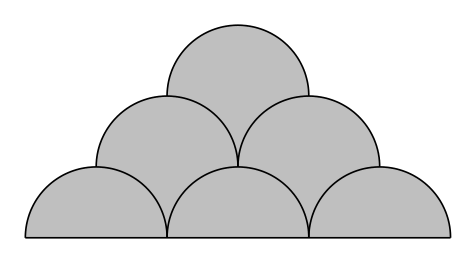
Le sei semicirconferenze presenti nella figura a lato hanno tutte raggio 1 cm. Quanti cm2 misura l’area della regione ombreggiata?
- (A) 8 + 3π/4
- (B) 9 + π/2
- (C) 9 + π/3
- (D) 6 + 3π/2
- (E) 10 + π/6
Topic: Geometria piana Abilita: Ragionamento geometrico Area: Geometria Risposta: D Fonte: apri PDF p.1
Regional area with six semicirculars radius 1
The six semicirculars in the figure on the side have a radius of 1 cm. How many cm2 is the area of the shaded region?
- (A) 8 + 3π/4
- (B) 9 + π/2
- (C) 9 + π/3
- (D) 6 + 3π/2
- (E) 10 + π/6
Answer: D src_archimede_2017_biennio__Q07
Coppie (a,b) con MCD 2 e mcm 60
Quante sono le coppie di interi positivi (a, b), con a < b, tali che MCD(a, b) = 2 e mcm(a, b) = 60?
- (A) 0
- (B) 4
- (C) 3
- (D) 2
- (E) 6
Topic: Teoria dei Numeri Metodo: Conteggio combinatorio Area: Aritmetica e Teoria dei Numeri Risposta: B Fonte: apri PDF p.1 Anche in triennio: apri PDF p.1
Pairs (a,b) with MCD 2 and mcm 60
How many pairs of positive integers (a, b), with a < b, such that MCD(a, b) = 2 and mcm(a, b) = 60?
- (A) 0
- (B) 4
- (C) 3
- (D) 2
- (E) 6
Answer: B src_archimede_2017_biennio__Q08
Triangolo con angoli BAD=ACD e CAD=ABD
Sia ABC un triangolo e sia D un punto sul lato BC. Supponiamo che si abbia
BAD =
ACD e
CAD =
ABD. Quale tra le seguenti affermazioni è certamente vera?
- (A) ABC è un triangolo equilatero
- (B) ABC è un triangolo ottusangolo
- (C) ABC è un triangolo isoscele
- (D) ABC è un triangolo scaleno
- (E) ABC è un triangolo rettangolo
Topic: Geometria piana Metodo: Tecniche trigonometriche Abilita: Ragionamento geometrico Area: Geometria Risposta: E Fonte: apri PDF p.1
Triangle with angles BAD=ACD and CAD=ABD
So ABC is a triangle and D is a point on the BC side. Let’s say you have \ BAD = \ ACD and \ CAD = \ ABD. Which of the following is certainly true?
- (A) ABC is an equilateral triangle
- (B) ABC is an octagonal triangle.
- (C) ABC is an isosceles triangle.
- (D) ABC is a right triangle.
- (E) ABC is a right triangle.
Answer: E src_archimede_2017_biennio__Q09
Primi che restano primi cancellando cifre
Quanti sono i numeri primi tali che, se si cancella da essi un qualsiasi gruppo di cifre anche non consecutive (senza però cancellarle tutte) e si leggono le cifre rimanenti nell’ordine in cui si trovano, si ottiene ancora un numero primo? (Si ricorda che 1 non è un numero primo.)
- (A) 7
- (B) 3
- (C) 5
- (D) 8
- (E) 10
Topic: Teoria dei Numeri Metodo: Analisi per casi Abilita: Casework accurato Area: Aritmetica e Teoria dei Numeri Risposta: D Fonte: apri PDF p.2
First remaining first by deleting digits
How many prime numbers are such that, if you delete any group of even non-consecutive digits from them (without deleting them all) and read the remaining digits in the order in which they are found, you still get a prime number? (Remember that 1 is not a prime number.)
- (A) 7
- (B) 3
- (C) 5
- (D) 8
- (E) 10
Answer: D src_archimede_2017_biennio__Q10
Area triangolo AEH con punti di trisezione/quadrisezione
L’area del triangolo ABC è pari a 60 m2. Siano D, E i punti interni al lato AB tali che AD = DE = EB e siano F, G, H i punti interni ad AC tali che AF = FG = GH = HC. Qual è l’area del triangolo AEH?
- (A) 20 m2
- (B) 45 m2
- (C) 30 m2
- (D) 40 m2
- (E) 24 m2
Topic: Geometria piana Abilita: Ragionamento geometrico Area: Geometria Risposta: C Fonte: apri PDF p.2 Anche in triennio: apri PDF p.2
Area of AEH triangle with trisection/quadrisection points
The area of the triangle ABC is 60 m2. The internal points on the AB side are D, E such that AD = DE = EB and are F, G, H the internal points in AC such that AF = FG = GH = HC. What is the area of the AEH triangle?
- (A) 20 m2
- (B) 45 m2
- (C) 30 m2
- (D) 40 m2
- (E) 24 m2
Answer: C src_archimede_2017_biennio__Q11
Probabilita che Chiara vinca dopo 6 a 4-2
Andrea e Chiara si sfidano lanciando più volte un dado. Ogni volta che esce un numero dispari fa un punto Andrea, quando esce un numero pari fa un punto Chiara. Vince la partita chi arriva per primo a 5 punti. Dopo 6 lanci, Andrea è in vantaggio per 4 a 2. Qual è la probabilità che sia Chiara a vincere la partita?
- (A) 1/8
- (B) 1/3
- (C) 1/6
- (D) 1/4
- (E) 1/5
Topic: Probabilita e statistica Metodo: Conteggio combinatorio Area: Combinatoria, Logica e Probabilita Risposta: A Fonte: apri PDF p.2
Probability of Chiara winning after 6 to 4-2
Andrea and Chiara challenge each other by throwing a dice several times. Every time an odd number comes out, Andrea makes a point, and every time an even number comes out, she makes a clear point. The first player to score five points wins the game. After six pitches, Andrea has a 4-2 lead. What are the odds of Clara winning the game?
- (A) 1/8
- (B) 1/3
- (C) 1/6
- (D) 1/4
- (E) 1/5
Answer: A src_archimede_2017_biennio__Q12
Sostituzione di bibita per ottenere 50% succo
Una bottiglia da un litro di bibita all’arancia è costituita per l’80% da acqua e per il 20% da succo d’arancia. Gianni vuole sostituire un po’ della bibita contenuta in questa bottiglia con del succo d’arancia, in modo da ottenere una nuova bibita che sia costituita per il 50% da succo d’arancia. Quanti ml della bibita iniziale Gianni deve sostituire con del succo d’arancia?
- (A) 300
- (B) 400
- (C) 375
- (D) 320
- (E) 350
Topic: Algebra Abilita: Manipolazione algebrica Area: Algebra e Analisi Risposta: C Fonte: apri PDF p.2
Replacement of beverage to obtain 50% juice
A bottle of 1 litre of orange drink is 80% water and 20% orange juice. Gianni wants to replace some of the beverage in this bottle with orange juice, so as to get a new beverage that is 50% orange juice. How many ml of Gianni’s initial drink should he replace with orange juice?
- (A) 300
- (B) 400
- (C) 375
- (D) 320
- (E) 350
Answer: C src_archimede_2017_biennio__Q13
Area trapezio isoscele inscritto in circonferenza
Il trapezio isoscele ABCD, di basi AB e CD, è inscritto in una circonferenza di raggio 13 m. Si sa che il centro della circonferenza è interno al trapezio ABCD ed inoltre AB = 24 m, CD = 10 m. Qual è l’area di ABCD?
- (A) 272 m2
- (B) 289 m2
- (C) 170 m2
- (D) 306 m2
- (E) 340 m2
Topic: Geometria piana Metodo: Metodo delle coordinate Abilita: Ragionamento geometrico Area: Geometria Risposta: B Fonte: apri PDF p.2
Isosceles trapezoidal area inscribed in the circumference
The ABCD isosceles trapezoid, of bases AB and CD, is inscribed within a radius of 13 m. It is known that the center of circumference is inside the ABCD trapezoid and furthermore AB = 24 m, CD = 10 m. What is the area of ABCD?
- (A) 272 m2
- (B) 289 m2
- (C) 170 m2
- (D) 306 m2
- (E) 340 m2
Answer: B src_archimede_2017_biennio__Q14
Cifra in posizione 2017 della sequenza degli interi
Caterina inizia a scrivere tutti i numeri interi positivi, uno di seguito all’altro: 12345678910111213… Quale cifra occuperà la 2017a posizione?
- (A) 8
- (B) 5
- (C) 1
- (D) 7
- (E) 2
Topic: Combinatoria Metodo: Conteggio per casi Abilita: Conteggio sistematico Area: Combinatoria, Logica e Probabilita Risposta: D Fonte: apri PDF p.2
Number at position 2017 of the sequence of integers
Catherine begins to write all positive integers, one after the other: 12345678910111213… What figure will occupy the 2017th position?
- (A) 8
- (B) 5
- (C) 1
- (D) 7
- (E) 2
Answer: D src_archimede_2017_biennio__Q15
Zeri finali del prodotto nello schema triangolare
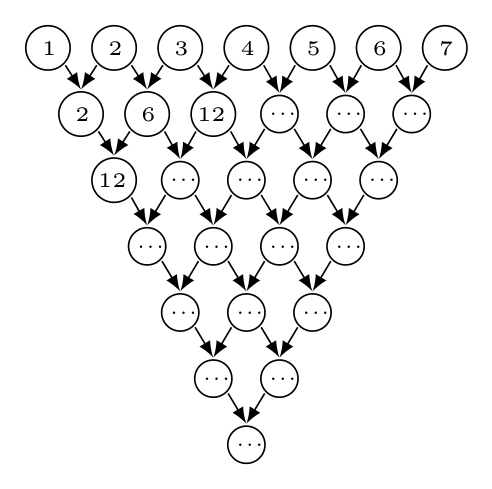
Dopo aver disegnato uno schema triangolare come quello qui a fianco, Alberto scrive nei cerchi della riga più in alto i numeri interi da 1 a 7. Poi, dentro ciascuno degli altri cerchi, scrive il prodotto dei numeri contenuti nei due cerchi sopra di esso che sono ad esso collegati con una freccia (dunque ottiene 2, 6, 12, … e così via). Con quanti zeri terminerà il numero che dovrà scrivere nel cerchio più in basso?
- (A) 15
- (B) 12
- (C) 16
- (D) 13
- (E) 14 1 2 3 4 5 6 7 2 6 12 … … … 12 … … … … … … … … … … … … … … T2 Unione Matematica Italiana PROGETTO OLIMPIADI DI MATEMATICA Ministero dell’Istruzione, dell’Università e della Ricerca I Giochi di Archimede - Gara Biennio 23 novembre 2017 • La prova è costituita da 16 problemi. Ogni domanda è seguita da 5 risposte indicate con le lettere (A), (B), (C), (D), (E). Una sola di queste risposte è corretta, le altre 4 sono sbagliate. • Ciascuna risposta corretta vale 5 punti, ciascuna risposta sbagliata vale 0 punti. Per ogni risposta lasciata in bianco oppure illeggibile verrà assegnato 1 punto. • Per ognuno dei problemi, devi trascrivere la lettera corrispondente alla risposta che ritieni corretta nella griglia riportata qui sotto. Non sono ammesse cancellature o correzioni sulla griglia. Non è consentito l’uso di alcun tipo di calcolatrice o di strumenti di comunicazione. Il tempo che hai a disposizione per svolgere la prova è di 110 minuti. Buon lavoro e buon divertimento! NOME COGNOME CLASSE data di nascita: mail (facoltativa): 1 2 3 4 5 6 7 8 9 10 11 12 13 14 15 16
Topic: Teoria dei Numeri Metodo: congruenze Abilita: Conteggio sistematico Area: Aritmetica e Teoria dei Numeri Risposta: A Fonte: apri PDF p.2 Anche in triennio: apri PDF p.2
Final product zeros in the triangular scheme
After drawing a triangular pattern like the one next to it, Alberto writes in the circles of the top row the whole numbers from 1 to 7. Then, inside each of the other circles, he writes the product of the numbers contained in the two circles above it that are connected to it with an arrow (so he gets 2, 6, 12, … and so on. How many zeros will you finish the number you have to write in the bottom circle?
- (A) 15
- (B) 12
- (C) 16
- (D) 13
- (E) 14 1 2 3 4 5 6 7 2 6 12 … … … 12 … … … … … … … … … … … … … … T2 Italian Mathematical Union PROJECT OLYMPIADS OF MATHEMATICS Ministry of Education, University and Research The Archimedes Games - Race Biennio 23 November 2017 • The test consists of 16 problems. Each question shall be followed by 5 answers indicated by the letters (A), (B), (C), (D) and (E). One of these answers is correct, the other four are wrong. • Each correct answer is worth 5 points, each wrong answer is worth 0 points. For each answer left blank or unreadable one point will be awarded. • For each problem, you must transcribe the letter corresponding to the answer you think is correct in the grid below. Cancellations or corrections on the grid are not permitted. The use of any kind of calculator or communication tool shall not be permitted. You have 110 minutes to run the test. Good work and good fun! Name of the applicant and date of birth: email (optional): 1 2 3 4 5 6 7 8 9 10 11 12 13 14 15 16
Answer: A src_archimede_2017_biennio__Q16