Somma delle facce nascoste dei 27 dadi incollati a cubo
Andrea incolla 27 normali dadi a 6 facce tra loro in modo da formare un grande cubo. I dadi sono orientati in modo che le somme dei valori leggibili su ciascuna faccia del cubo siano, in un qualche ordine, 14, 22, 30, 38, 46, 54. Quanto vale la somma di tutte le facce dei dadi che, essendo state incollate tra loro, non si leggono più?
- (A) 189
- (B) 204
- (C) 261
- (D) 333
- (E) 363
Topic: Teoria dei Numeri, Geometria solida Abilita: Conteggio sistematico Area: Aritmetica e Teoria dei Numeri, Geometria Risposta: E Fonte: apri PDF p.3
Sum of the hidden faces of the 27 cubically glued dice
Andrea glues 27 normal 6-faced dice together to form a large cube. The dice are oriented so that the sums of the read values on each side of the cube are, in some order, 14, 22, 30, 38, 46, 54. What is the sum of all the faces of the dice that, being glued together, are no longer read?
- (A) 189
- (B) 204
- (C) 261
- (D) 333
- (E) 363
Answer: E
Chi prepara piu ravioli tra Alberto, Barbara e Ciro
Alberto, Barbara e Ciro si ritrovano un giorno per preparare dei ravioli per una cena di beneficenza a favore delle olimpiadi di matematica. Come prima cosa decidono di ripartire equamente le ore di lavoro fra la mattina e il pomeriggio, e ovviamente lavorano contemporaneamente e per la stessa quantità di tempo. Alberto è molto affidabile: prepara 90 ravioli all’ora per tutta la giornata di lavoro. Barbara fa 110 ravioli all’ora durante la mattina, ma al pomeriggio è più distratta e prepara 70 ravioli all’ora. Ciro fa 2/3 dei suoi ravioli a un ritmo di 140 ravioli l’ora e l’ultimo terzo a soli 50 ravioli l’ora. Chi ha fatto più ravioli a fine giornata?
- (A) Alberto
- (B) Barbara
- (C) Ciro
- (D) Alberto e Barbara, in ugual numero.
- (E) Alberto e Ciro, in ugual numero.
Topic: Algebra Abilita: traduzione del testo Area: Algebra e Analisi Risposta: D Fonte: apri PDF p.3
Who makes more ravioli among Alberto, Barbara and Ciro
Alberto, Barbara and Ciro meet one day to prepare ravioli for a charity dinner in support of the mathematics olympiads. As a first thing, they decide to divide equally the working hours between the morning and the afternoon, and obviously they work simultaneously and for the same amount of time. Alberto is very reliable: he prepares 90 ravioli per hour throughout the working day. Barbara makes 110 ravioli per hour during the morning, but in the afternoon she is more distracted and prepares 70 ravioli per hour. Ciro makes 2/3 of his ravioli at a rate of 140 ravioli per hour and the last third at only 50 ravioli per hour. Who made more ravioli at the end of the day?
- (A) Alberto
- (B) Barbara
- (C) Ciro
- (D) Alberto and Barbara, in equal number.
- (E) Alberto and Ciro, in equal number.
Answer: D
Cinque primi in progressione aritmetica di ragione 6, frase falsa
Siano a < b < c < d < e cinque numeri primi in progressione aritmetica di ragione 6 (ovvero b = a + 6, c = b + 6, d = c + 6 e e = d + 6). Quali delle seguenti affermazioni è falsa?
- (A) a + b + c + d + e è multiplo di 5.
- (B) abcde > 104.
- (C) a + b + c + d + e è multiplo di 29.
- (D) abcde è multiplo di 29.
- (E) L’unico quadrato perfetto che divide abcde è 1. Nota. Si ricorda che un intero n è detto quadrato perfetto se esiste un intero a tale che n = a2.
Topic: Teoria dei Numeri Metodo: congruenze Abilita: Casework accurato Area: Aritmetica e Teoria dei Numeri Risposta: C Fonte: apri PDF p.3
Five primes in arithmetic progression of the ratio 6, false sentence
They are a < b < c < d < and five prime numbers in arithmetic progression of rational 6 (i.e. b = a + 6, c = b + 6, d = c + 6 and e = d + 6). Which of the following is false?
- (A) a + b + c + d + e is multiple of 5.
- (B) the abcde > 104.
- (C) a + b + c + d + e is multiple of 29.
- (D) abcde is a multiple of 29.
- (E) The only perfect square that divides abcde is 1. I’ll take it from here. Remember that an integer n is called a perfect square if there exists an integer such that n = a2.
Answer: C
Lunghezza AD nel quadrilatero a diagonali perpendicolari
Il quadrilatero ABCD ha le diagonali perpendicolari. Si sa inoltre che AB = 100, BC = 120, CD = 75. Determinare la lunghezza di AD.
- (A) 30
- (B) 24 √ 2
- (C) 20 √ 3
- (D) 35
- (E) 125 2
Topic: Geometria piana Metodo: Metodo delle coordinate Abilita: Ragionamento geometrico Area: Geometria Risposta: D Fonte: apri PDF p.3
Length AD in the perpendicular diagonal quadrilateral
The quadrilateral ABCD has the perpendicular diagonal. We also know that AB = 100, BC = 120, CD = 75. Determine the length of AD.
- (A) 30
- (B) 24 √ 2
- (C) 20 √ 3
- (D) 35
- (E) 125 2
Answer: D
Rapporto P(2)/P(1/2) per polinomio con radici prime e reciproci
Il polinomio P(x), di grado 42, assume il valore 0 nei primi 21 numeri primi dispari e nei loro reciproci (si ricorda che il reciproco di un intero positivo n è il numero razionale 1/n). Quanto vale il rapporto P(2)/P(1/2)?
- (A) 0
- (B) 1
- (C) 221
- (D) 321
- (E) 421
Topic: Algebra Metodo: Sfruttamento della simmetria Abilita: Manipolazione algebrica Area: Algebra e Analisi Risposta: E Fonte: apri PDF p.3
Related P(2)/P(1/2) for polynomials with prime and reciprocal roots
The polynomial P(x), of degree 42, assumes the value 0 in the first 21 odd prime numbers and their reciprocals (remember that the reciprocal of a positive integer n is the rational number 1/n). What is the ratio P(2)/P(1/2)?
- (A) 0
- (B) 1
- (C) 221
- (D) 321
- (E) 421
Answer: E
Modi di comprare 3 case non adiacenti tra 10 in fila
Abelarda, Brunilda e Callisto, tre vecchi conoscenti, vogliono comprare una casa a testa tra le 10 casette in fila sulla via principale della città. Siccome non si sopportano, vogliono assolutamente evitare di essere vicini di casa: desiderano perciò che le case che acquistano siano due a due non adiacenti. In quanti modi possono comprare casa in modo da soddisfare questa condizione?
- (A) 56
- (B) 120
- (C) 336
- (D) 480
- (E) 504
Topic: Combinatoria Metodo: Conteggio combinatorio Abilita: Conteggio sistematico Area: Combinatoria, Logica e Probabilita Risposta: C Fonte: apri PDF p.3
How to buy 3 non-adjacent houses out of 10 in a row
Abelarda, Brunilda and Callisto, three old acquaintances, want to buy a house head-on among the 10 row houses on the main street of the city. Because they can’t stand each other, they want to avoid being close to home - so they want the houses they buy to be two to two apartments. How many ways can they buy a house to meet this requirement?
- (A) 56
- (B) 120
- (C) 336
- (D) 480
- (E) 504
Answer: C
Distanza tra punti medi di BC e AD nel trapezio circoscritto
Un trapezio rettangolo con base maggiore AB e base minore CD è circoscritto ad una circonferenza di raggio 10. Si sa che il lato obliquo BC misura 24. Qual è la distanza tra i punti medi di BC e AD?
- (A) 21
- (B) 13 2 √ 11
- (C) 33 5 √ 11
- (D) 22
- (E) 23
Topic: Geometria piana Abilita: Ragionamento geometrico Area: Geometria Risposta: D Fonte: apri PDF p.3
Distance between BC and AD midpoints in the enclosed trapezoid
A rectangular trapezoid with base major AB and base minor CD is circumscribed to a radius of 10 radii. We know that the oblique side BC measures 24. What is the distance between the mean points of BC and AD?
- (A) 21
- (B) 13 2 √ 11
- (C) 33 5 √ 11
- (D) 22
- (E) 23
Answer: D
Massimo MCD di sequenze di 2017 interi distinti con somma data
Luca scrive su una lavagna tutte le possibili sequenze costituite da 2017 interi positivi distinti la cui somma è 2016 · 2017 · 2018. Fatto ciò, sostituisce ognuna di tali sequenze con il massimo comun divisore dei suoi elementi. Quando questa lunga operazione è terminata, quanto vale il massimo dei numeri scritti alla lavagna?
- (A) 2
- (B) 2 · 2016
- (C) 2 · 2017
- (D) 2 · 2018
- (E) 2016 · 2018
Topic: Teoria dei Numeri Metodo: congruenze, Principio di estremalita Abilita: Manipolazione algebrica Area: Aritmetica e Teoria dei Numeri Risposta: B Fonte: apri PDF p.3
Maximum MCD of sequences of 2017 distinct integers with given sum
Luke writes on a board all possible sequences constituted by 2017 distinct positive integers whose sum is 2016 · 2017 · 2018. After doing so, it replaces each of these sequences with the maximum common divisor of its elements. When this long operation is over, what is the maximum value of the numbers written on the board?
- (A) 2
- (B) 2 · 2016
- (C) 2 · 2017
- (D) 2 · 2018
- (E) 2016 · 2018
Answer: B
Coppie reali (x,y) con x+y^2=y^3 e y+x^2=x^3
Quante sono le coppie di numeri reali (x,y) che soddisfano entrambe le equazioni x + y2 = y3 e y + x2 = x3?
- (A) 1
- (B) 3
- (C) 5
- (D) 9
- (E) Infinite
Topic: Algebra Metodo: Analisi per casi, Sfruttamento della simmetria Abilita: Manipolazione algebrica Area: Algebra e Analisi Risposta: B Fonte: apri PDF p.3
Real pairs (x,y) with x+y^2=y^3 and y+x^2=x
How many pairs of real numbers (x,y) satisfy both equations x + y2 = y3 and y + x2 = x3?
- (A) 1
- (B) 3
- (C) 5
- (D) 9
- (E) Infinite
Answer: B
Lunghezza PD con cerchio tangente, tangenti e raggio dati
Sia ABC un triangolo acutangolo e sia D il piede della bisettrice uscente da A. Sia ω la circonferenza per A tangente a BC in D, e siano E, F le intersezioni di ω con AB, AC rispettivamente. Le tangenti a ω in E e F si intersecano in P. Sapendo che PE = 3 e che il raggio di ω è 4, quanto misura il segmento PD?
- (A) 3 4
- (B) 1
- (C) 1+ √ 2 2
- (D) √ 2
- (E) I dati non sono sufficienti per determinarlo
Topic: Geometria piana Abilita: Ragionamento geometrico Area: Geometria Risposta: B Fonte: apri PDF p.4
PD length with tangent circle, tangents and data radius
Either ABC is an acute triangle and D is the foot of the beetle coming out of A. Both ω the circumference for A tangent to BC in D, and E, F the intersections of ω with AB, AC respectively. The tangents at ω in E and F intersect in P. Knowing that PE = 3 and that the radius of ω is 4, how much does the PD segment measure?
- (A) 3 4
- (B) 1
- (C) 1+ √ 2 2
- (D) √ 2
- (E) The data are not sufficient to determine this.
Answer: B
Probabilita di estrarre la pallina 8 dopo le operazioni
Un’urna contiene 8 palline, sulle quali sono scritti i numeri da 1 a 8. Federica pesca due palline di seguito, cancella il numero scritto sulla prima e lo sostituisce con il suo doppio, cancella il numero sulla seconda pallina e lo sostituisce con il quadruplo di esso. Reinserisce quindi le due palline nell’urna (ad esempio, se Federica ha pescato le palline 3 e 7 in quest’ordine, reinserirà nell’urna due palline con i numeri 6 e 28). Infine, estrae nuovamente una pallina: qual è la probabilità che la pallina estratta abbia il numero 8?
- (A) 1 8
- (B) 1 7
- (C) 7 44
- (D) 9 56
- (E) 1 6
Topic: Probabilita e statistica Abilita: Conteggio sistematico Area: Combinatoria, Logica e Probabilita Risposta: A Fonte: apri PDF p.4
Probability of removing ball 8 after operations
One journal contains 8 balls, on which the numbers 1 to 8 are written. Federica catches two balls in a row, erases the number written on the first and replaces it with her double, erases the number on the second ball and replaces it with the fourfold of it. Then reinsert the two balls into the urn (for example, if Federica caught balls 3 and 7 in this order, she will reinsert two balls with the numbers 6 and 28 into the urn). Finally, extract a ball again: what is the probability that the ball extracted has the number 8?
- (A) 1 8
- (B) 1 7
- (C) 7 44
- (D) 9 56
- (E) 1 6
Answer: A
Cifra iniziale di 5^n sapendo che 2^n inizia con 7
Sia n un intero positivo tale che la rappresentazione decimale di 2n inizia con la cifra 7 (ovvero la cifra non nulla più a sinistra è 7). Con che cifra inizia la rappresentazione decimale di 5n?
- (A) 1
- (B) 2
- (C) 5
- (D) 7
- (E) Dipende da n Problemi a risposta numerica – 5 punti
Topic: Teoria dei Numeri Metodo: congruenze Abilita: Stima e approssimazione Area: Aritmetica e Teoria dei Numeri Risposta: A Fonte: apri PDF p.4
Leading digit of 5^n knowing that 2^n starts with 7
Sia n un intero positivo tale che la rappresentazione decimale di 2n inizia con la cifra 7 (ovvero la cifra non nulla più a sinistra è 7). Con che cifra inizia la rappresentazione decimale di 5n?
- (A) 1
- (B) 2
- (C) 5
- (D) 7
- (E) Dipende da n Problemi a risposta numerica – 5 punti
Answer: A
a1211b divisibile per 88, trovare le cifre
Il ricco Creso compra 88 vasi identici. Il prezzo di ognuno di essi, espresso in dracme, è un numero intero (lo stesso per tutti gli 88 vasi). Sappiamo che Creso paga un totale di a1211b dracme, dove a, b sono cifre da determinare (e che possono essere distinte o meno). Quante dracme costa un singolo vaso?
Topic: Teoria dei Numeri Metodo: congruenze Abilita: Casework accurato Area: Aritmetica e Teoria dei Numeri Risposta: 1274 Fonte: apri PDF p.4
a1211b divisible by 88, find the numbers
The rich Creso buys 88 identical vessels. The price of each of them, expressed in drachmas, is an integer (the same for all 88 vessels). We know that Creso pays a total of a1211b drachmas, where a, b are figures to be determined (and which may or may not be distinct). How many drachmas does a single vessel cost?
Answer: 1274
Lunghezza EF con triangoli congruenti e angoli dati
Sia ABCD un quadrilatero convesso, F un punto sul segmento CD, E il punto di intersezione di AC con BF. È noto che AB = FC, AE = 14, BE = 10 √ 2,
BAC =
BFD,
BEA = 45°. Quanto misura il segmento EF?
Topic: Geometria piana Metodo: Tecniche trigonometriche Abilita: Ragionamento geometrico Area: Geometria Risposta: 6 Fonte: apri PDF p.4
EF length with congruent triangles and data angles
Whether ABCD is a convex quadrilateral, F a point on the CD segment, and AC’s intersection point with BF. It is known that AB = FC, AE = 14, BE = 10 √ 2, \ BAC = \ BFD, \ BEA = 45°. How large is the EF segment?
Answer: 6
Infinite terne (x,y,z) con x^2+y^2+z^2 quadrato, anche con MCD 1
ESERCIZIO DIMOSTRATIVO (a) Dimostrare che esistono infinite terne (x,y,z) di interi positivi tali che x2 + y2 + z2 sia un quadrato perfetto. (b) Dimostrare che esistono infinite terne (x,y,z) di interi positivi tali che x2 + y2 + z2 sia un quadrato perfetto e con la proprietà che il massimo comun divisore dei tre numeri (x,y,z) sia 1. Nota. Si ricorda che un intero n è detto quadrato perfetto se esiste un intero a tale che n = a2.
Topic: Teoria dei Numeri, Algebra Metodo: Induzione Abilita: generalizzazione Area: Algebra e Analisi, Aritmetica e Teoria dei Numeri Fonte: apri PDF p.5
Infinite terne (x,y,z) with x^2+y^2+z^2 squared, also with MCD 1
DEMOSTRATIVE EXERCISE (a) Demonstrate that there are infinite numbers (x,y,z) of positive integers such that x2 + y2 + z2 is a perfect square. (b) Demonstrate that there are infinite numbers (x,y,z) of positive integers such that x2 + y2 + z2 is a perfect square and with the property that the maximum common divisor of the three numbers (x,y,z) is 1. I’ll take it from here. Remember that an integer n is called a perfect square if there exists an integer such that n = a2.
triangolo isoscele e parallelogramma
ESERCIZIO DIMOSTRATIVO Data una circonferenza ω di diametro AB e P un punto interno al segmento AB, sia M il punto medio di PB. Siano r, s due rette parallele passanti rispettivamente per M, P, non coincidenti con la retta AB n´e ad essa ortogonali. Sia poi H la proiezione ortogonale di A su s e sia K il punto d’intersezione (distinto da A) tra ω e la retta AH. Siano infine X, Y le intersezioni di r con ω, dove X è dalla parte opposta di H rispetto ad AB. (a) Dimostrare che il triangolo HY K è isoscele. (b) Dimostrare che BXHY è un parallelogramma.
Topic: Geometria piana Abilita: Ragionamento geometrico Area: Geometria Fonte: apri PDF p.7
isosceles triangle and parallelogram
DEMOSTRATIVE EXERCISE Given a circumference ω of diameter AB and P an inner point of the AB segment, both M and the middle point of PB. If r, s two parallel lines passing through M, P respectively, do not coincide with the straight AB and are orthogonal to it. Then either H is the orthogonal projection of A over s and K is the point of intersection (different from A) between ω and the straight AH. Finally X, Y are the intersections of r with ω, where X is on the opposite side of H to AB. (a) Demonstrate that the triangle HY K is isosceles. (b) Demonstrate that BXHY is a parallelogram.
n puo essere solo 0 o 2
\begin{document}
\begin{tikzpicture}
  \coordinate (A0) at (0,0);
  \coordinate (A1) at (2,0);
  \coordinate (A2) at (4,0);
  \coordinate (A3) at (6,0);
  \coordinate (B0) at (1,1.732);
  \coordinate (B1) at (3,1.732);
  \coordinate (B2) at (5,1.732);
  \coordinate (C0) at (2,3.464);
  \coordinate (C1) at (4,3.464);
  \coordinate (D0) at (3,5.196);
  \draw (A0)--(A3)--(D0)--cycle;
  \draw (A1)--(B0)--(B2)--(A2);
  \draw (A1)--(B1)--(A2);
  \draw (B0)--(C0)--(C1)--(B2);
  \draw (B1)--(C0); \draw (B1)--(C1);
  \node at (1.000,0.577) {0};
  \node at (3.000,0.577) {0};
  \node at (5.000,0.577) {0};
  \node at (2.000,1.155) {0};
  \node at (4.000,1.155) {0};
  \node at (2.000,2.309) {0};
  \node at (4.000,2.309) {0};
  \node at (3.000,2.887) {0};
  \node at (3.000,4.041) {0};
\end{tikzpicture}
\end{document}
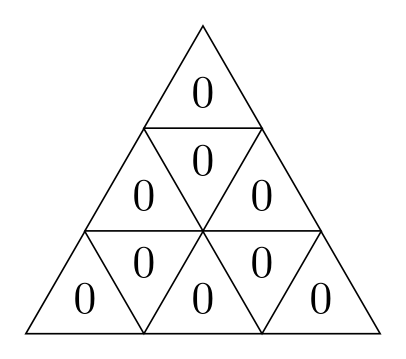
ESERCIZIO DIMOSTRATIVO Un triangolo equilatero è diviso in 9 triangolini come in figura, e su ogni triangolino è inizialmente scritto il numero 0. Marco, per passare il tempo, fa il seguente gioco: ad ogni mossa sceglie 2 triangolini con un lato in comune e somma o sottrae 1 ad entrambi i numeri scritti su questi triangolini (si intende che l’operazione effettuata sui due triangolini è la stessa). Dopo qualche tempo si accorge che i numeri scritti sui 9 triangolini sono, in un qualche ordine, n, n+1, … , n+8, dove n è un intero non negativo. Dimostrare che n può essere soltanto 0 o 2. Nota. I casi n = 0 e n = 2 possono effettivamente verificarsi, ma non si chiede di dimostrare questa affermazione.
Topic: Combinatoria, Logica, giochi, strategie Metodo: monovarianti Abilita: generalizzazione Area: Combinatoria, Logica e Probabilita Fonte: apri PDF p.9
n can only be 0 or 2
\begin{document}
\begin{tikzpicture}
  \coordinate (A0) at (0,0);
  \coordinate (A1) at (2,0);
  \coordinate (A2) at (4,0);
  \coordinate (A3) at (6,0);
  \coordinate (B0) at (1,1.732);
  \coordinate (B1) at (3,1.732);
  \coordinate (B2) at (5,1.732);
  \coordinate (C0) at (2,3.464);
  \coordinate (C1) at (4,3.464);
  \coordinate (D0) at (3,5.196);
  \draw (A0)--(A3)--(D0)--cycle;
  \draw (A1)--(B0)--(B2)--(A2);
  \draw (A1)--(B1)--(A2);
  \draw (B0)--(C0)--(C1)--(B2);
  \draw (B1)--(C0); \draw (B1)--(C1);
  \node at (1.000,0.577) {0};
  \node at (3.000,0.577) {0};
  \node at (5.000,0.577) {0};
  \node at (2.000,1.155) {0};
  \node at (4.000,1.155) {0};
  \node at (2.000,2.309) {0};
  \node at (4.000,2.309) {0};
  \node at (3.000,2.887) {0};
  \node at (3.000,4.041) {0};
\end{tikzpicture}
\end{document}
DEMONSTRATIVE PROBLEM An equilateral triangle is divided into 9 small triangles as shown in the figure, and initially, the number 0 is written on each small triangle. Marco, to pass the time, plays the following game: at each move, he selects two small triangles sharing a common side and either adds 1 or subtracts 1 from both numbers written on these two triangles (the same operation is applied to both). After some time, he notices that the numbers written on the 9 small triangles are, in some order, n, n+1, …, n+8, where n is a non-negative integer. Prove that n can only be 0 or 2. Note. The cases n = 0 and n = 2 are indeed achievable, but it is not required to prove this statement.