Coppie (m,n) con m^n = 2^24
Quante sono le coppie di numeri interi positivi (m, n) tali che mn = 224?
- (A) 2
- (B) 8
- (C) 1
- (D) 6
- (E) 4
Topic: Teoria dei Numeri Metodo: Conteggio combinatorio Area: Aritmetica e Teoria dei Numeri Risposta: B Fonte: apri PDF p.1
Pairs (m,n) with m^n = 2^24
How many pairs of positive integers (m, n) are such that mn = 224?
- (A) 2
- (B) 8
- (C) 1
- (D) 6
- (E) 4
Answer: B src_archimede_2017_triennio__Q01
tra quanti anni doppio
Sei anni fa, l’età di Anna era il quintuplo dell’età di suo figlio Mario. Adesso, invece, è il triplo dell’età di Mario. Tra quanti anni l’età di Anna sarà il doppio dell’età di Mario?
- (A) 8
- (B) 6
- (C) 10
- (D) 9
- (E) 12
Topic: Algebra Abilita: Manipolazione algebrica Area: Algebra e Analisi Risposta: E Fonte: apri PDF p.1
over two years
Six years ago, Anna was five times as old as her son, Mario. Now, instead, it’s three times Mario’s age. How many years from now will Anna be twice as old as Mario?
- (A) 8
- (B) 6
- (C) 10
- (D) 9
- (E) 12
Answer: E src_archimede_2017_triennio__Q02
Cifra delle decine di H = somma fattoriali
Con il simbolo n! si indica il prodotto dei numeri interi positivi da 1 a n, ad esempio: 4! = 1 · 2 · 3 · 4. Consideriamo il numero H = 1! + 2! + 3! + 4! + … + 2016! + 2017! (una somma con 2017 addendi). Qual è la cifra delle decine di H?
- (A) 5
- (B) 7
- (C) 1
- (D) 3
- (E) 6
Topic: Teoria dei Numeri Metodo: congruenze Area: Aritmetica e Teoria dei Numeri Risposta: C Fonte: apri PDF p.1
Number of decimal places of H = factor sums
With the symbol n! the product of positive integers from 1 to n, for example: 4! = 1 · 2 · 3 · 4. Let’s say the number H is equal to 1. + 2! + 3! + 4! + … + 2016! + 2017! (a sum with 2017 pluses). What’s the number of tens of H?
- (A) 5
- (B) 7
- (C) 1
- (D) 3
- (E) 6
Answer: C src_archimede_2017_triennio__Q03
numero cavalieri
Attorno a un tavolo circolare sono sedute 6 persone, ciascuna delle quali può essere o un cavaliere (che dice sempre la verità) o un furfante (che mente sempre). Ognuno dei presenti afferma: “Considerando i miei due vicini e la persona che è seduta proprio di fronte a me, esattamente due di queste tre persone sono furfanti”. Quanti sono, in tutto, i cavalieri seduti al tavolo?
- (A) nessuno
- (B) 1
- (C) 3
- (D) 4
- (E) gli elementi forniti non sono sufficienti per stabilirlo
Topic: Logica, giochi, strategie Metodo: Analisi per casi Abilita: Casework accurato Area: Combinatoria, Logica e Probabilita Risposta: A Fonte: apri PDF p.1
number of knights
Around a round table are six people, each of whom can be either a knight (who always tells the truth) or a cunning man (who always lies). Each of the people present says: Considering my two neighbors and the person sitting right in front of me, exactly two of these three people are cunning. How many knights are there at the table?
- (A) No one
- (B) 1
- (C) 3
- (D) 4
- (E) the information provided is insufficient to establish it;
Answer: A src_archimede_2017_triennio__Q04
Area quadrilatero FGEH con triangoli equilateri
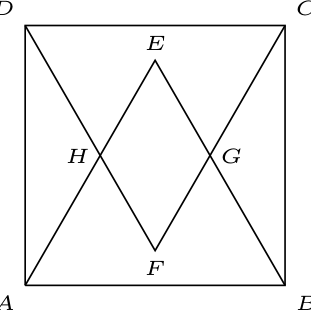
\begin{document}
\begin{tikzpicture}[scale=2]
  \coordinate (A) at (0,0);
  \coordinate (B) at (2,0);
  \coordinate (C) at (2,2);
  \coordinate (D) at (0,2);
  \coordinate (E) at (1,1.732);
  \coordinate (F) at (1,0.268);
  \draw (A)--(B)--(C)--(D)--cycle;
  \draw (A)--(C);
  \draw (B)--(D);
  \draw (A)--(E)--(B);
  \draw (C)--(F)--(D);
  \node[below left] at (A) {$A$};
  \node[below right] at (B) {$B$};
  \node[above right] at (C) {$C$};
  \node[above left] at (D) {$D$};
  \node[above] at (E) {$E$};
  \node[below] at (F) {$F$};
  \node[left] at (0.634,1) {$H$};
  \node[right] at (1.366,1) {$G$};
\end{tikzpicture}
\end{document}
Nella figura qui a fianco, ABCD è un quadrato di lato pari a 2 cm ed i triangoli ABE e CDF sono equilateri. Quanti cm2 misura l’area del quadrilatero FGEH?
- (A) 8 √ 3 4
- (B) 2 √ 3 3
- (C) 8 √ 3 3 −4
- (D) 2 √ 3 3 −1
- (E) 1 2
Topic: Geometria piana Abilita: Ragionamento geometrico Area: Geometria Risposta: C Fonte: apri PDF p.1
FGEH quadrilateral area with equilateral triangles
\begin{document}
\begin{tikzpicture}[scale=2]
  \coordinate (A) at (0,0);
  \coordinate (B) at (2,0);
  \coordinate (C) at (2,2);
  \coordinate (D) at (0,2);
  \coordinate (E) at (1,1.732);
  \coordinate (F) at (1,0.268);
  \draw (A)--(B)--(C)--(D)--cycle;
  \draw (A)--(C);
  \draw (B)--(D);
  \draw (A)--(E)--(B);
  \draw (C)--(F)--(D);
  \node[below left] at (A) {$A$};
  \node[below right] at (B) {$B$};
  \node[above right] at (C) {$C$};
  \node[above left] at (D) {$D$};
  \node[above] at (E) {$E$};
  \node[below] at (F) {$F$};
  \node[left] at (0.634,1) {$H$};
  \node[right] at (1.366,1) {$G$};
\end{tikzpicture}
\end{document}
In the figure next to this, ABCD is a side square equal to 2 cm and the triangles ABE and CDF are equilateral. How many cm2 is the area of the FGEH quadrilateral?
- (A) 8 √ 3 4
- (B) 2 √ 3 3
- (C) 8 √ 3 3 −4
- (D) 2 √ 3 3 −1
- (E) 1 2
Answer: C src_archimede_2017_triennio__Q05
Sostituzione di bibita per ottenere 50% succo
Una bottiglia da 33 cl di una bibita all’arancia è costituita per il 75% da acqua e per il 25% da succo d’arancia. Enrica vuole sostituire un po’ della bibita contenuta in questa bottiglia con del succo d’arancia, in modo da ottenere una nuova bibita che sia costituita per il 50% da succo d’arancia. Quanti cl della bibita iniziale Enrica deve sostituire con del succo d’arancia?
- (A) 8,25
- (B) 10
- (C) 9, 75
- (D) 12
- (E) 11
Topic: Algebra Abilita: Manipolazione algebrica Area: Algebra e Analisi Risposta: E Fonte: apri PDF p.1
Replacement of beverage to obtain 50% juice
A 33 cl bottle of an orange drink is 75% water and 25% orange juice. Enrica wants to replace some of the beverage in this bottle with orange juice, so as to get a new beverage that is 50% orange juice. How many cl of the original drink should Enrica replace with orange juice?
- (A) 8,25
- (B) 10
- (C) 9, 75
- (D) 12
- (E) 11
Answer: E src_archimede_2017_triennio__Q06
affermazione falsa
Sia LMN un triangolo e sia P un punto sul lato MN. Supponiamo che si abbia
MLP =
LNP e
NLP =
LMP. Quale tra le seguenti affermazioni è falsa?
- (A) LN > LP
- (B) MN · LP > LM · LN
- (C) LP ≤MN 2
- (D) LM < MN
- (E) MP · NP = LP 2
Topic: Geometria piana Abilita: Ragionamento geometrico Area: Geometria Risposta: B Fonte: apri PDF p.1
false statement
So LMN is a triangle and P is a point on the MN side. Let’s say you have \ MLP = \ LNP and \ NLP = \ LMP. Which of the following is false?
- (A) LN > LP
- (B) MN · LP > LM · LN
- (C) LP ≤MN 2
- (D) LM < MN
- (E) MP · NP = LP 2
Answer: B src_archimede_2017_triennio__Q09
dopo quanti minuti
Alle 12 : 00 : 00 le lancette delle ore e dei minuti di un orologio sono sovrapposte. Dopo quanti minuti, per la prima volta, esse saranno allineate ed opposte?
- (A) circa 30
- (B) circa 98
- (C) circa 100
- (D) circa 33
- (E) circa 34
Topic: Algebra Abilita: traduzione del testo Area: Algebra e Analisi Risposta: D Fonte: apri PDF p.2
after several minutes
At 12:00 p.m. the hours and minutes of a clock are overlapping. After how many minutes, for the first time, will they be aligned and opposite?
- (A) about 30
- (B) about 98
- (C) about 100
- (D) about 33
- (E) about 34
Answer: D src_archimede_2017_triennio__Q10
Probabilita che Silvia vinca dopo 5 a 4-1
Silvia e Luigi si sfidano lanciando più volte un dado. Ogni volta che esce un numero pari fa un punto Silvia, quando esce un numero dispari fa un punto Luigi. Vince la partita chi arriva per primo a 5 punti. Dopo 5 lanci, Silvia è in vantaggio per 4 a 1. Qual è la probabilità che sia Silvia a vincere la partita?
- (A) 4/5
- (B) 5/6
- (C) 7/8
- (D) 3/4
- (E) 15/16
Topic: Probabilita e statistica Metodo: Conteggio combinatorio Area: Combinatoria, Logica e Probabilita Risposta: E Fonte: apri PDF p.2
The odds of Silvia winning after 5 to 4-1
Silvia and Luigi challenge each other by throwing a dice several times. Every time an even number comes out, Silvia makes a point, every time an odd number comes out, she makes a point. The first player to score five points wins the game. After five pitches, Silvia has a 4-1 lead. What are the odds of Silvia winning the game?
- (A) 4/5
- (B) 5/6
- (C) 7/8
- (D) 3/4
- (E) 15/16
Answer: E src_archimede_2017_triennio__Q11
possibile posizione di Gerardo
Per ciascun giocatore di scacchi ogni mese viene calcolato un punteggio, derivante dai suoi risultati e reso noto pubblicamente, che indica il suo livello di abilità in quel momento. Gerardo sta per iniziare un torneo di scacchi con 64 partecipanti, che si svolge ad eliminazione diretta (prima i 32imi di finale, poi i 16esimi, poi gli ottavi, etc.): chi vince una partita passa il turno, l’altro è eliminato (in caso di patta, si ripete la partita). La precedente edizione del torneo è stata molto avara di sorprese: in ogni partita ha sempre vinto il giocatore con punteggio più alto. Prima del sorteggio del tabellone (che avviene in modo casuale tra tutti i partecipanti), Gerardo si informa sugli altri giocatori presenti (che hanno tutti punteggi diversi) e conclude che, se tutto dovesse andare ancora come nella precedente edizione, egli potrebbe al massimo arrivare in semifinale. Se ne deduce che, tra i partecipanti al torneo, il punteggio di Gerardo…
- (A) può trovarsi in qualsiasi posizione successiva alla 32a
- (B) può trovarsi in qualsiasi posizione dalla 32a alla 48a (incluse)
- (C) può trovarsi in qualsiasi posizione precedente alla 50a
- (D) può trovarsi in qualsiasi posizione precedente alla 49a
- (E) può trovarsi in qualsiasi posizione dalla 34a alla 49a (incluse)
Topic: Logica, giochi, strategie Metodo: Analisi per casi Abilita: generalizzazione Area: Combinatoria, Logica e Probabilita Risposta: E Fonte: apri PDF p.2
possible location of Gerardo
A score is calculated for each chess player each month, derived from their results and made public, indicating their skill level at that time. Gerardo is about to start a chess tournament with 64 participants, which takes place in direct elimination (first the 32nd of the final, then the 16th, then the eighth, etc.): whoever wins a match passes the round, the other is eliminated (in case of a deal, the match is repeated). The previous edition of the tournament was very lavish with surprises: in each match the player with the highest score always won. Before the draw of the table (which occurs randomly among all participants), Gerardo informs himself about the other players present (who all have different scores) and concludes that, if everything should go again as in the previous edition, he could at most reach the semi-finals. It follows that, among the participants in the tournament, Gerardo’s score…
- (A) may be located in any position after 32a.
- (B) can be found in any position from 32a to 48a (included)
- (C) may be located in any position prior to 50a
- (D) may be located in any position prior to 49a
- (E) can be found in any position from 34a to 49a (included)
Answer: E src_archimede_2017_triennio__Q13
lato
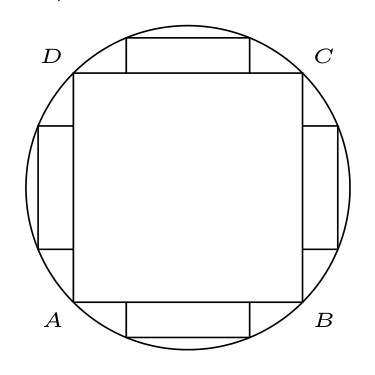
Un quadrato ABCD di lato pari a 2 cm è inscritto in una circonferenza. Nei segmenti circolari delimitati dai lati del quadrato vengono inscritti 4 rettangoli. Quanti cm deve misurare ciascun lato di tali rettangoli, affinch´e essi siano dei quadrati?
- (A) √ 2/4
- (B) 1/3
- (C) 3/8
- (D) 2/5
- (E) 1/4
Topic: Geometria piana Metodo: Metodo delle coordinate Abilita: Ragionamento geometrico Area: Geometria Risposta: D Fonte: apri PDF p.2
The manufacturer shall provide the manufacturer with the following information:
A square ABCD of 2 cm on the side shall be inscribed in a circumference. Four rectangles are inscribed in the circular segments bounded by the sides of the square. How many centimeters must each side of such rectangles measure so that they are squares?
- (A) √ 2/4
- (B) 1/3
- (C) 3/8
- (D) 2/5
- (E) 1/4
Answer: D src_archimede_2017_triennio__Q14
Primi che restano primi cancellando cifre
Quanti sono i numeri primi tali che, se si cancella da essi un qualsiasi gruppo di cifre anche non consecutive (senza però cancellarle tutte) e si leggono le cifre rimanenti nell’ordine in cui si trovano, si ottiene ancora un numero primo? (Si ricorda che 1 non è un numero primo.)
- (A) 8
- (B) 10
- (C) 5
- (D) 7
- (E) 3
Topic: Teoria dei Numeri Metodo: Analisi per casi Area: Aritmetica e Teoria dei Numeri Risposta: A Fonte: apri PDF p.2
First remaining first by deleting digits
How many prime numbers are such that, if you delete from them any group of even non-consecutive digits (without deleting all of them) and you read the remaining digits in the order in which they are located, you still get a prime number? (Remember that 1 is not a prime number.)
- (A) 8
- (B) 10
- (C) 5
- (D) 7
- (E) 3
Answer: A src_archimede_2017_triennio__Q15
Quadrati in griglia 7x7 contenenti casella centrale
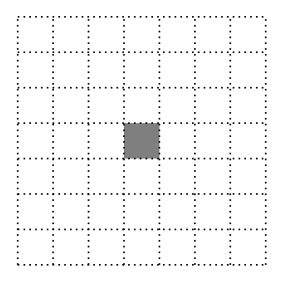
Presa una griglia 7×7, consideriamo i possibili quadrati (da 1×1 a 7 × 7) ottenuti dall’unione di una o più caselle della griglia. Quanti tra questi quadrati contengono la casella centrale della griglia?
- (A) 50
- (B) 30
- (C) 44
- (D) 42
- (E) 28
Topic: Combinatoria Metodo: Conteggio combinatorio Abilita: Conteggio sistematico Area: Combinatoria, Logica e Probabilita Risposta: C Fonte: apri PDF p.2
7x7 grid squares containing the central box
Taking a grid 7×7, consider the possible squares (from 1×1 to 7 × 7) obtained from the union of one or more grid boxes. How many of these squares contain the central box of the grid?
- (A) 50
- (B) 30
- (C) 44
- (D) 42
- (E) 28
Answer: C src_archimede_2017_triennio__Q16
Cifra in posizione 2017 sequenza dei pari
Carolina inizia a scrivere tutti gli interi positivi pari, uno di seguito all’altro: 246810121416… Quale cifra occuperà la 2017a posizione?
- (A) 8
- (B) 7
- (C) 2
- (D) 5
- (E) 1
Topic: Combinatoria Metodo: Conteggio per casi Abilita: Conteggio sistematico Area: Combinatoria, Logica e Probabilita Risposta: E Fonte: apri PDF p.2
*Sequence of peers in position 2017 *
Carolina begins to write all positive integers even, one after the other: 246810121416… What figure will occupy the 2017th position?
- (A) 8
- (B) 7
- (C) 2
- (D) 5
- (E) 1
Answer: E src_archimede_2017_triennio__Q17
Polinomio coefficienti +-1, p(2)=11 trovare p(3)
In un polinomio di 5°grado p(x) = ax5 + bx4 + cx3 + dx2 + ex + f, ciascuno dei coefficienti a, b, c, d, e, f è 1 oppure −1. Sapendo che si ha p(2) = 11, qual è il valore di p(3)?
- (A) 178
- (B) 244
- (C) 126
- (D) 142
- (E) 196
Topic: Algebra Metodo: Analisi per casi Abilita: Manipolazione algebrica Area: Algebra e Analisi Risposta: D Fonte: apri PDF p.2
*Polynomial coefficients +-1, p(2)=11 to find p(3) *
In a polynomial of 5°degree p(x) = ax5 + bx4 + cx3 + dx2 + ex + f, each of the coefficients a, b, c, d, e, f is 1 or −1. Knowing that you have p(2) = 11, what’s the value of p(3)?
- (A) 178
- (B) 244
- (C) 126
- (D) 142
- (E) 196
Answer: D src_archimede_2017_triennio__Q18
Area rettangolo ABCD da angolo doppio e area CPT
Dato un rettangolo ABCD, sia P un punto interno al lato CD. La retta AP interseca la retta BC nel punto T. Detto M il punto medio del lato BC, è noto che
APM = 2 [ ATC. Sapendo che l’area del triangolo CPT è di 10 cm2, qual è l’area del rettangolo ABCD?
- (A) 90 cm2
- (B) 120 cm2
- (C) 60 cm2
- (D) 80 cm2
- (E) 160 cm2 T2 Unione Matematica Italiana PROGETTO OLIMPIADI DI MATEMATICA Ministero dell’Istruzione, dell’Università e della Ricerca I Giochi di Archimede - Gara Triennio 23 novembre 2017 • La prova è costituita da 20 problemi. Ogni domanda è seguita da 5 risposte indicate con le lettere (A), (B), (C), (D), (E). Una sola di queste risposte è corretta, le altre 4 sono sbagliate. • Ciascuna risposta corretta vale 5 punti, ciascuna risposta sbagliata vale 0 punti. Per ogni risposta lasciata in bianco oppure illeggibile verrà assegnato 1 punto. • Per ognuno dei problemi, devi trascrivere la lettera corrispondente alla risposta che ritieni corretta nella griglia riportata qui sotto. Non sono ammesse cancellature o correzioni sulla griglia. Non è consentito l’uso di alcun tipo di calcolatrice o di strumenti di comunicazione. Il tempo che hai a disposizione per svolgere la prova è di 110 minuti. Buon lavoro e buon divertimento! NOME COGNOME CLASSE data di nascita: mail (facoltativa): 1 2 3 4 5 6 7 8 9 10 11 12 13 14 15 16 17 18 19 20
Topic: Geometria piana Metodo: Tecniche trigonometriche Abilita: Ragionamento geometrico Area: Geometria Risposta: B Fonte: apri PDF p.2
Area ABCD rectangle from double angle and area CPT
Given an ABCD rectangle, P is an inner point on the CD side. The AP line intersects the BC line at point T. Given M the midpoint of the BC side, it is known that \ APM = 2 [ ATC. Since the area of the CPT triangle is 10 cm2, what is the area of the ABCD rectangle?
- (A) 90 cm2
- (B) 120 cm2
- (C) 60 cm2
- (D) 80 cm2
- (E) 160 cm2 T2 Italian Mathematical Union PROJECT OLIMPIAD OF MATHEMATICS Ministry of Education, University and Research The Archimedes Games - Triennial competition 23 November 2017 • The test consists of 20 problems. Each question shall be followed by 5 answers indicated by the letters (A), (B), (C), (D) and (E). One of these answers is correct, the other four are wrong. • Each correct answer is worth 5 points, each wrong answer is worth 0 points. For each answer left blank or unreadable one point will be awarded. • For each problem, you must transcribe the letter corresponding to the answer you think is correct in the grid below. Cancellations or corrections on the grid are not permitted. The use of any kind of calculator or communication tool shall not be permitted. You have 110 minutes to run the test. Good work and good fun! Name of the applicant and date of birth: e-mail (optional): 1 2 3 4 5 6 7 8 9 10 11 12 13 14 15 16 17 18 19 20
Answer: B src_archimede_2017_triennio__Q20