Punteggio impossibile in gara a punteggio +5/-1
Una gara di matematica consta di 90 domande a risposta multipla. Camilla ha risposto a tutte le domande: quale dei seguenti non può essere il punteggio totalizzato da Camilla, sapendo che una risposta corretta vale 5 punti e una risposta sbagliata vale −1 punto?
- (A) −78
- (B) 116
- (C) 204
- (D) 318
- (E) 402
Topic: Teoria dei Numeri Metodo: congruenze Abilita: Manipolazione algebrica Area: Aritmetica e Teoria dei Numeri Risposta: B Fonte: apri PDF p.3
Impossible score in a competition with a score of +5/-1
A math competition consists of 90 multiple-choice questions. Camilla answered all the questions: which of the following cannot be the total score of Camilla, knowing that a correct answer is worth 5 points and a wrong answer is worth -1 point?
- (A) −78
- (B) 116
- (C) 204
- (D) 318
- (E) 402
Answer: B src_archimede_2018_2livello__Q01
Sequenze binarie di lunghezza 8 contenenti 01
Quante sono le sequenze di numeri di lunghezza otto composte unicamente da 0 e 1 che contengono il codice 01?
- (A) 64
- (B) 128
- (C) 192
- (D) 247
- (E) 255
Topic: Combinatoria Metodo: Conteggio combinatorio, Inclusione-esclusione Abilita: Conteggio sistematico Area: Combinatoria, Logica e Probabilita Risposta: D Fonte: apri PDF p.3
Binary sequences of length 8 containing 01
How many sequences of eight numbers consisting only of 0s and 1s containing code 01?
- (A) 64
- (B) 128
- (C) 192
- (D) 247
- (E) 255
Answer: D src_archimede_2018_2livello__Q02
Triangoli isosceli simili costruiti sui lati, trovare AB
Sia ABC un triangolo isoscele con base BC = 10 e AB = AC. Si costruiscano esternamente sui suoi due lati obliqui altri due triangoli isosceli DAB e EAC, entrambi simili ad ABC, con DA = DB e EA = EC. Sapendo che DE = 45, trovare la lunghezza di AB.
- (A) 15
- (B) 20
- (C) 9 √ 5
- (D) 22.5
- (E) Non è possibile determinarlo con i soli dati forniti.
Topic: Geometria piana Metodo: Sfruttamento della simmetria Abilita: Ragionamento geometrico Area: Geometria Risposta: A Fonte: apri PDF p.3
Similar isosceles triangles constructed on the sides, find AB
So ABC is an isosceles triangle with base BC = 10 and AB = AC. Two other isosceles DAB and EAC are constructed externally on its two oblique sides, both similar to ABC, with DA = DB and EA = EC. Knowing that DE is 45, find the length of AB.
- (A) 15
- (B) 20
- (C) 9 √ 5
- (D) 22.5
- (E) It is not possible to determine this on the basis of the data provided.
Answer: A src_archimede_2018_2livello__Q03
Operazione binaria iterata su reali positivi
Dati due numeri reali positivi a, b definiamo a ⋆b = ab + 1 a + b . Quanto vale 1 ⋆(2 ⋆(3 ⋆(· · (2017 ⋆2018))))?
- (A) 1/2018
- (B) 1
- (C) 2018/2017
- (D) 1009
- (E) 2018
Topic: Algebra Metodo: Induzione Abilita: Riconoscimento di pattern Area: Algebra e Analisi Risposta: B Fonte: apri PDF p.3
*Iterated binary operation on positive real *
Given two positive real numbers a, b we define a ⋆b = ab + 1 a + b. How much is 1 ⋆(2 ⋆(3 ⋆(· (2017 ⋆2018)))?
- (A) 1/2018
- (B) 1
- (C) 2018/2017
- (D) 1009
- (E) 2018
Answer: B src_archimede_2018_2livello__Q04
Numeri m con 3m=ABC e 4m=CAB
Veronica osserva che 81·3 = 243 e 81·4 = 324 e si chiede quanti siano i numeri m con 10 ≤m ≤99 e tali che 3m = ABC e 4m = CAB, con A, B e C cifre decimali (si considerano validi anche i casi in cui una o più delle cifre A, B, C siano uguali a zero).
- (A) 1
- (B) 2
- (C) 3
- (D) 4
- (E) 6
Topic: Teoria dei Numeri Metodo: congruenze Abilita: Manipolazione algebrica Area: Aritmetica e Teoria dei Numeri Risposta: C Fonte: apri PDF p.3
Numbers m with 3m=ABC and 4m=CAB
Veronica observes that 81·3 = 243 and 81·4 = 324 and asks how many are the numbers m with 10 ≤m ≤99 and such that 3m = ABC and 4m = CAB, with A, B and C decimal digits (also considered valid cases where one or more of the digits A, B, C are equal to zero).
- (A) 1
- (B) 2
- (C) 3
- (D) 4
- (E) 6
Answer: C src_archimede_2018_2livello__Q05
Cavalieri e furfanti in fila, parità affermazioni
Nel villaggio di Asip tutti gli abitanti appartengono ad uno dei due gruppi seguenti: i Cavalieri, che dicono sempre la verità, e i Furfanti, che mentono sempre. Oggi, per il censimento annuale, è arrivato dalla capitale il Gran Notaio e tutti gli abitanti si mettono in fila indiana davanti a lui. Ciascuno di essi dichiara: “Il numero di coloro che non appartengono al mio gruppo e sono in fila davanti a me è pari”. Oltre a questo, i primi tre abitanti nella fila affermano, in ordine, quanto segue: “Nel villaggio ci sono 999 abitanti”, “I Cavalieri sono esattamente 666”, “Ci sono almeno tre Furfanti ad Asip”. Quanti sono i Cavalieri ad Asip?
- (A) 0
- (B) 1
- (C) 501
- (D) 666
- (E) 997
Topic: Logica, giochi, strategie Metodo: Analisi per casi Abilita: Casework accurato Area: Combinatoria, Logica e Probabilita Risposta: E Fonte: apri PDF p.3
Knights and thieves in line, equal claims
In the village of Asip all the inhabitants belong to one of the following two groups: the Knights, who always tell the truth, and the Sphinx, who always lie. Today, for the annual census, the Great Notary has arrived from the capital and all the inhabitants line up in front of him. Each of them declares: The number of those who do not belong to my group and are in line before me is equal. In addition to this, the first three inhabitants in the line affirm, in order, the following: In the village there are 999 inhabitants, The Knights are exactly 666, There are at least three Snatchers in Asip. How many knights are there in Asip?
- (A) 0
- (B) 1
- (C) 501
- (D) 666
- (E) 997
Answer: E src_archimede_2018_2livello__Q06
Area poligono da quadrati esterni a trapezio isoscele
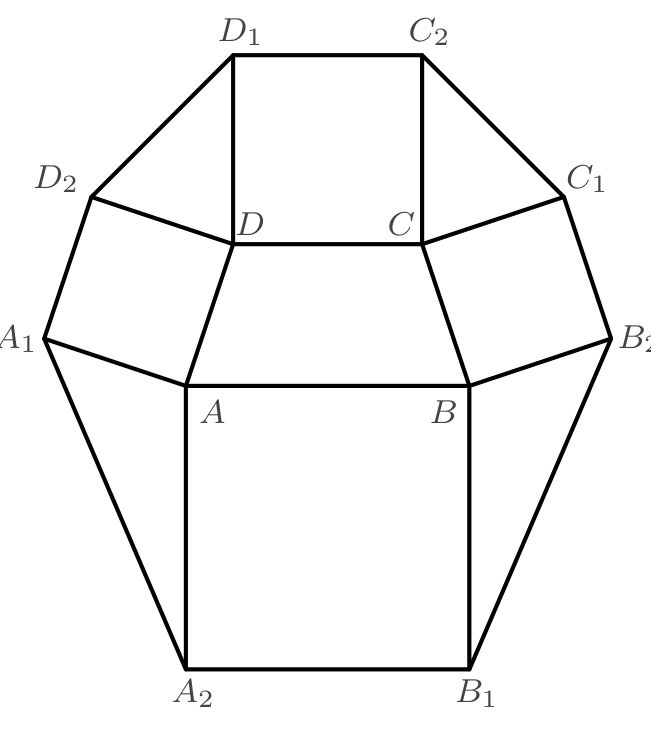
ABCD è un trapezio isoscele con lati di lunghezze AB = 15, BC = DA = 5, CD = 7. Sui lati di ABCD, esternamente ad ABCD, vengono costruiti quattro quadrati. Con riferimento alla figura, qual è l’area del poligono A1A2B1B2C1C2D1D2?
- (A) 297 + 35 √ 5
- (B) 396
- (C) 423
- (D) 105 + 144 √ 5
- (E) 200 √ 5 A B C D D2 A1 C2 D1 B2 C1 A2 B1
Topic: Geometria piana Metodo: Metodo delle coordinate Abilita: Ragionamento geometrico Area: Geometria Risposta: C Fonte: apri PDF p.3
*External square polygon area with isosceles trapezoid *
ABCD is an isosceles trapezoid with sides of lengths AB = 15, BC = DA = 5, CD = 7. On the sides of ABCD, externally to ABCD, four squares are constructed. With reference to the figure, what is the area of the polygon A1A2B1B2C1C2D1D2?
- (A) 297 + 35 √ 5
- (B) 396
- (C) 423
- (D) 105 + 144 √ 5
- (E) 200 √ 5 A B C D D2 A1 C2 D1 B2 C1 A2 B1
Answer: C src_archimede_2018_2livello__Q07
Tre amiche a calcio, chi ha iniziato in porta
Annalisa, Bruna e Cecilia giocano a calcio: una di loro sta in porta e le altre in campo. Chi fa gol rimane in campo, mentre chi non ha segnato si scambia con il portiere. Sapendo che Annalisa è stata in campo per 12 turni e Bruna per 21 turni, mentre Cecilia è stata in porta 8 volte, chi ha cominciato in porta?
- (A) Annalisa
- (B) Bruna
- (C) Cecilia
- (D) Annalisa o Bruna (ma sicuramente non Cecilia)
- (E) Può essere una qualunque delle tre amiche.
Topic: Logica, giochi, strategie Metodo: Analisi per casi Abilita: traduzione del testo Area: Combinatoria, Logica e Probabilita Risposta: A Fonte: apri PDF p.3
Three soccer friends who started at the door.
Annalisa, Bruna and Cecilia play football: one of them is at the door and the other is on the field. Whoever scores stays on the pitch, while whoever doesn’t score changes to the goalkeeper. Knowing that Annalisa has been on the field for 12 laps and Bruna for 21 laps, while Cecilia has been on the court eight times, who started on the court?
- (A) It shall be analysed.
- (B) Brown
- (C) Cecilia
- (D) Annalisa or Bruna (but certainly not Cecilia)
- (E) It could be any one of the three friends.
Answer: A src_archimede_2018_2livello__Q08
Due quadratiche con radice comune, somma a+b
Siano a e b due numeri reali distinti. Si sa che le due equazioni x2 + ax + 3b = 0 x2 + bx + 3a = 0 hanno una soluzione in comune: quali sono i possibili valori per la somma a + b?
- (A) 0 o −3
- (B) 0 o 3
- (C) Soltanto 0
- (D) Soltanto −3
- (E) Esistono infiniti valori possibili
Topic: Algebra Metodo: manipolazione algebrica Abilita: Manipolazione algebrica Area: Algebra e Analisi Risposta: D Fonte: apri PDF p.4
Two squares with common root, sum a+b
Let a and b be two distinct real numbers. We know that the two equations x2 + ax + 3b = 0 x2 + bx + 3a = 0 have a common solution: what are the possible values for the sum of a + b?
- (A) 0 o −3
- (B) 0 o 3
- (C) Only 0
- (D) Only −3
- (E) There are infinite possible values.
Answer: D src_archimede_2018_2livello__Q09
Quaterne interi positivi con x+y=ab e a+b=xy
Quante sono le quaterne di interi positivi (a, b, x, y) tali che x + y = a · b e a + b = x · y?
- (A) 1
- (B) 5
- (C) 9
- (D) 17
- (E) Infinite
Topic: Teoria dei Numeri Metodo: Analisi per casi, manipolazione algebrica Abilita: Casework accurato Area: Aritmetica e Teoria dei Numeri Risposta: C Fonte: apri PDF p.4
Positive integers with x+y=ab and a+b=xy
How many are the four positive integers (a, b, x, y) such that x + y = a · b and a + b = x · y?
- (A) 1
- (B) 5
- (C) 9
- (D) 17
- (E) Infinite
Answer: C src_archimede_2018_2livello__Q10
Tre cerchi tangenti, raggio circoscritta ad AA1A2
Sono date tre circonferenze Γ, Γ1, Γ2 di raggi rispettivamente 6, 3, 2. Γ1 e Γ2 sono tangenti esternamente in A, mentre Γ tange entrambe le altre circonferenze internamente, rispettivamente in A1 ed A2. Determinare il raggio della circonferenza circoscritta ad AA1A2.
- (A) 2 √ 6
- (B) 5
- (C) √ 2 + √ 3 + √ 6
- (D) 4 + √ 3
- (E) 6
Topic: Geometria piana Metodo: Metodo delle coordinate Abilita: Ragionamento geometrico Area: Geometria Risposta: E Fonte: apri PDF p.4
Three tangent circles, radius limited to AA1A2
Three radial circumferences Γ, Γ1, Γ2 are given, respectively, 6, 3, 2. Γ1 and Γ2 are tangent externally in A, while Γ tangent both other circumferences internally, respectively in A1 and A2. Determine the radius of the circumference circumscribed at AA1A2.
- (A) 2 √ 6
- (B) 5
- (C) √ 2 + √ 3 + √ 6
- (D) 4 + √ 3
- (E) 6
Answer: E src_archimede_2018_2livello__Q11
Somma telescopica con prodotti di dispari
Per ogni intero positivo n chiamiamo f(n) il prodotto di tutti i numeri naturali dispari minori o uguali a 2n + 1 (per esempio f(4) = 1 · 3 · 5 · 7 · 9). Poniamo poi g(n) = n f(n). Cosa si può dire della somma S = g(1) + g(2) + · · + g(30)?
- (A) S ≤0.35
- (B) 0.35 < S ≤0.49
- (C) 0.49 < S ≤0.50
- (D) 0.50 < S ≤0.51
- (E) S > 0.51 Problemi a risposta numerica – 5 punti
Topic: successioni Metodo: Somme telescopiche Abilita: Manipolazione algebrica Area: Algebra e Analisi Risposta: C Fonte: apri PDF p.4
Telescopic sum with odd products
For every positive integer n, we call f (n) the product of all odd natural numbers less than or equal to 2n + 1 (e.g. f) = 1 · 3 · 5 · 7 · 9). Then we put g (n) = n f (n). What can be said of the sum S = g(1) + g(2) + · · + g(30)?
- (A) S ≤0.35
- (B) 0.35 < S ≤0.49
- (C) 0.49 < S ≤0.50
- (D) 0.50 < S ≤0.51
- (E) S > 0.51 Problems with a numerical answer 5 points
Answer: C src_archimede_2018_2livello__Q12
Polinomi prodotto, grado minimo del quoziente
Angela ha a disposizione i polinomi x −1, (x −1)(x −2), (x −1)(x −2)(x −3), … fino a (x −1)(x −2) · · (x −2017)(x −2018), e li divide in due gruppi. Detto p(x) il prodotto dei polinomi del primo gruppo e q(x) quello dei polinomi del secondo gruppo, Angela si accorge che il polinomio p(x) divide il polinomio q(x), e che il grado del quoziente q(x) p(x) è il più piccolo possibile: quanto vale tale grado?
Topic: Algebra Metodo: Principio di estremalita, manipolazione algebrica Abilita: generalizzazione Area: Algebra e Analisi Risposta: 1009 Fonte: apri PDF p.4
Produced polynomials, minimum grade of the quotient
Angela has the polynomials x −1, (x −1) x −2), (x −1) x −2) x −3), … up to (x −1)(x −2) · · (x −2017)(x −2018), and divides them into two groups. Having said that p(x) is the product of the polynomials of the first group and q(x) is that of the polynomials of the second group, Angela notices that the polynomial p(x) divides the polynomial q(x), and that the degree of the quotient q(x) p(x) is as small as possible: how much is that degree worth?
Answer: 1009 src_archimede_2018_2livello__Q13
Orologio digitale, minimo intero che non divide
Consideriamo un orologio digitale e i numeri formati dalle quattro cifre (ore e minuti): le 10:45 indicheranno il numero 1045. Quale è il più piccolo intero positivo che non divide alcuno dei numeri che compaiono fra le 11:00 e le 12:59?
Topic: Teoria dei Numeri Metodo: congruenze Abilita: Casework accurato Area: Aritmetica e Teoria dei Numeri Risposta: 84 Fonte: apri PDF p.4
*Digital clock, not dividing *
Consider a digital clock and the four-digit numbers (hours and minutes): 10:45 will indicate the number 1045. What is the smallest positive integer that doesn’t divide any of the numbers that appear between 11:00 and 12:59?
Answer: 84 src_archimede_2018_2livello__Q14
Interi le cui cifre cancellate restano divisori
ESERCIZIO DIMOSTRATIVO (a) Trovare tutti gli interi positivi n di due cifre che godano della seguente proprietà: entrambi gli interi che si ottengono cancellando una delle due cifre della rappresentazione decimale di n sono divisori (interi positivi) di n. (b) Sia n > 10 un intero che si scrive con k cifre decimali, tutte diverse da zero. Supponiamo che ciascuno degli interi ottenuti cancellando una delle k cifre della rappresentazione decimale di n sia un divisore (intero positivo) di n. Mostrare che necessariamente k = 2. Esempio. Per n = 123 si ha k = 3, e gli interi ottenuti cancellando cifre di n sono 23, 13, 12.
Topic: Teoria dei Numeri Metodo: Analisi per casi, congruenze Abilita: Manipolazione algebrica Area: Aritmetica e Teoria dei Numeri Fonte: apri PDF p.5
Interies whose deleted digits remain divisors
DEMOSTRATIVE EXERCISE (a) Find all positive integers n of two digits that have the following property: both integers obtained by deleting one of the two digits of the decimal representation of n are divisors (positive integers) of n. (b) Whether n > 10 is an integer written with k decimal digits, all other than zero. Suppose each of the integers obtained by deleting one of the k digits of the decimal representation of n is a divisor (positive integer) of n. To show that k is necessarily equal to 2. I’ll give you an example. For n = 123, we have k = 3, and the integers obtained by deleting the digits of n are 23, 13, 12.
src_archimede_2018_2livello__Q15
Gioco tessere su griglia 1x2018, strategia vincente
ESERCIZIO DIMOSTRATIVO Alice e Barbara hanno inventato il seguente gioco. Hanno una griglia 1 × 2018, con le caselle numerate da 1 a 2018 da sinistra verso destra, e 2018 tessere numerate anch’esse da 1 a 2018. La partita inizia con la griglia vuota, e le due giocatrici si alternano nel fare mosse; la giocatrice di turno può scegliere fra: • selezionare una tessera non ancora collocata sulla griglia e porla su una casella libera, a patto che i numeri sulle tessere collocate, se letti da sinistra verso destra, siano in ordine crescente; • selezionare una tessera già collocata sulla griglia e spostarla in una casella adiacente in modo che la tessera si avvicini alla casella che reca lo stesso numero della tessera, a patto che la casella di arrivo sia libera (esempio: se la tessera col numero 7 si trova sulla casella numero 12, la si può spostare a sinistra, ma non a destra; se invece una tessera si trova già nella casella col suo stesso numero, non potrà più essere spostata). (a) Dimostrare che a ogni turno, se le tessere non sono tutte sulla griglia, esiste una mossa lecita. (b) Se inizia Alice e vince chi colloca l’ultima tessera, chi ha una strategia vincente?
Topic: Combinatoria, Logica, giochi, strategie Metodo: monovarianti Abilita: generalizzazione Area: Combinatoria, Logica e Probabilita Fonte: apri PDF p.7
Playing cards on a grid 1x2018, winning strategy
Alice and Barbara invented the following game. They have a grid of 1 × 2018, with boxes numbered from 1 to 2018 from left to right, and 2018 cards numbered from 1 to 2018 too. The game begins with the empty grid, and the two players alternate in making moves; the turn player can choose between: • selecting a card not yet placed on the grid and placing it on a free box, provided that the numbers on the cards placed, if read from left to right, are in increasing order; • selecting a card already placed on the grid and moving it to an adjacent box so that the card approaches the box with the same number as the card, provided that the arrival box is free (example: if the card with number 7 is on box number 12, it can be moved to the left, but not to the right; instead, if a card with its number is already in the box itself, it can no longer be moved). (a) Demonstrate that at each turn, if the cards are not all on the grid, there is a lawful move. (b) If Alice starts and the winner is the one who plays the last card, who has a winning strategy?
src_archimede_2018_2livello__Q16
Triangolo con punto interno, calcolare angolo BAC
ESERCIZIO DIMOSTRATIVO Siano ABC un triangolo e P un suo punto interno. Sia H il punto sul lato BC tale che la bisettrice dell’angolo
AHP è perpendicolare alla retta BC. Sapendo che
ABC =
HPC e
BPC = 130o, determinare la misura dell’angolo
BAC.
Topic: Geometria piana Metodo: Tecniche trigonometriche Abilita: Ragionamento geometrico Area: Geometria Risposta: 50° Fonte: apri PDF p.9
Triangle with inner point, calculate the angle BAC
Let ABC be a triangle and P be its inner point. Both H the point on the side of BC such that the bisector of the angle \ AHP is perpendicular to the BC straight. Knowing that \ ABC = \ HPC and \ BPC = 130o, determine the measure of the angle \ BAC.
Answer: 50° src_archimede_2018_2livello__Q17