Dodecagono regolare, intersezione diagonali e circonferenza S
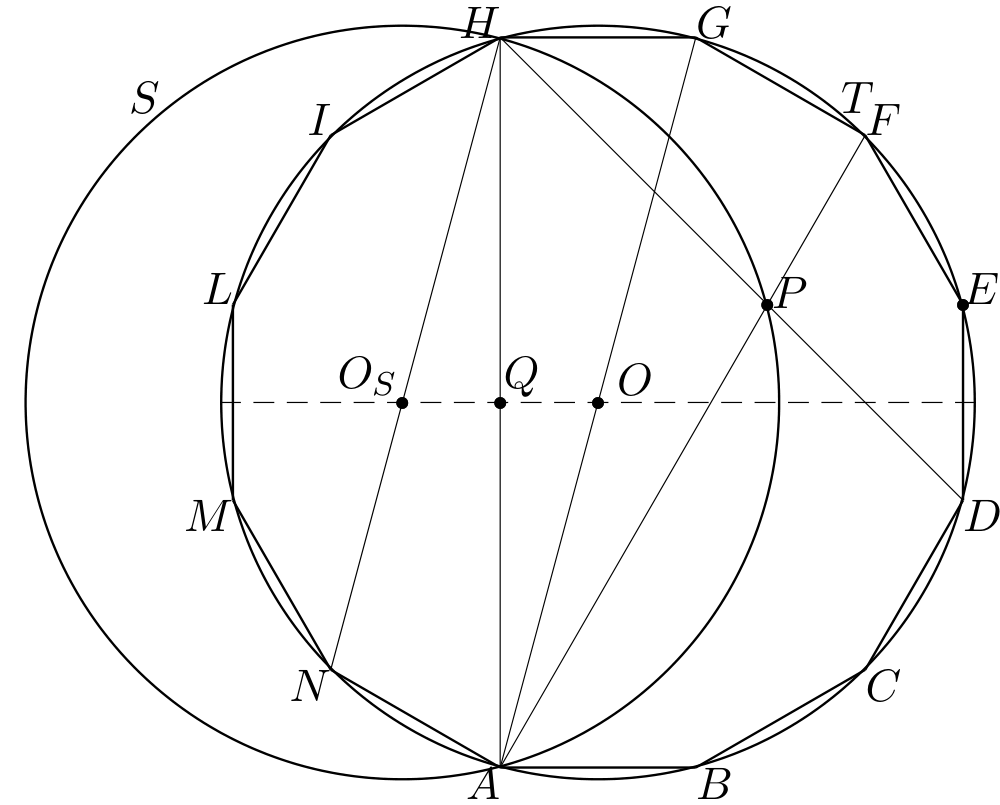
Sia ABCDEFGHILMN un dodecagono regolare. Sia P il punto di intersezione delle diagonali AF e DH. Sia S la circonferenza passante per A e H, congruente a quella circoscritta al dodecagono e distinta da essa. Dimostrare che: (a) P appartiene a S; (b) il centro di S appartiene alla diagonale HN; (c) la lunghezza di PE è uguale al lato del dodecagono.
Topic: Geometria piana Metodo: Sfruttamento della simmetria Abilita: Ragionamento geometrico Area: Geometria Risposta: dimostrato (traslazione) Fonte: apri PDF p.1
Regular decagon, diagonal intersection and circumference S
It’s either ABCDEFGHILMN or a regular dodecagon. P is the intersection point of the AF and DH diagonals. Whether S is the circumference passing through A and H, congruent to that circumscribed to the dodecagon and distinct from it. Demonstrate that: (a) P belongs to S; (b) the center of S belongs to the HN diagonal; (c) the length of PE is equal to the side of the dodecahedron.
Answer: dimostrato (traslazione) src_cesenatico_2008__Q01
numero colorazioni
Sia n ≥2 un numero intero. Coloriamo tutte le caselle di una scacchiera n × n in rosso o blu in modo che ogni quadrato 2 × 2 contenuto nella scacchiera abbia esattamente due caselle rosse e due blu. Quante sono le colorazioni possibili? NOTA: due colorazioni che si ottengono l’una dall’altra con una rotazione o una simmetria della scacchiera sono considerate distinte.
Topic: Combinatoria Metodo: Conteggio combinatorio Area: Combinatoria, Logica e Probabilita Risposta: 2^(n+1)-2 Fonte: apri PDF p.1
number of colours
Let n ≥2 be an integer. We color all the boxes on a chessboard n × n in red or blue so that every square 2 × 2 contained in the chessboard has exactly two red and two blue boxes. How many colors are possible? NOTE: Two colours obtained from each other by rotation or symmetry of the chessboard are considered to be distinct.
Answer: 2^(n+1)-2 src_cesenatico_2008__Q02
Funzioni Z->R crescenti con differenze nell’immagine
Determinare tutte le funzioni f, definite sull’insieme Z dei numeri interi relativi e a valori nell’insieme R dei numeri reali, che soddisfano simultaneamente le seguenti proprietà: • per ogni coppia di interi (m, n) con m < n si ha f(m) < f(n); • per ogni coppia di interi (m, n) esiste un intero k tale che f(m) −f(n) = f(k).
Topic: successioni Metodo: manipolazione algebrica Abilita: generalizzazione Area: Algebra e Analisi Risposta: f(n)=(n-n0)a con a reale positivo Fonte: apri PDF p.2
Growing Z->R functions with differences in image
Determine all the functions f, defined on the set Z of the relative integers and values in the set R of the real numbers, which satisfy simultaneously the following properties: • for each pair of integers (m, n) with m < n we have f(m) < f(n); • for each pair of integers (m, n) there exists an integer k such that f(m) −f(n) = f(k.
Answer: f(n)=(n-n0)a con a reale positivo src_cesenatico_2008__Q03
Terne (a,b,c) interi positivi con a^2+2^(b+1)=3^c
Determinare tutte le terne (a, b, c) di numeri interi maggiori di zero tali che a2 + 2b+1 = 3c.
Topic: Teoria dei Numeri Metodo: congruenze Area: Aritmetica e Teoria dei Numeri Risposta: (1,2,2) e (7,4,4) Fonte: apri PDF p.2
Term (a,b,c) positive integers with a^2+2^(b+1) = 3^c
Determine all terns (a, b, c) of integers greater than zero such that a2 + 2b + 1 = 3c.
Answer: (1,2,2) e (7,4,4) src_cesenatico_2008__Q04
tre quadrati uguali e retta rC
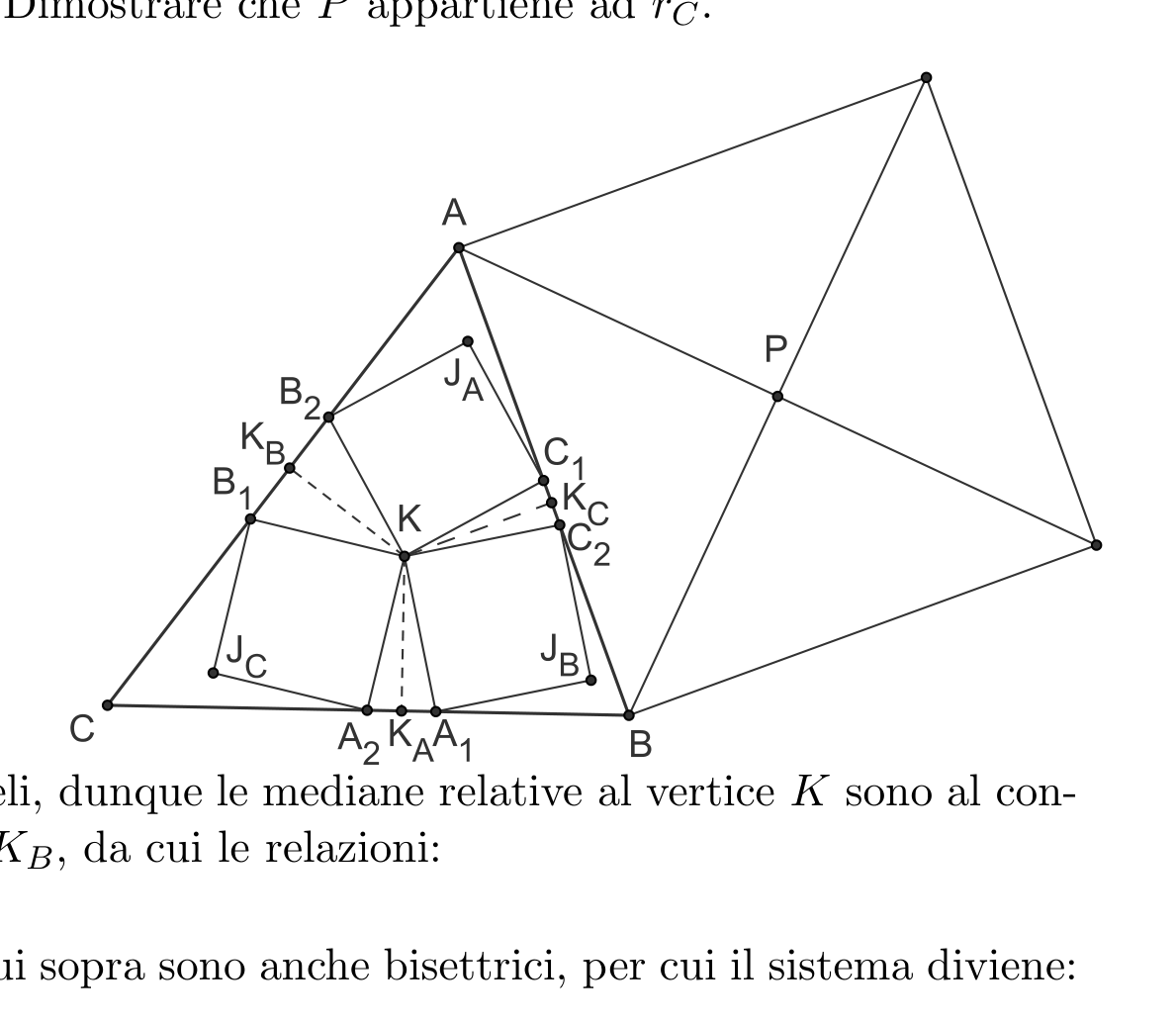
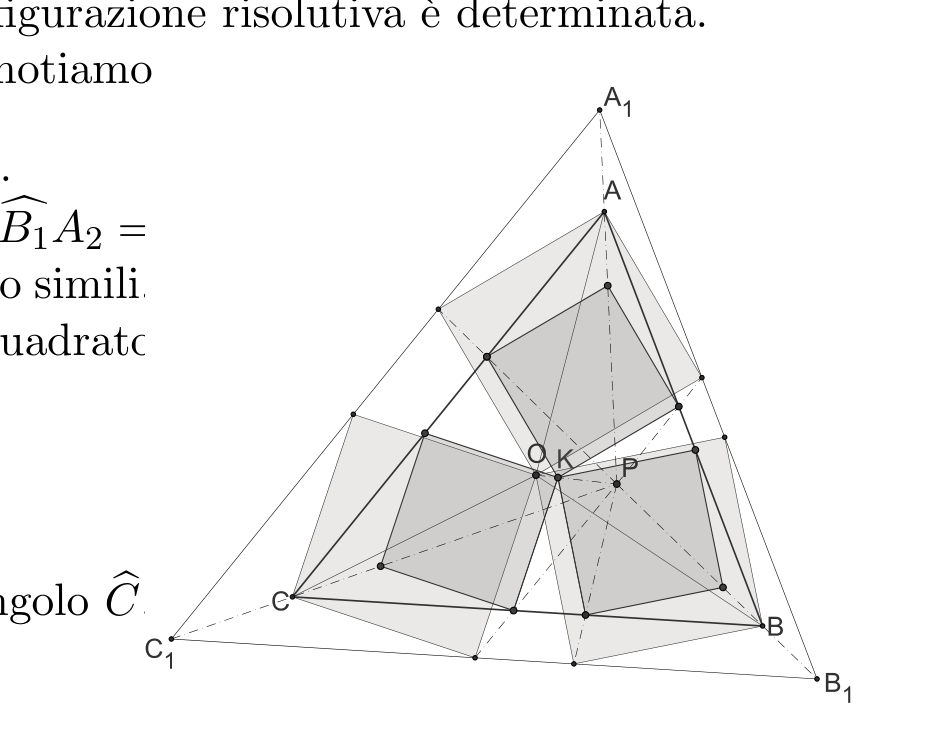
Sia ABC un triangolo con tutti gli angoli maggiori di 45°e minori di 90°. (a) Dimostrare che si possono disporre all’interno di ABC tre quadrati con le seguenti proprietà: • i tre quadrati hanno tutti lo stesso lato; • i tre quadrati hanno un vertice comune K interno al triangolo; • due quadrati qualsiasi non hanno punti in comune oltre a K; • ciascuno dei quadrati ha due vertici opposti sul perimetro di ABC e per il resto è tutto all’interno del triangolo ABC. (b) Sia P il centro del quadrato con lato AB ed esterno ad ABC. Sia rC la simmetrica della retta passante per C e K rispetto alla bisettrice di uscente da C. Dimostrare che P appartiene ad rC.
Topic: Geometria piana Metodo: Sfruttamento della simmetria Abilita: Ragionamento geometrico Area: Geometria Risposta: dimostrato Fonte: apri PDF p.3
three equal and direct squares rC
Whether ABC is a triangle with all the angles greater than 45° and less than 90°. (a) Demonstrate that three squares within ABC can be arranged with the following properties: • the three squares all have the same side; • the three squares have a common vertex K inside the triangle; • any two squares have no points in common beyond K; • each of the squares has two opposite vertices on the perimeter of ABC and for the rest is all within the triangle ABC. (b) Both P the center of the square with side AB and exterior to ABC. RC is the symmetry of the passing straight line for C and K with respect to the beam coming out of C. Prove that P belongs to rC.
Answer: dimostrato src_cesenatico_2008__Q05
strategia
Francesca e Giorgia fanno il seguente gioco. Su un tavolo ci sono inizialmente alcune colonne di monete. Ogni colonna contiene un certo numero di monete, che può eventualmente variare da colonna a colonna. A turno, ogni giocatrice fa una e una sola delle seguenti possibili mosse: • sceglie una colonna contenente un numero pari non nullo 2k di monete e la sostituisce con due colonne contenenti k monete ciascuna; • leva dal tavolo tutte le colonne contenenti un numero dispari di monete. Nel caso in cui non fosse possibile effettuare una mossa del primo tipo, la giocatrice ne farà necessariamente una del secondo tipo, e viceversa. Inizia Francesca. Vince chi prende dal tavolo l’ultima moneta. (a) Se inizialmente sul tavolo c’è una sola colonna, la quale contiene 20082008 monete, quale giocatrice ha una strategia vincente? (b) Per quali configurazioni iniziali Francesca ha una strategia vincente?
Topic: Logica, giochi, strategie Metodo: monovarianti Area: Combinatoria, Logica e Probabilita Risposta: (a) Francesca; (b) valore configurazione dispari Fonte: apri PDF p.4
The Commission shall adopt a decision on the implementation of this Regulation.
Francesca and Georgia play the following game. On a table there are initially some columns of coins. Each column contains a number of coins, which may vary from column to column. In turn, each player makes one and only one of the following possible moves: • selects a column containing a non-zero number of 2k coins and replaces it with two columns containing k coins each; • draws all columns containing an odd number of coins from the table. In the event that it is not possible to make a move of the first type, the player will necessarily make a move of the second type, and vice versa. Let’s start with Francesca. Whoever takes the last coin from the table wins. (a) If initially there is only one column on the table, which contains 2008-2008 coins, which player has a winning strategy? (b) For what initial configurations does Francesca have a winning strategy?
Answer: (a) Francesca; (b) valore configurazione dispari src_cesenatico_2008__Q06