Suddividere trapezio in m+n trapezi di area uguale, minimo m+n
È dato un trapezio con le basi lunghe 1 e 4, rispettivamente. Lo suddividiamo in due trapezi mediante un taglio parallelo alle basi, lungo 3. Vogliamo ora suddividere i due nuovi trapezi, sempre mediante tagli paralleli alle basi, in m ed n trapezi, rispettivamente, in modo che tutti gli m + n trapezi ottenuti abbiano la stessa area. Determinare il minimo valore possibile per m + n e le lunghezze dei tagli da effettuare per realizzare tale minimo valore.
Topic: Geometria piana Abilita: Ragionamento geometrico Area: Geometria Risposta: 15 (tagli lunghi sqrt2..sqrt15) Fonte: apri PDF p.1
To divide the trapezoid into m+n trapezoids of equal area, minimum m+n
A trapezoid is given with long bases 1 and 4, respectively. We divide it into two trapezoids by a cut parallel to the bases, length 3. We now want to divide the two new trapezoids, always by cutting parallel to the bases, into m and n trapezoids, respectively, so that all the m + n trapezoids obtained have the same area. Determine the minimum possible value for m + n and the lengths of the cuts to be made to achieve this minimum value.
Answer: 15 (tagli lunghi sqrt2..sqrt15) src_cesenatico_2011__Q01
Esistenza di due scalette con MCD termini =1 e >1
Una sequenza di interi positivi a1, a2, … , an è detta scaletta di lunghezza n se è composta da n numeri consecutivi, in ordine crescente. (a) Dimostrare che per ogni intero positivo n esistono due scalette di lunghezza n, senza elementi in comune, a1, a2, … , an e b1, b2, … , bn, tali che per ogni i tra 1 ed n il massimo comune divisore fra ai e bi è uguale a 1. (b) Dimostrare che per ogni intero positivo n esistono due scalette di lunghezza n, senza elementi in comune, a1, a2, … , an e b1, b2, … , bn, tali che per ogni i tra 1 ed n il massimo comune divisore fra ai e bi è maggiore di 1.
Topic: Teoria dei Numeri Metodo: Induzione Abilita: generalizzazione Area: Aritmetica e Teoria dei Numeri Fonte: apri PDF p.1
Existence of two scales with MCD terms =1 and >1
A sequence of positive integers a1, a2, … , an is called a length scale n if it consists of n consecutive numbers, in ascending order. (a) Demonstrate that for each positive integer n there are two length scales n, with no elements in common, a1, a2, … , an e b1, b2, … , bn, such that for each i between 1 and n the maximum common divisor between a and b is equal to 1. (b) Demonstrate that for every positive integer n there are two length scales n, with no elements in common, a1, a2, … , an e b1, b2, … , bn, such that for each i between 1 and n the maximum common divisor between a and b is greater than 1.
numero finale invariante per parita
Su una lavagna sono scritti dei numeri interi, compresi fra 1 e 7. È possibile che non tutti i numeri da 1 a 7 siano presenti, ed è anche possibile che uno, alcuni o tutti i numeri siano ripetuti, una o più volte. Una mossa consiste nello scegliere uno o più numeri presenti sulla lavagna, purch´e tutti diversi, cancellarli, e scrivere al loro posto i numeri che, unitamente a quelli cancellati, formano l’intero insieme {1, 2, 3, 4, 5, 6, 7}. Ad esempio, mosse consentite sono:
• cancellare un 4 ed un 5, e scrivere al loro posto i numeri 1, 2, 3, 6 e 7; • cancellare un 1, un 2, un 3, un 4, un 5, un 6 ed un 7 senza scrivere niente al loro posto. Dimostrare che, se è possibile trovare una sequenza di mosse che, partendo dalla situazione iniziale, porti ad avere sulla lavagna un unico numero (scritto una sola volta), allora questo numero non dipende dalla sequenza di mosse utilizzata.
Topic: Combinatoria Metodo: monovarianti Abilita: generalizzazione Area: Combinatoria, Logica e Probabilita Fonte: apri PDF p.1
Final number unchanged per parity
On a board are written whole numbers, ranging from 1 to 7. It is possible that not all numbers from 1 to 7 are present, and it is also possible that one, some or all numbers are repeated, one or more times. A move consists of choosing one or more numbers on the board, although they are all different, deleting them, and writing in their place the numbers that, together with those deleted, form the whole together {1, 2, 3, 4, 5, 6, 7}. For example, permitted moves are:
• delete a 4 and a 5, and write the numbers 1, 2, 3, 6 and 7 instead; • delete a 1, 2, 3, 4, 5, 6 and 7 without writing anything in their place. Demonstrate that, if you can find a sequence of moves that, starting from the initial situation, leads to having a single number (written only once) on the board, then this number does not depend on the sequence of moves used.
angoli e somme lati
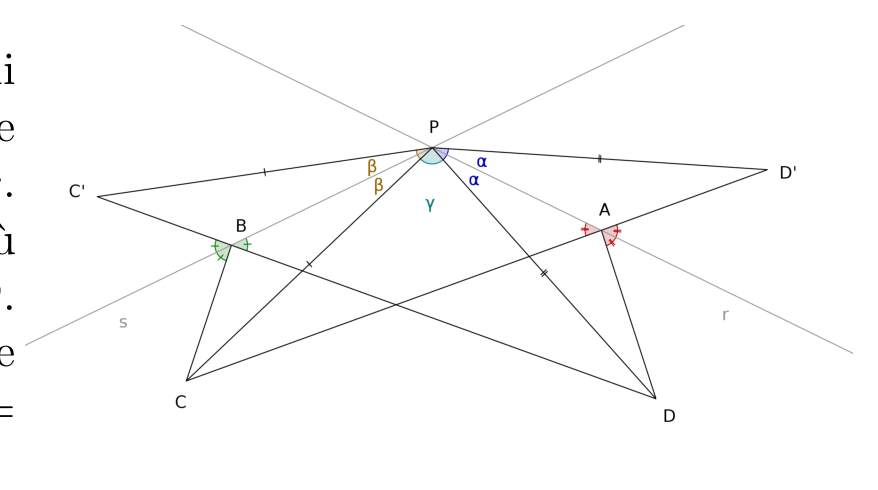
Sia ABCD un quadrilatero convesso. Sia P l’intersezione delle bisettrici esterne di e . Dimostrare che = se e solo se AD + AC = BC + BD. [Nota : Si ricorda che la bisettrice esterna ad un angolo è la retta passante per il vertice dell’angolo e perpendicolare alla bisettrice interna (cioè l’usuale bisettrice) dell’angolo stesso.]
Topic: Geometria piana Metodo: Sfruttamento della simmetria Abilita: Ragionamento geometrico Area: Geometria Fonte: apri PDF p.1
*angles and sides *
Let ABCD be a convex quadrilateral. Both P the intersection of the outer blades of and . Show that = if and only if AD + AC = BC + BD. [Note: Please note that the outer edge of an angle is the straight line passing through the top of the angle and perpendicular to the inner edge (i.e. the usual edge) of the angle itself.]
Soluzioni intere di n^3 = p^2 - p - 1 con p primo
Determinare tutte le soluzioni (p, n) dell’equazione n3 = p2 −p −1 dove p è un numero primo e n è un numero intero.
Topic: Teoria dei Numeri Metodo: Analisi per casi, manipolazione algebrica Abilita: Manipolazione algebrica Area: Aritmetica e Teoria dei Numeri Risposta: (2,1) e (37,11) Fonte: apri PDF p.1
*Integres of n^3 = p^2 - p - 1 with p prime *
Determine all solutions (p, n) of the equation n3 = p2 −p −1 where p is a prime number and n is an integer.
Answer: (2,1) e (37,11) src_cesenatico_2011__Q05
4 colori bastano, 3 no
Sia X = {1, 2, 3, 4, 5, 6, 7, 8}. Vogliamo colorare, usando k colori, tutti i sottoinsiemi di 3 elementi di X in modo tale che, comunque se ne scelgano due disgiunti, abbiano colori distinti. Dimostrare che: (a) 4 colori sono sufficienti; (b) 3 colori non sono sufficienti.
Topic: Combinatoria Metodo: parita Abilita: Casework accurato Area: Combinatoria, Logica e Probabilita Fonte: apri PDF p.1
4 colours are enough, 3 no
If X is equal to {1, 2, 3, 4, 5, 6, 7, 8}. We want to colour, using k colors, all the subset of 3 elements of X so that, however you choose two disjoint elements, they have distinct colors. Demonstrate that: (a) 4 colours are sufficient; (b) 3 colours are not sufficient.