velocita intere salita/piano/discesa
Un modellino di automobile viene testato su alcuni circuiti chiusi lunghi 600 metri, composti da tratti piani e tratti in salita o discesa. Tutti i tratti in salita e in discesa hanno la stessa pendenza. I test mettono in risalto alcuni fatti curiosi: (a) la velocità del modellino dipende solo dal fatto che la macchina stia percorrendo un tratto di salita, piano o discesa; chiamando rispettivamente vs, vp e vd queste tre velocità, si ha vs < vp < vd; (b) vs, vp e vd, espresse in metri al secondo, sono dei numeri interi; (c) comunque sia composto il circuito (con più o meno salite e discese) il tempo di percorrenza è sempre di 50 secondi. Trovare tutti i possibili valori di vs, vp e vd.
Topic: Algebra Abilita: Manipolazione algebrica Area: Algebra e Analisi Risposta: (10,12,15),(9,12,18),(8,12,24),(7,12,42) Fonte: apri PDF p.1
full speed up/down/down
An automobile model is tested on some 600-meter-long closed circuits, consisting of up- and down-level tracks. All up and down tracts have the same slope. The tests highlight some curious facts: (a) the speed of the model depends only on the fact that the machine is going up, down or down; calling respectively vs, vp and vd these three speeds, we have vs < vp < vd; (b) vs, vp and vd, expressed in meters per second, are integers; (c) however the circuit is composed (with more or less up and down) the travel time is always 50 seconds. Find all possible values of vs, vp and vd.
Answer: (10,12,15),(9,12,18),(8,12,24),(7,12,42) src_cesenatico_2013__Q01
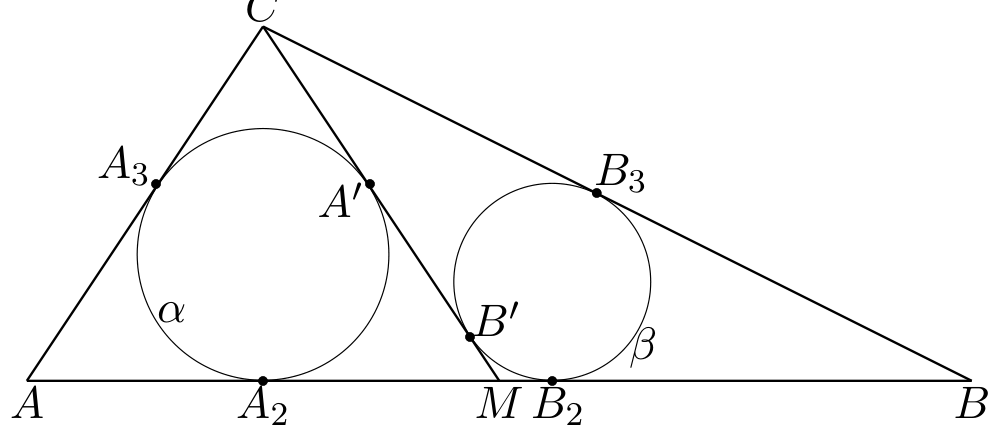
dimostrare A’B’=(a-b)/2
\begin{document}
\begin{tikzpicture}[scale=0.9]
  \coordinate (A) at (0,0);
  \coordinate (B) at (10,0);
  \coordinate (C) at (2.6,4.2);
  \coordinate (M) at (5,0);
  \coordinate (I1) at (2.551,1.421);
  \coordinate (I2) at (5.664,1.145);
  \coordinate (Ap) at (3.785,2.126);
  \coordinate (Bp) at (4.67,0.577);
  \draw (A)--(B)--(C)--cycle;
  \draw (C)--(M);
  \draw (I1) circle (1.421);
  \draw (I2) circle (1.145);
  \fill (Ap) circle (1.5pt) node[above right] {$A'$};
  \fill (Bp) circle (1.5pt) node[above right] {$B'$};
  \node[below left] at (A) {$A$};
  \node[below right] at (B) {$B$};
  \node[above] at (C) {$C$};
  \node[below] at (M) {$M$};
  \node at (2.0,1.0) {$\alpha$};
  \node at (5.7,0.6) {$\beta$};
\end{tikzpicture}
\end{document}
Nel triangolo ABC supponiamo di avere a > b, dove a = BC e b = AC. Sia M il punto medio di AB, e siano α e β le circonferenze inscritte, rispettivamente, ai triangoli ACM e BCM. Siano poi A′ e B′ i punti di tangenza di α e β con CM. Dimostrare che A′B′ = a −b 2 .
Topic: Geometria piana Metodo: Sfruttamento della simmetria Abilita: Ragionamento geometrico Area: Geometria Fonte: apri PDF p.1
to show A’B’=(a-b)/2
\begin{document}
\begin{tikzpicture}[scale=0.9]
  \coordinate (A) at (0,0);
  \coordinate (B) at (10,0);
  \coordinate (C) at (2.6,4.2);
  \coordinate (M) at (5,0);
  \coordinate (I1) at (2.551,1.421);
  \coordinate (I2) at (5.664,1.145);
  \coordinate (Ap) at (3.785,2.126);
  \coordinate (Bp) at (4.67,0.577);
  \draw (A)--(B)--(C)--cycle;
  \draw (C)--(M);
  \draw (I1) circle (1.421);
  \draw (I2) circle (1.145);
  \fill (Ap) circle (1.5pt) node[above right] {$A'$};
  \fill (Bp) circle (1.5pt) node[above right] {$B'$};
  \node[below left] at (A) {$A$};
  \node[below right] at (B) {$B$};
  \node[above] at (C) {$C$};
  \node[below] at (M) {$M$};
  \node at (2.0,1.0) {$\alpha$};
  \node at (5.7,0.6) {$\beta$};
\end{tikzpicture}
\end{document}
In the triangle ABC, let’s say we have a > b, where a = BC and b = AC. Both M the median point of AB and α and β are the circumferences inscribed respectively on the ACM and BCM triangles. The tangent points of α and β with CM are then A′ and B′. Show that A′B′ = a −b 2 .
esiste blocco di 2000 bilanciato
Ogni numero intero viene colorato con uno di due colori, rosso o blu. Sappiamo che, per ogni insieme finito A di interi consecutivi, il valore assoluto della differenza tra il numero degli interi rossi e il numero degli interi blu nell’insieme A è al più 1000. Dimostrare che esiste un insieme di 2000 interi consecutivi fra i quali ci sono esattamente 1000 numeri rossi e 1000 numeri blu.
Topic: Combinatoria Metodo: monovarianti Abilita: generalizzazione Area: Combinatoria, Logica e Probabilita Fonte: apri PDF p.1
- there is a balanced 2000 block*
Each whole number is colored with one of two colors, red or blue. We know that for every finite set A of consecutive integers, the absolute value of the difference between the number of red integers and the number of blue integers in the set A is at most 1000. Demonstrate that there is a set of 2000 consecutive integers among which there are exactly 1000 red numbers and 1000 blue numbers.
In quali basi 5654 e’ potenza di un primo
In quali basi b > 6 la scrittura 5654 rappresenta una potenza di un numero primo?
Topic: Teoria dei Numeri Metodo: manipolazione algebrica Abilita: Manipolazione algebrica Area: Aritmetica e Teoria dei Numeri Risposta: base 7 (2048=2^11) Fonte: apri PDF p.1
In which base 5654 is the power of a prime
In which bases b > 6 does the writing 5654 represent a power of a prime number?
Answer: base 7 (2048=2^11) src_cesenatico_2013__Q04
parallelismo e concorrenza di tre rette
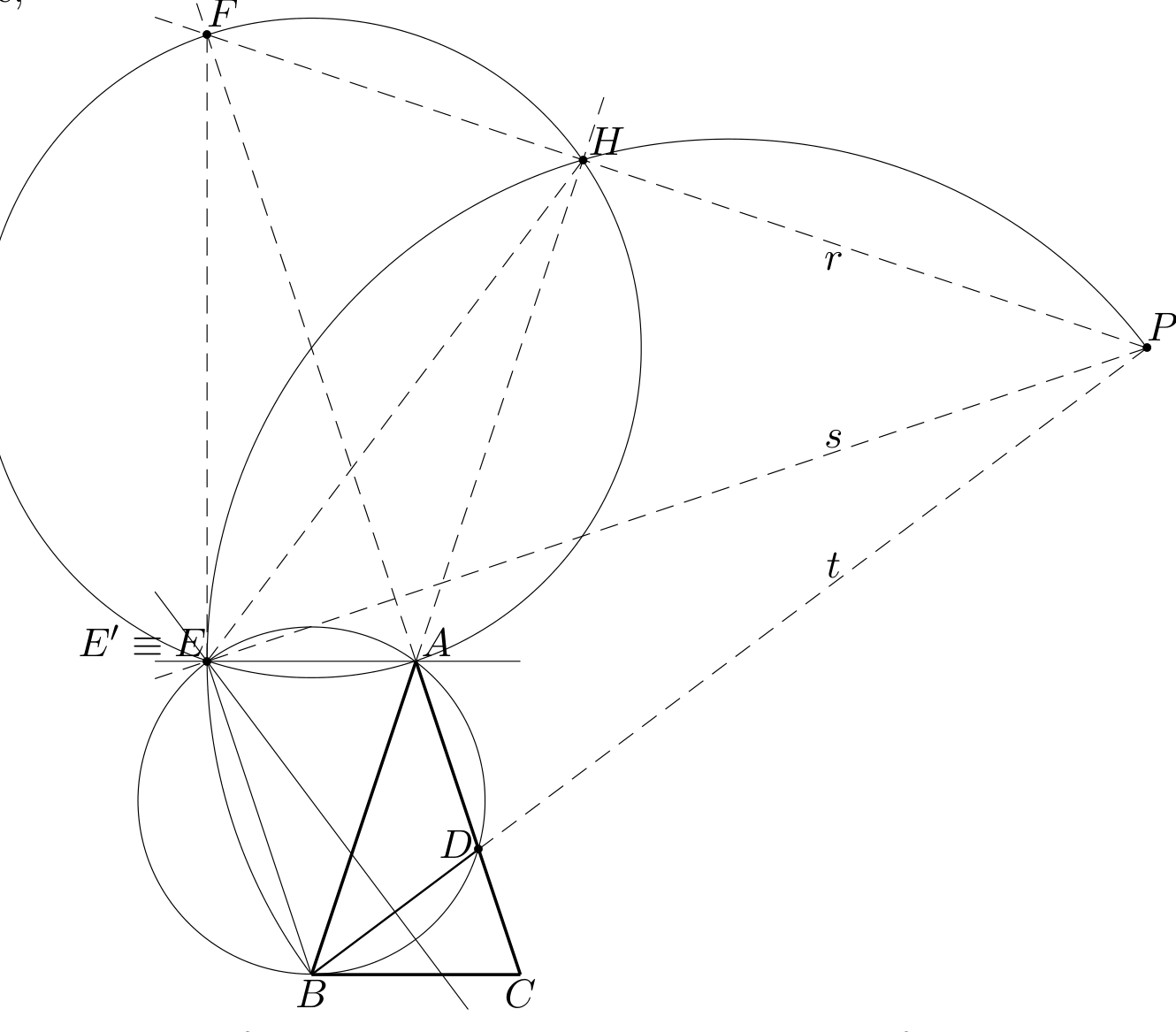
Dato un triangolo isoscele ABC con AB = AC e
BAC < 60o, sia D il punto su AC tale che
DBC =
BAC, sia E l’intersezione dell’asse di BD con la retta parallela a BC passante per A, e sia F il punto sulla retta AC, dalla parte di A rispetto a C, tale che la lunghezza di FA sia il doppio della lunghezza di AC. Infine, siano r la perpendicolare ad AB condotta da F, s la perpendicolare ad AC condotta da E, e t la retta BD. Dimostrare che: (a) le rette EB e AC sono parallele; (b) le rette r, s e t concorrono.
Topic: Geometria piana Metodo: Sfruttamento della simmetria Abilita: Ragionamento geometrico Area: Geometria Fonte: apri PDF p.1
*parallelism and competition of three sectors *
Given an isosceles triangle ABC with AB = AC and \ BAC < 60o, both D the point on AC such that \ DBC = \ BAC, both E the intersection of the BD axis with the straight line parallel to BC passing through A, and F the point on the straight AC, from the side of A with respect to C, such that the length of FA is twice the length of AC. Finally, be r the perpendicular to AB led by F, s the perpendicular to AC led by E, and t the straight BD. Demonstrate that: (a) the EB and AC directions are parallel; (b) the r, s and t directions compete.
per quali n la strategia funziona
Due maghi si esibiscono nel seguente numero. All’inizio il primo mago rinchiude il secondo mago in una cabina dove non possa n´e vedere n´e sentire nulla. Per iniziare il gioco, il primo mago invita Daniele, un membro del pubblico, a porre su ogni casella di una scacchiera n × n, a propria discrezione, una pedina bianca o nera. Dopodich´e chiede a Daniele di indicargli una casella C a sua scelta. A questo punto, il primo mago sceglie una casella D (non necessariamente diversa da C) e sostituisce la pedina che si trova su D con una dell’altro colore (bianca con nera o nera con bianca). Viene quindi aperta la cabina in cui era rinchiuso il secondo mago. Osservando la scacchiera, il secondo mago riesce a indovinare qual è la casella C. Per quali n i due maghi possono attuare una strategia tale che il loro numero riesca sempre?
Topic: Combinatoria, Logica, giochi, strategie Metodo: monovarianti Abilita: generalizzazione Area: Combinatoria, Logica e Probabilita Risposta: n potenza di due Fonte: apri PDF p.3
- for which the strategy works*
Two magicians perform in the following issue. At first, the first magician locks the second magician in a cabin where he can’t see or hear anything. To start the game, the first magician invites Daniel, a member of the audience, to put on each box of a chessboard a white or black board at his discretion. Then he asks Daniel to point him to a box C of his choice. At this point, the first magician chooses a box D (not necessarily different from C) and replaces the pedina on D with one of the other color (white with black or black with white). Then the cabin where the second magician was locked is opened. Looking at the chessboard, the second magician can guess what box C is. Which of the two magicians can implement a strategy that their numbers always succeed?
Answer: n potenza di due src_cesenatico_2013__Q06