Per quali n esiste multiplo di 2022 con n cifre 7 e resto 0
Determinare per quali interi positivi n esiste un intero positivo A tale che • A è multiplo di 2022, • l’espressione decimale di A contiene solo cifre 0 e 7, • l’espressione decimale di A contiene esattamente n volte la cifra 7.
Topic: Teoria dei Numeri Metodo: congruenze Abilita: Riconoscimento di pattern Area: Aritmetica e Teoria dei Numeri Risposta: multipli di 3 Fonte: apri PDF p.1
For which n is a multiple of 2022 with n digit 7 and remainder 0
Determine for which positive integers n there exists a positive integer A such that • A is multiple to 2022, • The decimal expression of A contains only digits 0 and 7, • The decimal expression of A contains exactly n times the number 7.
Answer: multipli di 3 src_cesenatico_2022__Q01
circonferenza per EFG tangente ad AC
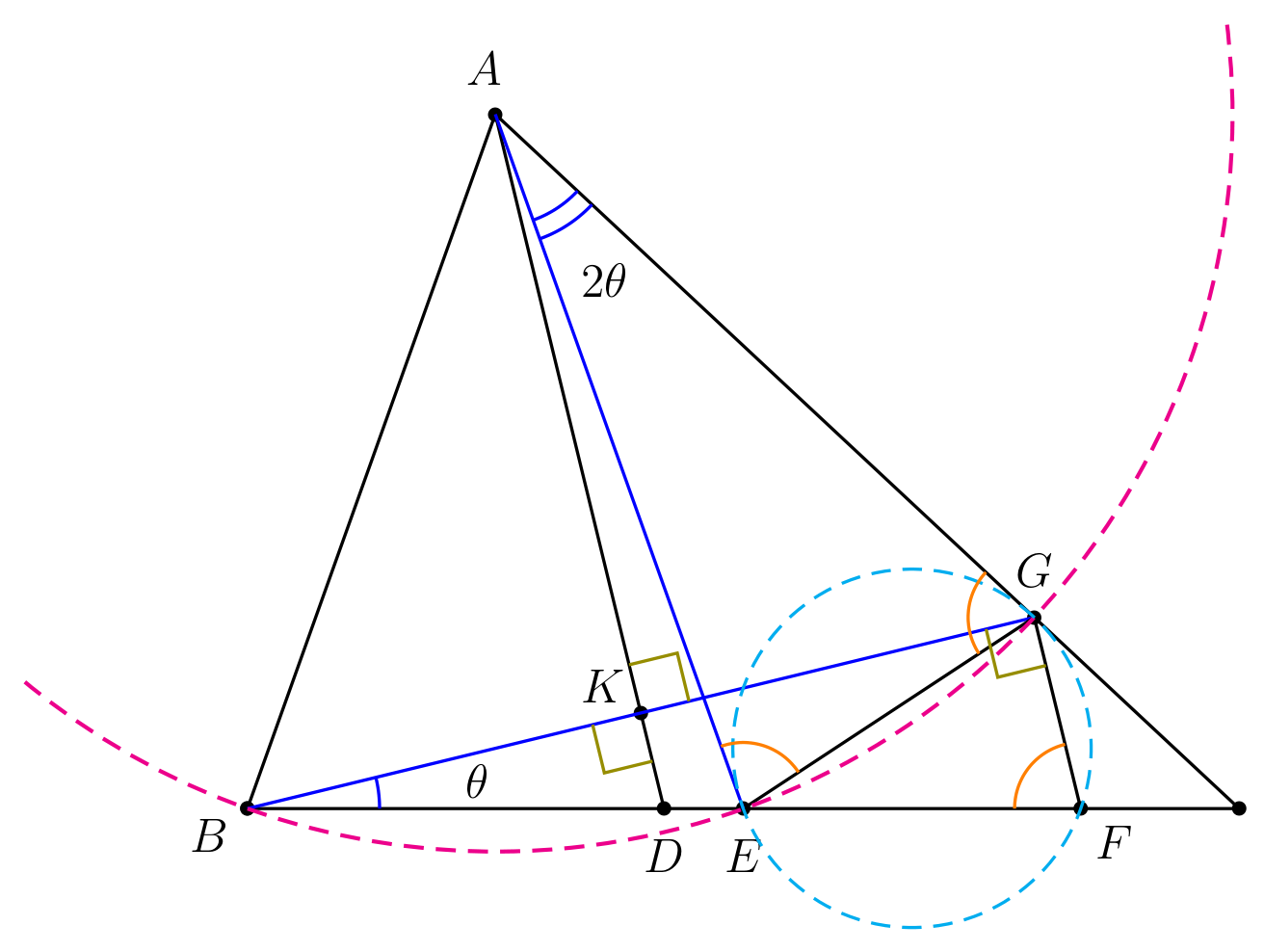
Sia ABC un triangolo acutangolo con AB < AC. Siano • D il piede della bisettrice dell’angolo in A, • E il punto del segmento BC (diverso da B) tale che AB = AE, • F il punto del segmento BC (diverso da B) tale che BD = DF, • G il punto del segmento AC tale che AB = AG. Dimostrare che la circonferenza circoscritta al triangolo EFG è tangente alla retta AC.
Topic: Geometria piana Metodo: Sfruttamento della simmetria Abilita: Ragionamento geometrico Area: Geometria Fonte: apri PDF p.1
circumference for EFG tangent to AC
Let’s say ABC is an acute triangle with AB < AC. They are • D the foot of the angle’s edge in A, • And the point of the segment BC (different from B) such that AB = AE, • F the point of the segment BC (different from B) such that BD = DF, • G the point of the segment AC such that AB = AG. Demonstrate that the circumference circumscribed to the EFG triangle is tangent to the straight AC.
chi prende la fetta piu grande
Ad una gara matematica partecipano n = 10 000 concorrenti. Alla festa conclusiva, in successione, il primo prende 1/n della torta, il secondo prende 2/n della torta rimanente, il terzo prende 3/n della torta che rimane dopo che il primo e il secondo si sono serviti, e così via fino all’ultimo, che prende tutta la torta rimanente. Determinare quale concorrente prende il pezzo di torta più grosso.
Topic: Algebra Metodo: Principio di estremalita Abilita: Manipolazione algebrica Area: Algebra e Analisi Risposta: il 100-esimo Fonte: apri PDF p.1
Who takes the biggest slice
In a mathematical competition, n = 10 000 competitors participate. At the closing party, in succession, the first takes 1/n of the cake, the second takes 2/n of the remaining cake, the third takes 3/n of the cake that remains after the first and second have been served, and so on until the last, who takes all the remaining cake. Determine which competitor gets the biggest piece of cake.
Answer: il 100-esimo src_cesenatico_2022__Q03
minimo domande per determinare ak
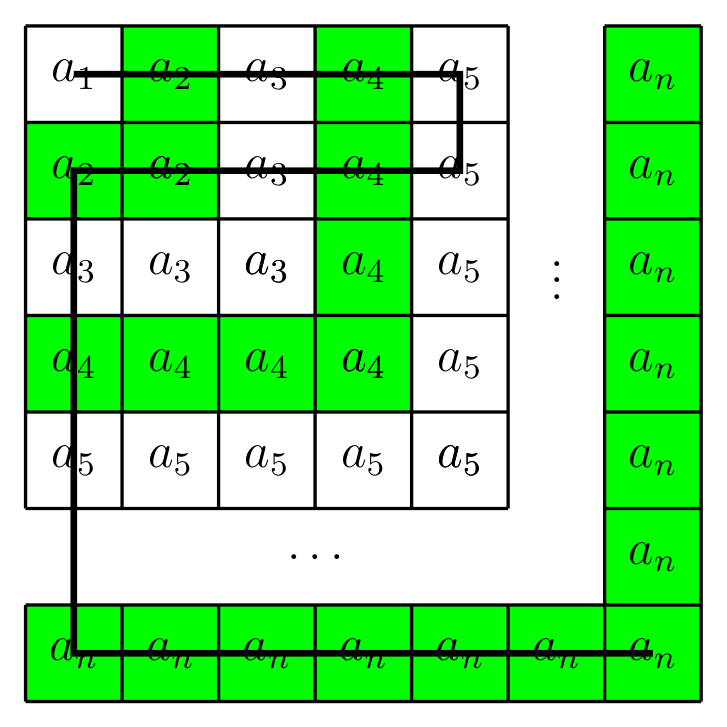
Alberto sceglie 2022 numeri interi a1, a2, … , a2022 (non necessariamente positivi e non necessariamente distinti) e li dispone su una tabella 2022 × 2022 in modo che nella casella (i, j) ci sia il numero ak, con k uguale al massimo tra i e j, come nella figura seguente (in cui, per maggior leggibilità, abbiamo indicato a2022 con an). a1 a2 a2 a3 a3 a3 a4 a4 a4 a4 a5 a5 a5 a5 a5 a2 a2 a3 a3 a3 a4 a4 a4 a4 a5 a5 a5 a5 a5 an an an an an an an an an an an an an … ... Olimpiade Italiana di Matematica 2022 — Testi e soluzioni — Pag.1 di 16
Barbara non conosce i numeri scelti da Alberto, ma sa come sono stati disposti nella tabella. Fissato un intero k, con 1 ≤k ≤2022, Barbara vuole determinare il valore di ak, mentre non le interessa determinare i valori degli altri ai con i ̸= k. Per farlo, Barbara può porre ad Alberto una o più domande, in ciascuna delle quali chiede ad Alberto quanto valga la somma dei numeri contenuti nelle caselle di un “percorso”, dove con il termine “percorso” si intende una lista ordinata di caselle con le seguenti caratteristiche: • il percorso inizia con la casella in alto a sinistra e finisce con la casella in basso a destra, • le caselle del percorso sono tutte distinte, • due caselle consecutive del percorso hanno sempre un lato in comune. Determinare, al variare di k, il numero minimo di domande necessarie a Barbara per determinare ak.
Topic: Combinatoria Metodo: Analisi per casi Abilita: generalizzazione Area: Combinatoria, Logica e Probabilita Risposta: 2 Fonte: apri PDF p.1
minimum questions to determine ak
Alberto chooses 2022 integers a1, a2, … , a2022 (not necessarily positive and not necessarily distinct) and sets them on a table 2022 × 2022 so that in box (i, j) there is the number ak, with k equal to the maximum between i and j, as in the following figure (in which, for greater readability, we have indicated a2022 with an). a1 a2 a2 a3 a3 a3 a4 a4 a4 a4 a5 a5 a5 a5 a5 a2 a2 a3 a3 a3 a4 a4 a4 a4 a5 a5 a5 a5 a5 an an an an an an an an an an an an an … ... Italian Olympic Games of Mathematics 2022 — Texts and solutions — Page 1 of 16
Barbara doesn’t know the numbers Alberto chose, but she knows how they were arranged in the table. Fitted an integer k, with 1 ≤k ≤2022, Barbara wants to determine the value of ak, while she is not interested in determining the values of the other a with the =k. To do this, Barbara can ask Albert one or more questions, each of which asks Albert how much the sum of the numbers contained in the boxes of a percorso is worth, where the term percorso means an ordered list of boxes with the following characteristics: • the path begins with the box above left and ends with the box below right, • the boxes of the path are all distinct, • two consecutive boxes of the path always have a side in common. Determine, when k varies, the minimum number of requests needed by Barbara to determine ak.
Answer: 2 src_cesenatico_2022__Q04
sottoinsiemi identificabili
Il robot “Mag-o-matic” manipola 101 bicchieri, disposti in una fila le cui posizioni sono numerate da 1 a 101. In ognuno dei bicchieri può trovarsi, oppure no, una pallina. Il robot Mag-o-matic accetta solo istruzioni elementari della forma (a; b, c), che interpreta come “considera il bicchiere in posizione a: se contiene una pallina, allora scambia tra di loro i bicchieri che si trovano nelle posizioni b e c (con il relativo eventuale contenuto), altrimenti passa all’istruzione successiva” (si intende che a, b, c sono interi compresi tra 1 e 101, con b e c diversi tra di loro, ma non necessariamente diversi da a). Un programma è una sequenza finita di istruzioni elementari, assegnate inizialmente, che Mag-o-matic esegue una dopo l’altra. Un sottoinsieme S ⊆{0, 1, 2, … , 101} si dice identificabile se esiste un programma che, a partire da una qualunque configurazione iniziale, produce una configurazione finale in cui il bicchiere in posizione 1 contiene una pallina se e solo se il numero dei bicchieri contenenti una pallina è un elemento di S. (a) Dimostrare che il sottoinsieme di {0, 1, … , 101} costituito dai numeri dispari è identificabile. (b) Determinare tutti i sottoinsiemi di {0, 1, … , 101} identificabili.
Topic: Combinatoria, Logica, giochi, strategie Metodo: monovarianti Abilita: generalizzazione Area: Combinatoria, Logica e Probabilita Risposta: S identificabile iff 0 non in S e 101 in S Fonte: apri PDF p.2
*identifiable subset *
The Mag-o-matic robot handles 101 glasses, arranged in a row whose positions are numbered from 1 to 101. There may or may not be a ball in each glass. The Mag-o-matic robot only accepts basic instructions of the form (a; b, c), which interprets how considers the glass in position a: if it contains a ball, then it exchanges between them the glasses in positions b and c (with the relevant content), otherwise it moves on to the subsequent instruction (it is understood that a, b, c are integers between 1 and 101, with b and c different between them, but not necessarily different from a). A program is a finite sequence of elementary instructions, assigned initially, that Mag-o-matic executes one after the other. A subset S ⊆{0, 1, 2, … , 101} is said to be identifiable if there is a program which, from any initial configuration, produces a final configuration in which the glass in position 1 contains a ball if and only if the number of glasses containing a ball is an element of S. (a) Demonstrate that the subset of {0, 1, … , 101} consisting of odd numbers can be identified. (b) Determine all subsets of {0, 1, … Identifiable.
Answer: S identificabile iff 0 non in S e 101 in S src_cesenatico_2022__Q05
P su circoscritta; perimetro
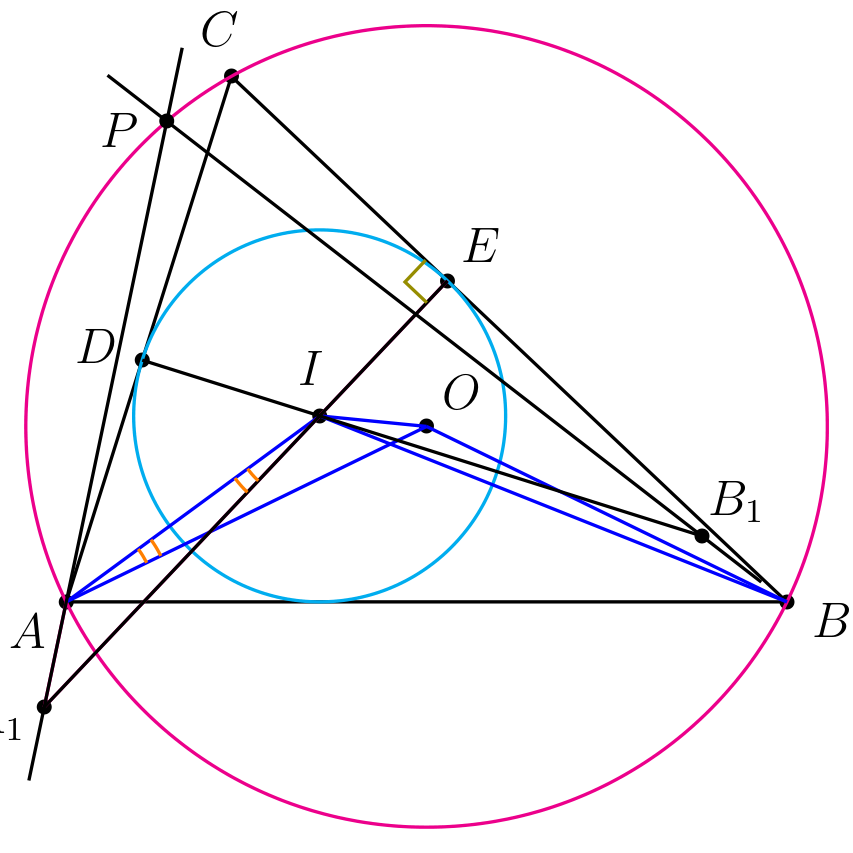
Sia ABC un triangolo non equilatero, e sia R il raggio della sua circonferenza circoscritta. La circonferenza inscritta ad ABC ha centro in I, ed è tangente al lato CA nel punto D, ed al lato CB nel punto E. Sia A1 il punto della retta EI tale che A1I = R, con I che sta tra A1 ed E. Sia B1 il punto della retta DI tale che B1I = R, con I che sta tra B1 e D. Sia P l’intersezione delle rette AA1 e BB1. (a) Dimostrare che P appartiene alla circonferenza circoscritta al triangolo ABC. (b) Supponiamo ora inoltre che AB = 1 e che P coincida con C. Determinare i possibili valori del perimetro di ABC.
Topic: Geometria piana, Trigonometria Metodo: Tecniche trigonometriche Abilita: Ragionamento geometrico Area: Geometria Risposta: perimetro tra 2 e 3 Fonte: apri PDF p.2
*P on a circumscribed basis; perimeter *
Let ABC be a non-equilateral triangle, and let R be the radius of its circumscribed circumference. The circumference inscribed in ABC is centered in I, and is tangent to the CA side at point D, and to the CB side at point E. So either A1 is the point of the line EI such that A1I = R, with I standing between A1 and E. Both B1 and B1I = R, with I standing between B1 and D. Both the AA1 and BB1 intersection. (a) Demonstrate that P belongs to the circumscribed circumference of the triangle ABC. (b) Now let’s also assume that AB = 1 and P is C. Determine the possible values of the perimeter of ABC.
Answer: perimetro tra 2 e 3 src_cesenatico_2022__Q06