Differenza massima tra due angoli di triangolo scaleno intero
Un triangolo scaleno e con area diversa da zero ha tutti gli angoli con misura un numero intero positivo di gradi. Quanto vale, al massimo, la differenza in gradi tra due angoli? A) 175 B) 179 C) 178 D) 177 E) 176 La risposta corretta è la E Con le condizioni descritte non si può avere un angolo di misura 0°. Dette 𝛼< 𝛽< 𝛾 le misure in gradi dei tre angoli, risulta 𝛾= 180 −𝛼−𝛽 da cui la differenza fra il maggiore e il minore risulta uguale a 𝛾−𝛼= 180 − 2𝛼−𝛽 e quindi conviene prendere 𝛼 il più piccolo possibile (𝛼= 1) e analogamente 𝛽 il più piccolo possibile (𝛽= 2, in quanto se fosse 𝛽= 1 il triangolo sarebbe isoscele). Da cui ne consegue che 𝛾−𝛼= 180 −2 −2 = 176.
Topic: Geometria piana, Teoria dei Numeri Metodo: Principio di estremalita Abilita: Casework accurato Area: Aritmetica e Teoria dei Numeri, Geometria Risposta: E Fonte: apri PDF p.1
Maximum difference between two angles of an integer scalene triangle
A slope triangle with an area other than zero has all the angles measuring a positive integer number of degrees. What is the difference in degrees between two angles, at most? A) 175 B) 179 C) 178 D) 177 E) 176 The correct answer is E Under the conditions described you cannot have a measuring angle 0°. Given α< β< γ the measurements in degrees of the three angles, the result is γ= 180 −α−β from which the difference between the major and the minor is equal to γ−α= 180 − 2α−β and therefore it is advisable to take α as small as possible (α= 1) and similarly β as small as possible (β= 2, since if β= 1 the triangle would be isosceles). Hence it follows that γ−α = 180 −2 −2 = 176.
Answer: E src_garaprime_2024__Q01
Numero massimo di cavalieri sull’isola di furfanti e cavalieri
Sull’isola dei furfanti (che mentono sempre) e dei cavalieri (che dicono sempre il vero) vivono 10 persone. Cinque di queste stanno zitte mentre ognuna delle altre cinque fa un’affermazione: “Qui siamo tutti furfanti!”; “Qui siamo tutti cavalieri!”; “Almeno 4 di noi sono furfanti”; “Esattamente 6 di noi sono furfanti”; “Al massimo 5 di noi sono cavalieri”. Quanti sono al massimo i cavalieri nell’isola? A) 5 B) 4 C) 6 D) 8 E) 7 La risposta corretta è la C Analizziamo ciascuna affermazione. La persona che afferma “Qui siamo tutti furfanti” non può essere un cavaliere (altrimenti direbbe il vero, e quindi le 10 persone sarebbero tutte furfanti, contro l’ipotesi che lui è un cavaliere) e quindi è un furfante. D’altro canto, anche la seconda persona è un furfante, perché non è vero che sono tutti cavalieri (abbiamo appena osservato che la prima persona che parla è un furfante). Se la terza persona fosse un furfante, i furfanti sarebbero al più 3, ma allora la persona successiva dovrebbe essere un cavaliere e dire la verità (ci sono esattamente 6 furfanti), mentre abbiamo appena detto che i furfanti sono al più 3. Dunque la terza persona deve essere un cavaliere: pertanto, ci sono almeno 4 furfanti e, di conseguenza, il numero dei cavalieri è al massimo 6. La presenza di 4 furfanti e 6 cavalieri è compatibile con le ultime due affermazioni: in particolare, se gli ultimi due sono furfanti, ci sono esattamente 4 furfanti e 6 cavalieri (la terza persona e tutti quelli che non hanno parlato).
Topic: Logica, giochi, strategie Metodo: Analisi per casi Abilita: Casework accurato Area: Combinatoria, Logica e Probabilita Risposta: C Fonte: apri PDF p.1
Maximum number of knights on the island of crooks and knights
On the island of thieves (who always lie) and knights (who always tell the truth) live 10 people. Five of these are silent while each of the other five makes a statement: Here we are all cunning!; Here we are all knights!; At least 4 of us are cunning; Exactly 6 of us are cunning; No more than 5 of us are knights. How many knights are there on the island? A) 5 B) 4 C) 6 D) 8 E) 7 The correct answer is C We analyse each statement. The person who says Here we are all cunning cannot be a knight (otherwise he would tell the truth, and so the 10 people would all be cunning, against the assumption that he is a knight) and so he is a cunning. On the other hand, even the second person is a con man, because it is not true that they are all knights (we have just observed that the first person speaking is a con man). If the third person was a crook, the crooks would be at most 3, but then the next person should be a knight and tell the truth (there are exactly 6 crooks), whereas we just said that crooks are at most 3. So the third person has to be a knight: therefore, there are at least 4 thieves and, consequently, the number of knights is at most 6. The presence of 4 thieves and 6 knights is compatible with the last two statements: in particular, if the last two are thieves, there are exactly 4 thieves and 6 knights (the third person and all those who did not speak).
Answer: C src_garaprime_2024__Q02
Quante cinquine consecutive con media pari e prodotto mult 11 e 13
Cinque numeri interi positivi consecutivi, minori di 100, sono tali che la loro media è un numero intero pari e il loro prodotto è un multiplo sia di 11 che di 13. Quante cinquine sono possibili? A) 4 B) 7 C) 5 D) 6 E) 8 La risposta corretta è la E Indichiamo i cinque numeri con 𝑥−2, 𝑥−1, 𝑥, 𝑥+ 1, 𝑥+ 2, con 𝑥> 2 e 𝑥< 98. La media risulta (𝑥−2)+(𝑥−1)+𝑥+(𝑥+1)+(𝑥+2) 5
5𝑥 5 = 𝑥, dunque 𝑥 deve essere pari. Si verifica facilmente che gli unici valori che può assumere la 𝑥 e che permettono di avere un prodotto multiplo sia di 11 che di 13 sono 𝑥= 12, 24, 54, 64, 66, 76, 78, 90, vale a dire 8 valori.
Topic: Teoria dei Numeri Metodo: Analisi per casi Abilita: Conteggio sistematico Area: Aritmetica e Teoria dei Numeri Risposta: E Fonte: apri PDF p.2
How many consecutive fifty with equal mean and product mult 11 and 13
Five consecutive positive integers, less than 100, are such that their mean is an even integer and their product is a multiple of both 11 and 13. How many fifty are possible? A) 4 B) 7 C) 5 D) 6 E) 8 The correct answer is E Let’s show the five numbers with x−2, x−1, x, x+1, x+2, with x>2 and x<98. The mean is (x−2)+(x−1)+x+(x+1)+(x+2) 5 = 5x 5 = x, so x must be equal. It is easy to see that the only values that x can take and that allow for a multiple product of both 11 and 13 are x=12, 24, 54, 64, 66, 76, 78, 90, i.e. 8 values.
Answer: E src_garaprime_2024__Q03
Massimo n per poligono con angoli in progressione di 30
Simone mette in ordine crescente le misure degli angoli interni di un poligono convesso di 𝑛 lati (con 𝑛> 2), ed osserva che ogni angolo, a partire dal secondo, misura 30° in più rispetto al precedente. Quanto può valere al massimo 𝑛? A) 5 B) 3 C) 4 D) 6 E) 8 La risposta corretta è la A Chiamiamo con 𝑥> 0 la misura in gradi dell’angolo più piccolo in modo che gli altri angoli misurano in ordine 𝑥+ 30°, 𝑥+ 60°, 𝑥+ 90°, 𝑥+ 120°, 𝑥+ 150°. Sicuramente non è possibile andare avanti perché già 𝑥+ 180° > 180° e il poligono non sarebbe più convesso. Dunque per ora escludiamo 𝑛> 6. Si osserva che con 𝑛= 6 non è possibile costruire un poligono che soddisfi anche la condizione della somma degli angoli 𝑆= (6 −2) ∙ 180° = 720°. Infatti 𝑥+ (𝑥+ 30°) + (𝑥+ 60°) + (𝑥+ 90°) + (𝑥+ 120°) + (𝑥+ 150°) = 6𝑥+ 450° = 720°, da cui 𝑥= 45°. In questo modo però l’ultimo angolo misura 45° + 150° = 195° > 180°, quindi 𝑛= 6 non va bene. Provando con 𝑛= 5 si ottiene 5𝑥+ 300° = 540°, da cui 𝑥= 48° e l’angolo più grande vale 48° + 120° = 168° < 180°, quindi 𝑛= 5 va bene ed è la soluzione.
Topic: Geometria piana, Algebra Abilita: Manipolazione algebrica Area: Algebra e Analisi, Geometria Risposta: A Fonte: apri PDF p.2
Maximum n per polygon with angles in progression of 30
Simone puts in increasing order the measurements of the inner angles of a convex polygon of n sides (with n> 2), and observes that each angle, starting from the second, measures 30° more than the previous one. What is the maximum value of n? A) 5 B) 3 C) 4 D) 6 E) 8 The correct answer is A Let’s call with x> 0 the degree measurement of the smallest angle so that the other angles measure in order x+ 30°, x+ 60°, x+ 90°, x+ 120°, x+ 150°. Surely it is not possible to proceed because already x+ 180° > 180° and the polygon would no longer be convex. So for now we’re going to exclude n>6. It is noted that with n=6 it is not possible to construct a polygon that also satisfies the condition of sum of the angles S= (6 −2) ∙ 180° = 720°. In fact x+ (x+ 30°) + (x+ 60°) + (x+ 90°) + (x+ 120°) + (x+ 150°) = 6x+ 450° = 720°, where x= 45°. This way, however, the last angle measures 45° + 150° = 195° > 180°, so n= 6 is not good. Trying with n=5 you get 5x+ 300° = 540°, where x= 48° and the largest angle is 48° + 120° = 168° < 180°, so n= 5 is fine and that’s the solution.
Answer: A src_garaprime_2024__Q04
Misura di HK in rettangolo diviso in tre congruenti
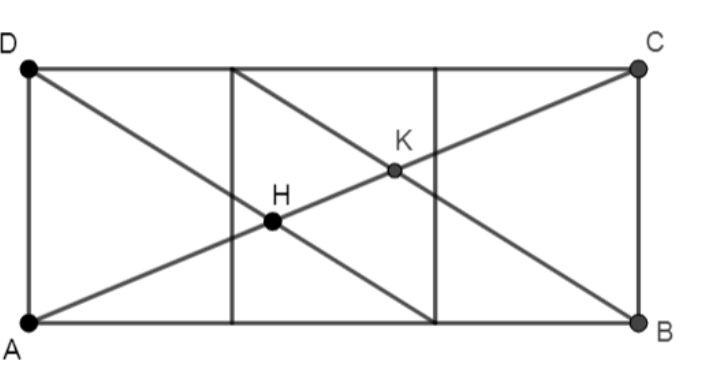
Il rettangolo in figura è suddiviso in tre rettangoli congruenti, ciascuno di base 20 cm e altezza 25 cm. Determina la misura di 𝐻𝐾 in cm. A) 14 B) 12 C) 13 D) 10 E) 11 La risposta corretta è la C Si tracciano le parallele a 𝐷𝑄 e a 𝑇𝐵 (da P e da R) come in figura. Dalla congruenza tra 𝐴𝑃, 𝑃𝑄 e 𝑄𝐵 segue la congruenza tra 𝐴𝑆, 𝑆𝐻 e 𝐻𝐾 (per Talete). Analogamente dalla congruenza di 𝐷𝑇, 𝑇𝑅 e 𝑅𝐶 segue la congruenza tra 𝐻𝐾, 𝐾𝑈 e 𝑈𝐶. Risulta così essere 𝐻𝐾= 1 5 𝐴𝐶. Per Pitagora 𝐴𝐶= √602 + 252 = 65 cm, dunque 𝐻𝐾= 13 cm.
Topic: Geometria piana Abilita: Ragionamento geometrico Area: Geometria Risposta: C Fonte: apri PDF p.2
*Measure of HK in rectangle divided into three congruent *
The rectangle in the figure is divided into three congruent rectangles, each 20 cm base and 25 cm high. Determine the size of HK in cm. A) 14 B) 12 C) 13 D) 10 E) 11 The correct answer is C The parallels to DQ and TB (from P to R) are drawn as shown in Figure 1. From the congruence between AP, PQ and QB follows the congruence between AS, SH and HK (for Talete). Similarly from the congruence of DT, TR and RC follows the congruence between HK, KU and UC. So it turns out that HK is equal to 15 AC. For Pythagoras AC= √602 + 252 = 65 cm, so HK= 13 cm.
Answer: C src_garaprime_2024__Q05
Lunghezza PB in triangolo rettangolo con angoli 30-60
\begin{document}
\begin{tikzpicture}
  \coordinate (B) at (0,0);
  \coordinate (A) at (5.196,0);
  \coordinate (C) at (0,3);
  \coordinate (P) at (1.732,0);
  \draw (A) -- (B) -- (C) -- cycle;
  \draw (C) -- (P);
  \draw (0,0.3) -- (0.3,0.3) -- (0.3,0);
  \fill (A) circle (2pt);
  \fill (B) circle (2pt);
  \fill (C) circle (2pt);
  \fill (P) circle (2pt);
  \node[below right] at (A) {$A$};
  \node[below left] at (B) {$B$};
  \node[above left] at (C) {$C$};
  \node[below] at (P) {$P$};
\end{tikzpicture}
\end{document}
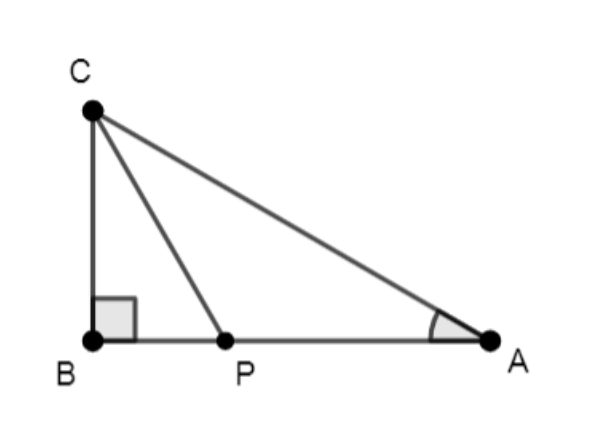
Sia 𝐴𝐵𝐶 un triangolo con 𝐵̂ = 90°, 𝐴̂ = 30°, e sia 𝑃 un punto di 𝐴𝐵 tale che l’angolo 𝐶𝑃̂𝐵 sia uguale a 60°. Se 𝐴𝑃= 30 cm, quanto è lungo 𝑃𝐵 in cm? A) 10 B) 15 C) 20 D) 25 E) 30
La risposta corretta è la B Si consideri il triangolo 𝐴𝑃𝐶. Esso è isoscele sulla base 𝐴𝐶 in quanto 𝐴̂ = 30° per ipotesi, 𝐴𝑃̂𝐶= 180° −60° = 120° e quindi 𝐴𝐶̂𝑃= 30°. Il triangolo 𝐵𝑃𝐶 è la metà di un triangolo equilatero, con 𝑃𝐶= 30 cm e 𝑃𝐵, essendo il lato opposto a 𝐵𝐶̂𝑃= 30°, è uguale a metà ipotenusa, vale a dire 15 cm.
Topic: Geometria piana Abilita: Ragionamento geometrico Area: Geometria Risposta: B Fonte: apri PDF p.2
Length PB in rectangular triangle with angles of 30-60
\begin{document}
\begin{tikzpicture}
  \coordinate (B) at (0,0);
  \coordinate (A) at (5.196,0);
  \coordinate (C) at (0,3);
  \coordinate (P) at (1.732,0);
  \draw (A) -- (B) -- (C) -- cycle;
  \draw (C) -- (P);
  \draw (0,0.3) -- (0.3,0.3) -- (0.3,0);
  \fill (A) circle (2pt);
  \fill (B) circle (2pt);
  \fill (C) circle (2pt);
  \fill (P) circle (2pt);
  \node[below right] at (A) {$A$};
  \node[below left] at (B) {$B$};
  \node[above left] at (C) {$C$};
  \node[below] at (P) {$P$};
\end{tikzpicture}
\end{document}
Whether ABC is a triangle with B̂ = 90°, Â = 30°, and whether P is a point of AB such that the angle CP̂B is equal to 60°. If AP is 30 cm, how long is PB in cm? A) 10 B) 15 C) 20 D) 25 E) 30
The correct answer is B. Consider the APC triangle. It is isosceles on the basis of AC as  = 30° for assumptions, AP̂C= 180° −60° = 120° and therefore AĈP= 30°. The BPC triangle is the half of an equilateral triangle, with PC=30 cm and PB, being the opposite side to BĈP= 30°, is equal to half hypotenuse, i.e. 15 cm.
Answer: B src_garaprime_2024__Q06
Area del triangolo BCQ nel giardino di Santina
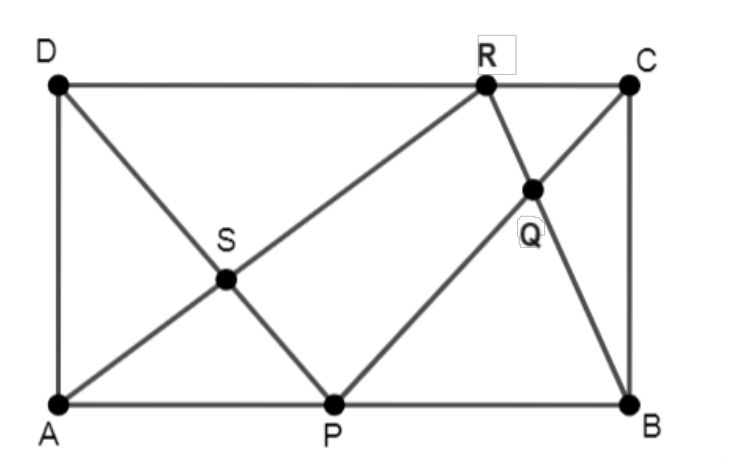
Il giardino di Santina ha la forma di un rettangolo e viene suddiviso in 7 zone nel modo indicato in figura. Sappiamo solo che il triangolo 𝐴𝑆𝐷 ha area 47 m2 e il quadrilatero 𝑆𝑃𝑄𝑅 ha area 89 m2. Quanto misura, in m2, l’area del triangolo 𝐵𝐶𝑄? A) 46 B) 42 C) 40 D) i dati non sono sufficienti
E) nessuna delle precedenti La risposta corretta è la B Avendo la stessa base e la stessa altezza, triangoli 𝐴𝑃𝐷 e 𝐴𝑃𝑅 hanno la stessa area, pertanto, per differenza (sottraendo ad entrambi l’area di 𝐴𝑃𝑆), risultano equivalenti 𝐴𝑆𝐷 e 𝑆𝑃𝑅; lo stesso può dirsi dei triangoli 𝑅𝑃𝑄 e 𝐵𝐶𝑄. Poiché l’area di 𝑅𝑃𝑄 è 89 −47 = 42 m2, anche l’area di 𝐵𝐶𝑄 sarà 42 m2.
Topic: Geometria piana Metodo: Sfruttamento della simmetria Abilita: Ragionamento geometrico Area: Geometria Risposta: B Fonte: apri PDF p.3
Area of the BCQ triangle in the garden of Santina
The garden of Santina is in the shape of a rectangle and is divided into 7 zones as shown in the figure. All we know is that the ASD triangle has an area of 47 m2 and the SPQR quadrilateral has an area of 89 m2. What is the area of the BCQ triangle in m2? A) 46 B) 42 C) 40 D) the data are insufficient E) none of the above The correct answer is B Having the same base and the same height, APD and APR triangles have the same area, therefore, by difference (subtracting from both the APS area), ASD and SPR are equivalent; the same can be said of RPQ and BCQ triangles. Since the area of RPQ is 89 −47 = 42 m2, the area of BCQ will also be 42 m2.
Answer: B src_garaprime_2024__Q07
Somma cifre unita delle potenze di 2024
Qual è la somma delle cifre delle unità dei numeri 2024, 20242, 20243, … , 20242024 ? A) 10120 B) 10000 C) 8096 D) 12144 E) 102024 La risposta corretta è la A Sia 1 ≤𝑘≤1012. La cifra dele unità di 20242𝑘−1 è uguale a 4, mentre quella di 20242𝑘 è uguale a 6. Pertanto la somma cercata è uguale a 4 ∙1012 + 6 ∙1012 = 1012 ∙(4 + 6) = 1012 ∙10 = 10120.
Topic: Teoria dei Numeri Metodo: congruenze Abilita: Riconoscimento di pattern Area: Aritmetica e Teoria dei Numeri Risposta: A Fonte: apri PDF p.3
Sum of power units for 2024
What is the sum of the digits of the units of the numbers 2024, 20242, 20243, … , 20242024 ? A) 10120 B) 10000 C) 8096 D) 12144 E) 102024 The correct answer is A Be 1 ≤k≤1012. The unit figure of 20242k−1 is equal to 4, while that of 20242k is equal to 6. So the sum you’re looking for is equal to 4 ∙1012 + 6 ∙1012 = 1012 ∙(4 + 6) = 1012 ∙10 = 10120.
Answer: A src_garaprime_2024__Q08
Perimetro del dodecagono attorno a esagono regolare
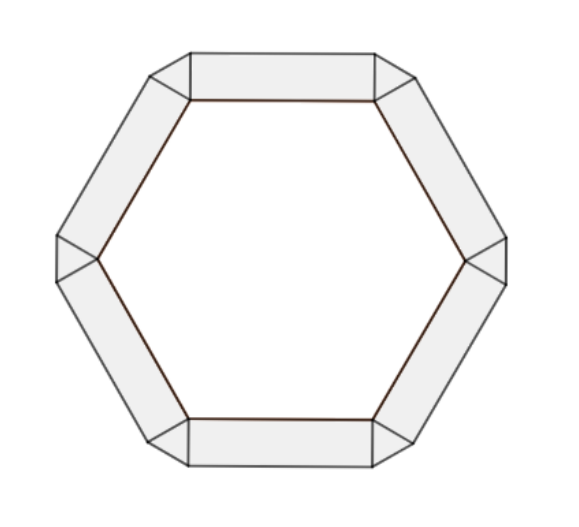
La siepe del giardino sotto casa di Lorenzo ha forma di esagono regolare ed è delimitata da un muretto il cui bordo più esterno ha forma dodecagonale composto da 6 rettangoli, tutti uguali tra loro e ciascuno di perimetro 20 m, e 6 triangoli, come mostrato in figura. Quanto vale il perimetro del dodecagono (in metri)? A) 60 B) 70 C) 48 D) 54 E) 115 2 ⁄
La risposta corretta è la A Poiché l’esagono è regolare, ciascun angolo interno vale (6−2)∙180° 6 = 120°. Di conseguenza ciascun triangolo ha l’angolo in corrispondenza del vertice condiviso con un vertice dell’esagono di 360° −2 ∙90° −120° = 60°. Inoltre, essendo i rettangoli tutti uguali tra loro, i triangoli hanno i lati coincidenti con i lati dei rettangoli uguali, e dunque sono triangoli equilateri. Ne consegue che il perimetro del dodecagono, essendo formato da sei lati lunghi e sei lati corti dei rettangoli, è lungo tre volte il perimetro di un rettangolo, vale a dire 20 ∙3 = 60 m.
Topic: Geometria piana Abilita: Ragionamento geometrico Area: Geometria Risposta: A Fonte: apri PDF p.3
Perimeter of the dodecahedron around the regular hexagon
The hedge of the garden beneath Lorenzo’s house has the shape of a regular hexagon and is bounded by a wall whose outer edge has a dodecagonal shape consisting of 6 rectangles, all equal to each other and each perimeter 20 m, and 6 triangles, as shown in the figure. What is the perimeter of the dodecahedron (in meters)? A) 60 B) 70 C) 48 D) 54 E) 115 2 ⁄ The correct answer is A Because the axis is regular, each inner angle is (6−2) ∙180° 6 = 120°. Consequently, each triangle has the angle corresponding to the shared summit with a summit of the hexagon of 360° −2 ∙90° −120° = 60°. Furthermore, since the rectangles are all equal to each other, triangles have sides that coincide with the sides of the same rectangles, and are therefore equilateral triangles. It follows that the perimeter of the dodecahedron, being formed by six long sides and six short sides of rectangles, is three times the perimeter of a rectangle, i.e. 20 ∙3 = 60 m.
Answer: A src_garaprime_2024__Q09
Minimo numero di monete in 12 tasche con conteggi distinti
La giacca di Sandro ha 12 tasche. Quante monete deve possedere Sandro, come minimo, se vuole disporle nelle tasche in modo che ogni tasca contenga un numero diverso di monete? Si tenga presente che una tasca potrebbe anche essere vuota. A) 64 B) 55 C) 66 D) 72 E) 78
La risposta corretta è la C Nella prima tasca possono non essere messe monete, nella seconda tasca 1 moneta, nella terza tasca 2 monete, nella quarta tasca 3 monete e così via fino ad arrivare alla dodicesima tasca dove possono essere messe 11 monete. Ne consegue che il numero minimo di monete possedute deve essere uguale a 1 + 2 + 3 + ⋯+ 11 = 11∙12 2
Topic: Combinatoria Abilita: Conteggio sistematico Area: Combinatoria, Logica e Probabilita Risposta: C Fonte: apri PDF p.3
Minimum number of coins in 12 pockets with separate counts
Sandro’s jacket has 12 pockets. How many coins does Sandro have to have, at least, if he wants to put them in his pockets so that each pocket contains a different number of coins? Keep in mind that a pocket may also be empty. A) 64 B) 55 C) 66 D) 72 E) 78
The correct answer is C In the first pocket you can not put coins, in the second pocket 1 coin, in the third pocket 2 coins, in the fourth pocket 3 coins and so on until you get to the 12th pocket where you can put 11 coins. It follows that the minimum number of coins owned must be equal to 1 + 2 + 3 + + 11 = 11∙12 2 = 66.
Answer: C src_garaprime_2024__Q10
Area di figura ottenuta togliendo rettangoli da un quadrato
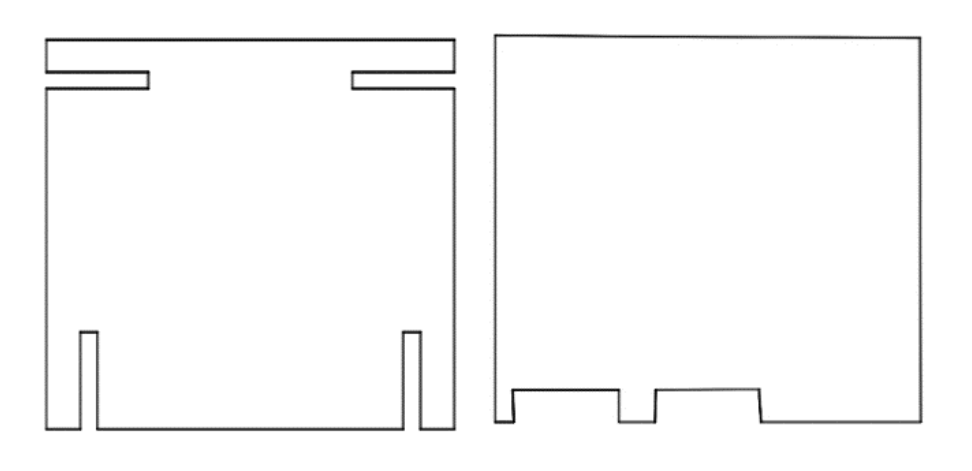
Considera le due figure (non in scala). Entrambe sono ottenute togliendo da un quadrato di perimetro 96 cm rispettivamente 4 e 2 rettangoli tutti uguali tra loro. Nella prima figura sul perimetro del quadrato di partenza stanno i lati corti dei rettangoli asportati mentre nella seconda figura ci stanno i lati lunghi. Sapendo che i perimetri delle due figure sono 160 cm la prima e 108 cm la seconda, quanto vale l’area della prima figura in cm2? A) 480 B) 512 C) 524 D) 528
E) c’è più di una soluzione La risposta corretta è la A Siano 𝑎, 𝑏 rispettivamente le misure in cm del lato lungo e di quello corto dei rettangolini sottratti al quadrato. Il perimetro della figura di sinistra è quello del quadrato sommato a 8𝑎, da cui 𝑎= 160−96 8 = 8. Analogamente il perimetro della figura di destra è quello del quadrato sommato 4𝑏, da cui 𝑏= 108−96 4 = 3. Infine la misura dell’area richiesta è [( 96 4 ) 2 −4 ∙3 ∙8] = 480 cm2.
Topic: Geometria piana, Algebra Abilita: Manipolazione algebrica Area: Algebra e Analisi, Geometria Risposta: A Fonte: apri PDF p.4
Figure area obtained by removing rectangles from a square
Consider the two figures (not in scale). Both are obtained by removing from a square of perimeter of 96 cm respectively 4 and 2 rectangles all equal to each other. In the first figure on the perimeter of the starting square there are the short sides of the distant rectangles while in the second figure there are the long sides. Knowing that the perimeter of the two figures is 160 cm for the first and 108 cm for the second, what is the area of the first figure in cm2? A) 480 B) 512 C) 524 D) 528 E) c) there is more than one solution The correct answer is A Siano a, b respectively the measurements in cm of the long and short sides of the rectangles subtracted from the square. The perimeter of the figure on the left is that of the square added to 8a, from which a=160−96 8 = 8. Similarly, the perimeter of the figure to the right is that of the sum of the squares 4b, from which b=108−96 4 = 3. Finally, the size of the required area is [(96 4 ) 2 −4 ∙3 ∙8] = 480 cm2.
Answer: A src_garaprime_2024__Q11
Quadrato perfetto successivo a n
Se il numero intero positivo 𝑛 è un quadrato perfetto, quale sarà il quadrato perfetto successivo? A) 𝑛+ 1 B) 𝑛+ √𝑛 C) 𝑛+ √𝑛+ 1 D) 𝑛+ 2√𝑛 E) 𝒏+ 𝟐√𝒏+ 𝟏 La risposta corretta è la E Se 𝑛 è un quadrato perfetto, allora la base di tale quadrato è √𝑛, il suo successivo è √𝑛+ 1 da cui il quadrato perfetto successivo a (√𝑛) 2 = 𝑛 è (√𝑛+ 1) 2 = 𝑛+ 2√𝑛+ 1.
Topic: Algebra Abilita: Manipolazione algebrica Area: Algebra e Analisi Risposta: E Fonte: apri PDF p.4
Perfect square after n
If the positive integer n is a perfect square, what is the next perfect square? A) n+ 1 B) n+ √n C) n+ √n+ 1 D) n+ 2√n E) n+ 2√n+ 1 The correct answer is E If n is a perfect square, then the base of that square is √n, its next is √n+ 1 where the perfect square following (√n) 2 = n is (√n+ 1) 2 = n+ 2√n+ 1.
Answer: E src_garaprime_2024__Q12
Quale numero non puo essere prodotto dei divisori
Emanuele calcola il prodotto di tutti i divisori di un numero (compreso il numero stesso) e scrive il risultato su un foglio. Quale dei seguenti numeri non può aver scritto? A) 1 B) 100 C) 101 D) 512 E) 1024 La risposta corretta è la D Il numero che Emanuele non può aver scritto è 512. Infatti se un numero è divisibile per 2𝑛, allora è divisibile anche per 2𝑛−1, 2𝑛−2, …, 22, 2, 1, il cui prodotto è uguale a 2𝑛∙2𝑛−1 ∙… ∙22 ∙2 ∙1 = 2𝑛+(𝑛−1)+⋯+2+1 = 2 𝑛∙(𝑛+1) 2 . Risulta 512 = 29 e non esiste alcun 𝑛 naturale tale che 𝑛∙(𝑛+1) 2 = 9. Tutti gli altri numeri invece sono il prodotto dei divisori di un numero: 1 è il prodotto dei divisori di 1, 100 di 10, 101 di 101 e 1024 di 16.
Topic: Teoria dei Numeri Metodo: congruenze Abilita: Riconoscimento di pattern Area: Aritmetica e Teoria dei Numeri Risposta: D Fonte: apri PDF p.4
Which number cannot be produced from the dividers
Emanuele calculates the product of all the divisors of a number (including the number itself) and writes the result on a sheet. Which of the following numbers can’t he have written? A) 1 B) 100 C) 101 D) 512 E) 1024 The correct answer is D The number that Emmanuel cannot have written is 512. In fact if a number is divisible by 2n, then it is also divisible by 2n−1, 2n−2, …, 22, 2, 1, whose product is equal to 2n∙2n−1 ∙… ∙22 ∙2 ∙1 = 2n+(n−1) ++2+1 = 2 n∙(n+1) 2 . So it’s 512 = 29, and there’s no natural n such that n∙(n+1) 2 = 9. All the other numbers are instead the product of the divisors of a number: 1 is the product of the divisors of 1, 100 of 10, 101 of 101 and 1024 of 16.
Answer: D src_garaprime_2024__Q13
Quanti numeri tra 2 e 900 hanno esattamente 3 divisori
Un numero primo ha esattamente 2 divisori: 1 e sé stesso. Michelangelo però deve trovare tutti i numeri tra 2 e 900 che hanno esattamente 3 divisori. Quanti sono? A) 10 B) 0 C) 30 D) 29 E) 49 La risposta corretta è la A Gli unici numeri ad avere esattamente 3 divisori sono i quadrati di numeri primi. Infatti, detto 𝑝 un numero primo, il suo quadrato 𝑝2 è divisibile solo per 1, per 𝑝 e per 𝑝2. D’altro canto, un numero che ammette come divisori due primi distinti 𝑝 e 𝑞, con 𝑝< 𝑞, allora è divisibile anche per 1 e per 𝑝𝑞, e quindi non può avere solo 3 divisori. I quadrati perfetti tra 2 e 900 che verificano la condizione richiesta sono pertanto i quadrati di 2, 3, 5, 7, 11, 13, 17, 19, 23, 29, vale a dire 10 numeri.
Topic: Teoria dei Numeri Metodo: congruenze Abilita: Conteggio sistematico Area: Aritmetica e Teoria dei Numeri Risposta: A Fonte: apri PDF p.5
Any number between 2 and 900 has exactly 3 divisors.
A prime number has exactly two divisors: 1 and itself. But Michelangelo has to find all the numbers between 2 and 900 that have exactly 3 divisors. How many are there? A) 10 B) 0 C) 30 D) 29 E) 49 The correct answer is A The only numbers to have exactly 3 divisors are the squares of prime numbers. In fact, if p is a prime number, its square p2 is divisible only by 1, by p and by p2. On the other hand, a number that admits as divisors two distinct primes p and q, with p< q, then it is also divisible by 1 and pq, and therefore cannot have only 3 divisors. The perfect squares between 2 and 900 that verify the required condition are therefore squares of 2, 3, 5, 7, 11, 13, 17, 19, 23, 29, i.e. 10 numbers.
Answer: A src_garaprime_2024__Q14
Modi di suddividere 6 ragazze in 3 squadre da 2
In quanti modi Simona può suddividere 6 ragazze in 3 squadre da 2 persone? Si tenga presente che due suddivisioni sono identiche se e solo se ogni ragazza ha la stessa compagna di squadra. A) 30 B) 60 C) 15 D) 20 E) 18 La risposta corretta è la C Il numero di modi di suddividere un insieme di 4 persone in due squadre da 2 è uguale al numero di modi in cui una delle quattro ragazze si può scegliere la compagna di squadra tra le rimanenti 3, cioè 3 modi. Se le persone sono 6, distinguiamo 5 casi (i 5 modi in cui fissata una delle 6 ragazze, essa può scegliersi la compagna) e in ciascuno di tali casi lei rimanenti 4 ragazze possono suddividersi in 3 modi in squadre da 2 per quanto detto in precedenza. Di conseguenza le diverse suddivisioni sono 5 ∙3 = 15.
Topic: Combinatoria Metodo: Conteggio combinatorio Abilita: Conteggio sistematico Area: Combinatoria, Logica e Probabilita Risposta: C Fonte: apri PDF p.5
How to divide 6 girls into 3 teams by 2
How many ways can Simona divide six girls into three two-person teams? Keep in mind that two subdivisions are identical if and only if each girl has the same teammate. A) 30 B) 60 C) 15 D) 20 E) 18 The correct answer is C The number of ways of dividing a set of 4 people into two teams of 2 is equal to the number of ways in which one of the four girls can choose the team mate from the remaining 3, i.e. 3 ways. If there are 6 people, let us distinguish 5 cases (the 5 ways in which one of the 6 girls is fixed, she can choose her partner) and in each of those cases the remaining 4 girls can be divided into 3 ways into teams of 2 as mentioned above. So the different subdivisions are 5 ∙3 = 15.
Answer: C src_garaprime_2024__Q15
Iscritti che sanno giocare a dama e scacchi (insiemi)
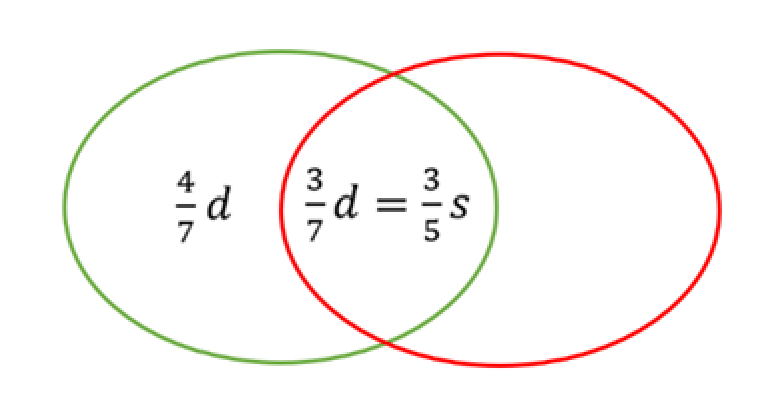
Al Winter Math Camp ci sono 72 iscritti ciascuno dei quali sa giocare a dama o a scacchi o ad entrambi; inoltre i 4 7 ⁄ di coloro che sanno giocare a dama non sanno giocare a scacchi, e i 3 5 ⁄ di coloro che sanno giocare a scacchi giocano anche a dama. Quanti sono gli iscritti che sanno giocare ad entrambi i giochi? A) 32 B) 30 C) 24 D) 28 E) 20 La risposta corretta è la C Sia 𝑑 il numero di coloro che sanno giocare a dama ed 𝑠 il numero di coloro che sanno giocare a scacchi. Dai dati si ha che
3 7 𝑑 sanno giocare anche a scacchi mentre
3 5 𝑠 sanno giocare a dama. Ma allora
3 7 𝑑= 3 5 𝑠 da cui 𝑠= 5 7 𝑑. Dunque, poiché
4 7 𝑑+ 𝑠= 72, si ha
4 7 𝑑+ 5 7 𝑑= 72 da cui 𝑑= 56 e quindi
3 7 𝑑= 24.
Topic: Insiemi e funzioni, Algebra Abilita: traduzione del testo Area: Algebra e Analisi Risposta: C Fonte: apri PDF p.5
*Scribers who know how to play chess and ladies (together) *
The Winter Math Camp has 72 members, each of whom can play chess or both; in addition, 4 7⁄ of those who can play chess do not know how to play chess, and 3 5⁄ of those who can play chess also play chess. How many subscribers can play both games? A) 32 B) 30 C) 24 D) 28 E) 20 The correct answer is C. The number of people who can play chess and s the number of people who can play chess. The data shows that 37 d can play chess as well while 35 d can play ladies. But then 3 7 d is equal to 3 5 s where s is equal to 5 7 d. So, since 4 7 d + s = 72, you have 4 7 d + 5 7 d = 72, where d = 56 and then 3 7 d = 24.
Answer: C src_garaprime_2024__Q16
Coppie non ordinate di palline di colore diverso
Claudia ha 11 palline tutte diverse tra loro che sono colorate nel seguente modo: 4 palline rosse, 2 verdi e 5 blu. In quanti modi può scegliere una coppia (non ordinata) di palline di colore diverso? A) 3 B) 38 C) 40 D) 45 E) 76 La risposta corretta è la B Le coppie valide sono: rossa-verde, rossa-blu e verde-blu. Non dobbiamo contare anche le tre coppie verde-rossa, blu-rossa e blu-verde poiché così conteremmo le coppie ordinate. Dato che le palline sono tutte diverse, possiamo scegliere la pallina rossa in 4 modi, la verde in 2 e la blu in 5. Per il principio fondamentale del calcolo combinatorio (o per la regola del prodotto cartesiano) il numero di coppie si trova facendo il prodotto delle cardinalità degli insiemi di partenza, ossia 4 ∙2 = 8, 4 ∙5 = 20 e 2 ∙5 = 10. Queste tre quantità vanno sommate perché le tre situazioni sono indipendenti tra di loro e quindi la soluzione è 8 + 20 + 10 = 38.
Topic: Combinatoria Metodo: Conteggio per casi Abilita: Conteggio sistematico Area: Combinatoria, Logica e Probabilita Risposta: B Fonte: apri PDF p.5
Unordered pairs of balls of different colour
Claudia has 11 different balls all of which are colored as follows: 4 red, 2 green and 5 blue. In how many ways can a pair of balls of different colours be chosen? A) 3 B) 38 C) 40 D) 45 E) 76 The correct answer is B The valid pairs are: red-green, red-blue and green-blue. We don’t even have to count the three green-red, blue-red and blue-green pairs because that would count the ordered pairs. Since the balls are all different, we can choose the red ball in four ways, the green ball in two and the blue ball in five. For the fundamental principle of combinatorial computation (or for the rule of the Cartesian product), the number of pairs is found by producing the cardinality of the starting sets, i.e. 4 ∙2 = 8, 4 ∙5 = 20 and 2 ∙5 = 10. These three quantities have to be added because the three situations are independent of each other and so the solution is 8 + 20 + 10 = 38.
Answer: B src_garaprime_2024__Q17
Massimo dei tre numeri data la somma combinata 396
Su una lavagna sono scritti inizialmente tre numeri interi positivi distinti. Accanto ad essi Carlo scrive la somma di tutte le possibili coppie (non ordinate) fra due di questi numeri e poi scrive anche la somma dei tre numeri iniziali. Infine, somma tutti i numeri scritti sulla lavagna e ottiene 396. Quanto vale al massimo il più grande tra i tre numeri iniziali? A) 96 B) 58 C) 52 D) 100 E) 80 La risposta corretta è la A Siano 𝑎< 𝑏< 𝑐 i tre valori così che le quantità finali scritte sulla lavagna saranno: 𝑎, 𝑏, 𝑐, 𝑎+ 𝑏, 𝑎+ 𝑐, 𝑏+ 𝑐, 𝑎+ 𝑏+ 𝑐; la somma di questi sette quantità è 4(𝑎+ 𝑏+ 𝑐) = 396 e quindi 𝑎+ 𝑏+ 𝑐= 99. Prendendo 𝑎 e 𝑏 interi positivi distinti più piccoli possibili, ossia 1 e 2, otteniamo il valore massimo di 𝑐= 96.
Topic: Algebra, Teoria dei Numeri Metodo: Doppio conteggio, Principio di estremalita Abilita: Manipolazione algebrica Area: Algebra e Analisi, Aritmetica e Teoria dei Numeri Risposta: A Fonte: apri PDF p.6
Maximum of three numbers given the combined sum 396
On a board are initially written three distinct positive integers. Alongside them, Charles writes the sum of all possible pairs (not ordered) between two of these numbers and then also writes the sum of the three initial numbers. Finally, you add up all the numbers on the board and you get 396. What is the maximum value of the largest of the first three numbers? A) 96 B) 58 C) 52 D) 100 E) 80 The correct answer is A Siano a< b< c the three values so that the final quantities written on the board will be: a, b, c, a+ b, a+ c, b+ c, a+ b+ c; the sum of these seven quantities is 4(a+ b+ c) = 396 and then a+ b+ c= 99. Taking the smallest possible distinct positive integers a and b, i.e. 1 and 2, we get the maximum value of c=96.
Answer: A src_garaprime_2024__Q18