L’inspiegabile caso del turista
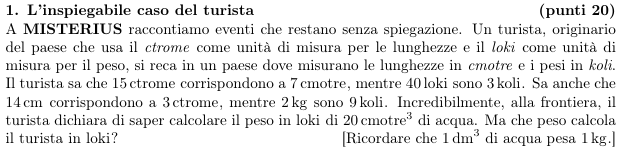
L’inspiegabile caso del turista (punti 20) A MISTERIUS raccontiamo eventi che restano senza spiegazione. Un turista, originario del paese che usa il ctrome come unità di misura per le lunghezze e il loki come unità di misura per il peso, si reca in un paese dove misurano le lunghezze in cmotre e i pesi in koli. Il turista sa che 15 ctrome corrispondono a 7 cmotre, mentre 40 loki sono 3 koli. Sa anche che 14 cm corrispondono a 3 ctrome, mentre 2 kg sono 9 koli. Incredibilmente, alla frontiera, il turista dichiara di saper calcolare il peso in loki di 20 cmotre^3 di acqua. Ma che peso calcola il turista in loki? [Ricordare che 1 dm^3 di acqua pesa 1 kg.]
Topic: Algebra Area: Algebra e Analisi Risposta: 1200 Fonte: apri PDF p.2 · phiquadro.it, Archivio gare ufficiali 2014 (= fairmath.it, Coppa Galileo 2014)
The inexplicable case of the tourist
The inexplicable case of the tourist (20 points) At MISTERIUS we tell of events that remain unexplained. A tourist, from the country that uses the ctrome as its unit of length and the loki as its unit of weight, travels to a country where lengths are measured in cmotre and weights in koli. The tourist knows that 15 ctrome correspond to 7 cmotre, while 40 loki are 3 koli. He also knows that 14 cm correspond to 3 ctrome, while 2 kg are 9 koli. Incredibly, at the border, the tourist declares that he can calculate the weight in loki of 20 cmotre^3 of water. But what weight in loki does the tourist calculate? [Recall that 1 dm^3 of water weighs 1 kg.]
Answer: 1200
A differenza di Dio, l’uomo gioca a dadi
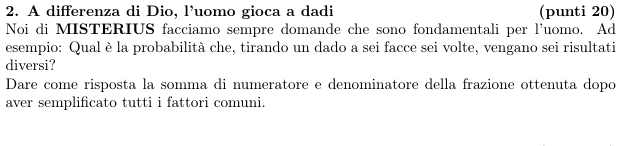
A differenza di Dio, l’uomo gioca a dadi (punti 20) Noi di MISTERIUS facciamo sempre domande che sono fondamentali per l’uomo. Ad esempio: Qual è la probabilità che, tirando un dado a sei facce sei volte, vengano sei risultati diversi? Dare come risposta la somma di numeratore e denominatore della frazione ottenuta dopo aver semplificato tutti i fattori comuni.
Topic: Probabilita e statistica Area: Combinatoria, Logica e Probabilita Risposta: 0329 Fonte: apri PDF p.2 · phiquadro.it, Archivio gare ufficiali 2014 (= fairmath.it, Coppa Galileo 2014)
Unlike God, man plays dice
Unlike God, man plays dice (20 points) We at MISTERIUS always ask questions that are fundamental for mankind. For example: what is the probability that, rolling a six-sided die six times, six different results come up? Give as the answer the sum of the numerator and the denominator of the fraction obtained after cancelling all common factors.
Answer: 0329
Il frazzo
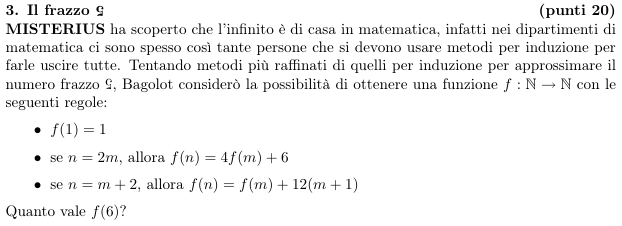
Il frazzo (punti 20) MISTERIUS ha scoperto che l’infinito è di casa in matematica, infatti nei dipartimenti di matematica ci sono spesso così tante persone che si devono usare metodi per induzione per farle uscire tutte. Tentando metodi più raffinati di quelli per induzione per approssimare il numero frazzo , Bagolot considerò la possibilità di ottenere una funzione f : N → N con le seguenti regole: • f(1) = 1 • se n = 2m, allora f(n) = 4f(m) + 6 • se n = m + 2, allora f(n) = f(m) + 12(m + 1) Quanto vale f(6)?
Topic: successioni Area: Algebra e Analisi Risposta: 0106 Fonte: apri PDF p.2 · phiquadro.it, Archivio gare ufficiali 2014 (= fairmath.it, Coppa Galileo 2014)
The frazzo
The frazzo (20 points) MISTERIUS has discovered that infinity is at home in mathematics: indeed in mathematics departments there are often so many people that induction methods have to be used to get them all out. Trying methods more refined than induction to approximate the number frazzo, Bagolot considered the possibility of obtaining a function f : N → N with the following rules: • f(1) = 1 • if n = 2m, then f(n) = 4f(m) + 6 • if n = m + 2, then f(n) = f(m) + 12(m + 1) What is f(6)?
Answer: 0106
Nel Nachlass di Bagolot
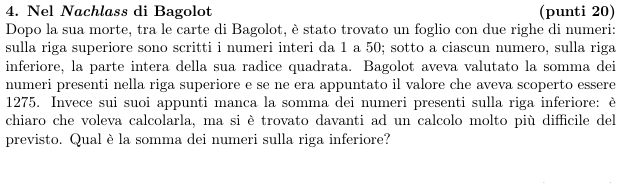
Nel Nachlass di Bagolot (punti 20) Dopo la sua morte, tra le carte di Bagolot, è stato trovato un foglio con due righe di numeri: sulla riga superiore sono scritti i numeri interi da 1 a 50; sotto a ciascun numero, sulla riga inferiore, la parte intera della sua radice quadrata. Bagolot aveva valutato la somma dei numeri presenti nella riga superiore e se ne era appuntato il valore che aveva scoperto essere 1275. Invece sui suoi appunti manca la somma dei numeri presenti sulla riga inferiore: è chiaro che voleva calcolarla, ma si è trovato davanti ad un calcolo molto più difficile del previsto. Qual è la somma dei numeri sulla riga inferiore?
Topic: Combinatoria Area: Combinatoria, Logica e Probabilita Risposta: 0217 Fonte: apri PDF p.2 · phiquadro.it, Archivio gare ufficiali 2014 (= fairmath.it, Coppa Galileo 2014)
In Bagolot’s Nachlass
In Bagolot’s Nachlass (20 points) After his death, among Bagolot’s papers, a sheet was found with two rows of numbers: the upper row contains the integers from 1 to 50; under each number, in the lower row, the integer part of its square root. Bagolot had computed the sum of the numbers in the upper row and had noted down its value, which he had found to be 1275. His notes, however, lack the sum of the numbers in the lower row: clearly he wanted to compute it, but he faced a much harder calculation than expected. What is the sum of the numbers in the lower row?
Answer: 0217
Il problema del pasticciere
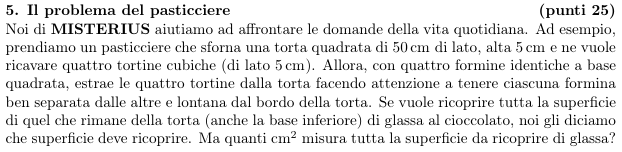
Il problema del pasticciere (punti 25) Noi di MISTERIUS aiutiamo ad affrontare le domande della vita quotidiana. Ad esempio, prendiamo un pasticciere che sforna una torta quadrata di 50 cm di lato, alta 5 cm e ne vuole ricavare quattro tortine cubiche (di lato 5 cm). Allora, con quattro formine identiche a base quadrata, estrae le quattro tortine dalla torta facendo attenzione a tenere ciascuna formina ben separata dalle altre e lontana dal bordo della torta. Se vuole ricoprire tutta la superficie di quel che rimane della torta (anche la base inferiore) di glassa al cioccolato, noi gli diciamo che superficie deve ricoprire. Ma quanti cm^2 misura tutta la superficie da ricoprire di glassa?
Topic: Algebra Area: Algebra e Analisi Risposta: 6200 Fonte: apri PDF p.2 · phiquadro.it, Archivio gare ufficiali 2014 (= fairmath.it, Coppa Galileo 2014)
The pastry cook’s problem
The pastry cook’s problem (25 points) We at MISTERIUS help to face the questions of everyday life. For example, take a pastry cook who bakes a square cake with sides of 50 cm, 5 cm high, and wants to cut four small cubic cakes (with sides of 5 cm) out of it. So, with four identical square-based moulds, he extracts the four small cakes from the cake, taking care to keep each mould well separated from the others and away from the edge of the cake. If he wants to cover the whole surface of what remains of the cake (including the bottom face) with chocolate icing, we tell him what surface he must cover. But how many cm^2 does the whole surface to be iced measure?
Answer: 6200
Il riscaldamento di Bagolot
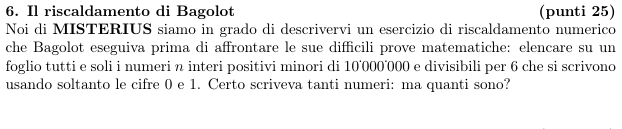
Il riscaldamento di Bagolot (punti 25) Noi di MISTERIUS siamo in grado di descrivervi un esercizio di riscaldamento numerico che Bagolot eseguiva prima di affrontare le sue difficili prove matematiche: elencare su un foglio tutti e soli i numeri n interi positivi minori di 10·000·000 e divisibili per 6 che si scrivono usando soltanto le cifre 0 e 1. Certo scriveva tanti numeri: ma quanti sono?
Topic: Teoria dei Numeri Area: Aritmetica e Teoria dei Numeri Risposta: 0021 Fonte: apri PDF p.3 · phiquadro.it, Archivio gare ufficiali 2014 (= fairmath.it, Coppa Galileo 2014)
Bagolot’s warm-up
Bagolot’s warm-up (25 points) We at MISTERIUS can describe a numerical warm-up exercise that Bagolot performed before facing his difficult mathematical trials: listing on a sheet all and only the positive integers n less than 10,000,000 and divisible by 6 that are written using only the digits 0 and 1. He certainly wrote a lot of numbers: but how many are there?
Answer: 0021
Il piccolo Bagolot
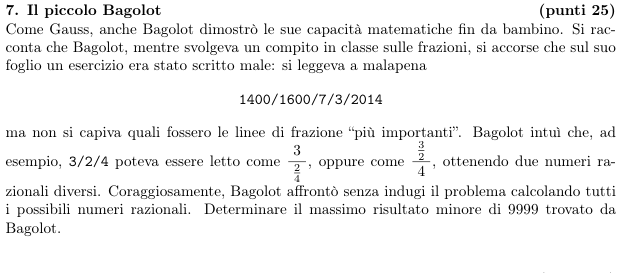
Il piccolo Bagolot (punti 25) Come Gauss, anche Bagolot dimostrò le sue capacità matematiche fin da bambino. Si racconta che Bagolot, mentre svolgeva un compito in classe sulle frazioni, si accorse che sul suo foglio un esercizio era stato scritto male: si leggeva a malapena 1400/1600/7/3/2014 ma non si capiva quali fossero le linee di frazione “più importanti”. Bagolot intuì che, ad esempio, 3/2/4 poteva essere letto come 3/(2/4), oppure come (3/2)/4, ottenendo due numeri razionali diversi. Coraggiosamente, Bagolot affrontò senza indugi il problema calcolando tutti i possibili numeri razionali. Determinare il massimo risultato minore di 9999 trovato da Bagolot.
Risposta: 4111 Fonte: apri PDF p.3 · phiquadro.it, Archivio gare ufficiali 2014 (= fairmath.it, Coppa Galileo 2014)
Little Bagolot
Little Bagolot (25 points) Like Gauss, Bagolot too showed his mathematical abilities as a child. It is said that Bagolot, while doing a class test on fractions, noticed that an exercise on his sheet had been written badly: one could barely read 1400/1600/7/3/2014 but it was not clear which fraction bars were the “most important”. Bagolot realised that, for example, 3/2/4 could be read as 3/(2/4), or as (3/2)/4, giving two different rational numbers. Bravely, Bagolot tackled the problem without hesitation, computing all the possible rational numbers. Determine the largest result less than 9999 found by Bagolot.
Answer: 4111
Impossibile!

Impossibile! (punti 25) Noi di MISTERIUS abbiamo anche il coraggio di presentare problemi impossibili per l’uomo. Ad esempio, qual è il perimetro più grande (misurato in metri) che può avere un triangolo rettangolo con lati che, misurati in metri, hanno lunghezze intere, sapendo che uno di essi misura 25 m?
Topic: Geometria piana Area: Geometria Risposta: 0650 Fonte: apri PDF p.3 · phiquadro.it, Archivio gare ufficiali 2014 (= fairmath.it, Coppa Galileo 2014)
Impossible!
Impossible! (25 points) We at MISTERIUS even have the courage to present problems that are impossible for mankind. For example, what is the largest perimeter (measured in metres) that a right triangle can have whose sides, measured in metres, have integer lengths, knowing that one of them measures 25 m?
Answer: 0650
Inimmaginabile!

Inimmaginabile! (punti 25) Noi di MISTERIUS abbiamo anche il coraggio di presentare problemi inimmaginabili. Ad esempio, quanti sono gli interi positivi di cinque cifre tali che il prodotto delle loro cifre sia 2000?
Topic: Teoria dei Numeri Area: Aritmetica e Teoria dei Numeri Risposta: 0030 Fonte: apri PDF p.3 · phiquadro.it, Archivio gare ufficiali 2014 (= fairmath.it, Coppa Galileo 2014)
Unimaginable!
Unimaginable! (25 points) We at MISTERIUS even have the courage to present unimaginable problems. For example, how many five-digit positive integers are there such that the product of their digits is 2000?
Answer: 0030
L’Ultimo Teorema di Bagolot

L’Ultimo Teorema di Bagolot (punti 30) Il famoso Ultimo Teorema di Bagolot è il seguente: considerato un triangolo rettangolo di cateti 30 e 16 inscritto in una circonferenza di raggio R, e circoscritto ad una circonferenza di raggio r, è impossibile determinare R + r. Dimostrare che l’Ultimo Teorema di Bagolot è falso calcolando il valore di R + r.
Topic: Geometria piana Area: Geometria Risposta: 0023 Fonte: apri PDF p.3 · phiquadro.it, Archivio gare ufficiali 2014 (= fairmath.it, Coppa Galileo 2014)
Bagolot’s Last Theorem
Bagolot’s Last Theorem (30 points) The famous Bagolot’s Last Theorem is the following: given a right triangle with legs 30 and 16 inscribed in a circle of radius R and circumscribed about a circle of radius r, it is impossible to determine R + r. Prove that Bagolot’s Last Theorem is false by computing the value of R + r.
Answer: 0023
La pizza Margherita
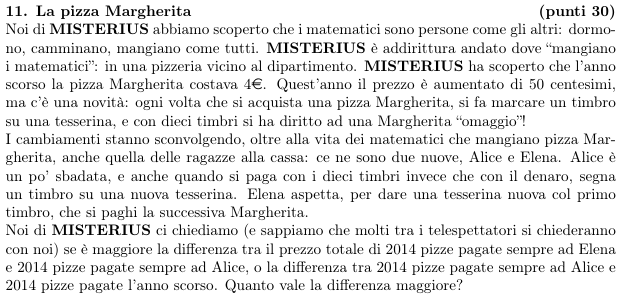
La pizza Margherita (punti 30) Noi di MISTERIUS abbiamo scoperto che i matematici sono persone come gli altri: dormono, camminano, mangiano come tutti. MISTERIUS è addirittura andato dove “mangiano i matematici”: in una pizzeria vicino al dipartimento. MISTERIUS ha scoperto che l’anno scorso la pizza Margherita costava 4 €. Quest’anno il prezzo è aumentato di 50 centesimi, ma c’è una novità: ogni volta che si acquista una pizza Margherita, si fa marcare un timbro su una tesserina, e con dieci timbri si ha diritto ad una Margherita “omaggio”! I cambiamenti stanno sconvolgendo, oltre alla vita dei matematici che mangiano pizza Margherita, anche quella delle ragazze alla cassa: ce ne sono due nuove, Alice e Elena. Alice è un po’ sbadata, e anche quando si paga con i dieci timbri invece che con il denaro, segna un timbro su una nuova tesserina. Elena aspetta, per dare una tesserina nuova col primo timbro, che si paghi la successiva Margherita. Noi di MISTERIUS ci chiediamo (e sappiamo che molti tra i telespettatori si chiederanno con noi) se è maggiore la differenza tra il prezzo totale di 2014 pizze pagate sempre ad Elena e 2014 pizze pagate sempre ad Alice, o la differenza tra 2014 pizze pagate sempre ad Alice e 2014 pizze pagate l’anno scorso. Quanto vale la differenza maggiore?
Topic: Teoria dei Numeri Area: Aritmetica e Teoria dei Numeri Risposta: 0102 Fonte: apri PDF p.3 · phiquadro.it, Archivio gare ufficiali 2014 (= fairmath.it, Coppa Galileo 2014)
The Margherita pizza
The Margherita pizza (30 points) We at MISTERIUS have discovered that mathematicians are people like everybody else: they sleep, walk and eat like everyone. MISTERIUS even went where “mathematicians eat”: a pizzeria near the department. MISTERIUS found out that last year the Margherita pizza cost 4 €. This year the price has gone up by 50 cents, but there is a novelty: every time a Margherita pizza is bought, a stamp is put on a card, and ten stamps entitle you to a “free” Margherita! The changes are upsetting not only the lives of the mathematicians who eat Margherita pizza, but also those of the girls at the till: there are two new ones, Alice and Elena. Alice is a bit absent-minded, and even when one pays with the ten stamps instead of money, she puts a stamp on a new card. Elena waits until the next Margherita is paid for before giving a new card with the first stamp. We at MISTERIUS wonder (and we know that many viewers will wonder with us) whether the difference between the total price of 2014 pizzas always paid to Elena and 2014 pizzas always paid to Alice is greater, or the difference between 2014 pizzas always paid to Alice and 2014 pizzas paid last year. What is the larger difference?
Answer: 0102
Probabilità al bar
Probabilità al bar (punti 40) MISTERIUS è riuscita a recuperare il video della famosa partita a dadi tra Bagolot e Enrico Fermi al bar a Gottinga nel 1923. Come si vede nel video, Bagolot e Fermi hanno tre dadi: uno con 4 facce, numerate da 1 a 4; un altro con 6 facce, numerate da 1 a 6; l’ultimo dado con 8 facce, numerate da 1 a 8. Bagolot sfida Fermi al seguente azzardo: Fermi tira tutti i dadi una volta; a quel punto Bagolot ne getta via uno; Fermi tira i due dadi rimasti una seconda volta. Si sommano tutti i punti ottenuti (con il primo lancio di tre dadi ed il secondo con i due rimasti): se la somma è 15, Fermi vince 100 marchi da Bagolot; altrimenti Bagolot ne vince 10 da Fermi. Si vede che Fermi tira una volta tutti e tre i dadi insieme, ottenendo 8 come somma delle facce. Purtroppo il video termina di colpo; si sa che, a quel punto, avvenne qualcosa di strabiliante: Bagolot valutò perfettamente le sue probabilità di vincere i 10 marchi a seconda del dado che avrebbe gettato. Qual era la sua migliore probabilità di vincere i 10 marchi? [Scrivere come soluzione le prime 4 cifre dopo la virgola del risultato.]
Topic: Probabilita e statistica, Teoria dei Numeri Area: Combinatoria, Logica e Probabilita, Aritmetica e Teoria dei Numeri Risposta: 8750 Fonte risposta: soluzione ufficiale, PDF p.8 Fonte: apri PDF p.4 · phiquadro.it, Archivio gare ufficiali 2014 (= fairmath.it, Coppa Galileo 2014)
Probability at the bar
Probability at the bar (40 points) MISTERIUS has managed to recover the video of the famous dice game between Bagolot and Enrico Fermi at the bar in Göttingen in 1923. As can be seen in the video, Bagolot and Fermi have three dice: one with 4 faces, numbered from 1 to 4; another with 6 faces, numbered from 1 to 6; the last one with 8 faces, numbered from 1 to 8. Bagolot challenges Fermi to the following gamble: Fermi rolls all the dice once; then Bagolot throws one of them away; Fermi rolls the two remaining dice a second time. All the points obtained are added up (from the first roll of three dice and the second roll of the two remaining ones): if the sum is 15, Fermi wins 100 marks from Bagolot; otherwise Bagolot wins 10 from Fermi. One sees Fermi roll all three dice together once, getting 8 as the sum of the faces. Unfortunately the video ends abruptly; it is known that at that point something astonishing happened: Bagolot evaluated perfectly his probabilities of winning the 10 marks depending on the die he would throw away. What was his best probability of winning the 10 marks? [Write as the solution the first 4 digits after the decimal point of the result.]
Answer: 8750
Leveraine idrofobo
Leveraine idrofobo (punti 40) Noi di MISTERIUS abbiamo scoperto che i matematici sono stravaganti. Ad esempio, Leveraine aveva una piscina rotonda di diametro 20 m; quando venne colpito da idrofobia, fece ridurre la superficie d’acqua facendo inserire nella piscina un’isola a forma di triangolo equilatero con i tre vertici che toccavano il bordo della piscina. L’idrofobia di Leveraine raggiunse livelli acuti e lui fece sovrapporre alla prima isola un’altra quadrata, sempre con i vertici che toccavano i bordi della piscina e con un lato parallelo ad uno dei lati del triangolo. La superficie d’acqua visibile rimasta non spaventava più Leveraine. Quanti m^2 misurava l’area dell’acqua visibile?
Topic: Geometria piana Area: Geometria Risposta: 0104 Fonte risposta: soluzione ufficiale, PDF p.8 Fonte: apri PDF p.4 · phiquadro.it, Archivio gare ufficiali 2014 (= fairmath.it, Coppa Galileo 2014)
Hydrophobic Leveraine
Hydrophobic Leveraine (40 points) We at MISTERIUS have discovered that mathematicians are eccentric. For example, Leveraine had a round swimming pool with a diameter of 20 m; when he was struck by hydrophobia, he had the water surface reduced by having an island shaped like an equilateral triangle placed in the pool, with its three vertices touching the edge of the pool. Leveraine’s hydrophobia reached acute levels and he had another, square, island superimposed on the first, again with its vertices touching the edge of the pool and with one side parallel to one of the sides of the triangle. The visible water surface left no longer frightened Leveraine. How many m^2 did the area of the visible water measure?
Answer: 0104
La Congettura di Bagolot
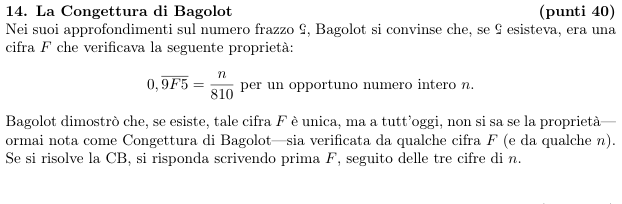
La Congettura di Bagolot (punti 40) Nei suoi approfondimenti sul numero frazzo ϛ, Bagolot si convinse che, se esisteva, era una cifra F che verificava la seguente proprietà: n 0,(9F5 periodico) = n/810 per un opportuno numero intero n. Bagolot dimostrò che, se esiste, tale cifra F è unica, ma a tutt’oggi, non si sa se la proprietà— ormai nota come Congettura di Bagolot—sia verificata da qualche cifra F (e da qualche n). Se si risolve la CB, si risponda scrivendo prima F, seguito delle tre cifre di n.
Topic: Teoria dei Numeri Area: Aritmetica e Teoria dei Numeri Risposta: 2750 Fonte risposta: soluzione ufficiale, PDF p.8 Fonte: apri PDF p.4 · phiquadro.it, Archivio gare ufficiali 2014 (= fairmath.it, Coppa Galileo 2014)
Bagolot’s Conjecture
Bagolot’s Conjecture (40 points) In his in-depth studies on the number frazzo ϛ, Bagolot became convinced that, if ϛ existed, it was a digit F satisfying the following property: 0.(9F5 repeating) = n/810 for a suitable integer n. Bagolot proved that, if it exists, such a digit F is unique, but to this day it is not known whether the property, now known as Bagolot’s Conjecture, is satisfied by some digit F (and some n). If you solve BC, answer by writing first F, followed by the three digits of n.
Answer: 2750
Irrisolubile!

Irrisolubile! (punti 40) Noi di MISTERIUS abbiamo scoperto un problema che la matematica non sa risolvere. Questa scatola che vedete inquadrata, a forma di parallelepipedo rettangolo, ha tre facce le cui aree sono, rispettivamente, di 429 m^2, 364 m^2 e 231 m^2. Ma quanto vale il suo volume in m
Topic: Geometria solida Area: Geometria Risposta: 6006 Fonte: apri PDF p.4 · phiquadro.it, Archivio gare ufficiali 2014 (= fairmath.it, Coppa Galileo 2014)
Unsolvable!
Unsolvable! (40 points) We at MISTERIUS have discovered a problem that mathematics cannot solve. This box you see on screen, shaped like a rectangular parallelepiped, has three faces whose areas are 429 m^2, 364 m^2 and 231 m^2 respectively. But what is its volume in m
Answer: 6006
La Grande Enciclopedia delle Scienze
La Grande Enciclopedia delle Scienze (punti 40) Nei suoi studi sulla Grande Enciclopedia delle Scienze, Laughton si rese conto che la difficoltà di reperire informazioni all’interno della GES dipendeva anche dalle caratteristiche del numero della pagina da trovare. Per questo introdusse la definizione di numero confuso: un numero intero positivo n si dice confuso se esiste un numero intero (positivo) k tale che il numero n × k è n letto da destra a sinistra. Ma quanti sono i numeri confusi di esattamente 4 cifre?
Topic: Combinatoria Area: Combinatoria, Logica e Probabilita Risposta: 0092 Fonte: apri PDF p.4 · phiquadro.it, Archivio gare ufficiali 2014 (= fairmath.it, Coppa Galileo 2014)
The Great Encyclopaedia of Sciences
The Great Encyclopaedia of Sciences (40 points) In his studies on the Great Encyclopaedia of Sciences, Laughton realised that the difficulty of finding information in the GES also depended on the features of the number of the page to be found. For this reason he introduced the definition of confused number: a positive integer n is called confused if there exists a (positive) integer k such that the number n × k is n read from right to left. But how many confused numbers with exactly 4 digits are there?
Answer: 0092
Leveraine a Legdo
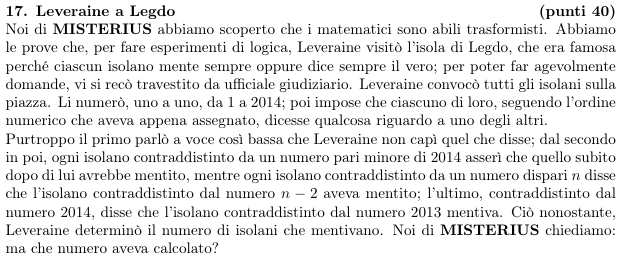
Leveraine a Legdo (punti 40) Noi di MISTERIUS abbiamo scoperto che i matematici sono abili trasformisti. Abbiamo le prove che, per fare esperimenti di logica, Leveraine visitò l’isola di Legdo, che era famosa perché ciascun isolano mente sempre oppure dice sempre il vero; per poter far agevolmente domande, vi si recò travestito da ufficiale giudiziario. Leveraine convocò tutti gli isolani sulla piazza. Li numerò, uno a uno, da 1 a 2014; poi impose che ciascuno di loro, seguendo l’ordine numerico che aveva appena assegnato, dicesse qualcosa riguardo a uno degli altri. Purtroppo il primo parlò a voce così bassa che Leveraine non capì quel che disse; dal secondo in poi, ogni isolano contraddistinto da un numero pari minore di 2014 asserì che quello subito dopo di lui avrebbe mentito, mentre ogni isolano contraddistinto da un numero dispari n disse che l’isolano contraddistinto dal numero n − 2 aveva mentito; l’ultimo, contraddistinto dal numero 2014, disse che l’isolano contraddistinto dal numero 2013 mentiva. Ciò nonostante, Leveraine determinò il numero di isolani che mentivano. Noi di MISTERIUS chiediamo: ma che numero aveva calcolato?
Topic: Teoria dei Numeri Area: Aritmetica e Teoria dei Numeri Risposta: 1007 Fonte: apri PDF p.5 · phiquadro.it, Archivio gare ufficiali 2014 (= fairmath.it, Coppa Galileo 2014)
Leveraine on Legdo
Leveraine on Legdo (40 points) We at MISTERIUS have discovered that mathematicians are skilful quick-change artists. We have proof that, to carry out logic experiments, Leveraine visited the island of Legdo, famous because each islander either always lies or always tells the truth; to be able to ask questions easily, he went there disguised as a bailiff. Leveraine summoned all the islanders to the square. He numbered them, one by one, from 1 to 2014; then he ordered each of them, following the numerical order he had just assigned, to say something about one of the others. Unfortunately the first one spoke so softly that Leveraine did not understand what he said; from the second on, every islander marked by an even number less than 2014 stated that the one right after him would lie, while every islander marked by an odd number n said that the islander marked by the number n − 2 had lied; the last one, marked by the number 2014, said that the islander marked by the number 2013 was lying. Nevertheless, Leveraine determined the number of islanders who were lying. We at MISTERIUS ask: what number had he calculated?
Answer: 1007
Il passatempo di Bagolot
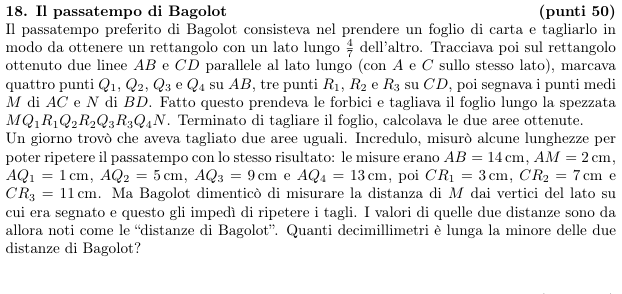
Il passatempo di Bagolot (punti 50) Il passatempo preferito di Bagolot consisteva nel prendere un foglio di carta e tagliarlo in modo da ottenere un rettangolo con un lato lungo 4/7 dell’altro. Tracciava poi sul rettangolo ottenuto due linee AB e CD parallele al lato lungo (con A e C sullo stesso lato), marcava quattro punti Q_1, Q_2, Q_3 e Q_4 su AB, tre punti R_1, R_2 e R_3 su CD, poi segnava i punti medi M di AC e N di BD. Fatto questo prendeva le forbici e tagliava il foglio lungo la spezzata MQ_1R_1Q_2R_2Q_3R_3Q_4N. Terminato di tagliare il foglio, calcolava le due aree ottenute. Un giorno trovò che aveva tagliato due aree uguali. Incredulo, misurò alcune lunghezze per poter ripetere il passatempo con lo stesso risultato: le misure erano AB = 14 cm, AM = 2 cm, AQ_1 = 1 cm, AQ_2 = 5 cm, AQ_3 = 9 cm e AQ_4 = 13 cm, poi CR_1 = 3 cm, CR_2 = 7 cm e CR_3 = 11 cm. Ma Bagolot dimenticò di misurare la distanza di M dai vertici del lato su cui era segnato e questo gli impedì di ripetere i tagli. I valori di quelle due distanze sono da allora noti come le “distanze di Bagolot”. Quanti decimillimetri è lunga la minore delle due distanze di Bagolot?
Topic: Geometria piana Area: Geometria Risposta: 0385 Fonte: apri PDF p.5 · phiquadro.it, Archivio gare ufficiali 2014 (= fairmath.it, Coppa Galileo 2014)
Bagolot’s pastime
Bagolot’s pastime (50 points) Bagolot’s favourite pastime was to take a sheet of paper and cut it so as to obtain a rectangle with one side 4/7 as long as the other. He then drew on the rectangle two lines AB and CD parallel to the long side (with A and C on the same side), marked four points Q_1, Q_2, Q_3 and Q_4 on AB and three points R_1, R_2 and R_3 on CD, and then marked the midpoints M of AC and N of BD. Having done this, he took the scissors and cut the sheet along the broken line MQ_1R_1Q_2R_2Q_3R_3Q_4N. Having finished cutting the sheet, he computed the two areas obtained. One day he found that he had cut two equal areas. Incredulous, he measured some lengths so as to be able to repeat the pastime with the same result: the measures were AB = 14 cm, AM = 2 cm, AQ_1 = 1 cm, AQ_2 = 5 cm, AQ_3 = 9 cm and AQ_4 = 13 cm, then CR_1 = 3 cm, CR_2 = 7 cm and CR_3 = 11 cm. But Bagolot forgot to measure the distance of M from the vertices of the side on which it was marked, and this prevented him from repeating the cuts. The values of those two distances have since been known as the “Bagolot distances”. How many tenths of a millimetre long is the smaller of the two Bagolot distances?
Answer: 0385
I pesi delle torri
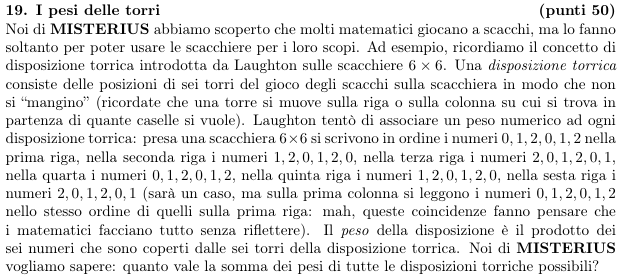
I pesi delle torri (punti 50) Noi di MISTERIUS abbiamo scoperto che molti matematici giocano a scacchi, ma lo fanno soltanto per poter usare le scacchiere per i loro scopi. Ad esempio, ricordiamo il concetto di disposizione torrica introdotta da Laughton sulle scacchiere 6 × 6. Una disposizione torrica consiste delle posizioni di sei torri del gioco degli scacchi sulla scacchiera in modo che non si “mangino” (ricordate che una torre si muove sulla riga o sulla colonna su cui si trova in partenza di quante caselle si vuole). Laughton tentò di associare un peso numerico ad ogni disposizione torrica: presa una scacchiera 6×6 si scrivono in ordine i numeri 0, 1, 2, 0, 1, 2 nella prima riga, nella seconda riga i numeri 1, 2, 0, 1, 2, 0, nella terza riga i numeri 2, 0, 1, 2, 0, 1, nella quarta i numeri 0, 1, 2, 0, 1, 2, nella quinta riga i numeri 1, 2, 0, 1, 2, 0, nella sesta riga i numeri 2, 0, 1, 2, 0, 1 (sarà un caso, ma sulla prima colonna si leggono i numeri 0, 1, 2, 0, 1, 2 nello stesso ordine di quelli sulla prima riga: mah, queste coincidenze fanno pensare che i matematici facciano tutto senza riflettere). Il peso della disposizione è il prodotto dei sei numeri che sono coperti dalle sei torri della disposizione torrica. Noi di MISTERIUS vogliamo sapere: quanto vale la somma dei pesi di tutte le disposizioni torriche possibili?
Topic: Combinatoria, Logica, giochi, strategie Area: Combinatoria, Logica e Probabilita Risposta: 1032 Fonte: apri PDF p.5 · phiquadro.it, Archivio gare ufficiali 2014 (= fairmath.it, Coppa Galileo 2014)
The weights of the rooks
The weights of the rooks (50 points) We at MISTERIUS have discovered that many mathematicians play chess, but they do it only to be able to use chessboards for their own purposes. For example, recall the concept of rook arrangement introduced by Laughton on 6 × 6 chessboards. A rook arrangement consists of the positions of six chess rooks on the chessboard such that they do not “capture” each other (recall that a rook moves along the row or the column it starts from by as many squares as it likes). Laughton tried to associate a numerical weight with each rook arrangement: on a 6 × 6 chessboard one writes in order the numbers 0, 1, 2, 0, 1, 2 in the first row, the numbers 1, 2, 0, 1, 2, 0 in the second row, the numbers 2, 0, 1, 2, 0, 1 in the third row, the numbers 0, 1, 2, 0, 1, 2 in the fourth, the numbers 1, 2, 0, 1, 2, 0 in the fifth row and the numbers 2, 0, 1, 2, 0, 1 in the sixth row (it may be a coincidence, but in the first column one reads the numbers 0, 1, 2, 0, 1, 2 in the same order as those in the first row: well, these coincidences suggest that mathematicians do everything without thinking). The weight of the arrangement is the product of the six numbers covered by the six rooks of the rook arrangement. We at MISTERIUS want to know: what is the sum of the weights of all possible rook arrangements?
Answer: 1032
L’Ipotesi di Bagolot
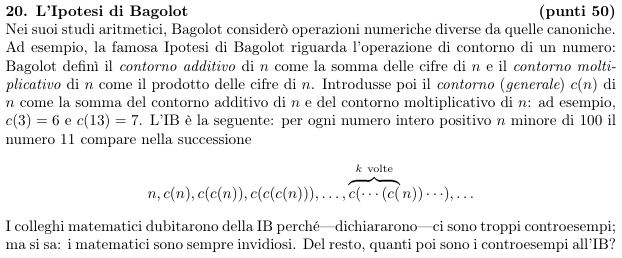
L’Ipotesi di Bagolot (punti 50) Nei suoi studi aritmetici, Bagolot considerò operazioni numeriche diverse da quelle canoniche. Ad esempio, la famosa Ipotesi di Bagolot riguarda l’operazione di contorno di un numero: Bagolot definì il contorno additivo di n come la somma delle cifre di n e il contorno moltiplicativo di n come il prodotto delle cifre di n. Introdusse poi il contorno (generale) c(n) di n come la somma del contorno additivo di n e del contorno moltiplicativo di n: ad esempio, c(3) = 6 e c(13) = 7. L’IB è la seguente: per ogni numero intero positivo n minore di 100 il numero 11 compare nella successione n, c(n), c(c(n)), c(c(c(n))), … , c(· · (c(n)) · ·) [c applicata k volte], … I colleghi matematici dubitarono della IB perché—dichiararono—ci sono troppi controesempi; ma si sa: i matematici sono sempre invidiosi. Del resto, quanti poi sono i controesempi all’IB?
Topic: Teoria dei Numeri, successioni Area: Aritmetica e Teoria dei Numeri, Algebra e Analisi Risposta: 0027 Fonte: apri PDF p.6 · phiquadro.it, Archivio gare ufficiali 2014 (= fairmath.it, Coppa Galileo 2014)
Bagolot’s Hypothesis
Bagolot’s Hypothesis (50 points) In his arithmetical studies, Bagolot considered numerical operations different from the canonical ones. For example, the famous Bagolot’s Hypothesis concerns the outline operation of a number: Bagolot defined the additive outline of n as the sum of the digits of n and the multiplicative outline of n as the product of the digits of n. He then introduced the (general) outline c(n) of n as the sum of the additive outline of n and the multiplicative outline of n: for example, c(3) = 6 and c(13) = 7. BH is the following: for every positive integer n less than 100 the number 11 appears in the sequence n, c(n), c(c(n)), c(c(c(n))), …, c(⋯(c(n))⋯) [c applied k times], … His fellow mathematicians doubted BH because, they declared, there are too many counterexamples; but you know, mathematicians are always envious. After all, how many counterexamples to BH are there?
Answer: 0027
Il primo problema del milionario
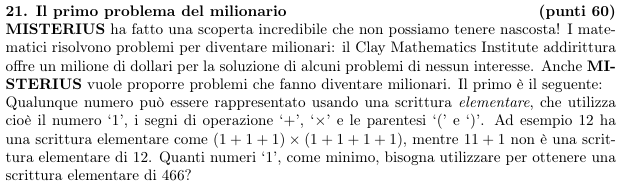
Il primo problema del milionario (punti 60) MISTERIUS ha fatto una scoperta incredibile che non possiamo tenere nascosta! I matematici risolvono problemi per diventare milionari: il Clay Mathematics Institute addirittura offre un milione di dollari per la soluzione di alcuni problemi di nessun interesse. Anche MISTERIUS vuole proporre problemi che fanno diventare milionari. Il primo è il seguente: Qualunque numero può essere rappresentato usando una scrittura elementare, che utilizza cioè il numero ‘1’, i segni di operazione ‘+’, ‘×’ e le parentesi ‘(’ e ‘)’. Ad esempio 12 ha una scrittura elementare come (1 + 1 + 1) × (1 + 1 + 1 + 1), mentre 11 + 1 non è una scrittura elementare di 12. Quanti numeri ‘1’, come minimo, bisogna utilizzare per ottenere una scrittura elementare di 466?
Topic: Teoria dei Numeri Area: Aritmetica e Teoria dei Numeri Risposta: 0020 Fonte: apri PDF p.6 · phiquadro.it, Archivio gare ufficiali 2014 (= fairmath.it, Coppa Galileo 2014)
The first millionaire problem
The first millionaire problem (60 points) MISTERIUS has made an incredible discovery that we cannot keep hidden! Mathematicians solve problems to become millionaires: the Clay Mathematics Institute even offers a million dollars for the solution of some problems of no interest at all. MISTERIUS too wants to propose problems that make people millionaires. The first is the following: any number can be represented using an elementary notation, that is one that uses the number ‘1’, the operation signs ‘+’, ‘×’ and the brackets ‘(’ and ‘)’. For example 12 has the elementary notation (1 + 1 + 1) × (1 + 1 + 1 + 1), while 11 + 1 is not an elementary notation for 12. What is the minimum number of ‘1’s needed to obtain an elementary notation for 466?
Answer: 0020
Il secondo problema del milionario

Il secondo problema del milionario (punti 60) Il secondo problema per diventare milionari è il seguente: Quanto fa la somma dei numeri interi positivi minori di 100 che si possono scrivere in almeno due modi distinti come differenza di quadrati di numeri interi positivi?
Topic: Teoria dei Numeri Area: Aritmetica e Teoria dei Numeri Risposta: 2102 Fonte: apri PDF p.6 · phiquadro.it, Archivio gare ufficiali 2014 (= fairmath.it, Coppa Galileo 2014)
The second millionaire problem
The second millionaire problem (60 points) The second problem for becoming a millionaire is the following: what is the sum of the positive integers less than 100 that can be written in at least two different ways as a difference of squares of positive integers?
Answer: 2102
Il terzo problema del milionario
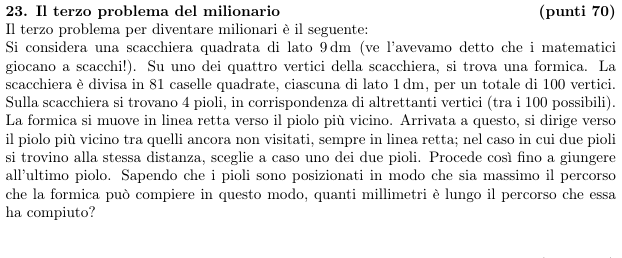
Il terzo problema del milionario (punti 70) Il terzo problema per diventare milionari è il seguente: Si considera una scacchiera quadrata di lato 9 dm (ve l’avevamo detto che i matematici giocano a scacchi!). Su uno dei quattro vertici della scacchiera, si trova una formica. La scacchiera è divisa in 81 caselle quadrate, ciascuna di lato 1 dm, per un totale di 100 vertici. Sulla scacchiera si trovano 4 pioli, in corrispondenza di altrettanti vertici (tra i 100 possibili). La formica si muove in linea retta verso il piolo più vicino. Arrivata a questo, si dirige verso il piolo più vicino tra quelli ancora non visitati, sempre in linea retta; nel caso in cui due pioli si trovino alla stessa distanza, sceglie a caso uno dei due pioli. Procede così fino a giungere all’ultimo piolo. Sapendo che i pioli sono posizionati in modo che sia massimo il percorso che la formica può compiere in questo modo, quanti millimetri è lungo il percorso che essa ha compiuto?
Topic: Combinatoria, Probabilita e statistica Area: Combinatoria, Logica e Probabilita Risposta: 3480 Fonte: apri PDF p.6 · phiquadro.it, Archivio gare ufficiali 2014 (= fairmath.it, Coppa Galileo 2014)
The third millionaire problem
The third millionaire problem (70 points) The third problem for becoming a millionaire is the following: consider a square chessboard with sides of 9 dm (we told you mathematicians play chess!). At one of the four corners of the chessboard there is an ant. The chessboard is divided into 81 square cells, each with sides of 1 dm, for a total of 100 vertices. On the chessboard there are 4 pegs, at as many vertices (among the 100 possible ones). The ant moves in a straight line towards the nearest peg. Having reached it, it heads for the nearest peg among those not yet visited, again in a straight line; if two pegs are at the same distance, it chooses one of the two at random. It goes on in this way until it reaches the last peg. Knowing that the pegs are positioned so that the path the ant can travel in this way is as long as possible, how many millimetres long is the path it has travelled?
Answer: 3480
Il quarto problema del milionario
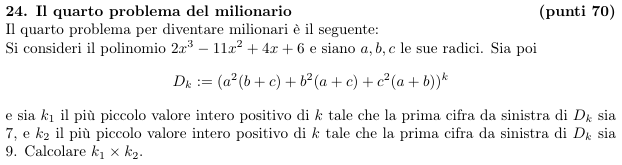
Il quarto problema del milionario (punti 70) Il quarto problema per diventare milionari è il seguente: Si consideri il polinomio 2x^3 − 11x^2 + 4x + 6 e siano a, b, c le sue radici. Sia poi D_k := (a^2(b + c) + b^2(a + c) + c^2(a + b))^k e sia k_1 il più piccolo valore intero positivo di k tale che la prima cifra da sinistra di D_k sia 7, e k_2 il più piccolo valore intero positivo di k tale che la prima cifra da sinistra di D_k sia 9. Calcolare k_1 × k_2.
Topic: Algebra Area: Algebra e Analisi Risposta: 2438 Fonte: apri PDF p.6 · phiquadro.it, Archivio gare ufficiali 2014 (= fairmath.it, Coppa Galileo 2014)
The fourth millionaire problem
The fourth millionaire problem (70 points) The fourth problem for becoming a millionaire is the following: consider the polynomial 2x^3 − 11x^2 + 4x + 6 and let a, b, c be its roots. Then let D_k := (a^2(b + c) + b^2(a + c) + c^2(a + b))^k, let k_1 be the smallest positive integer value of k such that the first digit from the left of D_k is 7, and k_2 the smallest positive integer value of k such that the first digit from the left of D_k is 9. Compute k_1 × k_2.
Answer: 2438