Il primo dubbio di Tuono
Il primo dubbio di Tuono Quali sono i due numeri interi positivi che, moltiplicati tra loro, danno 2016 e, sottraendo il minore dal maggiore, si ottiene 20? [Dare come risposta le prime quattro cifre dopo la virgola del rapporto tra il minore e il maggiore.]
Topic: Teoria dei Numeri Area: Aritmetica e Teoria dei Numeri Risposta: 6428 Fonte: apri PDF p.2 · phiquadro.it, Archivio gare ufficiali 2016 (= fairmath.it, Coppa Gauss 2016)
Tuono’s first doubt
Tuono’s first doubt Which are the two positive integers that, multiplied together, give 2016 and such that subtracting the smaller from the larger gives 20? [Give as the answer the first four digits after the decimal point of the ratio between the smaller and the larger.]
Answer: 6428
I gioielli nello scrigno
I gioielli nello scrigno In uno scrigno vi sono 10000 gioielli, 5500 di questi sono verdi, mentre 4500 sono rossi; metà sono lisci, metà sono ruvidi. Quanti gioielli bisogna estrarre dallo scrigno per essere certi di aver estratto almeno un gioiello verde e liscio?
Risposta: 9501 Fonte: apri PDF p.2 · phiquadro.it, Archivio gare ufficiali 2016 (= fairmath.it, Coppa Gauss 2016)
The jewels in the casket
The jewels in the casket In a casket there are 10000 jewels; 5500 of them are green, while 4500 are red; half are smooth and half are rough. How many jewels must be taken out of the casket to be certain of having taken out at least one green smooth jewel?
Answer: 9501
Igiene dentale
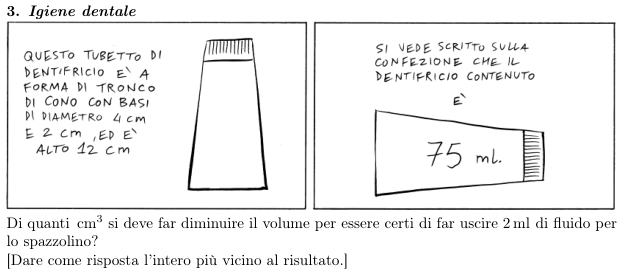
Igiene dentale [Testo del fumetto: «Questo tubetto di dentifricio è a forma di tronco di cono con basi di diametro 4 cm e 2 cm, ed è alto 12 cm.» «Si vede scritto sulla confezione che il dentifricio contenuto è 75 ml.»] Di quanti cm^3 si deve far diminuire il volume per essere certi di far uscire 2 ml di fluido per lo spazzolino? [Dare come risposta l’intero più vicino al risultato.]
Topic: Geometria solida Area: Geometria Risposta: 0015 Fonte: apri PDF p.2 · phiquadro.it, Archivio gare ufficiali 2016 (= fairmath.it, Coppa Gauss 2016)
Dental hygiene
Dental hygiene [Comic-strip text: «This toothpaste tube has the shape of a truncated cone with bases of diameter 4 cm and 2 cm, and it is 12 cm high.» «It says on the package that the toothpaste contained is 75 ml.»] By how many cm^3 must the volume be decreased to be sure of squeezing out 2 ml of paste for the toothbrush? [Give as the answer the integer closest to the result.]
Answer: 0015
Il secondo dubbio di Tuono
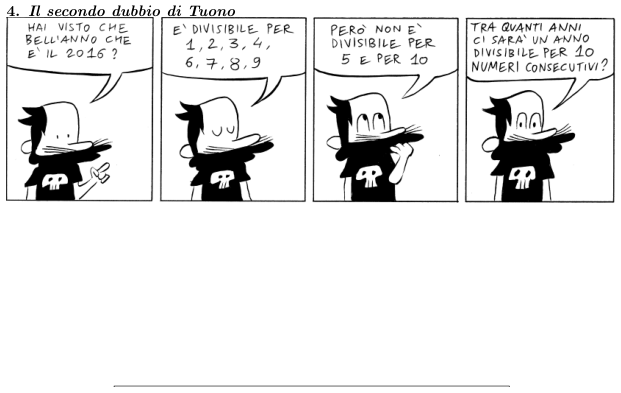
Il secondo dubbio di Tuono [Testo del fumetto: «Hai visto che bell’anno che è il 2016?» «È divisibile per 1, 2, 3, 4, 6, 7, 8, 9.» «Però non è divisibile per 5 e per 10.» «Tra quanti anni ci sarà un anno divisibile per 10 numeri consecutivi?»]
Risposta: 0504 Fonte: apri PDF p.2 · phiquadro.it, Archivio gare ufficiali 2016 (= fairmath.it, Coppa Gauss 2016)
Tuono’s second doubt
Tuono’s second doubt [Comic-strip text: «Have you seen what a nice year 2016 is?» «It is divisible by 1, 2, 3, 4, 6, 7, 8, 9.» «But it is not divisible by 5 and by 10.» «In how many years will there be a year divisible by 10 consecutive numbers?»]
Answer: 0504
La sveglia
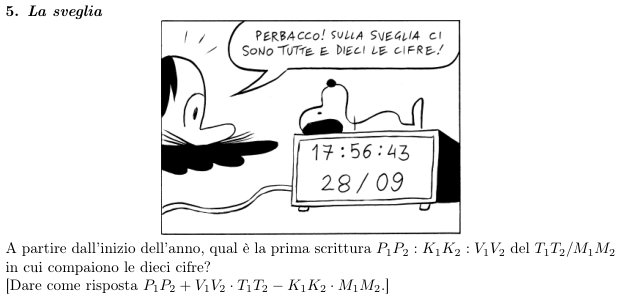
La sveglia [Testo del fumetto: «Perbacco! Sulla sveglia ci sono tutte e dieci le cifre!» La sveglia mostra 17:56:43 e 28/09.] A partire dall’inizio dell’anno, qual è la prima scrittura P_1P_2 : K_1K_2 : V_1V_2 del T_1T_2/M_1M_2 in cui compaiono le dieci cifre? [Dare come risposta P_1P_2 + V_1V_2 · T_1T_2 − K_1K_2 · M_1M_2.]
Topic: Teoria dei Numeri Area: Aritmetica e Teoria dei Numeri Risposta: 1407 Fonte: apri PDF p.3 · phiquadro.it, Archivio gare ufficiali 2016 (= fairmath.it, Coppa Gauss 2016)
The alarm clock
The alarm clock [Comic-strip text: «Goodness! All ten digits are on the alarm clock!» The clock shows 17:56:43 and 28/09.] Starting from the beginning of the year, what is the first display P_1P_2 : K_1K_2 : V_1V_2 of T_1T_2/M_1M_2 in which the ten digits appear? [Give as the answer P_1P_2 + V_1V_2 · T_1T_2 − K_1K_2 · M_1M_2.]
Answer: 1407
Il primo problema di Zoe
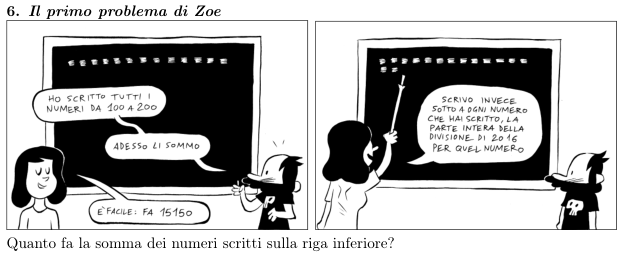
Il primo problema di Zoe [Testo del fumetto: «Ho scritto tutti i numeri da 100 a 200.» «Adesso li sommo.» «È facile: fa 15150.» «Scrivo invece sotto a ogni numero che hai scritto la parte intera della divisione di 2016 per quel numero.»] Quanto fa la somma dei numeri scritti sulla riga inferiore?
Topic: Teoria dei Numeri Area: Aritmetica e Teoria dei Numeri Risposta: 1366 Fonte: apri PDF p.3 · phiquadro.it, Archivio gare ufficiali 2016 (= fairmath.it, Coppa Gauss 2016)
Zoe’s first problem
Zoe’s first problem [Comic-strip text: «I’ve written all the numbers from 100 to 200.» «Now I’ll add them up.» «It’s easy: it makes 15150.» «Instead, under each number you have written, I write the integer part of the division of 2016 by that number.»] What is the sum of the numbers written on the lower row?
Answer: 1366
Il primo robot indaffarato
Il primo robot indaffarato Su una scacchiera 20 × 16, un piccolo robot è posizionato sulla prima casella più in basso a sinistra ed è rivolto verso la casella più in alto a sinistra, la sedicesima. Il robot si può muovere sulla scacchiera utilizzando le seguenti mosse (a) andare avanti di una casella nella direzione in cui è rivolto; (b) ruotare di 90° alla sua destra e andare avanti di una casella nella direzione in cui è rivolto dopo la rotazione. Il robot può fare quante mosse vuole, ma non può uscire dalla scacchiera, non può ritornare su una casella già visitata e deve continuare ad eseguire la stessa mossa finché non gli è più possibile eseguirla per rispettare le altre regole. Quante sono le caselle su cui gli può capitare di passare, sempre partendo dalla prima casella più in basso a sinistra e rivolto verso la casella più in alto a sinistra?
Topic: Combinatoria Area: Combinatoria, Logica e Probabilita Risposta: 0050 Fonte: apri PDF p.3 · phiquadro.it, Archivio gare ufficiali 2016 (= fairmath.it, Coppa Gauss 2016)
The first busy robot
The first busy robot On a 20 × 16 chessboard, a small robot is placed on the bottom-left square and faces the top-left square, the sixteenth. The robot can move on the chessboard using the following moves: (a) move forward one square in the direction it is facing; (b) turn 90° to its right and move forward one square in the direction it is facing after the rotation. The robot can make as many moves as it likes, but it cannot leave the chessboard, cannot return to a square already visited and must keep making the same move until it can no longer make it while respecting the other rules. On how many squares can it happen to pass, always starting from the bottom-left square and facing the top-left square?
Answer: 0050
La burocrazia perditempo
La burocrazia perditempo River ha analizzato le regole che i 10000 sportelli, numerati da 1 a 10000, nel Palazzo della Burocrazia applicano per vidimare un modulo. Ha scoperto che ogni impiegato, quando una persona si presenta davanti al proprio sportello con un modulo da firmare, guarda nell’ordine un elenco di regole numerate ed effettua la prima che può essere effettivamente eseguita:
- se n ≥ 300 firma il modulo;
- se n è divisibile per 5 non firma il modulo e manda la persona allo sportello n
- se n è divisibile per 3 non firma il modulo e manda la persona allo sportello n + 100;
- se n è divisibile per 2 non firma il modulo e manda la persona allo sportello n − 1;
- se n è divisibile per 11 non firma il modulo e manda la persona allo sportello pari alla somma delle cifre di n;
- firma il modulo. In particolare, se lo sportello a cui deve essere mandata la persona non esiste, firma il modulo. River determina da quale sportello inizia il giro che passa dal maggior numero di sportelli possibile prima di ottenere la firma sul modulo. Qual è il numero dello sportello determinato da River?
Topic: Teoria dei Numeri Area: Aritmetica e Teoria dei Numeri Risposta: 0054 Fonte: apri PDF p.4 · phiquadro.it, Archivio gare ufficiali 2016 (= fairmath.it, Coppa Gauss 2016)
Time-wasting bureaucracy
Time-wasting bureaucracy River has analysed the rules that the 10000 counters, numbered from 1 to 10000, in the Palace of Bureaucracy apply to validate a form. He has discovered that each clerk, when a person comes to his counter with a form to be signed, looks in order at a list of numbered rules and carries out the first one that can actually be carried out (n is the number of the counter):
- if n ≥ 300, he signs the form;
- if n is divisible by 5, he does not sign the form and sends the person to counter n
- if n is divisible by 3, he does not sign the form and sends the person to counter n + 100;
- if n is divisible by 2, he does not sign the form and sends the person to counter n − 1;
- if n is divisible by 11, he does not sign the form and sends the person to the counter equal to the sum of the digits of n;
- he signs the form. In particular, if the counter to which the person should be sent does not exist, he signs the form. River determines from which counter the round starts that passes through the largest possible number of counters before obtaining the signature on the form. What is the number of the counter determined by River?
Answer: 0054
Il quadrante di Kaylee
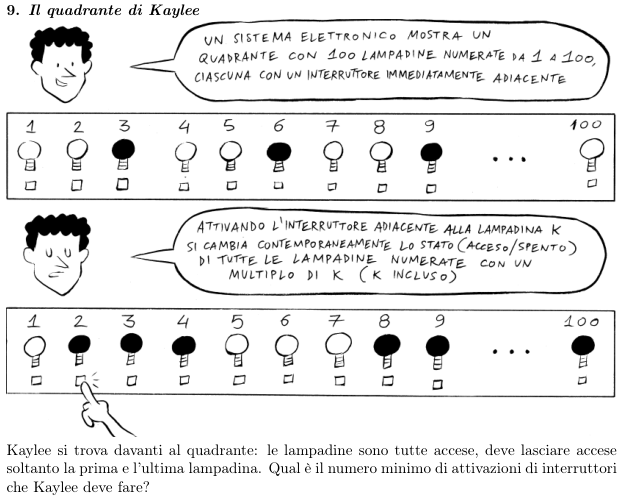
Il quadrante di Kaylee [Testo del fumetto: «Un sistema elettronico mostra un quadrante con 100 lampadine numerate da 1 a 100, ciascuna con un interruttore immediatamente adiacente.» «Attivando l’interruttore adiacente alla lampadina k si cambia contemporaneamente lo stato (acceso/spento) di tutte le lampadine numerate con un multiplo di k (k incluso).»] Kaylee si trova davanti al quadrante: le lampadine sono tutte accese, deve lasciare accese soltanto la prima e l’ultima lampadina. Qual è il numero minimo di attivazioni di interruttori che Kaylee deve fare?
Risposta: 0061 Fonte: apri PDF p.4 · phiquadro.it, Archivio gare ufficiali 2016 (= fairmath.it, Coppa Gauss 2016)
Kaylee’s panel
Kaylee’s panel [Comic-strip text: «An electronic system shows a panel with 100 light bulbs numbered from 1 to 100, each with a switch immediately next to it.» «Activating the switch next to bulb k simultaneously changes the state (on/off) of all the bulbs numbered with a multiple of k (k included).»] Kaylee stands in front of the panel: the bulbs are all on, and she must leave on only the first and the last bulb. What is the minimum number of switch activations Kaylee must make?
Answer: 0061
Il secondo problema di Zoe
Il secondo problema di Zoe Quanti interi positivi minori di 100 hanno la proprietà che il numero dei loro divisori interi positivi è uguale al prodotto delle loro cifre?
Topic: Teoria dei Numeri Area: Aritmetica e Teoria dei Numeri Risposta: 0007 Fonte: apri PDF p.4 · phiquadro.it, Archivio gare ufficiali 2016 (= fairmath.it, Coppa Gauss 2016)
Zoe’s second problem
Zoe’s second problem How many positive integers less than 100 have the property that the number of their positive integer divisors is equal to the product of their digits?
Answer: 0007
La festa a Lilac
La festa a Lilac Un operaio deve piazzare 2016 paletti per la festa nella grande piazza di Lilac secondo uno schema ben preciso. Incomincia fissando il paletto 1; si allontana dal paletto 1 di 1 m e fissa il paletto 2. A questo punto, con la schiena contro il paletto 2 ruota di 120° in senso antiorario rispetto alla direzione che aveva percorso dal paletto 1 al paletto 2 e fissa il paletto 3 dopo aver camminato per 2 m. Come prima, schiena al paletto 3, ruota di 120° in senso antiorario rispetto alla direzione dal paletto 2 al paletto 3, cammina per 3 m e fissa il paletto 4. Continua così finché non pianta a terra 2016 paletti. Quanto dista il paletto 1 dal paletto 2016?
Topic: Combinatoria Area: Combinatoria, Logica e Probabilita Risposta: 1163 Fonte: apri PDF p.5 · phiquadro.it, Archivio gare ufficiali 2016 (= fairmath.it, Coppa Gauss 2016)
The party in Lilac
The party in Lilac A worker has to place 2016 posts for the party in the large square of Lilac according to a very precise scheme. He begins by fixing post 1; he moves 1 m away from post 1 and fixes post 2. At this point, with his back against post 2, he turns 120° anticlockwise with respect to the direction he had walked from post 1 to post 2, and fixes post 3 after walking 2 m. As before, with his back to post 3, he turns 120° anticlockwise with respect to the direction from post 2 to post 3, walks 3 m and fixes post 4. He goes on like this until he has planted 2016 posts in the ground. How far is post 1 from post 2016?
Answer: 1163
Le piante di fagioli
Le piante di fagioli Un contadino ha comprato da un membro dell’Alleanza una scatola di fagioli gialli. Ogni notte la pianta di fagiolo giallo cresce di (1/n) m dove n è il numero di giorni passati dall’ultima volta che il terreno è stato concimato. La prima mattina il contadino semina un fagiolo e concima tutto il suo terreno, in accordo con la sua natura nella notte il fagiolo cresce di 1 m. In ognuna delle dieci mattine successive l’agricoltore farà una sola tra le seguenti due azioni: seminerà un nuovo fagiolo oppure concimerà tutto il suo terreno. All’alba del dodicesimo giorno, misura l’altezza di ogni sua piantina e ne calcola la somma in cm. Quanto vale, al massimo, tale somma?
Risposta: 3700 Fonte: apri PDF p.5 · phiquadro.it, Archivio gare ufficiali 2016 (= fairmath.it, Coppa Gauss 2016)
The bean plants
The bean plants A farmer has bought a box of yellow beans from a member of the Alliance. Every night a yellow bean plant grows by (1/n) m, where n is the number of days since the soil was last fertilised. On the first morning the farmer sows a bean and fertilises all his land; true to its nature, during the night the bean grows by 1 m. On each of the following ten mornings the farmer will do exactly one of the following two actions: he will sow a new bean or he will fertilise all his land. At dawn on the twelfth day, he measures the height of each of his plants and computes their sum in cm. What is the maximum value of this sum?
Answer: 3700
Il terzo dubbio di Tuono
Il terzo dubbio di Tuono Considerato il polinomio P(x) ottenuto facendo il prodotto dei 2016 polinomi x + 1, x^2 + 2, … , x^(2015) + 2015 e x^(2016) + 2016, qual è il più piccolo intero positivo n tale che la somma dei coefficienti del polinomio P(x) non è divisibile per n?
Topic: Algebra Area: Algebra e Analisi Risposta: 2027 Fonte: apri PDF p.5 · phiquadro.it, Archivio gare ufficiali 2016 (= fairmath.it, Coppa Gauss 2016)
Tuono’s third doubt
Tuono’s third doubt Considering the polynomial P(x) obtained as the product of the 2016 polynomials x + 1, x^2 + 2, …, x^2015 + 2015 and x^2016 + 2016, what is the smallest positive integer n such that the sum of the coefficients of the polynomial P(x) is not divisible by n?
Answer: 2027
Il circuito di Kaylee
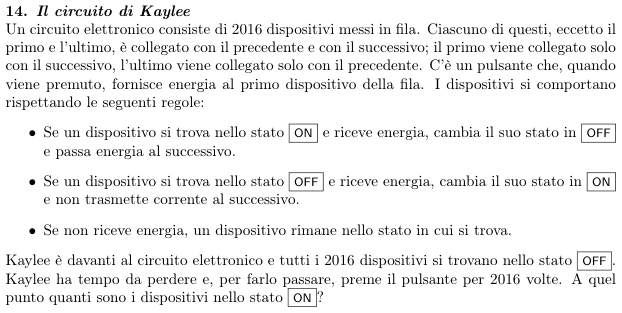
Il circuito di Kaylee Un circuito elettronico consiste di 2016 dispositivi messi in fila. Ciascuno di questi, eccetto il primo e l’ultimo, è collegato con il precedente e con il successivo; il primo viene collegato solo con il successivo, l’ultimo viene collegato solo con il precedente. C’è un pulsante che, quando viene premuto, fornisce energia al primo dispositivo della fila. I dispositivi si comportano rispettando le seguenti regole: • Se un dispositivo si trova nello stato ON e riceve energia, cambia il suo stato in OFF e passa energia al successivo. • Se un dispositivo si trova nello stato OFF e riceve energia, cambia il suo stato in ON e non trasmette corrente al successivo. • Se non riceve energia, un dispositivo rimane nello stato in cui si trova. Kaylee è davanti al circuito elettronico e tutti i 2016 dispositivi si trovano nello stato OFF . Kaylee ha tempo da perdere e, per farlo passare, preme il pulsante per 2016 volte. A quel punto quanti sono i dispositivi nello stato ON ?
Topic: Combinatoria Area: Combinatoria, Logica e Probabilita Risposta: 0006 Fonte: apri PDF p.5 · phiquadro.it, Archivio gare ufficiali 2016 (= fairmath.it, Coppa Gauss 2016)
Kaylee’s circuit
Kaylee’s circuit An electronic circuit consists of 2016 devices placed in a row. Each of them, except the first and the last, is connected to the previous and to the next one; the first is connected only to the next one, the last only to the previous one. There is a button that, when pressed, supplies energy to the first device of the row. The devices behave according to the following rules: • If a device is in the ON state and receives energy, it changes its state to OFF and passes energy to the next one. • If a device is in the OFF state and receives energy, it changes its state to ON and does not pass current to the next one. • If it does not receive energy, a device remains in the state it is in. Kaylee is in front of the electronic circuit and all 2016 devices are in the OFF state. Kaylee has time to kill and, to pass it, presses the button 2016 times. At that point how many devices are in the ON state?
Answer: 0006
I codici di River
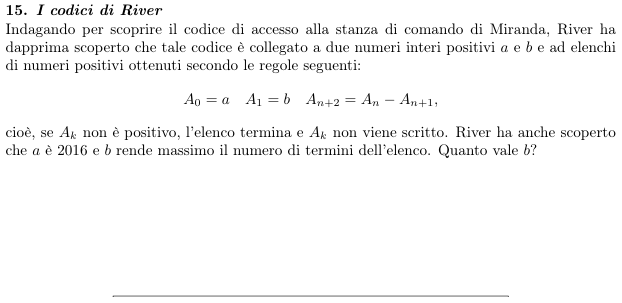
I codici di River Indagando per scoprire il codice di accesso alla stanza di comando di Miranda, River ha dapprima scoperto che tale codice è collegato a due numeri interi positivi a e b e ad elenchi di numeri positivi ottenuti secondo le regole seguenti: A_0 = a A_1 = b A_n_(+2) = A_n − A_n_(+1), cioè, se A_k non è positivo, l’elenco termina e A_k non viene scritto. River ha anche scoperto che a è 2016 e b rende massimo il numero di termini dell’elenco. Quanto vale b?
Topic: Teoria dei Numeri, successioni Area: Aritmetica e Teoria dei Numeri, Algebra e Analisi Risposta: 1246 Fonte: apri PDF p.5 · phiquadro.it, Archivio gare ufficiali 2016 (= fairmath.it, Coppa Gauss 2016)
River’s codes
River’s codes Investigating to discover the access code to Miranda’s control room, River first discovered that this code is linked to two positive integers a and b and to lists of positive numbers obtained according to the following rules: A_0 = a, A_1 = b, A_(n+2) = A_n − A_(n+1); that is, if A_k is not positive, the list ends and A_k is not written. River also discovered that a is 2016 and that b maximises the number of terms of the list. What is b?
Answer: 1246
Il terzo problema di Zoe
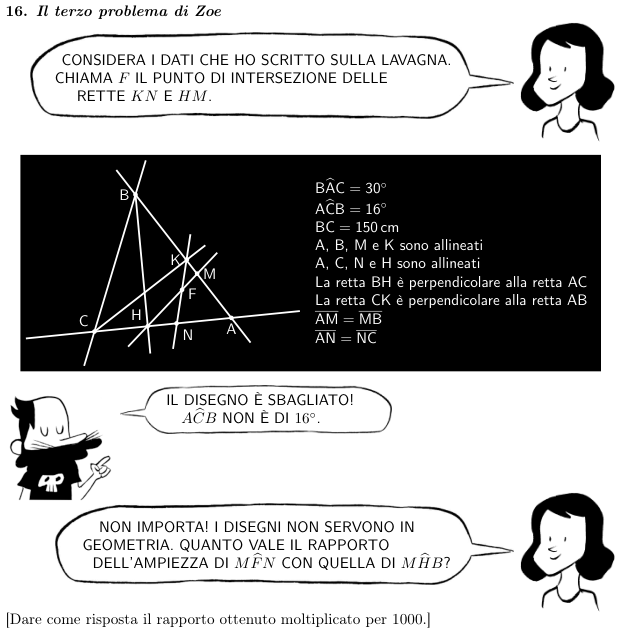
Il terzo problema di Zoe CONSIDERA I DATI CHE HO SCRITTO SULLA LAVAGNA. CHIAMA F IL PUNTO DI INTERSEZIONE DELLE RETTE KN E HM. Dati sulla lavagna: l’angolo BAC = 30°; l’angolo ACB = 16°; BC = 150 cm; A, B, M e K sono allineati; A, C, N e H sono allineati; la retta BH è perpendicolare alla retta AC; la retta CK è perpendicolare alla retta AB; AM = MB; AN = NC. IL DISEGNO È SBAGLIATO! L’ANGOLO ACB NON È DI 16°. NON IMPORTA! I DISEGNI NON SERVONO IN GEOMETRIA. QUANTO VALE IL RAPPORTO DELL’AMPIEZZA DELL’ANGOLO MFN CON QUELLA DELL’ANGOLO MHB? [Dare come risposta il rapporto ottenuto moltiplicato per 1000.]
Topic: Algebra Area: Algebra e Analisi Risposta: 1500 Fonte: apri PDF p.6 · phiquadro.it, Archivio gare ufficiali 2016 (= fairmath.it, Coppa Gauss 2016)
Zoe’s third problem
Zoe’s third problem CONSIDER THE DATA I HAVE WRITTEN ON THE BLACKBOARD. CALL F THE POINT OF INTERSECTION OF THE LINES KN AND HM. Data on the blackboard: angle BAC = 30°; angle ACB = 16°; BC = 150 cm; A, B, M and K are collinear; A, C, N and H are collinear; line BH is perpendicular to line AC; line CK is perpendicular to line AB; AM = MB; AN = NC. THE DRAWING IS WRONG! ANGLE ACB IS NOT 16°. IT DOESN’T MATTER! DRAWINGS ARE NOT NEEDED IN GEOMETRY. WHAT IS THE RATIO OF THE MEASURE OF ANGLE MFN TO THAT OF ANGLE MHB? [Give as the answer the ratio obtained multiplied by 1000.]
Answer: 1500
Il dado truccato di River
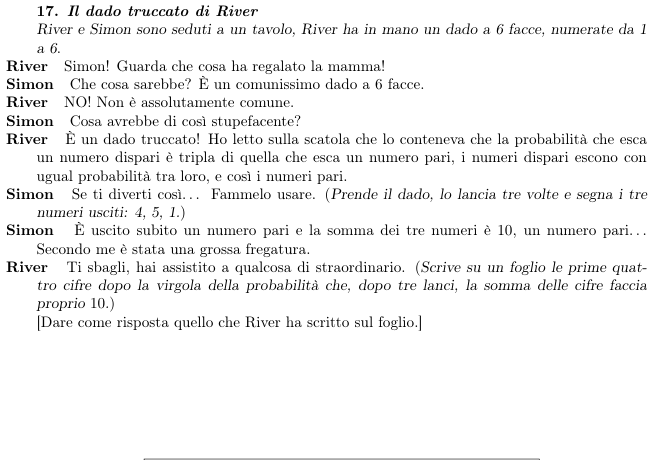
Il dado truccato di River River e Simon sono seduti a un tavolo, River ha in mano un dado a 6 facce, numerate da 1 a 6. River Simon! Guarda che cosa ha regalato la mamma! Simon Che cosa sarebbe? È un comunissimo dado a 6 facce. River NO! Non è assolutamente comune. Simon Cosa avrebbe di così stupefacente? River È un dado truccato! Ho letto sulla scatola che lo conteneva che la probabilità che esca un numero dispari è tripla di quella che esca un numero pari, i numeri dispari escono con ugual probabilità tra loro, e così i numeri pari. Simon Se ti diverti così… Fammelo usare. (Prende il dado, lo lancia tre volte e segna i tre numeri usciti: 4, 5, 1.) Simon È uscito subito un numero pari e la somma dei tre numeri è 10, un numero pari… Secondo me è stata una grossa fregatura. River Ti sbagli, hai assistito a qualcosa di straordinario. (Scrive su un foglio le prime quattro cifre dopo la virgola della probabilità che, dopo tre lanci, la somma delle cifre faccia proprio 10.) [Dare come risposta quello che River ha scritto sul foglio.]
Topic: Probabilita e statistica Area: Combinatoria, Logica e Probabilita Risposta: 1128 Fonte: apri PDF p.6 · phiquadro.it, Archivio gare ufficiali 2016 (= fairmath.it, Coppa Gauss 2016)
River’s loaded die
River’s loaded die River and Simon are sitting at a table; River holds a 6-sided die, with faces numbered from 1 to 6. River: Simon! Look what Mum has given me! Simon: What’s that supposed to be? It’s a perfectly ordinary 6-sided die. River: NO! It’s not ordinary at all. Simon: What’s so amazing about it? River: It’s a loaded die! I read on the box it came in that the probability of an odd number coming up is three times that of an even number coming up; the odd numbers come up with equal probability among themselves, and so do the even numbers. Simon: If that’s how you have fun… Let me use it. (He takes the die, rolls it three times and notes the three numbers that came up: 4, 5, 1.) Simon: An even number came up straight away and the sum of the three numbers is 10, an even number… In my opinion it was a big rip-off. River: You’re wrong, you have witnessed something extraordinary. (He writes on a sheet the first four digits after the decimal point of the probability that, after three rolls, the sum of the digits is exactly 10.) [Give as the answer what River wrote on the sheet.]
Answer: 1128
Il quarto dubbio di Tuono
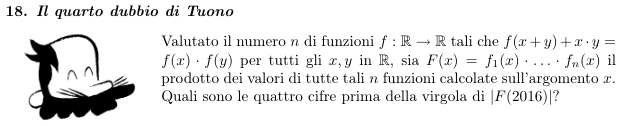
Il quarto dubbio di Tuono Valutato il numero n di funzioni f : R → R tali che f(x + y) + x · y = f(x) · f(y) per tutti gli x, y in R, sia F(x) = f_1(x) · … · f_n(x) il prodotto dei valori di tutte tali n funzioni calcolate sull’argomento x. Quali sono le quattro cifre prima della virgola di |F(2016)|?
Topic: Teoria dei Numeri Area: Aritmetica e Teoria dei Numeri Risposta: 4255 Fonte: apri PDF p.7 · phiquadro.it, Archivio gare ufficiali 2016 (= fairmath.it, Coppa Gauss 2016)
Tuono’s fourth doubt
Tuono’s fourth doubt Having determined the number n of functions f : R → R such that f(x + y) + x · y = f(x) · f(y) for all x, y in R, let F(x) = f_1(x) · … · f_n(x) be the product of the values of all these n functions computed at the argument x. What are the four digits before the decimal point of |F(2016)|?
Answer: 4255
La cassaforte di Mal
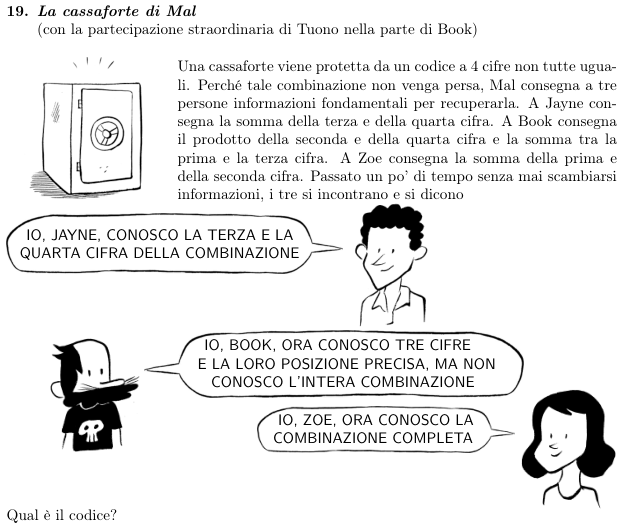
La cassaforte di Mal (con la partecipazione straordinaria di Tuono nella parte di Book) Una cassaforte viene protetta da un codice a 4 cifre non tutte uguali. Perché tale combinazione non venga persa, Mal consegna a tre persone informazioni fondamentali per recuperarla. A Jayne consegna la somma della terza e della quarta cifra. A Book consegna il prodotto della seconda e della quarta cifra e la somma tra la prima e la terza cifra. A Zoe consegna la somma della prima e della seconda cifra. Passato un po’ di tempo senza mai scambiarsi informazioni, i tre si incontrano e si dicono IO, JAYNE, CONOSCO LA TERZA E LA QUARTA CIFRA DELLA COMBINAZIONE IO, BOOK, ORA CONOSCO TRE CIFRE E LA LORO POSIZIONE PRECISA, MA NON CONOSCO L’INTERA COMBINAZIONE IO, ZOE, ORA CONOSCO LA COMBINAZIONE COMPLETA Qual è il codice?
Topic: Teoria dei Numeri Area: Aritmetica e Teoria dei Numeri Risposta: 8900 Fonte: apri PDF p.7 · phiquadro.it, Archivio gare ufficiali 2016 (= fairmath.it, Coppa Gauss 2016)
Mal’s safe (with a special guest appearance by Tuono as Book)
Mal’s safe (with a special guest appearance by Tuono as Book) A safe is protected by a 4-digit code whose digits are not all equal. So that this combination is not lost, Mal gives three people information that is essential to recover it. To Jayne he gives the sum of the third and the fourth digit. To Book he gives the product of the second and the fourth digit and the sum of the first and the third digit. To Zoe he gives the sum of the first and the second digit. After some time, without ever exchanging information, the three meet and say: I, JAYNE, KNOW THE THIRD AND THE FOURTH DIGIT OF THE COMBINATION. I, BOOK, NOW KNOW THREE DIGITS AND THEIR EXACT POSITION, BUT I DO NOT KNOW THE WHOLE COMBINATION. I, ZOE, NOW KNOW THE COMPLETE COMBINATION. What is the code?
Answer: 8900
Energia per Serenity

Energia per Serenity Un cubo è formato da 343 cubetti più piccoli, disposti in 7 piani da 49 cubetti ciascuno. Per poter estrarre un cubetto deve esistere un percorso libero dalla sua posizione fino all’esterno. Per fornire energia all’astronave Serenity, Mal deve estrarre esattamente 116 cubetti esponendo la superficie massima ottenibile. Quanti cm^2 vale tale superficie massima sapendo che il lato di ogni cubetto misura 1 cm?
Topic: Geometria solida Area: Geometria Risposta: 0754 Fonte: apri PDF p.7 · phiquadro.it, Archivio gare ufficiali 2016 (= fairmath.it, Coppa Gauss 2016)
Energy for Serenity
Energy for Serenity A cube is made up of 343 smaller cubes, arranged in 7 layers of 49 small cubes each. To be able to extract a small cube there must be a free path from its position to the outside. To supply energy to the spaceship Serenity, Mal must extract exactly 116 small cubes, exposing the maximum obtainable surface. How many cm^2 is this maximum surface, knowing that the side of each small cube is 1 cm?
Answer: 0754
Il secondo robot indaffarato
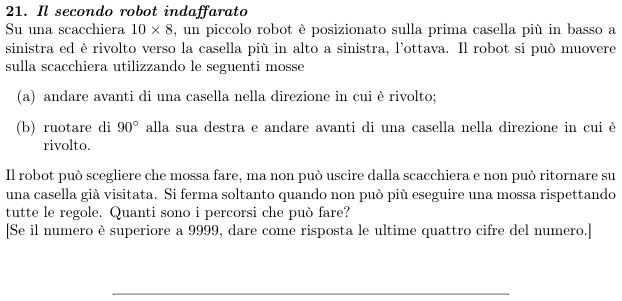
Il secondo robot indaffarato Su una scacchiera 10 × 8, un piccolo robot è posizionato sulla prima casella più in basso a sinistra ed è rivolto verso la casella più in alto a sinistra, l’ottava. Il robot si può muovere sulla scacchiera utilizzando le seguenti mosse (a) andare avanti di una casella nella direzione in cui è rivolto; (b) ruotare di 90° alla sua destra e andare avanti di una casella nella direzione in cui è rivolto. Il robot può scegliere che mossa fare, ma non può uscire dalla scacchiera e non può ritornare su una casella già visitata. Si ferma soltanto quando non può più eseguire una mossa rispettando tutte le regole. Quanti sono i percorsi che può fare? [Se il numero è superiore a 9999, dare come risposta le ultime quattro cifre del numero.]
Topic: Combinatoria Area: Combinatoria, Logica e Probabilita Risposta: 1440 Fonte: apri PDF p.7 · phiquadro.it, Archivio gare ufficiali 2016 (= fairmath.it, Coppa Gauss 2016)
The second busy robot
The second busy robot On a 10 × 8 chessboard, a small robot is placed on the bottom-left square and faces the top-left square, the eighth. The robot can move on the chessboard using the following moves: (a) move forward one square in the direction it is facing; (b) turn 90° to its right and move forward one square in the direction it is facing. The robot can choose which move to make, but it cannot leave the chessboard and cannot return to a square already visited. It stops only when it can no longer make a move respecting all the rules. How many paths can it make? [If the number is greater than 9999, give as the answer its last four digits.]
Answer: 1440
La circonferenza di Wash
La circonferenza di Wash Wash, per passare il tempo viaggiando nello spazio profondo, disegna una circonferenza di raggio 12 cm e disegna 4 punti A, B, C, D sulla circonferenza nel modo seguente. Fissato A, segna B in modo che AB sia lungo 9 cm; poi segna D dalla parte opposta a B rispetto ad A in modo che AD sia lungo quanto il raggio della circonferenza. A questo punto traccia l’altezza del triangolo ABD dal vertice A e indica con C il punto di intersezione dell’altezza con la circonferenza diverso da A. Qual è il rapporto tra la diagonale più corta e la diagonale più lunga del quadrilatero ABCD? [Dare come risposta le prime quattro cifre dopo la virgola.]
Topic: Geometria piana Area: Geometria Risposta: 7959 Fonte: apri PDF p.8 · phiquadro.it, Archivio gare ufficiali 2016 (= fairmath.it, Coppa Gauss 2016)
Wash’s circle
Wash’s circle To pass the time while travelling in deep space, Wash draws a circle with a radius of 12 cm and marks 4 points A, B, C, D on the circle as follows. Having fixed A, he marks B so that AB is 9 cm long; then he marks D on the opposite side of B with respect to A so that AD is as long as the radius of the circle. At this point he draws the altitude of triangle ABD from vertex A and calls C the point of intersection of the altitude with the circle other than A. What is the ratio between the shorter and the longer diagonal of the quadrilateral ABCD? [Give as the answer the first four digits after the decimal point.]
Answer: 7959
Giocando a Tri
Giocando a Tri Mal e Inara giocano a Tri con un mazzo composto da tredici carte, di cui dieci sono numerate dall’1 al 10 e le altre tre sono figure. Nel gioco di Tri le carte numerate hanno il loro valore numerico, mentre le figure valgono 10. Il gioco si svolge come segue: Inara pesca una carta a caso dal mazzo, quindi Mal pesca a sua volta una carta a caso dalle rimanenti dodici. Se il valore della carta di Mal è divisibile per il valore della carta di Inara, Mal vince, altrimenti Mal pesca una nuova carta dalle rimanenti del mazzo. Se il prodotto delle due carte di Mal è divisibile per il valore della carta di Inara, Mal vince; si procede così finché Mal pesca la quinta carta; se anche con la quinta carta non ha vinto, Mal perde. Qual è la probabilità che Mal vinca? [Dare come risposta le prime quattro cifre dopo la virgola del risultato.]
Topic: Probabilita e statistica, Logica, giochi, strategie Area: Combinatoria, Logica e Probabilita Risposta: 7600 Fonte: apri PDF p.8 · phiquadro.it, Archivio gare ufficiali 2016 (= fairmath.it, Coppa Gauss 2016)
Playing Tri
Playing Tri Mal and Inara play Tri with a deck of thirteen cards, ten of which are numbered from 1 to 10 while the other three are face cards. In Tri the numbered cards have their numerical value, while the face cards are worth 10. The game goes as follows: Inara draws a card at random from the deck, then Mal in turn draws a card at random from the remaining twelve. If the value of Mal’s card is divisible by the value of Inara’s card, Mal wins; otherwise Mal draws a new card from the remaining ones in the deck. If the product of Mal’s two cards is divisible by the value of Inara’s card, Mal wins; and so on until Mal draws the fifth card; if he has not won even with the fifth card, Mal loses. What is the probability that Mal wins? [Give as the answer the first four digits after the decimal point of the result.]
Answer: 7600
L’isola di Hol
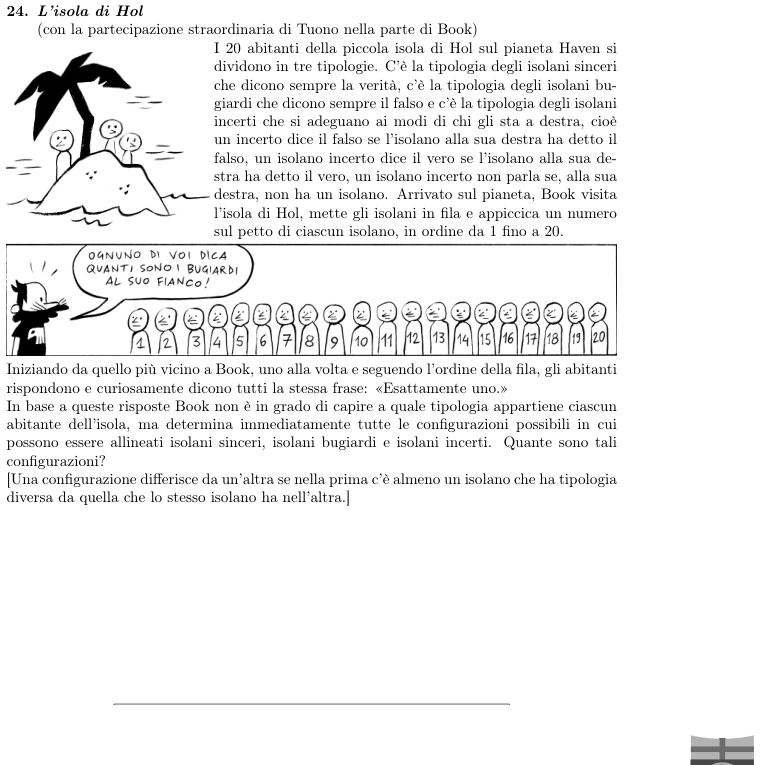
L’isola di Hol (con la partecipazione straordinaria di Tuono nella parte di Book) I 20 abitanti della piccola isola di Hol sul pianeta Haven si dividono in tre tipologie. C’è la tipologia degli isolani sinceri che dicono sempre la verità, c’è la tipologia degli isolani bugiardi che dicono sempre il falso e c’è la tipologia degli isolani incerti che si adeguano ai modi di chi gli sta a destra, cioè un incerto dice il falso se l’isolano alla sua destra ha detto il falso, un isolano incerto dice il vero se l’isolano alla sua destra ha detto il vero, un isolano incerto non parla se, alla sua destra, non ha un isolano. Arrivato sul pianeta, Book visita l’isola di Hol, mette gli isolani in fila e appiccica un numero sul petto di ciascun isolano, in ordine da 1 fino a 20. Iniziando da quello più vicino a Book, uno alla volta e seguendo l’ordine della fila, gli abitanti rispondono e curiosamente dicono tutti la stessa frase: «Esattamente uno.» In base a queste risposte Book non è in grado di capire a quale tipologia appartiene ciascun abitante dell’isola, ma determina immediatamente tutte le configurazioni possibili in cui possono essere allineati isolani sinceri, isolani bugiardi e isolani incerti. Quante sono tali configurazioni? [Una configurazione differisce da un’altra se nella prima c’è almeno un isolano che ha tipologia diversa da quella che lo stesso isolano ha nell’altra.]
Topic: Probabilita e statistica, Logica, giochi, strategie Area: Combinatoria, Logica e Probabilita Risposta: 3100 Fonte: apri PDF p.8 · phiquadro.it, Archivio gare ufficiali 2016 (= fairmath.it, Coppa Gauss 2016)
The island of Hol (with a special guest appearance by Tuono as Book)
The island of Hol (with a special guest appearance by Tuono as Book) The 20 inhabitants of the small island of Hol on the planet Haven are divided into three types. There is the type of the sincere islanders, who always tell the truth; the type of the liar islanders, who always say what is false; and the type of the uncertain islanders, who conform to the ways of whoever is on their right, that is an uncertain islander says what is false if the islander on his right has said what is false, says what is true if the islander on his right has said what is true, and does not speak if there is no islander on his right. Having arrived on the planet, Book visits the island of Hol, lines up the islanders and sticks a number on the chest of each islander, in order from 1 to 20. Starting from the one closest to Book, one at a time and following the order of the line, the inhabitants answer and curiously all say the same sentence: «Exactly one.» On the basis of these answers Book is not able to tell which type each inhabitant of the island belongs to, but he immediately determines all the possible configurations in which sincere, liar and uncertain islanders can be lined up. How many such configurations are there? [A configuration differs from another if in the first there is at least one islander whose type is different from the type that the same islander has in the other.]
Answer: 3100