Ghirlande
Ghirlande (Luca Renzi) Fate, elfi, Titania, Oberon, Puck sono insieme nella radura illuminata dalla luna. Titania Puck, prendi questo cesto pieno di ghirlande e distribuiscile tra tutti noi per celebrare questa notte incantata. (Puck prende il cesto) Dai un ventesimo delle ghirlande nel cesto alla prima fata; dai un diciannovesimo delle ghirlande rimaste nel cesto alla seconda fata; dai un diciottesimo delle ghirlande rimaste nel cesto alla terza fata; dai un diciassettesimo delle ghirlande rimaste nel cesto alla quarta fata. Continui così con altre quindici fate. Poi dai le ghirlande rimaste a Oberon. Oberon (Protestando) Ma ne resteranno pochissime. (Si stupisce quando Puck gli dà 10 ghirlande) Ma quante erano inizialmente le ghirlande nel cesto? (Titania scuote la testa sconsolata.)
Risposta: 0200 Fonte: apri PDF p.2 · phiquadro.it, Archivio gare ufficiali 2019 (= fairmath.it, Coppa Gauss 2019)
Garlands
Garlands (Luca Renzi) Fairies, elves, Titania, Oberon and Puck are together in the moonlit glade. Titania: Puck, take this basket full of garlands and share them out among all of us to celebrate this enchanted night. (Puck takes the basket) Give one twentieth of the garlands in the basket to the first fairy; give one nineteenth of the garlands left in the basket to the second fairy; give one eighteenth of the garlands left in the basket to the third fairy; give one seventeenth of the garlands left in the basket to the fourth fairy. Carry on like this with fifteen more fairies. Then give the remaining garlands to Oberon. Oberon (protesting): But there will be very few left. (He is amazed when Puck gives him 10 garlands) But how many garlands were there in the basket at the start? (Titania shakes her head in dismay.)
Answer: 0200
Oberon si arrabbia

Oberon si arrabbia (Sandro Campigotto) Titania Oberon, qual è la somma di tutti i numeri da 0 a 9999 che si scrivono utilizzando le sole cifre 0 e 1? (Oberon fugge nel bosco inveendo contro Puck.)
Topic: Teoria dei Numeri Area: Aritmetica e Teoria dei Numeri Risposta: 8888 Fonte: apri PDF p.2 · phiquadro.it, Archivio gare ufficiali 2019 (= fairmath.it, Coppa Gauss 2019)
Oberon gets angry
Oberon gets angry (Sandro Campigotto) Titania: Oberon, what is the sum of all the numbers from 0 to 9999 that are written using only the digits 0 and 1? (Oberon runs off into the wood cursing Puck.)
Answer: 8888
Ad Atene
Ad Atene (Giuseppe Rosolini) Nella piazza centrale di Atene. Ippolita (Rivolta a Teseo) Queste due piastrelle nere hanno qualche significato? Teseo Sì. Ippolita D’accordo hanno un significato, ma sai anche dirmi qual è? Vedo che una è quadrata, l’altra è un pentagono regolare; una ha un lato che combacia con un lato dell’altra, cioè le due mattonelle hanno lati di ugual lunghezza. Teseo Chiama ABCD il quadrato, DEFGA il pentagono regolare. AB e AG sono lati adiacenti di un poligono regolare che verrà disegnato nella piazza a partire da questi due lati. Ippolita Ma quanti lati ha quel poligono? (Teseo sorride ebetemente.)
Topic: Geometria piana Area: Geometria Risposta: 0020 Fonte: apri PDF p.2 · phiquadro.it, Archivio gare ufficiali 2019 (= fairmath.it, Coppa Gauss 2019)
In Athens
In Athens (Giuseppe Rosolini) In the main square of Athens. Hippolyta (to Theseus): Do these two black tiles mean anything? Theseus: Yes. Hippolyta: All right, they mean something, but can you also tell me what? I see that one is a square and the other a regular pentagon; one has a side that coincides with a side of the other, that is, the two tiles have sides of equal length. Theseus: Call ABCD the square and DEFGA the regular pentagon. AB and AG are adjacent sides of a regular polygon that will be drawn in the square starting from these two sides. Hippolyta: But how many sides does that polygon have? (Theseus smiles vacantly.)
Answer: 0020
La nuova operazione
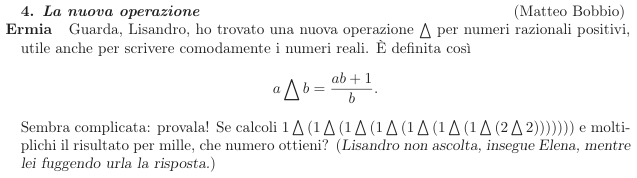
La nuova operazione (Matteo Bobbio) Ermia Guarda, Lisandro, ho trovato una nuova operazione △ per numeri razionali positivi, utile anche per scrivere comodamente i numeri reali. È definita così a △ b = (ab + 1)/b. Sembra complicata: provala! Se calcoli 1 △ (1 △ (1 △ (1 △ (1 △ (1 △ (1 △ (2 △ 2))))))) e moltiplichi il risultato per mille, che numero ottieni? (Lisandro non ascolta, insegue Elena, mentre lei fuggendo urla la risposta.)
Topic: Algebra Area: Algebra e Analisi Risposta: 1617 Fonte: apri PDF p.2 · phiquadro.it, Archivio gare ufficiali 2019 (= fairmath.it, Coppa Gauss 2019)
The new operation
The new operation (Matteo Bobbio) Hermia: Look, Lysander, I’ve found a new operation △ on positive rational numbers, also useful for writing real numbers conveniently. It is defined as follows: a △ b = (ab + 1)/b. It looks complicated: try it! If you compute 1 △ (1 △ (1 △ (1 △ (1 △ (1 △ (1 △ (2 △ 2))))))) and multiply the result by a thousand, what number do you get? (Lysander isn’t listening; he is chasing Helena, who shouts the answer as she runs away.)
Answer: 1617
La tragedia
La tragedia (Sandro Campigotto) Cotogna (Preparando il materiale per la rappresentazione della tragedia di Piramo e Tisbe) Se, in un triangolo rettangolo ABC, l’angolo retto è in C e il quadrato CDEF ha D su BC, E su AB e F su AC, quanto vale l’area del quadrato CDEF, sapendo che AE = 20 cm e EB = 15 cm? (Placido, distratto, sbatte contro il muro e lo fa crollare; tutti gli inveiscono contro.)
Topic: Geometria piana Area: Geometria Risposta: 0144 Fonte: apri PDF p.2 · phiquadro.it, Archivio gare ufficiali 2019 (= fairmath.it, Coppa Gauss 2019)
The tragedy
The tragedy (Sandro Campigotto) Quince (preparing the props for the performance of the tragedy of Pyramus and Thisbe): If, in a right triangle ABC, the right angle is at C and the square CDEF has D on BC, E on AB and F on AC, what is the area of the square CDEF, given that AE = 20 cm and EB = 15 cm? (Snout, distracted, bumps into the wall and knocks it down; everyone yells at him.)
Answer: 0144
Carte
Carte (Luca Renzi) Fondo (Mentre cammina dietro agli altri nel bosco) Che strano mazzo di carte! Ogni carta ha un numero su ciascuna faccia, non necessariamente uguali. E, se due carte hanno su una faccia lo stesso numero, non è detto che i numeri sull’altra faccia coincidano. (Fondo si ferma e depone tutte le 60 carte del mazzo sul prato davanti a sé, in modo da vedere solo una faccia di ciascuna carta: vede tre 1 ,tre 2, tre 3,… ,tre 19, tre 20. Non si accorge che viene circondato dalle fate.) Kael Dietro a un multiplo di 5 c’è un numero pari. Kale Dietro a un numero primo, se c’è una potenza di 2, questa deve essere con esponente dispari. Kail Dietro alle potenze di 3 non c’è 19. Kela Dietro ai multipli di 4 c’è un numero maggiore o uguale a 7. Puck Fondo, quali carte devi girare per controllare che le fate hanno detto il vero? [Dare come risposta la somma dei numeri che sono visibili sulle carte che Fondo deve girare.]
Topic: Teoria dei Numeri Area: Aritmetica e Teoria dei Numeri Risposta: 0534 Fonte: apri PDF p.3 · phiquadro.it, Archivio gare ufficiali 2019 (= fairmath.it, Coppa Gauss 2019)
Cards
Cards (Luca Renzi) Bottom (walking behind the others in the wood): What a strange deck of cards! Each card has a number on each face, not necessarily equal. And if two cards have the same number on one face, the numbers on the other face need not coincide. (Bottom stops and lays all 60 cards of the deck on the grass in front of him, so that he sees only one face of each card: he sees three 1s, three 2s, three 3s, …, three 19s, three 20s. He doesn’t notice that he is being surrounded by the fairies.) Kael: Behind a multiple of 5 there is an even number. Kale: Behind a prime number, if there is a power of 2, it must have an odd exponent. Kail: Behind the powers of 3 there is no 19. Kela: Behind the multiples of 4 there is a number greater than or equal to 7. Puck: Bottom, which cards must you turn over to check that the fairies have told the truth? [Give as the answer the sum of the numbers visible on the cards Bottom must turn over.]
Answer: 0534
Primi e ultimi

Primi e ultimi (Silvia Sconza) Elena Qual è il più grande numero primo inferiore a 9999 tale che ogni cifra che lo compone sia un numero primo; ogni numero composto da due cifre vicine nel numero sia un numero primo; ogni numero composto da tre cifre vicine nel numero sia un numero primo? (Lisandro si getta nel fiume.)
Topic: Teoria dei Numeri Area: Aritmetica e Teoria dei Numeri Risposta: 0373 Fonte: apri PDF p.3 · phiquadro.it, Archivio gare ufficiali 2019 (= fairmath.it, Coppa Gauss 2019)
First and last
First and last (Silvia Sconza) Helena: What is the largest prime number less than 9999 such that every digit in it is a prime number; every number formed by two adjacent digits of it is a prime number; every number formed by three adjacent digits of it is a prime number? (Lysander throws himself into the river.)
Answer: 0373
La sostituzione
La sostituzione (Mattia Fecit) Cotogna Dobbiamo trovare come sostituire il muro, altrimenti non riusciamo a fare la scena tra Piramo e Tisbe. Placido Ho un’idea! Considera un triangolo rettangolo con cateti di lunghezza 12 cm e 5 cm. Facciamo ruotare il triangolo intorno al cateto maggiore e usiamo il solido ottenuto come muro. Cotogna Ho un’idea migliore: facciamo ruotare il triangolo intorno al cateto minore e usiamo il solido ottenuto come muro. Voce fuori campo Quanto è 1000 volte il rapporto tra il volume del solido ottenuto da Placido e il volume del solido ottenuto da Cotogna?
Topic: Geometria piana, Geometria solida Area: Geometria Risposta: 0416 Fonte: apri PDF p.3 · phiquadro.it, Archivio gare ufficiali 2019 (= fairmath.it, Coppa Gauss 2019)
The replacement
The replacement (Mattia Fecit) Quince: We have to find a way to replace the wall, otherwise we can’t do the scene between Pyramus and Thisbe. Snout: I have an idea! Consider a right triangle with legs of length 12 cm and 5 cm. Let’s rotate the triangle about the longer leg and use the resulting solid as the wall. Quince: I have a better idea: let’s rotate the triangle about the shorter leg and use the resulting solid as the wall. Voice-over: What is 1000 times the ratio between the volume of the solid obtained by Snout and the volume of the solid obtained by Quince?
Answer: 0416
Alberi

Alberi (Matteo Bobbio) Titania vede Fondo nel bosco e gli si avvicina. Fondo (Tra sé e sé) Ma quanti alberi ci sono nel bosco? Titania (Guardando Fondo con occhi sognanti) Ci sono più alberi che le cifre della rappresentazione decimale del risultato della moltiplicazione di 5^(4007) per 4^(2019). Voce fuori campo Quanti alberi ci sono come minimo nel bosco?
Topic: Teoria dei Numeri Area: Aritmetica e Teoria dei Numeri Risposta: 4018 Fonte: apri PDF p.3 · phiquadro.it, Archivio gare ufficiali 2019 (= fairmath.it, Coppa Gauss 2019)
Trees
Trees (Matteo Bobbio) Titania sees Bottom in the wood and approaches him. Bottom (to himself): But how many trees are there in the wood? Titania (gazing dreamily at Bottom): There are more trees than the digits of the decimal representation of the result of multiplying 5^(4007) by 4^(2019). Voice-over: What is the minimum number of trees in the wood?
Answer: 4018
Le due fate

Le due fate (Alessandro Logar) Titania Guarda, Fondo: le due fate Kael e Kale accendono le loro luci intermittenti. Kael accende la luce per 4 secondi, poi la spegne per 2; Kale l’accende per 3 secondi, poi la spegne per 5. Ora accendono la luce contemporaneamente. Fondo Tra un’ora e tre quarti, quando farà giorno, per quanti secondi in totale le due luci saranno state accese entrambe?
Risposta: 1577 Fonte: apri PDF p.3 · phiquadro.it, Archivio gare ufficiali 2019 (= fairmath.it, Coppa Gauss 2019)
The two fairies
The two fairies (Alessandro Logar) Titania: Look, Bottom: the two fairies Kael and Kale are switching on their flashing lights. Kael switches the light on for 4 seconds, then off for 2; Kale switches it on for 3 seconds, then off for 5. Now they switch their lights on at the same time. Bottom: In an hour and three quarters, when day breaks, for how many seconds in total will both lights have been on together?
Answer: 1577
Un dato truccato
Un dato truccato (Alessandro Murchio) Titania Fai un gioco con me? Usiamo questo dado a sei facce truccato: la probabilità che esca un numero pari è 2019 volte la probabilità che esca un numero dispari (1, 3 e 5), ogni numero pari (2, 4 e 6) esce con la stessa probabilità—così pure per i numeri dispari. Fondo Ora che so in che modo è truccato non c’è più trucco. Titania (Sorpresa dalla risposta intelligente) Lancio il dado quattro volte e compongo un numero: l’esito del primo lancio è la cifra delle unità, l’esito del secondo quella della decine, poi l’esito del terzo quella delle centinaia, infine quella delle migliaia. Vinci se il numero ottenuto è un multiplo di 3. Voce fuori campo Quanto vale la probabilità che Fondo vinca moltiplicata per 10000?
Topic: Teoria dei Numeri, Probabilita e statistica Area: Aritmetica e Teoria dei Numeri, Combinatoria, Logica e Probabilita Risposta: 3333 Fonte: apri PDF p.3 · phiquadro.it, Archivio gare ufficiali 2019 (= fairmath.it, Coppa Gauss 2019)
A loaded die
A loaded die (Alessandro Murchio) Titania: Will you play a game with me? Let’s use this loaded six-sided die: the probability of an even number coming up is 2019 times the probability of an odd number (1, 3 and 5) coming up; every even number (2, 4 and 6) comes up with the same probability, and likewise for the odd numbers. Bottom: Now that I know how it is loaded, there’s no trick any more. Titania (surprised by the clever answer): I roll the die four times and form a number: the result of the first roll is the units digit, the result of the second the tens digit, then the result of the third the hundreds digit, and finally the thousands digit. You win if the number obtained is a multiple of 3. Voice-over: What is the probability that Bottom wins, multiplied by 10000?
Answer: 3333
Aspettando
Aspettando (Mario De Simoni) Flauto (Nei panni di Tisbe) Sto aspettando il mio amato Piramo. Nell’attesa riempirò questo pavimento, fatto di mattonelle quadrate bianche a scacchiera, di numeri interi positivi. Mi metto su una mattonella e scrivo 1; poi continuo così: • se il quadrato a sinistra è vuoto, mi giro a sinistra, altrimenti non mi giro; • scrivo il numero successivo del numero scritto sulla mattonella su cui sono sulla mattonella adiacente davanti a me; • passo su quella mattonella. (Lentamente Flauto dopo quattro passi riempie un quadrato con i numeri da 1 a 4, dopo nove passi, ha riempito un quadrato con i numeri da 1 a 9) Fondo (Fuori scena, nei panni di Piramo) Mia adorata Tisbe, arrivo quando scriverai il numero n^2 dispari tale che il valore assoluto della differenza fra le somme dei numeri scritti sulle mattonelle delle due diagonali della scacchiera sia la maggiore possibile al di sotto di 2019. (Teseo, Ippolita e tutto il pubblico scoppiano a ridere.) Ippolita Qual è il numero n a cui si riferisca Piramo? (Teseo guarda nel vuoto.)
Topic: Teoria dei Numeri Area: Aritmetica e Teoria dei Numeri Risposta: 0063 Fonte: apri PDF p.4 · phiquadro.it, Archivio gare ufficiali 2019 (= fairmath.it, Coppa Gauss 2019)
Waiting
Waiting (Mario De Simoni) Flute (playing Thisbe): I am waiting for my beloved Pyramus. While I wait I will fill this floor, made of white square tiles like a chessboard, with positive integers. I stand on a tile and write 1; then I carry on like this: • if the square on my left is empty, I turn left, otherwise I don’t turn; • on the adjacent tile in front of me I write the number following the one written on the tile I am standing on; • I step onto that tile. (Slowly, after four steps Flute fills a square with the numbers from 1 to 4; after nine steps she has filled a square with the numbers from 1 to 9) Bottom (offstage, playing Pyramus): My adored Thisbe, I will arrive when you write the odd number n^2 such that the absolute value of the difference between the sums of the numbers written on the tiles of the two diagonals of the board is the largest possible below 2019. (Theseus, Hippolyta and the whole audience burst out laughing.) Hippolyta: What is the number n that Pyramus is referring to? (Theseus stares into space.)
Answer: 0063
Nel sacchetto
Nel sacchetto (Sandro Campigotto) Titania Facciamo un gioco. Io metto quattro palline blu in questo sacchetto. Tu, Puck, mettine due rosse; Fondo mettine tre gialle. (Puck e Fondo fanno come istruiti) Agitiamo il sacchetto per mescolare le palline. Ora estraiamo a caso una pallina alla volta. Vince chi, per primo, vedrà estratte tutte le palline che aveva gettato nel sacchetto. Qual è la probabilità che vinca Fondo? [Dare come risposta la somma tra numeratore e denominatore della frazione ridotta ai minimi termini.]
Topic: Probabilita e statistica, Logica, giochi, strategie Area: Combinatoria, Logica e Probabilita Risposta: 0137 Fonte: apri PDF p.4 · phiquadro.it, Archivio gare ufficiali 2019 (= fairmath.it, Coppa Gauss 2019)
In the bag
In the bag (Sandro Campigotto) Titania: Let’s play a game. I put four blue balls into this bag. You, Puck, put in two red ones; Bottom, put in three yellow ones. (Puck and Bottom do as instructed) Let’s shake the bag to mix the balls. Now we draw one ball at a time at random. The winner is whoever first sees all the balls he or she put into the bag drawn. What is the probability that Bottom wins? [Give as the answer the sum of the numerator and denominator of the fraction in lowest terms.]
Answer: 0137
Sullo stagno
Sullo stagno (Giuseppe Rosolini) Sullo stagno galleggia una lunga linea chiusa, composta da piccoli segmenti, tutti di uguale lunghezza: in totale sono 2019 segmenti.. Titania Vedi, Fondo. Ciascuno dei due estremi di ogni segmento è congiunto a un estremo di un altro segmento; è in questo modo che la linea resta chiusa. Con la linea giocano tre fate librandosi nell’aria e posandosi ciascuna leggera su uno dei 2019 estremi. Fondo Le vedo: sono una rossa, una blu, una gialla. Titania Quando si posano, la linea si muove e forma un triangolo che ha per vertici i tre estremi dove le tre fate si sono posate. Fondo I triangoli (non degeneri) diversi che si possono formare in questo modo sono moltissimi. Titania Sì. Basta che mi dici le quattro cifre che servono per scrivere il numero che li conta, elencate in ordine crescente da sinistra a destra. [Un triangolo è diverso da un altro esattamente quando almeno uno dei lati tra due fate nel primo triangolo ha lunghezza diversa da quello tra le (stesse) due fate nell’altro.]
Topic: Geometria piana, Teoria dei Numeri Area: Geometria, Aritmetica e Teoria dei Numeri Risposta: 0459 Fonte: apri PDF p.4 · phiquadro.it, Archivio gare ufficiali 2019 (= fairmath.it, Coppa Gauss 2019)
On the pond
On the pond (Giuseppe Rosolini) A long closed line floats on the pond, made up of small segments, all of the same length: there are 2019 segments in total. Titania: You see, Bottom. Each of the two endpoints of every segment is joined to an endpoint of another segment; that is how the line stays closed. Three fairies play with the line, hovering in the air and each alighting lightly on one of the 2019 endpoints. Bottom: I see them: one is red, one blue, one yellow. Titania: When they alight, the line moves and forms a triangle whose vertices are the three endpoints where the three fairies have alighted. Bottom: The different (non-degenerate) triangles that can be formed in this way are very many. Titania: Yes. Just tell me the four digits needed to write the number that counts them, listed in increasing order from left to right. [One triangle is different from another exactly when at least one of the sides between two fairies in the first triangle has a different length from the one between the (same) two fairies in the other.]
Answer: 0459
Il terreno diviso
Il terreno diviso (Luca Renzi) Titania Fondo, ho bisogno del tuo aiuto per dividere il terreno all’interno del recinto per sistemarvi elfi e fate. Voglio dividerlo tracciando soltanto linee di separazione continue che partono da un punto del recinto e terminano in un altro punto del recinto, tutte contenute al suo interno. Ogni linea viene tracciata facendo attenzione che incontri ciascuna altra linea tracciata in precedenza una sola volta, ma in modo da dividere il terreno nel maggior numero possibile di zone. (Fondo si concentra) In ogni zona che è delimitata anche dal recinto starà un elfo; nelle altre zone starà una fata in modo che la differenza tra il numero di fate e quello di elfi sia il più piccolo multiplo di 41 possibile. (Guardando Fondo con gioia) Quanti solchi devo far tracciare?
Topic: Teoria dei Numeri Area: Aritmetica e Teoria dei Numeri Risposta: 0024 Fonte: apri PDF p.4 · phiquadro.it, Archivio gare ufficiali 2019 (= fairmath.it, Coppa Gauss 2019)
The divided land
The divided land (Luca Renzi) Titania: Bottom, I need your help to divide the land inside the enclosure to settle elves and fairies there. I want to divide it by drawing only continuous dividing lines that start from a point of the fence and end at another point of the fence, all contained inside it. Each line is drawn taking care that it meets each previously drawn line exactly once, but so as to divide the land into the largest possible number of zones. (Bottom concentrates) In each zone that is also bounded by the fence there will be an elf; in the other zones there will be a fairy, so that the difference between the number of fairies and the number of elves is the smallest possible multiple of 41. (Looking at Bottom with joy) How many furrows must I have drawn?
Answer: 0024
Due colori
Due colori (Milo Orlich) Fondo Le tue fate mi hanno spiegato che stanno inventando due colori, arangiallo e bligio, e li stanno sperimentando. Stanno cercando di decidere, stendendo due di questi colori in successione, quali siano i migliori “risultati finali”—eventualmente, anche risultati “imprevedibili”! Ad esempio, potrebbero fare in modo che, stendendo prima una mano di arangiallo e poi una di bligio si ottenga bligio, e magari con una di bligio seguita da una di arangiallo si abbia invece arangiallo, oppure che dandone prima una di arangiallo e poi un’altra di arangiallo si ottenga bligio … L’importante è che il colore finale sia ancora uno tra arangiallo e bligio. Titania Penso che l’effetto più utile sia che, stendendo prima un colore e poi un altro, si ottenga lo stesso effetto che si avrebbe invertendo l’ordine dei colori. Fondo Sarebbe più interessante se, stendendo prima in successione un colore X e un colore Y, e aggiungendo poi un colore Z, si ottenesse lo stesso effetto che si avrebbe stendendo prima il colore X, e dopo un po’ di tempo il colore ottenuto separatamente sulla tavolozza stendendo il colore Y seguito dal colore Z. Voce fuori campo In quanti modi si può realizzare l’effetto proposto da Titania? E in quanti modi si può realizzare l’effetto proposto da Fondo? [Dare come risposta il prodotto del numero che risponde alla prima domanda e del numero che risponde alla seconda domanda.]
Topic: Combinatoria, successioni Area: Combinatoria, Logica e Probabilita, Algebra e Analisi Risposta: 0064 Fonte: apri PDF p.5 · phiquadro.it, Archivio gare ufficiali 2019 (= fairmath.it, Coppa Gauss 2019)
Two colours
Two colours (Milo Orlich) Bottom: Your fairies have explained to me that they are inventing two colours, orangellow and blurey, and are experimenting with them. By laying two of these colours one after the other, they are trying to decide which are the best “final results”, possibly even “unpredictable” results! For example, they could arrange that laying first a coat of orangellow and then one of blurey gives blurey, and perhaps that one of blurey followed by one of orangellow gives orangellow instead, or that laying first one of orangellow and then another of orangellow gives blurey… What matters is that the final colour is still one of orangellow and blurey. Titania: I think the most useful effect would be that laying first one colour and then another gives the same effect as reversing the order of the colours. Bottom: It would be more interesting if laying first a colour X and then a colour Y in succession, and then adding a colour Z, gave the same effect as laying first colour X and, after a while, the colour obtained separately on the palette by laying colour Y followed by colour Z. Voice-over: In how many ways can the effect proposed by Titania be achieved? And in how many ways can the effect proposed by Bottom be achieved? [Give as the answer the product of the number answering the first question and the number answering the second question.]
Answer: 0064
In fila
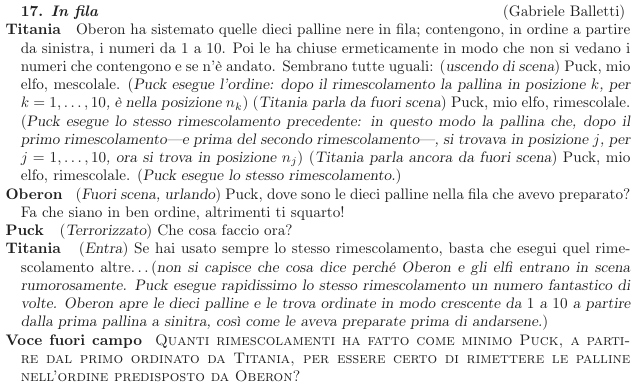
In fila (Gabriele Balletti) Titania Oberon ha sistemato quelle dieci palline nere in fila; contengono, in ordine a partire da sinistra, i numeri da 1 a 10. Poi le ha chiuse ermeticamente in modo che non si vedano i numeri che contengono e se n’è andato. Sembrano tutte uguali: (uscendo di scena) Puck, mio elfo, mescolale. (Puck esegue l’ordine: dopo il rimescolamento la pallina in posizione k, per k = 1, … , 10, è nella posizione n_k) (Titania parla da fuori scena) Puck, mio elfo, rimescolale. (Puck esegue lo stesso rimescolamento precedente: in questo modo la pallina che, dopo il primo rimescolamento—e prima del secondo rimescolamento—, si trovava in posizione j, per j = 1, … , 10, ora si trova in posizione n_j) (Titania parla ancora da fuori scena) Puck, mio elfo, rimescolale. (Puck esegue lo stesso rimescolamento.) Oberon (Fuori scena, urlando) Puck, dove sono le dieci palline nella fila che avevo preparato? Fa che siano in ben ordine, altrimenti ti squarto! Puck (Terrorizzato) Che cosa faccio ora? Titania (Entra) Se hai usato sempre lo stesso rimescolamento, basta che esegui quel rimescolamento altre… (non si capisce che cosa dice perché Oberon e gli elfi entrano in scena rumorosamente. Puck esegue rapidissimo lo stesso rimescolamento un numero fantastico di volte. Oberon apre le dieci palline e le trova ordinate in modo crescente da 1 a 10 a partire dalla prima pallina a sinitra, così come le aveva preparate prima di andarsene.) Voce fuori campo Quanti rimescolamenti ha fatto come minimo Puck, a partire dal primo ordinato da Titania, per essere certo di rimettere le palline nell’ordine predisposto da Oberon?
Topic: Teoria dei Numeri Area: Aritmetica e Teoria dei Numeri Risposta: 2520 Fonte: apri PDF p.5 · phiquadro.it, Archivio gare ufficiali 2019 (= fairmath.it, Coppa Gauss 2019)
In a row
In a row (Gabriele Balletti) Titania: Oberon has arranged those ten black balls in a row; in order, starting from the left, they contain the numbers from 1 to 10. Then he sealed them so that the numbers they contain cannot be seen, and went away. They all look the same: (leaving the stage) Puck, my elf, shuffle them. (Puck carries out the order: after the shuffle, the ball in position k, for k = 1, …, 10, is in position n_k) (Titania speaks from offstage) Puck, my elf, shuffle them again. (Puck performs the same shuffle as before: in this way the ball that, after the first shuffle and before the second, was in position j, for j = 1, …, 10, is now in position n_j) (Titania speaks again from offstage) Puck, my elf, shuffle them again. (Puck performs the same shuffle.) Oberon (offstage, shouting): Puck, where are the ten balls in the row I had prepared? Make sure they are in proper order, or I’ll tear you apart! Puck (terrified): What do I do now? Titania (entering): If you always used the same shuffle, you just need to perform that shuffle another… (what she says cannot be heard, because Oberon and the elves come on stage noisily. Puck very quickly performs the same shuffle a fantastic number of times. Oberon opens the ten balls and finds them arranged in increasing order from 1 to 10 starting from the first ball on the left, just as he had prepared them before leaving.) Voice-over: What is the minimum number of shuffles Puck has made, starting from the first one ordered by Titania, to be certain of putting the balls back in the order arranged by Oberon?
Answer: 2520
Dammi il resto

Dammi il resto (Alessandro Logar) Ippolita Qual è il resto della divisione di 123456789101112 per 999? (Teseo guarda i fiori.)
Topic: Teoria dei Numeri Area: Aritmetica e Teoria dei Numeri Risposta: 0582 Fonte: apri PDF p.5 · phiquadro.it, Archivio gare ufficiali 2019 (= fairmath.it, Coppa Gauss 2019)
Give me the remainder
Give me the remainder (Alessandro Logar) Hippolyta: What is the remainder of the division of 123456789101112 by 999? (Theseus looks at the flowers.)
Answer: 0582
La domande di Oberon

La domande di Oberon (Giuseppe Rosolini) Oberon Titania, puoi usare questi sei bastoncini, tutti della stessa lunghezza, uno giallo, uno blu, uno rosso, uno verde, uno viola e uno arancione, come lati di un tetraedro. Quanti tetraedri diversi puoi costruire?
Topic: Geometria solida Area: Geometria Risposta: 0060 Fonte: apri PDF p.5 · phiquadro.it, Archivio gare ufficiali 2019 (= fairmath.it, Coppa Gauss 2019)
Oberon’s questions
Oberon’s questions (Giuseppe Rosolini) Oberon: Titania, you can use these six sticks, all of the same length, one yellow, one blue, one red, one green, one purple and one orange, as the edges of a tetrahedron. How many different tetrahedra can you build?
Answer: 0060
La domanda di Lisandro

La domanda di Lisandro (Mattia Fecit) Lisandro Ermia, un numero intero positivo è educato se è divisibile per la somma delle sue cifre. Per esempio, tutti i numeri da 1 a 10 sono educati; 11 non è educato; 12 è educato; 13, 14, 15, 16 e 17 non sono educati. Siano A, B, C e D i primi quattro numeri educati consecutivi maggiori di 10. Quanto vale D?
Topic: Teoria dei Numeri Area: Aritmetica e Teoria dei Numeri Risposta: 0513 Fonte: apri PDF p.5 · phiquadro.it, Archivio gare ufficiali 2019 (= fairmath.it, Coppa Gauss 2019)
Lysander’s question
Lysander’s question (Mattia Fecit) Lysander: Hermia, a positive integer is polite if it is divisible by the sum of its digits. For example, all the numbers from 1 to 10 are polite; 11 is not polite; 12 is polite; 13, 14, 15, 16 and 17 are not polite. Let A, B, C and D be the first four consecutive polite numbers greater than 10. What is D?
Answer: 0513
La domanda di Teseo

La domanda di Teseo (Giuseppe Rosolini) Teseo Ippolita, considerati tutti i numeri interi positivi a, b e c minori di 10000 tali che a^4 + a · b^3 = c^2, qual è il valore massimo di a + b + c?
Topic: Teoria dei Numeri Area: Aritmetica e Teoria dei Numeri Risposta: 9918 Fonte: apri PDF p.5 · phiquadro.it, Archivio gare ufficiali 2019 (= fairmath.it, Coppa Gauss 2019)
Theseus’s question
Theseus’s question (Giuseppe Rosolini) Theseus: Hippolyta, considering all positive integers a, b and c less than 10000 such that a^4 + a · b^3 = c^2, what is the maximum value of a + b + c?
Answer: 9918
La domanda di Demetrio
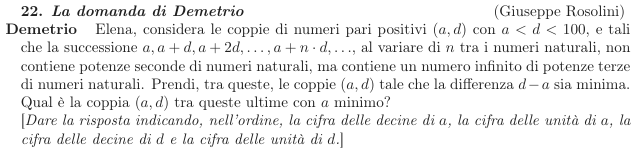
La domanda di Demetrio (Giuseppe Rosolini) Demetrio Elena, considera le coppie di numeri pari positivi (a, d) con a < d < 100, e tali che la successione a, a + d, a + 2d, … , a + n · d, …, al variare di n tra i numeri naturali, non contiene potenze seconde di numeri naturali, ma contiene un numero infinito di potenze terze di numeri naturali. Prendi, tra queste, le coppie (a, d) tale che la differenza d−a sia minima. Qual è la coppia (a, d) tra queste ultime con a minimo? [Dare la risposta indicando, nell’ordine, la cifra delle decine di a, la cifra delle unità di a, la cifra delle decine di d e la cifra delle unità di d.]
Topic: successioni Area: Algebra e Analisi Risposta: 0810 Fonte risposta: soluzione ufficiale, PDF p.12 Fonte: apri PDF p.6 · phiquadro.it, Archivio gare ufficiali 2019 (= fairmath.it, Coppa Gauss 2019)
Demetrius’s question
Demetrius’s question (Giuseppe Rosolini) Demetrius: Helena, consider the pairs of positive even numbers (a, d) with a < d < 100 such that the sequence a, a + d, a + 2d, …, a + n · d, …, as n ranges over the natural numbers, contains no squares of natural numbers but contains infinitely many cubes of natural numbers. Among these, take the pairs (a, d) such that the difference d − a is minimal. Which pair (a, d) among the latter has minimal a? [Give the answer by writing, in order, the tens digit of a, the units digit of a, the tens digit of d and the units digit of d.]
Answer: 0810
Alla fine
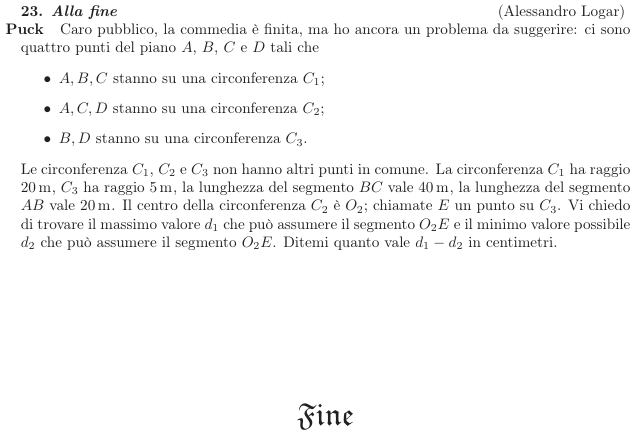
Alla fine (Alessandro Logar) Puck Caro pubblico, la commedia è finita, ma ho ancora un problema da suggerire: ci sono quattro punti del piano A, B, C e D tali che • A, B, C stanno su una circonferenza C_1; • A, C, D stanno su una circonferenza C_2; • B, D stanno su una circonferenza C_3. Le circonferenza C_1, C_2 e C_3 non hanno altri punti in comune. La circonferenza C_1 ha raggio 20 m, C_3 ha raggio 5 m, la lunghezza del segmento BC vale 40 m, la lunghezza del segmento AB vale 20 m. Il centro della circonferenza C_2 è O_2; chiamate E un punto su C_3. Vi chiedo di trovare il massimo valore d_1 che può assumere il segmento O_2E e il minimo valore possibile d_2 che può assumere il segmento O_2E. Ditemi quanto vale d_1 − d_2 in centimetri. Fine
Topic: Geometria piana, Probabilita e statistica Area: Geometria, Combinatoria, Logica e Probabilita Risposta: 1058 Fonte risposta: soluzione ufficiale, PDF p.12 Fonte: apri PDF p.6 · phiquadro.it, Archivio gare ufficiali 2019 (= fairmath.it, Coppa Gauss 2019)
At the end
At the end (Alessandro Logar) Puck: Dear audience, the play is over, but I still have a problem to suggest: there are four points A, B, C and D in the plane such that • A, B, C lie on a circle C_1; • A, C, D lie on a circle C_2; • B, D lie on a circle C_3. The circles C_1, C_2 and C_3 have no other points in common. The circle C_1 has radius 20 m, C_3 has radius 5 m, the length of segment BC is 40 m, the length of segment AB is 20 m. The centre of circle C_2 is O_2; call E a point on C_3. I ask you to find the maximum value d_1 that the segment O_2E can take and the minimum possible value d_2 that the segment O_2E can take. Tell me what d_1 − d_2 is in centimetres. The End
Answer: 1058
In camerino
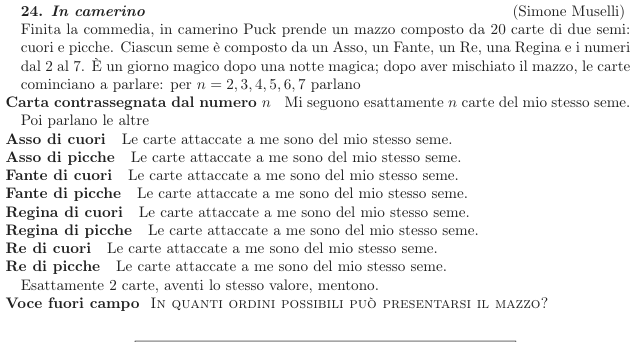
In camerino (Simone Muselli) Finita la commedia, in camerino Puck prende un mazzo composto da 20 carte di due semi: cuori e picche. Ciascun seme è composto da un Asso, un Fante, un Re, una Regina e i numeri dal 2 al 7. È un giorno magico dopo una notte magica; dopo aver mischiato il mazzo, le carte cominciano a parlare: per n = 2, 3, 4, 5, 6, 7 parlano Carta contrassegnata dal numero n Mi seguono esattamente n carte del mio stesso seme. Poi parlano le altre Asso di cuori Le carte attaccate a me sono del mio stesso seme. Asso di picche Le carte attaccate a me sono del mio stesso seme. Fante di cuori Le carte attaccate a me sono del mio stesso seme. Fante di picche Le carte attaccate a me sono del mio stesso seme. Regina di cuori Le carte attaccate a me sono del mio stesso seme. Regina di picche Le carte attaccate a me sono del mio stesso seme. Re di cuori Le carte attaccate a me sono del mio stesso seme. Re di picche Le carte attaccate a me sono del mio stesso seme. Esattamente 2 carte, aventi lo stesso valore, mentono. Voce fuori campo In quanti ordini possibili può presentarsi il mazzo?
Topic: Probabilita e statistica, Logica, giochi, strategie Area: Combinatoria, Logica e Probabilita Risposta: 7200 Fonte: apri PDF p.6 · phiquadro.it, Archivio gare ufficiali 2019 (= fairmath.it, Coppa Gauss 2019)
In the dressing room
In the dressing room (Simone Muselli) When the play is over, in the dressing room Puck takes a deck of 20 cards of two suits: hearts and spades. Each suit consists of an Ace, a Jack, a King, a Queen and the numbers from 2 to 7. It is a magical day after a magical night; after the deck has been shuffled, the cards begin to speak. For n = 2, 3, 4, 5, 6, 7 speaks: Card marked with the number n: Exactly n cards of my own suit follow me. Then the others speak: Ace of hearts: The cards next to me are of my own suit. Ace of spades: The cards next to me are of my own suit. Jack of hearts: The cards next to me are of my own suit. Jack of spades: The cards next to me are of my own suit. Queen of hearts: The cards next to me are of my own suit. Queen of spades: The cards next to me are of my own suit. King of hearts: The cards next to me are of my own suit. King of spades: The cards next to me are of my own suit. Exactly 2 cards, having the same value, are lying. Voice-over: In how many possible orders can the deck appear?
Answer: 7200