Valori possibili della somma di 3 dadi
Lancio simultaneamente tre dadi e sommo i punti che appaino sulle loro facce superiori. Quanti sono i diversi valori possibili di tale somma?
- (A) 18
- (B) 17
- (C) 16
- (D) 15
- (E) 14.
Topic: Combinatoria Abilita: Conteggio sistematico Area: Combinatoria, Logica e Probabilita Risposta: C Fonte: apri PDF p.1
Possible values of the sum of 3 dice
I’m simultaneously throwing three dice and adding up the dots on their upper faces. What are the different possible values of that sum?
- (A) 18
- (B) 17
- (C) 16
- (D) 15
- (E) 14.
Answer: C src_kangourou_2001_junior__Q01
Posizione di A nella fila
Gli studenti A, B, C, D, E ed F sono disposti in fila indiana. Si sa che: 1) D si trova tra E ed F; 2) C tra D ed E; 3) B tra C e D; 4) A tra B e C. Quale delle seguenti affermazioni è vera?
Kangourou 15 marzo 2001. Categoria Junior. Pagina N. 2
- (A) A si trova ad un’estremità (destra o sinistra) della fila
- (B) A è il secondo a partire da una delle estremità
- (C) A è il terzo a partire da una delle estremità
- (D) una tale disposizione non è possibile
- (E) una tale disposizione è possibile, ma non si può determinare in modo univoco la posizione di A.
Topic: Logica, giochi, strategie Abilita: Casework accurato Area: Combinatoria, Logica e Probabilita Risposta: C Fonte: apri PDF p.2
Position of A in the row
Students A, B, C, D, E, and F are in the Indian queue. We know that: 1) D is between E and F; 2) C is between D and E; 3) B is between C and D; 4) A is between B and C. Which of the following statements is true?
Kangourou 15 March 2001. Junior class. This item is not intended to be used. 2
- (A) A is at one end (right or left) of the row
- (B) A is the second from one of the ends
- (C) A is the third from one of the ends
- (D) Such a provision is not possible.
- (E) This provision is possible, but the position of A cannot be determined uniquely.
Answer: C src_kangourou_2001_junior__Q02
Lunghezza diagonale d del poligono
Una delle diagonali d divide un poligono di perimetro 31 cm in due poligoni di perimetro rispettivamente 21 cm e 30 cm. Allora la lunghezza di d è
- (A) 5 cm
- (B) 10 cm
- (C) 15 cm
- (D) 20 cm
- (E) non determinabile senza ulteriori informazioni.
Topic: Geometria piana Abilita: Ragionamento geometrico Area: Geometria Risposta: B Fonte: apri PDF p.2
Diagonal length d of the polygon
One of the diagonal d divides a polygon of 31 cm perimeter into two polygons of 21 cm and 30 cm perimeter respectively. So the length of d is
- (A) 5 cm
- (B) 10 cm
- (C) 15 cm
- (D) 20 cm
- (E) cannot be determined without further information.
Answer: B src_kangourou_2001_junior__Q03
Cubetti da aggiungere per formare un cubo
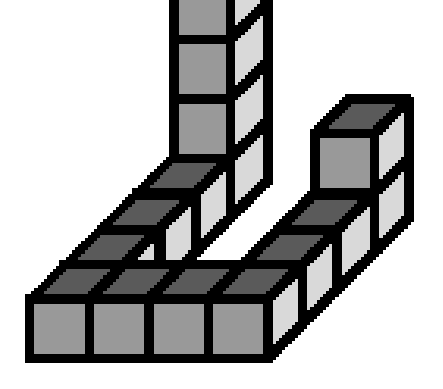
Il solido rappresentato nella figura a lato è formato da cubetti di lato unitario. Qual è il minimo numero di cubetti di lato unitario che occorre aggiungere per formare un cubo che contenga il solido iniziale? (I cubetti esistenti non possono essere spostati).
- (A) 49
- (B) 60
- (C) 65
- (D) 110
- (E) 125.
Topic: Geometria solida Abilita: Conteggio sistematico Area: Geometria Risposta: D Fonte: apri PDF p.2
Cubs to be added to form a cube
The solid shown in the figure on the side is made up of unit side cubes. What is the minimum number of unit-side cubes to be added to form a cube containing the initial solid? (Existing cubes cannot be moved).
- (A) 49
- (B) 60
- (C) 65
- (D) 110
- (E) 125.
Answer: D src_kangourou_2001_junior__Q04
Affermazione vera con MCD(m,35)>10
m è un intero positivo tale che MCD (m, 35) > 10. Quale delle seguenti affermazioni è certamente vera?
- (A) la rappresentazione decimale di m ha almeno tre cifre
- (B) m è un multiplo di 35
- (C) m è divisibile per 15
- (D) 35 è un multiplo di m
- (E) m è divisibile per 5 o per 7, ma non per entrambi Nota: MCD (a, b) indica il massimo comune divisore tra a e b.
Topic: Teoria dei Numeri Metodo: manipolazione algebrica Abilita: Manipolazione algebrica Area: Aritmetica e Teoria dei Numeri Risposta: B Fonte: apri PDF p.2
True claim with MCD(m,35)>10
m is a positive integer such that MCD (m, 35) > 10. Which of the following is certainly true?
- (A) the decimal representation of m has at least three digits
- (B) m is a multiple of 35.
- (C) m is divisible by 15
- (D) 35 is a multiple of m.
- (E) m is divisible by 5 or by 7, but not by both Note: MCD (a, b) indicates the maximum common divisor between a and b.
Answer: B src_kangourou_2001_junior__Q05
Fiammiferi minimi per 11 quadrati
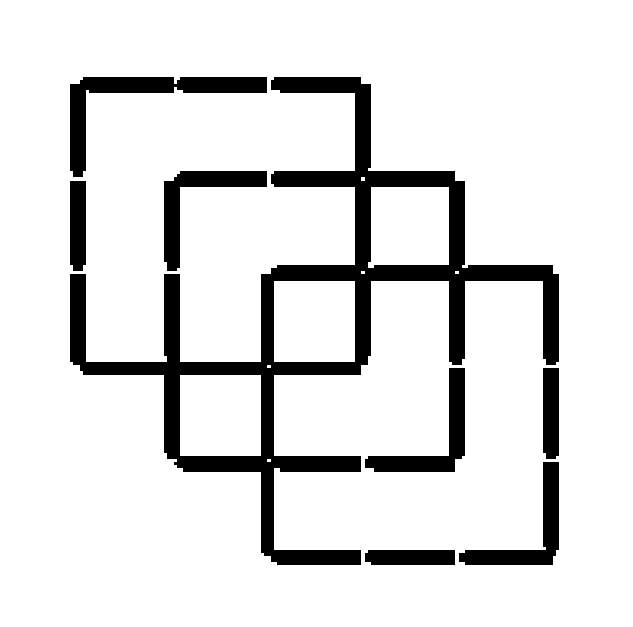
Trova il minimo numero di fiammiferi che bisogna aggiungere alla figura in modo da ottenere esattamente 11 quadrati.
- (A) 2
- (B) 3
- (C) 4
- (D) 5
- (E) 6.
Topic: Combinatoria Abilita: Ragionamento geometrico Area: Combinatoria, Logica e Probabilita Risposta: A Fonte: apri PDF p.2
Minimum firefighters for 11 squares
Find the minimum number of matches you need to add to the figure so you get exactly 11 squares.
- (A) 2
- (B) 3
- (C) 4
- (D) 5
- (E) 6.
Answer: A src_kangourou_2001_junior__Q06
Primi minori di 2001 con somma cifre 2
Quanti sono i numeri primi minori di 2001 la somma delle cui cifre è uguale a 2?
- (A) 1
- (B) 2
- (C) 3
- (D) 4
- (E) più di quattro. Kangourou 15 marzo 2001. Categoria Junior. Pagina N. 3
Topic: Teoria dei Numeri Metodo: Analisi per casi Abilita: Conteggio sistematico Area: Aritmetica e Teoria dei Numeri Risposta: C Fonte: apri PDF p.2
*Minor firsts of 2001 with sum of 2 figures *
What are the prime numbers of 2001 whose sum is equal to 2?
- (A) 1
- (B) 2
- (C) 3
- (D) 4
- (E) More than four. Kangourou 15 March 2001. Junior class. This item is not intended to be used. 3
Answer: C src_kangourou_2001_junior__Q07
Perimetro del poligono con angoli retti
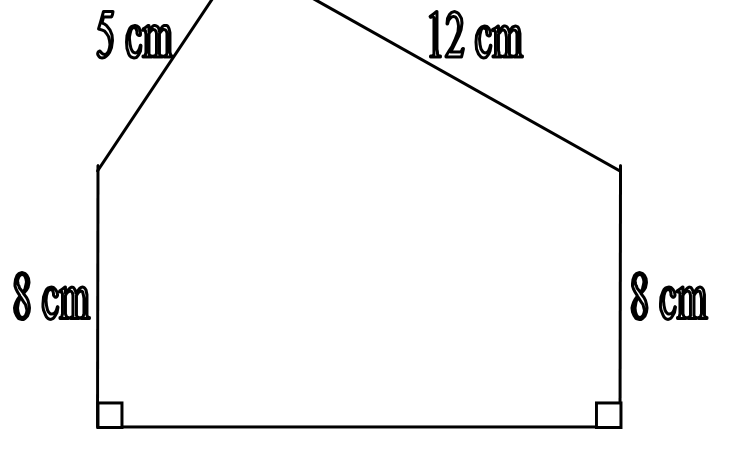
\begin{document}
\begin{tikzpicture}[scale=0.45]
  \coordinate (A) at (0,0);
  \coordinate (B) at (13,0);
  \coordinate (C) at (13,8);
  \coordinate (E) at (0,8);
  \coordinate (T) at (1.923, 12.615);
  \draw (A) -- (B) -- (C) -- (T) -- (E) -- cycle;
  \draw (0.5,0) -- (0.5,0.5) -- (0,0.5);
  \draw (13,0.5) -- (12.5,0.5) -- (12.5,0);
  \draw (2.115, 13.077) -- (2.577, 12.885) -- (2.385, 12.423);
  \node[left] at (0,4) {$8$\,cm};
  \node[right] at (13,4) {$8$\,cm};
  \node[left] at (0.96, 10.3) {$5$\,cm};
  \node[above right] at (7.0, 10.6) {$12$\,cm};
\end{tikzpicture}
\end{document}
Il perimetro del poligono raffigurato a lato (i tre angoli indicati sono retti) vale
- (A) 38 cm
- (B) 41 cm
- (C) 46 cm
- (D) 50 cm
- (E) 59 cm.
Topic: Geometria piana Abilita: Ragionamento geometrico Area: Geometria Risposta: C Fonte: apri PDF p.3
Perimeter of the polygon with right angles
\begin{document}
\begin{tikzpicture}[scale=0.45]
  \coordinate (A) at (0,0);
  \coordinate (B) at (13,0);
  \coordinate (C) at (13,8);
  \coordinate (E) at (0,8);
  \coordinate (T) at (1.923, 12.615);
  \draw (A) -- (B) -- (C) -- (T) -- (E) -- cycle;
  \draw (0.5,0) -- (0.5,0.5) -- (0,0.5);
  \draw (13,0.5) -- (12.5,0.5) -- (12.5,0);
  \draw (2.115, 13.077) -- (2.577, 12.885) -- (2.385, 12.423);
  \node[left] at (0,4) {$8$\,cm};
  \node[right] at (13,4) {$8$\,cm};
  \node[left] at (0.96, 10.3) {$5$\,cm};
  \node[above right] at (7.0, 10.6) {$12$\,cm};
\end{tikzpicture}
\end{document}
The perimeter of the polygon depicted on the side (the three angles indicated are straight) is:
- (A) 38 cm
- (B) 41 cm
- (C) 46 cm
- (D) 50 cm
- (E) 59 cm.
Answer: C src_kangourou_2001_junior__Q08
Cifre del minimo numero con 0 e 1 divisibile 225
Quante cifre contiene la rappresentazione decimale del più piccolo intero positivo che può essere scritto usando le sole cifre 0 e 1, e che sia divisibile per 225?
- (A) 10
- (B) 11
- (C) 12
- (D) 13
- (E) 14.
Topic: Teoria dei Numeri Metodo: congruenze Abilita: Manipolazione algebrica Area: Aritmetica e Teoria dei Numeri Risposta: B Fonte: apri PDF p.3
Minimum number with 0 and 1 divisible by 225
How many digits does the decimal representation of the smallest positive integer that can be written using the only digits 0 and 1, and that is divisible by 225 contain?
- (A) 10
- (B) 11
- (C) 12
- (D) 13
- (E) 14.
Answer: B src_kangourou_2001_junior__Q09
Tagliare un anello per liberarli
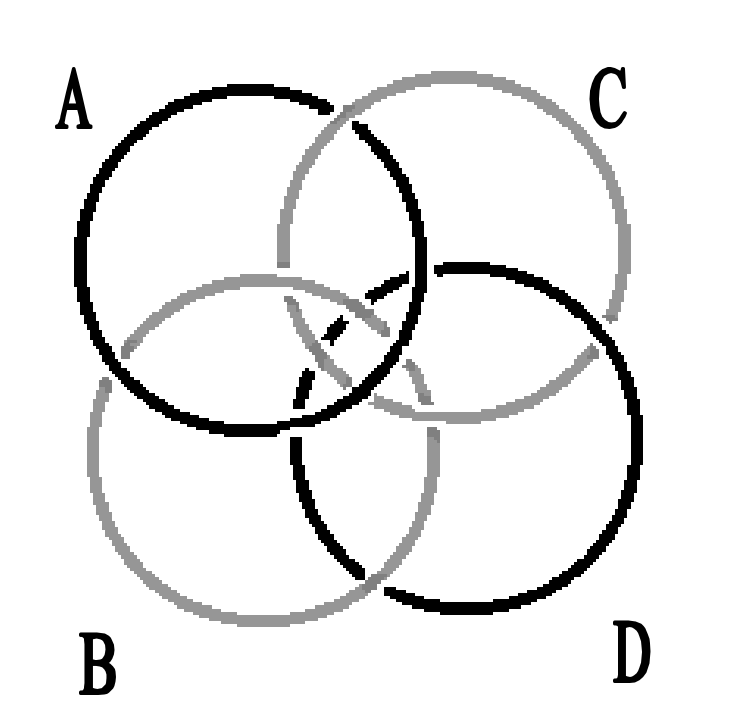
Tagliando un solo anello, è possibile liberarli tutti?
- (A) sì, tagliando A
- (B) sì, tagliando B
- (C) sì, tagliando C
- (D) sì, tagliando D
- (E) no. I quesiti dal N. 11 al N. 20 valgono 4 punti ciascuno
Topic: Logica, giochi, strategie Abilita: Ragionamento geometrico Area: Combinatoria, Logica e Probabilita Risposta: C Fonte: apri PDF p.3
Cutting a ring to free them
By cutting off a single ring, can you free them all?
- (A) Yes, by cutting A
- (B) Yes, by cutting B
- (C) Yes, by cutting C
- (D) Yes, by cutting D
- (E) no. The questions from N. 11 al N. 20 is worth 4 points each.
Answer: C src_kangourou_2001_junior__Q10
Valori di d con a+b=cd e a+b+c=12
a, b, c e d sono interi positivi tali che a + b = c d e che a + b + c = 12. Quanti sono i possibili diversi valori che può assumere d ?
- (A) 2
- (B) 3
- (C) 4
- (D) 5
- (E) 6.
Topic: Teoria dei Numeri Metodo: Analisi per casi Abilita: Casework accurato Area: Aritmetica e Teoria dei Numeri Risposta: D Fonte: apri PDF p.3
Values of d with a+b=cd and a+b+c=12
a, b, c and d are positive integers such that a + b = c d and a + b + c = 12. How many different possible values can it assume ?
- (A) 2
- (B) 3
- (C) 4
- (D) 5
- (E) 6.
Answer: D src_kangourou_2001_junior__Q11
Misura dell’angolo x nella figura
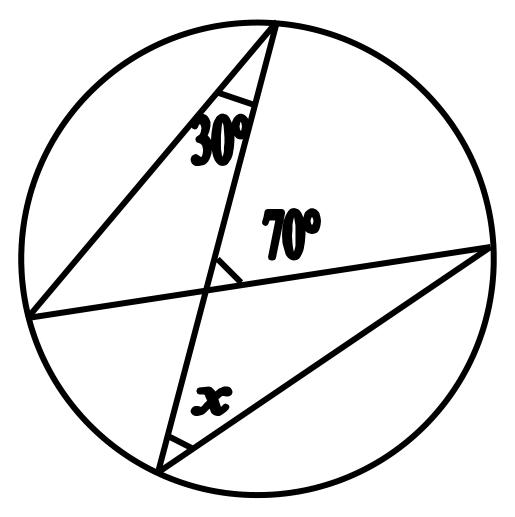
Qual è la misura dell’angolo “x” nella figura?
- (A) 30°
- (B) 35°
- (C) 40°
- (D) 45°
- (E) 50°. Kangourou 15 marzo 2001. Categoria Junior. Pagina N. 4
Topic: Geometria piana Abilita: Ragionamento geometrico Area: Geometria Risposta: C Fonte: apri PDF p.3
*Measure of the angle x in figure *
What’s the size of the angle “x” in the figure?
- (A) 30°
- (B) 35°
- (C) 40°
- (D) 45°
- (E) 50°. Kangourou 15 March 2001. Junior class. This item is not intended to be used. 4
Answer: C src_kangourou_2001_junior__Q12
Ore di ritardo in una settimana
Un orologio ritarda di X minuti ogni Y ore. Quante ore, in termini di X e Y, ritarderà quell’orologio in una settimana?
Topic: Algebra Abilita: Manipolazione algebrica Area: Algebra e Analisi Risposta: C Fonte: apri PDF p.4
Late hours in one week
A clock lags by X minutes every Y hour. How many hours, in terms of X and Y, will you delay that clock in a week?
Answer: C src_kangourou_2001_junior__Q13
Franchi rimasti a Gaspare
Gaspare aveva 400 franchi e doveva acquistare 100 tavolette di cioccolato al costo di 4 franchi l’una. Nel supermercato ha scoperto che per ogni 6 tavolette di cioccolato che aveva nel carrello, una nuova tavoletta veniva aggiunta gratuitamente alla cassa. Quanti franchi sono rimasti a Gaspare all’uscita dal supermercato, sapendo che oltre al cioccolato non ha acquistato altro?
- (A) 52
- (B) 56
- (C) 60
- (D) 64
- (E) 68.
Topic: Teoria dei Numeri Abilita: traduzione del testo Area: Aritmetica e Teoria dei Numeri Risposta: B Fonte: apri PDF p.4
This appropriation is intended to cover expenditure on research and technological developments in the field of biotechnology.
Gaspare had 400 francs and had to buy 100 chocolate bars at the cost of 4 francs each. At the grocery store, he found that for every six tablespoons of chocolate he had in his cart, a new tablet was added to the box for free. How many francs did Gaspare have left when he left the supermarket, knowing that he bought nothing but chocolate?
- (A) 52
- (B) 56
- (C) 60
- (D) 64
- (E) 68.
Answer: B src_kangourou_2001_junior__Q14
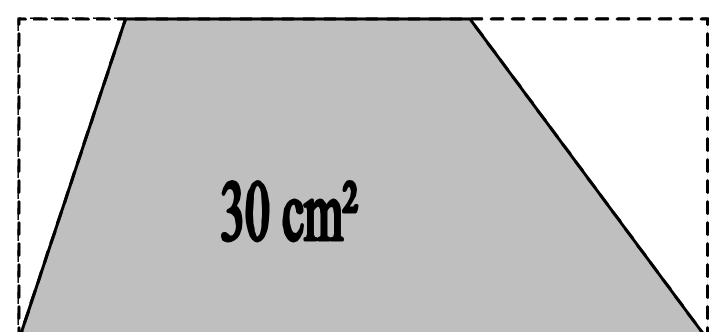
Somma aree dei due triangoli tolti
\begin{document}
\begin{tikzpicture}[scale=0.7]
  \draw[dashed] (0,0) rectangle (6,2.5);
  \draw[fill=gray!30] (0,0) -- (6,0) -- (5,2.5) -- (1,2.5) -- cycle;
  \node at (3,1.25) {\textbf{30 cm}$^2$};
\end{tikzpicture}
\end{document}
Due triangoli sono stati tolti da un rettangolo (si veda la figura). Il restante trapezio ha l’area di 30 cm² e la sua base maggiore è doppia della minore. Qual è la somma delle aree dei due triangoli che sono stati tolti?
- (A) 10 cm²
- (B) 12 cm²
- (C) 15 cm²
- (D) 18 cm²
- (E) 20 cm².
Topic: Geometria piana Abilita: Ragionamento geometrico Area: Geometria Risposta: A Fonte: apri PDF p.4
sum of areas of the two triangles removed
\begin{document}
\begin{tikzpicture}[scale=0.7]
  \draw[dashed] (0,0) rectangle (6,2.5);
  \draw[fill=gray!30] (0,0) -- (6,0) -- (5,2.5) -- (1,2.5) -- cycle;
  \node at (3,1.25) {\textbf{30 cm}$^2$};
\end{tikzpicture}
\end{document}
Two triangles have been removed from a rectangle (see figure). The remaining trapezoid has an area of 30 cm2 and its major base is twice the minor. What is the sum of the areas of the two triangles that have been removed?
- (A) 10 cm2
- (B) 12 cm2
- (C) 15 cm2
- (D) 18 cm2
- (E) 20 inches square.
Answer: A src_kangourou_2001_junior__Q15
Peso del cammello Desiree assetato
Ogni volta che il cammello Desirée ha sete, l’84% del suo corpo è costituito da acqua. Dopo aver bevuto, il suo peso raggiunge gli 800 kg e l’acqua costituisce l’85% del suo peso. Qual è il peso del cammello Desirée quando ha sete?
- (A) 672 kg
- (B) 680 kg
- (C) 715 kg
- (D) 720 kg
- (E) 750 kg.
Topic: Algebra Abilita: Manipolazione algebrica Area: Algebra e Analisi Risposta: E Fonte: apri PDF p.4
Weight of the thirsty Desiree camel
Whenever the Desirée camel is thirsty, 84 percent of its body is made up of water. After drinking, its weight reaches 800 kg and water makes up 85 percent of its weight. What’s the weight of the Desirée camel when it’s thirsty?
- (A) 672 kg
- (B) 680 kg
- (C) 715 kg
- (D) 720 kg
- (E) 750 kg.
Answer: E src_kangourou_2001_junior__Q16
Numero di figli con prodotto eta 1664
Il prodotto delle età dei miei figli (in anni) è 1664. Il più giovane ha la metà degli anni del più anziano e non vi sono gemelli. Quanti figli ho?
- (A) 2
- (B) 3
- (C) 4
- (D) 5
- (E) 6.
Topic: Teoria dei Numeri Metodo: manipolazione algebrica Abilita: Casework accurato Area: Aritmetica e Teoria dei Numeri Risposta: B Fonte: apri PDF p.4
Number of children with a product age 1664
The product of the ages of my children (in years) is 1664. The youngest is half the age of the oldest and there are no twins. How many kids do I have?
- (A) 2
- (B) 3
- (C) 4
- (D) 5
- (E) 6.
Answer: B src_kangourou_2001_junior__Q17
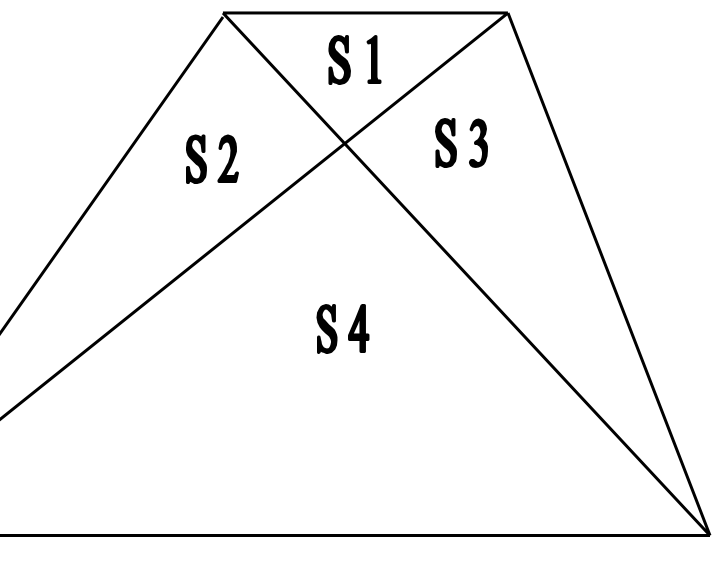
Relazione tra aree S4 e S1 nel trapezio
\begin{document}
\begin{tikzpicture}[scale=1.4]
  \coordinate (A) at (0,0);
  \coordinate (B) at (4,0);
  \coordinate (C) at (3,2);
  \coordinate (D) at (1,2);
  \draw (A) -- (B) -- (C) -- (D) -- cycle;
  \draw (A) -- (C);
  \draw (B) -- (D);
  \node at (2,1.7) {$S_1$};
  \node at (1.1,1.0) {$S_2$};
  \node at (2.9,1.0) {$S_3$};
  \node at (2,0.45) {$S_4$};
  \node[above left] at (D) {$D$};
  \node[above right] at (C) {$C$};
  \node[below right] at (B) {$B$};
  \node[below left] at (A) {$A$};
\end{tikzpicture}
\end{document}
Il trapezio ABCD è suddiviso dalle sue diagonali in quattro triangoli di area S 1, S2, S 3, S 4 (si veda la figura). Se S 2 = 3 ⋅ S 1, allora
- (A) S 4 = 3 ⋅ S 1
- (B) S 4 = 4 ⋅ S 1
- (C) S 4 = 6 ⋅ S 1
- (D) S 4 = 9 ⋅ S 1
- (E) S 4 = 12 ⋅ S 1 . . Y 168X (E) 14X 5Y (D) 5Y 14X (C) 2X 5Y (B) 5Y 2X ) A ( Kangourou 15 marzo 2001. Categoria Junior. Pagina N. 5
Topic: Geometria piana Abilita: Ragionamento geometrico Area: Geometria Risposta: D Fonte: apri PDF p.4
Relation between S4 and S1 areas in the trapezoid
\begin{document}
\begin{tikzpicture}[scale=1.4]
  \coordinate (A) at (0,0);
  \coordinate (B) at (4,0);
  \coordinate (C) at (3,2);
  \coordinate (D) at (1,2);
  \draw (A) -- (B) -- (C) -- (D) -- cycle;
  \draw (A) -- (C);
  \draw (B) -- (D);
  \node at (2,1.7) {$S_1$};
  \node at (1.1,1.0) {$S_2$};
  \node at (2.9,1.0) {$S_3$};
  \node at (2,0.45) {$S_4$};
  \node[above left] at (D) {$D$};
  \node[above right] at (C) {$C$};
  \node[below right] at (B) {$B$};
  \node[below left] at (A) {$A$};
\end{tikzpicture}
\end{document}
The trapezoid ABCD is divided by its diagonal into four triangles of area S 1, S2, S 3, S 4 (see figure). If S2 is equal to 3 ⋅ S1, then
- (A) S 4 = 3 ⋅ S 1
- (B) S 4 = 4 ⋅ S 1
- (C) S 4 = 6 ⋅ S 1
- (D) S 4 = 9 ⋅ S 1
- (E) S 4 = 12 ⋅ S 1 . . The Commission shall adopt delegated acts in accordance with the procedure referred to in paragraph 1 of this Article. Junior class. This item is not intended to be used. 5
Answer: D src_kangourou_2001_junior__Q18
Numero non ottenibile con segni alterni
Nell’espressione 2 * 4 * 6 * 8 * 10 * 12 * 14 ad ogni asterisco può essere sostituito il segno ” + ” o il segno ” – ”. Quale numero non può essere il risultato di alcuna di queste espressioni ?
- (A) 0
- (B) 4
- (C) – 4
- (D) 48
- (E) 30.
Topic: Teoria dei Numeri Metodo: congruenze Abilita: Riconoscimento di pattern Area: Aritmetica e Teoria dei Numeri Risposta: E Fonte: apri PDF p.5
Number not available with alternate characters
In expression 2 * 4 * 6 * 8 * 10 * 12 * 14 the ” + ” or ” ” mark may be replaced by each asterisk. What number cannot be the result of any of these expressions ?
- (A) 0
- (B) 4
- (C) – 4
- (D) 48
- (E) 30.
Answer: E src_kangourou_2001_junior__Q19
n dato resto di 999:n
Nella divisione 999 : n, dove n è un numero naturale di due cifre (significative), il resto vale 3. Allora il resto della divisione 2001 : n vale
- (A) 3
- (B) 5
- (C) 6
- (D) 7
- (E) 9. I quesiti dal N. 21 al N. 30 valgono 5 punti ciascuno
Topic: Teoria dei Numeri Metodo: congruenze Abilita: Manipolazione algebrica Area: Aritmetica e Teoria dei Numeri Risposta: E Fonte: apri PDF p.5
n given the remainder of 999:n
In division 999: n, where n is a natural number of two digits (significant), the rest is 3. Then the rest of the 2001 division:
- (A) 3
- (B) 5
- (C) 6
- (D) 7
- (E) 9. The questions from N. 21 al N. 30 is worth 5 points each.
Answer: E src_kangourou_2001_junior__Q20
Caramelle mangiate da Cristina
In una scatola di caramelle vi erano 31 caramelle. Il primo giorno Cristina mangiò i 3/4 del totale delle caramelle che Paolo aveva appena mangiato prelevandole da quella scatola. Il secondo giorno Cristina mangiò i 2/3 del totale delle caramelle appena mangiate da Paolo nel secondo giorno (sempre prelevate dalla stessa scatola). Alla fine del secondo giorno la scatola era vuota. Quante caramelle ha mangiato Cristina da quella scatola?
- (A) 9
- (B) 10
- (C) 12
- (D) 13
- (E) 15.
Topic: Algebra, Teoria dei Numeri Abilita: Manipolazione algebrica Area: Algebra e Analisi, Aritmetica e Teoria dei Numeri Risposta: D Fonte: apri PDF p.5
Candies eaten by Cristina
In a box of candy, there were 31 candies. On the first day, Cristina ate three-quarters of the total of the candy that Paul had just eaten by taking it out of that box. On the second day, Cristina ate 2/3 of the total of the candies Paul had just eaten on the second day (always taken from the same box). By the end of the second day, the box was empty. How many candy did Cristina eat out of that box?
- (A) 9
- (B) 10
- (C) 12
- (D) 13
- (E) 15.
Answer: D src_kangourou_2001_junior__Q21
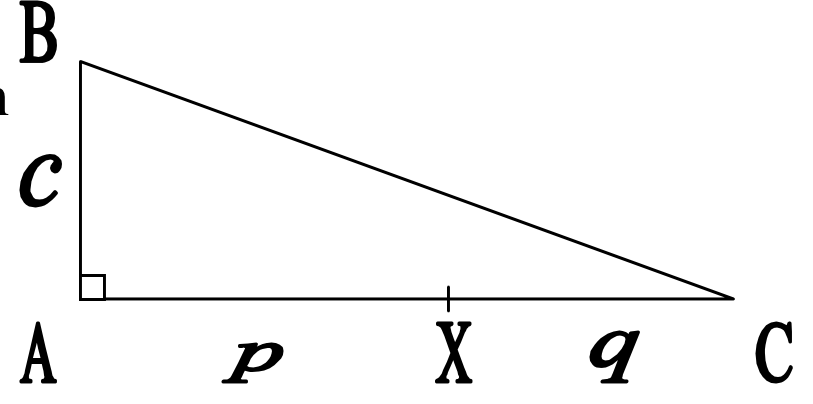
Valore di q in funzione di p e c
\begin{document}
\begin{tikzpicture}[scale=1.2]
  \coordinate (A) at (0,0);
  \coordinate (B) at (0,2.5);
  \coordinate (C) at (5,0);
  \coordinate (X) at (2.2,0);
  \draw (A) -- (B) -- (C) -- cycle;
  \draw (0.18,0) -- (0.18,0.18) -- (0,0.18);
  \draw (X) ++(0,0.08) -- ++(0,-0.16);
  \node[left] at (B) {$B$};
  \node[below left] at (A) {$A$};
  \node[below right] at (C) {$C$};
  \node[above] at (X) {$X$};
  \node[left] at (0,1.25) {$c$};
  \node[below] at (1.1,0) {$p$};
  \node[below] at (3.6,0) {$q$};
\end{tikzpicture}
\end{document}
Un triangolo rettangolo ABC come in figura, con AB = c, AX = p e XC = q, rappresenta un terreno. Jenny e Vicky camminano alla stessa velocità in direzioni opposte sul bordo del terreno, partendo entrambe allo stesso istante dalla posizione X. Le due ragazze si incontrano in B. Qual è il valore di q in funzione di p e c?
Topic: Geometria piana, Algebra Abilita: Manipolazione algebrica Area: Algebra e Analisi, Geometria Risposta: B Fonte: apri PDF p.5
Q value in relation to p and c
\begin{document}
\begin{tikzpicture}[scale=1.2]
  \coordinate (A) at (0,0);
  \coordinate (B) at (0,2.5);
  \coordinate (C) at (5,0);
  \coordinate (X) at (2.2,0);
  \draw (A) -- (B) -- (C) -- cycle;
  \draw (0.18,0) -- (0.18,0.18) -- (0,0.18);
  \draw (X) ++(0,0.08) -- ++(0,-0.16);
  \node[left] at (B) {$B$};
  \node[below left] at (A) {$A$};
  \node[below right] at (C) {$C$};
  \node[above] at (X) {$X$};
  \node[left] at (0,1.25) {$c$};
  \node[below] at (1.1,0) {$p$};
  \node[below] at (3.6,0) {$q$};
\end{tikzpicture}
\end{document}
An ABC rectangle triangle as in the figure, with AB = c, AX = p and XC = q, represents a terrain. Jenny and Vicky walk at the same speed in opposite directions on the edge of the ground, both starting at the same moment from position X. The two girls meet in B. What’s the value of q as a function of p and c?
Answer: B src_kangourou_2001_junior__Q22
Scatole totali date 102 vuote
Ho 11 scatole grandi: alcune di esse contengono 8 scatole medie ciascuna, alcune delle scatole medie contengono a loro volta 8 scatole piccole ciascuna. Se le scatole (di varia dimensione) vuote sono 102, quante sono in totale le scatole (a prescindere dalla dimensione)? (A) 102 (B) 64 (C) 118 (D) 115 (E) non è possibile rispondere. .
(E)
2
(D)
2
(C)
2 (B)
2
(A) 2 2 c-p
c p c
c p c p pc c p
Kangourou 15 marzo 2001. Categoria Junior. Pagina N. 6
Topic: Algebra Abilita: Manipolazione algebrica Area: Algebra e Analisi Risposta: D Fonte: apri PDF p.5
*Total 102 empty boxes given *
I have 11 large boxes: some of them contain 8 medium boxes each, some of the medium boxes contain 8 small boxes each. If the empty boxes (of varying size) are 102, how many boxes are there in total (regardless of size)? (A) 102 B 64 C 118 D 115 E cannot be answered. .
(E)
2
(D)
2
(C)
2 (B)
2
(A) 2 2 c-p
c p c
c p c p pc c p + + + + +
Kangourou 15 March 2001. Junior class. This item is not intended to be used. 6
Answer: D src_kangourou_2001_junior__Q23
Cifra delle unita della somma di potenze
Sia a = 1997 1998 + 1998 1999 + 1999 2000 + 2000 2001. La cifra delle unità di a è
- (A) 0
- (B) 2
- (C) 3
- (D) 4
- (E) 5.
Topic: Teoria dei Numeri Metodo: congruenze Abilita: Riconoscimento di pattern Area: Aritmetica e Teoria dei Numeri Risposta: B Fonte: apri PDF p.6
Number of units of the sum of powers
This is the same as in the case of a = 1997 1998 + 1998 1999 + 1999 2000 + 2000 2001. The number of units of a is
- (A) 0
- (B) 2
- (C) 3
- (D) 4
- (E) 5.
Answer: B src_kangourou_2001_junior__Q24
Area del triangolo PQR nel cubo
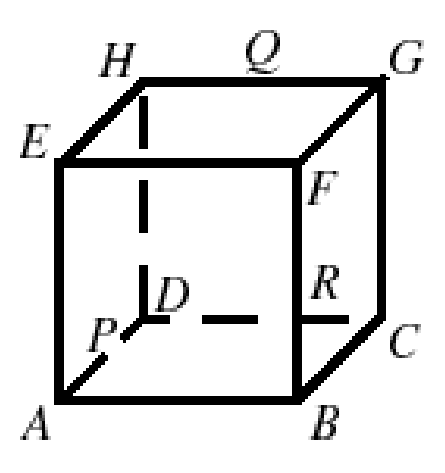
ABCDEFGH è un cubo di lato 2 cm. P, Q e R sono i punti medi di AD, GH e BF rispettivamente. Quanto misura l’area del triangolo PQR?
Topic: Geometria solida Metodo: Metodo delle coordinate Abilita: Ragionamento geometrico Area: Geometria Risposta: C Fonte: apri PDF p.6
Area of the PQR triangle in the cube
ABCDEFGH is a 2 cm side cube. P, Q and R are the mean points of AD, GH and BF respectively. What is the area of the PQR triangle?
Answer: C src_kangourou_2001_junior__Q25
Segmenti lunghi 5 cm nella griglia

\begin{document}
\begin{tikzpicture}
  \foreach \x in {0,1,2,3,4,5} {
    \foreach \y in {0,1,2,3,4,5,6} {
      \fill (\x,\y) circle (2pt);
    }
  }
\end{tikzpicture}
\end{document}
Nella griglia a fianco, la distanza tra due punti adiacenti è 1 cm sia in orizzontale sia in verticale. Congiungete due punti in modo da formare un segmento lungo 5 cm. Quanti di questi segmenti possono essere tracciati nella griglia?
- (A) 10
- (B) 12
- (C) 24
- (D) 34
- (E) 36.
Topic: Combinatoria, Geometria piana Metodo: Conteggio combinatorio Abilita: Conteggio sistematico Area: Combinatoria, Logica e Probabilita, Geometria Risposta: E Fonte: apri PDF p.6
Sections 5 cm long in the grid
\begin{document}
\begin{tikzpicture}
  \foreach \x in {0,1,2,3,4,5} {
    \foreach \y in {0,1,2,3,4,5,6} {
      \fill (\x,\y) circle (2pt);
    }
  }
\end{tikzpicture}
\end{document}
In the side grid, the distance between two adjacent points is 1 cm both horizontally and vertically. Combine two points to form a 5 cm long segment. How many of these segments can be traced in the grid?
- (A) 10
- (B) 12
- (C) 24
- (D) 34
- (E) 36.
Answer: E src_kangourou_2001_junior__Q26
Interi che diminuiscono di 14 volte
Cancelliamo la cifra delle unità di un intero positivo e notiamo che il numero diminuisce di 14 volte. Quanti numeri interi possiedono questa proprietà?
- (A) 0
- (B) 1
- (C) 2
- (D) 3
- (E) 4.
Topic: Teoria dei Numeri Abilita: Manipolazione algebrica Area: Aritmetica e Teoria dei Numeri Risposta: C Fonte: apri PDF p.6
Interies decreasing by 14 times
We cancel out the number of units of a positive integer and notice that the number decreases by 14 times. How many integers have this property?
- (A) 0
- (B) 1
- (C) 2
- (D) 3
- (E) 4.
Answer: C src_kangourou_2001_junior__Q27
Valore A-B con quadrato e semicerchi
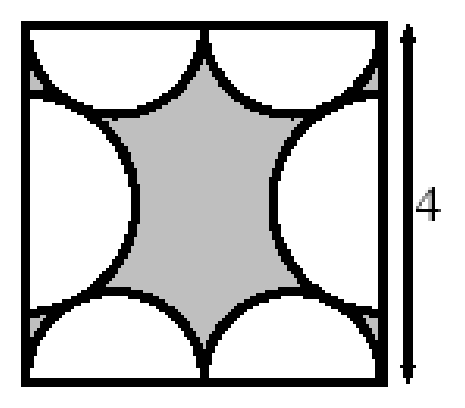
Se A è l’area del quadrato (di lato 4) e B è l’area totale dei sei semicerchi come in figura, allora il valore di A – B è
- (A) 8
- (B) 16 – 3π
- (C) 16 – 4π
- (D) 16 – 8π + 2√5 π
- (E) 16 – 4π + √5 π.
Topic: Geometria piana Abilita: Ragionamento geometrico Area: Geometria Risposta: D Fonte: apri PDF p.6
A-B value with square and semicircles
If A is the area of the square (on side 4) and B is the total area of the six semicircles as shown in the figure, then the value of A B is
- (A) 8
- (B) 16 – 3π
- (C) 16 – 4π
- (D) 16 – 8π + 2√5 π
- (E) 16 – 4π + √5 π.
Answer: D src_kangourou_2001_junior__Q28
Modi di piastrellare 2x8 con domino
In quanti modi differenti si può piastrellare un pavimento di forma rettangolare di dimensione 2 × 8, utilizzando delle piastrelle rettangolari di dimensione 1 × 2 (senza sovrapposizioni)?
- (A) 16
- (B) 21
- (C) 30
- (D) 32
- (E) 34.
Topic: Combinatoria Metodo: Ricorsione Abilita: Conteggio sistematico Area: Combinatoria, Logica e Probabilita Risposta: E Fonte: apri PDF p.6
Mode of tiles 2x8 with dominoes
How many different ways can a rectangular floor of size 2 × 8 be tiled using rectangular tiles of size 1 × 2 (without overlapping)?
- (A) 16
- (B) 21
- (C) 30
- (D) 32
- (E) 34.
Answer: E src_kangourou_2001_junior__Q29
Scomposizioni di 30 in tre interi positivi
In quanti modi differenti si può scomporre il numero 30 come somma di tre interi strettamente positivi? (Due scomposizioni sono uguali se differiscono solo per l’ordine degli addendi.)
- (A) 105
- (B) 75
- (C) 81
- (D) 362
- (E) 101. . cm 3 2 (E) cm 3 2 (D) cm 2 3 3 (C) cm 3 3 (B) cm 2 3 A) ( 2 2 2 2 2 1 Risposte Categoria Junior Gara del 15 marzo 2001
Topic: Combinatoria Metodo: Conteggio combinatorio Abilita: Conteggio sistematico Area: Combinatoria, Logica e Probabilita Risposta: B Fonte: apri PDF p.6
Compositions of 30 into three positive integers
How many different ways can the number 30 be broken down as the sum of three strictly positive integers? (Two breakdowns are equal if they differ only in the order of the additives.)
- (A) 105
- (B) 75
- (C) 81
- (D) 362
- (E) 101. . This is the total number of participants in the contested competition.
Answer: B src_kangourou_2001_junior__Q30