Gradi dell’angolo della fetta (15%)
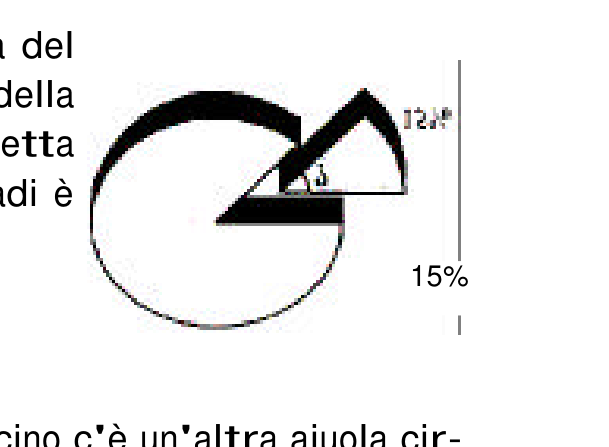
Da una torta circolare viene tagliata una fetta del tipo indicato in figura (naturalmente il “vertice” della fetta è al “centro” della torta). Sapendo che la fetta rappresenta il 15% dell’intera torta, di quanti gradi è l’angolo indicato con il punto interrogativo? A) 30° B) 45° C) 54° D) 15° E) 20°
Topic: Geometria piana Abilita: Ragionamento geometrico Area: Geometria Risposta: C Fonte: apri PDF p.1
*Grades of the angle of the slice (15%) *
From a circular cake a slice of the type indicated in the figure is cut (naturally the “top” of the slice is at the “center” of the cake). Knowing that the slice represents 15% of the entire cake, how many degrees is the angle indicated by the question mark? A) 30° B) 45° C) 54° D) 15° E) 20°
Answer: C src_kangourou_2003_junior__Q01
Diametro seconda aiuola con area quadrupla
Un’aiuola circolare ha un diametro di 1,2 m e vicino c’è un’altra aiuola circolare la cui area è 4 volte l’area della prima aiuola. Qual è il diametro di questa seconda aiuola? A) 2,4 m B) 3,6 m C) 4,8 m D) 6,4 m E) 9,6 m
Topic: Geometria piana Abilita: Ragionamento geometrico Area: Geometria Risposta: A Fonte: apri PDF p.1
Second diameter of the wool with quadruple area
A circular awning has a diameter of 1.2 m and nearby there is another circular awning whose area is 4 times the area of the first awning. What’s the diameter of this second shell? A) 2,4 m B) 3,6 m C) 4,8 m D) 6,4 m E) 9,6 m
Answer: A src_kangourou_2003_junior__Q02
Quale striscia ha area maggiore
\begin{document}
\begin{tikzpicture}[scale=0.8]
\draw[thick] (-0.5,2) -- (7.5,2) node[right] {$r$};
\draw[thick] (-0.5,0) -- (7.5,0) node[right] {$s$};
\draw[fill=gray!20] (0,0) -- (0,2) -- (1.5,2) -- (1.5,0) -- cycle;
\node at (0.75,1) {1};
\draw[<->] (0,2.4) -- (1.5,2.4) node[midway,above] {$a$};
\draw[fill=gray!20] (2,0) -- (3,2) -- (4.5,2) -- (3.5,0) -- cycle;
\node at (3.25,1) {2};
\draw[<->] (3,2.4) -- (4.5,2.4) node[midway,above] {$a$};
\draw[fill=gray!20] (4.5,0) -- (6,2) -- (7,2) -- (5.5,0) -- cycle;
\node at (5.75,1) {3};
\draw[<->] (6,2.4) -- (7,2.4) node[midway,above] {$a$};
\end{tikzpicture}
\end{document}
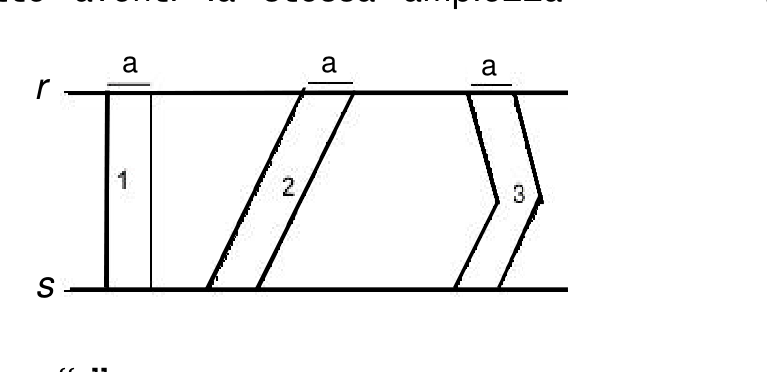
Nella figura sono indicate tre strisce tutte aventi la stessa ampiezza orizzontale pari ad “a”. Le due rette “r” ed “s” che delimitano queste strisce sono parallele. Quale striscia ha area maggiore? A) Le strisce hanno la stessa area B) La striscia 1 C) La striscia 2 D) La striscia 3 E) Non è possibile rispondere se non si conosce “a”
Topic: Geometria piana Abilita: Ragionamento geometrico Area: Geometria Risposta: A Fonte: apri PDF p.1
Which strip has a larger area
\begin{document}
\begin{tikzpicture}[scale=0.8]
\draw[thick] (-0.5,2) -- (7.5,2) node[right] {$r$};
\draw[thick] (-0.5,0) -- (7.5,0) node[right] {$s$};
\draw[fill=gray!20] (0,0) -- (0,2) -- (1.5,2) -- (1.5,0) -- cycle;
\node at (0.75,1) {1};
\draw[<->] (0,2.4) -- (1.5,2.4) node[midway,above] {$a$};
\draw[fill=gray!20] (2,0) -- (3,2) -- (4.5,2) -- (3.5,0) -- cycle;
\node at (3.25,1) {2};
\draw[<->] (3,2.4) -- (4.5,2.4) node[midway,above] {$a$};
\draw[fill=gray!20] (4.5,0) -- (6,2) -- (7,2) -- (5.5,0) -- cycle;
\node at (5.75,1) {3};
\draw[<->] (6,2.4) -- (7,2.4) node[midway,above] {$a$};
\end{tikzpicture}
\end{document}
In the figure three strips are indicated, all having the same horizontal width equal to a. The two lines r and s that delimit these strips are parallel. Which strip has larger area? A) The strips have the same area B) The strip 1 C) The strip 2 D) The strip 3 E) You cannot answer if you do not know a
Answer: A src_kangourou_2003_junior__Q03
Quale numero dispari per ogni intero n
Quale dei seguenti numeri è dispari qualunque sia l’intero n ? A) 2003n B) n2 + 2003
C) n3 D) n + 2004 E) 2n2 + 2003
Topic: Teoria dei Numeri Metodo: congruenze Abilita: Manipolazione algebrica Area: Aritmetica e Teoria dei Numeri Risposta: E Fonte: apri PDF p.1
What is the odd number for each integer n
Which of the following numbers is odd, whatever the integer n is? A) 2003n B) n2 + 2003 C) n3 D) n + 2004 E) 2n2 + 2003
Answer: E src_kangourou_2003_junior__Q04
Tipo di triangolo con angoli x,2x,3x
In un triangolo ABC l’angolo in C è il triplo dell’angolo in A e l’angolo in B è il doppio dell’angolo in A. Allora il triangolo ABC è A) equilatero B) isoscele non equilatero
C) ottusangolo D) rettangolo E) acutangolo non equilatero r s a a a 15%Pag. Pag. 23 23 Kang 2003 Kang 2003
Topic: Geometria piana Abilita: Ragionamento geometrico Area: Geometria Risposta: D Fonte: apri PDF p.1
Type of triangle with angles x,2x,3x*
In an ABC triangle the angle in C is triple the angle in A and the angle in B is double the angle in A. So the triangle ABC is A) equilateral B) non-equilateral isosceles C) octahedral D) rectangle E) non-equilateral acutangol r s a to 15%
I’m going to pay. I’m going to pay. 23 23 Kang 2003 Kang
Answer: D src_kangourou_2003_junior__Q05
Frazione tempo in cui i tre cantano insieme
Tre cantanti devono cantare un canone formato da tre righe della stessa lunghezza e ognuno finisce quando ha cantato il pezzo 4 volte. Il secondo cantante inizia quando il primo cantante inizia la seconda riga e il terzo inizia quando il primo inizia la terza riga. Quale frazione del tempo totale del canto rappresenta il tempo in cui i tre cantanti cantano simultaneamente? A) 3/5 B) 4/5 C) 4/7 D) 5/7 E) 7/11
Topic: Combinatoria, Algebra Abilita: traduzione del testo Area: Algebra e Analisi, Combinatoria, Logica e Probabilita Risposta: D Fonte: apri PDF p.2
Time fraction in which the three sing together
Three singers are to sing a canon made up of three lines of the same length and each one ends when they have sung the piece four times. The second singer begins when the first singer begins the second line and the third begins when the first begins the third line. How much of the total singing time is the time the three singers sing simultaneously? A) 3/5 B) 4/5 C) 4/7 D) 5/7 E) 7/11
Answer: D src_kangourou_2003_junior__Q06
Decimo termine successione (Fibonacci con segni)
I primi due termini di una sequenza di numeri sono 1 e 2 e ogni nuovo termine è ottenuto dividendo il termine prima del precedente con il termine precedente. Qual è il decimo termine della successione? A) 2-10 B) 256 C) 2-13 D) 1024 E) 234
Topic: successioni, Teoria dei Numeri Metodo: Ricorsione Abilita: Riconoscimento di pattern Area: Algebra e Analisi, Aritmetica e Teoria dei Numeri Risposta: E Fonte: apri PDF p.2
*Tenth term succession (Fibonacci with signs) *
The first two terms of a sequence of numbers are 1 and 2 and each new term is obtained by dividing the term before the previous term by the previous term. What is the tenth term of succession? A) 2-10 B) 256 C) 2-13 D) 1024 E) 234
Answer: E src_kangourou_2003_junior__Q07
Area figura delimitata dall’elastico (3 cerchi)
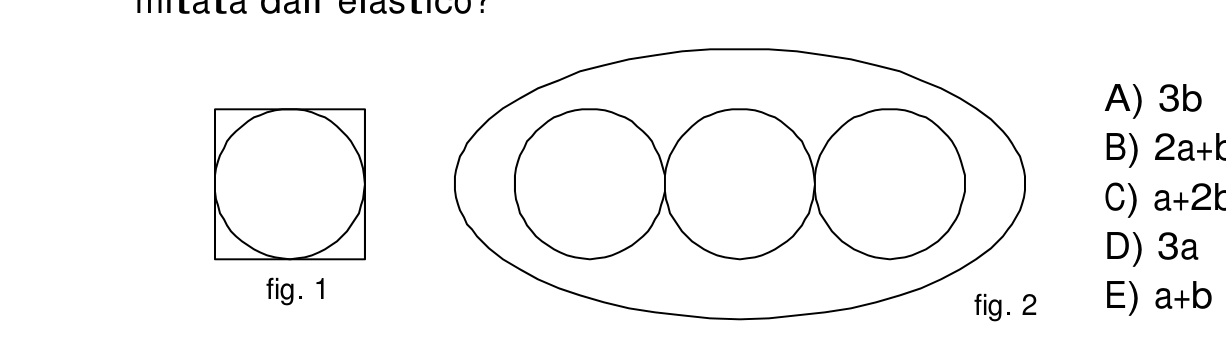
L’area del quadrato della figura 1 vale “a”; chiamiamo “b” l’area di ciascuno dei cerchi delle figure 1 e 2. Nella figura 2, i tre cerchi allineati sono racchiusi da un elastico. Se l’elastico viene accorciato in modo che sia in tensione, senza cambiare la posizione dei tre cerchi, qual è l’area della figura delimitata dall’elastico? A) 3b B) 2a+b C) a+2b D) 3a E) a+b
Topic: Geometria piana Abilita: Ragionamento geometrico Area: Geometria Risposta: B Fonte: apri PDF p.2
*Figure area bounded by elastic (3 circles) *
The area of the square in Figure 1 is a; we call b the area of each of the circles in Figures 1 and 2. In Figure 2, the three aligned circles are enclosed by a rubber band. If the elastic is shortened so that it is in tension, without changing the position of the three circles, what is the area of the figure bounded by the elastic? A) 3b B) 2a+b C) a+2b D) 3a E) a+b
Answer: B src_kangourou_2003_junior__Q08
Quale modulo e il quarto (parallelepipedo)
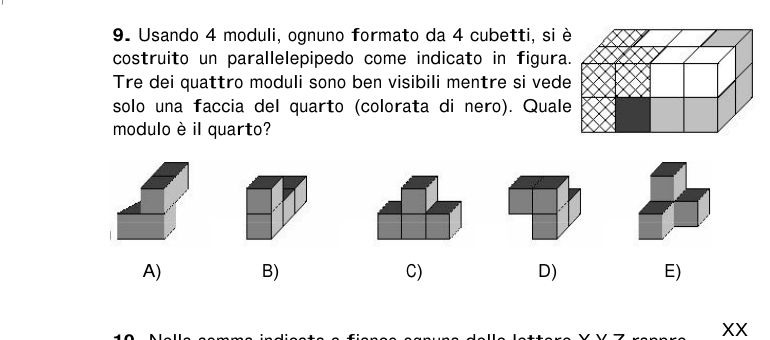
Usando 4 moduli, ognuno formato da 4 cubetti, si è costruito un parallelepipedo come indicato in figura. Tre dei quattro moduli sono ben visibili mentre si vede solo una faccia del quarto (colorata di nero). Quale modulo è il quarto? A) B) C) D) E)
Topic: Geometria solida Abilita: Ragionamento geometrico Area: Geometria Risposta: C Fonte: apri PDF p.2
*Which module and the fourth (parallellepiped) *
Using 4 modules, each made up of 4 cubes, a parallel piped was constructed as shown in the figure. Three of the four modules are clearly visible while only one face of the fourth (black). What’s the fourth form? A) B) C) D) E)
Answer: C src_kangourou_2003_junior__Q09
Cifra X nella somma criptaritmetica XX+YY+ZZ=ZYX
Nella somma indicata a fianco ognuna delle lettere X,Y,Z rappresenta una cifra non nulla. Se le tre cifre sono distinte fra loro, allora la lettera X sta per:
A) 1 B) 2 C) 7
D) 8 E) 9 XX YY ZZZYX fig. 1 fig. 2
Pag. Pag. 24 24 Kang 2003 Kang 2003 I quesiti dal N. 11 al N. 21 valgono 4 punti ciascuno
Topic: Teoria dei Numeri, Logica, giochi, strategie Abilita: Casework accurato Area: Aritmetica e Teoria dei Numeri, Combinatoria, Logica e Probabilita Risposta: D Fonte: apri PDF p.2
X in the cryptographic sum XX+YY+ZZ=ZYX
In the sum shown next to each of the letters X,Y,Z, it represents a non-zero number. If the three digits are distinct from each other, then the letter X stands for: A) 1 B) 2 C) 7 D) 8 E) 9 XX YY ZZ ------ ZYX fig. 1 Fig. 2
I’m going to pay. I’m going to pay. 24 24 Kang 2003 Kang 2003 Questions from N. 11 al N. Twenty-one is worth four points each.
Answer: D src_kangourou_2003_junior__Q10
Frazione area triangolo PQT nel rettangolo
\begin{document}
\begin{tikzpicture}[scale=1.5]
\coordinate (A) at (0,0);
\coordinate (B) at (2,0);
\coordinate (C) at (2,1.5);
\coordinate (D) at (0,1.5);
\draw[thick] (A) -- (B) -- (C) -- (D) -- cycle;
\node[below left] at (A) {$A$};
\node[below right] at (B) {$B$};
\node[above right] at (C) {$C$};
\node[above left] at (D) {$D$};
\coordinate (P) at (1,0);
\coordinate (Q) at (2,0.75);
\coordinate (R) at (1,1.5);
\coordinate (S) at (0,0.75);
\node[below] at (P) {$P$};
\node[right] at (Q) {$Q$};
\node[above] at (R) {$R$};
\node[left] at (S) {$S$};
\fill[white] (P) circle (2pt);
\draw (P) circle (2pt);
\fill[white] (Q) circle (2pt);
\draw (Q) circle (2pt);
\fill[white] (R) circle (2pt);
\draw (R) circle (2pt);
\fill[white] (S) circle (2pt);
\draw (S) circle (2pt);
\coordinate (T) at (0.5,1.125);
\fill[white] (T) circle (2pt);
\draw (T) circle (2pt);
\node[above left] at (T) {$T$};
\fill[gray!40] (P) -- (Q) -- (T) -- cycle;
\draw (P) -- (Q) -- (T) -- cycle;
\end{tikzpicture}
\end{document}
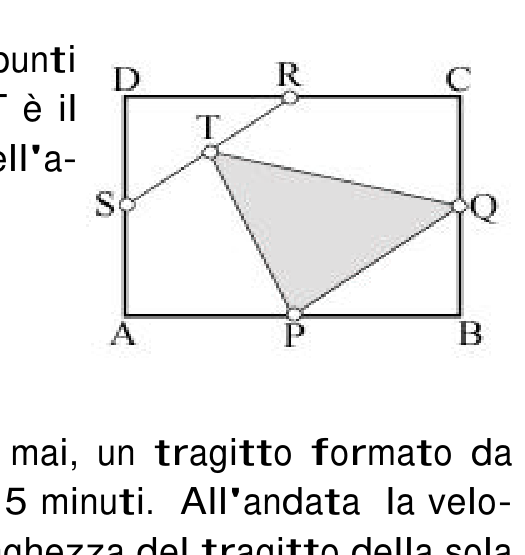
Nel rettangolo ABCD siano P,Q,R e S i punti medi dei lati, come illustrato dalla figura. Se T è il punto medio del segmento RS, quale frazione dell’area di ABCD è occupata dal triangolo PQT ? A) 5/16 B) 1/4 C) 1/5 D) 1/6 E) 3/8
Topic: Geometria piana Metodo: Metodo delle coordinate Abilita: Ragionamento geometrico Area: Geometria Risposta: B Fonte: apri PDF p.3
PQT triangle area fraction in the rectangle
\begin{document}
\begin{tikzpicture}[scale=1.5]
\coordinate (A) at (0,0);
\coordinate (B) at (2,0);
\coordinate (C) at (2,1.5);
\coordinate (D) at (0,1.5);
\draw[thick] (A) -- (B) -- (C) -- (D) -- cycle;
\node[below left] at (A) {$A$};
\node[below right] at (B) {$B$};
\node[above right] at (C) {$C$};
\node[above left] at (D) {$D$};
\coordinate (P) at (1,0);
\coordinate (Q) at (2,0.75);
\coordinate (R) at (1,1.5);
\coordinate (S) at (0,0.75);
\node[below] at (P) {$P$};
\node[right] at (Q) {$Q$};
\node[above] at (R) {$R$};
\node[left] at (S) {$S$};
\fill[white] (P) circle (2pt);
\draw (P) circle (2pt);
\fill[white] (Q) circle (2pt);
\draw (Q) circle (2pt);
\fill[white] (R) circle (2pt);
\draw (R) circle (2pt);
\fill[white] (S) circle (2pt);
\draw (S) circle (2pt);
\coordinate (T) at (0.5,1.125);
\fill[white] (T) circle (2pt);
\draw (T) circle (2pt);
\node[above left] at (T) {$T$};
\fill[gray!40] (P) -- (Q) -- (T) -- cycle;
\draw (P) -- (Q) -- (T) -- cycle;
\end{tikzpicture}
\end{document}
In the rectangle ABCD, P, Q, R and S are the midpoints of the sides, as shown in the figure. If T is the midpoint of the RS segment, what fraction of the area of ABCD is occupied by the PQT triangle? A) 5/16 B) 1/4 C) 1/5 D) 1/6 E) 3/8
Answer: B src_kangourou_2003_junior__Q11
Lunghezza andata con velocita diverse
Un canguro ha percorso, senza fermarsi mai, un tragitto formato da andata e ritorno in un tempo complessivo di 15 minuti. All’andata la velocità è stata di 5 m/s e al ritorno di 4 m/s. La lunghezza del tragitto della sola andata è A) 4,05 km
B) 8,1 km C) 0,9 km D) 2 km E) impossibile da determinarsi con queste sole informazioni.
Topic: Algebra Abilita: traduzione del testo Area: Algebra e Analisi Risposta: D Fonte: apri PDF p.3
Length travelled at different speeds
A kangaroo traveled, never stopping, a round trip in a total of 15 minutes. On the way, the speed was 5 m/s and on the way back, 4 m/s. The length of the one-way journey is A) 4.05 km B) 8.1 km C) 0.9 km D) 2 km E) impossible to determine with this information alone.
Answer: D src_kangourou_2003_junior__Q12
Capacita vaschetta dalle percentuali
Quando una vaschetta è riempita tranne che per il 30% contiene 30 litri più di quando è riempita solo al 30%. Quanti litri contiene la vaschetta quando è piena? A) 60 B) 75 C) 90 D) 100 E) 120
Topic: Algebra Abilita: traduzione del testo Area: Algebra e Analisi Risposta: B Fonte: apri PDF p.3
Table capacity by percentages
When a tank is filled except that it contains 30% more liters than when it is filled only 30%. How many liters does the tank contain when it’s full? A) 60 B) 75 C) 90 D) 100 E) 120
Answer: B src_kangourou_2003_junior__Q13
Differenza max-min multipli di 8 da 888
Anna e Barbara scrivono il numero di tre cifre 888, che è chiaramente un multiplo di 8. Anna cambia 2 delle tre cifre in modo da ottenere il massimo numero possibile ancora multiplo di 8 e Barbara invece cambia due cifre di 888 in modo di ottenere il minimo numero possibile di tre cifre multiplo di 8. Qual è la differenza fra i due risultati? A) 800 B) 840 C) 856 D) 864 E) 904
Topic: Teoria dei Numeri Metodo: Principio di estremalita Abilita: Casework accurato Area: Aritmetica e Teoria dei Numeri Risposta: C Fonte: apri PDF p.3
Max-min multiple difference of 8 from 888
Anna and Barbara write the three-digit number 888, which is clearly a multiple of 8. Anna changes 2 of the three digits so that she gets the maximum possible number still multiple of 8 and Barbara instead changes two digits of 888 so that she gets the minimum possible number of three digits multiple of 8. What is the difference between the two results? A) 800 B) 840 C) 856 D) 864 E) 904
Answer: C src_kangourou_2003_junior__Q14
Differenza aree grigia/nera (4 quadrati)
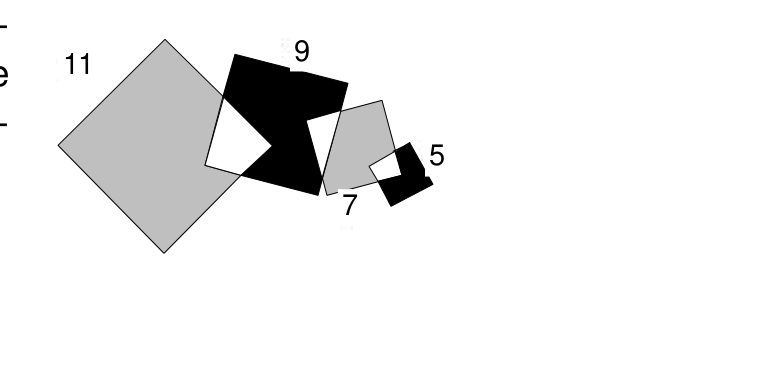
Nella figura sono rappresentati 4 quadrati parzialmente sovrapposti con lati di 11 cm, 9 cm, 7 cm e 5 cm. Quanto è la differenza fra l’area della regione grigia e l’area della regione nera? A) 25 cm2 B) 36 cm2 C) 49 cm2 D) 64 cm2 E) 0 cm2
Topic: Geometria piana Metodo: Sfruttamento della simmetria Abilita: Ragionamento geometrico Area: Geometria Risposta: D Fonte: apri PDF p.3
*Differential grey/black areas (4 squares) *
The figure shows four partially overlapping squares with sides of 11 cm, 9 cm, 7 cm and 5 cm. What is the difference between the grey area and the black area? A) 25 cm2 B) 36 cm2 C) 49 cm2 D) 64 cm2 E) 0 cm2
Answer: D src_kangourou_2003_junior__Q15
Valore del prodotto telescopico fino a 2003
Il valore dell’espressione è uguale a A) 2004 B) 2003 C) 2002 D) 1002 E) 1001 11 9 7 5 ?? ? ?? ? ? ? ? ?? ? ?? ? ? ? ?? ? ?? ? ? 2003 1 1 3 1 1 2 1 1
Pag. Pag. 25 25 Kang 2003 Kang 2003
Topic: Algebra Metodo: Somme telescopiche Abilita: Manipolazione algebrica Area: Algebra e Analisi Risposta: D Fonte: apri PDF p.3
Value of the telescopic product up to 2003
The value of the expression is equal to A) 2004 B) 2003 C) 2002 D) 1002 E) 1001 11 9 7 5 ?? ? ?? ? ? ? ? ?? ? ?? ? ? ? ?? ? ?? ? ? 2003 1 1 3 1 1 2 1 1
I’m going to pay. I’m going to pay. 25 25 Kang 2003 Kang
Answer: D src_kangourou_2003_junior__Q16
Raggio cerchio tangente a 4 semicerchi
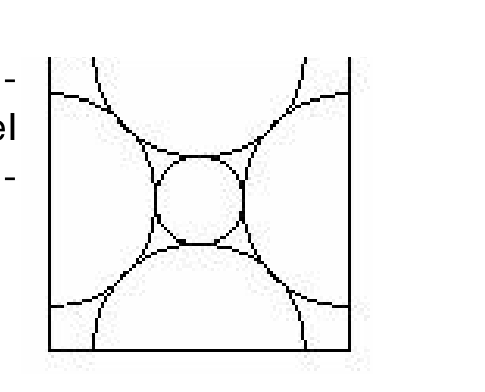
Il disegno mostra 4 semicerchi di raggio 1 cm. I centri dei semicerchi coincidono con i punti medi dei lati del quadrato. Qual è il raggio del cerchio tangente ai 4 semicerchi? A) B) ? /2-1 C) D) E)
Topic: Geometria piana Abilita: Ragionamento geometrico Area: Geometria Risposta: A Fonte: apri PDF p.4
4 semicircle tangent circle beam
The drawing shows four semicircles with a radius of 1 cm. The centers of the semicircles coincide with the midpoints of the sides of the square. What is the radius of the circle tangent to the four semicircles? A) B) ? /2-1 C) D) E)
Answer: A src_kangourou_2003_junior__Q17
Somma di tutti i numeri da cifre di 2003
Consideriamo tutti i numeri (interi positivi) di 4 cifre ottenibili utilizzando ogni volta le 4 cifre del numero 2003. Sommando tutti questi numeri che numero si ottiene? A) 5005
B) 5555
C) 16665 D) 1110 E) 15555
Topic: Combinatoria, Teoria dei Numeri Metodo: Conteggio combinatorio Abilita: Conteggio sistematico Area: Aritmetica e Teoria dei Numeri, Combinatoria, Logica e Probabilita Risposta: E Fonte: apri PDF p.4
Summary of all 2003 numerical numbers
Let’s consider all the four-digit integers we can get by using each of the four digits of the 2003 number. Putting all these numbers together, what number do you get? A) 5005 B) 5555 C) 16665 D) 1110 E) 15555
Answer: E src_kangourou_2003_junior__Q18
Somma cifre del prodotto 2003A*
Indichiamo con A il numero 11111… 1111 formato da 2003 cifre tutte uguali a 1. Qual è la somma delle cifre del prodotto di 2003 per A ? A) 10000 B) 10015 C) 10020 D) 10030 E) 20032
Topic: Teoria dei Numeri Abilita: Manipolazione algebrica Area: Aritmetica e Teoria dei Numeri Risposta: B Fonte: apri PDF p.4
Summary of product figures 2003A*
Let’s use A to indicate the number 11111… 1111 formed from 2003 figures all equal to 1. What is the sum of the 2003 product figures for A ? A) 10000 B) 10015 C) 10020 D) 10030 E) 20032
Answer: B src_kangourou_2003_junior__Q19
Lato del rombo da foglio piegato sulla diagonale
Un foglio di carta rettangolare di misura 6 cm x 12 cm è piegato lungo la sua diagonale. Le due parti non sovrapposte vengono tagliate via e poi si riapre il foglio ottenendo così un rombo. Qual è la lunghezza del lato del rombo? A) 3,5 cm B) 7, 35 cm C) 7,5 cm D) 7,85 cm E) 8,1 cm I quesiti dal N. 21 al N. 30 valgono 5 punti ciascuno
Topic: Geometria piana Abilita: Ragionamento geometrico Area: Geometria Risposta: C Fonte: apri PDF p.4
*Side of the sheet folded diagonally *
A rectangular sheet of paper measuring 6 cm x 12 cm is folded along its diagonal. The two non-overlapping parts are cut off and the sheet is then reopened to form a roll. What is the length of the side of the rim? A) 3.5 cm B) 7.35 cm C) 7.5 cm D) 7.85 cm E) 8.1 cm I Questions from N. 21 al N. 30 is worth 5 points each.
Answer: C src_kangourou_2003_junior__Q20
Rapporto aree triangoli ADE e ABC (simili)
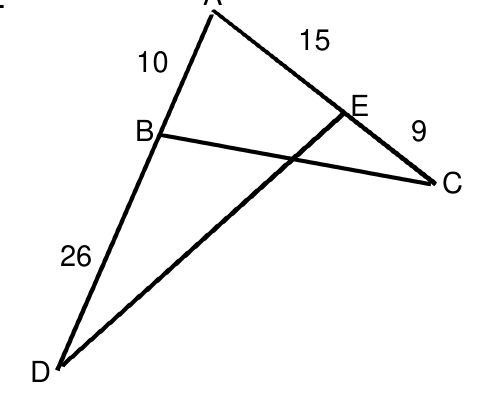
Qual è il rapporto delle aree dei triangoli ADE e ABC illustrati nella figura? A) 9/4 B) 7/3 C) 4/5 D)15/10 E) 26/9
Topic: Geometria piana Abilita: Ragionamento geometrico Area: Geometria Risposta: A Fonte: apri PDF p.4
*Report of ADE and ABC triangle areas (similar) *
What is the ratio of the areas of the ADE and ABC triangles shown in the figure? A) 9/4 B) 7/3 C) 4/5 D)15/10 E) 26/9
Answer: A src_kangourou_2003_junior__Q21
Area rettangolo OPCQ (cerchio inscritto)
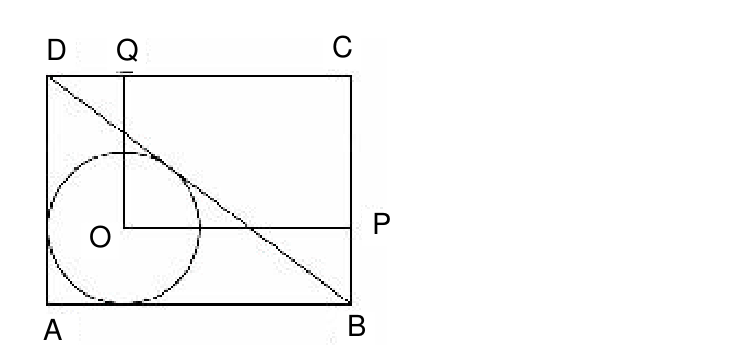
Il rettangolo ABCD ha area 36 cm2. Un cerchio con centro nel punto O è inscritto nel triangolo ABD. Qual è l’area del rettangolo OPCQ ? A) 24 cm2 B) 6 ? ?cm2 C) 18 cm2 D) 12 cm2 E) Non si può determinare, in quanto dipende dal rapporto fra le lunghezze dei lati del rettangolo. 2 1 2 ? 1 3 ? 2 5 ? 2 7 ? 5 Q C O P B 26 10 15 9
Pag. Pag. 26 26 Kang 2003 Kang 2003
Topic: Geometria piana Abilita: Ragionamento geometrico Area: Geometria Risposta: C Fonte: apri PDF p.4
*OPCQ rectangular area (inscribed circle) *
The rectangle ABCD has an area of 36 cm2. A circle with center at the point O is inscribed in the triangle ABD. What is the area of the OPCQ rectangle? A) 24 cm2 B) 6 ? (c) 18 cm2 D) 12 cm2 E) It cannot be determined because it depends on the ratio of the lengths of the sides of the rectangle. 2 1 2 ? 1 3 ? 2 5 ? 2 7 ? 5 Q C O P B 26 10 15 9
I’m going to pay. I’m going to pay. 26 26 Kang 2003 Kang
Answer: C src_kangourou_2003_junior__Q22
Quanti ragazzi dicono la verita
Ci sono 4 ragazzi i cui cognomi sono Bianchi, Neri, Rossi e Verdi. Bianchi dice: “Rossi, Neri e Verdi sono ragazze.” Rossi dice: ” Bianchi, Neri e Verdi sono ragazzi.” Neri dice: “Bianchi e Rossi mentono.” Verdi dice: “Bianchi, Rossi e Neri dicono la verità.” Quanti ragazzi hanno detto la verità? A) 0 B)1 C) 2 D) 3 E) Non si può determinare.
Topic: Logica, giochi, strategie Metodo: Analisi per casi Abilita: Casework accurato Area: Combinatoria, Logica e Probabilita Risposta: B Fonte: apri PDF p.5
How many kids are telling the truth?
There are four boys whose last names are White, Black, Red and Green. White says, “Red, Black and Green are girls”. Red says, “White, Black and Green are boys”. Black says, “White and Red are lying”. Green says, “White, Red and Black are telling the truth”. How many kids have told the truth? A) 0 B) 1 C) 2 D) 3 E) It cannot be determined.
Answer: B src_kangourou_2003_junior__Q23
Probabilita secondo numero maggiore del primo
In una scatola vengono inseriti 2003 biglietti numerati da 1 a 2003. Viene estratto a sorte un biglietto e quindi ne viene estratto un secondo, senza che il primo estratto sia stato reinserito. A questo punto vengono letti, nell’ordine, i numeri dei biglietti estratti. Allora la probabilità che il secondo dei due numeri sia superiore al primo è A) più di 1/2 B) 1/2 C) fra 1/3 e 1/2 D) 1/3 E) meno di 1/3.
Topic: Probabilita e statistica Metodo: Sfruttamento della simmetria Abilita: generalizzazione Area: Combinatoria, Logica e Probabilita Risposta: B Fonte: apri PDF p.5
Probability of second largest number of the first
In a box, 2003 tickets numbered from 1 to 2003 are placed. A ticket is drawn at random and then a second is drawn, without the first extract being reintroduced. At this point, the numbers of the extracted tickets are read in the order. So the probability that the second of the two numbers is greater than the first is A) more than 1/2 B) 1/2 C) between 1/3 and 1/2 D) 1/3 E) less than 1/3.
Answer: B src_kangourou_2003_junior__Q24
Coppie (x,y) reali che soddisfano l’equazione
Quante sono le coppie (x,y) di numeri reali che soddisfano l’equazione ( x + y )2 = ( x + 3) ( y - 3) ? A) 0 B) 1 C) 2 D) 3 E) infinite
Topic: Algebra Metodo: manipolazione algebrica Abilita: Manipolazione algebrica Area: Algebra e Analisi Risposta: B Fonte: apri PDF p.5
Real (x,y) pairs satisfying the equation
How many pairs (x,y) of real numbers satisfy the equation (x + y )2 = (x + 3) (y - 3) ? A) 0 B) 1 C) 2 D) 3 E) infinite
Answer: B src_kangourou_2003_junior__Q25
Max interi consecutivi con somma cifre non div 5
Qual è il più grande numero di interi consecutivi maggiori di 0 tali che per nessuno di essi la somma delle cifre sia divisibile per 5 ? A) 4 B) 5 C) 6 D) 7 E) 8
Topic: Teoria dei Numeri Metodo: Principio di estremalita Abilita: Casework accurato Area: Aritmetica e Teoria dei Numeri Risposta: E Fonte: apri PDF p.5
Max consecutive integers with sum of non-divisible digits 5
What is the greatest number of consecutive integers greater than 0 such that for none of them the sum of the digits is divisible by 5 ? A) 4 B) 5 C) 6 D) 7 E) 8
Answer: E src_kangourou_2003_junior__Q26
Quale conclusione sui libri puo essere falsa
Tutti i 50 libri in uno scaffale di una libreria sono di matematica o di fisica. Sappiamo che non ci sono due libri di fisica uno accanto all’altro e che ogni libro di matematica ha un altro libro di matematica accanto. Quale fra queste conclusioni può essere falsa? A) Ci sono tre libri di matematica consecutivi, cioè non intervallati da libri di fisica. B) Il numero dei libri di matematica è almeno 32. C) Il numero dei libri di fisica è al massimo 17. D) Se il numero dei libri di fisica è 17 allora uno di loro sta al primo o all’ultimo posto dello scaffale. E) Presi 9 libri situati in modo consecutivo, almeno 6 fra questi sono di matematica.
Topic: Logica, giochi, strategie, Combinatoria Metodo: Principio dei cassetti Abilita: Casework accurato Area: Combinatoria, Logica e Probabilita Risposta: A Fonte: apri PDF p.5
What conclusions about books can be false
All 50 books on a bookshelf in a library are mathematics or physics. We know that there are no two physics books next to each other, and that every math book has another math book next to it. Which of these conclusions can be false? A) There are three consecutive mathematics books, that is, not interspersed with physics books. B) The number of mathematics books is at least 32. (c) The number of physics books is not more than 17. D) If the number of physics books is 17, then one of them is in the first or last place on the shelf. E) I took nine books in a row, at least six of which are mathematical.
Answer: A src_kangourou_2003_junior__Q27
Quante somme distinte di tre elementi
a, b e c sono tre numeri distinti presi nell’insieme {1, 4, 7, 10, 13, 16, 19, 22, 25, 28}. Quante diverse somme a + b + c sono possibili? A) 19 B) 21 C) 22 D) 30 E) 63
Pag. Pag. 27 27 Kang 2003 Kang 2003
Topic: Combinatoria, Teoria dei Numeri Metodo: Conteggio combinatorio Abilita: Conteggio sistematico Area: Aritmetica e Teoria dei Numeri, Combinatoria, Logica e Probabilita Risposta: C Fonte: apri PDF p.5
*How many sums of three elements *
a, b and c are three distinct numbers taken together {1, 4, 7, 10, 13, 16, 19, 22, 25, 28}. How many different sums of a + b + c are possible? A) 19 B) 21 C) 22 D) 30 E) 63
I’m going to pay. I’m going to pay. 27 27 Kang 2003 Kang
Answer: C src_kangourou_2003_junior__Q28
Min mosse cambio colore scacchiera 2x3
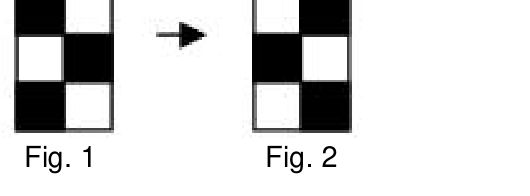
I quadrati di una scacchiera 2x3 sono colorati di bianco o di nero come nella figura 1. Determinare il minimo numero di mosse necessarie per passare dalla configurazione della figura 1 alla configurazione della figura 2 se ogni mossa rispetta le seguenti regole: 1.- si devono cambiare i colori soltanto di una e una sola coppia di caselle adiacenti (cioè due caselle aventi un lato in comune); 2.- il nero cambia in verde, il verde cambia in bianco, il bianco cambia in nero. A) 3 B) 5 C) 6 D) 8 E) 9
Topic: Combinatoria, Logica, giochi, strategie Metodo: monovarianti Abilita: Casework accurato Area: Combinatoria, Logica e Probabilita Risposta: C Fonte: apri PDF p.6
Min moves change chess colour 2x3
The squares of a 2x3 chessboard are colored white or black as in Figure 1. Determine the minimum number of moves necessary to move from the configuration of Figure 1 to the configuration of Figure 2 if each move complies with the following rules: 1.- Only one and only one pair of adjacent boxes (i.e. two boxes having one side in common) must be changed in colour; 2.- black turns green, green turns white, white turns black. A) 3 B) 5 C) 6 D) 8 E) 9
Answer: C src_kangourou_2003_junior__Q29
Quanti ‘1’ nei numeri fino a 7 cifre binarie
Scriviamo tutti i numeri interi maggiori o uguali a 0 aventi al massimo 7 cifre tutte uguali a 0 o 1. Quanti “1” abbiamo utilizzato? A) 128 B) 288 C) 448 D) 512 E) 896 Fig. 1 Fig. 2
Risposte commentate livello JUNIOR 2a e 3a superiore
Topic: Combinatoria, Teoria dei Numeri Metodo: Conteggio combinatorio Abilita: Conteggio sistematico Area: Aritmetica e Teoria dei Numeri, Combinatoria, Logica e Probabilita Risposta: C Fonte: apri PDF p.6
Quantities of ‘1’ in numbers up to 7 binary digits
Let’s write all integers greater than or equal to 0 with a maximum of 7 digits all equal to 0 or 1. How many 1 have we used? A) 128 B) 288 C) 448 D) 512 E) 896 Fig. 1 Fig. 2
Answers commented at JUNIOR level 2a and 3a above
Answer: C src_kangourou_2003_junior__Q30