Valore di (1-2)-(3-4)-…-(99-100)
Il valore dell’espressione (1 −2) −(3 −4) −(5 −6) −… −(99 −100) è A) 0 B) 49 C) − 48 D) 48 E) 50
Topic: Algebra, Teoria dei Numeri Metodo: Somme telescopiche Abilita: Manipolazione algebrica Area: Algebra e Analisi, Aritmetica e Teoria dei Numeri Risposta: D Fonte: apri PDF p.1
Value of (1-2)-(3-4)-…-(99-100)
The value of the expression (1 −2) −(3 −4) −(5 −6) −… −(99 −100) is A) 0 B) 49 C) − 48 D) 48 E) 50
Answer: D
Coriandoli di altri colori
Hai 2004 coriandoli (ognuno di un solo colore). Metà di essi sono blu, un quarto sono rossi e un sesto sono verdi. Quanti coriandoli sono di altri colori? A) 167 B) 334 C) 501 D) 1002 E) 1837
Topic: Algebra, Teoria dei Numeri Abilita: traduzione del testo Area: Algebra e Analisi, Aritmetica e Teoria dei Numeri Risposta: A Fonte: apri PDF p.1
Confetti of other colors
You have 2004 confetti (each of one color). Half of them are blue, a quarter are red and a sixth are green. How many confetti are of other colors? A) 167 B) 334 C) 501 D) 1002 E) 1837
Answer: A
Spigoli di una piramide con 7 facce
Una piramide ha 7 facce. Quanti sono i suoi spigoli? A) 7 B) 8 C) 12 D) 14 E) 21
Topic: Geometria solida Abilita: Ragionamento geometrico Area: Geometria Risposta: C Fonte: apri PDF p.1
Edges of a pyramid with 7 faces
A pyramid has 7 faces. How many edges does it have? A) 7 B) 8 C) 12 D) 14 E) 21
Answer: C
Misura angolo nel quadrilatero (BC=AD)
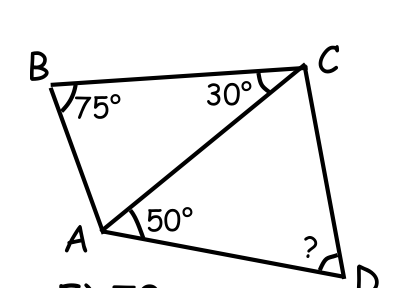
In un quadrilatero ABCD alcuni angoli sono noti (vedi figura, dove le misure sono riportate in gradi). Si sa inoltre che il lato BC è lungo quanto il lato AD. Quanti gradi misura l’angolo A C ? A) 30 B) 50 C) 55 D) 65 E) 70
Topic: Geometria piana Abilita: Ragionamento geometrico Area: Geometria Risposta: D Fonte: apri PDF p.1
Measurement of angle in the quadrilateral (BC=AD)
In an ABCD quadrilateral some angles are known (see Figure, where the measurements are given in degrees). We also know that the BC side is as long as the AD side. How many degrees does the angle AC measure? A) 30 B) 50 C) 55 D) 65 E) 70
Answer: D
Punti di Giovanni a ping-pong (sistema)
Giovanni e Stefano stanno giocando a ping-pong. In questo momento, se Giovanni avesse 5 punti in più ne avrebbe il doppio di Stefano, mentre se avesse 7 punti in meno ne avrebbe la metà di Stefano. Quanti punti ha Giovanni in questo momento? A) 5 B) 7 C) 9 D) 11 E) 15
Topic: Algebra Abilita: traduzione del testo Area: Algebra e Analisi Risposta: D Fonte: apri PDF p.1
John’s points in ping-pong (system)
Giovanni and Stefano are playing ping-pong. Right now, if Giovanni had five more points, he’d have doubled Stefano’s, while if he had seven fewer points, he’d have half Stefano’s. How many points does Giovanni have right now? A) 5 B) 7 C) 9 D) 11 E) 15
Answer: D
Noci alla piu giovane (proporzioni)
Alessia, Beatrice e Carla hanno raccolto complessivamente 770 noci e decidono di dividersele proporzionalmente alla loro età. In base a questo criterio, se ad Alessia toccassero 4 noci, a Carla ne toccherebbero 3; se a Beatrice toccassero 7 noci, ad Alessia ne toccherebbero 6. Quante noci di quelle raccolte spettano alla più giovane delle tre? A) 264 B) 256 C) 218 D) 198 E) 180 Dˆ A B C D 30° 75° 50° ?
Pag. Pag. 23 23 Kang 2004 Kang 2004
Topic: Algebra, Teoria dei Numeri Abilita: traduzione del testo Area: Algebra e Analisi, Aritmetica e Teoria dei Numeri Risposta: D Fonte: apri PDF p.2
Nuts to the youngest (proportions)
Alessia, Beatrice and Carla have collected a total of 770 nuts and decide to divide them proportionally to their age. According to this criterion, if Alessia were to get 4 nuts, Carla would get 3; if Beatrice were to get 7 nuts, Alessia would get 6. How many nuts of those collected are due to the youngest of the three? A) 264 B) 256 C) 218 D) 198 E) 180 Dˆ A B C D 30° 75° 50° ?
Pag. Pag. 23 23 Kang 2004 Kang 2004
Answer: D
In che scala e la mappa
Il pavimento di un capannone ha forma rettangolare con lati di 40 metri e 60 metri. Lo stesso pavimento è riportato su una mappa come un rettangolo il cui perimetro misura (sulla mappa) 100 centimetri. In che scala è la mappa? A) 1:50 B) 1:100 C) 1:150 D) 1:160 E) 1:200
Topic: Algebra Abilita: traduzione del testo Area: Algebra e Analisi Risposta: E Fonte: apri PDF p.2
What scale is the map
The floor of a shed is rectangular in shape with sides of 40 meters and 60 meters. The same floor is shown on a map as a rectangle whose perimeter measures (on the map) 100 centimeters. What scale is the map? A) 1:50 B) 1:100 C) 1:150 D) 1:160 E) 1:200
Answer: E
Quanti biscotti nel vassoio
In un vassoio, fra biscotti e cioccolatini, vi sono 30 dolcetti in tutto. Se dal vassoio prendiamo 12 dolcetti a caso, troviamo almeno un biscotto fra di essi; se dal vassoio prendiamo 20 dolcetti a caso, troviamo almeno un cioccolatino fra di essi. Quanti biscotti vi sono nel vassoio? A) 11 B) 12 C) 19 D) 20 E) 29
Topic: Combinatoria, Logica, giochi, strategie Metodo: Principio dei cassetti Abilita: Casework accurato Area: Combinatoria, Logica e Probabilita Risposta: C Fonte: apri PDF p.2
How many biscuits are in the tray
In one tray, among cookies and chocolates, there are 30 sweets in all. If we pick up 12 candies at random from the tray, we find at least one cookie among them; if we pick up 20 candies at random from the tray, we find at least one chocolate in them. How many cookies are in the tray? A) 11 B) 12 C) 19 D) 20 E) 29
Answer: C
Rapporto area anello nero/cerchio interno

\begin{document}
\begin{tikzpicture}
  \fill[black] (0,0) circle (3);
  \fill[white] (0,0) circle (2);
  \fill[black] (0,0) circle (1);
\end{tikzpicture}
\end{document}
La figura mostra un bersaglio con 3 campi. Lo spessore dei due anelli, nero e bianco, è lo stesso ed è uguale al raggio del cerchio nero interno. Quanto vale il rapporto fra l’area dell’anello nero e l’area del cerchio nero interno? A) 2 B) 3 C) 4 D) 5 E) 6
Topic: Geometria piana Abilita: Ragionamento geometrico Area: Geometria Risposta: D Fonte: apri PDF p.2
Black ring area/inner circle ratio
\begin{document}
\begin{tikzpicture}
  \fill[black] (0,0) circle (3);
  \fill[white] (0,0) circle (2);
  \fill[black] (0,0) circle (1);
\end{tikzpicture}
\end{document}
The figure shows a target with three fields. The thickness of the two rings, black and white, is the same and is equal to the radius of the inner black circle. What’s the ratio between the black ring area and the inner black circle area? A) 2 B) 3 C) 4 D) 5 E) 6
Answer: D
Altezza della panchina (semicerchi)
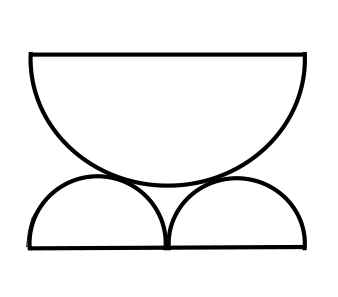
La figura mostra una sezione di una panchina costruita utilizzando, come indicato, tre mezzi tronchi semicircolari: due del diametro di 2 decimetri ciascuno a fare da base e uno del diametro di 4 decimetri a fare da sedile. Quanti decimetri è alta la panchina? A) 3 B) C) 2,85 D) E) 2,5 I quesiti dal N. 11 al N. 20 valgono 4 punti ciascuno
Topic: Geometria piana Abilita: Ragionamento geometrico Area: Geometria Risposta: B Fonte: apri PDF p.2
Height of the bench (half-circles)
The figure shows a section of a bench constructed using, as indicated, three half-circular trunks: two of a diameter of 2 decimeters each acting as the base and one of a diameter of 4 decimeters acting as the seat. How many decimeters high is the bench? A) 3 B) C) 2,85 D) E) 2,5 Questions from N. 11 to N. 20 are worth 4 points each.
Answer: B
Possibile prodotto di cinque scelte da 1,2,4
Cinque persone scelgono un numero fra questi tre: 1, 2, 4. I cinque numeri scelti vengono moltiplicati fra loro. Uno solo fra i numeri seguenti potrebbe essere il prodotto ottenuto: quale? A) 100 B) 256 C) 768 D) 2048 E) 4096
Topic: Teoria dei Numeri Abilita: Manipolazione algebrica Area: Aritmetica e Teoria dei Numeri Risposta: B Fonte: apri PDF p.3
Possible product of five choices from 1,2,4
Five people choose a number from these three: 1, 2, 4. The five numbers chosen are multiplied together. Only one of the following numbers could be the product obtained: which? A) 100 B) 256 C) 768 D) 2048 E) 4096
Answer: B
Modi di completare la griglia di carte
\begin{document}
\begin{tikzpicture}
  \draw[thick] (0,0) grid (4,4);
  \node at (0.5,3.5) {\textbf{B}};
  \node at (0.5,2.5) {\textbf{R}};
  \node at (1.5,2.5) {\textbf{B}};
  \node at (1.5,1.5) {\textbf{G}};
  \node at (1.5,0.5) {\textbf{V}};
\end{tikzpicture}
\end{document}
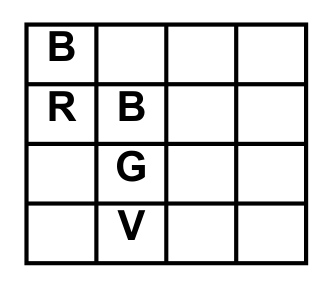
Hai 16 carte: 4 blu (B), 4 rosse (R), 4 gialle (G) e 4 verdi (V). Vuoi collocarle nella griglia quadrata riportata nella figura, una per cella, in modo che ogni riga e ogni colonna della griglia contenga una carta per ogni colore. Hai già iniziato l’opera come indicato; in quanti diversi modi puoi completarla? A) 1 B) 2 C) 4 D) 16 E) 128 B R B G V 8 10
Pag. Pag. 24 24 Kang 2004 Kang 2004
Topic: Combinatoria Metodo: Conteggio combinatorio Abilita: Conteggio sistematico Area: Combinatoria, Logica e Probabilita Risposta: C Fonte: apri PDF p.3
Mode of completing the card grid
\begin{document}
\begin{tikzpicture}
  \draw[thick] (0,0) grid (4,4);
  \node at (0.5,3.5) {\textbf{B}};
  \node at (0.5,2.5) {\textbf{R}};
  \node at (1.5,2.5) {\textbf{B}};
  \node at (1.5,1.5) {\textbf{G}};
  \node at (1.5,0.5) {\textbf{V}};
\end{tikzpicture}
\end{document}
You have 16 cards: 4 blue (B), 4 red (R), 4 yellow (G) and 4 green (V). You want to place them in the square grid shown in the figure, one per cell, so that each row and column of the grid contains a card for each color. You have already started the work as indicated; how many different ways can you complete it? A) 1 B) 2 C) 4 D) 16 E) 128 B R B G V 8 10
Answer: C
Quanti numeri 100-200 con soli fattori 2 e 3
Quanti sono i numeri compresi fra 100 e 200 che abbiano fra i loro fattori primi soltanto i numeri 2 e/o 3? A) 2 B) 3 C) 4 D) 5 E) 6
Topic: Teoria dei Numeri Metodo: Conteggio combinatorio Abilita: Casework accurato Area: Aritmetica e Teoria dei Numeri Risposta: D Fonte: apri PDF p.3
Numbers 100-200 with only factors 2 and 3
How many numbers between 100 and 200 have their prime factors only the numbers 2 and/or 3? A) 2 B) 3 C) 4 D) 5 E) 6
Answer: D
Altezza acqua nella tanica II immersa
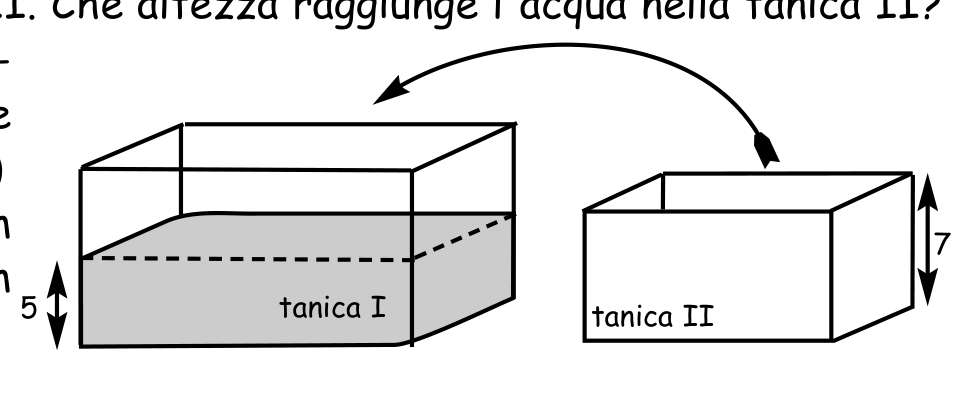
Osserva la figura. Nella tanica I, la cui base ha una superficie di 2 decimetri quadrati, l’acqua raggiunge l’altezza di 5 centimetri. La tanica II, alta 7 centimetri e la cui base ha una superficie di 1 decimetro quadrato, viene immersa, vuota, nella tanica I fino ad essere ancorata sul fondo di questa. A questo punto una parte dell’acqua si riversa nella tanica II. Che altezza raggiunge l’acqua nella tanica II? (Considera trascurabile lo spessore delle pareti delle taniche.) A) 1 cm B) 2 cm C) 3 cm D) 4 cm E) 5 cm
Topic: Geometria solida, Algebra Abilita: traduzione del testo Area: Algebra e Analisi, Geometria Risposta: C Fonte: apri PDF p.3
Water height in the submerged can II
Observe the figure. In can I, whose base has an area of 2 square decimeters, the water reaches a height of 5 centimeters. Can II, 7 centimeters tall and whose base has an area of 1 square decimeter, is immersed, empty, in can I until it is anchored to the bottom of the latter. At this point some of the water pours into can II. What height does the water reach in can II? (Consider the thickness of the walls of the cans negligible.) A) 1 cm B) 2 cm C) 3 cm D) 4 cm E) 5 cm
Answer: C
Domande senza risposta dato punteggio 87
Un test a risposta chiusa (come Kangourou) consta di 20 domande. Per ogni risposta corretta vengono assegnati 7 punti, mentre per ogni risposta sbagliata ne vengono sottratti 2. Risposte non date sono ininfluenti (0 punti di addebito). Hai sostenuto il test e hai totalizzato 87 punti. Quante sono le domande a cui non hai dato risposta? A) 2 B) 3 C) 4 D) 5 E) 6
Topic: Algebra, Teoria dei Numeri Abilita: Casework accurato Area: Algebra e Analisi, Aritmetica e Teoria dei Numeri Risposta: D Fonte: apri PDF p.3
Unanswered questions given score 87
A closed response test (such as Kangourou) consists of 20 questions. For each correct answer, 7 points are awarded, while for each wrong answer, 2 points are subtracted. Unsubmitted replies have no effect (0 points of charge). You passed the test and scored 87 points. How many questions have you not answered? A) 2 B) 3 C) 4 D) 5 E) 6
Answer: D
Rapporto distanze percorse dalle lancette
Un orologio ha un quadrante tradizionale (12 ore). La lancetta delle ore è lunga 4 centimetri, mentre quella dei minuti è lunga 8 centimetri. Qual è il rapporto fra le distanze percorse dalle punte delle due lancette tra mezzogiorno e le 15.00 di uno stesso giorno? A) 1:2 B) 1:4 C) 1:6 D) 1:12 E) 1:24
Topic: Geometria piana, Algebra Abilita: Ragionamento geometrico Area: Algebra e Analisi, Geometria Risposta: E Fonte: apri PDF p.3
Ratio of distances traveled by hands
A clock has a traditional dial (12 hours). The hour hand is 4 centimeters long, while the minute hand is 8 centimeters long. What is the ratio between the distances traveled by the tips of the two hands between noon and 3 p.m. on the same day? A) 1:2 B) 1:4 C) 1:6 D) 1:12 E) 1:24
Answer: E
Quanti giorni e durata la vacanza (pioggia)
La famiglia Kangourou è stata in vacanza a Londra per alcuni giorni. Durante la vacanza, è piovuto in 15 diversi giorni, ma :
- mattine piovose sono sempre state seguite da pomeriggi asciutti;
- pomeriggi piovosi sono sempre stati preceduti da mattine asciutte;
- le mattine asciutte sono state in tutto 12 e i pomeriggi asciutti
sono stati in tutto 13. Quanti giorni è durata la vacanza? A) 15 B) 16 C) 19 D) 20 E) 25 tanica II 7 5 tanica IPag. Pag. 25 25 Kang 2004 Kang 2004
Topic: Combinatoria, Logica, giochi, strategie Metodo: Analisi per casi Abilita: Casework accurato Area: Combinatoria, Logica e Probabilita Risposta: D Fonte: apri PDF p.4
How many days did the vacation last (rain)
The Kangourou family was on vacation in London for a few days. During the vacation, it rained on 15 different days, but:
- rainy mornings were always followed by dry afternoons;
- rainy afternoons were always preceded by dry mornings;
- the dry mornings were 12 in all and the dry afternoons were 13 in all. How many days did the vacation last? A) 15 B) 16 C) 19 D) 20 E) 25 can II 7 5 can I
Pag. Pag. 25 25 Kang 2004 Kang 2004
Answer: D
Area quadrato col dodecagono equilatero inscritto
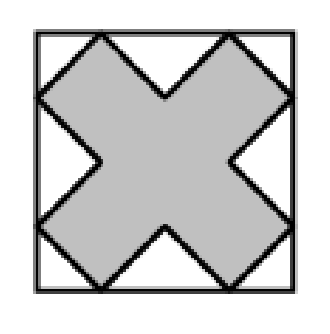
La figura mostra un quadrato in cui è “inscritto” un dodecagono equilatero (i due “bracci della croce” che formano il dodecagono sono fra loro perpendicolari). Il perimetro del dodecagono misura 36 centimetri. Quanto vale, in centimetri quadrati, l’area del quadrato? A) 48 B) 72 C) 108 D) 115,2 E) 144
Topic: Geometria piana Abilita: Ragionamento geometrico Area: Geometria Risposta: B Fonte: apri PDF p.4
Square area with the equilateral dodecagon inscribed
The figure shows a square in which an equilateral dodecagon is “inscribed” (the two “arms of the cross” that form the dodecagon are perpendicular to each other). The perimeter of the dodecagon measures 36 centimetres. What is the area of the square, in square centimetres? A) 48 B) 72 C) 108 D) 115,2 E) 144
Answer: B
Rapporto tra i raggi delle due circonferenze
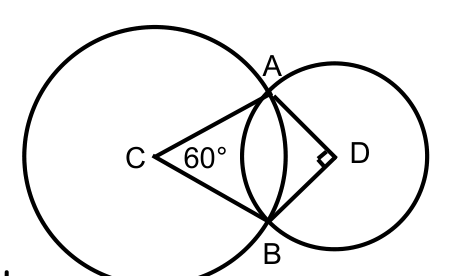
Osserva la figura. La circonferenza di centro C e quella di centro D si incontrano nei punti A e B. L’angolo A B misura 60 gradi, mentre l’angolo A B misura 90 gradi. Qual è il rapporto fra il maggiore e il minore dei due raggi delle circonferenze? A) 4:3 B) C) 3:2 D) E)2:1
Topic: Geometria piana Abilita: Ragionamento geometrico Area: Geometria Risposta: B Fonte: apri PDF p.4
Ratio between the radii of the two circumferences
Look at the figure. The circumference of centre C and centre D meet at points A and B. The angle A C B measures 60 degrees, while the angle A D B measures 90 degrees. What is the ratio between the greater and the lesser of the two radii of the circumferences? A) 4:3 B) C) 3:2 D) E)2:1
Answer: B
Quante piastrelle bianche nel mosaico diagonali
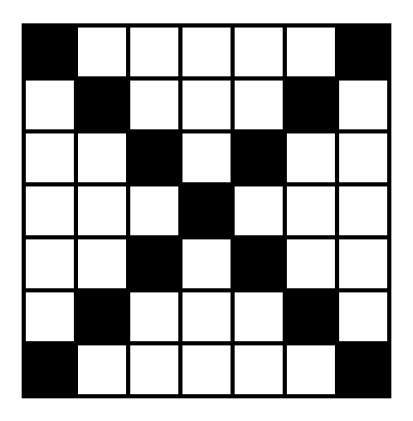
Un mosaico quadrato di lato 2003 è ottenuto accostando piastrelle bianche e piastrelle grigie di lato 1. Le piastrelle grigie sono tutte e sole quelle centrate sulle diagonali (come nella figura, dove la situazione è rappresentata per un quadrato di lato 7). Quante sono le piastrelle bianche?
A) 20022 B) 2002 x 2001 C) 20032 D) 2003 x 2004 E) 20042 I quesiti dal N. 21 al N. 30 valgono 5 punti ciascuno
Topic: Combinatoria, Teoria dei Numeri Metodo: Conteggio combinatorio Abilita: Conteggio sistematico Area: Aritmetica e Teoria dei Numeri, Combinatoria, Logica e Probabilita Risposta: A Fonte: apri PDF p.4
How many white tiles in the diagonal mosaic
A square mosaic of side 2003 is obtained by placing white tiles and gray tiles of side 1. The gray tiles are all only those centered on the diagonals (as in the figure, where the situation is represented for a square of side 7). How many white tiles are there? A) 20022 B) 2002 x 2001 C) 20032 D) 2003 x 2004 E) 20042 Questions from N. 21 to N. 30 are worth 5 points each.
Answer: A
Quante volte l’alpinista e tornato indietro
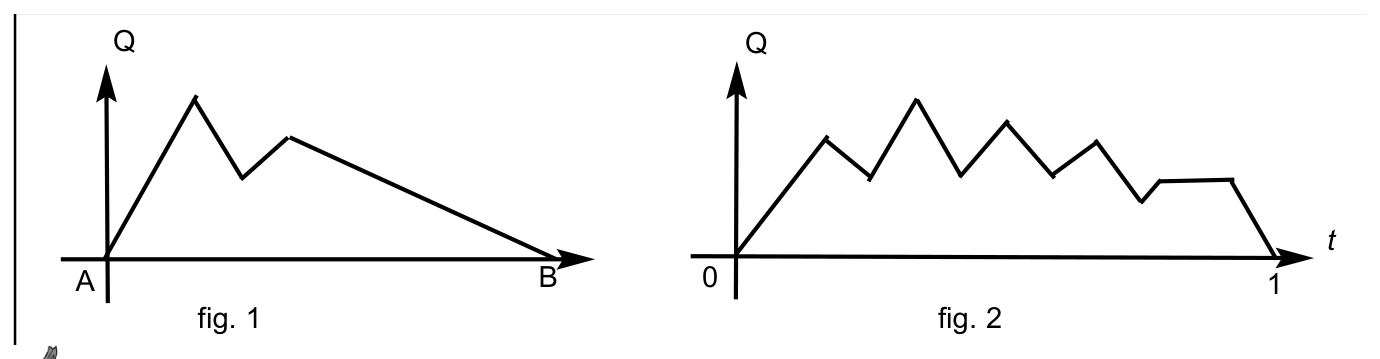
Un alpinista molto distratto attraversa una montagna seguendone fedelmente il profilo illustrato in figura 1, dunque senza mai percorrere tratti in orizzontale. L’alpinista si porta dal punto A al punto B, ma di tanto in tanto ritorna sui suoi passi per cercare effetti personali che ha perduto. Il diagramma in figura 2 vede in ascissa il tempo t e in ordinata la quota Q (espressa rispetto alla stessa unità di misu- 1 : 3 1 : 2 D A B C 60° fig. 1 fig. 2 A B Q Q t 0 1 Cˆ Dˆ
Pag. Pag. 26 26 Kang 2004 Kang 2004 ra della figura 1) e mostra, istante per istante, la quota a cui si trova l’alpinista (all’istante 0 egli parte da A mentre all’istante 1 raggiunge B). Quante volte l’alpinista è tornato indietro per cercare qualcosa? A) 1 B) 2 C) 3 D) 4 E) 5
Topic: Insiemi e funzioni, Logica, giochi, strategie Abilita: Lettura attenta del testo Area: Algebra e Analisi, Combinatoria, Logica e Probabilita Risposta: C Fonte: apri PDF p.5
How many times did the climber turn back
A very absent-minded climber crosses a mountain following faithfully the profile shown in figure 1, therefore without ever traveling horizontal stretches. The climber goes from point A to point B, but from time to time he retraces his steps to look for personal belongings that he has lost. The diagram in figure 2 has time t on the x-axis and altitude Q on the y-axis (expressed with respect to the same unit of measure 1 : 3 1 : 2 D A B C 60° fig. 1 fig. 2 A B Q Q t 0 1 Cˆ Dˆ
Pag. Pag. 26 26 Kang 2004 Kang 2004 of figure 1) and shows, moment by moment, the altitude at which the climber is (at instant 0 he leaves from A while at instant 1 he reaches B). How many times did the climber turn back to look for something? A) 1 B) 2 C) 3 D) 4 E) 5
Answer: C
Area del rombo da rettangolo piegato
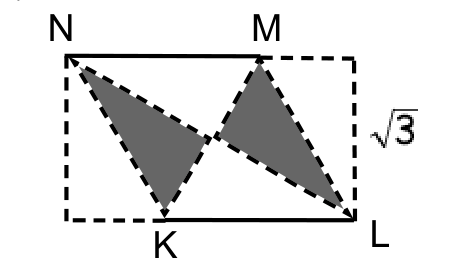
Il rombo KLMN in figura è ottenuto ripiegando due vertici opposti di un opportuno rettangolo fino a farli combaciare con il punto di mezzo della diagonale. Il più corto dei lati del rettangolo misura . Quanto misura l’area del rombo? A) 3 B) C) 2 D) 4 E)3
Topic: Geometria piana Abilita: Ragionamento geometrico Area: Geometria Risposta: C Fonte: apri PDF p.5
Area of the rhombus from a folded rectangle
The rhombus KLMN in the figure is obtained by folding two opposite vertices of a suitable rectangle until they coincide with the midpoint of the diagonal. The shorter of the sides of the rectangle measures . What is the area of the rhombus? A) 3 B) C) 2 D) 4 E)3
Answer: C
Numero al posto 120 dopo 200 passaggi (divisori)
Partiamo con 200 numeri tutti uguali a zero scritti in successione. Al primo passaggio aggiungiamo 1 ad ognuno dei duecento numeri. Al secondo passaggio aggiungiamo 1 solo ai numeri il cui posto è un multiplo di 2 (cioè a quelli di posto pari). Al terzo passaggio aggiungiamo 1 solo ai numeri il cui posto è un multiplo di 3 e procediamo secondo questa legge: all’n-esimo passaggio aggiungiamo 1 solo ai numeri il cui posto è un multiplo di n. Dopo 200 passaggi, che numero troviamo al posto 120? A) 16 B) 12 C) 8 D) 32 E) 24
Topic: Teoria dei Numeri Metodo: Conteggio combinatorio Abilita: Conteggio sistematico Area: Aritmetica e Teoria dei Numeri Risposta: A Fonte: apri PDF p.5
Number in place of 120 after 200 steps (divisors)
We start with 200 numbers all equal to zero written in succession. In the first step, we add 1 to each of the 200 numbers. In the second step we add 1 only to the numbers whose place is a multiple of 2 (i.e. those in even positions). In the third step we add 1 only to the numbers whose place is a multiple of 3 and we proceed according to this law: in the n-th step we add 1 only to the numbers whose place is a multiple of n. After 200 steps, what number do we find in place 120? A) 16 B) 12 C) 8 D) 32 E) 24
Answer: A
Rapporto diagonali/segmento PQ (simili)
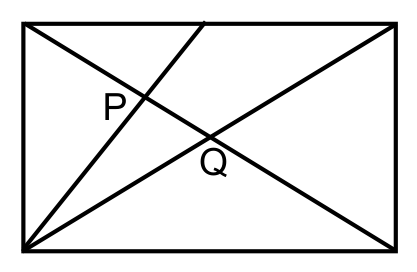
Osserva la figura. Vi è rappresentato un rettangolo in cui sono tracciate le diagonali e il segmento che unisce un vertice al punto medio di uno dei lati che non vi confluiscono. Quanto vale il rapporto fra la lunghezza delle diagonali e la lunghezza del segmento PQ? A) non è possibile rispondere perché dipende dalle misure del rettangolo B) 6 C) 13/3 D) 4 E) 3
Topic: Geometria piana Metodo: Metodo delle coordinate Abilita: Ragionamento geometrico Area: Geometria Risposta: B Fonte: apri PDF p.5
Ratio of diagonals/segment PQ (similar)
Observe the figure. It shows a rectangle in which the diagonals and the segment joining a vertex to the midpoint of one of the sides that do not meet there are drawn. What is the ratio between the length of the diagonals and the length of segment PQ? A) it is not possible to answer because it depends on the measurements of the rectangle B) 6 C) 13/3 D) 4 E) 3
Answer: B
Lunghezza AB data area regione ombreggiata
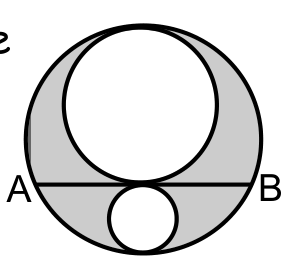
Quelli in figura sono cerchi. L’area della regione ombreggiata vale 2π. Quanto è lungo il segmento AB? A) 1 B) 2 C) 3 D) 4 E) non è possibile rispondere perché dipende dai raggi dei cerchi K L M N P Q A B
Pag. Pag. 27 27 Kang 2004 Kang 2004
Topic: Geometria piana Abilita: Ragionamento geometrico Area: Geometria Risposta: D Fonte: apri PDF p.5
Length AB given the area of the shaded region
Those in the figure are circles. The area of the shaded region is 2π. How long is the segment AB? A) 1 B) 2 C) 3 D) 4 E) it is not possible to answer because it depends on the radii of the circles K L M N P Q A B
Pag. Pag. 27 27 Kang 2004 Kang 2004
Answer: D
Lunghezza passatoia arrotolata (cilindro)
Una passatoia rettangolare è realizzata con un tappeto dello spessore di 1 centimetro che, arrotolato su se stesso per tutta la sua lunghezza, fornisce un cilindro la cui base è (approssimativamente) un cerchio di diametro 1 metro. Quale dei seguenti numeri si avvicina di più alla lunghezza della passatoia espressa in metri? A) 20 B) 50 C) 75 D) 150 E) 300
Topic: Geometria piana, Algebra Abilita: Stima e approssimazione Area: Algebra e Analisi, Geometria Risposta: C Fonte: apri PDF p.6
Length of rolled-up runner (cylinder)
A rectangular runner is made with a 1 cm thick carpet that, rolled over itself for its entire length, provides a cylinder whose base is (approximately) a circle of 1 meter in diameter. Which of the following numbers is closest to the length of the runner in meters? A) 20 B) 50 C) 75 D) 150 E) 300
Answer: C
Traiettoria del punto P (cerchio che rotola)
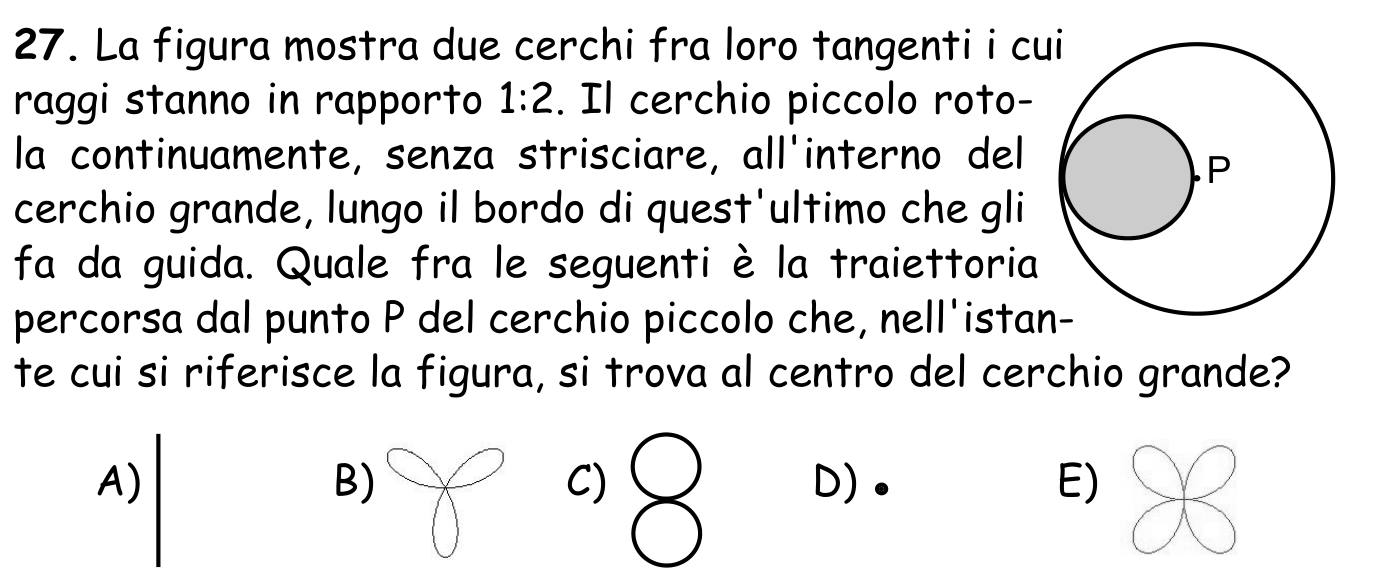
La figura mostra due cerchi fra loro tangenti i cui raggi stanno in rapporto 1:2. Il cerchio piccolo rotola continuamente, senza strisciare, all’interno del cerchio grande, lungo il bordo di quest’ultimo che gli fa da guida. Quale fra le seguenti è la traiettoria percorsa dal punto P del cerchio piccolo che, nell’istante cui si riferisce la figura, si trova al centro del cerchio grande? A) B) C) D) E)
Topic: Geometria piana Abilita: Ragionamento geometrico Area: Geometria Risposta: A Fonte: apri PDF p.6
Trajectory of the P-point (rolling circle)
The figure shows two circles mutually tangent whose radii are in the ratio 1:2. The small circle continuously rolls, without slipping, within the large circle, along the edge of the latter which guides it. Which of the following is the trajectory of point P of the small circle which, at the moment the figure refers to, is at the center of the large circle? A) B) C) D) E)
Answer: A
Quanti n di tre cifre con prodotto div 7
Quanti numeri interi n di esattamente tre cifre (in rappresentazione decimale), non superiori a 200, sono tali che il prodotto
(n + 1)(n + 2)(n + 3) sia divisibile per 7? A) 43 B) 31 C) 34 D) 24 E) 39
Topic: Teoria dei Numeri, Combinatoria Metodo: congruenze Abilita: Casework accurato Area: Aritmetica e Teoria dei Numeri, Combinatoria, Logica e Probabilita Risposta: A Fonte: apri PDF p.6
How many three-digit n with product div 7
How many integers n of exactly three digits (in decimal form), not more than 200, are such that the product (n + 1)(n + 2)(n + 3) is divisible by 7? A) 43 B) 31 C) 34 D) 24 E) 39
Answer: A
Numero al 2004-simo posto (div 5 o 11)
Alla lavagna sono stati scritti, in ordine crescente, tutti i numeri interi da 1 a 10000. Sono poi stati cancellati tutti e soli quei numeri che non sono divisibili né per 5 né per 11, ottenendo una nuova successione. Quale fra i numeri rimasti si viene a trovare al 2004-simo posto di questa nuova successione? A) 1000 B) 5000 C) 10000 D) 6545 E) 7348
Topic: Teoria dei Numeri Metodo: Inclusione-esclusione Abilita: Riconoscimento di pattern Area: Aritmetica e Teoria dei Numeri Risposta: E Fonte: apri PDF p.6
Number in the 2004th position (divisible by 5 or 11)
On the blackboard, all the integers from 1 to 10000 were written in increasing order. Then all and only those numbers that are divisible neither by 5 nor by 11 were erased, obtaining a new sequence. Which among the remaining numbers comes to be in the 2004th position of this new sequence? A) 1000 B) 5000 C) 10000 D) 6545 E) 7348
Answer: E
Numeri di 10 cifre con somme posti pari/dispari uguali
Determina quanti sono i numeri di dieci cifre che soddisfano i seguenti requisiti: la prima cifra è 1, tutte le rimanenti nove cifre sono 0 oppure 1, la somma delle cifre di posto dispari è uguale alla somma delle cifre di posto pari. A) 29 B) 126 C) 81 D) 32 E) 64 P
SOLUZIONI JUNIOR 2004
Topic: Combinatoria, Teoria dei Numeri Metodo: Conteggio combinatorio Abilita: Conteggio sistematico Area: Aritmetica e Teoria dei Numeri, Combinatoria, Logica e Probabilita Risposta: B Fonte: apri PDF p.6
10-digit numbers with equal sums in even/odd positions
Determine how many ten-digit numbers satisfy the following requirements: the first digit is 1, all the remaining nine digits are 0 or 1, the sum of the digits in odd positions is equal to the sum of the digits in even positions. A) 29 B) 126 C) 81 D) 32 E) 64 P
JUNIOR 2004 SOLUTIONS
Answer: B