Costo medio di m+n penne acquistate incrociate
Se si acquistano m penne al costo di n euro ciascuna e n penne al costo di m euro ciascuna, allora il costo medio in euro di ogni penna è: A) 1 B) (m + n) /2 C) 2mn /(m +n)
D) mn E) m2 n 2 /2
Topic: Algebra Abilita: Manipolazione algebrica Area: Algebra e Analisi Risposta: C Fonte: apri PDF p.1
Mean cost of m+n cross-purchased pens
If m pencils are purchased at a cost of n euro each and n pencils at a cost of m euro each, then the average cost in euro of each pen is:
Answer: C
Spigoli di una piramide con 17 facce
Una piramide ha 17 facce. Quanti sono i suoi spigoli? A) 16 B) 17 C) 18 D) 32 E) 34
Topic: Geometria solida Abilita: Ragionamento geometrico Area: Geometria Risposta: D Fonte: apri PDF p.1
Edges of a pyramid with 17 faces
A pyramid has 17 faces. How many edges does it have? A) 16 B) 17 C) 18 D) 32 E) 34
Answer: D
Minimo x reale con x^2-2004<0
Il più piccolo numero reale x che verifica la disuguaglianza x2 −2004 < 0 è: A) −2004
B) 2004 C) 0 D) E) −
Topic: Algebra Abilita: Manipolazione algebrica Area: Algebra e Analisi Risposta: E Fonte: apri PDF p.1
Minimum real x with x^2-2004< 0
The smallest real number x that results in inequality x2 −2004 < 0 is: A) −2004 B) 2004 C) 0 D) −√2004 E) √2004
Answer: E
Vertici poligono con somma angoli un settimo di 16-gono
Quanti sono i vertici di un poligono regolare la somma dei cui angoli interni è uguale a un settimo della somma degli angoli interni di un 16-gono regolare? A) 3 B) 4 C) 6
D) 7 E) 10
Topic: Geometria piana Abilita: Ragionamento geometrico Area: Geometria Risposta: B Fonte: apri PDF p.1
Vertices of a polygon with sum of angles one seventh of 16-gon
How many vertices does a regular polygon have if the sum of its interior angles is equal to one seventh of the sum of the interior angles of a regular 16-gon? A) 3 B) 4 C) 6 D) 7 E) 10
Answer: B
Area regione non dipinta in quadrato lato s
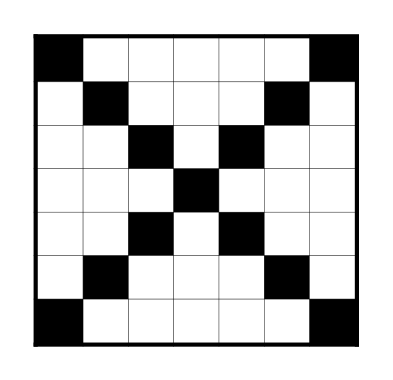
s è un intero positivo dispari. In un quadrato di lato s i quadratini di lato 1 centrati sulle diagonali sono stati dipinti di nero (vedi l’esempio in figura, dove s = 7). Qual è l’area della regione non dipinta? A)s2 + 1 − 2s
B)s2 + 4 − 4s C) 2s2 + 1− 4s D) s2 −1 −2s
E) s2 − 2s
Topic: Geometria piana, Combinatoria Metodo: Conteggio combinatorio Abilita: Conteggio sistematico Area: Combinatoria, Logica e Probabilita, Geometria Risposta: A Fonte: apri PDF p.1
Region area not squared side s
s is an odd positive integer. In a s-side square the unit squares centered on the diagonals were painted in black (see the example in figure, where s = 7). What is the area of the unpainted region? A)s2 + 1 − 2s B)s2 + 4 − 4s C) 2s2 + 1− 4s D) s2 −1 −2s E) s2 − 2s
Answer: A
Numero di celebrita in un gruppo di 100 persone
Per definizione, in un gruppo di persone una “celebrità ” è una persona del gruppo che è conosciuta da ogni altra persona del gruppo, ma che non conosce alcuna altra persona del gruppo. Consideriamo un gruppo di 100 persone: al suo interno il numero delle celebrità
A) è necessariamente 0 B) è necessariamente 1 C) è necessariamente 0 o 1 D) è necessariamente 0 o 100 E) è necessariamente 1 o 2 2004 2004Pag. Pag. 29 29 Kang 2004 Kang 2004 tudent
Topic: Logica, giochi, strategie, Combinatoria Metodo: Teoria dei grafi Abilita: generalizzazione Area: Combinatoria, Logica e Probabilita Risposta: C Fonte: apri PDF p.1
Number of celebrities in a group of 100 people
By definition, in a group of people a “celebrity” is a person in the group who is known by every other person in the group, but who does not know any other person in the group. Consider a group of 100 people: within it the number of celebrities A) is necessarily 0 B) is necessarily 1 C) is necessarily 0 or 1 D) is necessarily 0 or 100 E) is necessarily 1 or 2 2004 2004
Pag. Pag. 29 29 Kang 2004 Kang 2004 tudent
Answer: C
Area quadrilatero da due triangoli equilateri
\begin{document}
\begin{tikzpicture}
  \coordinate (B) at (0,0);
  \coordinate (C) at (2,0);
  \coordinate (A) at (1,1.732);
  \coordinate (D) at (3,0);
  \coordinate (E) at (2.5,0.866);
  \draw (A) -- (B) -- (C) -- (A);
  \draw (E) -- (C) -- (D) -- (E);
  \node[above] at (A) {A};
  \node[below left] at (B) {B};
  \node[below] at (C) {C};
  \node[right] at (E) {E};
  \node[below right] at (D) {D};
\end{tikzpicture}
\end{document}
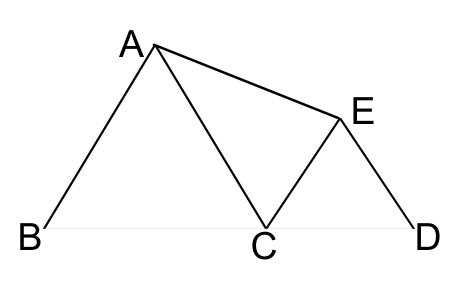
I due triangoli equilateri ABC e ECD nella figura hanno lati di lunghezza 2 e 1 rispettivamente. L’area del quadrilatero ABCE è: A) B) C) 3
D) E)
Topic: Geometria piana Abilita: Ragionamento geometrico Area: Geometria Risposta: E Fonte: apri PDF p.2
Quadrilateral area by two equilateral triangles
\begin{document}
\begin{tikzpicture}
  \coordinate (B) at (0,0);
  \coordinate (C) at (2,0);
  \coordinate (A) at (1,1.732);
  \coordinate (D) at (3,0);
  \coordinate (E) at (2.5,0.866);
  \draw (A) -- (B) -- (C) -- (A);
  \draw (E) -- (C) -- (D) -- (E);
  \node[above] at (A) {A};
  \node[below left] at (B) {B};
  \node[below] at (C) {C};
  \node[right] at (E) {E};
  \node[below right] at (D) {D};
\end{tikzpicture}
\end{document}
The two equilateral triangles ABC and ECD in the figure have sides of length 2 and 1 respectively. The area of the ABCE quadrilateral is: A) B) C) 3 D) E)
Answer: E
Prodotto possibile di cinque numeri scelti tra 1,2,4
Cinque persone scelgono un numero fra questi tre: 1, 2, 4. I cinque numeri scelti vengono moltiplicati fra loro. Uno solo fra i numeri seguenti potrebbe essere il prodotto ottenuto: quale? A) 100 B) 256 C) 768 D) 2048 E) 4096
Topic: Teoria dei Numeri Abilita: Riconoscimento di pattern Area: Aritmetica e Teoria dei Numeri Risposta: B Fonte: apri PDF p.2
Possible product of five numbers chosen from 1,2,4
Five people choose a number from these three: 1, 2, 4. The five numbers chosen are multiplied together. Only one of the following numbers could be the product obtained: which? A) 100 B) 256 C) 768 D) 2048 E) 4096
Answer: B
Gambe iniziali di pecore e pastori
In un pascolo vi erano 15 pecore e alcuni pastori. Dopo che metà dei pastori e un terzo delle pecore si sono allontanati dal pascolo, vi è un totale di 50 gambe. Quante erano inizialmente le gambe? A) 60 B) 72 C) 80 D) 90 E) 100
Topic: Algebra Abilita: traduzione del testo Area: Algebra e Analisi Risposta: C Fonte: apri PDF p.2
Initial legs of sheep and shepherds
In one pasture there were 15 sheep and some shepherds. After half the shepherds and a third of the sheep have moved away from the pasture, there are a total of 50 legs. How many legs were there initially? A) 60 B) 72 C) 80 D) 90 E) 100
Answer: C
Angolo CAB con raggio uguale al lato CB
Un triangolo ABC è inscritto in una circonferenza il cui centro cade all’interno del triangolo e il cui raggio è lungo quanto il lato CB. Quanto misura in gradi l’angolo CÂB? A) 22,5° B) 30° C) 45° D) 60° E) 90° I quesiti dal N. 11 al N. 20 valgono 4 punti
Topic: Geometria piana Abilita: Ragionamento geometrico Area: Geometria Risposta: B Fonte: apri PDF p.2
CAB angle with radius equal to the CB side
An ABC triangle is inscribed in a circumference whose center falls within the triangle and whose radius is as long as the CB side. What is the degree of the angle of CAB? (a) 22,5° B) 30° C) 45° D) 60° E) 90° Questions from N. 11 al N. Twenty is worth four points.
Answer: B
Quadrati con vertice in (-1,-1) e asse di simmetria
Considera il piano cartesiano. Quanti sono i quadrati aventi un vertice in (-1,-1) e tali che almeno uno degli assi coordinati sia asse di simmetria del quadrato stesso? A) 2 B) 3 C) 4 D) 5 E) 6
Topic: Geometria analitica, Combinatoria Metodo: Metodo delle coordinate, Sfruttamento della simmetria Abilita: Conteggio sistematico Area: Combinatoria, Logica e Probabilita, Geometria Risposta: D Fonte: apri PDF p.2
Squares with a vertex in (-1,-1) and axes of symmetry
Consider the Cartesian plane. How many squares have a vertex in (-1,-1) such that at least one of the coordinate axes is the axis of symmetry of the square itself? A) 2 B) 3 C) 4 D) 5 E) 6
Answer: D
Minimo carte da estrarre per prodotto divisibile per 4
In una scatola non trasparente vi sono 100 carte, numerate da 1 a 100. Qual è il numero minimo di carte che dobbiamo estrarre al buio dalla scatola, per essere sicuri che il prodotto dei numeri che appaiono sulle carte estratte sia divisibile per quattro? A) 51 B) 52 C) 53 D) 54 E) 55
Topic: Teoria dei Numeri, Combinatoria Metodo: Principio dei cassetti, congruenze Abilita: Casework accurato Area: Aritmetica e Teoria dei Numeri, Combinatoria, Logica e Probabilita Risposta: B Fonte: apri PDF p.2
Minimum cards to be extracted per product divisible by 4*
In a non-transparent box, there are 100 cards, numbered 1 to 100. What is the minimum number of cards we need to extract from the box in the dark, to make sure that the product of the numbers that appear on the extracted cards is divisible by four? A) 51 B) 52 C) 53 D) 54 E) 55
Answer: B
Percentuale marziani con tentacoli sopra la media
Ogni marziano ha uno, due o tre tentacoli sulla propria testa. Esattamente l’1% della popolazione marziana consiste di individui con tre tentacoli, mentre il 97% consiste di individui con due tentacoli e il rimanen- 4 3 7 4 3 5 4 + 2 3 3 4 3 6 + A E D B C
Pag. Pag. 30 30 Kang 2004 Kang 2004 tudent te 2% ha un solo tentacolo. Quale percentuale di marziani ha più tentacoli sulla propria testa della media della totalità della popolazione marziana? A) 1% B) 3% C) 97% D) 98% E) 99%
Topic: Teoria dei Numeri, Probabilita e statistica Abilita: Stima e approssimazione Area: Aritmetica e Teoria dei Numeri, Combinatoria, Logica e Probabilita Risposta: D Fonte: apri PDF p.3
Percentage of Martians with above-average tentacles
Every Martian has one, two or three tentacles on their head. Exactly 1% of the Martian population consists of individuals with three tentacles, while 97% consists of individuals with two tentacles and the remain- 4 3 7 4 3 5 4 + 2 3 3 4 3 6 + A E D B C
Pag. Pag. 30 30 Kang 2004 Kang 2004 tudent te 2% has only one tentacle. What percentage of Martians has more tentacles on their head than the average of the entire Martian population? A) 1% B) 3% C) 97% D) 98% E) 99%
Answer: D
Numeri di due cifre con quadrato e cubo stessa cifra finale
Quanti sono i numeri di due cifre i cui quadrati e i cui cubi terminano con la stessa cifra? A) 1 B) 9 C) 18 D) 27 E) più di trenta
Topic: Teoria dei Numeri Metodo: congruenze Abilita: Riconoscimento di pattern Area: Aritmetica e Teoria dei Numeri Risposta: E Fonte: apri PDF p.3
Two-digit numbers with the same final digit for square and cube
How many two-digit numbers have squares and cubes ending in the same number? A) 1 B) 9 C) 18 D) 27 E) more than thirty
Answer: E
Conteggio interi positivi in base 3 bilanciata
Quanti sono i numeri interi positivi che possono essere scritti nella forma a0 + 3 a1 + 32 a2 + 33 a3 + 34 a4 con a0 , a1 , a2 , a3 , a4 appartenenti all’insieme {-1, 0, 1}? A) 5 B) 80 C) 81 D) 121 E) 243
Topic: Teoria dei Numeri, Combinatoria Metodo: Conteggio combinatorio Abilita: Conteggio sistematico Area: Aritmetica e Teoria dei Numeri, Combinatoria, Logica e Probabilita Risposta: D Fonte: apri PDF p.3
Counting positive integers in balanced base 3
How many positive integers can be written in the form a0 + 3 a1 + 32 a2 + 33 a3 + 34 a4 with a0 , a1 , a2 , a3 , a4 belonging to the set {-1, 0, 1}? A) 5 B) 80 C) 81 D) 121 E) 243
Answer: D
Natura di una espressione numerica con radicali
Il numero è A) negativo B) uguale a zero C) la quarta potenza di un intero non nullo D) uguale a 11
E) un intero positivo divisibile per 5
Topic: Algebra Metodo: manipolazione algebrica Abilita: Manipolazione algebrica Area: Algebra e Analisi Risposta: C Fonte: apri PDF p.3
Nature of a numerical expression with radicals
The number is A) negative B) equal to zero C) the fourth power of a non-zero integer D) equal to 11 E) a positive integer divisible by 5
Answer: C
Triangoli rettangoli da vertici di un 14-gono
Quanti sono i triangoli rettangoli i cui vertici sono tre tra i 14 vertici di un 14-gono regolare? A) 72 B) 82 C) 84 D) 88 E) altra risposta
Topic: Geometria piana, Combinatoria Metodo: Conteggio combinatorio Abilita: Conteggio sistematico Area: Combinatoria, Logica e Probabilita, Geometria Risposta: C Fonte: apri PDF p.3
Right triangles with vertices of a 14-gon
How many right triangles have three of the 14 vertices of a regular 14-gon? A) 72 B) 82 C) 84 D) 88 E) other answer
Answer: C
Raggio circonferenza inscritta in quarto di cerchio
\begin{document}
\begin{tikzpicture}[scale=0.8]
  \draw (6,0) arc (0:90:6);
  \draw (0,0) -- (6,0);
  \draw (0,0) -- (0,6);
  \draw (2.485,2.485) circle (2.485);
  \node at (2.485,2.485) {K};
  \draw (0.3,0) -- (0.3,0.3) -- (0,0.3);
\end{tikzpicture}
\end{document}
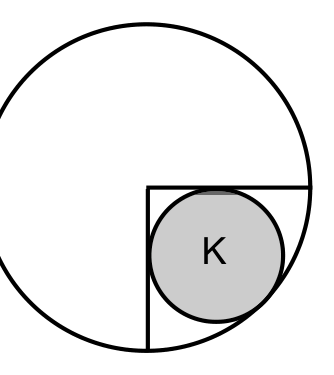
Una circonferenza K è inscritta nel settore circolare che è un quarto di un cerchio di raggio 6, come mostrato in figura. Qual è il raggio di K? A)
B) C) 2,5 D) 3 E)
Topic: Geometria piana Metodo: Metodo delle coordinate Abilita: Ragionamento geometrico Area: Geometria Risposta: E Fonte: apri PDF p.3
Radius of circle inscribed in a quarter circle
\begin{document}
\begin{tikzpicture}[scale=0.8]
  \draw (6,0) arc (0:90:6);
  \draw (0,0) -- (6,0);
  \draw (0,0) -- (0,6);
  \draw (2.485,2.485) circle (2.485);
  \node at (2.485,2.485) {K};
  \draw (0.3,0) -- (0.3,0.3) -- (0,0.3);
\end{tikzpicture}
\end{document}
A circle K is inscribed in the circular sector which is a quarter of a circle of radius 6, as shown in Figure 1. What’s the radius of K? A) B) C) 2,5 D) 3 E)
Answer: E
Segno prodotto in successione geometrica a3<a2<a4
In una successione geometrica a 1, a 2, a 3, … si hanno le seguenti disuguaglianze: a 3 < a 2 < a 4 . Allora sicuramente A) a 3 Aa 4 > 0 B)a 2 Aa 3 < 0
C) a 2 Aa 4 < 0 D)a 2 < 0
E) a 2 Aa 3 > 0
Topic: successioni, Algebra Metodo: Analisi per casi Abilita: Manipolazione algebrica Area: Algebra e Analisi Risposta: B Fonte: apri PDF p.3
Sign of the product in a geometric sequence a3<a2<a4
In a geometric sequence a 1, a 2, a 3, … the following inequalities hold: a 3 < a 2 < a 4 . Then certainly A) a 3 Aa 4 > 0 B)a 2 Aa 3 < 0
C) a 2 Aa 4 < 0 D)a 2 < 0
E) a 2 Aa 3 > 0
Answer: B
Penultima cifra di 11^2004
Qual è la penultima cifra di 112004? A) 0
B) 1 C) 2 D) 3 E) 4 ( ) 22 12 22 2 12 22 − − + 2 2 6 − 2 2 3 ( ) 1 2 6 − K
Pag. Pag. 31 31 Kang 2004 Kang 2004 tudent I quesiti dal N. 21 al N. 30 valgono 5 punti
Topic: Teoria dei Numeri Metodo: congruenze Abilita: Riconoscimento di pattern Area: Aritmetica e Teoria dei Numeri Risposta: E Fonte: apri PDF p.3
Second-to-last digit of 11^2004
What is the second-to-last digit of 112004? A) 0
B) 1 C) 2 D) 3 E) 4 ( ) 22 12 22 2 12 22 − − + 2 2 6 − 2 2 3 ( ) 1 2 6 − K
Pag. Pag. 31 31 Kang 2004 Kang 2004 tudent Questions from No. 21 to No. 30 are worth 5 points
Answer: E
Percentuale Partito dei Broccoli
In Ortolandia vi sono le elezioni. Ogni elettore del Partito dei Broccoli ha già mangiato broccoli, mentre il 90% degli elettori degli altri partiti non ha mai mangiato broccoli. Quale percentuale ha ottenuto il Partito dei Broccoli, se esattamente il 46% dei votanti ha già mangiato broccoli? A) 40% B) 41% C) 43% D) 45% E) 46%
Topic: Algebra Abilita: traduzione del testo Area: Algebra e Analisi Risposta: A Fonte: apri PDF p.4
% of broccoli *
There’s an election in Ortholand. Every voter in the Broccoli Party has already eaten broccoli, while 90% of voters in the other parties have never eaten broccoli. What percentage did the Broccoli Party get, if exactly 46% of voters have already eaten broccoli? A) 40% B) 41% C) 43% D) 45% E) 46%
Answer: A
Aree dei quattro triangoli in un parallelogramma
\begin{document}
\begin{tikzpicture}[scale=1.0]
  \coordinate (A) at (0,0);
  \coordinate (B) at (4,0);
  \coordinate (C) at (5,2);
  \coordinate (D) at (1,2);
  \coordinate (P) at (2.8,0.8);
  \draw (A) -- (B) -- (C) -- (D) -- cycle;
  \draw (A) -- (P) -- (B);
  \draw (C) -- (P) -- (D);
  \node at (1.5,0.5) {$a$};
  \node at (3.2,0.3) {$b$};
  \node at (3.5,1.2) {$c$};
  \node at (2.0,1.5) {$d$};
\end{tikzpicture}
\end{document}
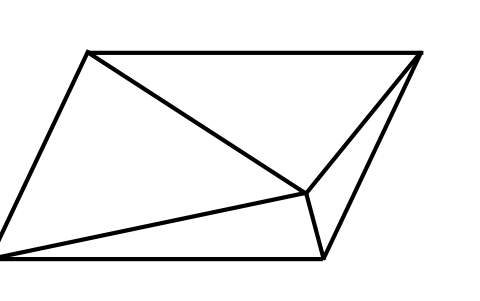
Un parallelogramma è suddiviso in 4 triangoli, seguendo un criterio analogo a quello mostrato in figura. Allora : A) le aree dei quattro triangoli, in m2 , possono essere 4, 5, 8, 9
B) le aree dei quattro triangoli, in m2 , possono essere 5, 6, 7, 12
C) le aree dei quattro triangoli, in m2 , possono essere 10, 11, 12, 19
D) le aree dei quattro triangoli, in m2 , possono essere: 11, 13, 15, 16 E) nessuna delle precedenti affermazioni è corretta
Topic: Geometria piana Metodo: Analisi per casi Abilita: Ragionamento geometrico Area: Geometria Risposta: A Fonte: apri PDF p.4
Areas of the four triangles in a parallelogram
\begin{document}
\begin{tikzpicture}[scale=1.0]
  \coordinate (A) at (0,0);
  \coordinate (B) at (4,0);
  \coordinate (C) at (5,2);
  \coordinate (D) at (1,2);
  \coordinate (P) at (2.8,0.8);
  \draw (A) -- (B) -- (C) -- (D) -- cycle;
  \draw (A) -- (P) -- (B);
  \draw (C) -- (P) -- (D);
  \node at (1.5,0.5) {$a$};
  \node at (3.2,0.3) {$b$};
  \node at (3.5,1.2) {$c$};
  \node at (2.0,1.5) {$d$};
\end{tikzpicture}
\end{document}
A parallelogram is divided into 4 triangles, following a criterion similar to that shown in the figure. So: A) the areas of the four triangles, in m2 , can be 4, 5, 8, 9 B) the areas of the four triangles, in m2 , can be 5, 6, 7, 12 C) the areas of the four triangles, in m2 , can be 10, 11, 12, 19 D) the areas of the four triangles, in m2 , can be: 11, 13, 15, 16 E) None of the previous statements are correct
Answer: A
Relazione tra grafici delle funzioni f e g
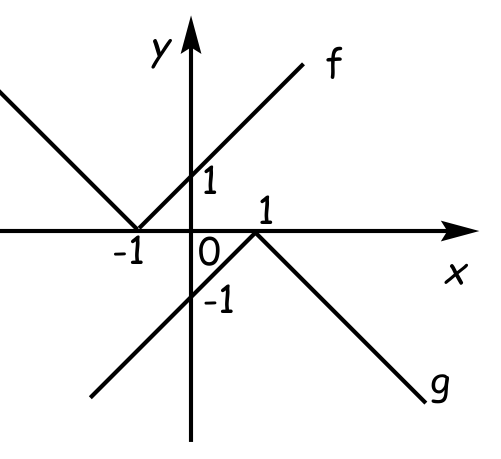
La figura mostra i grafici di due funzioni f e g, definite sui numeri reali. Quale delle seguenti uguaglianze è soddisfatta, per ogni numero reale x ? A) f(x) = −g(x) +2 B) f(x) = −g(x) −2 C) f(x) = −g(x+2) D) f(x+2) = −g(x) E) f(x+1) = −g(x−1)
Topic: Insiemi e funzioni Metodo: Sfruttamento della simmetria Abilita: Ragionamento geometrico Area: Algebra e Analisi Risposta: C Fonte: apri PDF p.4
Relation between graphs of functions f and g
The figure shows the graphs of two functions f and g, defined on real numbers. Which of the following equations is satisfied for every real number x? A) f(x) = −g(x) +2 B) f(x) = −g(x) −2 C) f(x) = −g(x+2) D) f(x+2) = −g(x) E) f(x+1) = −g(x−1)
Answer: C
Raggio arco che bisseca un triangolo equilatero
Un triangolo equilatero ha lato 4. Il raggio dell’arco di circonferenza, centrata in uno qualunque dei vertici, che suddivide il triangolo in due parti aventi la stessa area, è: A) B) C) D) E)
f 1 -1 1 -1 g 0 x y π 3 12 π 3 24 π 3 30 π 3 6 π 3 48Pag. Pag. 32 32 Kang 2004 Kang 2004 tudent
Topic: Geometria piana Abilita: Ragionamento geometrico Area: Geometria Risposta: A Fonte: apri PDF p.4
Arc radius that bisects an equilateral triangle
An equilateral triangle has side 4. The radius of the arc of a circle, centered at any one of the vertices, that divides the triangle into two parts having the same area, is: A) B) C) D) E)
f 1 -1 1 -1 g 0 x y π 3 12 π 3 24 π 3 30 π 3 6 π 3 48Pag. Pag. 32 32 Kang 2004 Kang 2004 tudent
Answer: A
Numero al posto 120 dopo 200 passaggi (divisori)
Partiamo con 200 numeri tutti uguali a zero scritti in successione. Al primo passaggio aggiungiamo 1 ad ognuno dei duecento numeri. Al secondo passaggio aggiungiamo 1 solo ai numeri il cui posto è un multiplo di 2 (cioè a quelli di posto pari). Al terzo passaggio aggiungiamo 1 solo ai numeri il cui posto è un multiplo di 3 e procediamo secondo questa legge: all’n-esimo passaggio aggiungiamo 1 solo ai numeri il cui posto è un multiplo di n. Dopo 200 passaggi, che numero troviamo al posto 120? A) 16 B) 12 C) 20 D)24 E) 32
Topic: Teoria dei Numeri Metodo: Conteggio combinatorio Abilita: Conteggio sistematico Area: Aritmetica e Teoria dei Numeri Risposta: A Fonte: apri PDF p.5
Number in place of 120 after 200 steps (divisors)
We start with 200 numbers all equal to zero written in succession. In the first step, we add 1 to each of the 200 numbers. In the second step we add 1 only to the numbers whose place is a multiple of 2 (i.e. those of even place). In the third step we add 1 only to the numbers whose place is a multiple of 3 and we proceed according to this law: in the n-th step we add 1 only to the numbers whose place is a multiple of n. After 200 steps, what number do we find in place 120? A) 16 B) 12 C) 20 D)24 E) 32
Answer: A
Triangoli non degeneri da 18 punti
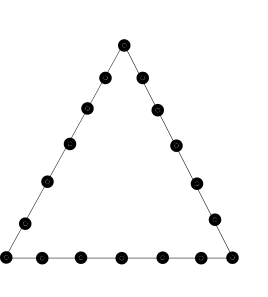
Quanti sono i triangoli (non degeneri) i cui vertici sono 3 tra i 18 punti mostrati in figura? A) 816 B) 711 C) 777 D) 717 E) 811
Topic: Combinatoria Metodo: Inclusione-esclusione Abilita: Conteggio sistematico Area: Combinatoria, Logica e Probabilita Risposta: B Fonte: apri PDF p.5
Non-degenerate triangles from 18 points
How many triangles (non-degenerate) have their vertices 3 of the 18 points shown in the figure? A) 816 B) 711 C) 777 D) 717 E) 811
Answer: B
Cifra c da somma 1554 delle permutazioni
a, b, c sono tre cifre tali che 0 < a < b < c . La somma di tutti gli interi di tre cifre che possono essere formati permutando queste tre cifre è 1554. Che cifra è c ? A) 3 B) 4 C) 5 D) 6 E) 7
Topic: Teoria dei Numeri, Combinatoria Metodo: manipolazione algebrica Abilita: Manipolazione algebrica Area: Aritmetica e Teoria dei Numeri, Combinatoria, Logica e Probabilita Risposta: B Fonte: apri PDF p.5
Digit c from sum 1554 of the permutations
a, b, c are three digits such that 0 < a < b < c. The sum of all the three-digit integers that can be formed by permuting these three digits is 1554. What digit is c ? A) 3 B) 4 C) 5 D) 6 E) 7
Answer: B
Somma cifre di n^2 con n=999…9
Il numero n = 999 … 9 ha la rappresentazione decimale formata da 999 nove. Qual è la somma delle cifre di n 2 ? A) 8982 B) 8991 C) 9000 D) 9009 E) 9018
Topic: Teoria dei Numeri Metodo: manipolazione algebrica Abilita: Riconoscimento di pattern Area: Aritmetica e Teoria dei Numeri Risposta: B Fonte: apri PDF p.5
Sum of digits of n^2 with n=999…9
The number n = 999 … 9 has the decimal representation formed by 999 nines. What is the sum of the digits of n 2 ? A) 8982 B) 8991 C) 9000 D) 9009 E) 9018
Answer: B
Insiemi di interi consecutivi con somma 100
Quanti insiemi formati da numeri interi positivi consecutivi sono tali che la somma dei numeri che li costituiscono sia esattamente 100? (N.B. Si escluda l’insieme costituito dal solo numero 100). A) 0 B) 1 C) 2 D) 3 E) 4
Topic: Teoria dei Numeri Metodo: manipolazione algebrica Abilita: Casework accurato Area: Aritmetica e Teoria dei Numeri Risposta: C Fonte: apri PDF p.5
Sets of consecutive integers with a sum of 100
How many sets of consecutive positive integers are such that the sum of their numbers is exactly 100? (N.B. The sum consisting of only number 100 is excluded. A) 0 B) 1 C) 2 D) 3 E) 4
Answer: C
Prodotto BD x AC in quadrilatero convesso
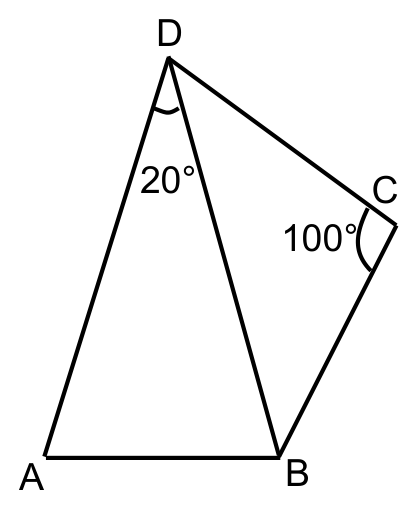
Sia ABCD un quadrilatero convesso di area unitaria, con AB e BD basi dei triangoli isosceli ABD e DBC rispettivamente. Sapendo inoltre che l’angolo B D misura 100° e l’angolo A B misura 20° (vedi figura), il prodotto è uguale a: A)
B)
C)
D)
E) altra risposta 100° 20° A B D C 2 3 3 3 4 BDx
AC Cˆ Dˆ
Students 2004 - Page n° 1 SOLUZIONI STUDENT 2004
Topic: Geometria piana, Trigonometria Metodo: Tecniche trigonometriche Abilita: Ragionamento geometrico Area: Geometria Risposta: D Fonte: apri PDF p.5
Product BD x AC in a convex quadrilateral
Let ABCD be a convex quadrilateral of unit area, with AB and BD bases of the isosceles triangles ABD and DBC respectively. Knowing furthermore that angle B D measures 100° and angle A B measures 20° (see figure), the product is equal to: A)
B)
C)
D)
E) other answer 100° 20° A B D C 2 3 3 3 4 BDx
AC Cˆ Dˆ
Students 2004 - Page n° 1 SOLUTIONS STUDENT 2004
Answer: D