Multiplo di 11 piu vicino a 1000
(5 punti) Qual è il multiplo di 11 più vicino a 1000?
Topic: Teoria dei Numeri Abilita: Manipolazione algebrica Area: Aritmetica e Teoria dei Numeri Risposta: 1001 Fonte: apri PDF p.1
Multiple of 11 closer to 1000
(5 points) What is the multiple of 11 closest to 1000?
Answer: 1001
Numero MALE dato MELA minimo a cifre distinte
(7 punti) Le lettere della parola “MELA” sono tutte distinte fra loro. Fa corrispondere ad ogni lettera di questa parola una cifra in modo tale che la parola “MELA” rappresenti il più piccolo numero di quattro cifre tutte distinte tra loro. Mantenendo questa scelta delle cifre, che numero è rappresentato dalla parola “MALE”?
Topic: Teoria dei Numeri, Combinatoria Abilita: Casework accurato Area: Aritmetica e Teoria dei Numeri, Combinatoria, Logica e Probabilita Risposta: 1320 Fonte: apri PDF p.1
MALE number given MELA minimum with distinct digits
*(7 points) * The letters of the word “MELA” are all distinct from each other. Match each letter of this word with a digit so that the word “MELA” represents the smallest number of four digits all distinct from each other. While maintaining this choice of digits, what number is represented by the word “MALE”?
Answer: 1320
Scritta PUZZLES vista riflessa dall’interno

(11 punti) Sulla vetrina di una cartoleria campeggia la scritta (composta con lettere adesive)
Disegna qui sotto la scritta che vedresti guardando la vetrina dall’interno del negozio. (vedi figura)
Topic: Geometria piana, Logica, giochi, strategie Abilita: Ragionamento geometrico Area: Combinatoria, Logica e Probabilita, Geometria Risposta: immagine speculare Fonte: apri PDF p.1
Written PUZZLES as seen from the inside
*(11 points) * On the window of a stationery shop is the writing (made up of sticky letters)
Draw here under the inscription that you’d see looking at the window from inside the store. (see figure)
Answer: mirror image
Affermazione che sincero e bugiardo possono dire
(14 punti) Arturo dice sempre la verità, invece Bernardo mente sempre. Trova una affermazione che entrambi possano pronunciare.
Topic: Logica, giochi, strategie Abilita: generalizzazione Area: Combinatoria, Logica e Probabilita Risposta: Io dico la verita Fonte: apri PDF p.1
Claim that the truthful and the liar can say
Arturo always tells the truth, while Bernardo always lies. Find a statement that both of them can make.
Answer: I am telling the truth
Numeri di 3 cifre con cifre che differiscono di almeno 4
(18 punti) Quanti sono i numeri di 3 cifre (significative, cioè la cui prima cifra non sia 0), tali che 2 di esse comunque prese non differiscano per meno di 4?
Topic: Teoria dei Numeri, Combinatoria Metodo: Conteggio combinatorio Abilita: Casework accurato Area: Aritmetica e Teoria dei Numeri, Combinatoria, Logica e Probabilita Risposta: 18 Fonte: apri PDF p.1
3-digit numbers with digits that differ by at least 4
(18 points) How many 3-digit numbers are there (significant, that is, whose first digit is not 0), such that any 2 of them taken together do not differ by less than 4?
Answer: 18
Minimo mattonelle per quadrato lato 7
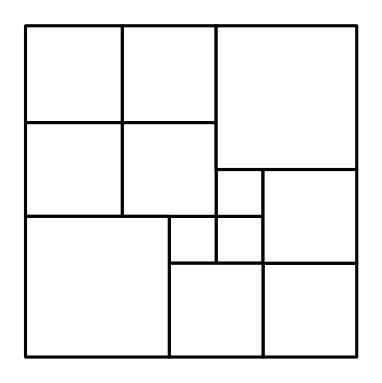
(22 punti) Hai a disposizione, nella quantità che desideri, mattonelle quadrate di tre misure diverse: i loro lati sono lunghi 1, 2 o 3 decimetri. Accostandole, senza sovrapporle e senza lasciare zone scoperte, puoi costruire un quadrato il cui lato misura 7 decimetri. Qual è il più piccolo numero di mattonelle che ti basta accostare e come vanno ripartite fra le diverse misure? Utilizza la quadrettatura per disegnare la figura che realizza la soluzione che hai trovato e spiega perché, secondo te, non basta un numero inferiore di mattonelle. (Puoi usare la quadrettatura anche per altri eventuali disegni che possano servire allo scopo.)
Topic: Combinatoria, Geometria piana Abilita: Casework accurato Area: Combinatoria, Logica e Probabilita, Geometria Risposta: 12 Fonte: apri PDF p.2
Minimum bricks per square side 7
You can have, in any quantity you want, three different sizes of square bricks: their sides are 1, 2 or 3 decimeter long. By placing them side by side, without overlapping them and without leaving any uncovered areas, you can build a square whose side measures 7 decimetres. What is the smallest number of bricks you need to place side by side and how they should be distributed between the different sizes? Use the grid to draw the figure that realises the solution you found and explain why you don’t think a smaller number of bricks is enough. (You can also use the grid for any other drawings that may serve the purpose.)
Answer: 12