Quali terne di numeri annotabili da casa a scuola
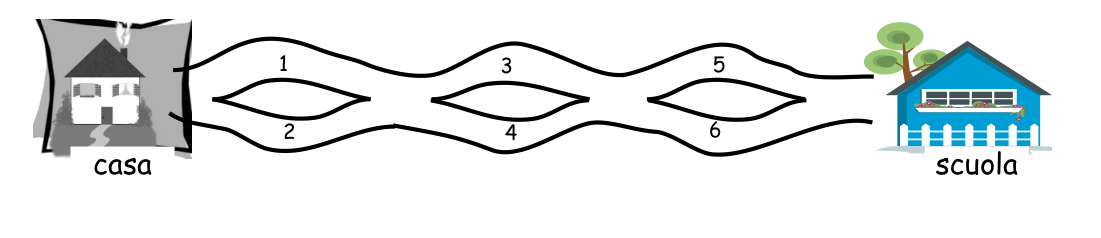
Osserva la figura. Zoe segue uno dei percorsi da casa a scuola senza mai tornare indietro. Quando passa su un numero lo annota. Quali terne di numeri, tra quelle proposte, può aver annotato quando arriva a scuola? A) 1, 2 e 4
B) 2, 3 e 4 C) 2, 3 e 5 D) 1, 5 e 6 E) 1, 2 e 5
Topic: Logica, giochi, strategie Abilita: Lettura attenta del testo Area: Combinatoria, Logica e Probabilita Risposta: C Fonte: apri PDF p.1
What kind of number tags can be marked from home to school
Look at the figure. Zoe follows one of the paths from home to school and never returns. When she passes over a number, she notes it. Which triples of numbers, among those proposed, could she have noted when she arrived at school? A) 1, 2 and 4 B) 2, 3 and 4 C) 2, 3 and 5 D) 1, 5 and 6 E) 1, 2 and 5
Answer: C
Lettere comuni a KANGOUROU e PROBLEMA
Quante lettere hanno in comune le parole KANGOUROU e PROBLEMA? A) 1 B) 2 C) 3 D) 4 E) 5
Topic: Logica, giochi, strategie Abilita: Lettura attenta del testo Area: Combinatoria, Logica e Probabilita Risposta: C Fonte: apri PDF p.1
Common letters to KANGOUROU and PROBLEMA
How many letters do the words KANGOUROU and PROBLEMA have in common? A) 1 B) 2 C) 3 D) 4 E) 5
Answer: C
Peso plausibile della bicicletta
Ho pesato la mia bicicletta. Quale fra i seguenti risultati posso aver trovato? A) 8 kg B) 1 kg C) 800 g D) 80 kg E) 800 kg
Topic: Logica, giochi, strategie Abilita: Stima e approssimazione Area: Combinatoria, Logica e Probabilita Risposta: A Fonte: apri PDF p.1
Plausible weight of the bicycle
I weighed my bike. Which of the following results may I have found? A) 8 kg B) 1 kg C) 800 g D) 80 kg E) 800 kg
Answer: A
Quale figura rimasta dopo ritaglio
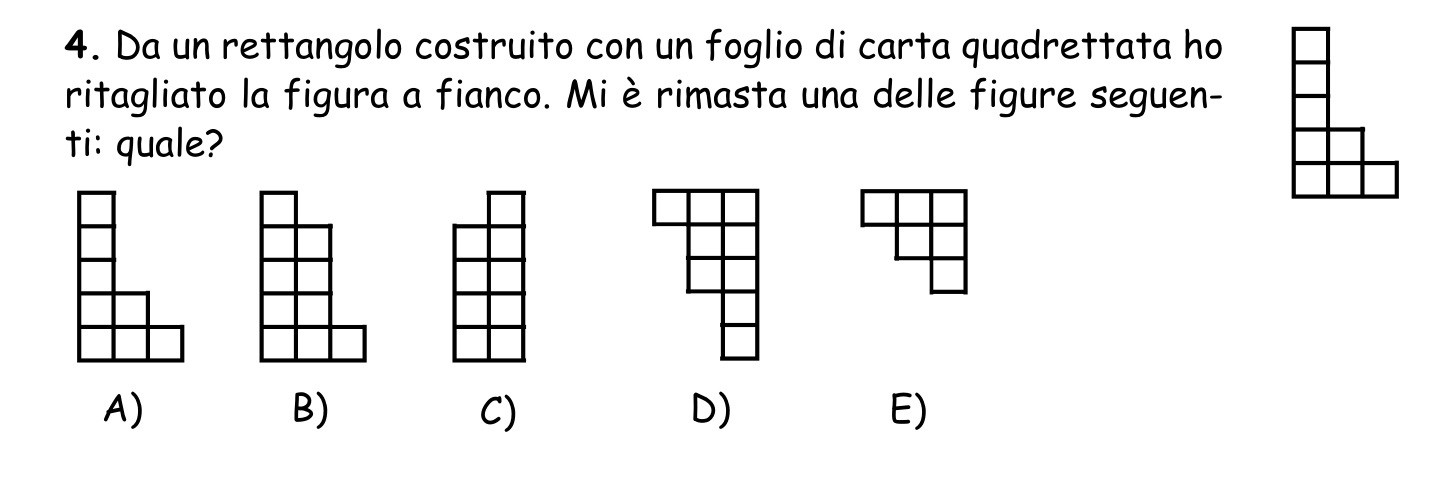
Da un rettangolo costruito con un foglio di carta quadrettata ho ritagliato la figura a fianco. Mi è rimasta una delle figure seguenti: quale?
Topic: Geometria piana Abilita: Ragionamento geometrico Area: Geometria Risposta: B Fonte: apri PDF p.1
What figure remains after cutting
From a rectangle constructed with a square sheet of paper I cut out the figure shown beside it. One of the following figures remained: which one?
Answer: B
Che ore sono (6 ore e mezza alle 4)
Fra sei ore e mezza saranno esattamente le quattro del mattino. Che ore sono? A) 21 : 30 B) 04 : 00 C) 20 : 00 D) 02 : 30 E) 10 : 30 1 2 3 4 5 6 casa scuola A) B) C) D) E) Testi_07.qxp 16-04-2007 12:02 Pagina 5
Pag. Pag. 6 Kang 2007 Kang 2007
Topic: Teoria dei Numeri Abilita: traduzione del testo Area: Aritmetica e Teoria dei Numeri Risposta: A Fonte: apri PDF p.1
What time is it (6 hours and a half to 4 hours)
In six and a half hours it will be exactly four in the morning. What time is it? A) 21: 30 B) 04: 00 C) 20: 00 D) 02: 30 E) 10: 30 1 2 3 4 5 6 school house A) B) C) D) E) Text_07.qxp 16-04-2007 12:02 Page 5
Answer: A
Numeri di 3 cifre con 0 e 7
Hai a disposizione solo le cifre 0 e 7. Quanti diversi numeri di tre cifre (significative) puoi scrivere? A) 8 B) 3 C) 7 D) 6 E) 4
Topic: Combinatoria Metodo: Conteggio combinatorio Abilita: Conteggio sistematico Area: Combinatoria, Logica e Probabilita Risposta: E Fonte: apri PDF p.2
Three-digit numbers with 0 and 7
You only have the digits 0 and 7. How many different three-digit numbers can you write? A) 8 B) 3 C) 7 D) 6 E) 4
Answer: E
Numero nella nuvoletta (operazione a ritroso)

Quale numero si deve inserire nella nuvoletta grigia affinché il calcolo risulti esatto?
Topic: Algebra Abilita: Manipolazione algebrica Area: Algebra e Analisi Risposta: E Fonte: apri PDF p.2
Number in the cloud (reverse operation)
What number must be inserted into the gray cloud for the calculation to be correct?
Answer: E
Modi di scambiarsi i doni (3 amiche)
Per Natale 3 amiche intendono scambiarsi i doni in questo modo: ciascuna fa un solo regalo (ovviamente non a sé stessa) e ne riceve uno. In quanti modi è possibile realizzare il progetto? A) 1 B) 2 C) 3
D) 4 E) 5 I quesiti dal N. 9 al N. 16 valgono 4 punti ciascuno
Topic: Combinatoria Metodo: Conteggio combinatorio Abilita: Conteggio sistematico Area: Combinatoria, Logica e Probabilita Risposta: B Fonte: apri PDF p.2
How to exchange gifts (3 friends)
For Christmas, three friends intend to exchange gifts in this way: each makes only one gift (not to herself, of course) and receives one. How many ways can the project be implemented? A) 1 B) 2 C) 3 D) 4 E) 5 Questions from N. 9 to N. 16 are worth 4 points each.
Answer: B
Terza bambolina per grandezza (matrioska)
Una matrioska è formata da 5 bamboline di colori diversi, una contenuta nell’altra. Quella azzurra è più piccola della verde, ma non della gialla. Quella blu è più grande sia della azzurra che della verde, ma più piccola della rossa. Di quale colore è la terza bambolina in ordine di grandezza? A) verde
B) rossa C) blu D) azzurra E) gialla
Topic: Logica, giochi, strategie Abilita: Casework accurato Area: Combinatoria, Logica e Probabilita Risposta: A Fonte: apri PDF p.2
Third doll by size (matryoshka)
A matryoshka is made up of 5 dolls of different colors, one contained inside the other. The blue one is smaller than the green one, but not than the yellow one. The blue one is larger than both the blue and the green one, but smaller than the red one. What color is the third doll in order of size? A) green
B) red C) blue D) blue E) yellow
Answer: A
Data di nascita di Matteo
Elisa, che è più giovane di suo fratello Matteo di un anno ed un giorno, è nata il 1° gennaio 2002. Qual è la data di nascita di Matteo? A) 2 gennaio 2003
B) 2 gennaio 2001
C) 31 dicembre 2000 D) 31 dicembre 2001 E) 30 dicembre 2000
Topic: Logica, giochi, strategie Abilita: Lettura attenta del testo Area: Combinatoria, Logica e Probabilita Risposta: C Fonte: apri PDF p.2
Matteo’s date of birth
Elisa, who is one year and one day younger than her brother Matteo, was born on January 1, 2002. What is Matteo’s date of birth? A) January 2, 2003
B) January 2, 2001
C) December 31, 2000 D) December 31, 2001 E) December 30, 2000
Answer: C
Numero totale dei rettangoli in figura
\begin{document}
\begin{tikzpicture}
  \draw[thick] (0,0) rectangle (4,5);
  \draw[thick] (1,0) -- (1,5);
  \draw[thick] (2,0) -- (2,5);
  \draw[thick] (3,0) -- (3,5);
\end{tikzpicture}
\end{document}
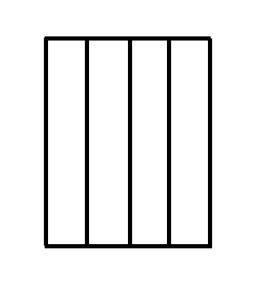
Qual è il numero totale dei rettangoli che si vedono in figura? A) 5 B) 12 C) 7 D) 10 E) nessuno dei precedenti
- 2 : 3
- 4 5 ? A) 1 B) 3
C) 7
D) 9
E) un numero diverso dai precedenti Testi_07.qxp 16-04-2007 12:02 Pagina 6Pag. Pag. 7 Kang 2007 Kang 2007
Topic: Combinatoria Metodo: Conteggio combinatorio Abilita: Conteggio sistematico Area: Combinatoria, Logica e Probabilita Risposta: D Fonte: apri PDF p.2
Total number of rectangles in the figure
\begin{document}
\begin{tikzpicture}
  \draw[thick] (0,0) rectangle (4,5);
  \draw[thick] (1,0) -- (1,5);
  \draw[thick] (2,0) -- (2,5);
  \draw[thick] (3,0) -- (3,5);
\end{tikzpicture}
\end{document}
What is the total number of rectangles that can be seen in the figure? A) 5 B) 12 C) 7 D) 10 E) none of the preceding
- 2 : 3
- 4 5 ? A) 1 B) 3
C) 7
D) 9
E) a number different from the preceding ones Testi_07.qxp 16-04-2007 12:02 Page 6Pag. Pag. 7 Kang 2007 Kang 2007
Answer: D
Sequenza di macchine per ottenere il risultato
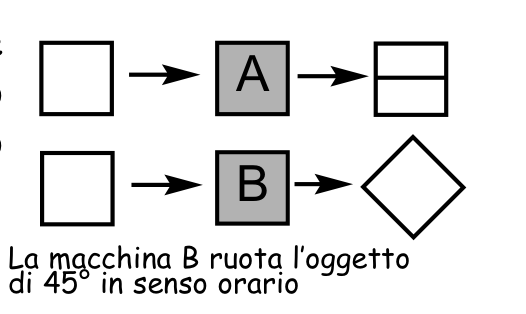
Il laboratorio del falegname dispone di due macchine A e B, il cui funzionamento è illustrato in figura. Qual è la sequenza corretta nell’uso delle macchine per ottenere ? A) BBA B) ABB C) BAB D) BA E) BABBB
Topic: Logica, giochi, strategie Metodo: Ragionamento all’indietro Abilita: Ragionamento geometrico Area: Combinatoria, Logica e Probabilita Risposta: B Fonte: apri PDF p.3
Sequence of machines to obtain the result
The carpenter’s laboratory has two machines A and B, the operation of which is shown in the figure. What is the correct sequence in the use of machines to obtain ? (a) BBA B) ABB C) BAB D) BA E) BABBB
Answer: B
In quanti posti puo sedersi Arrigo (cappelli)
Quindici ragazzi sono seduti in cerchio. Ognuno indossa un cappello: il primo è rosso, il secondo bianco, il terzo blu, il quarto rosso di nuovo, il quinto bianco, il sesto blu e così di seguito. Arrigo, che indossa un cappello arancione, vuole entrare nel cerchio in modo da aver vicino un cappello rosso, ma non un cappello blu. In quanti posti può sedersi? A) 4 B) 5 C) 10 D) 15 E) 1
Topic: Combinatoria Metodo: Conteggio combinatorio Abilita: Conteggio sistematico Area: Combinatoria, Logica e Probabilita Risposta: B Fonte: apri PDF p.3
How many seats can Arrigo sit in?
Fifteen boys are sitting in a circle. Each one wears a hat: the first is red, the second white, the third blue, the fourth red again, the fifth white, the sixth blue, and so on. Arrigo, who wears an orange hat, wants to enter the circle so that he has a red hat nearby, but not a blue hat. How many seats can he sit in? A) 4 B) 5 C) 10 D) 15 E) 1
Answer: B
Quale affermazione puo essere vera (sport)
Anna, Bianca, Cecilia e Diana praticano ciascuna uno ed uno solo dei seguenti sport: karate, calcio, pallavolo e judo. Anna non pratica sport che utilizzano una palla, la judoka Bianca va spesso allo stadio ad assistere a partite di calcio. Quale delle seguenti affermazioni può essere vera? A) Anna gioca a pallavolo B) Bianca gioca a calcio C) Cecilia gioca a pallavolo D) Diana fa karate E) Anna fa judo
Topic: Logica, giochi, strategie Abilita: Casework accurato Area: Combinatoria, Logica e Probabilita Risposta: C Fonte: apri PDF p.3
Which statement can be true (sport)
Anna, Bianca, Cecilia, and Diana each practice one of the following sports: karate, soccer, volleyball, and judo. Anna does not practice sports that use a ball, Bianca, the judoka, often goes to the stadium to attend football matches. Which of the following statements can be true? A) Anna plays volleyball B) Bianca plays soccer C) Cecilia plays volleyball D) Diana plays karate E) Anna plays judo
Answer: C
Quanti sedili nella giostra
I sedili di una giostra sono equispaziati (cioè la distanza di un sedile da quello che lo segue è sempre la stessa) e numerati in ordine 1, 2, 3, … . In questa giostra Pietro è seduto sul sedile numero 11, esattamente dall’altra parte di Maria che occupa il sedile numero 4. Quanti sedili sono presenti in quella giostra?
A) 13 B) 14 C) 16 D) 17 E) 22
Topic: Teoria dei Numeri Abilita: traduzione del testo Area: Aritmetica e Teoria dei Numeri Risposta: B Fonte: apri PDF p.3
How many seats in the carousel
The seats of a carousel are equally spaced (that is, the distance from one seat to the one that follows it is always the same) and numbered in order 1, 2, 3, … . In this carousel Pietro is sitting on seat number 11, exactly on the other side from Maria, who occupies seat number 4. How many seats are there in that carousel?
A) 13 B) 14 C) 16 D) 17 E) 22
Answer: B
Numero possibile nella casella ? (latino 3x3)
I numeri 1, 2 e 3 devono essere scritti nelle caselle della tabella in figura in modo che ciascuno dei numeri 1, 2 e 3 compaia in ogni riga ed in ogni colonna. Isabella ha iniziato ad inserire alcuni numeri nella tabella: quale numero può scrivere nella casella indicata con il punto di domanda? A) solo 1 B) solo 2 C) solo 3 D) 2 o 3 E) 1, 2 oppure 3 A B La macchina B ruota l’oggetto di 45° in senso orario 1 ? 2 1 Testi_07.qxp 16-04-2007 12:02 Pagina 7
I quesiti dal N. 17 al N. 24 valgono 5 punti ciascuno
Topic: Combinatoria Metodo: Analisi per casi Abilita: Casework accurato Area: Combinatoria, Logica e Probabilita Risposta: C Fonte: apri PDF p.3
Possible number in the cell? (Latin 3×3)
The numbers 1, 2, and 3 must be written in the cells of the table shown so that each of the numbers 1, 2, and 3 appears in each row and each column. Isabella has already started filling in some numbers in the table: which number can be written in the cell marked with a question mark?
A) only 1 B) only 2 C) only 3 D) 2 or 3 E) 1, 2, or 3
A B
Machine B rotates the object by 45° clockwise 1 ? 2 1
Questions 17 to 24 are worth 5 points each.
Answer: C
Quante cifre scrivendo da 1 a 100
Immagina di scrivere uno dopo l’altro tutti i numeri da 1 a 100 inclusi: quante cifre hai scritto? A) 100 B) 150 C) 190 D) 192 E) 200
Topic: Teoria dei Numeri Metodo: Conteggio combinatorio Abilita: Conteggio sistematico Area: Aritmetica e Teoria dei Numeri Risposta: D Fonte: apri PDF p.4
How many digits to write from 1 to 100
Imagine you’re writing one after another all the numbers from 1 to 100 inclusive: how many digits have you written? A) 100 B) 150 C) 190 D) 192 E) 200
Answer: D
Chi aspetta chi e per quanto (orologi)
Chiara e Donatella hanno appuntamento alle 7:05. Quando arriva, Donatella pensa di essere in anticipo di 15 minuti, ma ha l’orologio indietro di 7 minuti; Chiara invece pensa di essere in ritardo di 10 minuti, ma ha l’orologio avanti di 7 minuti. Quale delle due amiche deve aspettare l’altra e per quanto tempo? A) Donatella aspetta Chiara per 5 minuti B) Donatella aspetta Chiara per 14 minuti C) Donatella aspetta Chiara per 11 minuti D) Chiara aspetta Donatella per 5 minuti E) Chiara aspetta Donatella per 11 minuti
Topic: Teoria dei Numeri Abilita: traduzione del testo Area: Aritmetica e Teoria dei Numeri Risposta: C Fonte: apri PDF p.4
Who waits for who and for how long (watches)
Chiara and Donatella have an appointment at 7:05. When she arrives, Donatella thinks she’s 15 minutes early, but her watch is 7 minutes behind; Chiara thinks she’s 10 minutes late, but her watch is 7 minutes ahead. Which of the two friends has to wait for the other and for how long? A) Donatella waits for 5 minutes B) Donatella waits for 14 minutes C) Donatella waits for 11 minutes D) Chiara waits for Donatella for 5 minutes E) Chiara waits for Donatella for 11 minutes
Answer: C
Somma punti invisibili di 7 dadi impilati
Un dado è un cubo le cui facce sono numerate da 1 a 6. La somma dei numeri che si trovano su due facce opposte è sempre 7. Sette dadi sono impilati come mostra la figura. Immagina di poter osservare le pile da ogni angolo: qual è la somma dei punti che risultano comunque invisibili, cioè nascosti fra i dadi o sotto le pile? A) 49 B) 47 C) 46 D) 42 E) 35
Topic: Teoria dei Numeri Abilita: Ragionamento geometrico Area: Aritmetica e Teoria dei Numeri Risposta: C Fonte: apri PDF p.4
Sum of invisible points of 7 stacked dice
A die is a cube whose faces are numbered from 1 to 6. The sum of the numbers on two opposite faces is always 7. Seven dice are stacked as shown in the figure. Imagine that you can observe the piles from every angle. What is the sum of the points that are still invisible, hidden between the dice or under the piles? A) 49 B) 47 C) 46 D) 42 E) 35
Answer: C
Quale figura non ottenibile piegando e tagliando
Un foglio di carta di forma quadrata viene piegato due volte in modo che il risultato sia ancora un quadrato. A questo quadrato viene tagliato un angolo. Quale delle figure sottostanti non può essere ottenuta con questo procedimento? A) B) C) D) E) nessuna Pag. Pag. 8 Kang 2007 Kang 2007 Testi_07.qxp 16-04-2007 12:02 Pagina 8
Pag. Pag. 9 Kang 2007 Kang 2007
Topic: Geometria piana Abilita: Ragionamento geometrico Area: Geometria Risposta: E Fonte: apri PDF p.4
Which shape cannot be obtained by folding and cutting?
A square piece of paper is folded twice in such a way that the result is still a square. Then, one corner of this square is cut off. Which of the following figures cannot be obtained by this procedure? A) B) C) D) E) none
Page 8 Kang 2007 Kang 2007 Testi_07.qxp 16-04-2007 12:02 Page 8
Page Page 9 Kang 2007 Kang 2007
Answer: E
Caselle bianche nel quadrato successivo
Nella figura è mostrata una sequenza di tre quadrati “quadrettati” con alcuni quadretti anneriti. Quante caselle bianche avrà il quadrato successivo, se lo costruiamo con lo stesso principio?
A) 50 B) 60 C) 65 D) 70 E) 75
Topic: Combinatoria Metodo: Ricorsione Abilita: Riconoscimento di pattern Area: Combinatoria, Logica e Probabilita Risposta: C Fonte: apri PDF p.5
White cells in the next square
The figure shows a sequence of three “squared” squares with some blackened cells. How many white cells will the next square have if we build it on the same principle? A) 50 B) 60 C) 65 D) 70 E) 75
Answer: C
Somma 2007+…+2016
2007 + 2008 + 2009 + 2010 + 2011 + 2012 + 2013 + 2014 + 2015 + 2016 = A) 20115 B) 10205 C) 2125 D) 202007 E) 20075
Topic: Teoria dei Numeri Abilita: Conteggio sistematico Area: Aritmetica e Teoria dei Numeri Risposta: A Fonte: apri PDF p.5
Sum 2007+…+2016
2007 + 2008 + 2009 + 2010 + 2011 + 2012 + 2013 + 2014 + 2015 + 2016 = A) 20115 B) 10205 C) 2125 D) 202007 E) 20075
Answer: A
Minimo carte per circuito chiuso piu grande
Anna dispone di una grande quantità di carte di forma quadrata come quella a fianco. Accostando opportunamente quattro di queste carte può costruire un circuito chiuso (in bianco nella seconda figura). Anna vuole costruire un circuito più grande: qual è il minimo numero di carte che le consente di attuare il suo progetto? A) 8 B) 10 C) 9 D) 16 E) 12
Topic: Geometria piana Abilita: Ragionamento geometrico Area: Geometria Risposta: E Fonte: apri PDF p.5
Minimum cards for larger closed circuit
Anna has a large number of square cards like the one next to her. Placing four of these cards appropriately can build a closed circuit (in white in the second figure). Anna wants to build a larger circuit: what is the minimum number of cards that allows her to implement her project? A) 8 B) 10 C) 9 D) 16 E) 12
Answer: E
Anni di Fabio oggi (eta amici)
Fabio, Luca e Mauro oggi compiono gli anni. La somma delle loro età oggi è di 22 anni; quando Fabio avrà l’età che Luca ha oggi tale somma sarà di 28 anni; quando Fabio avrà l’età che Mauro ha oggi tale somma sarà di 37 anni. Quanti anni ha Fabio oggi? A) 4 B) 5 C) 6 D) 7 E) 8 8 caselle bianche 21 caselle bianche 40 caselle bianche Testi_07.qxp 16-04-2007 12:02 Pagina 9
1 Kangourou della Matematica 2007 Categoria Écolier Per studenti di quarta o quinta della scuola primaria
Topic: Algebra Abilita: traduzione del testo Area: Algebra e Analisi Risposta: B Fonte: apri PDF p.5
Years of Fabio today (age of friends)
Fabio, Luca and Mauro have their birthday today. The sum of their ages today is 22 years; when Fabio will have the age that Luca has today that sum will be 28 years; when Fabio will have the age that Mauro has today that sum will be 37 years. How old is Fabio today? A) 4 B) 5 C) 6 D) 7 E) 8 8 white boxes 21 white boxes 40 white boxes Text_07.qxp 16-04-2007 12:02 Page 9
1 Kangourou of Mathematics 2007 Category Écolier For fourth or fifth graders of primary school
Answer: B