Probabilita prodotto facce visibili divisibile per 6
Lancia un dado tradizionale: qual è la probabilità che il prodotto dei numeri che compaiono sulle cinque facce che rimangono visibili sia divisibile per 6? A) 1/3 B) 1/2 C) 2/3 D) 5/6 E) 1
Topic: Probabilita e statistica Abilita: generalizzazione Area: Combinatoria, Logica e Probabilita Risposta: E Fonte: apri PDF p.1
Probability of visible faces divided by 6
He throws a traditional dice: what is the probability that the product of the numbers that appear on the five faces that remain visible is divisible by 6? A) 1/3 B) 1/2 C) 2/3 D) 5/6 E) 1
Answer: E src_kangourou_2007_junior_marzo__Q01
Quanti biglietti premiati (vincolo sulle cifre)
In una lotteria vengono premiati tutti e soli i possessori di biglietti il cui numero sia composto da almeno cinque cifre, delle quali al più tre siano maggiori di 2. Tra i possessori dei seguenti biglietti 1022, 22222, 102334, 213343, 3042531 quanti vengono premiati? A) 1 B) 2 C) 3
D) 4 E) 5
Topic: Combinatoria Metodo: Conteggio combinatorio Abilita: Lettura attenta del testo Area: Combinatoria, Logica e Probabilita Risposta: B Fonte: apri PDF p.1
*How many tickets were awarded (link on figures) *
In a lottery, only those ticket holders whose number is at least five digits are awarded prizes, three of which are higher than two. Of the following ticket holders, 1022, 22222, 102334, 213343, 3042531, how many are awarded? A) 1 B) 2 C) 3 D) 4 E) 5
Answer: B src_kangourou_2007_junior_marzo__Q02
Max distanza tra due persone (ricetrasmittente)
Un pallone aerostatico è fermo a 1200 metri di altezza sul suolo. Il personale a bordo possiede una rice-trasmittente in grado di operare nel raggio di 1300 metri. Qual è la massima distanza in metri di due persone a terra che, munite di analoghe rice-trasmittenti, possono comunicare con il personale a bordo? A) 500
B) 800
C) 1000
D) 1200
E) 1300
Topic: Geometria piana Abilita: Ragionamento geometrico Area: Geometria Risposta: C Fonte: apri PDF p.1
*Max distance between two persons (re-transmitter) *
A balloon is stationary at 1,200 meters above the ground. The crew on board has a receiver capable of operating within 1300 metres. What is the maximum distance in metres for two people on the ground to communicate with the crew on board, equipped with similar transmitters? A) 500 B) 800 C) 1000 D) 1200 E) 1300
Answer: C src_kangourou_2007_junior_marzo__Q03
Area triangolo AEF (punti medi)
Sia ABC un triangolo di area 96. Siano D il punto medio del lato AB, E il punto medio del segmento DB, F il punto medio del lato BC. Quanto vale l’area del triangolo AEF ? A) 16
B) 24
C) 32
D) 36
E) 48
Topic: Geometria piana Abilita: Ragionamento geometrico Area: Geometria Risposta: D Fonte: apri PDF p.1
*AEF triangle area (middle points) *
Let ABC be a triangle of area 96. So D is the midpoint of the AB side, and DB is the midpoint of the segment, and F is the midpoint of the BC side. How much is the area of the AEF triangle ? A) 16 B) 24 C) 32 D) 36 E) 48
Answer: D src_kangourou_2007_junior_marzo__Q04
Membri fra tre anni (+50% ogni anno)
Un organismo internazionale è attualmente composto da 32 membri. Da quanti membri sarà composto fra tre anni, se ogni anno il numero dei membri è superiore del 50% rispetto all’anno precedente? A) 182
B) 128
C) 108
D) 96
E) 80 Testi_07.qxp 16-04-2007 12:06 Pagina 22Pag. Pag. 23 23 Kang 2007 Kang 2007
Topic: successioni Abilita: traduzione del testo Area: Algebra e Analisi Risposta: C Fonte: apri PDF p.1
*Members after three years (+50% annually) *
An international body currently consists of 32 members. How many members will it have in three years’ time if the number of members is 50% higher than the previous year? A) 182 B) 128 C) 108 D) 96 E) 80 Texts
I’m going to pay. I’m going to pay. 23 23 Kang 2007 Kang 2007
Answer: C src_kangourou_2007_junior_marzo__Q05
Quanti percorsi minimi tra le caselle marcate
\begin{document}
\begin{tikzpicture}[scale=0.6]
  \draw[line width=1pt] (0,0) grid (4,5);
  \node at (0.5,4.5) {$\triangle$};
  \node at (3.5,0.5) {$\triangle$};
\end{tikzpicture}
\end{document}
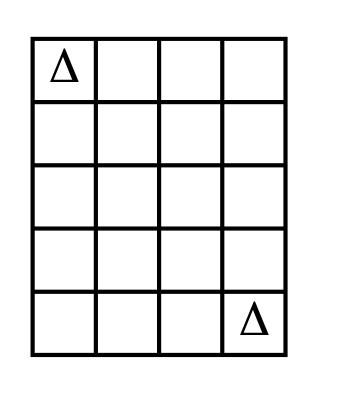
Osserva la griglia in figura. Una mossa consiste esclusivamente nello spostare (in orizzontale, in verticale o in diagonale) una pedina da una casella ad un’altra adiacente. Vuoi spostare una pedina da una delle due caselle marcate con il triangolo sull’altra, impiegando il minor numero possibile di mosse. Quanti percorsi diversi hai a disposizione? A) 2
B) 4
C) 7
D) 20
E) 35
Topic: Combinatoria Metodo: Conteggio combinatorio Abilita: Conteggio sistematico Area: Combinatoria, Logica e Probabilita Risposta: B Fonte: apri PDF p.2
Minimum number of paths between the marked boxes
\begin{document}
\begin{tikzpicture}[scale=0.6]
  \draw[line width=1pt] (0,0) grid (4,5);
  \node at (0.5,4.5) {$\triangle$};
  \node at (3.5,0.5) {$\triangle$};
\end{tikzpicture}
\end{document}
Look at the grid in the figure. A move consists exclusively of moving (horizontal, vertical or diagonal) a foot from one box to another adjacent one. You want to move a pedal from one of the two boxes marked with the triangle on the other, using as few moves as possible. How many different routes do you have available? A) 2 B) 4 C) 7 D) 20 E) 35
Answer: B src_kangourou_2007_junior_marzo__Q06
Cifre X e Y nella griglia (somma 2 per riga/colonna)
\begin{document}
\begin{tikzpicture}[scale=0.7]
  \draw[line width=1pt] (0,0) grid (4,4);
  \node at (0.5,3.5) {1};
  \node at (2.5,3.5) {1};
  \node at (2.5,2.5) {1};
  \node at (1.5,1.5) {$x$};
  \node at (3.5,1.5) {0};
  \node at (1.5,0.5) {$y$};
\end{tikzpicture}
\end{document}
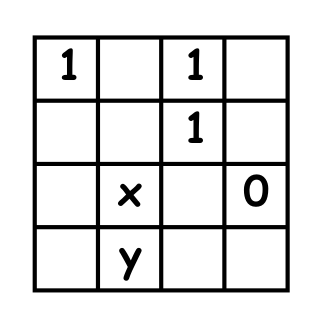
In ogni cella della griglia in figura va inserita la cifra 0 oppure la cifra 1, facendo in modo che in ogni riga e in ogni colonna la somma delle cifre che vi compaiono sia 2. Quali cifre occorre sostituire a X e a Y? A) X = 1, Y = 1
B) X = 1, Y = 0
C) X = 0, Y = 1
D) X = 0, Y = 0
E) Non è possibile realizzare la configurazione.
Topic: Combinatoria Metodo: Analisi per casi Abilita: Casework accurato Area: Combinatoria, Logica e Probabilita Risposta: A Fonte: apri PDF p.2
*X and Y figures in the grid (sum of 2 per row/column) *
\begin{document}
\begin{tikzpicture}[scale=0.7]
  \draw[line width=1pt] (0,0) grid (4,4);
  \node at (0.5,3.5) {1};
  \node at (2.5,3.5) {1};
  \node at (2.5,2.5) {1};
  \node at (1.5,1.5) {$x$};
  \node at (3.5,1.5) {0};
  \node at (1.5,0.5) {$y$};
\end{tikzpicture}
\end{document}
In each grid cell in the figure, the digit 0 or the digit 1 must be inserted, so that in each row and column the sum of the digits that appear there is 2. What digits should be substituted for X and Y? A) X = 1, Y = 1 B) X = 1, Y = 0 C) X = 0, Y = 1 D) X = 0, Y = 0 E) The configuration cannot be made.
Answer: A src_kangourou_2007_junior_marzo__Q07
Max di KAN+GA+ROO (cifre distinte)
Trova il massimo valore che può assumere l’espressione KAN + GA + ROO quando ad ogni lettera viene fatta corrispondere una cifra, in modo che a lettere diverse corrispondano cifre diverse. A) 1906
B) 1897
C) 1905
D) 1895 E) 2007
Topic: Teoria dei Numeri Metodo: Principio di estremalita Abilita: Casework accurato Area: Aritmetica e Teoria dei Numeri Risposta: B Fonte: apri PDF p.2
*Max of KAN+GA+ROO (different figures) *
Find the maximum value that the expression KAN + GA + ROO can assume when each letter is assigned a digit, so that different letters have different digits. A) 1906 B) 1897 C) 1905 D) 1895 E) 2007
Answer: B src_kangourou_2007_junior_marzo__Q08
Numero regioni con 4 segmenti da A e B
\begin{document}
\begin{tikzpicture}[scale=2.5]
  \coordinate (A) at (2,0);
  \coordinate (B) at (1.2,1.5);
  \coordinate (C) at (0,0);
  \draw[line width=1.2pt] (A) -- (B) -- (C) -- cycle;
  \node[above right] at (B) {B};
  \node[below left] at (C) {C};
  \node[below right] at (A) {A};
  \draw (A) -- (0.4,0.5);
  \draw (A) -- (0.8,1.0);
  \draw (B) -- (0.667,0);
  \draw (B) -- (1.333,0);
\end{tikzpicture}
\end{document}
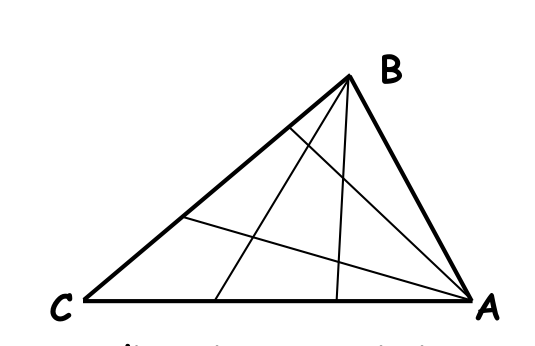
Nella figura vedi un triangolo ABC in cui dal vertice A partono due diversi segmenti con secondo estremo sul lato opposto, e lo stesso accade dal vertice B. I quattro segmenti così tracciati ripartiscono il triangolo in 9 regioni disgiunte (salvo per i bordi). Se da ciascuno dei due vertici A e B si tracciano quattro diversi segmenti, invece di due, fino ad incontrare il lato opposto, qual è il numero di regioni (disgiunte, salvo per i bordi) in cui risulta ripartito il triangolo? A) 16
B) 25
C) 36
D) 42
E) 49
Topic: Combinatoria Metodo: Conteggio combinatorio Abilita: Riconoscimento di pattern Area: Combinatoria, Logica e Probabilita Risposta: B Fonte: apri PDF p.2
Number of regions with 4 segments from A and B
\begin{document}
\begin{tikzpicture}[scale=2.5]
  \coordinate (A) at (2,0);
  \coordinate (B) at (1.2,1.5);
  \coordinate (C) at (0,0);
  \draw[line width=1.2pt] (A) -- (B) -- (C) -- cycle;
  \node[above right] at (B) {B};
  \node[below left] at (C) {C};
  \node[below right] at (A) {A};
  \draw (A) -- (0.4,0.5);
  \draw (A) -- (0.8,1.0);
  \draw (B) -- (0.667,0);
  \draw (B) -- (1.333,0);
\end{tikzpicture}
\end{document}
In the figure you see an ABC triangle where two different segments start from the A vertex with a second end on the opposite side, and the same happens from the B vertex. The four segments thus charted divide the triangle into 9 regions (except for the edges). If from each of the two vertices A and B four distinct segments, instead of two, are plotted until they meet the opposite side, what is the number of regions (disjoint except for the edges) in which the triangle is distributed? A) 16 B) 25 C) 36 D) 42 E) 49
Answer: B src_kangourou_2007_junior_marzo__Q09
Max mesi con cinque domeniche
Qual è il massimo numero di mesi di uno stesso anno che possono avere cinque domeniche? A) 3 B) 4
C) 5
D) 6 E) 7 Δ Δ 1 1 1 x 0 y B C A Testi_07.qxp 16-04-2007 12:06 Pagina 23Pag. Pag. 24 24 Kang 2007 Kang 2007 I quesiti dal N. 11 al N. 20 valgono 4 punti ciascuno
Topic: Combinatoria Metodo: Analisi per casi Abilita: generalizzazione Area: Combinatoria, Logica e Probabilita Risposta: C Fonte: apri PDF p.2
Max months with five Sundays
What is the maximum number of months in a year that can have five Sundays? A) 3 B) 4 C) 5 D) 6 E) 7 Δ Δ 1 1 x 0 y B C A Test_07.qxp 16-04-2007 12:06 Page 23
I’m going to pay. I’m going to pay. 24 24 Kang 2007 Kang 2007 Questions from N. 11 al N. 20 is worth 4 points each.
Answer: C src_kangourou_2007_junior_marzo__Q10
Quanti mentitori fra i 12 (dichiarazioni)
Gli abitanti di un’isola si dividono in mentitori (persone che mentono sempre) o sinceri (persone che dicono sempre la verità). Un giorno 12 abitanti, fra cui vi sono sia sinceri sia mentitori, si trovano insieme e fanno alcune dichiarazioni. Due di essi dicono: “Esattamente due di noi 12 sono mentitori”. Altri quattro dicono: “Esattamente quattro di noi 12 sono mentitori”. I restanti sei dicono: “Esattamente sei di noi 12 sono mentitori”. Quanti mentitori vi sono fra quei 12? A) 2 B) 4 C) 6 D) 8 E) 10
Topic: Logica, giochi, strategie Metodo: Analisi per casi Abilita: Casework accurato Area: Combinatoria, Logica e Probabilita Risposta: C Fonte: apri PDF p.3
*How many liars out of 12 (statements) *
The inhabitants of an island are divided into liars (people who always lie) or truthful (people who always tell the truth). One day, 12 residents, both honest and lying, gather together and make some statements. Two of them say: Exactly two of us 12 are liars The other four say, “Exactly four of us 12 are liars”. The remaining six say, “Exactly six of us 12 are liars”. How many liars are there among those 12? A) 2 B) 4 C) 6 D) 8 E) 10
Answer: C src_kangourou_2007_junior_marzo__Q11
A quale potenza elevare 4^4 per ottenere 8^8
A quale potenza dobbiamo elevare 44 per ottenere 88 ? A) 2 B) 3 C) 4 D) 8 E) 16
Topic: Teoria dei Numeri Metodo: manipolazione algebrica Abilita: Manipolazione algebrica Area: Aritmetica e Teoria dei Numeri Risposta: B Fonte: apri PDF p.3
To what power do we raise 4^4 to get 8^8
What power do we have to raise 44 to get 88 ? A) 2 B) 3 C) 4 D) 8 E) 16
Answer: B src_kangourou_2007_junior_marzo__Q12
Come incernierare le due sezioni della porta
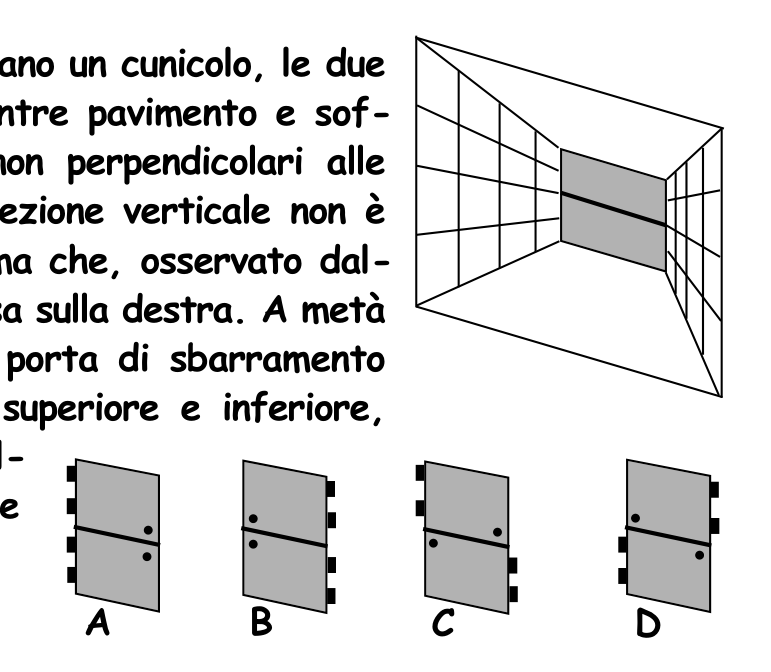
Delle quattro pareti che delimitano un cunicolo, le due laterali (opposte) sono verticali mentre pavimento e soffitto sono paralleli fra loro, ma non perpendicolari alle pareti laterali: di conseguenza la sezione verticale non è un rettangolo, ma un parallelogramma che, osservato dall’ingresso, presenta la parte più bassa sulla destra. A metà del cunicolo si vuole costruire una porta di sbarramento che sia costituita da due sezioni, superiore e inferiore, apribili l’una indipendentemente dall’altra. Guardando dall’ingresso, come vanno incernierate le due sezioni? A) Entrambe sul lato sinistro.
B) Entrambe sul lato destro.
C) Quella superiore sul lato sinistro e quella inferiore sul lato destro. D) Quella superiore sul lato destro e quella inferiore sul lato sinistro. E) Il progetto non è realizzabile.
Topic: Geometria solida Abilita: Ragionamento geometrico Area: Geometria Risposta: C Fonte: apri PDF p.3
How to anchor the two sections of the door
Of the four walls that delimit a cone, the two sides (opposite) are vertical while the floor and ceiling are parallel to each other, but not perpendicular to the side walls: consequently the vertical section is not a rectangle, but a parallelogram which, observed from the entrance, presents the lowest part on the right. In the middle of the cone, a barrier door is to be constructed which consists of two sections, upper and lower, open one independently of the other. Looking at the entrance, how are the two sections to be anchored? A) Both on the left side. B) Both on the right side. C) The upper one on the left side and the lower one on the right side. D) The upper one on the right side and the lower one on the left side. E) The project is not feasible.
Answer: C src_kangourou_2007_junior_marzo__Q13
chi ha risolto o le ragazze
Una classe ha affrontato uno dei problemi di Kangourou. Il numero dei ragazzi che hanno risolto il problema coincide con il numero delle ragazze che non l’hanno risolto. È maggiore il numero di coloro (ragazzi e ragazze) che hanno risolto il problema o il numero complessivo delle ragazze? A) La situazione non può verificarsi. B) I dati non sono sufficienti per rispondere. C) Il numero delle ragazze. D) Il numero di coloro che hanno risolto il problema E) I due numeri sono uguali. A B C D Testi_07.qxp 16-04-2007 12:06 Pagina 24
Pag. Pag. 25 25 Kang 2007 Kang 2007
Topic: Logica, giochi, strategie Abilita: generalizzazione Area: Combinatoria, Logica e Probabilita Risposta: E Fonte: apri PDF p.3
who solved or girls
A class was facing one of Kangourou’s problems. The number of boys who solved the problem matches the number of girls who didn’t. Is the number of those (boys and girls) who solved the problem higher or the overall number of girls? A) The situation cannot occur. B) The data are insufficient to answer. (c) The number of girls. D) The number of people who have solved the problem E) The two numbers are equal. A B C D Texts_07.qxp 16-04-2007 12:06 Page 24
I’m going to pay. I’m going to pay. 25 25 Kang 2007 Kang
Answer: E src_kangourou_2007_junior_marzo__Q14
Perimetro regione di movimento del cane
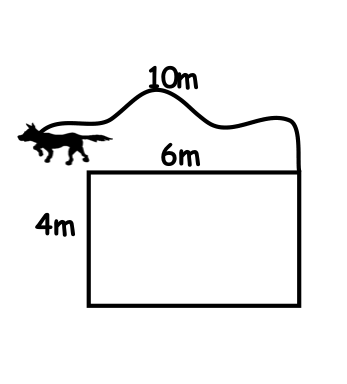
Osserva la figura. Uno dei due estremi di una corda lunga 10 metri è fissato ad un angolo di un capanno a pianta rettangolare di 4 metri per 6 metri, mentre all’altro estremo è legato un cane (che non può ovviamente entrare nel capanno). Qual è il perimetro della regione entro la quale può muoversi il cane? A) 20 π B) 22 π C) 40 π D) 88 π E) 100 π
Topic: Geometria piana Abilita: Ragionamento geometrico Area: Geometria Risposta: A Fonte: apri PDF p.4
Perimeter of movement region of the dog
Look at the figure. One of the two ends of a 10-metre long rope is attached to a corner of a 4-metre by 6-metre rectangular planted shed, while the other end is tied to a dog (which obviously cannot enter the shed). What is the perimeter of the region within which the dog can move? A) 20 π B) 22 π C) 40 π D) 88 π E) 100 π
Answer: A src_kangourou_2007_junior_marzo__Q15
A che ora arrivo al distributore (consumo)
Sono le 21:00 e sto guidando alla velocità di 100 km/h. A questa velocità con la benzina che mi resta posso percorrere solo 80 km, ma il distributore più vicino è distante 100 km. La quantità di benzina che la mia auto consuma è direttamente proporzionale alla velocità dell’auto e io desidero perdere quanto meno tempo è possibile. A che ora arriverò al distributore? A) 22:12
B) 22:15
C) 22:20
D) 22:25 E) 22:30
Topic: Algebra Metodo: Disuguaglianze classiche Abilita: traduzione del testo Area: Algebra e Analisi Risposta: B Fonte: apri PDF p.4
*What time do I get to the distributor (consumption) *
It’s 9:00, and I’m driving at 100 miles an hour. At this speed with the gas I have left I can only run 80 kilometers, but the nearest distributor is 100 kilometers away. The amount of gasoline my car consumes is directly proportional to the speed of the car and I want to waste as little time as possible. What time do I get to the distributor? A) 22:12 B) 22:15 C) 22:20 D) 22:25 E) 22:30
Answer: B src_kangourou_2007_junior_marzo__Q16
Perimetro del triangolo originale (trapezio)
Un trapezio è costruito a partire da un triangolo equilatero “segandone un angolo” (cioè sopprimendo da esso un opportuno triangolo più piccolo avente un vertice in comune con esso). Due copie di questo trapezio vengono accostate in modo da formare un parallelogramma il cui perimetro risulta 10 centimetri più lungo del perimetro del triangolo originale. Quanti centimetri misura il perimetro del triangolo originale? A) 10
B) 30
C) 40
D) 60
E) I dati sono insufficienti.
Topic: Geometria piana Abilita: Ragionamento geometrico Area: Geometria Risposta: B Fonte: apri PDF p.4
*Perimeter of the original triangle (trapezoid) *
A trapezoid is constructed from an equilateral triangle sequencing an angle (i.e. removing from it a suitable smaller triangle having a vertex in common with it). Two copies of this trapezoid are joined together to form a parallelogram whose perimeter is 10 centimeters longer than that of the original triangle. How many centimeters does the perimeter of the original triangle measure? A) 10 B) 30 C) 40 D) 60 E) The data are insufficient.
Answer: B src_kangourou_2007_junior_marzo__Q17
Quando l’orologio segnera 5 minuti in piu
L’orologio della nonna ogni giorno, rispetto alla marcia corretta, — tra le 0:00 e le 6:00 va avanti di 15 secondi; — tra le 6:00 e le 12:00 resta indietro di 10 secondi; — tra le 12:00 e le 18:00 va avanti di 15 secondi; — tra le 18:00 e le 24:00 resta indietro di 10 secondi. Oggi, 15 marzo, a mezzogiorno l’orologio segna l’ora esatta. Se la nonna non regolerà più l’orologio, a che ora di quale giorno il suo orologio segnerà per la prima volta esattamente 5 minuti in più rispetto all’ora esatta? A) Non potrà mai accadere B) Alle 12:00 del 14 aprile. C) Alle 12:00 del 15 aprile. D) Alle 12:00 del 13 aprile. E) Alle 6:00 del 13 aprile 4m 6m 10m Testi_07.qxp 16-04-2007 12:06 Pagina 25
Pag. Pag. 26 26 Kang 2007 Kang 2007
Topic: Teoria dei Numeri Metodo: congruenze Abilita: traduzione del testo Area: Aritmetica e Teoria dei Numeri Risposta: E Fonte: apri PDF p.4
When the clock signs 5 more minutes
The grandmother’s clock every day, compared to the correct walk, between 0:00 and 6:00 goes forward by 15 seconds; between 6:00 and 12:00 goes back 10 seconds; between 12:00 and 18:00 goes forward by 15 seconds; between 18:00 and 24:00 goes back 10 seconds. Today, 15 March, at noon, the clock marks the exact time. If grandma no longer sets the clock, what time of day will her watch mark exactly 5 minutes longer than the exact time? (A) It will never happen (B) At 12:00 on April 14. (c) At 12:00 on 15 April. D) At 12:00 on 13 April. E) At 6:00 on 13 April 4m 6m 10m Texts_07.qxp 16-04-2007 12:06 Page 25
I’m going to pay. I’m going to pay. 26 26 Kang 2007 Kang 2007
Answer: E src_kangourou_2007_junior_marzo__Q18
Quante partite gioca ogni studente (doppi)
Due scuole si sfidano a tennis in partite soltanto di doppio. Ogni scuola è rappresentata da cinque studenti: vengono formate tutte le possibili coppie fra studenti della stessa scuola e ogni coppia di ciascuna scuola affronta una e una sola volta ogni coppia dell’altra. Quante partite deve giocare ognuno degli studenti? A) 10 B) 20 C) 30 D) 40 E) 50
Topic: Combinatoria Metodo: Conteggio combinatorio Abilita: Conteggio sistematico Area: Combinatoria, Logica e Probabilita Risposta: D Fonte: apri PDF p.5
*How many games each student plays (doubles) *
Two schools challenge each other in tennis only in doubles. Each school is represented by five pupils: all possible pairs of pupils from the same school are formed and each pair from each school faces each other once. How many games does each student have to play? A) 10 B) 20 C) 30 D) 40 E) 50
Answer: D src_kangourou_2007_junior_marzo__Q19
Somma raggi due circonferenze nel quadrato
\begin{document}
\begin{tikzpicture}[scale=4]
  \draw[line width=1pt] (0,0) rectangle (1,1);
  \draw[line width=1pt] (0.371,0.371) circle (0.371);
  \draw[line width=1pt] (0.784,0.784) circle (0.216);
\end{tikzpicture}
\end{document}
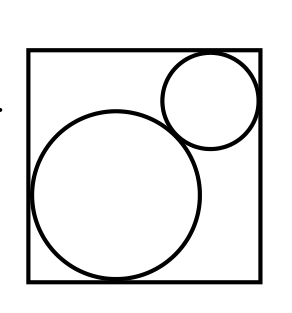
Osserva la figura: due circonferenze hanno il centro sulla stessa diagonale di un quadrato, sono tangenti fra loro e tangenti internamente al quadrato. Il lato del quadrato è lungo 1 metro. Quanto vale la somma delle lunghezze, in metri, dei raggi delle due circonferenze? A) B) C) D)
E) Le informazioni non sono sufficienti. I quesiti dal N. 21 al N. 30 valgono 5 punti ciascuno
Topic: Geometria piana Metodo: Metodo delle coordinate Abilita: Ragionamento geometrico Area: Geometria Risposta: D Fonte: apri PDF p.5
Sum of radii of two circumferences in the square
\begin{document}
\begin{tikzpicture}[scale=4]
  \draw[line width=1pt] (0,0) rectangle (1,1);
  \draw[line width=1pt] (0.371,0.371) circle (0.371);
  \draw[line width=1pt] (0.784,0.784) circle (0.216);
\end{tikzpicture}
\end{document}
Look at the figure: two circumferences have the center on the same diagonal as a square, they are tangent to each other and tangent to the square internally. The side of the square is 1 meter long. What is the sum of the lengths, in meters, of the radii of the two circumferences? A) B) C) D) E) The information is not sufficient. The questions from N. 21 al N. 30 is worth 5 points each.
Answer: D src_kangourou_2007_junior_marzo__Q20
Valore a^3+b^3 dove a,b radici di x^2-3x+1
Chiama a e b le soluzioni dell’equazione x2 - 3x + 1 = 0. Quanto vale a3 + b3 ? A) 12 B) 14 C) 16 D) 18 E) 24
Topic: Algebra Metodo: manipolazione algebrica Abilita: Manipolazione algebrica Area: Algebra e Analisi Risposta: D Fonte: apri PDF p.5
Value a^3+b^3 where a,b roots of x^2-3x+1
Call a and b the solutions of the equation x2 - 3x + 1 = 0. How much is a3 + b3 ? A) 12 B) 14 C) 16 D) 18 E) 24
Answer: D src_kangourou_2007_junior_marzo__Q21
Prodotto di tutti i divisori di 2007
Il prodotto di tutti i divisori (interi) di 2007 vale A) 20072 B) 20073 C) 20074 D) 20075 E) 20076
Topic: Teoria dei Numeri Metodo: manipolazione algebrica Abilita: Manipolazione algebrica Area: Aritmetica e Teoria dei Numeri Risposta: B Fonte: apri PDF p.5
Product of all dividers of 2007
The product of all (internal) dividers in 2007 is A) 20072 B) 20073 C) 20074 D) 20075 E) 20076
Answer: B src_kangourou_2007_junior_marzo__Q22
Quale lettera resta (eliminazioni posti dispari)
La sequenza di lettere KANGAROOKANGAROO…KANGAROO è costruita scrivendo 20 volte di seguito la parola KANGAROO. Elimina dapprima tutte e sole le lettere che occupano nella sequenza un posto dispari; riaccosta quindi le lettere rimaste ed elimina ancora tutte e sole le lettere che nella nuova sequenza occupano un posto dispari; ripeti il procedimento fino a quando rimane una lettera sola. Che lettera è? A) K
B) A
C) N
D) G
E) O
Topic: Teoria dei Numeri Metodo: Induzione Abilita: Riconoscimento di pattern Area: Aritmetica e Teoria dei Numeri Risposta: E Fonte: apri PDF p.5
*What letter remains (elimination occurs oddly) *
The sequence of letters KANGAROOKANGAROO…KANGAROO is constructed by typing the word KANGAROO 20 times in succession. First, remove all the letters that occupy an odd place in the sequence; then put back the remaining letters and delete all the letters that occupy an odd place in the new sequence; repeat the procedure until there is only one letter left. What letter is that? A) K B) A C) N D) G E) O
Answer: E src_kangourou_2007_junior_marzo__Q23
Max abitanti della citta (numero capelli)
In una città non ci sono due persone con lo stesso numero di capelli e nessuno ha esattamente 9999 capelli. Il numero degli abitanti della città è superiore al numero di capelli della persona che ne ha di più. Quanti possono essere al massimo gli abitanti di quella città? A) 1 B) 9997 C) 9998 D) 9999 E) 10000 1 2
1 2 2 −1 2 − 2 Testi_07.qxp 16-04-2007 12:06 Pagina 26
Pag. Pag. 27 27 Kang 2007 Kang 2007
Topic: Combinatoria Metodo: Principio dei cassetti Abilita: generalizzazione Area: Combinatoria, Logica e Probabilita Risposta: D Fonte: apri PDF p.5
*Max population of the city (number of hairs) *
In a city, there are no two people with the same number of hairs, and no one has exactly 9999 hairs. The number of inhabitants of the city is greater than the number of hairs of the person who has more. How many people can that town be? A) 1 B) 9997 C) 9998 D) 9999 E) 10000 1 2
The Commission has decided to extend the scope of this Regulation to the following areas:
I’m going to pay. I’m going to pay. 27 27 Kang 2007 Kang
Answer: D src_kangourou_2007_junior_marzo__Q24
Quale uguaglianza vera (triangolo, esagono, cerchio)
\begin{document}
\begin{tikzpicture}[scale=1.8]
  \draw[line width=0.8pt] (0,0) circle (1);
  \draw[line width=0.8pt]
    (2,0) -- (-1,1.732) -- (-1,-1.732) -- cycle;
  \draw[line width=0.8pt]
    (1,0) -- (-0.5,0.866) -- (-0.5,-0.866) -- cycle;
  \draw[line width=0.8pt]
    (1,0) -- (0.5,0.866) -- (-0.5,0.866) -- (-1,0) -- (-0.5,-0.866) -- (0.5,-0.866) -- cycle;
\end{tikzpicture}
\end{document}
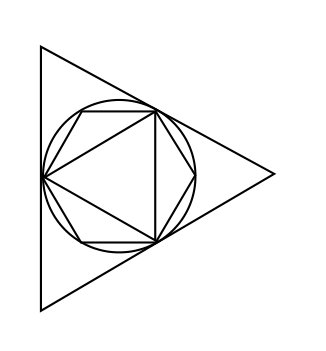
Osserva la figura. Un triangolo equilatero di area t ed un esagono regolare di area E sono inscritti in una circonferenza, che a sua volta è inscritta in un altro triangolo equilatero di area T.Quale delle seguenti uguaglianze è vera? A) B) E = (t + T)/2 C) T = t + E D) E) T = E + 3t
Topic: Geometria piana Metodo: Sfruttamento della simmetria Abilita: Ragionamento geometrico Area: Geometria Risposta: A Fonte: apri PDF p.6
*What is true equality (triangle, hexagon, circle) *
\begin{document}
\begin{tikzpicture}[scale=1.8]
  \draw[line width=0.8pt] (0,0) circle (1);
  \draw[line width=0.8pt]
    (2,0) -- (-1,1.732) -- (-1,-1.732) -- cycle;
  \draw[line width=0.8pt]
    (1,0) -- (-0.5,0.866) -- (-0.5,-0.866) -- cycle;
  \draw[line width=0.8pt]
    (1,0) -- (0.5,0.866) -- (-0.5,0.866) -- (-1,0) -- (-0.5,-0.866) -- (0.5,-0.866) -- cycle;
\end{tikzpicture}
\end{document}
Look at the figure. An equilateral triangle of area t and a regular hexagon of area E are inscribed in a circumference, which in turn is inscribed in another equilateral triangle of area T. Which of the following equations is true? A) B) E = (t + T)/2 C) T = t + E D) E) T = E + 3t
Answer: A src_kangourou_2007_junior_marzo__Q25
Divisori di k (10k quadrato, 6k cubo)
k è il più piccolo numero intero positivo con questa proprietà: 10k è un quadrato perfetto e 6k è un cubo perfetto. Quanti divisori (positivi) ha il numero k ? A) 30 B) 40 C) 54 D) 72 E) 96
Topic: Teoria dei Numeri Metodo: Conteggio combinatorio, manipolazione algebrica Abilita: Manipolazione algebrica Area: Aritmetica e Teoria dei Numeri Risposta: D Fonte: apri PDF p.6
*K dividers (10k squared, 6k cubic) *
k is the smallest positive integer with this property: 10k is a perfect square and 6k is a perfect cube. How many positive divisors does the number k have ? A) 30 B) 40 C) 54 D) 72 E) 96
Answer: D src_kangourou_2007_junior_marzo__Q26
Quante collane rubate (diamanti tra 200 e 300)
Da una cassaforte sono state rubate alcune collane di diamanti, tutte con lo stesso numero di diamanti (almeno 2 per collana). Tutti i diamanti che le componevano vengono ritrovati: il loro numero complessivo è compreso fra 200 e 300. L’investigatore che indaga sul furto, semplicemente contando i diamanti ritrovati, è in grado di risalire con certezza al numero delle collane rubate. Quante collane sono state rubate dalla cassaforte? A) 16 B) 17 C) 19 D) 25 E) un numero diverso dai precedenti
Topic: Teoria dei Numeri Metodo: manipolazione algebrica Abilita: generalizzazione Area: Aritmetica e Teoria dei Numeri Risposta: B Fonte: apri PDF p.6
*How many necklaces were stolen (diamonds between 200 and 300) *
Some diamond necklaces were stolen from a safe, all with the same number of diamonds (at least 2 per necklace). All of the diamonds that made up them are found: their total number is between 200 and 300. The investigator who investigates the theft, simply by counting the diamonds found, can trace the number of necklaces stolen with certainty. How many necklaces were stolen from the safe? A) 16 B) 17 C) 19 D) 25 E) a number different from the previous one
Answer: B src_kangourou_2007_junior_marzo__Q27
Evento piu probabile (estrazione 3 carte)
Per ognuno di quattro colori diversi, in un’urna ci sono tre carte numerate da 1 a 3. Estrai a caso tre carte dall’urna. Quale fra i seguenti eventi è il più probabile? A) Le tre carte estratte sono dello stesso colore. B) Le tre carte estratte, indipendentemente dai loro colori, riportano i numeri 1, 2 e 3. C) Le tre carte estratte sono di tre colori diversi. D) Le tre carte estratte hanno lo stesso numero. E) Nessuno: i quattro eventi precedenti hanno tutti la stessa probabilità di verificarsi.
Topic: Probabilita e statistica Metodo: Conteggio combinatorio Abilita: Conteggio sistematico Area: Combinatoria, Logica e Probabilita Risposta: C Fonte: apri PDF p.6
The most likely event (extraction of 3 cards)
For each of four different colors, there are three cards numbered 1 to 3 in a day. You’ve randomly drawn three cards from the hour. Which of the following is most likely? A) The three extracted cards are of the same colour. B) The three extracted cards, regardless of their colour, bear the numbers 1, 2 and 3. (c) The three extracts are of three different colours. D) The three extracted cards have the same number. E) None: the previous four events all have the same probability of occurring.
Answer: C src_kangourou_2007_junior_marzo__Q28
Modi di scambio regali senza il proprio (5 amici)
Ad una festa cinque amici si scambiano regali in modo che ciascuno faccia e riceva esattamente un regalo (e, naturalmente, che nessuno riceva il proprio regalo). In quanti modi diversi lo possono fare? A) 5 B) 10 C) 44 D) 50 E) 120
Topic: Combinatoria Metodo: Inclusione-esclusione Abilita: Conteggio sistematico Area: Combinatoria, Logica e Probabilita Risposta: C Fonte: apri PDF p.6
How to exchange gifts without one’s own (5 friends)
At a party, five friends exchange gifts so that each one makes and receives exactly one gift (and, of course, no one receives their own gift). How many different ways can they do this? A) 5 B) 10 C) 44 D) 50 E) 120
Answer: C src_kangourou_2007_junior_marzo__Q29
Volume del tetraedro regolare (distanza spigoli)
In un tetraedro regolare la distanza fra due spigoli che non si tocchino è 6 centimetri. Qual è, in centimetri cubi, il volume del tetraedro? A) 18 B) 36 C) 48 D) 72 E) 14 Testi_07.qxp 16-04-2007 12:06 Pagina 27
1 Kangourou della Matematica 2007 Categoria Junior Per studenti di seconda o terza delle scuola secondaria di secondo grado
Topic: Geometria solida Metodo: Metodo delle coordinate Abilita: Ragionamento geometrico Area: Geometria Risposta: D Fonte: apri PDF p.6
*Volume of the regular tetrahedron (spindle distance) *
In a regular tetrahedron, the distance between two untouched spikes is 6 centimeters. What is the volume of the tetrahedron in cubic centimeters? A) 18 B) 36 C) 48 D) 72 E) 14 Texts_07.qxp
1 Kangourou of Mathematics 2007 Junior category For secondary or tertiary secondary school students
Answer: D src_kangourou_2007_junior_marzo__Q30