Quale simbolo rende vera 1+11-2=100*
Considera l’uguaglianza 1 + 1 ∗1 – 2 = 100. Quale fra i segni o le cifre che seguono devi sostituire al simbolo ∗ per renderla vera? A) + B) – C) x D) 0 E) 1
Topic: Teoria dei Numeri Abilita: Lettura attenta del testo Area: Aritmetica e Teoria dei Numeri Risposta: D Fonte: apri PDF p.1
Which symbol makes true 1+11-2=100*
Consider the equation 1 + 1 1 2 = 100. Which of the following signs or numbers do you need to replace with the symbol to make it true? A) + B) – C) x D) 0 E) 1
Answer: D src_kangourou_2008_ecolier_marzo__Q01
Quante stelline nella figura
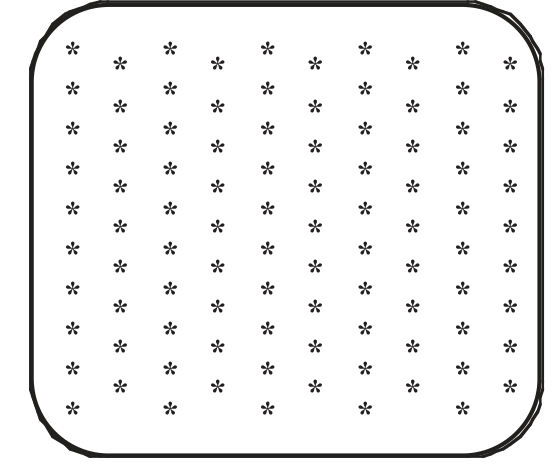
Quante stelline ci sono nella figura? A) 100 B) 90 C) 95 D) 85 E) 105
Topic: Teoria dei Numeri, Combinatoria Abilita: Conteggio sistematico Area: Aritmetica e Teoria dei Numeri, Combinatoria, Logica e Probabilita Risposta: C Fonte: apri PDF p.1
How many stars in the figure
How many stars are in the figure? A) 100 B) 90 C) 95 D) 85 E) 105
Answer: C src_kangourou_2008_ecolier_marzo__Q02
Che fiore riceve la mamma
Miriam porta alla mamma, alla nonna, alla zia e alle sue due sorelle un fiore per ciascuna. Sai che • i fiori per le sorelle e per la zia hanno lo stesso colore; • la nonna non riceve una rosa. Che fiore riceve la mamma, se i fiori regalati da Miriam sono quelli indicati qui sotto? A) Un tulipano giallo. B) Una rosa rossa. C) Un garofano rosso. D) Una rosa gialla. E) Un garofano giallo.
Topic: Logica, giochi, strategie Abilita: Casework accurato Area: Combinatoria, Logica e Probabilita Risposta: B Fonte: apri PDF p.1
What a flower the mother receives
Miriam brings her mother, grandmother, aunt, and two sisters a flower for each. Do you know that • the flowers for the sisters and the aunt are the same color; • the grandmother does not receive a rose. What flower does the mother receive, if Miriam’s gift is the one listed below? A) A yellow tulip. B) A red rose. C) A red carnation. D) A yellow rose. E) A yellow carnation.
Answer: B src_kangourou_2008_ecolier_marzo__Q03
Quanti quadrati nella sesta figura
\begin{document}
\begin{tikzpicture}[scale=1]
\draw (0,0) rectangle (2,2);
\draw (1,0)--(1,2);
\draw (0,1)--(2,1);
\begin{scope}[xshift=2.5cm]
\draw (0,0) rectangle (2,2);
\draw (1,0)--(1,2);
\draw (0,1)--(2,1);
\draw (1.5,1)--(1.5,2);
\draw (1,1.5)--(2,1.5);
\end{scope}
\begin{scope}[xshift=5cm]
\draw (0,0) rectangle (2,2);
\draw (1,0)--(1,2);
\draw (0,1)--(2,1);
\draw (1.5,1)--(1.5,2);
\draw (1,1.5)--(2,1.5);
\draw (1.75,1.5)--(1.75,2);
\draw (1.5,1.75)--(2,1.75);
\end{scope}
\end{tikzpicture}
\end{document}
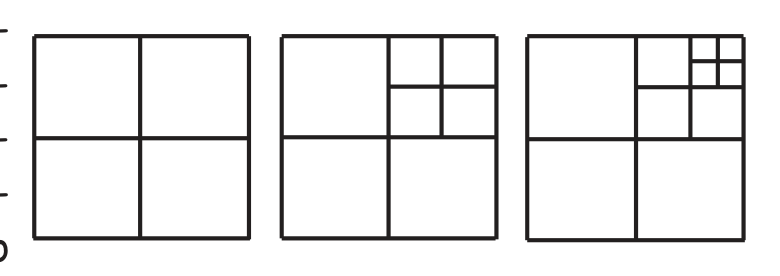
Nelle tre figure puoi osservare tre quadrati grandi, ognuno suddiviso in quadrati più piccoli secondo la regola seguente: passando da un quadrato grande al successivo, il quadrato in alto a destra viene suddiviso in 4 quadrati più piccoli. Se non conteggiamo i quadrati che sono suddivisi
Testi_08.qxp 9-03-2008 14:56 Pagina 5
Pag. Pag. 6 Kang 2008 Kang 2008 in quadrati più piccoli, nella prima figura vi sono 4 quadrati, nella seconda 7, nella terza 10. Proseguendo in questo modo, quanti quadrati vi saranno nella sesta figura (sempre escludendo i quadrati che ne contengono altri)? A) 16 B) 17 C) 18 D) 19 E) 20
Topic: Combinatoria, successioni Abilita: Riconoscimento di pattern Area: Algebra e Analisi, Combinatoria, Logica e Probabilita Risposta: D Fonte: apri PDF p.2
Quantity of squares in the sixth figure
\begin{document}
\begin{tikzpicture}[scale=1]
\draw (0,0) rectangle (2,2);
\draw (1,0)--(1,2);
\draw (0,1)--(2,1);
\begin{scope}[xshift=2.5cm]
\draw (0,0) rectangle (2,2);
\draw (1,0)--(1,2);
\draw (0,1)--(2,1);
\draw (1.5,1)--(1.5,2);
\draw (1,1.5)--(2,1.5);
\end{scope}
\begin{scope}[xshift=5cm]
\draw (0,0) rectangle (2,2);
\draw (1,0)--(1,2);
\draw (0,1)--(2,1);
\draw (1.5,1)--(1.5,2);
\draw (1,1.5)--(2,1.5);
\draw (1.75,1.5)--(1.75,2);
\draw (1.5,1.75)--(2,1.75);
\end{scope}
\end{tikzpicture}
\end{document}
In the three figures you can see three large squares, each divided into smaller squares according to the following rule: going from one large square to the next, the square at the top right is divided into 4 smaller squares. If we do not count the squares that are divided * * * * * * * * * *
The Commission shall adopt delegated acts in accordance with the opinion of the European Parliament and of the Council concerning:
I’m going to pay. I’m going to pay. 6 Kang 2008 Kang 2008 in smaller squares, in the first figure there are 4 squares, in the second 7, in the third 10. In this way, how many squares will there be in the sixth figure (always excluding squares containing others)? A) 16 B) 17 C) 18 D) 19 E) 20
Answer: D src_kangourou_2008_ecolier_marzo__Q04
In quanti orari poteva iniziare la telefonata
L’orologio digitale di Lucia è difettoso: qualche volta fa apparire la cifra 8 al posto della cifra 0 e qualche volta fa apparire la cifra 0 al posto della cifra 8. All’inizio di una telefonata, Lucia ha guardato il suo orologio e ha letto 20:08. In quanti diversi orari potrebbe essere iniziata quella telefonata? A) 1 B) 2 C) 3 D) 4 E) 8
Topic: Logica, giochi, strategie, Teoria dei Numeri Metodo: Analisi per casi Abilita: Casework accurato Area: Aritmetica e Teoria dei Numeri, Combinatoria, Logica e Probabilita Risposta: B Fonte: apri PDF p.2
How many hours could the call start
Lucia’s digital clock is flawed: sometimes it shows the digit 8 instead of the digit 0, and sometimes it shows the digit 0 instead of the digit 8. At the beginning of a phone call, Lucia looked at her watch and read 20:08. How many different times could that phone call have started? A) 1 B) 2 C) 3 D) 4 E) 8
Answer: B src_kangourou_2008_ecolier_marzo__Q05
In quante parti 4 rette per un punto dividono il foglio
\begin{document}
\begin{tikzpicture}
\draw (0,0) rectangle (4,2);
\fill (2,1) circle (2pt);
\end{tikzpicture}
\end{document}
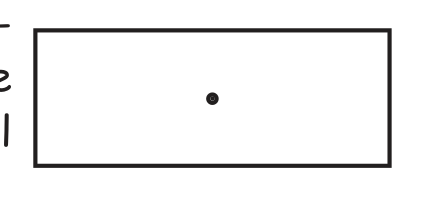
In figura vedi un foglio sul quale è stato segnato un punto. Se tracci sul foglio quattro rette tutte diverse fra loro, ma tutte passanti per quel punto, in quante parti risulta suddiviso il foglio? A) 4 B) 6
C) 5
D) 8
E) 12
Topic: Geometria piana, Combinatoria Abilita: Ragionamento geometrico Area: Combinatoria, Logica e Probabilita, Geometria Risposta: D Fonte: apri PDF p.2
In which parts 4 lines per point divide the sheet
\begin{document}
\begin{tikzpicture}
\draw (0,0) rectangle (4,2);
\fill (2,1) circle (2pt);
\end{tikzpicture}
\end{document}
In the figure you see a sheet of paper marked with a dot. If you draw on the sheet four lines, all of which are different from each other, but all of which pass through that point, how many parts does the sheet divide? A) 4 B) 6 C) 5 D) 8 E) 12
Answer: D src_kangourou_2008_ecolier_marzo__Q06
Chi e il piu alto di tutti
Aldo è più alto di Bruno, ma più basso di Enrico. Dario è più alto di Carlo, ma più basso di Aldo. Chi è il più alto di tutti? A) Aldo B) Bruno C) Carlo D) Dario E) Enrico
Topic: Logica, giochi, strategie Abilita: Casework accurato Area: Combinatoria, Logica e Probabilita Risposta: E Fonte: apri PDF p.2
Who is the tallest of all
Aldo is taller than Bruno, but lower than Enrico. Darius is taller than Charles, but lower than Aldo. Who’s the tallest of them all? (A) Aldo B) Bruno C) Charles D) Darius E) Henry
Answer: E src_kangourou_2008_ecolier_marzo__Q07
Chi puo costruire un cubo pieno
Andrea ha 8 cubetti, Bernardo ne ha 12, Cesare ne ha 16, Diana ne ha 20. I cubetti di ogni ragazzo sono tutti uguali fra loro. Fra questi ragazzi, chi può costruire un grande cubo pieno usando tutti i suoi cubetti? A) Solo Andrea. B) Solo Cesare. C) Sia Diana sia Bernardo. D) Sia Andrea sia Diana. E) Nessuno dei quattro. I quesiti dal N. 9 al N. 16 valgono 4 punti ciascuno
Topic: Teoria dei Numeri, Geometria solida Abilita: Manipolazione algebrica Area: Aritmetica e Teoria dei Numeri, Geometria Risposta: A Fonte: apri PDF p.2
Who can build a full cube
Andrea has eight cubes, Bernardo has 12, Caesar has 16, Diana has 20. Every boy’s cubes are all the same. Of these guys, who can build a big full cube using all its cubes? A) Just Andrew. B) Only Caesar. C) Both Diana and Bernardo. D) Both Andrea and Diana. E) None of the four. The questions from N. 9 al N. 16 is worth 4 points each.
Answer: A src_kangourou_2008_ecolier_marzo__Q08
Fra quanti anni unita = 4 volte migliaia
Il numero che esprime l’anno 2008 ha la cifra delle unità uguale a quattro volte la cifra delle migliaia. Fra quanti anni si ripresenterà per la prima volta la medesima situazione? A) 10 B) 100 C) 1000 D) 2008 E) Un numero di anni diverso dai precedenti. Testi_08.qxp 9-03-2008 14:56 Pagina 6
Pag. Pag. 7 Kang 2008 Kang 2008
Topic: Teoria dei Numeri Abilita: Riconoscimento di pattern Area: Aritmetica e Teoria dei Numeri Risposta: A Fonte: apri PDF p.3
*For how many years combined = 4 times thousands *
The number that represents the year 2008 has the number of units equal to four times the number of thousands. In how many years will the same situation be repeated for the first time? A) 10 B) 100 C) 1000 D) 2008 E) A number of years different from the previous ones. This is the main reason why we are not prepared to accept the proposal.
I’m going to pay. I’m going to pay. 7 Kang 2008 Kang 2008
Answer: A src_kangourou_2008_ecolier_marzo__Q09
Tempo tra inizio primo e fine terzo brano
Su un CD sono incisi alcuni pezzi musicali: esaminando i primi tre, il primo dura 6 minuti e 25 secondi, il secondo 12 minuti e 25 secondi, il terzo 10 minuti e 13 secondi. Ognuno dei pezzi è separato dal successivo da un intervallo di 5 secondi. Ascoltando il CD, quanto tempo passa fra l’inizio del primo pezzo e la fine del terzo? A) 28 minuti e 3 secondi B) 28 minuti e 18 secondi C) 29 minuti e 13 secondi
D) 29 minuti e 3 secondi E) 29 minuti e 18 secondi
Topic: Teoria dei Numeri Abilita: traduzione del testo Area: Aritmetica e Teoria dei Numeri Risposta: C Fonte: apri PDF p.3
Time between the beginning of the first and the end of the third line
On a CD, some pieces of music are recorded: the first takes 6 minutes and 25 seconds, the second 12 minutes and 25 seconds, the third 10 minutes and 13 seconds. Each piece is separated from the next by an interval of 5 seconds. Listening to the CD, how much time passes between the beginning of the first piece and the end of the third? A) 28 minutes and 3 seconds B) 28 minutes and 18 seconds C) 29 minutes and 13 seconds D) 29 minutes and 3 seconds E) 29 minutes and 18 seconds
Answer: C src_kangourou_2008_ecolier_marzo__Q10
Quale costruzione di cubetti non e realizzabile
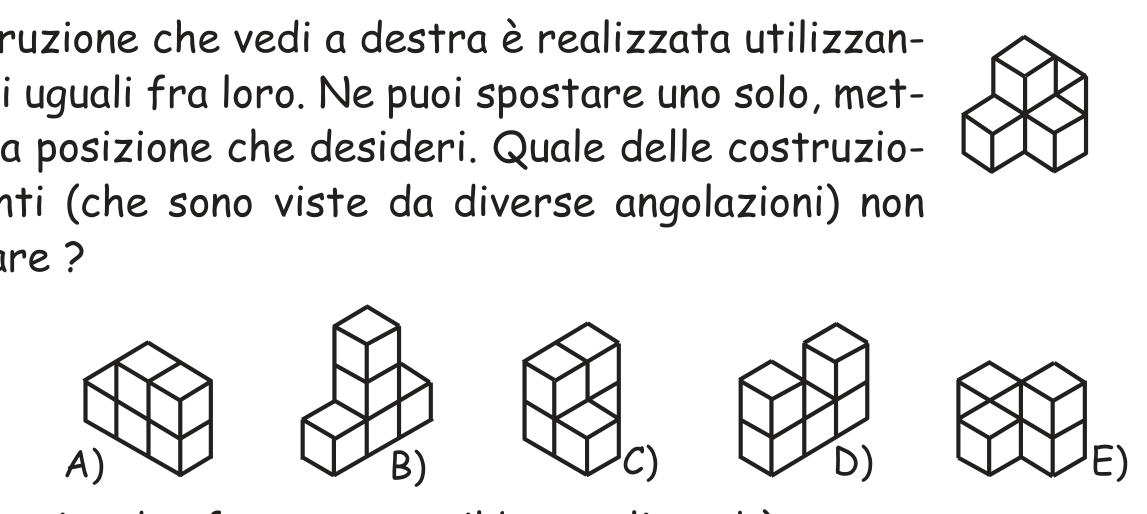
La costruzione che vedi a destra è realizzata utilizzando 5 cubetti uguali fra loro. Ne puoi spostare uno solo, mettendolo nella posizione che desideri. Quale delle costruzioni sottostanti (che sono viste da diverse angolazioni) non può realizzare ?
Topic: Geometria solida Abilita: Ragionamento geometrico Area: Geometria Risposta: D Fonte: apri PDF p.3
Which construction of cubes is not feasible
The construction you see on the right is done using 5 equal cubes. You can move only one, put it in the position you want. Which of the underlying constructions (seen from different angles) cannot be realized ?
Answer: D src_kangourou_2008_ecolier_marzo__Q11
Quanti punteggi diversi con due frecce
\begin{document}
\begin{tikzpicture}
\draw (0,0) circle (2cm);
\draw (0,0) circle (1.2cm);
\draw (0,0) circle (0.55cm);
\node at (0,0) {6};
\node at (0,0.9) {3};
\node at (0,1.65) {2};
\draw[->,thick] (-2.2,0.6) -- (-1.5,0.4);
\draw[->,thick] (-2.2,-0.3) -- (-0.9,-0.2);
\end{tikzpicture}
\end{document}
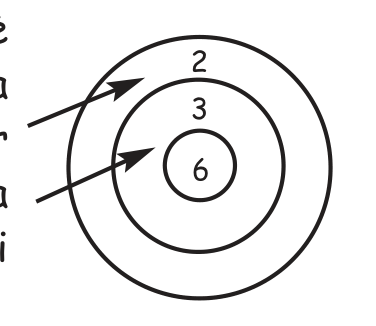
Giovanna tira due frecce verso il bersaglio, ed è sicura di colpirlo. Il punteggio ottenuto è la somma dei punteggi realizzati con le singole frecce: per esempio nella figura vediamo una situazione nella quale il punteggio ottenuto è 5. Quanti punteggi diversi fra loro può ottenere Giovanna (5 incluso)? A) 4 B) 6 C) 8 D) 9 E) 10
Topic: Combinatoria Metodo: Conteggio combinatorio Abilita: Conteggio sistematico Area: Combinatoria, Logica e Probabilita Risposta: B Fonte: apri PDF p.3
How many different scores with two arrows
\begin{document}
\begin{tikzpicture}
\draw (0,0) circle (2cm);
\draw (0,0) circle (1.2cm);
\draw (0,0) circle (0.55cm);
\node at (0,0) {6};
\node at (0,0.9) {3};
\node at (0,1.65) {2};
\draw[->,thick] (-2.2,0.6) -- (-1.5,0.4);
\draw[->,thick] (-2.2,-0.3) -- (-0.9,-0.2);
\end{tikzpicture}
\end{document}
Joan throws two arrows at the target, and she’s sure to hit him. The resulting score is the sum of the scores achieved with the individual arrows: for example, in the figure we see a situation in which the resulting score is 5. How many different scores among them can Giovanna get (5 included)? A) 4 B) 6 C) 8 D) 9 E) 10
Answer: B src_kangourou_2008_ecolier_marzo__Q12
Numeri di 4 cifre con cifra doppio della destra
Quanti diversi numeri di 4 cifre puoi scrivere, se vuoi che ogni cifra (esclusa quella delle unità) sia il doppio di quella che si trova immediatamente alla sua destra? A) 0 B) 1 C) 2 D) 3 E) 4
Topic: Teoria dei Numeri, Combinatoria Abilita: Riconoscimento di pattern Area: Aritmetica e Teoria dei Numeri, Combinatoria, Logica e Probabilita Risposta: B Fonte: apri PDF p.3
Four-digit numbers with a right-hand double digit
How many different 4-digit numbers can you write if you want every digit (except the unit number) to be double the one immediately to your right? A) 0 B) 1 C) 2 D) 3 E) 4
Answer: B src_kangourou_2008_ecolier_marzo__Q13
Massimo mattoncini 1x2x4 in scatola 4x4x4
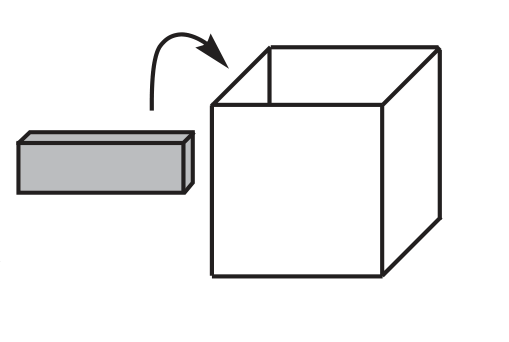
Hai un certo numero di mattoncini di dimensioni 1 cm x 2 cm x 4 cm. Vuoi inserirne il maggior numero possibile in una scatola cubica le cui dimensioni sono 4 cm x 4 cm x 4 cm, in modo che la scatola possa essere chiusa da un coperchio. Quanti mattoncini puoi inserire nella scatola al massimo? A) 6 B) 7 C) 8 D) 9 E) 10 6 3 2 A) B) C) D) E) Testi_08.qxp 9-03-2008 14:56 Pagina 7
Topic: Geometria solida Abilita: Ragionamento geometrico Area: Geometria Risposta: C Fonte: apri PDF p.3
Maximum bricks 1x2x4 in a box 4x4x4
You have a number of bricks that are 1cm x 2cm x 4cm. You want to put as many of them as possible in a cubic box whose dimensions are 4 cm x 4 cm x 4 cm, so that the box can be closed by a lid. How many bricks can you put in the box at most? A) 6 B) 7 C) 8 D) 9 E) 10 6 3 2 A) B) C) D) E) Text_08.qxp
Answer: C src_kangourou_2008_ecolier_marzo__Q14
Perimetro della piscina nel giardino quadrato
\begin{document}
\begin{tikzpicture}
\draw (0,0) rectangle (2,2);
\draw (1,0)--(1,2);
\draw (0,1)--(2,1);
\node at (0.5,1.5) {$P$};
\node at (1.5,1.5) {$A$};
\node at (0.5,0.5) {$G$};
\node at (1.5,0.5) {$S$};
\end{tikzpicture}
\end{document}
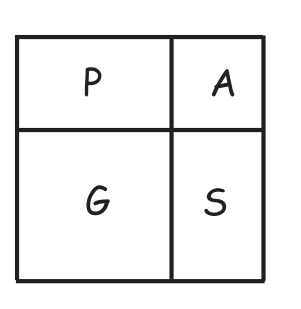
In figura vedi la pianta di un giardino quadrato, suddiviso in una piscina (P), un’aiuola (A), un’area - giochi (G) e una serra (S). L’aiuola e l’area-giochi sono entrambe quadrate. Il perimetro dell’aiuola misura 12 metri, quello dell’area-giochi 20 metri. Quanto misura in metri il perimetro della piscina? A) 10
B) 12
C) 14
D) 16
E) 18
Topic: Geometria piana Abilita: Ragionamento geometrico Area: Geometria Risposta: D Fonte: apri PDF p.4
Perimeter of the swimming pool in the square garden
\begin{document}
\begin{tikzpicture}
\draw (0,0) rectangle (2,2);
\draw (1,0)--(1,2);
\draw (0,1)--(2,1);
\node at (0.5,1.5) {$P$};
\node at (1.5,1.5) {$A$};
\node at (0.5,0.5) {$G$};
\node at (1.5,0.5) {$S$};
\end{tikzpicture}
\end{document}
In the figure you can see the plant of a square garden, divided into a swimming pool (P), a rooftop (A), a play area (G) and a greenhouse (S). The roof and the play area are both square. The perimeter of the roof measures 12 metres, the perimeter of the play area 20 metres. What is the perimeter of the pool in meters? A) 10 B) 12 C) 14 D) 16 E) 18
Answer: D src_kangourou_2008_ecolier_marzo__Q15
Quanti anni su Frettoloso
Sul pianeta Frettoloso un anno dura 3 mesi, un mese dura 10 giorni e un giorno dura come un giorno sul pianeta Terra. Giovanna, sulla Terra, ha 360 giorni. Quanti anni avrebbe su Frettoloso? A) 4 B) 6 C) 10 D) 12 E) Un altro numero. I quesiti dal N. 17 al N. 24 valgono 5 punti ciascuno
Topic: Teoria dei Numeri Abilita: traduzione del testo Area: Aritmetica e Teoria dei Numeri Risposta: D Fonte: apri PDF p.4
How many years on Frettoloso
On the fast-moving planet, a year lasts three months, a month lasts 10 days, and a day lasts as long as a day on planet Earth. Joan on Earth has 360 days. How old would she be on “Friday”? A) 4 B) 6 C) 10 D) 12 E) Another number. The questions from N. 17 al N. Twenty-four is worth five points each.
Answer: D src_kangourou_2008_ecolier_marzo__Q16
Peso del canguro nell autunno 2004
Un canguro in inverno ingrassa di 5 chili e in estate dimagrisce di 4. Il suo peso viene controllato in primavera e in autunno. Nella primavera 2008 il canguro pesa 100 chili. Quanti chili pesava nell’autunno 2004? A) 92
B) 93
C) 95
D) 96
E) 98
Topic: Algebra Metodo: Ragionamento all’indietro Abilita: traduzione del testo Area: Algebra e Analisi Risposta: A Fonte: apri PDF p.5
Weight of the kangaroo in autumn 2004
A kangaroo gets 5 pounds in winter and 4 pounds in summer. Her weight is monitored in spring and autumn. In the spring of 2008, the kangaroo weighed 100 pounds. How many pounds did he weigh in the fall of 2004? A) 92 B) 93 C) 95 D) 96 E) 98
Answer: A src_kangourou_2008_ecolier_marzo__Q17
Numero di figli nella famiglia
Guglielmo ha tante sorelle quanti fratelli. Per sua sorella Anna, il numero dei fratelli è il doppio di quello delle sorelle. Quanti figli vi sono in quella famiglia? A) 3 B) 4 C) 5 D) 6 E) 7
Topic: Algebra, Logica, giochi, strategie Abilita: traduzione del testo Area: Algebra e Analisi, Combinatoria, Logica e Probabilita Risposta: E Fonte: apri PDF p.5
Number of children in the family
William has as many sisters as brothers. For his sister Anna, the number of brothers is twice that of sisters. How many children are there in that family? A) 3 B) 4 C) 5 D) 6 E) 7
Answer: E src_kangourou_2008_ecolier_marzo__Q18
Peso complessivo dei tre frutti
Una pera, una mela ed una prugna si trovano sul piatto di una bilancia. Se togliamo la pera, la bilancia indica 230 grammi; se togliamo la mela la bilancia indica 200 grammi; se togliamo la prugna, la bilancia indica 290 grammi. Quanti grammi pesano complessivamente i 3 frutti? A) 200 B) 250 C) 300 D) 360 E) 420
Topic: Algebra Abilita: traduzione del testo Area: Algebra e Analisi Risposta: D Fonte: apri PDF p.5
Total weight of the three fruits
A pear, an apple, and a plum are on the plate of a scale. If we remove the pear, the balance is 230 grams; if we remove the apple, the balance is 200 grams; if we remove the plum, the balance is 290 grams. How many grams weigh all three fruits? A) 200 B) 250 C) 300 D) 360 E) 420
Answer: D src_kangourou_2008_ecolier_marzo__Q19
Quale forma non puo avere la sezione della piramide
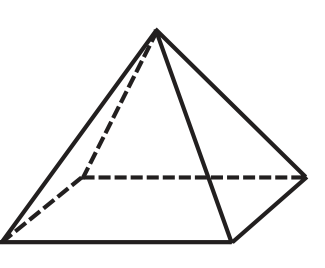
Una piramide piena a base quadrata, esternamente verniciata di nero, viene sezionata in due parti con un taglio piano. Poiché la piramide è di legno chiaro, ognuna delle due parti ha una faccia chiara mentre tutte le altre sono evidentemente nere. Quale delle seguenti non può essere la forma della faccia chiara? Pag. Pag. 8 Kang 2008 Kang 2008 P G A S Testi_08.qxp 9-03-2008 14:56 Pagina 8
Pag. Pag. 9 Kang 2008 Kang 2008 A) Quadrato B) Trapezio C) Triangolo D) Pentagono
E) Tutte le forme elencate sono possibili
Topic: Geometria solida Abilita: Ragionamento geometrico Area: Geometria Risposta: E Fonte: apri PDF p.5
What shape can’t have the pyramid section
A full pyramid with a square base, outwardly painted black, is cut into two parts with a flat cut. Since the pyramid is of clear wood, each of the two sides has a clear face while all the others are obviously black. Which of the following cannot be the shape of the clear face? I’m going to pay. I’m going to pay. 8 Kang 2008 Kang 2008 P G A S Texts_08.qxp 9-03-2008 14:56 Page 8
I’m going to pay. I’m going to pay. 9 Kang 2008 Kang 2008 A) Square B) Trapezoid C) Triangle D) Pentagon E) All the shapes listed are possible
Answer: E src_kangourou_2008_ecolier_marzo__Q20
Quanti naturali 2-3 cifre maggiori della somma cifre
Quanti sono i numeri interi naturali di 2 o 3 cifre che sono maggiori della somma delle loro cifre? A) 1 B) 100 C) 989 D) 990 E) 999
Topic: Teoria dei Numeri, Combinatoria Metodo: Conteggio combinatorio Abilita: Conteggio sistematico Area: Aritmetica e Teoria dei Numeri, Combinatoria, Logica e Probabilita Risposta: D Fonte: apri PDF p.5
*Natural quantities 2 to 3 digits greater than the sum of the digits *
How many two- or three-digit natural integers are greater than the sum of their digits? A) 1 B) 100 C) 989 D) 990 E) 999
Answer: D src_kangourou_2008_ecolier_marzo__Q21
Quante date leggibili al contrario
Se leggi la data 21.02 (il 21 febbraio) da destra a sinistra, ottieni 20.12 ed in questo caso si tratta ancora di una data possibile (il 20 dicembre). Invece la data 10.09 (il 10 settembre) non possiede questa proprietà (non esiste il 90 gennaio). Quante date, in un anno, possiedono questa proprietà (cioè sono come il 21 febbraio)? A) 30 B) 18 C) 36 D) 35 E) Dipende dall’anno
Topic: Combinatoria, Logica, giochi, strategie Metodo: Conteggio per casi Abilita: Casework accurato Area: Combinatoria, Logica e Probabilita Risposta: 34 Fonte: apri PDF p.5
How many dates are readable in reverse
If you read the date 21.02 (February 21) from right to left, you get 20.12 and in this case it is still a possible date (December 20). However, the date 10.09 (10 September) does not have this property (there is no date 90 January). How many dates in a year do they have this property (i.e. are like February 21st)? A) 30 B) 18 C) 36 D) 35 E) Depends on the year
Answer: 34 src_kangourou_2008_ecolier_marzo__Q22
Almeno quante persone con la stessa eta
In una piazza si sono radunate 2008 persone. Nessuna di loro ha più di 50 anni. Qual è il più grande numero per il quale è vero quanto segue: “siamo sicuri che nella piazza vi è almeno quel numero di persone che hanno la stessa età” ? A) 39 B) 40 C) 41 D) 42 E) Nessuno dei precedenti.
Topic: Combinatoria Metodo: Principio dei cassetti Abilita: Conteggio sistematico Area: Combinatoria, Logica e Probabilita Risposta: B Fonte: apri PDF p.5
At least as many people as the same age
In a square, 2008 people gathered. None of them are over 50. What is the largest number for which the following is true: Are we sure that there are at least that number of people in the square who are the same age? A) 39 B) 40 C) 41 D) 42 E) None of the above.
Answer: B src_kangourou_2008_ecolier_marzo__Q23
Somma carte del primo saggio (parita)
Una scatola contiene sette carte numerate da 1 a 7. Due saggi pescano a caso delle carte dalla scatola: il primo ne prende tre, il secondo due delle rimanenti; le ultime due restano chiuse nella scatola. Il primo saggio, dopo aver guardato solo i numeri scritti sulle carte da lui pescate, dice al secondo: “Sono certo che la somma dei numeri riportati sulle tue carte è pari”. Quanto vale la somma dei numeri riportati sulle carte pescate dal primo saggio? A) 10 B) 12 C) 6 D) 9 E) 15 Testi_08.qxp 9-03-2008 14:56 Pagina 9
1 Kangourou della Matematica 2008 Categoria Écolier Per studenti di quarta o quinta della scuola primaria
Topic: Combinatoria, Logica, giochi, strategie Metodo: Analisi per casi Abilita: Casework accurato Area: Combinatoria, Logica e Probabilita Risposta: B Fonte: apri PDF p.5
*Sum of cards from the first essay (parity) *
A box contains seven cards numbered from 1 to 7. Two wise men randomly take the cards out of the box: the first takes three, the second two of the remaining cards; the last two remain closed in the box. The first essay, after looking only at the numbers written on the cards he caught, says to the second: “I am sure that the sum of the numbers shown on your cards is equal”. How much is the sum of the numbers shown on the cards the first essay read? The Commission has decided to extend the scope of this Regulation to the following areas:
1 Kangourou of Mathematics 2008 Category Écolier For fourth or fifth graders of primary school
Answer: B src_kangourou_2008_ecolier_marzo__Q24