Maggiore dei due incogniti nella tabella 2x2
Nelle celle di un tabella 2 x 2 sono scritti (uno per cella) i numeri 3 e 4 e due numeri non noti. Si sa che la somma dei numeri di una riga è 5, la somma dei numeri dell’altra riga è 10 e la somma dei numeri di una colonna è 9. Qual è il più grande dei due numeri incogniti?
A) 5 B) 6 C) 7 D) 8 E) 3
Topic: Algebra Abilita: Manipolazione algebrica Area: Algebra e Analisi Risposta: B Fonte: apri PDF p.1
Most of the two unknowns in Table 2x2
In the cells of a 2 x 2 table, the numbers 3 and 4 and two unknown numbers are written (one per cell). You know the sum of the numbers in one row is 5, the sum of the numbers in the other row is 10, and the sum of the numbers in one column is 9. Which is the larger of the two unknown numbers? A) 5 B) 6 C) 7 D) 8 E) 3
Answer: B src_kangourou_2008_student_marzo__Q01
Valore di x^2008/y^2008 con x+y=0
Se x + y = 0 e x ≠y, allora
A) −1 B) 0 C) 1 D) 22008 E) x/y
Topic: Algebra Abilita: Manipolazione algebrica Area: Algebra e Analisi Risposta: C Fonte: apri PDF p.1
Value of x^2008/y^2008 with x+y=0
If x + y = 0 and x ≠y, then = A) −1 B) 0 C) 1 D) 22008 E) x/y
Answer: C src_kangourou_2008_student_marzo__Q02
Quante celle restano dopo cancellazioni (33x21)
In una tabella rettangolare 33 x 21 le righe sono numerate da 1 a 33 e le colonne sono numerate da 1 a 21. Cancelliamo le righe il cui numero non è un multiplo di 3 e le colonne il cui numero è pari. Quante celle rimangono nella tabella? A) 110 B) 121 C) 115,5 D) 119 E) 242
Topic: Teoria dei Numeri, Combinatoria Metodo: Conteggio combinatorio Abilita: Conteggio sistematico Area: Aritmetica e Teoria dei Numeri, Combinatoria, Logica e Probabilita Risposta: B Fonte: apri PDF p.1
*How many cells remain after deletion (33x21) *
In a rectangular table 33 x 21, the rows are numbered from 1 to 33 and the columns are numbered from 1 to 21. We delete the rows whose number is not a multiple of 3 and the columns whose number is equal. How many cells are left in the table? A) 110 B) 121 C) 115,5 D) 119 E) 242
Answer: B src_kangourou_2008_student_marzo__Q03
Quanti primi p tali che p^4+1 sia primo
Quanti numeri primi p hanno la proprietà che anche p4 +1 è primo? (Ricorda che 1 non è un numero primo.) A) Nessuno B) 1 C) 2 D) 3 E) Infiniti
Topic: Teoria dei Numeri Metodo: congruenze Abilita: Manipolazione algebrica Area: Aritmetica e Teoria dei Numeri Risposta: B Fonte: apri PDF p.1
*How many prime p such that p^4+1 is prime *
How many prime numbers p have the property that p4+1 is also prime? (Remember that 1 is not a prime number.) A) None B) 1 C) 2 D) 3 E) Infinite
Answer: B src_kangourou_2008_student_marzo__Q04
Parte d acqua in B (biforcazioni del fiume)

Un fiume inizia nel punto A. Nel suo corso si divide in due; il primo ramo riceve i 2/3 dell’ acqua e il secondo il resto. Più avanti il primo ramo si divide in tre sottorami, di cui il primo riceve 1/8 dell’ acqua, il secondo 5/8 e il terzo il resto. Infine quest’ultimo sottoramo incontra il secondo ramo della prima biforcazione del fiume: la mappa qui sotto illustra la situazione. Che parte dell’acqua iniziale fluisce nel punto B? x2008 y2008 A B 2 3 1 8 5 8 Testi_08.qxp 9-03-2008 14:56 Pagina 28
Pag. Pag. 29 29 Kang 2008 Kang 2008 A) B) C) D) E)
Topic: Teoria dei Numeri Abilita: Manipolazione algebrica Area: Aritmetica e Teoria dei Numeri Risposta: D Fonte: apri PDF p.1
*Part of water in B (river forks) *
A river starts at point A. In its course it is divided into two parts; the first branch receives 2/3 of the water and the second the rest. Later the first branch is divided into three sub-branches, of which the first receives 1/8 of the water, the second 5/8 and the third the rest. Finally, the latter sub-region encounters the second branch of the first river fork: the map below illustrates the situation. What part of the initial water flows to point B? The Commission has decided to extend the scope of this Regulation to the following areas:
I’m going to pay. I’m going to pay. 29 29 Kang 2008 Kang 2008 A) B) C) D) E)
Answer: D src_kangourou_2008_student_marzo__Q05
Misura angolo ACB (triangolo isoscele con D)
\begin{document}
\begin{tikzpicture}[scale=2]
  \coordinate (A) at (0,0);
  \coordinate (B) at (3,0);
  \coordinate (C) at ({1.854*0.809}, {1.854*0.588});
  \coordinate (D) at ({1.854}, 0);
  \draw (A) -- (B) -- (C) -- cycle;
  \draw (C) -- (D);
  \node[below left] at (A) {$A$};
  \node[below right] at (B) {$B$};
  \node[above] at (C) {$C$};
  \node[below] at (D) {$D$};
\end{tikzpicture}
\end{document}
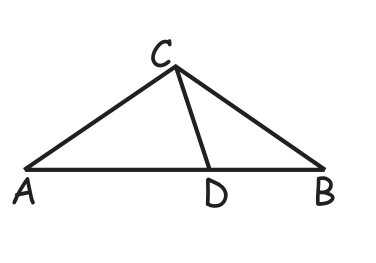
È dato un triangolo isoscele ABC (CA = CB). Il punto D sul lato AB è tale che AD = AC e DB = DC (vedi figura). Allora la misura dell’angolo ACB è A) 98° B) 100° C) 104° D) 108° E) 110°
Topic: Geometria piana Abilita: Ragionamento geometrico Area: Geometria Risposta: D Fonte: apri PDF p.2
*Measure the ACB angle (isosceles triangle with D) *
\begin{document}
\begin{tikzpicture}[scale=2]
  \coordinate (A) at (0,0);
  \coordinate (B) at (3,0);
  \coordinate (C) at ({1.854*0.809}, {1.854*0.588});
  \coordinate (D) at ({1.854}, 0);
  \draw (A) -- (B) -- (C) -- cycle;
  \draw (C) -- (D);
  \node[below left] at (A) {$A$};
  \node[below right] at (B) {$B$};
  \node[above] at (C) {$C$};
  \node[below] at (D) {$D$};
\end{tikzpicture}
\end{document}
A isosceles triangle ABC (CA = CB) is given. The D-point on side AB is such that AD = AC and DB = DC (see figure). So the measurement of the ACB angle is A) 98° B) 100° C) 104° D) 108° E) 110°
Answer: D src_kangourou_2008_student_marzo__Q06
Somma carte del primo saggio (parita)
Una scatola contiene sette carte numerate da 1 a 7. Due saggi pescano a caso delle carte dalla scatola: il primo ne prende tre, il secondo due delle rimanenti; le ultime due restano chiuse nella scatola. Il primo saggio, dopo aver guardato solo i numeri scritti sulle carte da lui pescate, dice al secondo: “Sono certo che la somma dei numeri riportati sulle tue carte è pari”. Quanto vale la somma dei numeri riportati sulle carte pescate dal primo saggio? A) 10 B) 12 C) 6 D) 9 E) 15
Topic: Combinatoria, Logica, giochi, strategie Metodo: congruenze Abilita: Casework accurato Area: Combinatoria, Logica e Probabilita Risposta: B Fonte: apri PDF p.2
*Sum of cards from the first essay (parity) *
A box contains seven cards numbered from 1 to 7. Two wise men randomly take the cards out of the box: the first takes three, the second two of the remaining cards; the last two remain closed in the box. The first essay, after looking only at the numbers written on the cards he caught, says to the second: “I am sure that the sum of the numbers shown on your cards is equal”. How much is the sum of the numbers shown on the cards the first essay read? A) 10 B) 12 C) 6 D) 9 E) 15
Answer: B src_kangourou_2008_student_marzo__Q07
Ordinata d del punto D sul cerchio
\begin{document}
\begin{tikzpicture}[scale=0.5]
  \draw[->] (-3.5,0) -- (10,0) node[right] {$x$};
  \draw[->] (0,-5.5) -- (0,6.5) node[above] {$y$};
  \draw (3,0) circle (5);
  \fill (-2,0) circle (2pt) node[below left] {$A(-2,0)$};
  \fill (8,0) circle (2pt) node[below right] {$B(8,0)$};
  \fill (0,4) circle (2pt) node[right] {$D(0,d)$};
\end{tikzpicture}
\end{document}
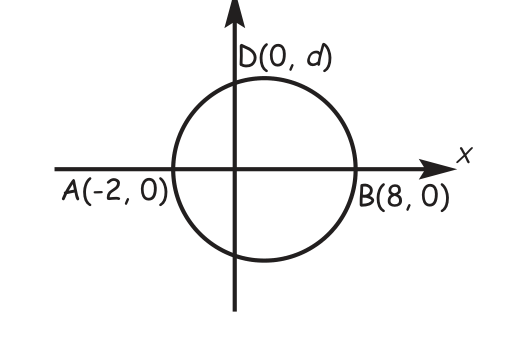
Nel cerchio disegnato in figura, AB è un diametro. Determina l’ordinata d del punto D. A) 3 B) C) 4 D) 5 E) 6
Topic: Geometria analitica Metodo: Metodo delle coordinate Abilita: Ragionamento geometrico Area: Geometria Risposta: B Fonte: apri PDF p.2
Ordination d of point D on the circle
\begin{document}
\begin{tikzpicture}[scale=0.5]
  \draw[->] (-3.5,0) -- (10,0) node[right] {$x$};
  \draw[->] (0,-5.5) -- (0,6.5) node[above] {$y$};
  \draw (3,0) circle (5);
  \fill (-2,0) circle (2pt) node[below left] {$A(-2,0)$};
  \fill (8,0) circle (2pt) node[below right] {$B(8,0)$};
  \fill (0,4) circle (2pt) node[right] {$D(0,d)$};
\end{tikzpicture}
\end{document}
In the circle drawn in the figure, AB is a diameter. Determine the order d of point D. A) 3 B) C) 4 D) 5 E) 6
Answer: B src_kangourou_2008_student_marzo__Q08
Valore di xyz da x^2yz^3 e xy^2
Sappiamo che x2yz3 =73 e xy2 = 79. Allora xyz = A) 74 B) 76 C) 78 D) 79 E) 710
Topic: Algebra Abilita: Manipolazione algebrica Area: Algebra e Analisi Risposta: A Fonte: apri PDF p.2
Value of xyz from x^2yz^3 and xy^2
We know that x2yz3 is 73 and xy2 is 79. So xyz is equal to A) 74 B) 76 C) 78 D) 79 E) 710
Answer: A src_kangourou_2008_student_marzo__Q09
Coppie di cifre per 2__8 divisibile per 3
Vuoi sistemare in ogni posto vuoto dell’allineamento 2_ _8 una cifra in modo da ottenere un numero di quattro cifre divisibile per 3. Quante scelte hai per la coppia (ordinata) di cifre da inserire? A) 29 B) 30 C) 19 D) 20 E) 33 I quesiti dal N. 11 al N. 20 valgono 4 punti ciascuno
Topic: Teoria dei Numeri, Combinatoria Metodo: congruenze Abilita: Conteggio sistematico Area: Aritmetica e Teoria dei Numeri, Combinatoria, Logica e Probabilita Risposta: E Fonte: apri PDF p.2
Pairs of digits for 2__8 divisible by 3
You want to put a digit in every empty place of the 2_8 alignment so you get a four-digit number divisible by 3. How many choices do you have for the (ordered) pair of digits to enter? A) 29 B) 30 C) 19 D) 20 E) 33 Questions from N. 11 al N. 20 is worth 4 points each.
Answer: E src_kangourou_2008_student_marzo__Q10
Quale numero escludere per tre coppie equisomma
Hai i seguenti sette numeri: –9 ; 0 ; –5 ; 5 ; –4 ; –1 ; –3. Utilizzando sei di essi vuoi formare tre coppie in modo tale che la somma dei numeri di ogni coppia sia sempre la stessa. Che numero devi escludere? A) 5 B) 0 C) –3 D) –4 E) –5 2 √3 1 4 1 2 2 9 5 4 1 3 A D B C X Y A(-2, 0) B(8, 0) D(0, d) Testi_08.qxp 9-03-2008 14:56 Pagina 29
Pag. Pag. 30 30 Kang 2008 Kang 2008
Topic: Algebra, Logica, giochi, strategie Abilita: Casework accurato Area: Algebra e Analisi, Combinatoria, Logica e Probabilita Risposta: E Fonte: apri PDF p.2
*What number to exclude for three pairs equals *
You have the following seven numbers: 9; 0; 5; 5; 4; 1; 3. Using six of them you want to form three pairs so that the sum of the numbers of each pair is always the same. What number do you have to rule out? A) 5 B) 0 C) 3 D) 4 E) 5 2 √3 1 4 1 2 2 9 5 4 1 3 A D B C X Y A(-2, 0) B(8, 0) D(0, d) Texts_08.qxp 9-03-2008 14:56 Page 29
I’m going to pay. I’m going to pay. 30 30 Kang 2008 Kang
Answer: E src_kangourou_2008_student_marzo__Q11
Lunghezza AB diagonale del parallelepipedo
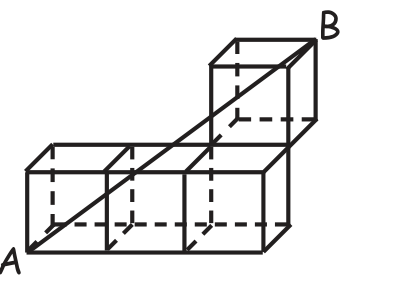
La lunghezza dello spigolo di ciascuno dei cubi in figura è 1. Qual è la lunghezza del segmento AB?
A) B) 7 C) D) E)
Topic: Geometria solida Metodo: Metodo delle coordinate Abilita: Ragionamento geometrico Area: Geometria Risposta: A Fonte: apri PDF p.3
*Diagonal length AB of the parallel piped *
The length of the beam of each of the cubes in the figure is 1. What is the length of the AB segment? A) B) 7 C) D) E)
Answer: A src_kangourou_2008_student_marzo__Q12
Punti totali di Roberto sui cinque problemi
Ad una gara matematica vengono proposti cinque problemi. I punteggi attribuiti ad essi sono tutti diversi tra loro e sono tutti interi positivi. Roberto ha risolto tutti i cinque problemi correttamente, ottenendo 10 punti in totale per i due problemi con i punteggi minori e 18 punti in totale per i due problemi con i punteggi maggiori. Quanti punti ha ottenuto Roberto in totale per i cinque problemi? A) 30 B) 32 C) 34 D) 35 E) 40
Topic: Algebra, Logica, giochi, strategie Metodo: Analisi per casi Abilita: Casework accurato Area: Algebra e Analisi, Combinatoria, Logica e Probabilita Risposta: D Fonte: apri PDF p.3
Total points from Roberto on the five problems
Five problems are proposed in a mathematical contest. The scores assigned to them are all different from each other and are all positive integers. Roberto solved all five problems correctly, scoring a total of 10 points for the two problems with the lowest scores and 18 points for the two problems with the highest scores. How many points did Roberto get in total for the five problems? A) 30 B) 32 C) 34 D) 35 E) 40
Answer: D src_kangourou_2008_student_marzo__Q13
Canguri di un solo colore (inclusione-esclusione)
Matilde ha disegnato 36 canguri usando tre colori distinti. Il bianco è stato usato per 25 canguri, il rosso per 28 e il nero per 20. Solo per 5 canguri sono stati usati tutti e tre i colori. Quanti dei canguri disegnati sono di un solo colore? A) 0 B) 4 C) 12 D) 31
E) Non è possibile stabilirlo.
Topic: Combinatoria Metodo: Inclusione-esclusione Abilita: Conteggio sistematico Area: Combinatoria, Logica e Probabilita Risposta: B Fonte: apri PDF p.3
*Single coloured crabs (inclusion and exclusion) *
Matilde drew 36 kangaroos using three distinct colors. The white was used for 25 kangaroos, the red for 28 and the black for 20. Only five kangaroos were used in all three colors. How many of the designed kangaroos are of the same color? A) 0 B) 4 C) 12 D) 31 E) It is not possible to establish it.
Answer: B src_kangourou_2008_student_marzo__Q14
Area regione ombreggiata (tre cerchi tangenti)
\begin{document}
\begin{tikzpicture}[scale=1.2]
  \coordinate (CL) at (0,0);
  \coordinate (CR) at (2,0);
  \coordinate (CT) at (1,1.732);
  \draw (CL) circle (1);
  \draw (CR) circle (1);
  \draw (CT) circle (1);
  \begin{scope}
    \clip (CL) circle (1);
    \clip (CR) circle (1);
    \fill[gray!40] (CT) circle (1);
  \end{scope}
  \draw (CT) -- ++(1,0) node[midway, above] {$1$};
\end{tikzpicture}
\end{document}
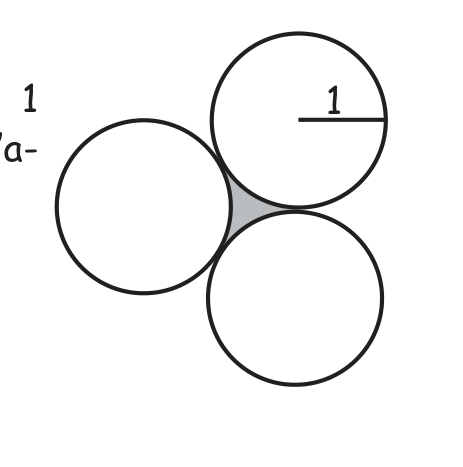
Osserva la figura. Tre circonferenze di raggio 1 sono a due a due tangenti esternamente. Quanto vale l’area della regione ombreggiata? A) B) C) D) E)
Topic: Geometria piana Abilita: Ragionamento geometrico Area: Geometria Risposta: A Fonte: apri PDF p.3
*Shaded region area (three tangent circles) *
\begin{document}
\begin{tikzpicture}[scale=1.2]
  \coordinate (CL) at (0,0);
  \coordinate (CR) at (2,0);
  \coordinate (CT) at (1,1.732);
  \draw (CL) circle (1);
  \draw (CR) circle (1);
  \draw (CT) circle (1);
  \begin{scope}
    \clip (CL) circle (1);
    \clip (CR) circle (1);
    \fill[gray!40] (CT) circle (1);
  \end{scope}
  \draw (CT) -- ++(1,0) node[midway, above] {$1$};
\end{tikzpicture}
\end{document}
Look at the figure. Three radius 1 circles are two to two tangents externally. How much is the shaded area worth? A) B) C) D) E)
Answer: A src_kangourou_2008_student_marzo__Q15
Volume parallelepipedo spigoli in prog. geometrica
Le lunghezze degli spigoli di un parallelepipedo rettangolo, misurata in centimetri, sono numeri interi e formano una progressione geometrica di ragione q = 2. Quale delle seguenti misure, in centimetri cubi, può rappresentare il volume del solido? A) 120 B) 188 C) 350 D) 500 E) Nessuna
Topic: Teoria dei Numeri, Geometria solida Abilita: Manipolazione algebrica Area: Aritmetica e Teoria dei Numeri, Geometria Risposta: E Fonte: apri PDF p.3
*Volume of parallel pipes in the forehead. The value of the underlying assets shall be calculated on the basis of the following information:
The lengths of the tips of a rectangular parallel-piped, measured in centimetres, are integers and form a geometric progression of the ratio q = 2. Which of the following measures, in cubic centimetres, can represent the volume of the solid? (a) 120 (b) 188 (c) 350 (d) 500 (e) None
Answer: E src_kangourou_2008_student_marzo__Q16
Segno e valore della frazione (negativi)
Il numeratore e il denominatore di una frazione sono numeri negativi e il numeratore è maggiore di uno del denominatore. Quale delle seguenti affermazioni è vera? A) La frazione è un numero minore di -1. B) La frazione è un numero tra -1 e 0. C) La frazione è un numero positivo minore di 1. D) La frazione è un numero maggiore di 1. E) Non si può stabilire se la frazione sia un numero positivo o negativo. 1 3 π - 1 2 √3 (√3 - 3 2 )π 1 8 π 1 2 π - 1 2 √3 √3 - 1 2 π √14 √7 √13 √17 A B 1 Testi_08.qxp 9-03-2008 14:56 Pagina 30
Pag. Pag. 31 31 Kang 2008 Kang 2008
Topic: Algebra Abilita: Manipolazione algebrica Area: Algebra e Analisi Risposta: C Fonte: apri PDF p.3
*Signs and fraction value (negative) *
The numerator and denominator of a fraction are negative numbers and the numerator is greater than one of the denominator. Which of the following statements is true? A) The fraction is a number less than -1. B) The fraction is a number between -1 and 0. C) The fraction is a positive number less than 1. D) The fraction is a number greater than 1. E) It cannot be established whether the fraction is a positive or a negative number. 1 3 π - 1 2 √3 (√3 - 3 2) π 1 8 π 1 2 π - 1 2 √3 √3 - 1 2 π √14 √7 √13 √17 A B 1 Tests_08.qxp 9-03-2008 14:56 Page 30
I’m going to pay. I’m going to pay. 31 31 Kang 2008 Kang
Answer: C src_kangourou_2008_student_marzo__Q17
Punto P che minimizza somma distanze (5 punti)
Cinque punti distinti A1, A2, A3, A4 e A5, sono disposti nell’ordine su una retta. Viene scelto un punto P sulla stessa retta in modo che la somma delle distanze PA1 + PA2 + PA3 + PA4 + PA5 sia minima. Si può affermare che il punto P è A) Necessariamente A1. B) Necessariamente A2. C) Necessariamente A3. D) Un qualunque punto tra A2 e A4. E) Un qualunque punto tra A1 e A5.
Topic: Geometria piana, Algebra Metodo: Principio di estremalita Abilita: Ragionamento geometrico Area: Algebra e Analisi, Geometria Risposta: C Fonte: apri PDF p.4
*Point P which minimizes sum of distances (5 points) *
Five distinct points A1, A2, A3, A4 and A5 are arranged in a straight line. A point P on the same line is chosen so that the sum of the distances PA1 + PA2 + PA3 + PA4 + PA5 is minimal. It can be said that point P is A) Necessarily A1. B) A2 as necessary. C) A3 as necessary. D) Any point between A2 and A4. E) Any point between A1 and A5.
Answer: C src_kangourou_2008_student_marzo__Q18
Probabilita di tre punti collineari
\begin{document}
\begin{tikzpicture}
  \foreach \x in {0,1,2,3} {
    \foreach \y in {0,1,2} {
      \fill (\x, \y) circle (3pt);
    }
  }
\end{tikzpicture}
\end{document}
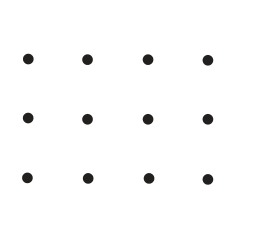
Si scelgano a caso tre punti dalla griglia a lato. Qual è la probabilità che essi siano collineari? A) B) C) D) E)
Topic: Probabilita e statistica, Combinatoria Metodo: Conteggio combinatorio Abilita: Conteggio sistematico Area: Combinatoria, Logica e Probabilita Risposta: B Fonte: apri PDF p.4
Probability of three hill points
\begin{document}
\begin{tikzpicture}
  \foreach \x in {0,1,2,3} {
    \foreach \y in {0,1,2} {
      \fill (\x, \y) circle (3pt);
    }
  }
\end{tikzpicture}
\end{document}
Three points are chosen at random from the grid to the side. What are the odds that they’re hilly? A) B) C) D) E)
Answer: B src_kangourou_2008_student_marzo__Q19
Somma punti facce interne di quattro dadi
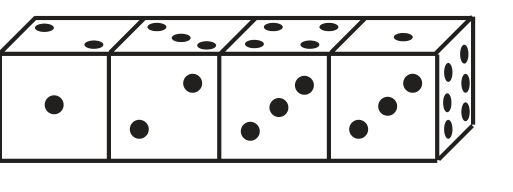
Quattro dadi identici sono accostati come in figura. Le facce di ciascun dado sono numerate da 1 a 6, ma i dadi non sono standard, cioè la somma dei punti di due facce opposte non è necessariamente 7. Qual è la somma dei punti delle 6 facce ciascuna delle quali viene a contatto con qualche altra faccia? A) 19 B) 20 C) 21 D) 22 E) 23 I quesiti dal N. 21 al N. 30 valgono 5 punti ciascuno
Topic: Geometria solida, Logica, giochi, strategie Abilita: Ragionamento geometrico Area: Combinatoria, Logica e Probabilita, Geometria Risposta: B Fonte: apri PDF p.4
sum of internal facial points of four dice
Four identical dice are drawn as shown in the figure. The faces of each dice are numbered from 1 to 6, but the dice are not standard, meaning the sum of the points of two opposite faces is not necessarily 7. What is the sum of the points of the six faces each of which comes into contact with some other face? A) 19 B) 20 C) 21 D) 22 E) 23 Questions from N. 21 al N. 30 is worth 5 points each.
Answer: B src_kangourou_2008_student_marzo__Q20
Probabilita di tornare al punto di partenza
Una pedina posta al centro di una griglia quadrata 5 x 5 viene mossa con passi orizzontali o verticali di ampiezza uno, determinati dal lancio simultaneo di una coppia di dadi, uno rosso e uno blu. Il dado rosso fa muovere la pedina di un passo verso destra se esce un numero pari e verso sinistra se esce un numero dispari, il dado blu fa muovere la pedina di un passo verso l’alto se esce un numero pari e verso il basso se esce un numero dispari. Qual è la probabilità che dopo due lanci la pedina sia tornata al punto di partenza? A) B) C) D) E)
Topic: Probabilita e statistica Metodo: Conteggio combinatorio Abilita: Conteggio sistematico Area: Combinatoria, Logica e Probabilita Risposta: C Fonte: apri PDF p.4
Probability of returning to the starting point
A pedal placed at the center of a 5 x 5 square grid is moved with horizontal or vertical steps of width one, determined by the simultaneous throwing of a pair of dice, a red and a blue. The red dice move the foot of a step to the right if an even number comes out and to the left if an odd number comes out, the blue dice move the foot of a step up if an even number comes out and down if an odd number comes out. What are the chances that after two throws the pedal will be back to its starting point? A) B) C) D) E)
Answer: C src_kangourou_2008_student_marzo__Q21
Prodotto dei due divisori di 3^32-1 tra 75 e 85
Il numero 332 – 1 ha esattamente due divisori (interi) entrambi maggiori di 75 e minori di 85. Quanto vale il prodotto di questi due divisori? A) 5852 B) 6560 C) 6804 D) 6888 E) 6972
Topic: Teoria dei Numeri Metodo: manipolazione algebrica Abilita: Manipolazione algebrica Area: Aritmetica e Teoria dei Numeri Risposta: B Fonte: apri PDF p.4
Product of the two divisions of 3^32-1 between 75 and 85
The number 332 1 has exactly two divisors (integers) both greater than 75 and less than 85. How much is the product of these two dividers? A) 5852 B) 6560 C) 6804 D) 6888 E) 6972
Answer: B src_kangourou_2008_student_marzo__Q22
Somma cifre del prodotto (moltiplicazione asterischi)
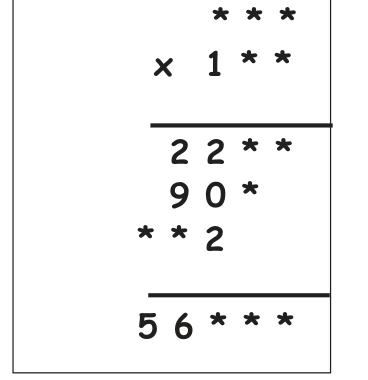
La figura rappresenta una moltiplicazione eseguita manualmente nel modo usuale. Ogni asterisco sostituisce una cifra. La somma delle cifre del prodotto è A) 16 B) 20 C) 26 D) 30 E) nessuno dei valori indicati. 1 9 1 6 1 4 1 3 1 2 3 12 1 8 1 16 1 11 1 12
x 1 * * 2 2 * * 9 0 *
- 2 5 6 * * * Testi_08.qxp 9-03-2008 14:56 Pagina 31
Pag. Pag. 32 32 Kang 2008 Kang 2008
Topic: Teoria dei Numeri, Logica, giochi, strategie Metodo: Analisi per casi Abilita: Casework accurato Area: Aritmetica e Teoria dei Numeri, Combinatoria, Logica e Probabilita Risposta: A Fonte: apri PDF p.4
*Sum of product figures (asterisked multiplication) *
The figure represents a multiplication performed manually in the usual way. Each asterisk replaces a number. The sum of the product figures is A) 16 B) 20 C) 26 D) 30 E) none of the values indicated. The Commission shall adopt delegated acts in accordance with the opinion of the Committee on Budgetary Control and with the opinion of the Committee on Budgetary Control and the Committee on Budgetary Control.
I’m going to pay. I’m going to pay. 32 32 Kang 2008 Kang
Answer: A src_kangourou_2008_student_marzo__Q23
Valore di x^2+y^2+z^2 con vincoli
È noto che x + y + z = 1 e = 0 Allora l’espressione x2 + y2 + z2 A) vale 0. B) vale 1. C) vale 2. D) vale 3. E) ha un valore non determinabile senza ulteriori informazioni.
Topic: Algebra Metodo: manipolazione algebrica Abilita: Manipolazione algebrica Area: Algebra e Analisi Risposta: B Fonte: apri PDF p.5
Value of x^2+y^2+z^2 with constraints
It’s known that x + y + z = 1 e = 0 So the expression x2 + y2 + z2 A) is 0. B) is 1. C) is 2. D) is 3. E) has a value that cannot be determined without further information.
Answer: B src_kangourou_2008_student_marzo__Q24
Valore di k tale che a_k=2008 (successione)
Sia {an} una successione. È noto che a1 = 0 e che, per n ≥ 0, si ha an+1 = an + (-1)n . n. Se ak = 2008, allora il valore di k è A) 2008 B) 2009
C) 4017
D) 4018
E) nessuno dei quattro indicati.
Topic: successioni Metodo: Ricorsione, Somme telescopiche Abilita: Riconoscimento di pattern Area: Algebra e Analisi Risposta: C Fonte: apri PDF p.5
*Value of k such that a_k=2008 (success) *
Let it be a succession. It is known that a1 = 0 and that, for n ≥ 0, we have an+1 = an + (-1)n. n. If ak = 2008, then the value of k is A) 2008 B) 2009 C) 4017 D) 4018 E) none of the four indicated.
Answer: C src_kangourou_2008_student_marzo__Q25
Perimetro del triangolo ADE (cerchio inscritto)
\begin{document}
\begin{tikzpicture}[scale=0.9]
  \coordinate (C) at (-1.5, 0);
  \coordinate (B) at (1.5, 0);
  \coordinate (A) at ({-11/6}, {-4*sqrt(14)/3});
  \coordinate (I) at ({(3*(-11/6) + 5*1.5 + 6*(-1.5))/14}, {(3*(-4*sqrt(14)/3))/14});
  \draw (A) -- (B) -- (C) -- cycle;
  \draw (I) circle ({2*sqrt(14)/7});
  \coordinate (D) at ({-1.5 + 1}, 0);
  \coordinate (E) at ({-1.5 + (1/5)*(-11/6+1.5)}, {(1/5)*(-4*sqrt(14)/3)});
  \draw (D) -- (E);
  \node[above left] at (C) {$C$};
  \node[above right] at (B) {$B$};
  \node[below] at (A) {$A$};
  \node[above] at (D) {$D$};
  \node[left] at (E) {$E$};
  \node[above] at (0,0) {$3$};
  \node[left] at ({(-1.5 + (-11/6))/2}, {(-4*sqrt(14)/3)/2}) {$5$};
  \node[right] at ({(1.5 + (-11/6))/2}, {(-4*sqrt(14)/3)/2}) {$6$};
\end{tikzpicture}
\end{document}
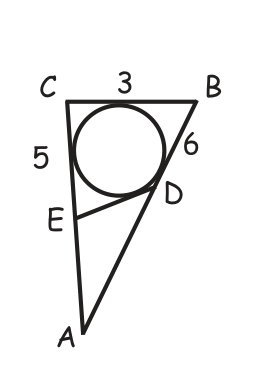
Osserva la figura. Nel triangolo ABC è inscritto un cerchio. Si sa che |AC| = 5, |AB| = 6, |BC| = 3 e che il segmento ED è tangente al cerchio. Il perimetro del triangolo ADE vale A) 7 B) 4 C) 9 D) 6 E) 8
Topic: Geometria piana Metodo: Sfruttamento della simmetria Abilita: Ragionamento geometrico Area: Geometria Risposta: E Fonte: apri PDF p.5
*Perimeter of the ADE triangle (inscribed circle) *
\begin{document}
\begin{tikzpicture}[scale=0.9]
  \coordinate (C) at (-1.5, 0);
  \coordinate (B) at (1.5, 0);
  \coordinate (A) at ({-11/6}, {-4*sqrt(14)/3});
  \coordinate (I) at ({(3*(-11/6) + 5*1.5 + 6*(-1.5))/14}, {(3*(-4*sqrt(14)/3))/14});
  \draw (A) -- (B) -- (C) -- cycle;
  \draw (I) circle ({2*sqrt(14)/7});
  \coordinate (D) at ({-1.5 + 1}, 0);
  \coordinate (E) at ({-1.5 + (1/5)*(-11/6+1.5)}, {(1/5)*(-4*sqrt(14)/3)});
  \draw (D) -- (E);
  \node[above left] at (C) {$C$};
  \node[above right] at (B) {$B$};
  \node[below] at (A) {$A$};
  \node[above] at (D) {$D$};
  \node[left] at (E) {$E$};
  \node[above] at (0,0) {$3$};
  \node[left] at ({(-1.5 + (-11/6))/2}, {(-4*sqrt(14)/3)/2}) {$5$};
  \node[right] at ({(1.5 + (-11/6))/2}, {(-4*sqrt(14)/3)/2}) {$6$};
\end{tikzpicture}
\end{document}
Look at the figure. In the triangle ABC, a circle is inscribed. You know that AC is equal to 5, AB is equal to 6, BC is equal to 3, and that the ED segment is tangent to the circle. The perimeter of the ADE triangle is A) 7 B) 4 C) 9 D) 6 E) 8
Answer: E src_kangourou_2008_student_marzo__Q26
Area regione ombreggiata nel quadrato (M medio)
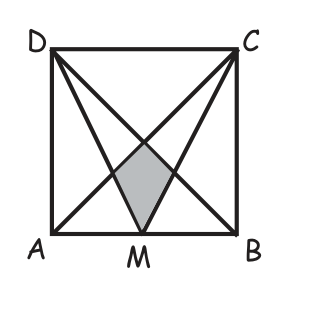
\begin{document}
\begin{tikzpicture}[scale=2]
  \coordinate (A) at (0,0);
  \coordinate (B) at (1,0);
  \coordinate (C) at (1,1);
  \coordinate (D) at (0,1);
  \coordinate (M) at (0.5,0);
  \draw (A) -- (B) -- (C) -- (D) -- cycle;
  \draw (A) -- (C);
  \draw (B) -- (D);
  \draw (D) -- (M);
  \draw (C) -- (M);
  \fill[gray!40] (0.5,0.5) -- ({1/3},{1/3}) -- (0.5,0) -- ({2/3},{1/3}) -- cycle;
  \node[below left] at (A) {$A$};
  \node[below] at (M) {$M$};
  \node[below right] at (B) {$B$};
  \node[above right] at (C) {$C$};
  \node[above left] at (D) {$D$};
\end{tikzpicture}
\end{document}
Il quadrato ABCD ha il lato di lunghezza 1 e M è il punto medio di AB. L’area della regione ombreggiata vale A) 1/14
B) 1/16
C) /18
D) 1/13
E) un valore diverso dai precedenti.
Topic: Geometria piana Metodo: Metodo delle coordinate Abilita: Ragionamento geometrico Area: Geometria Risposta: E Fonte: apri PDF p.5
*Area region shaded in square (M medium) *
\begin{document}
\begin{tikzpicture}[scale=2]
  \coordinate (A) at (0,0);
  \coordinate (B) at (1,0);
  \coordinate (C) at (1,1);
  \coordinate (D) at (0,1);
  \coordinate (M) at (0.5,0);
  \draw (A) -- (B) -- (C) -- (D) -- cycle;
  \draw (A) -- (C);
  \draw (B) -- (D);
  \draw (D) -- (M);
  \draw (C) -- (M);
  \fill[gray!40] (0.5,0.5) -- ({1/3},{1/3}) -- (0.5,0) -- ({2/3},{1/3}) -- cycle;
  \node[below left] at (A) {$A$};
  \node[below] at (M) {$M$};
  \node[below right] at (B) {$B$};
  \node[above right] at (C) {$C$};
  \node[above left] at (D) {$D$};
\end{tikzpicture}
\end{document}
The ABCD square has the length side 1 and M is the middle point of AB. The area of the shaded region is A) 1/14 B) 1/16 C) /18 D) 1/13 E) a different value from the previous ones.
Answer: E src_kangourou_2008_student_marzo__Q27
Misura angolo ABC tra due cubi (Pitagora)
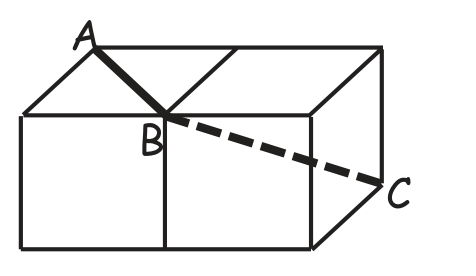
I due cubi in figura hanno una faccia in comune. Qual è, in gradi, la misura dell’angolo ABC? A) 90
B) 115
C) 120 D) 135 E) 150
Topic: Geometria solida Metodo: Metodo delle coordinate Abilita: Ragionamento geometrico Area: Geometria Risposta: A Fonte: apri PDF p.5
*Measuring the angle ABC between two cubes (Pitagoras) *
The two cubes in the figure have a face in common. What is the degree of the angle ABC? A) 90 B) 115 C) 120 D) 135 E) 150
Answer: A src_kangourou_2008_student_marzo__Q28
Quante sbarrette per 61 ottagoni
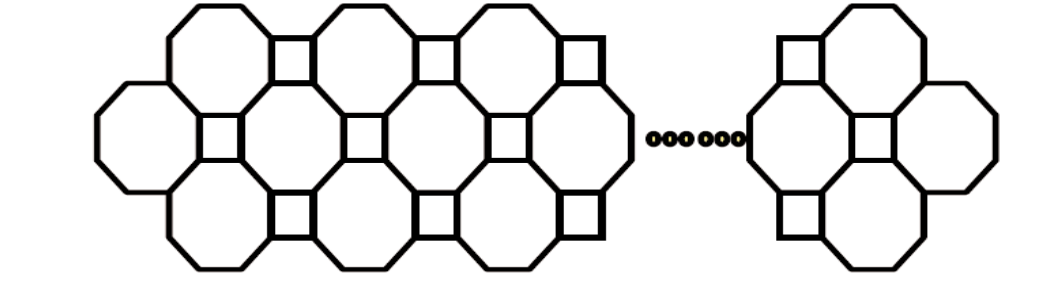
Per costruire questa decorazione sono state usate (senza piegarle) sbarrette metalliche. Si sa che nella decorazione compaiono 61 ottagoni. Quante sbarrette sono state usate? A) 488 B) 400 C) 328 D) 244 E) 446
Topic: Combinatoria, Geometria piana Metodo: Ricorsione Abilita: Conteggio sistematico Area: Combinatoria, Logica e Probabilita, Geometria Risposta: E Fonte: apri PDF p.5
*How many bars for 61 octages *
Metal bars were used (without folding) to construct this decoration. We know that there are 61 octagons in the decoration. How many bars were used? A) 488 B) 400 C) 328 D) 244 E) 446
Answer: E src_kangourou_2008_student_marzo__Q29
Numeri di 2007 cifre con coppie divisibili 17 o 23
Quanti sono i numeri interi positivi n di 2007 cifre (in rappresentazione decimale) con la seguente proprietà: ogni numero intero di due cifre costituito da due cifre consecutive di n (nello stesso ordine in cui compaiono in n) è divisibile per 17 o per 23? A) 5 B) 6 C) 7 D) 9 E) Più di 9 √2 1 x
- 1 y
- 1 z 3 5 6 A D M B C Testi_08.qxp 9-03-2008 14:56 Pagina 32
Categoria Student Per studenti del quarto e quinto anno della scuola media superiore
I quesiti dal N.1 al N. 10 valgono 3 punti ciascuno
Topic: Teoria dei Numeri, Combinatoria Metodo: Analisi per casi, congruenze Abilita: Casework accurato Area: Aritmetica e Teoria dei Numeri, Combinatoria, Logica e Probabilita Risposta: D Fonte: apri PDF p.5
2007 numbers with divisible pairs 17 or 23
What are the positive integers n of 2007 digits (in decimal representation) with the following property: any two-digit integer consisting of two consecutive digits of n (in the same order in which they appear in n) is divisible by 17 or by 23? A) 5 B) 6 C) 7 D) 9 E) More than 9 √2 1 x + 1 y + 1 z 3 5 6 A D M B C Tests_08.qxp 9-03-2008 14:56 Page 32
Category Student For fourth and fifth year students of secondary school
Questions from N.1 to N. 10 is worth 3 points each.
Answer: D src_kangourou_2008_student_marzo__Q30