Minimo numero di problemi per cinque categorie con vincoli di punteggio
Alla finale di Mirabilandia per ognuna delle cinque categorie vengono proposti sei problemi, uno per ciascuno dei seguenti punteggi: 5, 7, 11, 14, 18 e 22. Naturalmente in ogni singola categoria i sei problemi devono essere tutti diversi fra loro, ma uno stesso problema può essere assegnato in più di una categoria. Tieni però presente che, se un problema fornisce un certo punteggio in una categoria e compare anche in una categoria superiore, in quest’ultima deve fornire un punteggio inferiore.
Il comitato organizzatore vuole preparare il minore numero possibile di problemi. Qual è questo numero?
Topic: Combinatoria, Logica, giochi, strategie Metodo: Principio di estremalita Abilita: generalizzazione Area: Combinatoria, Logica e Probabilita Risposta: 10 Fonte: apri PDF p.2
Minimum number of problems for five categories with scoring constraints
In the Mirabilandia final, six problems are proposed for each of the five categories, one for each of the following scores: 5, 7, 11, 14, 18 and 22. Of course, in each category the six problems must all be different, but the same problem can be assigned to more than one category. Please note, however, that if a problem provides a certain score in a category and also appears in a higher category, it must provide a lower score in the latter category.
The organising committee wants to prepare as few problems as possible. What’s this number?
Answer: 10
Minima differenza tra numeri con somma cifre divisibile per 5
Immagina una lista in cui compaiano in ordine crescente tutti i numeri interi positivi la somma delle cui cifre è divisibile per 5 (la lista inizierà dunque così: 5, 14, 19, 23, …). Qual è la minima differenza possibile fra un numero e quello che lo precede in questa lista?
Topic: Teoria dei Numeri Metodo: congruenze Abilita: Riconoscimento di pattern Area: Aritmetica e Teoria dei Numeri Risposta: 1 Fonte: apri PDF p.2
Minimum difference between numbers with sum of digits divisible by 5
Imagine a list in which all positive integers appear in increasing order the sum of whose digits is divisible by 5 (the list will begin as follows: 5, 14, 19, 23, …). What is the smallest possible difference between a number and the one before it in this list?
Answer: 1
Minima lunghezza filo su cilindro che incontra ogni generatrice
Un cilindro circolare retto ha le basi di raggio 1 cm e l’altezza misura 4 cm. I punti e , rispettivamente sulla base inferiore e sulla base superiore, stanno sulla stessa generatrice (si chiama “generatrice” ogni retta perpendicolare alle basi che interseca la superficie laterale del cilindro). Un filo ha un capo in e l’altro in e incontra almeno una volta ogni generatrice. Qual è la minima lunghezza possibile del filo?
Topic: Geometria solida Abilita: Ragionamento geometrico Area: Geometria Risposta: 2pi*sqrt rect diag Fonte: apri PDF p.2
Minimum length of wire per cylinder encountered by each generator
A straight circular cylinder has bases of radius 1 cm and a height of 4 cm. The and points, respectively on the lower and upper base, are on the same generator (each line perpendicular to the bases that intersects the cylinder’s side surface is called a ‘generator’). A wire has one end in and the other in and meets each generator at least once. What is the minimum possible length of the wire?
Answer: 2pi*sqrt rect diag
Chi salta un circuito con fossato senza cadere e perche
Ada, Bruna e Carla saltano ciascuna sul proprio jumper la cui base è praticamente un punto. Ognuna di loro compie salti sempre della stessa lunghezza; le lunghezze sono rispettivamente 70, 80, e 85 cm. Seguono tutte, partendo da uno stesso punto e muovendosi nello stesso verso, uno stesso circuito circolare lungo 400 metri, che è attraversato da un fossato largo 73 cm. Accade che solo una di loro riesce a fare 2 giri completi del circuito senza cadere nel fossato: chi e perché? (Le lunghezze dei salti e la larghezza del fossato si intendono misurate su archi del circuito, non su corde.)
Topic: Teoria dei Numeri, Logica, giochi, strategie Abilita: traduzione del testo Area: Aritmetica e Teoria dei Numeri, Combinatoria, Logica e Probabilita Risposta: Bruna Fonte: apri PDF p.3
Who skips a pit circuit without falling and why
Ada, Bruna, and Carla jump on their own jumper whose base is practically a point. Each of them always jumps the same length; the lengths are 70, 80 and 85 cm respectively. They all follow, starting at the same point and moving in the same direction, a 400-meter-long circular circuit, which is traversed by a 73-cm-wide moat. It happens that only one of them can make two complete laps of the circuit without falling into the ditch: who and why? (The lengths of the jumps and the width of the trench are to be measured on circuit arcs, not on chords.)
Answer: Bruna
numero di C sempre uguale
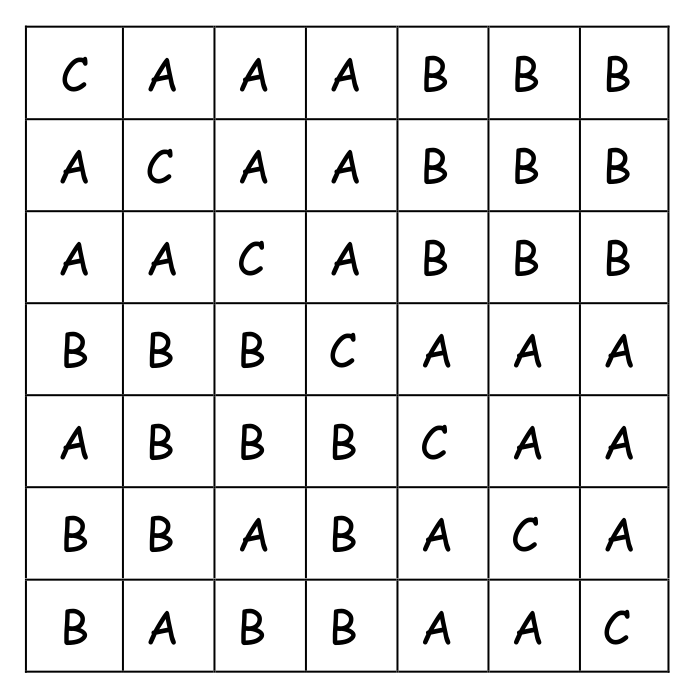
Hai una griglia . Vuoi inserire in ogni casella una e una sola delle lettere , , in modo che:
- in ogni riga il numero delle caselle con la lettera sia non minore del numero delle caselle con la lettera e del numero delle caselle con la lettera ;
- in ogni colonna il numero delle caselle con la lettera sia non minore del numero delle caselle con la lettera e del numero delle caselle con la lettera .
Mostra che puoi raggiungere lo scopo in diversi modi, ma che il numero delle caselle con la lettera è sempre lo stesso. Qual è? Perché?
Topic: Combinatoria Metodo: monovarianti Abilita: Conteggio sistematico Area: Combinatoria, Logica e Probabilita Risposta: 7 Fonte: apri PDF p.3
number of C always equal
You have a grid. You want to insert in each box one and only one of the letters , , so that:
- in each row the number of boxes with the letter is not less than the number of boxes with the letter and the number of boxes with the letter ; - in each column the number of boxes with the letter is not less than the number of boxes with the letter and the number of boxes with the letter .
Show that you can achieve the goal in different ways, but that the number of boxes with the letter is always the same. What is it? Why?
Answer: 7
Quanti valori distinti della somma perimetri di 4 triangoli area 1/4
Vi sono diversi modi di ripartire un quadrato di lato 1 in 4 triangoli ciascuno di area (per “ripartire” si intende scomporre senza sovrapposizioni se non, eventualmente, di lati). Al variare dei modi, può variare la somma dei perimetri dei triangoli. Quanti sono i possibili diversi valori che questa somma può assumere? Giustifica la risposta nel modo più esauriente possibile.
Topic: Geometria piana, Combinatoria Metodo: Conteggio combinatorio Abilita: Casework accurato, Ragionamento geometrico Area: Combinatoria, Logica e Probabilita, Geometria Risposta: 5 Fonte: apri PDF p.4
How many distinct values of the sum of the perimeters of 4 triangles area 1/4
There are several ways of dividing a square of side 1 into 4 triangles each of area (by “divide” we mean to decompose without overlaps except, possibly, of sides). The sum of the perimeters of the triangles may vary as the modes vary. How many different possible values can this sum assume? Justify the answer in the most comprehensive way possible.
Answer: 5