In che giorno scolpisce l’ultima lettera di KANGOUROU
Angelo vuole scolpire nel legno la parola KANGOUROU. È in grado di scolpire una lettera al giorno e inizia di giovedì. In quale giorno della settimana scolpirà l’ultima lettera? A) Lunedì B) Martedì C) Mercoledì D) Giovedì E) Venerdì
Topic: Teoria dei Numeri, Logica, giochi, strategie Abilita: Conteggio sistematico Area: Aritmetica e Teoria dei Numeri, Combinatoria, Logica e Probabilita Risposta: E Fonte: apri PDF p.1
On what day did you carve the last letter of KANGOUROU?
Angelo wants to carve the word KANGOUROU into the wood. He can carve a letter a day and he starts on Thursday. On what day of the week will he carve the last letter? A) Monday B) Tuesday C) Wednesday D) Thursday E) Friday
Answer: E
Da quale numero era partita Elisa
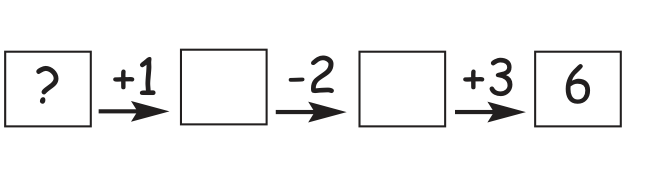
Partendo da un certo numero, Elisa ha eseguito le operazioni che sono indicate nella figura, ottenendo come risultato 6. Da quale numero era partita? A) 9 B) 7 C) 4 D) 0 E) 1
Topic: Algebra Metodo: Ragionamento all’indietro Abilita: Manipolazione algebrica Area: Algebra e Analisi Risposta: C Fonte: apri PDF p.1
What number had Elisa started from
Starting from a certain number, Elisa carried out the operations shown in the figure, obtaining 6 as a result. What number had she started from? A) 9 B) 7 C) 4 D) 0 E) 1
Answer: C
Posizione finale della pedina dopo le mosse
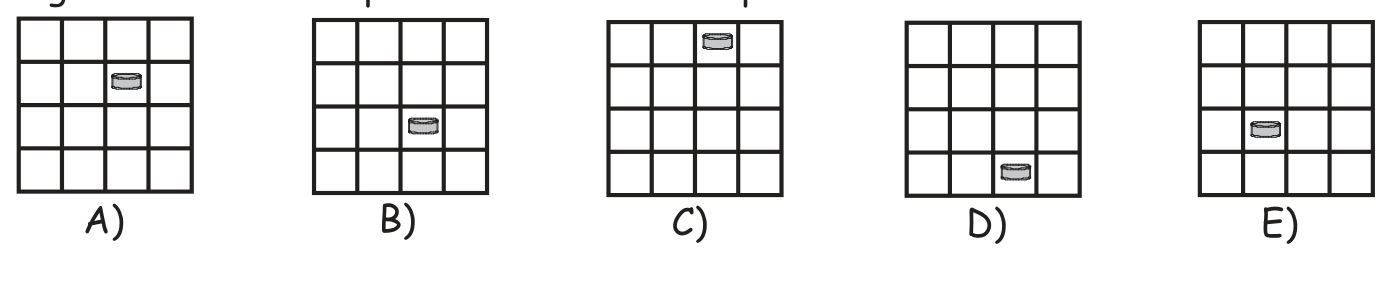
Carlo ha posto una pedina in una casella di una griglia quadrata, come ti mostra la figura a destra. Ora si diverte a spostarla, sempre di una casella per volta, prima a destra, poi in alto, poi a sinistra, poi in basso e infine ancora a destra. In quale delle seguenti figure è indicata la posizione finale della pedina?
Topic: Logica, giochi, strategie, Geometria piana Abilita: Lettura attenta del testo Area: Combinatoria, Logica e Probabilita, Geometria Risposta: B Fonte: apri PDF p.1
Final position of the token after movements
Charles placed a token in a square grid box, as shown in the figure to the right. Now he enjoys moving it, one box at a time, first to the right, then up, then to the left, then down, and finally back to the right. Which of the following figures shows the final position of the token?
Answer: B
Minuti per decorare torte e panettoni con due persone
Un cliente ha ordinato ad un pasticcere tre torte alla crema e tre panettoni. Quando arriva in pasticceria, i dolci sono quasi pronti: mancano solo le decorazioni. Per fare il più in fretta possibile, il pasticcere si fa aiutare da un commesso. Ogni dolce però deve essere decorato da una sola persona: se per decorare una torta alla crema si impiegano 9 minuti e per decorare un panettone si impiegano 3 minuti, quanti minuti dovrà aspettare il cliente? A) 9 B) 12 C) 15 D) 18 E) 24
Topic: Logica, giochi, strategie, Teoria dei Numeri Abilita: traduzione del testo Area: Aritmetica e Teoria dei Numeri, Combinatoria, Logica e Probabilita Risposta: D Fonte: apri PDF p.1
Minutes to decorate cakes and pastries with two people
A customer ordered three cream cakes and three panettoni from a bakery. When you get to the bakery, the desserts are almost ready. In order to do it as quickly as possible, the baker has a clerk help him. Each dessert, however, must be decorated by one person: if it takes nine minutes to decorate a cream cake and three minutes to decorate a panettone, how many minutes will the customer have to wait? A) 9 B) 12 C) 15 D) 18 E) 24
Answer: D
Di quale figura parla Marina (grigia rotonda o triangolare)
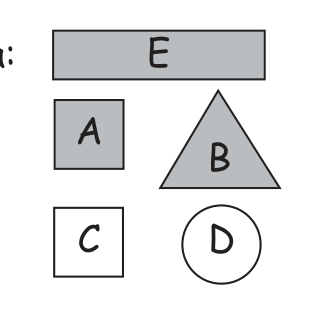
Riferendosi ad una delle figure qui a lato, Marina afferma: “È grigia, è rotonda o triangolare”. Di quale figura si tratta? A) A B) B C) C D) D E) E
A) B) C) D) E) E A C D B ? 6 +1 -2 +3 Testi_11Mat.qxp 19-05-2011 21:20 Pagina 5
Pag. Pag. 6 Kang 201 Kang 2011
Topic: Logica, giochi, strategie Abilita: Lettura attenta del testo Area: Combinatoria, Logica e Probabilita Risposta: B Fonte: apri PDF p.1
Which shape is Marina referring to (gray round or triangular)?
Referring to one of the figures shown here, Marina states: “It is gray, round, or triangular.” Which figure is it?
(A) A (B) B (C) C (D) D (E) E
A) B) C) D) E) E A C D B ? 6 +1 -2 +3 Texts_11Mat.qxp 19-05-2011 21:20 Page 5
Page Page 6 Kangaroo 2011
Answer: B
Quanto ha pagato Sandro per gelato e torta
Anna, Mario e Sandro sono andati in pasticceria. Anna ha pagato 1 € e 50 cent per tre palline di gelato, Mario ha pagato 2 € e 40 cent per due fette di torta. Quanto ha pagato Sandro per una pallina di gelato e una fetta di torta? A) 1 € e 70 cent B) 1 € e 90 cent C) 2 € e 20 cent
D) 2 € e 70 cent E) 3 € e 90 cent
Topic: Algebra Abilita: traduzione del testo Area: Algebra e Analisi Risposta: A Fonte: apri PDF p.2
How much did Sandro pay for ice cream and cake?
Anna, Mario and Sandro went to the bakery. Anna paid €1.50 for three ice cream balls, Mario paid €2.40 for two slices of cake. How much did Sandro pay for an ice cream ball and a slice of cake? A) 1 € and 70 cents B) 1 € and 90 cents C) 2 € and 20 cents D) 2 € and 70 cents E) 3 € and 90 cents
Answer: A
Quanti colpi batte l’orologio tra 7.55 e 10.45
L’orologio di un campanile allo scoccare di ogni ora batte il numero di colpi corrispondente all’ora (ad esempio alle 7.00 batte 7 colpi, alle 8.00 batte 8 colpi e così via). Inoltre, batte un colpo ad ogni ora intera più 30 minuti (ad esempio alle 7.30, alle 8.30 e così via). Quanti colpi batte in tutto l’orologio tra le 7.55 e le 10.45 di uno stesso giorno? A) 6 B) 18 C) 27 D) 30 E) 33
Topic: Teoria dei Numeri, Logica, giochi, strategie Metodo: Conteggio combinatorio Abilita: Conteggio sistematico Area: Aritmetica e Teoria dei Numeri, Combinatoria, Logica e Probabilita Risposta: D Fonte: apri PDF p.2
How many strokes does the clock strike between 7.55 and 10.45
The clock of a bell tower strikes at the stroke of each hour the number of strokes corresponding to the hour (e.g. at 7.00 beats 7 strokes, at 8.00 beats 8 strokes and so on). In addition, it strikes one stroke at every hour plus 30 minutes (e.g. 7:30 a.m., 8:30 a.m., etc.). How many strokes does the clock strike in all between 7:55 and 10:45 on the same day? A) 6 B) 18 C) 27 D) 30 E) 33
Answer: D
Minimo numero di scatole per 66 uova
Per inscatolare le uova si possono usare scatole da 6 uova e scatole da 12 uova. Qual è il minimo numero di scatole che consente di inscatolare 66 uova? A) 5 B) 6 C) 9 D) 11 E) 13 I quesiti dal N. 9 al N. 16 valgono 4 punti ciascuno
Topic: Teoria dei Numeri Abilita: Conteggio sistematico Area: Aritmetica e Teoria dei Numeri Risposta: B Fonte: apri PDF p.2
Minimum number of boxes for 66 eggs
Boxing eggs can be done using boxes of 6 eggs and boxes of 12 eggs. What is the minimum number of boxes that can contain 66 eggs? A) 5 B) 6 C) 9 D) 11 E) 13 Questions from N. 9 to N. 16 are worth 4 points each.
Answer: B
Quale figura ha l’area piu grande

Quale delle seguenti figure ha l’area più grande?
Topic: Geometria piana Abilita: Ragionamento geometrico Area: Geometria Risposta: C Fonte: apri PDF p.2
Which figure has the largest area
Which of the following figures has the largest area?
Answer: C
Quanti ragazzi nella classe con gatti cani pesci
I ragazzi di una classe hanno complessivamente 8 gatti, 6 cani e 3 pesci. Ogni ragazzo ha almeno un animale, nessuno ne ha più di due e chi ne ha due ha sicuramente un cane, ma non ha due cani. Esattamente due ragazzi hanno sia un cane sia un pesce ed esattamente tre ragazzi hanno sia un gatto sia un cane. Quanti ragazzi vi sono in quella classe? A) 11 B) 12 C) 13 D) 14 E) 17
Topic: Combinatoria, Logica, giochi, strategie Metodo: Conteggio combinatorio Abilita: traduzione del testo Area: Combinatoria, Logica e Probabilita Risposta: B Fonte: apri PDF p.2
How many kids in the class have catfish dogs
The kids in one class have a total of eight cats, six dogs and three fish. Every kid has at least one animal, no one has more than two, and whoever has two certainly has a dog, but he doesn’t have two dogs. Exactly two kids have both a dog and a fish and exactly three kids have both a cat and a dog. How many kids are in that class? A) 11 B) 12 C) 13 D) 14 E) 17
Answer: B
Quale somma non puo avere con 13 monete da 5 o 10
Andrea ha in tasca 13 monete: ognuna di esse è da 5 centesimi o da 10 centesimi. Quale fra le seguenti non può certamente essere, in centesimi, la somma totale che Andrea ha in tasca? A) 80 B) 60 C) 70 D) 115 E) 125
Topic: Teoria dei Numeri Metodo: congruenze Abilita: Conteggio sistematico Area: Aritmetica e Teoria dei Numeri Risposta: B Fonte: apri PDF p.2
What sum can’t have with 13 coins of 5 or 10
Andrea has 13 coins in her pocket, each of which is five cents or ten cents. Which of the following certainly cannot be, in cents, the total amount Andrew has in his pocket? A) 80 B) 60 C) 70 D) 115 E) 125
Answer: B
Quale lettera non coperta piegando il foglio
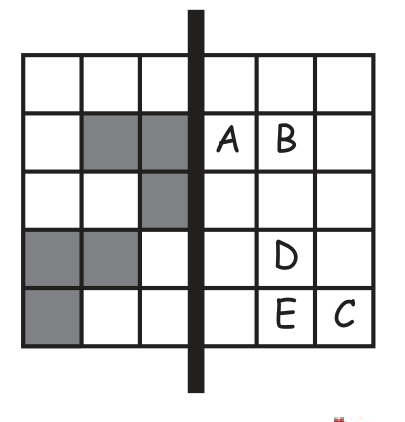
Osserva la figura: se pieghi il foglio lungo la linea indicata, quale delle lettere non risulterà coperta da un quadratino grigio? A) A B) B C) C D) D E) E B) A) C) D) E) A B D E C Testi_11Mat.qxp 19-05-2011 21:20 Pagina 6
Pag. Pag. 7 Kang 201 Kang 2011
Topic: Geometria piana, Logica, giochi, strategie Metodo: Sfruttamento della simmetria Abilita: Ragionamento geometrico Area: Combinatoria, Logica e Probabilita, Geometria Risposta: E Fonte: apri PDF p.2
Which letter is not covered when folding the sheet
Look at the figure: if you fold the sheet along the indicated line, which of the letters will not be covered by a small gray square? A) A B) B C) C D) D E) E B) A) C) D) E) A B D E C Testi_11Mat.qxp 19-05-2011 21:20 Page 6
Pag. Pag. 7 Kang 201 Kang 2011
Answer: E
Qual e il numero di Franco con i dadi
Anna, Bruno, Cecilia, Dario, Enrica e Franco lanciano un dado (numerato da 1 a 6) e ottengono numeri tutti diversi fra loro. Il numero di Anna è il doppio di quello di Bruno e il triplo di quello di Cecilia. Il numero di Dario è quattro volte quello di Enrica. Qual è il numero di Franco? A) 2 B) 3 C) 4 D) 5 E) 6
Topic: Logica, giochi, strategie, Teoria dei Numeri Abilita: Casework accurato Area: Aritmetica e Teoria dei Numeri, Combinatoria, Logica e Probabilita Risposta: D Fonte: apri PDF p.3
What is Franco’s number with the dice
Anna, Bruno, Cecilia, Dario, Enrica and Franco roll a die (numbered from 1 to 6) and get numbers all different from each other. Anna’s number is twice Bruno’s and three times Cecilia’s. Dario’s number is four times Enrica’s. What is Franco’s number? A) 2 B) 3 C) 4 D) 5 E) 6
Answer: D
Quante risposte ha sbagliato il signor Rossi
Un quiz televisivo è basato sulle regole seguenti. Ogni partecipante ha una dotazione iniziale di 10 punti e deve rispondere a 10 domande: guadagna un punto per ogni risposta corretta che fornisce e perde un punto per ogni risposta sbagliata. Dopo aver risposto a tutte le domande del quiz, il signor Rossi si ritrova ad avere 14 punti. Quante risposte ha sbagliato? A) 7 B) 4 C) 5 D) 3 E) 6
Topic: Algebra Abilita: Manipolazione algebrica Area: Algebra e Analisi Risposta: D Fonte: apri PDF p.3
How many answers did Mr Rossi get wrong?
A TV quiz is based on the following rules. Each participant has an initial allocation of 10 points and must answer 10 questions: he earns one point for each correct answer he provides and loses one point for each wrong answer. After answering all the questions in the quiz, Mr. Rossi finds himself with 14 points. How many answers did he get wrong? A) 7 B) 4 C) 5 D) 3 E) 6
Answer: D
Quale griglia non puo aver scritto Emanuela

Emanuela si diverte a scrivere il proprio nome su alcune griglie come quelle indicate nelle risposte. Inserisce nell’ordine una lettera in ogni casella seguendo questa regola: può partire da una casella qualunque ma, scritta una lettera in una casella, la successiva deve essere scritta in una casella che ha un lato o un vertice in comune con la precedente. Quale di queste griglie non può essere stata riempita da Emanuela?
Topic: Combinatoria, Logica, giochi, strategie Metodo: Teoria dei grafi Abilita: Lettura attenta del testo Area: Combinatoria, Logica e Probabilita Risposta: E Fonte: apri PDF p.3
Which grid could Emanuela not have written
Emanuela enjoys writing her name on some grids like the ones in the answers. Enter a letter in each box in the order following this rule: it can start from any box but, if a letter is written in a box, the next one must be written in a box that has a side or a vertex in common with the previous one. Which of these grids could not have been filled by Emanuela?
Answer: E
Quanti erano gli invitati alla festa con due torte
Ad una festa sono state portate due torte. Ognuna è stata divisa in quattro parti e da ognuna di queste parti si sono ottenute tre fette. Ogni invitato ha avuto esattamente una fetta e sono avanzate tre fette. Quanti erano gli invitati? A) 24 B) 21 C) 18 D) 27 E) 13 I quesiti dal N. 17 al N. 24 valgono 5 punti ciascuno
Topic: Teoria dei Numeri Abilita: Conteggio sistematico Area: Aritmetica e Teoria dei Numeri Risposta: B Fonte: apri PDF p.3
How many people were invited to the party with two cakes?
Two cakes were brought to a party. Each was divided into four parts and three pieces were obtained from each of these parts. Each guest had exactly one slice and three slices were left over. How many guests were there? A) 24 B) 21 C) 18 D) 27 E) 13 Questions from N. 17 to N. 24 are worth five points each.
Answer: B
Ordine iniziale delle quattro amiche sulla panchina
Anna, Bice, Carla e Daria sono quattro amiche. Passeggiando arrivano ad una panchina e si siedono in un certo ordine. Dopo 10 minuti Anna si scambia di posto con Carla; dopo altri 10 minuti Carla si scambia di posto con Daria. A questo punto, le quattro amiche si trovano sedute, da sinistra a destra, secondo l’ordine alfabetico dei loro nomi. Quale era l’ordine, da sinistra a destra, in cui si erano sedute inizialmente? A) Anna, Bice, Carla, Daria B) Anna, Carla, Daria, Bice C) Carla, Bice, Daria, Anna D) Bice, Anna, Carla, Daria E) Daria, Anna, Bice, Carla E M A A L N E U A N M U E E L A A L E E U M N A E A M L E A U N A) B) C) D) E) E M A N L A E U Testi_11Mat.qxp 19-05-2011 21:20 Pagina 7
Topic: Combinatoria, Logica, giochi, strategie Metodo: Ragionamento all’indietro Abilita: Casework accurato Area: Combinatoria, Logica e Probabilita Risposta: C Fonte: apri PDF p.3
Initial order of the four friends on the bench
Anna, Bice, Carla and Daria are four friends. They walk to a bench and sit in a certain order. After 10 minutes, Anna switches places with Carla; after another 10 minutes, Carla switches places with Daria. At this point, the four friends are seated, from left to right, in alphabetical order of their names. What was the order, from left to right, in which they sat initially? A) Anna, Bice, Carla, Daria B) Anna, Carla, Daria, Bice C) Carla, Bice, Daria, Anna D) Bice, Anna, Carla, Daria E) Daria, Anna, Bice, Carla and M A A L N E U N N U E E E A L A L E E E E M N A E E A M L E A U N A A A B) C) D) E) E E M A N L A E E E U_11Mat.qxp 19-05-2011 21:20 Page 7
Answer: C
Quante volte le quattro cifre dell’orologio sono uguali
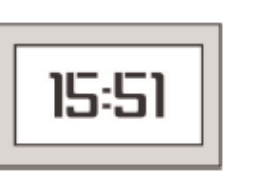
Un orologio digitale mostra l’ora, dalle 00:00 alle 23:59, con quattro cifre, come in figura. Quante volte capita in un giorno che le quattro cifre mostrate siano tutte uguali fra loro? A) 1 B) 24 C) 3 D) 5 E) 12
Topic: Teoria dei Numeri, Combinatoria Metodo: Analisi per casi Abilita: Conteggio sistematico Area: Aritmetica e Teoria dei Numeri, Combinatoria, Logica e Probabilita Risposta: C Fonte: apri PDF p.4
How many times the four digits of the watch are equal
A digital clock shows the time from 00:00 to 23:59, with four digits, as shown in the figure. How many times in a day do the four digits shown are all the same? A) 1 B) 24 C) 3 D) 5 E) 12
Answer: C
Come appare la costruzione di dadi vista da dietro
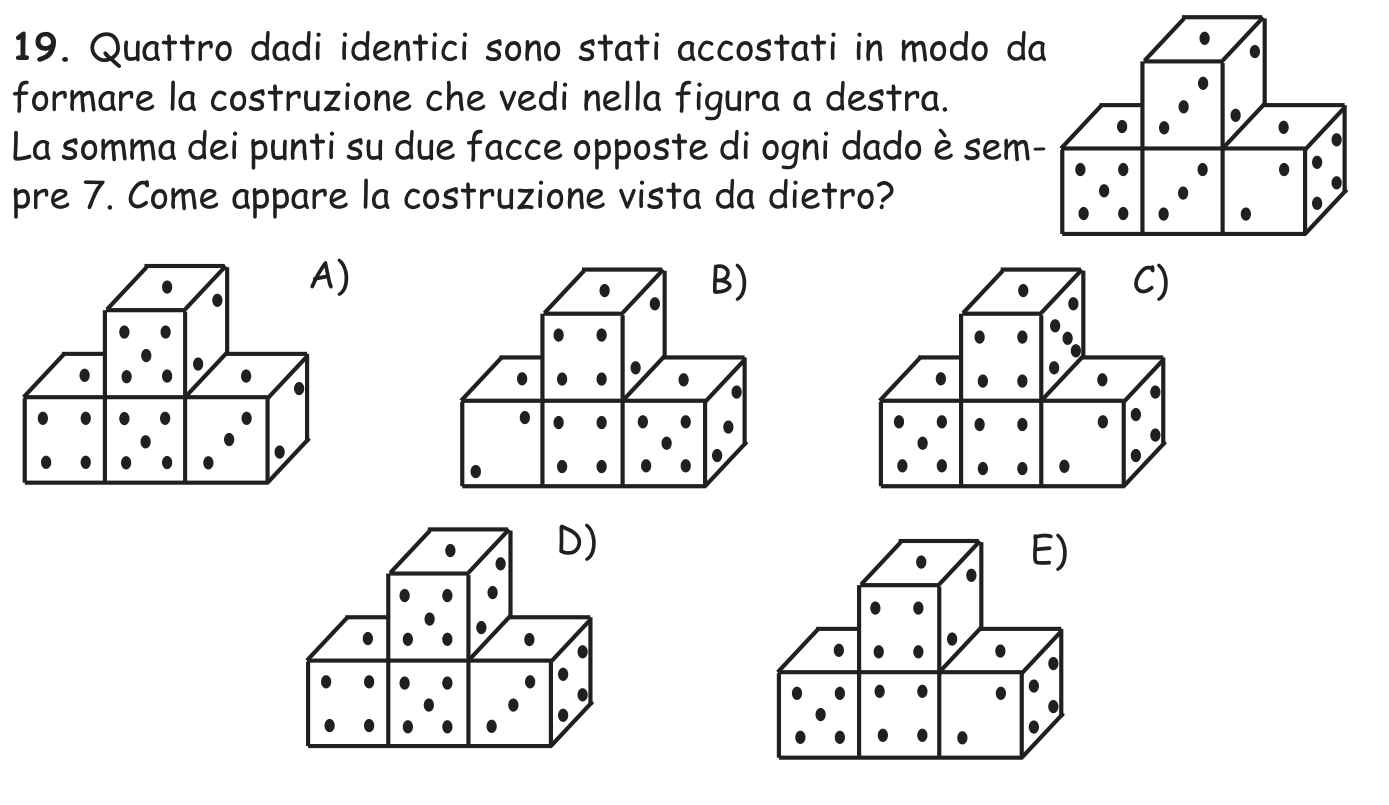
Quattro dadi identici sono stati accostati in modo da formare la costruzione che vedi nella figura a destra. La somma dei punti su due facce opposte di ogni dado è sempre 7. Come appare la costruzione vista da dietro?
Topic: Geometria solida Abilita: Ragionamento geometrico Area: Geometria Risposta: C Fonte: apri PDF p.4
What the construction of dice looks like from behind
Four identical dice have been placed together to form the structure you see in the figure to the right. The sum of the points on two opposite sides of each die is always 7. What does the construction look like from behind?
Answer: C
Quanti numeri di tre cifre con le tre carte 9,9,8
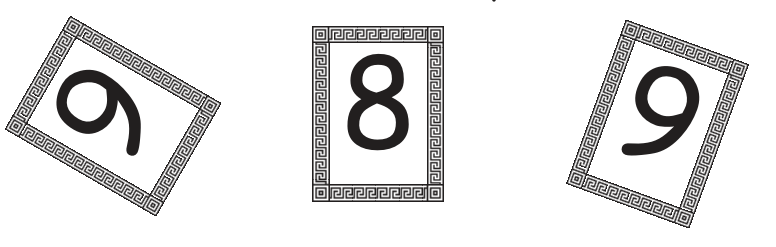
Hai le tre carte che vedi in figura. Accostandole, puoi formare diversi numeri di tre cifre ciascuno, ad esempio 989 o 986. Quanti numeri diversi puoi formare? A) 4 B) 6 C) 8 D) 9 E) 12
Topic: Combinatoria Metodo: Conteggio combinatorio Abilita: Conteggio sistematico Area: Combinatoria, Logica e Probabilita Risposta: E Fonte: apri PDF p.4
Three-digit numbers with the three cards 9,9,8
You have the three cards you see in the figure. So by combining them, you can form different three-digit numbers, like 989 or 986. How many different numbers can you form? A) 4 B) 6 C) 8 D) 9 E) 12
Answer: E
Quale pezzo certamente non usato nel mosaico
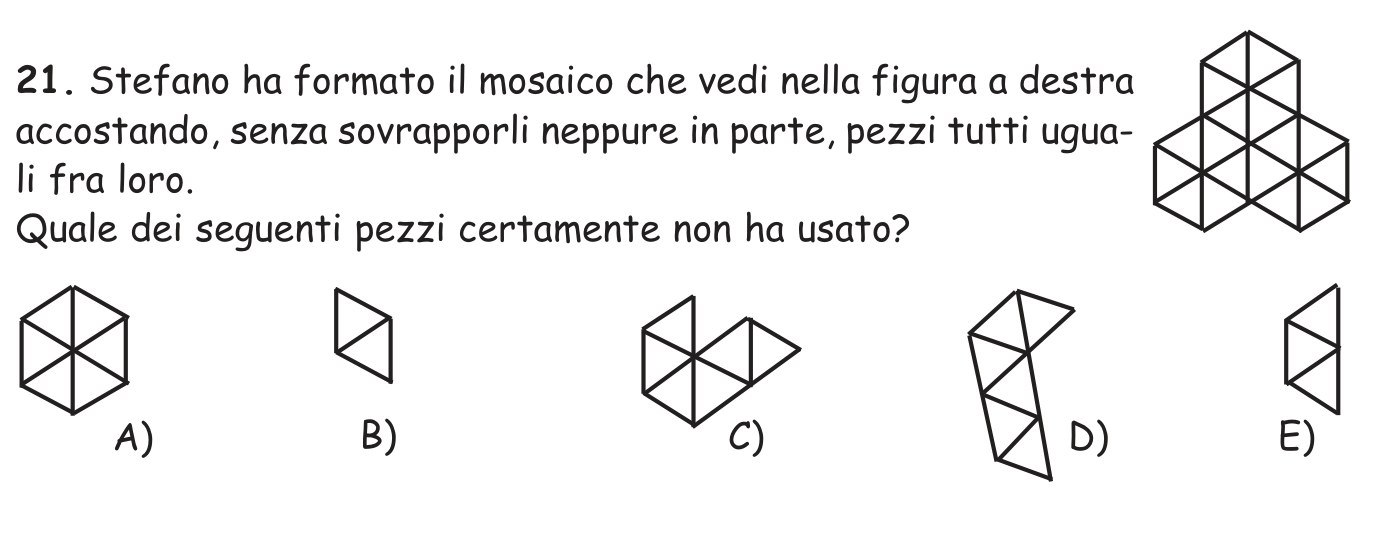
Stefano ha formato il mosaico che vedi nella figura a destra accostando, senza sovrapporli neppure in parte, pezzi tutti uguali fra loro. Quale dei seguenti pezzi certamente non ha usato? Pag. Pag. 8 Kang 201 Kang 2011 A) B) C) D) E) 9 9 8 A) B) C) D) E) Testi_11Mat.qxp 19-05-2011 21:20 Pagina 8
Pag. Pag. 9 Kang 201 Kang 2011
Topic: Geometria piana, Combinatoria Abilita: Ragionamento geometrico Area: Combinatoria, Logica e Probabilita, Geometria Risposta: D Fonte: apri PDF p.4
Which piece is certainly not used in the mosaic
Stefano has assembled the mosaic shown in the figure on the right by joining identical pieces, without overlapping or even partially overlapping. Which of the following pieces was certainly not used?
Page Page 8 Kang 2011 Kang 20111 A) B) C) D) E) 9 9 8 A) B) C) D) E) Testi_11Mat.qxp 19-05-2011 21:20 Page 8
Page Page 9 Kangaroo 2011
Answer: D
Quanti pezzi di formaggio ha preso il topo nel labirinto
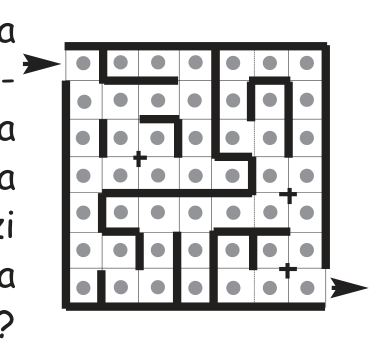
In ogni cella quadrata del labirinto che vedi in figura c’è un pezzo di formaggio. Il topo Luigi è entrato nel labirinto dall’apertura indicata dalla freccia in alto a sinistra ed è uscito da quella indicata dalla freccia in basso a destra dopo essersi preso il più grande numero di pezzi di formaggio che poteva prendere passando da ogni cella al massimo una volta. Quanti pezzi di formaggio ha preso? A) 17 B) 33 C) 37 D) 41 E) 49
Topic: Combinatoria, Logica, giochi, strategie Metodo: Principio di estremalita Abilita: Conteggio sistematico Area: Combinatoria, Logica e Probabilita Risposta: C Fonte: apri PDF p.5
How many pieces of cheese did the mouse take in the maze
In every square cell of the maze you see in the figure, there’s a piece of cheese. The mouse Luigi entered the maze from the opening indicated by the upper left arrow and came out of the one indicated by the lower right arrow after taking the largest number of cheese pieces he could take by passing through each cell at most once. How many pieces of cheese did you have? A) 17 B) 33 C) 37 D) 41 E) 49
Answer: C
Spettatori certamente italiani maschi e vegetariani
In un teatro vi sono 100 spettatori: 50 di essi sono italiani, 60 sono maschi, 90 sono vegetariani. Di quanti spettatori presenti in quel teatro si può essere certi che siano allo stesso tempo italiani, maschi e vegetariani? A) 0 B) 1 C) 10 D) 40 E) 50
Topic: Combinatoria, Insiemi e funzioni Metodo: Inclusione-esclusione Abilita: traduzione del testo Area: Algebra e Analisi, Combinatoria, Logica e Probabilita Risposta: A Fonte: apri PDF p.5
Spectators certainly Italian male and vegetarian
In a theater there are 100 spectators: 50 of them are Italians, 60 are men, 90 are vegetarians. How many spectators in that theater can you be sure of being Italian, male and vegetarian at the same time? A) 0 B) 1 C) 10 D) 40 E) 50
Answer: A
Da quanti esagoni e formata la quinta figura
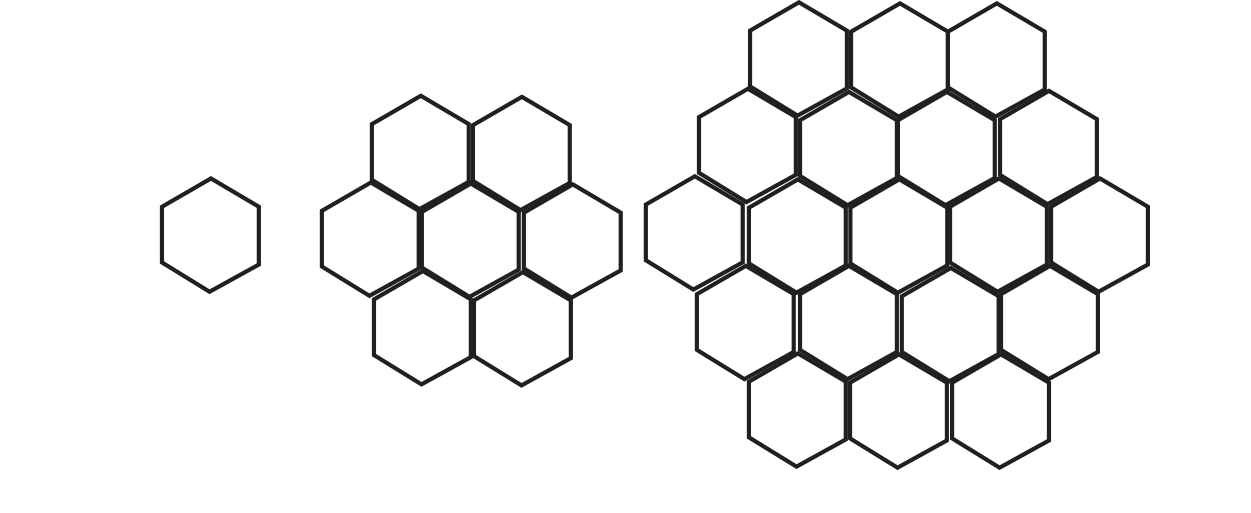
Usando delle tessere tutte uguali fra loro a forma di esagono, Silvia ha costruito cinque figure. Qui ti mostriamo le prime tre, dicendoti che Silvia ha costruito la quarta e la quinta basandosi sulla stessa regola con la quale ha costruito quelle che vedi (cioè ogni figura è costruita “circondando di esagoni” la figura precedente). Da quanti esagoni è formata la quinta figura? A) 37 B) 49 C) 57 D) 61 E) 64 Testi_11Mat.qxp 19-05-2011 21:20 Pagina 9
1 2011 Categoria Écolier
Topic: Combinatoria Metodo: Ricorsione Abilita: Riconoscimento di pattern Area: Combinatoria, Logica e Probabilita Risposta: D Fonte: apri PDF p.5
How many hexagons is the fifth figure made of?
Using identical hexagonal tiles, Silvia has built five figures. Here we show the first three, and you are told that Silvia constructed the fourth and fifth figures following the same rule used to build the ones you see (i.e., each figure is built by “surrounding hexagons” around the previous figure). How many hexagons form the fifth figure? (A) 37 (B) 49 (C) 57 (D) 61 (E) 64
1 2011 Category Écolier
Answer: D