Sfere passanti per tre punti non allineati nello spazio
Assegnati tre punti non allineati nello spazio, quante sfere passano per questi tre punti? Nel caso ne possa passare più di una, come si può determinare il raggio di quella che ha raggio minore?
Topic: Geometria solida Abilita: Ragionamento geometrico Area: Geometria Fonte: apri PDF p.1
Spheres passing through three non-aligned points in space
Assigned three non-aligned points in space, how many spheres pass through these three points? If more than one can pass, how can the radius of the smaller be determined?
src_kangourou_2012_student_finale__Q01
Fila di dadi con somma facce esposte uguale a 2012

Pietro vuole mettere in fila un certo numero di dadi tradizionali (la somma dei punti su facce opposte è sempre 7), come ti mostra la figura. Incolla due facce insieme solo se il numero di punti sulle due facce è uguale, e vuole ottenere una fila in modo che la somma dei punti su tutte le facce esposte sia . Può riuscirci e, in caso affermativo, quanti dadi deve usare? (vedi figura)
Topic: Teoria dei Numeri, Logica, giochi, strategie Abilita: traduzione del testo Area: Aritmetica e Teoria dei Numeri, Combinatoria, Logica e Probabilita Fonte: apri PDF p.1
Fire of dice with the sum of exposed faces equal to 2012
Peter wants to line up a number of traditional dice (the sum of points on opposite faces is always 7), as the figure shows. It joins two faces together only if the number of points on both faces is equal, and it wants to get a row so that the sum of points on all the faces exposed is . Can he do it, and if so, how many dice does he have to use? (see figure)
src_kangourou_2012_student_finale__Q02
Colorazioni di 20 tessere con regola di somma
Venti tessere sono numerate con gli interi da a . Vogliamo colorare ogni tessera di un solo colore, bianco o nero, in modo che sia rispettata la seguente regola: se due (diverse) tessere di numeri e hanno lo stesso colore e , allora anche la tessera di numero deve avere quel colore. In quanti modi diversi possiamo attribuire i colori?
Topic: Combinatoria Metodo: parita Abilita: Casework accurato Area: Combinatoria, Logica e Probabilita Fonte: apri PDF p.1
Colors of 20 sheets with sum rule
Twenty cards are numbered with integers from to . We want to colour each card of a single color, white or black, so that the following rule is observed: if two (different) cards of numbers and have the same color and , then the number card must also have that color. How many different ways can we assign colors?
src_kangourou_2012_student_finale__Q03
Ogni poliedro ha due facce con ugual numero di spigoli
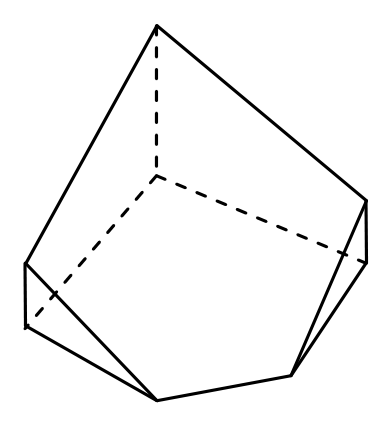
Dimostra che ogni poliedro (solido la cui superficie è costituita da un numero finito di poligoni) ha almeno due facce che hanno lo stesso numero di spigoli. Esistono poliedri che non hanno tre facce con lo stesso numero di spigoli?
Topic: Geometria solida, Combinatoria Metodo: Principio dei cassetti Abilita: generalizzazione Area: Combinatoria, Logica e Probabilita, Geometria Fonte: apri PDF p.1
Each polyhedron has two faces with the same number of beads
It shows that each polyhedron (a solid whose surface consists of a finite number of polygons) has at least two faces having the same number of vertices. Are there any polyhedra that don’t have three faces with the same number of beads?
src_kangourou_2012_student_finale__Q04
Sottoinsieme con somma multiplo di n tra n interi
Dimostrare che, comunque siano assegnati numeri interi positivi, è sempre possibile sceglierne alcuni in modo che la loro somma sia un multiplo di .
Topic: Teoria dei Numeri Metodo: Principio dei cassetti, congruenze Abilita: generalizzazione Area: Aritmetica e Teoria dei Numeri Fonte: apri PDF p.1
*Sub-totals with multiple sums of n between n integers *
Demonstrate that, however positive integers are assigned , some of them can always be chosen so that their sum is a multiple of .
src_kangourou_2012_student_finale__Q05
Famiglia infinita di sottoinsiemi quasi-disgiunti non numerabile
Denotiamo con l’insieme degli interi positivi. È noto che l’insieme dei sottoinsiemi di non può essere messo in corrispondenza biunivoca con , ma può essere messo in corrispondenza biunivoca con qualsiasi intervallo (non banale) dell’asse reale. Diciamo che due sottoinsiemi infiniti di sono “quasi-disgiunti” se hanno in comune al più un numero finito di elementi. Provare che esiste un insieme infinito che non può essere messo in corrispondenza biunivoca con , i cui elementi sono sottoinsiemi di a due a due quasi-disgiunti.
Topic: Insiemi e funzioni Abilita: generalizzazione Area: Algebra e Analisi Fonte: apri PDF p.1
Infinite family of nearly disjoint unnumerable subsets
We denote the sum of positive integers with . It is known that the set of subsets of cannot be given a bi-univocal correspondence with , but can be given a bi-univocal correspondence with any (non-trivial) interval of the real axis. Let’s say that two infinite subsets of are “almost disjoint” if they have at most a finite number of elements in common. Prove that there exists an infinite set that cannot be biunivocal with , the elements of which are subsets of two to two quasi-disjoint.