Numero che completa l’albero delle addizioni
Osserva la figura. Mara e Bruna si trovano alle due estremità del percorso indicato: che distanza deve percorre Mara per raggiungere Bruna? A) 300 m B) 400 m C) 800 m D) 1 km E) 700 m
Topic: Algebra, Teoria dei Numeri Abilita: Manipolazione algebrica Area: Algebra e Analisi, Aritmetica e Teoria dei Numeri Fonte: apri PDF p.1
Number that completes the additions tree
Look at the figure. Mara and Bruna are at the two ends of the indicated path: what distance must Mara travel to reach Bruna? A) 300 m B) 400 m C) 800 m D) 1 km E) 700 m
Quanti cubetti mancano per costruire il cubo grande
Nicola sta imparando a guidare: per ora è capace di curvare a destra, ma non è ancora in grado di curvare a sinistra. Ora, con la sua auto, si trova nel punto A della mappa e intende raggiungere il punto B partendo nella direzione e verso indicati dalla freccia. Qual è il minimo numero di curve (tutte a destra) che gli consentirà di arrivare in B? A) 3 B) 4 C) 6 D) 8 E) 10
Topic: Geometria solida Abilita: Ragionamento geometrico Area: Geometria Fonte: apri PDF p.1
How many cubes are needed to build the large cube
Nicholas is learning to drive: for now he can bend to the right, but he is not yet able to bend to the left. Now, with his car, he’s at point A on the map and he’s going to get to point B in the direction and direction the arrow points. What is the minimum number of curves (all on the right) that will allow them to get to B? A) 3 B) 4 C) 6 D) 8 E) 10
Distanza da percorrere per raggiungere l’amica
Oggi la somma delle età di Anna, Bruno e Cristina è 31 anni. Quale sarà la somma delle loro età fra tre anni? A) 32
B) 34
C) 35
D) 37 E) 40
Topic: Teoria dei Numeri Abilita: traduzione del testo Area: Aritmetica e Teoria dei Numeri Fonte: apri PDF p.1
Distance to reach the friend
Today, the sum of the ages of Anna, Bruno, and Cristina is 31. What will be the sum of their ages in three years? A) 32
B) 34
C) 35
D) 37 E) 40
Numero minimo di svolte a destra per andare da A a B
Natalia e Diana hanno molti cubetti, tutti uguali fra loro. Con alcuni di questi cubetti, Natalia ha costruito il cubo che vedi nella figura a sinistra. Diana vuole costruire un cubo identico a quello di Natalia, ma per ora è arrivata ad ottenere il solido che vedi nella figura a destra (i cubetti in posizioni non visibili sono già stati tutti inseriti). Quanti cubetti le mancano per completare la costruzione? A) 5 B) 6
C) 7
D) 8
E) 9
Topic: Logica, giochi, strategie, Geometria piana Metodo: Conteggio combinatorio Abilita: traduzione del testo Area: Combinatoria, Logica e Probabilita, Geometria Fonte: apri PDF p.1
Minimum number of turns to the right to go from A to B
Natalia and Diana have a lot of cubes, all the same. With some of these cubes, Natalia built the cube you see in the figure on the left. Diana wants to build a cube identical to Natalia’s, but for now she has managed to get the solid you see in the figure on the right (the cubes in unseen positions have already been all inserted). How many cubes does she need to complete the construction? A) 5 B) 6
C) 7
D) 8
E) 9
Somma delle tre eta tra tre anni
Il simbolo r indica una delle dieci cifre. Se r r × r = 176, qual è la cifra indicata da r ? A) 6
B) 4
C) 7 D) 9
E) 8 Mara Bruna
Topic: Teoria dei Numeri Abilita: Lettura attenta del testo Area: Aritmetica e Teoria dei Numeri Fonte: apri PDF p.1
Summary of three years of age over three years
The symbol r indicates one of the ten digits. If r r × r = 176, what is the figure indicated by r ? A) 6
B) 4
C) 7 D) 9
(E) 8 Brown
Ordine finale dei cinque canguri che saltano
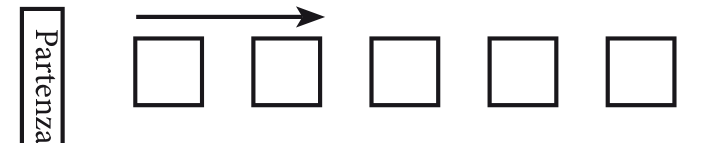
Cinque canguri K, L, M, N, e O hanno davanti a sè cinque grandi piastrelle quadrate, allineate come ti indica la figura. Ogni canguro parte dalla posizione indicata con “Partenza’’, salta nel verso della freccia e ad ogni salto atterra sulla prima piastrella libera che trova. Partono nell’ordine in cui te li abbiamo elencati: K per primo e fa tre salti, L per secondo e fa anche lui tre salti, M per terzo e fa due salti, N per quarto e fa anche lui due salti e infine O che fa solo un salto. Quando anche O è arrivato, in che ordine si trovano i cinque canguri? A) OKMLN
B) OKLMN C) OMLKN
D) OMLNK E) OMKLN
Topic: Logica, giochi, strategie Abilita: Casework accurato Area: Combinatoria, Logica e Probabilita Risposta: E Fonte: apri PDF p.2
Final order of the five jumping kangaroos
Five kangaroos K, L, M, N, and O have five large square tiles in front of them, aligned as shown in the figure. Each kangaroo starts from the position indicated with Partenza, jumps towards the arrow and at each jump lands on the first free tile it finds. They start in the order that we’ve listed them for you: K first and he jumps three times, L second and he jumps three times, M third and he jumps two times, N fourth and he jumps two times and finally O who jumps one time. When O also arrived, in what order are the five kangaroos? (A) OKMLN
(b) OKLMN C) OMLKN D) OMLNK E) OMKLN
Answer: E
Ora della quarta pillola a quarti d’ora
Per curarsi, Michele deve prendere delle pillole, ognuna (dalla seconda in poi) a distanza di un quarto d’ora dalla precedente. Ha preso la prima alle 11:05. A che ora ha preso la quarta? A) 11:40 B) 11:50 C) 11:55 D) 12:00 E) 12:05
Topic: Teoria dei Numeri Abilita: traduzione del testo Area: Aritmetica e Teoria dei Numeri Risposta: B Fonte: apri PDF p.2
Time of the fourth quarter-hour pill
To heal himself, Michele must take pills, each one (from the second onward) a quarter of an hour away from the previous one. He took the first one at 11:05. What time did he take the fourth? A) 11:40 B) 11:50 C) 11:55 D) 12:00 E) 12:05
Answer: B
Numeri tra 20 e 30 divisibili per la cifra unità
Il numero 36 ha la proprietà di essere divisibile per la sua cifra delle unità: infatti 36 è divisibile per 6. Quanti numeri compresi fra 20 e 30 hanno questa proprietà? A) 2
B) 3
C) 4
D) 5
E) 6
Topic: Teoria dei Numeri Abilita: Conteggio sistematico Area: Aritmetica e Teoria dei Numeri Risposta: C Fonte: apri PDF p.2
Numbers between 20 and 30 divisible by its units digit
The number 36 has the property of being divisible by its units digit: in fact 36 is divisible by 6. How many numbers between 20 and 30 have this property? A) 2
B) 3
C) 4
D) 5
E) 6
Answer: C
Posizione lancetta a un terzo del viaggio
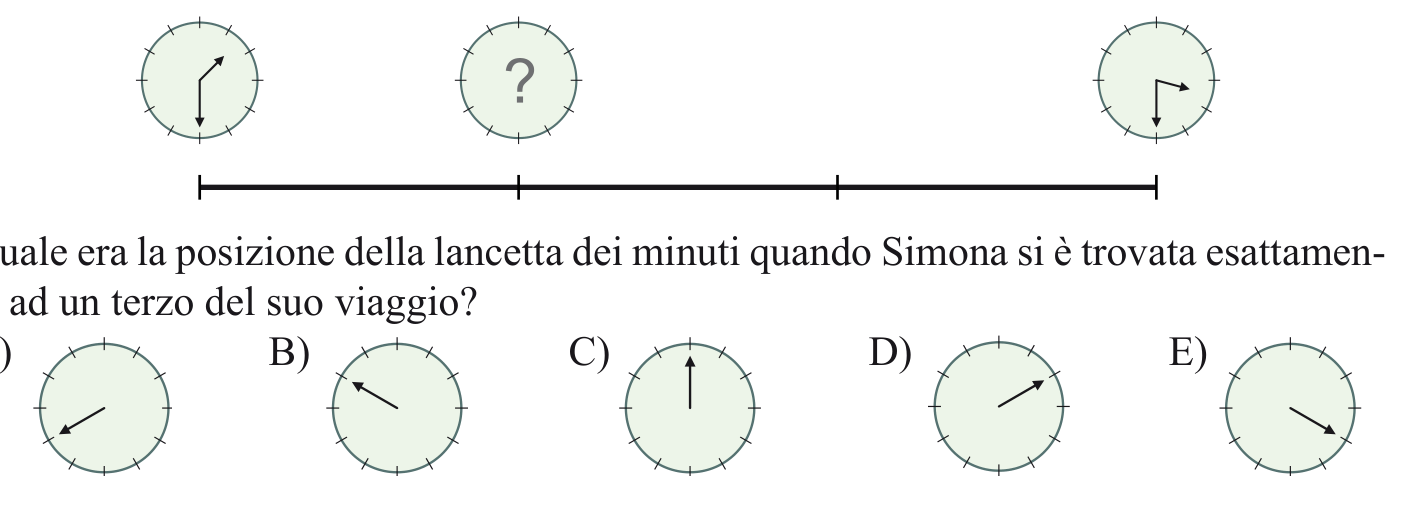
Ieri pomeriggio Simona ha fatto un viaggio in bicicletta, mantenendo sempre la stessa velocità. Alla partenza e all’arrivo ha guardato l’orologio, e ha visto le immagini che ti mostriamo nello schema qui sotto.
Quale era la posizione della lancetta dei minuti quando Simona si è trovata esattamente ad un terzo del suo viaggio? A)
B)
C)
D)
E)
Topic: Teoria dei Numeri Abilita: traduzione del testo Area: Aritmetica e Teoria dei Numeri Risposta: D Fonte: apri PDF p.2
Hand position at one third of the journey
Yesterday afternoon, Simona took a bicycle trip, always keeping the same speed. On departure and arrival she looked at the clock, and she saw the images we show you in the diagram below.
What was the position of the minute hand when Simona was exactly one third of her journey? A)
B)
C)
D)
E)
Answer: D
Quante figure hanno lo stesso perimetro del foglio quadrato
Cristina ha molti tasselli identici a quello nella figura di sinistra. Vuole inserirne quanti più possibile nel rettangolo 5×4 che vedi nella figura a destra, formato da quadratini della stessa taglia di quelli che formano i tasselli. I tasselli non devono sovrapporsi, neppure parzialmente. Quanti può inserirne al massimo? A) 2 B) 3 C) 4 D) 5 E) 6 Partenza
I quesiti dal N. 11 al N. 20 valgono 4 punti ciascuno
Topic: Geometria piana Abilita: Ragionamento geometrico Area: Geometria Fonte: apri PDF p.2
How many figures have the same perimeter as the square sheet
Cristina has many tiles identical to the one in the figure on the left. She wants to fit as many as possible into the 5×4 rectangle that you see in the figure on the right, made up of small squares of the same size as those that make up the tiles. The tiles must not overlap, not even partially. How many can she fit at most? A) 2 B) 3 C) 4 D) 5 E) 6 Start
Questions from No. 11 to No. 20 are worth 4 points each
Massimo numero di regioni con due quadrati
\begin{document}
\begin{tikzpicture}
  \fill[gray!60] (0,0) circle (1.34);
  \begin{scope}
    \clip (1.67,0) circle (1.0);
    \clip (0,0) circle (1.34);
    \fill[gray!40] (0,0) circle (1.34);
  \end{scope}
  \fill[gray!25] (1.67,0) circle (1.0);
  \begin{scope}
    \clip (0,0) circle (1.34);
    \clip (1.67,0) circle (1.0);
    \fill[gray!50] (1.67,0) circle (1.0);
  \end{scope}
  \draw (0,0) circle (1.34);
  \draw (1.67,0) circle (1.0);
\end{tikzpicture}
\end{document}
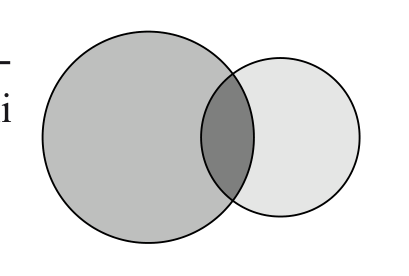
Osserva la figura: tracciando due cerchi, Stefano ha delimitato tre diverse regioni. Qual è il massimo numero di regioni diverse che può delimitare tracciando due quadrati? A) 3 B) 5 C) 7 D) 9 E) 12
Topic: Geometria piana, Combinatoria Metodo: Analisi per casi Abilita: Ragionamento geometrico Area: Combinatoria, Logica e Probabilita, Geometria Risposta: D Fonte: apri PDF p.3
Maximum number of regions with two squares
\begin{document}
\begin{tikzpicture}
  \fill[gray!60] (0,0) circle (1.34);
  \begin{scope}
    \clip (1.67,0) circle (1.0);
    \clip (0,0) circle (1.34);
    \fill[gray!40] (0,0) circle (1.34);
  \end{scope}
  \fill[gray!25] (1.67,0) circle (1.0);
  \begin{scope}
    \clip (0,0) circle (1.34);
    \clip (1.67,0) circle (1.0);
    \fill[gray!50] (1.67,0) circle (1.0);
  \end{scope}
  \draw (0,0) circle (1.34);
  \draw (1.67,0) circle (1.0);
\end{tikzpicture}
\end{document}
Notice the figure: By drawing two circles, Stephen delimits three different regions. What is the maximum number of different regions that you can delimit by drawing two squares? A) 3 B) 5 C) 7 D) 9 E) 12
Answer: D
Pezzo che copre più punti nella griglia
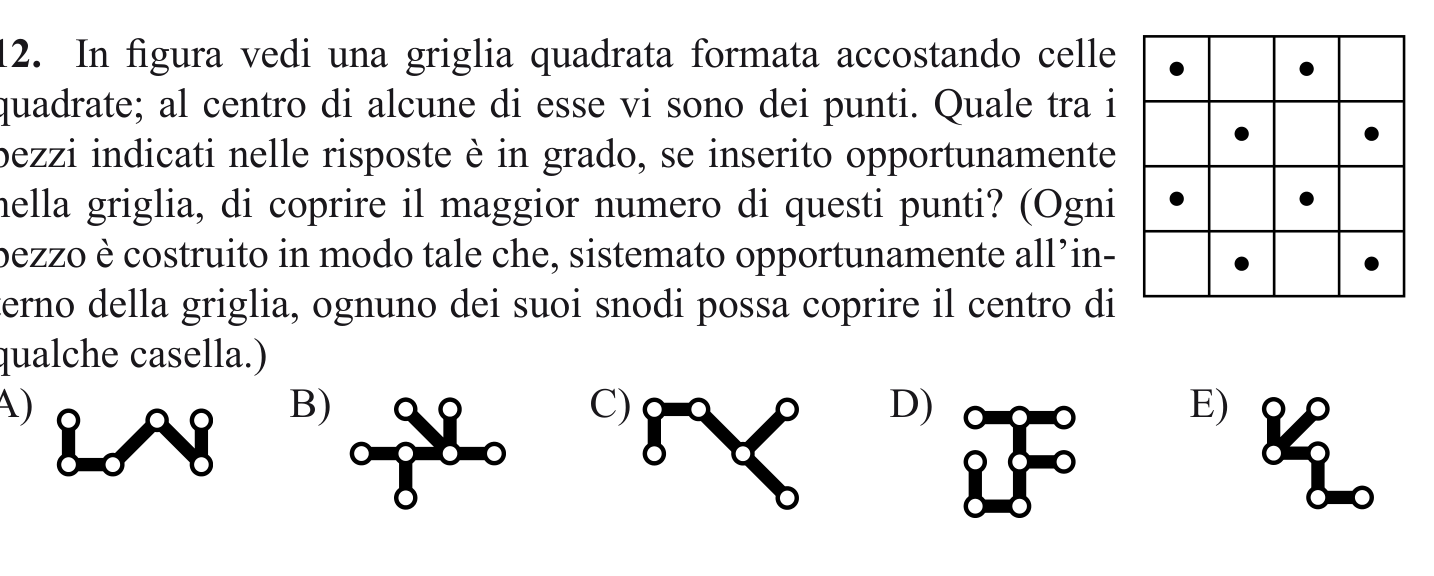
In figura vedi una griglia quadrata formata accostando celle quadrate; al centro di alcune di esse vi sono dei punti. Quale tra i pezzi indicati nelle risposte è in grado, se inserito opportunamente nella griglia, di coprire il maggior numero di questi punti? (Ogni pezzo è costruito in modo tale che, sistemato opportunamente all’interno della griglia, ognuno dei suoi snodi possa coprire il centro di qualche casella.) A)
B) C) D)
E)
Topic: Combinatoria Abilita: Ragionamento geometrico Area: Combinatoria, Logica e Probabilita Risposta: C Fonte: apri PDF p.3
Piece that covers more points in the grid
In the figure, you can see a square grid formed by squared cells; at the center of some of them are points. Which of the items in the answers, if properly inserted into the grid, can cover the most of these points? (Each piece is constructed in such a way that, properly placed inside the grid, each of its knots can cover the centre of some box.) A)
B) C) D)
E)
Answer: C
Quante regioni grigie hanno stesso perimetro del foglio

In figura vedi sei fogli quadrati. Ognuno di essi contiene una regione, evidenziata in grigio scuro, che lascia libere alcune porzioni rettangolari (eventualmente quadrate) di foglio. Quante sono le regioni evidenziate in grigio scuro che hanno lo stesso perimetro del foglio quadrato che le ospita? A) 2
B) 3
C) 4
D) 5
E) 6
Topic: Geometria piana Abilita: Ragionamento geometrico Area: Geometria Risposta: C Fonte: apri PDF p.3
How many grey regions have the same perimeter as the sheet
In the figure, you see six square sheets. Each contains a region, highlighted in dark gray, which leaves some rectangular (possibly square) portions of paper free. How many regions highlighted in dark gray have the same perimeter as the square sheet that houses them? A) 2
B) 3
C) 4
D) 5
E) 6
Answer: C
Pesci pescati se triplo darebbe 12 in più
Matteo è andato a pescare. Se avesse preso il triplo dei pesci che ha pescato, ne avrebbe pescati 12 in più. Quanti pesci ha pescato? A) 7
B) 6 C) 5
D) 4
E) 3
Topic: Algebra Abilita: Manipolazione algebrica Area: Algebra e Analisi Risposta: B Fonte: apri PDF p.3
Fished if tripled would give 12 more
Matteo went fishing. If he had caught three times the fish he caught, he would have caught 12 more. How many fish did he catch? A) 7
B) 6 C) 5
D) 4
E) 3
Answer: B
Numero di facce del cubo con cubetti rimossi ai vertici
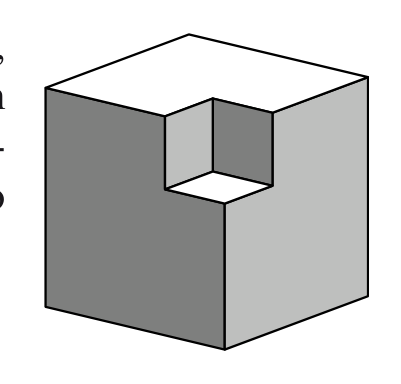
La figura rappresenta un cubo di 3 cm di lato dopo che, in corrispondenza di uno dei suoi vertici, è stato rimosso un cubetto di 1 cm di lato. Considera il solido che si ottiene ripetendo l’operazione su ciascuno dei vertici rimanenti (del cubo grande): quante facce ha?
A) 16B) 20
C) 24
D) 30 E) 36
Topic: Geometria solida Abilita: Ragionamento geometrico Area: Geometria Risposta: D Fonte: apri PDF p.3
Number of faces of the cube with cubes removed at the vertices
The figure represents a 3 cm side cube after a 1 cm side cube has been removed from one of its vertices. Consider the solid obtained by repeating the operation on each of the remaining vertices (of the large cube): how many faces does it have? A) 16
B) 20
C) 24 D) 30 E) 36
Answer: D
Reti segnate dalla squadra di casa
In una partita di calcio sono state segnate molte reti. Alla fine del primo tempo ne erano già state segnate sei e la squadra ospite era in vantaggio; segnando tre reti nel secondo tempo, la squadra di casa ha però vinto la partita. Quante reti ha segnato in tutto la squadra di casa? A) 3
B) 4
C) 5
D) 6
E) 7
Topic: Logica, giochi, strategie Metodo: Analisi per casi Abilita: Casework accurato Area: Combinatoria, Logica e Probabilita Risposta: C Fonte: apri PDF p.4
Goals scored by the home team
In a football game, a lot of goals were scored. At the end of the first half, six of them had already been scored and the away team was in the lead; scoring three goals in the second half, the home team won the match. How many goals did the home team score in total? A) 3
B) 4
C) 5
D) 6
E) 7
Answer: C
Coppie di numeri di due cifre con differenza 50
Considera tutte le coppie formate da numeri interi positivi, ciascuno di due cifre, tali che la differenza fra il maggiore e il minore dei due numeri sia 50. Quante sono? A) 40 B) 30
C) 50
D) 60 E) 10
Topic: Teoria dei Numeri, Combinatoria Metodo: Conteggio combinatorio Abilita: Conteggio sistematico Area: Aritmetica e Teoria dei Numeri, Combinatoria, Logica e Probabilita Risposta: A Fonte: apri PDF p.4
Pairs of two-digit numbers with a difference of 50
Consider all pairs of positive integers, each of two digits, such that the difference between the largest and the smallest of the two numbers is 50. How many are there? A) 40 B) 30
C) 50
D) 60 E) 10
Answer: A
Numeri diversi nella griglia 4x4 con celle adiacenti che differiscono di 1
In ogni cella di una griglia 4 × 4 è stato scritto un numero. Numeri scritti in celle adiacenti, cioè che abbiano un lato in comune, differiscono di 1. Fra i numeri scritti vi sono il 9 e il 3; quest’ultimo compare nella cella in alto a sinistra. Quanti diversi numeri compaiono nella griglia? A) 4 B) 6 C) 7 D) 8 E) 9
Topic: Combinatoria Metodo: parita Abilita: Casework accurato Area: Combinatoria, Logica e Probabilita Risposta: C Fonte: apri PDF p.4
Different numbers in the 4x4 grid with adjacent cells differing by 1
In each cell of a grid 4 × 4 a number is written. Numbers written in adjacent cells, i.e. having one side in common, differ by 1. Among the written numbers are 9 and 3; the latter appears in the upper left cell. How many different numbers appear in the grid? A) 4 B) 6 C) 7 D) 8 E) 9
Answer: C
Voti del secondo classificato nelle elezioni
In una classe si sono svolte le elezioni per nominare il capoclasse. I voti espressi sono stati complessivamente 36. Hanno ricevuto voti cinque candidati: il più votato ne ha ricevuti 12, quello meno votato ne ha ricevuti 4 e non ci sono due candidati con lo stesso numero di voti. Quanti voti ha ottenuto il candidato che si è piazzato al secondo posto? A) 8
B) 8 o 9, ed entrambi gli esiti sono possibili C) 9 D) 9 o 10, ed entrambi gli esiti sono possibili
E) 10
Topic: Logica, giochi, strategie, Combinatoria Metodo: Analisi per casi Abilita: Casework accurato Area: Combinatoria, Logica e Probabilita Risposta: B Fonte: apri PDF p.4
Votes from the second place in the elections
In one class, elections were held to appoint the head of the class. The total number of votes cast was 36. Five candidates received votes: the most voted received 12, the least voted received 4, and there are no two candidates with the same number of votes. How many votes did the candidate who placed second get? A) 8
B) 8 or 9, and both outcomes are possible C) 9 D) 9 or 10, and both outcomes are possible
E) 10
Answer: B
Immagine vista di fronte dell’edificio di cubetti
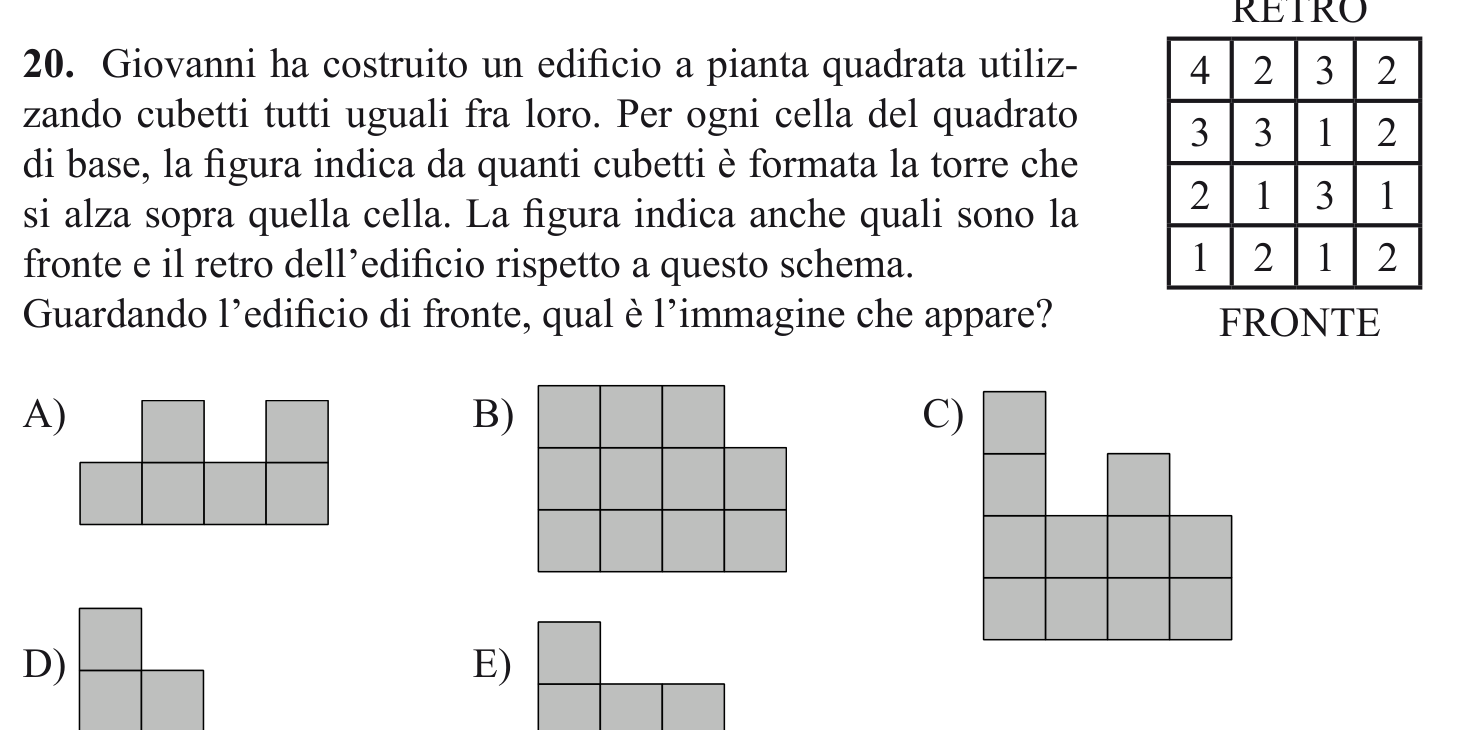
Giovanni ha costruito un edificio a pianta quadrata utilizzando cubetti tutti uguali fra loro. Per ogni cella del quadrato di base, la figura indica da quanti cubetti è formata la torre che si alza sopra quella cella. La figura indica anche quali sono la fronte e il retro dell’edificio rispetto a questo schema. Guardando l’edificio di fronte, qual è l’immagine che appare? A)
B)
C) D)
E) 3 4 2 3 2 3 3 1 2 2 1 3 1 1 2 1 2 RETRO FRONTE
I quesiti dal N. 21 al N. 30 valgono 5 punti ciascuno
Topic: Geometria solida Abilita: Ragionamento geometrico Area: Geometria Risposta: E Fonte: apri PDF p.4
Front view image of the building of small cubes
Giovanni built a building with a square base using small cubes all equal to each other. For each cell of the square base, the figure indicates how many cubes the tower that rises above that cell is made of. The figure also indicates which are the front and the back of the building with respect to this diagram. Looking at the building from the front, which image appears? A)
B)
C) D)
E) 3 4 2 3 2 3 3 1 2 2 1 3 1 1 2 1 2 BACK FRONT
Questions from No. 21 to No. 30 are worth 5 points each
Answer: E
Logica con bugiardi sui colori delle biglie
Andrea, Bruno e Carlo non dicono mai la verità. Ognuno di essi ha una biglia che è rossa oppure verde. Andrea dice: La mia biglia e quella di Bruno sono dello stesso colore. Bruno dice: La mia biglia e quella di Carlo sono dello stesso colore. Carlo dice: Due di noi hanno una biglia rossa, l’altro ce l’ha verde. Quale delle seguenti affermazioni è vera? A) La biglia di Andrea è verde .
B) La biglia di Bruno è verde.
C) La biglia di Carlo è rossa. D) Le biglie di Andrea e Carlo sono di colore diverso.
E) Nessuna delle precedenti affermazioni è vera.
Topic: Logica, giochi, strategie Metodo: Analisi per casi Abilita: Casework accurato Area: Combinatoria, Logica e Probabilita Risposta: A Fonte: apri PDF p.5
Logic with liars about the colors of the marbles
Andrea, Bruno and Carlo never tell the truth. Each of them has a marble that is either red or green. Andrea says: My marble and Bruno’s are the same color. Bruno says: My marble and Carlo’s are the same color. Carlo says: Two of us have a red marble, the other has a green one. Which of the following statements is true? A) Andrea’s marble is green .
B) Bruno’s marble is green.
C) Carlo’s marble is red. D) Andrea’s and Carlo’s marbles are of different colors.
E) None of the previous statements is true.
Answer: A
Numero minimo di pezzi per chiudere il circuito di binario
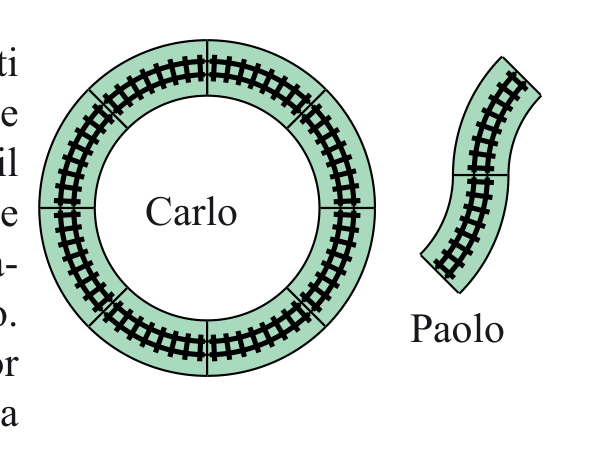
Carlo e Paolo hanno a disposizione alcuni tratti di binario curvo, tutti uguali fra loro. Ciascuno vuole costruire un circuito chiuso, sul quale far circolare il proprio treno. La figura mostra il circuito circolare che ha costruito Carlo, usando 8 tratti di binario, e in quale modo Paolo ha iniziato a costruire il suo circuito. Paolo vuole chiudere il suo circuito usando il minor numero possibile di pezzi: quando sarà terminato, da quanti pezzi risulterà formato il circuito di Paolo?
A) 11B) 12
C) 14
D) 15
E) 16
Topic: Geometria piana Abilita: Ragionamento geometrico Area: Geometria Risposta: B Fonte: apri PDF p.5
Minimum number of parts to close the track circuit
Charles and Paul have some pieces of curved track, all of them equal to each other. Everyone wants to build a closed circuit, on which to run their own train. The figure shows the circular circuit that Charles built, using 8 track pieces, and how Paul began to build his circuit. Paul wants to close his circuit by using as few pieces as possible. When finished, how many pieces will make up Paul’s circuit? A) 11
B) 12
C) 14
D) 15
E) 16
Answer: B
Minimo numero di gatte finaliste (insiemi)
Al concorso di Miss Gatta 2013 partecipano 66 gatte. 21 sono state eliminate perchè hanno fallito la prova di caccia al topo. Delle rimanenti, 27 hanno il pelo di almeno due colori e 32 hanno la coda bianca. Tutte le gatte con il pelo di almeno due colori e la coda bianca sono in finale. Allora il minor numero possibile di gatte finaliste è A) 5.
B) 7. C) 13.
D) 14. E) 27.
Topic: Combinatoria Metodo: Inclusione-esclusione Abilita: Conteggio sistematico Area: Combinatoria, Logica e Probabilita Risposta: D Fonte: apri PDF p.5
Minimum number of finalist cats (sets)
There are 66 cats in the Miss Cat 2013 competition. Twenty-one were eliminated because they failed the mouse-hunting test. Of the rest, 27 have at least two colors of hair and 32 have a white tail. All cats with at least two colors of hair and a white tail are in the final. So the smallest possible number of finalist cats is A) 5.
B) 7. C) 13.
D) 14. E) 27.
Answer: D
Massimo numero di maschi con vincolo sulla distanza
Dieci studenti, maschi e femmine, sono in fila. Comunque si scelgano due maschi nella fila, il numero di studenti che stanno fra quei due maschi è diverso da 2. Quanti maschi possono esserci al massimo nella fila? A) 7
B) 6
C) 3
D) 4 E) 5
Topic: Combinatoria Metodo: Principio di estremalita Abilita: Casework accurato Area: Combinatoria, Logica e Probabilita Risposta: B Fonte: apri PDF p.5
Maximum number of males with distance restriction
Ten students, male and female, are in line. However you choose two males in the line, the number of students standing between those two males is different from 2. How many males can there be in line at most? A) 7
B) 6
C) 3
D) 4 E) 5
Answer: B
Ragazzi che danno la mano sinistra a una ragazza in cerchio
40 ragazzi e 28 ragazze si dispongono in cerchio, mano nella mano, tutti rivolti verso l’interno del cerchio. I ragazzi che danno la loro mano destra ad una ragazza sono 18. Quanti sono i ragazzi che danno la loro mano sinistra ad una ragazza? A) 18 B) 9
C) 28 D) 14
E) 20 Carlo Paolo
Topic: Combinatoria Metodo: Doppio conteggio Abilita: Conteggio sistematico Area: Combinatoria, Logica e Probabilita Risposta: A Fonte: apri PDF p.5
Boys giving left hand to a girl in a circle
40 boys and 28 girls stand in a circle, hand in hand, all facing inside the circle. Boys who give a girl their right hand are 18. How many boys give their left hand to a girl? A) 18 B) 9
C) 28 D) 14
E) 20 Carlo Paolo
Answer: A
Minimo numero di pulsanti per rendere allegre le facce

In figura vedi quattro pulsanti: due di essi mostrano una faccia allegra, gli altri due una faccia triste. Se ne premi uno qualunque, la faccia mostrata cambia espressione (da triste diventa allegra o, da allegra, triste) e lo stesso accade per le facce che appaiono sui pulsanti adiacenti a quello che hai premuto. Vuoi rendere allegre tutte le facce: qual è il minimo numero di pulsanti premendo i quali puoi raggiungere lo scopo? A) 2
B) 3
C) 4
D) 5
E) 6
Topic: Logica, giochi, strategie Metodo: Ragionamento all’indietro Abilita: Casework accurato Area: Combinatoria, Logica e Probabilita Risposta: B Fonte: apri PDF p.6
Minimum number of buttons to make faces cheerful
In the picture you see four buttons: two of them show a happy face, the other two a sad face. If you press any of them, the face shown changes expression (from sad to happy or, from happy, sad) and the same goes for the faces that appear on the buttons adjacent to the one you pressed. You want to make all the faces cheerful, what is the minimum number of buttons you must press to reach the goal? A) 2
B) 3
C) 4
D) 5
E) 6
Answer: B
Massima differenza dopo 2013 operazioni cambio sulla terna
L’operazione cambio su una terna di numeri consiste nel sostituire ciascuno dei tre numeri della terna con la somma degli altri due. Per esempio, l’operazione cambio trasforma la terna {3, 4, 6} nella terna {10, 9, 7}; applicando cambio a questa seconda terna si ottiene la terna {16, 17, 19}. Partiamo dalla terna {20, 1, 3} ed applichiamo cambio 2013 volte consecutivamente: qual è la massima differenza tra due numeri dell’ultima terna che otteniamo? A) 1
B) 2
C) 17
D) 19
E) 2013
Topic: successioni Metodo: monovarianti Abilita: Riconoscimento di pattern Area: Algebra e Analisi Risposta: D Fonte: apri PDF p.6
Maximum difference after 2013 change operations on the triple
The change operation on a triple of numbers consists in replacing each of the three numbers of the triple with the sum of the other two. For example, the change operation transforms the triple {3, 4, 6} into the triple {10, 9, 7}; applying change to this second triple gives the triple {16, 17, 19}. We start from the triple {20, 1, 3} and apply change 2013 times consecutively: what is the maximum difference between two numbers of the last triple that we obtain? A) 1
B) 2
C) 17
D) 19
E) 2013
Answer: D
Quanti numeri strani n con n-297 inverso
Un numero intero positivo n di tre cifre viene detto strano se ha la seguente proprietà: il numero n – 297 è ancora intero positivo di tre cifre e le sue cifre sono le stesse di n lette nell’ordine inverso. Quanti numeri strani esistono? A) 6
B) 7
C) 10
D) 60 E) 70
Topic: Teoria dei Numeri Metodo: Conteggio combinatorio Abilita: Casework accurato Area: Aritmetica e Teoria dei Numeri Risposta: D Fonte: apri PDF p.6
How many strange numbers n with n-297 inverse
A positive integer n of three digits is called strange if it has the following property: the number n – 297 is still a positive integer of three digits and its digits are the same as those of n read in reverse order. How many strange numbers exist? A) 6
B) 7
C) 10
D) 60 E) 70
Answer: D
Massima somma facce visibili del solido 2x2x1 di cubi
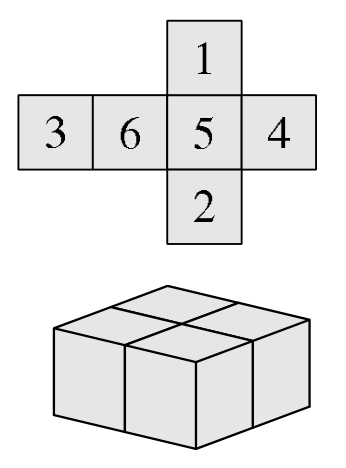
Alice ha quattro cubi identici, su ciascuna faccia di ciascuno dei quali è riportato un numero. Uno sviluppo di ciascuno dei cubi è indicato nella figura a sinistra in alto. Alice incolla i quattro cubi ottenendo il solido 2×2×1 indicato nella figura a sinistra in basso, con l’avvertenza che due facce possono combaciare solo se i numeri riportati su di esse sono uguali. Infine Alice calcola la somma dei numeri riportati sulle facce visibili del solido. Qual è la somma più alta che può ottenere? A) 64 B) 56 C) 80 D) 70 E) 68
Topic: Geometria solida, Combinatoria Metodo: Analisi per casi Abilita: Ragionamento geometrico Area: Combinatoria, Logica e Probabilita, Geometria Risposta: E Fonte: apri PDF p.6
Maximum number of visible faces of the solid 2x2x1 cubic
Alice has four identical cubes, on each face of which a number is shown. A net of each of the cubes is shown in the upper left figure. Alice glues the four cubes to the solid 2×2×1 shown in the figure to the left below, warning that two faces can only match if the numbers shown on them are equal. Finally, Alice calculates the sum of the numbers on the visible faces of the solid. What is the highest sum she can get? A) 64 B) 56 C) 80 D) 70 E) 68
Answer: E
Cubi distinti 2x2 con 4 cubetti bianchi e 4 neri
Quanti diversi cubi di lato 2 cm si possono ottenere accostando 4 cubetti bianchi e 4 cubetti neri, tutti di lato 1 cm? (Due cubi vanno considerati diversi se non si possono ottenere l’uno dall’altro per rotazioni.) A) 16
B) 9
C) 8
D) 7
E) 6
STRINGA BENJAMIN 2013
Topic: Combinatoria Metodo: Conteggio combinatorio Abilita: Conteggio sistematico Area: Combinatoria, Logica e Probabilita Risposta: D Fonte: apri PDF p.6
Separate 2x2 cubes with 4 white and 4 black cubes
How many different 2 cm side cubes can be obtained by putting together 4 white cubes and 4 black cubes, all of which are 1 cm side? (Two cubes shall be considered different if they cannot be obtained from each other by rotation.) A) 16
B) 9
C) 8
D) 7
E) 6
BENJAMIN STRING 2013
Answer: D