Area regione ombreggiata in triangolo equilatero suddiviso

Il triangolo grande rappresentato in figura è equilatero e ha area 9. I segmenti tracciati al suo interno sono paralleli ai lati e ciascun lato viene suddiviso in tre parti uguali dai loro estremi. Qual è l’area della regione ombreggiata? A) 1
B) 4
C) 5
D) 6
E) 7
Topic: Geometria piana Metodo: Sfruttamento della simmetria Abilita: Ragionamento geometrico Area: Geometria Risposta: D Fonte: apri PDF p.1
Area region shaded in divided equilateral triangle
The large triangle in the figure is equilateral and has an area of 9. The segments traced within it are parallel to the sides and each side is divided into three equal parts by their ends. What is the area of the shaded region? A) 1
B) 4
C) 5
D) 6
E) 7
Answer: D
Valore di espressione con ripunit (11…1)
È facile verificare che Quanto vale ? A) 5
B) 9
C) 11
D) 55
E) 99
Topic: Teoria dei Numeri Metodo: Somme telescopiche Abilita: Manipolazione algebrica Area: Aritmetica e Teoria dei Numeri Risposta: D Fonte: apri PDF p.1
Value of an expression with repunits (11…1)
It is easy to verify that What is the value of ? A) 5
B) 9
C) 11
D) 55
E) 99
Answer: D
Quante regioni grigie hanno stesso perimetro del foglio

In figura vedi sei fogli quadrati. Ognuno di essi contiene una regione, evidenziata in grigio scuro, che lascia libere alcune porzioni rettangolari (eventualmente quadrate) di foglio. Quante sono le regioni evidenziate in grigio scuro che hanno lo stesso perimetro del foglio quadrato che le ospita? A) 2 B) 3 C) 4 D) 5 E) 6
Topic: Geometria piana Abilita: Ragionamento geometrico Area: Geometria Risposta: C Fonte: apri PDF p.1
How many grey regions have the same perimeter as the sheet
In the figure, you see six square sheets. Each contains a region, highlighted in dark gray, which leaves some rectangular (possibly square) portions of paper free. How many regions highlighted in dark gray have the same perimeter as the square sheet that houses them? A) 2 B) 3 C) 4 D) 5 E) 6
Answer: C
Candele ancora accese dopo 55 minuti
Alessandro accende una candela ogni dieci minuti. Ogni candela arde per 40 minuti e poi si spegne. Quante candele sono ancora accese 55 minuti dopo che Alessandro ha acceso la prima candela? A) 2
B) 3
C) 4
D) 5
E) 6
Topic: Teoria dei Numeri Abilita: traduzione del testo Area: Aritmetica e Teoria dei Numeri Risposta: C Fonte: apri PDF p.1
Candle still lit after 55 minutes
Alexander lights a candle every ten minutes. Every candle burns for 40 minutes and then it goes out. How many candles are still lit 55 minutes after Alexander lit the first candle? A) 2
B) 3
C) 4
D) 5
E) 6
Answer: C
193
Le acque del Mar Morto sono composte da masse di sale e acqua in rapporto 7:193. Quanti chilogrammi di sale ci sono in 1000 kg di acque del Mar Morto? A) 35
B) 186 C) 193 D) 200 E) 350 1111 {{{{{{ = 11. 101 3333
{{{{{{ + 101 6666
{{{{{{ 303
Topic: Algebra Abilita: Manipolazione algebrica Area: Algebra e Analisi Risposta: A Fonte: apri PDF p.1
193
The waters of the Dead Sea are composed of masses of salt and water in a ratio of 7:193. How many kilos of salt are in 1,000 kilos of Dead Sea water? A) 35
B) 186 C) 193 D) 200 E) 350 1111 {{{{{{ = 11. 101 3333 {{{{{{ + 101 6666 {{{{{{ 303
Answer: A
Minimo celle avanzate ritagliando pezzi
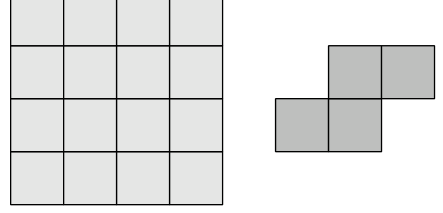
Anna ha un foglio di carta quadrato quadrettato come quello mostrato in figura. Tagliando lungo le righe tracciate nel quadrato ritaglia alcuni pezzi che, eventualmente dopo essere stati ruotati nel piano o nello spazio, sono sovrapponibili a quello mostrato a destra. Qual è il minimo numero di celle quadrate che le possono avanzare dopo tale operazione? A) 0 B) 2 C) 4 D) 6 E) 8
Topic: Combinatoria Abilita: Ragionamento geometrico Area: Combinatoria, Logica e Probabilita Risposta: C Fonte: apri PDF p.2
Minimum cells left over when cutting out pieces
Anna has a square sheet of graph paper like the one shown in the figure. By cutting along the lines drawn in the square she cuts out some pieces which, possibly after having been rotated in the plane or in space, can be superimposed on the one shown on the right. What is the minimum number of square cells that can be left over after this operation? A) 0 B) 2 C) 4 D) 6 E) 8
Answer: C
Somma cifre minimo numero con prodotto cifre 24
Rosa vuol trovare un numero intero positivo il prodotto delle cui cifre sia 24. Qual è la somma delle cifre del più piccolo numero che Rosa può trovare? A) 6
B) 8
C) 9
D) 10
E) 11
Topic: Teoria dei Numeri Metodo: manipolazione algebrica Abilita: Casework accurato Area: Aritmetica e Teoria dei Numeri Risposta: E Fonte: apri PDF p.2
Sum of digits of the smallest number with digit product 24
Rosa wants to find a positive integer whose digits have product 24. What is the sum of the digits of the smallest number that Rosa can find? A) 6
B) 8
C) 9
D) 10
E) 11
Answer: E
Quale media di figli non è possibile per 5 famiglie
Il numero medio di figli di 5 famiglie non può essere A) 0,2. B) 1,2. C) 2,2. D) 2,4. E) 2,5.
Topic: Teoria dei Numeri Abilita: Lettura attenta del testo Area: Aritmetica e Teoria dei Numeri Risposta: E Fonte: apri PDF p.2
What average of children is not possible for 5 households
The average number of children in 5 households cannot be A) 0,2. B) 1,2. C) 2,2. D) 2,4. E) 2,5.
Answer: E
Giri di Lisa quando Marco la raggiunge (fontana)
Marco e Lisa sono fermi al bordo di una fontana circolare, da parti diametralmente opposte. Iniziano a correre entrambi nello stesso verso intorno alla fontana. La velocità di Marco è i 9/8 di quella di Lisa. Quando Marco raggiungerà Lisa per la prima volta, quanti giri della fontana avrà concluso Lisa? A) 4
B) 8
C) 9
D) 2,4 E) 7,5
Topic: Algebra Abilita: traduzione del testo Area: Algebra e Analisi Risposta: A Fonte: apri PDF p.2
Lisa’s turn when Marco reaches her (source)
Marco and Lisa are standing at the edge of a circular fountain, diametrically opposite. They both start running in the same direction around the fountain. Marco’s speed is 9/8 of Lisa’s. When Marco reaches Lisa for the first time, how many turns of the fountain will Lisa have completed? A) 4
B) 8
C) 9
D) 2,4 E) 7,5
Answer: A
Somma di tre interi dai prodotti a coppie 14,10,35
Tre numeri interi positivi, moltiplicati a due a due, danno come risultati 14, 10 e 35. Quanto vale la loro somma? A) 10
B) 12
C) 14
D) 16
E) 18 I quesiti dal N. 11 al N. 20 valgono 4 punti ciascuno
Topic: Teoria dei Numeri Metodo: manipolazione algebrica Abilita: Manipolazione algebrica Area: Aritmetica e Teoria dei Numeri Risposta: C Fonte: apri PDF p.2
Sum of three integers from coupled products 14,10,35
Three positive integers, multiplied two at a time, yield 14, 10, and 35. How much is their sum? A) 10
B) 12
C) 14
D) 16
(E) 18 Questions from N. 11 al N. 20 is worth 4 points each.
Answer: C
Misura angolo delta da angoli dati
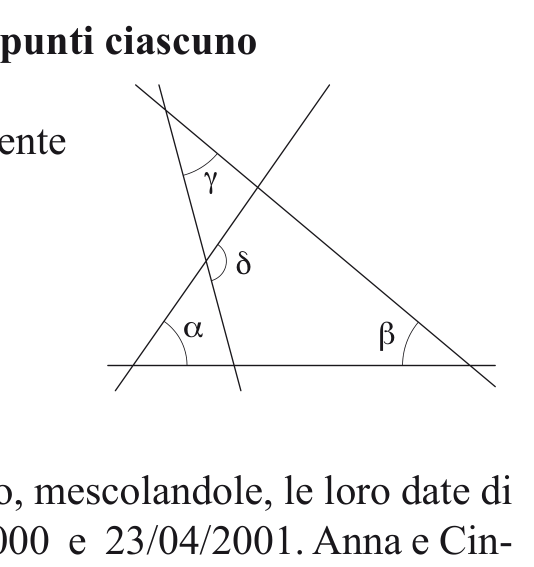
Gli angoli α, β, γ in figura misurano rispettivamente 55, 40 e 35 gradi. Quanti gradi misura δ? A) 100 B) 105 C) 120 D) 125 E) 130
Topic: Geometria piana Abilita: Ragionamento geometrico Area: Geometria Risposta: E Fonte: apri PDF p.2
Measurement of delta angle from data angles
The angles α, β, γ in the figure are 55, 40 and 35 degrees respectively. How many degrees does δ measure? A) 100 B) 105 C) 120 D) 125 E) 130
Answer: E
La più giovane tra cinque ragazze da date di nascita
Anna, Betta, Cinzia, Dina ed Elisa ci hanno fornito, mescolandole, le loro date di nascita: 20/02/2001, 12/03/2000, 20/03/2001, 12/04/2000 e 23/04/2001. Anna e Cinzia sono nate nello stesso giorno di mesi diversi; anche Dina ed Elisa sono nate nello stesso giorno di mesi diversi. Qual è la più giovane tra le cinque ragazze? A) Anna B) Betta C) Cinzia D) Dina E) Elisa α β γ δ
Topic: Logica, giochi, strategie Metodo: Analisi per casi Abilita: Casework accurato Area: Combinatoria, Logica e Probabilita Risposta: B Fonte: apri PDF p.2
The youngest of five girls by birth
Anna, Betta, Cinzia, Dina and Elisa have given us their dates of birth by mixing them: 20/02/2001, 12/03/2000, 20/03/2001, 12/04/2000 and 23/04/2001. Anna and Cinzia were born on the same day of different months; and Dina and Elisa were born on the same day of different months. Which is the youngest of the five girls? (A) Anna B) Betta C) Cinzia D) Dina E) Elisa α β γ δ
Answer: B
Angoli minori di trapezio con perimetro 5 e lati interi
Il perimetro di un trapezio vale 5 e le lunghezze dei suoi lati sono espresse da numeri interi. Quanti gradi misurano i due angoli minori del trapezio? A) Entrambi 30. B) Entrambi 60. C) Entrambi 45. D) Uno 30 e l’altro 45. E) Uno 45 e l’altro 90.
Topic: Geometria piana Metodo: Analisi per casi Abilita: Casework accurato Area: Geometria Risposta: B Fonte: apri PDF p.3
Smaller angles of trapezoid with perimeter 5 and full sides
The perimeter of a trapezoid is 5 and the lengths of its sides are expressed by integers. How many degrees do the two smaller angles of the trapezoid measure? A) Both 30. B) Both 60. C) Both 45. D) One 30 and the other 45. E) One 45 and the other 90.
Answer: B
Quale sviluppo piano non forma un cubo
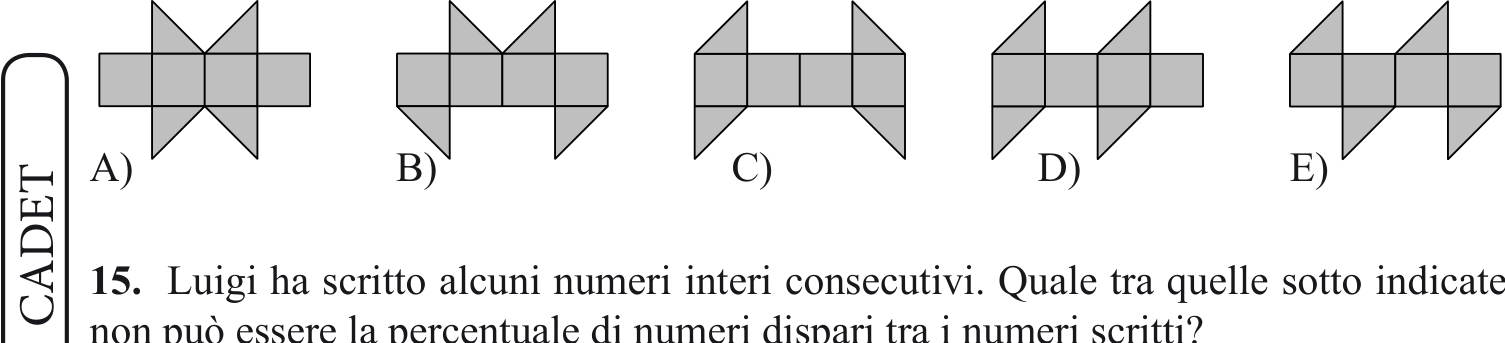
Uno e uno solo dei seguenti sviluppi piani non può essere ripiegato a formare un cubo. Quale? A) B)
C)
               D)
E)
Topic: Geometria solida Abilita: Ragionamento geometrico Area: Geometria Risposta: C Fonte: apri PDF p.3
Which net does not form a cube
One and only one of the following nets cannot be folded to form a cube. Which one? A) B)
C) D)
E)
Answer: C
Percentuale di dispari impossibile tra interi consecutivi
Luigi ha scritto alcuni numeri interi consecutivi. Quale tra quelle sotto indicate non può essere la percentuale di numeri dispari tra i numeri scritti? A) 40
B) 45
C) 48
D) 50
E) 60
Topic: Teoria dei Numeri Metodo: Analisi per casi Abilita: Riconoscimento di pattern Area: Aritmetica e Teoria dei Numeri Risposta: B Fonte: apri PDF p.3
Impossible percentage of odd numbers among consecutive integers
Luigi wrote some consecutive integers. Which of the following cannot be the percentage of odd numbers among the numbers written? A) 40
B) 45
C) 48
D) 50
E) 60
Answer: B
Vertice con rapporto y/x minimo nel rettangolo
\begin{document}
\begin{tikzpicture}
  \draw[->] (0,0) -- (4.5,0) node[right] {$x$};
  \draw[->] (0,0) -- (0,2.5) node[above] {$y$};
  \fill[gray!30] (1,-2) rectangle (4,-0.8);
  \draw (1,-2) rectangle (4,-0.8);
  \node[below left] at (1,-2) {$A$};
  \node[below right] at (4,-2) {$B$};
  \node[above right] at (4,-0.8) {$C$};
  \node[above left] at (1,-0.8) {$D$};
\end{tikzpicture}
\end{document}
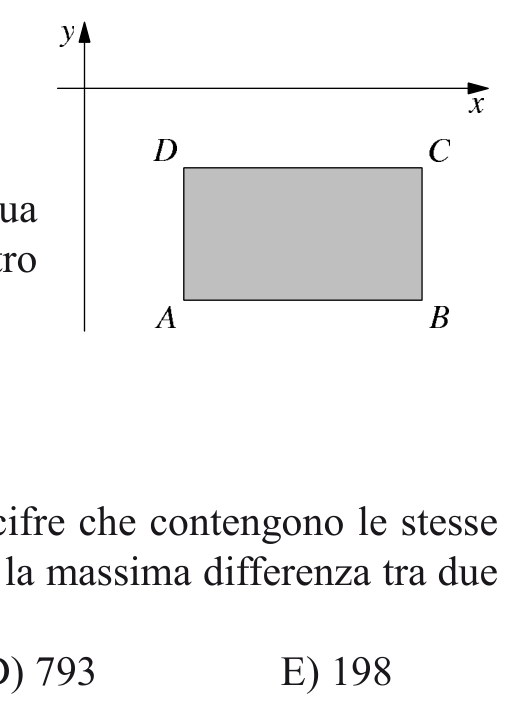
In figura è rappresentato un rettangolo ABCD che • ha lati paralleli agli assi coordinati, • giace “sotto” l’asse x e “a destra” dell’asse y. Per ciascuno dei vertici calcoliamo il rapporto tra la sua coordinata y e la sua coordinata x. Per quale dei quattro punti tale rapporto è minimo? A) A B) B C) C D) D
E) dipende dal rettangolo.
Topic: Geometria analitica Metodo: Metodo delle coordinate Abilita: Ragionamento geometrico Area: Geometria Risposta: A Fonte: apri PDF p.3
Vertex with minimum y/x ratio in the rectangle
\begin{document}
\begin{tikzpicture}
  \draw[->] (0,0) -- (4.5,0) node[right] {$x$};
  \draw[->] (0,0) -- (0,2.5) node[above] {$y$};
  \fill[gray!30] (1,-2) rectangle (4,-0.8);
  \draw (1,-2) rectangle (4,-0.8);
  \node[below left] at (1,-2) {$A$};
  \node[below right] at (4,-2) {$B$};
  \node[above right] at (4,-0.8) {$C$};
  \node[above left] at (1,-0.8) {$D$};
\end{tikzpicture}
\end{document}
The figure shows an ABCD rectangle which • has sides parallel to the coordinate axes, • lies under the x-axis and to the right of the y-axis. For each of the vertices, we calculate the ratio between its y coordinate and its x coordinate. For which of the four points is this ratio the minimum? A) A B) B C) C D) D E) depends on the rectangle.
Answer: A
Massima differenza tra numeri consecutivi con cifre di 2013
Ho scritto sulla lavagna tutti i numeri di quattro cifre che contengono le stesse cifre di 2013, disponendoli in ordine crescente. Qual è la massima differenza tra due numeri consecutivi in questa sequenza? A) 702 B) 703 C) 693 D) 793 E) 198
Topic: Combinatoria Metodo: Conteggio combinatorio Abilita: Conteggio sistematico Area: Combinatoria, Logica e Probabilita Risposta: A Fonte: apri PDF p.3
Maximum difference between consecutive numbers with the digits of 2013
I wrote all the four-digit numbers on the board that contain the same digits as 2013, arranging them in increasing order. What’s the biggest difference between two consecutive numbers in this sequence? A) 702 B) 703 C) 693 D) 793 E) 198
Answer: A
Celle non intersecate dalle diagonali in griglia 6x10
\begin{document}
\begin{tikzpicture}
  \draw[step=1cm] (0,0) grid (8,6);
  \draw (0,6) -- (8,0);
  \draw (0,0) -- (8,6);
\end{tikzpicture}
\end{document}
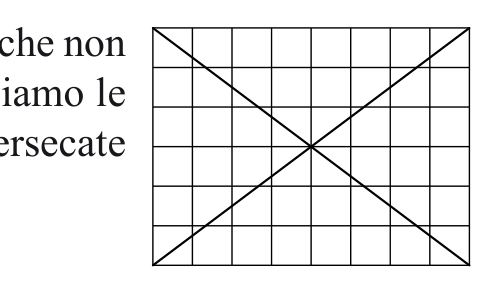
Nella griglia 6×8 mostrata in figura ci sono 24 celle che non sono intersecate da alcuna delle due diagonali. Se tracciamo le diagonali di una griglia 6×10 quante celle non sono intersecate da alcuna delle due diagonali? A) 28 B) 29 C) 30 D) 31 E) 32
Topic: Combinatoria, Geometria piana Metodo: Conteggio combinatorio Abilita: Conteggio sistematico Area: Combinatoria, Logica e Probabilita, Geometria Risposta: E Fonte: apri PDF p.3
Cells not intersected by diagonals in a 6x10 grid
\begin{document}
\begin{tikzpicture}
  \draw[step=1cm] (0,0) grid (8,6);
  \draw (0,6) -- (8,0);
  \draw (0,0) -- (8,6);
\end{tikzpicture}
\end{document}
In the grid 6×8 shown in the figure there are 24 cells are not intersected by any of the two diagonals. If we trace the diagonals of a grid 6×10 how many cells are not intersected by any of the two diagonals? A) 28 B) 29 C) 30 D) 31 E) 32
Answer: E
Immagine dal retro dell’edificio di cubetti
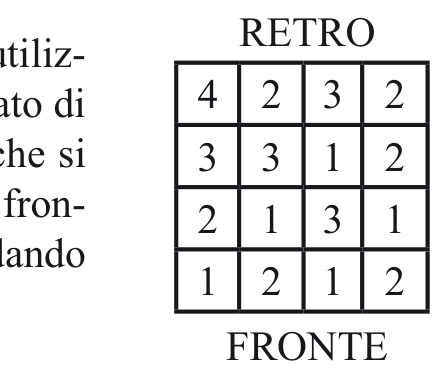
Giovanni ha costruito un edificio a pianta quadrata utilizzando cubetti tutti uguali fra loro. Per ogni cella del quadrato di base, la figura indica da quanti cubetti è formata la torre che si alza sopra quella cella. La figura indica anche quali sono la fronte e il retro dell’edificio rispetto a questo schema. Guardando l’edificio dal retro, qual è l’immagine che appare? 4 2 3 2 3 3 1 2 2 1 3 1 1 2 1 2 RETRO FRONTE
    A)

     B)
    C)
      D)
     E)
Topic: Geometria solida Abilita: Ragionamento geometrico Area: Geometria Risposta: C Fonte: apri PDF p.3
Image from the back of the building of small cubes
Giovanni built a building with a square base using small cubes all equal to each other. For each cell of the square base, the figure indicates how many cubes the tower rising above that cell is made of. The figure also indicates which are the front and the back of the building with respect to this diagram. Looking at the building from the back, which image appears? 4 2 3 2 3 3 1 2 2 1 3 1 1 2 1 2 BACK FRONT
    A)

     B)
    C)
      D)
     E)
Answer: C
Area del quadrilatero KLMN su griglia
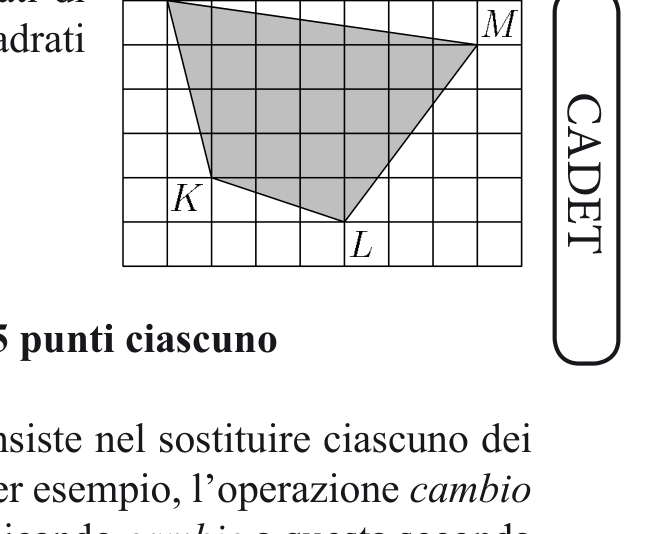
Ogni cella del foglio quadrettato in figura ha lati di lunghezza 2 cm. Qual è la misura in centimetri quadrati dell’area del quadrilatero KLMN? A) 96
B) 84
C) 76
D) 21E) 42 I quesiti dal N. 21 al N. 30 valgono 5 punti ciascuno
Topic: Geometria piana Metodo: Metodo delle coordinate Abilita: Ragionamento geometrico Area: Geometria Risposta: B Fonte: apri PDF p.4
Area of the KLMN quadrilateral on the grid
Each cell of the square sheet in the figure has sides 2 cm long. What is the square centimetre area of the KLMN quadrilateral? A) 96
B) 84
C) 76 D) 21
E) 42 Questions from N. 21 to N. 30 are worth 5 points each.
Answer: B
Quante operazioni cambio per far apparire 2013
L’operazione cambio su una terna di numeri consiste nel sostituire ciascuno dei tre numeri della terna con la somma degli altri due. Per esempio, l’operazione cambio trasforma la terna {3, 4, 6} nella terna {10, 9, 7}; applicando cambio a questa seconda terna si ottiene la terna {16, 17, 19}. Partiamo dalla terna {1, 2, 3}; quante volte dobbiamo applicare cambio consecutivamente perchè nella terna appaia il numero 2013? A) 8 B) 9 C) 10 D) 2013 E) 2013 non apparirà mai.
Topic: successioni Metodo: monovarianti Abilita: Riconoscimento di pattern Area: Algebra e Analisi Risposta: E Fonte: apri PDF p.4
How many exchange operations to make 2013 appear
The change operation on a triple of numbers consists of replacing each of the three numbers in the triple with the sum of the other two. For example, the change operation transforms {3, 4, 6} into {10, 9, 7}; by applying change to this second triple, we obtain the triple {16, 17, 19}. Let’s start from the triple {1, 2, 3}; how many times do we have to apply change consecutively for the number 2013 to appear in the triple? A) 8 B) 9 C) 10 D) 2013 E) 2013 will never appear.
Answer: E
Somma cifre del numero di 5 cifre dato somma 52713
Pippo sceglie un numero intero positivo di 5 cifre e ne cancella una in modo da ottenere un numero di 4 cifre. La somma del numero originale e del numero modificato è 52713. Qual è la somma delle cifre del numero di 5 cifre? A) 26
B) 20
C) 23
D) 19
E) 17
Topic: Teoria dei Numeri Metodo: manipolazione algebrica Abilita: Manipolazione algebrica Area: Aritmetica e Teoria dei Numeri Risposta: C Fonte: apri PDF p.4
sum of digits of the 5-digit number given sum of 52713
Pippo picks a positive five-digit integer and deletes one so that it gets a four-digit number. The sum of the original number and the modified number is 52713. What is the sum of the digits of the five-digit number? A) 26
B) 20
C) 23
D) 19
E) 17
Answer: C
Massimo aceri tra 20 alberi senza 3 alberi tra due aceri
Un giardiniere progetta di piantare 20 alberi (aceri e tigli) lungo la passeggiata che costeggia il fiume. Vuole che tra due aceri, in qualunque posizione siano, non ci siano mai esattamente tre alberi. Quanti al massimo, dei 20 alberi che il giardiniere pianterà, potranno essere aceri? A) 8
B) 10
C) 12
D) 14
E) 16
Topic: Combinatoria Metodo: Principio di estremalita Abilita: Casework accurato Area: Combinatoria, Logica e Probabilita Risposta: C Fonte: apri PDF p.4
Maximum maples among 20 trees without 3 trees between two maples
A gardener plans to plant 20 trees (maples and lindens) along the walkway that runs alongside the river. He wants that between two maples, in whatever position they are, there are never exactly three trees. At most how many, of the 20 trees that the gardener will plant, could be maples? A) 8
B) 10
C) 12
D) 14
E) 16
Answer: C
Numero concorrenti nella corsa campestre
Andrea e Daniele hanno partecipato ad una corsa campestre. Nell’ordine d’arrivo Andrea precede un numero di concorrenti doppio di quello di coloro che precedono Daniele e Daniele precede un numero di concorrenti che è una volta e mezza il numero di coloro che precedono Andrea. Andrea è arrivato ventunesimo: quanti erano i concorrenti? A) 31
B) 41
C) 51
D) 61
E) 81
Topic: Algebra Abilita: traduzione del testo Area: Algebra e Analisi Risposta: B Fonte: apri PDF p.4
Number of competitors in the field race
Andrea and Daniele took part in a cross-country race. In the order of arrival Andrea precedes a number of contestants twice that of those who precede Daniele and Daniele precedes a number of contestants that is one and a half times the number of those who precede Andrea. Andrea came twenty-first: how many competitors were there? A) 31
B) 41
C) 51
D) 61
E) 81
Answer: B
Modi distinti uscita di quattro auto dalla rotonda
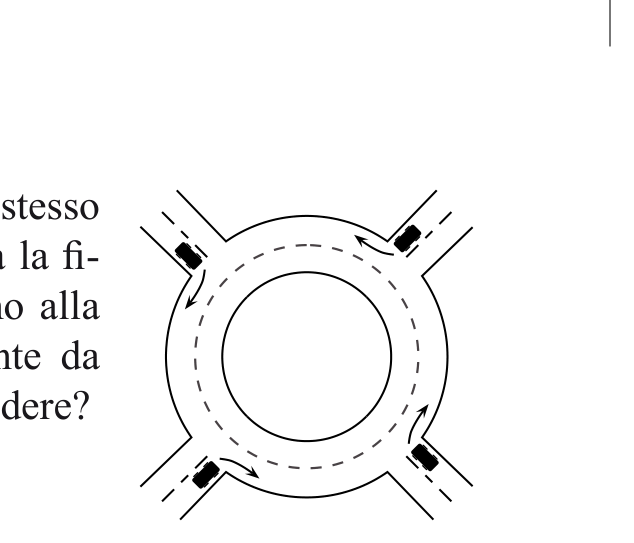
Quattro automobili entrano in una rotonda nello stesso momento, ciascuna da ingressi differenti, come mostra la figura. Ogni auto compie meno di un intero giro intorno alla rotonda e ciascuna di esse esce da un’uscita differente da ognuna delle altre. In quanti modi diversi ciò può succedere? A) 9 B) 12 C) 15 D) 24 E) 81
Topic: Combinatoria Metodo: Conteggio combinatorio Abilita: Conteggio sistematico Area: Combinatoria, Logica e Probabilita Risposta: A Fonte: apri PDF p.5
Distinct modes of exit of four cars from the roundabout
Four cars enter a roundabout at the same time, each from different entrances, as shown in the figure. Each car makes less than a full lap around the roundabout and each car comes out of a different exit from each other. How many different ways can this happen? A) 9 B) 12 C) 15 D) 24 E) 81
Answer: A
Numero n di rette intersecate da c
Nel piano sono state tracciate alcune rette. La retta a interseca esattamente tre rette (diverse da se stessa) e la retta b interseca esattamente quattro rette. Il numero esatto n delle rette intersecate dalla retta c non è né tre né quattro. Quale fra i seguenti è il numero n ? A) 2
B) 5
C) 6
D) 7
E) nessuno.
Topic: Combinatoria, Geometria piana Metodo: Analisi per casi Abilita: Casework accurato Area: Combinatoria, Logica e Probabilita, Geometria Risposta: B Fonte: apri PDF p.5
Number of lines intersected by c
There were a few lines drawn in the plane. The straight a intersects exactly three lines (different from itself) and the straight b intersects exactly four lines. The exact number n of lines intersected by line c is neither three nor four. Which of the following is number n ? A) 2
B) 5
C) 6
D) 7
E) none.
Answer: B
Somma primi 2013 termini di successione di prodotti
Una successione di numeri inizia con questi cinque termini: 1, – 1, – 1, 1, – 1. Ogni termine dopo il quinto è uguale al prodotto dei due che lo precedono. Ad esempio il sesto termine è il prodotto del quarto e del quinto. Qual è la somma dei primi 2013 termini di questa successione? A) – 1006 B) – 671 C) 0
D) 671 E) 1007
Topic: successioni Metodo: Ricorsione Abilita: Riconoscimento di pattern Area: Algebra e Analisi Risposta: B Fonte: apri PDF p.5
Sum of the first 2013 terms of a sequence of products
A sequence of numbers begins with these five terms: 1, – 1, – 1, 1, – 1. Each term after the fifth is equal to the product of the two that precede it. For example the sixth term is the product of the fourth and the fifth. What is the sum of the first 2013 terms of this sequence? A) – 1006 B) – 671 C) 0
D) 671 E) 1007
Answer: B
Relazione tra numero quadrati e cubi perfetti fino a 2013^6
Considera tutti gli interi da 1 a 20136 (estremi inclusi): tra di essi alcuni numeri sono quadrati perfetti, altri sono cubi perfetti. Denota con Q il numero di quadrati perfetti e con C il numero di cubi perfetti da 1 a 20136: allora A) Q = C. B) 2Q = 3C.
C) 3Q = 2C.
D) Q 3 = C 2.
E) nessuna delle precedenti relazioni è corretta.
Topic: Teoria dei Numeri Metodo: Conteggio combinatorio Abilita: Manipolazione algebrica Area: Aritmetica e Teoria dei Numeri Risposta: E Fonte: apri PDF p.5
Relation between perfect square and perfect cube numbers up to 2013^6
Consider all integers from 1 to 2013^6 (extremes included): among them some numbers are perfect squares, others are perfect cubes. Denote with Q the number of perfect squares and with C the number of perfect cubes from 1 to 2013^6: then A) Q = C. B) 2Q = 3C.
C) 3Q = 2C.
D) Q 3 = C 2. E) None of the previous relations is correct.
Answer: E
Ordine impossibile in cui le frittelle sono mangiate
Lucia ha preparato sei frittelle e su ciascuna ha inciso un numero da 1 a 6: poi le ha cotte secondo l’ordine indicato dal numero. Mentre stava lavorando (ma non sappiamo quando e quante volte), i suoi bambini sono entrati in cucina e ogni volta si sono mangiati la frittella più calda. Quale tra quelli indicati sotto non può essere l’ordine in cui le frittelle sono state mangiate? A) 456231 B) 125436 C) 325461 D) 123456 E) 654321
Topic: Logica, giochi, strategie, Combinatoria Metodo: monovarianti Abilita: Casework accurato Area: Combinatoria, Logica e Probabilita Risposta: A Fonte: apri PDF p.5
Impossible order in which the pancakes are eaten
Lucia prepared six pancakes and engraved a number from 1 to 6 on each, then cooked them in the order indicated by the number. While she was working (but we don’t know when and how many times), her children walked into the kitchen and ate the hottest pancakes each time. Which of the following cannot be the order in which the pancakes were eaten? A) 456231 B) 125436 C) 325461 D) 123456 E) 654321
Answer: A
Proprietà dei numeri piccoli (somma dei tre divisori maggiori)
Diciamo che un numero intero positivo N è piccolo se è più piccolo della somma dei suoi tre divisori maggiori (naturalmente escludendo N stesso). Quale delle seguenti affermazioni è vera? A) Ogni numero piccolo è divisibile per 4.
B) Ogni numero piccolo è divisibile per 5.
C) Ogni numero piccolo è divisibile per 6.
D) Ogni numero piccolo è divisibile per 7.
E) Non esistono numeri piccoli.STRINGA CADET 2013
Topic: Teoria dei Numeri Metodo: manipolazione algebrica Abilita: Casework accurato Area: Aritmetica e Teoria dei Numeri Risposta: C Fonte: apri PDF p.5
Property of small numbers (sum of the three largest divisors)
We say that a positive integer N is small if it is smaller than the sum of its three largest divisors (naturally excluding N itself). Which of the following statements is true? A) Every small number is divisible by 4.
B) Every small number is divisible by 5.
C) Every small number is divisible by 6.
D) Every small number is divisible by 7.
E) There are no small numbers.STRINGA CADET 2013
Answer: C