Quale numero non e fattore di 200013-2013
Il numero 200013 – 2013 non è divisibile per A) 2
B) 3.
C) 5.
D) 7.
E) 11.
Topic: Teoria dei Numeri Metodo: congruenze Abilita: Manipolazione algebrica Area: Aritmetica e Teoria dei Numeri Fonte: apri PDF p.1
Which number is not a factor of 200013-2013
Number 200013 – 2013 is not divisible by A) 2
B) 3.
C) 5.
D) 7.
E) 11.
Quante figure hanno lo stesso perimetro del foglio quadrato
Un cioccolatino costa 40 centesimi, ma ogni cinque cioccolatini acquistati ne viene dato un altro in omaggio. Marta ha regalato quattro cioccolatini a ciascuno dei suoi quattro amici: quanti euro ha speso? A) 5,60 B) 2,40 C) 1,60 D) 6,40
E) Una cifra diversa da ciascuna delle precedenti.
Topic: Geometria piana Abilita: Ragionamento geometrico Area: Geometria Fonte: apri PDF p.1
How many figures have the same perimeter as the square sheet
A chocolate bar costs 40 cents, but for every five chocolates purchased, another one is given as a gift. Marta gave four chocolates to each of her four friends. How much did she spend? A) 5.60 B) 2.40 C) 1.60 D) 6.40 E) A figure different from each of the preceding figures.
Quanto paga con l’offerta delle pannocchie
Solo tre numeri opportunamente scelti fra 2, 4, 16, 25 e 125 hanno come prodotto 1000. Qual è la loro somma? A) 70
B) 77
C) 145 D) 143 E) 131
Topic: Teoria dei Numeri Abilita: traduzione del testo Area: Aritmetica e Teoria dei Numeri Fonte: apri PDF p.1
How much does he pay with the corn cob offer
Only three numbers chosen appropriately between 2, 4, 16, 25 and 125 have the product of 1000. What’s their sum? A) 70
B) 77
C) 145 D) 143 E) 131
Somma di tre numeri il cui prodotto e 1000
Rita e un’amica giocano a battaglia navale su una griglia 5×5. Rita ha già sistemato due navi, una da una cella e una da due celle, come indicato in figura. Deve sistemare ancora una nave che copra esattamente tre celle consecutive, allineate in orizzontale o in verticale. Se due navi non possono avere alcun punto in comune, in quanti modi potrà sistemare la nave da tre celle? A) 4
B) 5
C) 6
D) 7
E) 8
Topic: Teoria dei Numeri Metodo: Conteggio combinatorio Abilita: Manipolazione algebrica Area: Aritmetica e Teoria dei Numeri Fonte: apri PDF p.1
sum of three numbers whose product is 1000
Rita and a friend play naval battle on a 5×5 grid. Rita has already arranged two ships, one one cell and one two cell, as shown in the figure. She needs to place another ship that covers exactly three cells in a row, aligned horizontally or vertically. If two ships can’t have anything in common, how many ways can she place the three-cell ship? A) 4
B) 5
C) 6
D) 7
E) 8
Area minima del triangolo da 6 punti su griglia
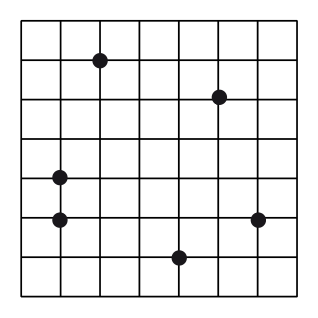
Nella griglia quadrata in figura, di passo 1, sono marcati sei punti. Vuoi sceglierne tre in modo che l’area del triangolo che li ha come vertici sia la più piccola possibile. Quanto vale questa area? A) B) C) 1 D) E) 2
Topic: Geometria piana, Combinatoria Metodo: Principio di estremalita Abilita: Ragionamento geometrico Area: Combinatoria, Logica e Probabilita, Geometria Fonte: apri PDF p.1
Minimum area of the 6-point triangle on the grid
In the square grid shown in Figure 1, six points are marked. You want to pick three so that the area of the triangle that has them as vertices is as small as possible. How much is this area worth? A) B) C) 1 D) E) 2
Potenza di due ottenuta da 4^15+8^10
Quanto vale la somma 415 + 810 ? A) 210
B) 215
C) 220
D) 230 E) 231 1{{{ 4 1{{{ 2 1{{{ 3
Topic: Teoria dei Numeri, Algebra Metodo: manipolazione algebrica Abilita: Manipolazione algebrica Area: Algebra e Analisi, Aritmetica e Teoria dei Numeri Fonte: apri PDF p.1
Power of two obtained from 4^15+8^10
What is the value of the sum 415 + 810 ? A) 210
B) 215
C) 220
D) 230 E) 231 1{{{ 4 1{{{ 2 1{{{ 3
Sviluppo piano del cubo dipinto
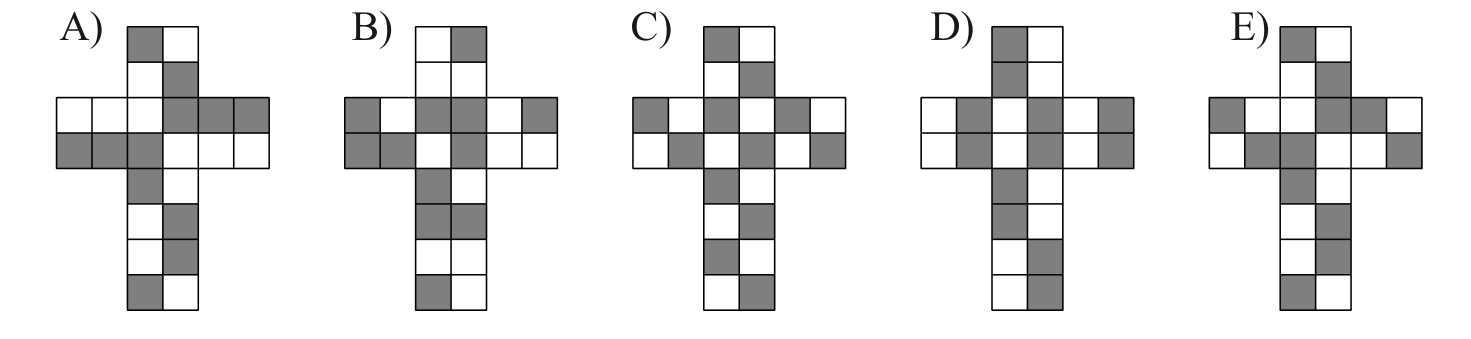
Osserva la figura: la superficie laterale di un cubo è stata dipinta di bianco e di grigio e ora il cubo appare come se fosse ottenuto accostando cubetti bianchi e cubetti grigi, tutti della stessa taglia. Quale dei seguenti può essere uno sviluppo piano del cubo dipinto? A)
B)
C)
D)
E)
Topic: Geometria solida Abilita: Ragionamento geometrico Area: Geometria Risposta: E Fonte: apri PDF p.2
Flat development of the painted cube
Look at the figure: the side surface of a cube was painted white and gray, and now the cube looks as if it were obtained by placing white cubes and grey cubes side by side, all of the same size. Which of the following can be a net of the painted cube? A)
B)
C)
D)
E)
Answer: E
Valore 4n-4m con vincoli su tre cifre
Il numero n è il più grande intero positivo tale che 4n sia un numero di tre cifre, il numero m invece è il più piccolo intero positivo tale che 4m sia un numero di tre cifre. Quanto vale 4n – 4m ? A) 892 B) 224 C) 225 D) 896 E) 199
Topic: Teoria dei Numeri Abilita: Manipolazione algebrica Area: Aritmetica e Teoria dei Numeri Risposta: D Fonte: apri PDF p.2
Value 4n-4m with three-digit constraints
The number n is the largest positive integer such that 4n is a three-digit number, the number m is the smallest positive integer such that 4m is a three-digit number. How much is 4n 4m ? A) 892 B) 224 C) 225 D) 896 E) 199
Answer: D
Risultato di rotazione e riflessione dell’arco
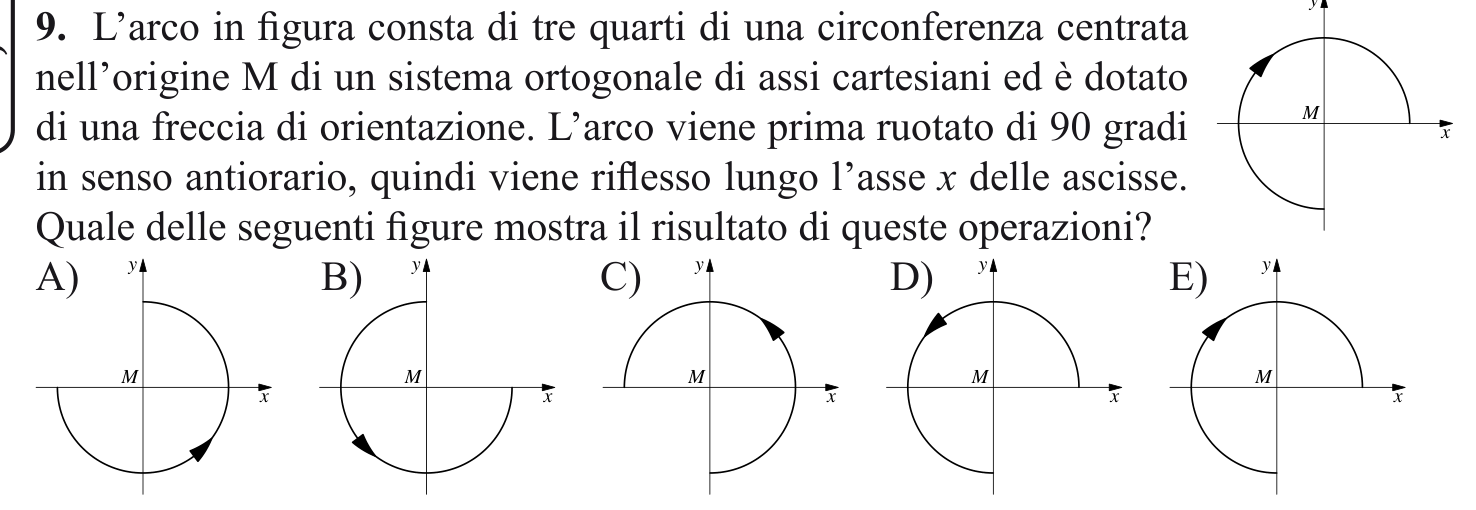
L’arco in figura consta di tre quarti di una circonferenza centrata nell’origine M di un sistema ortogonale di assi cartesiani ed è dotato di una freccia di orientazione. L’arco viene prima ruotato di 90 gradi in senso antiorario, quindi viene riflesso lungo l’asse x delle ascisse. Quale delle seguenti figure mostra il risultato di queste operazioni? A) B) C) D) E)
Topic: Geometria piana Abilita: Ragionamento geometrico Area: Geometria Risposta: D Fonte: apri PDF p.2
Result of arc rotation and reflection
The arc in the figure consists of three quarters of a circumference centred on the M origin of an orthogonal Cartesian axis system and is equipped with an orientation arrow. The arc is first rotated 90 degrees in an anti-clockwise direction, then reflected along the x-axis of the axes. Which of the following figures shows the result of these operations? A) B) C) D) E)
Answer: D
Quale espressione e la piu grande
Quale è il maggiore fra i seguenti numeri? A) 20 • B) • 13 C) • D) • 3 E)
I quesiti dal N. 11 al N. 20 valgono 4 punti ciascuno
Topic: Teoria dei Numeri Metodo: Disuguaglianze classiche Abilita: Riconoscimento di pattern Area: Aritmetica e Teoria dei Numeri Fonte: apri PDF p.2
Which expression is the largest
Which is the largest among the following numbers? A) 20 • B) • 13 C) • D) • 3 E)
Questions from No. 11 to No. 20 are worth 4 points each
Angolo alpha dopo rotazione del triangolo equilatero
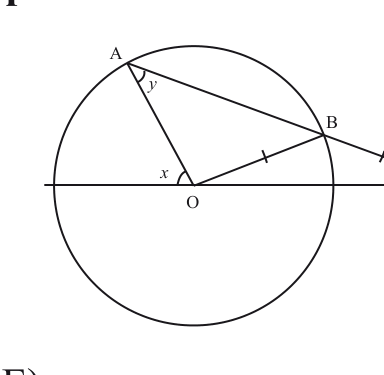
Osserva la figura. O è il centro della circonferenza e il segmento BC è lungo quanto il raggio; x e y sono le misure in gradi degli angoli acuti indicati. Quale delle seguenti relazioni è necessariamente vera? A) 2x = 3y
B) x + y = 90°
C) x = 2y D) x + 2y = 180° E) x = y y x M y x M y x M y x M y x M y x M 13 √ 20 √ 20 √ 13 √ 201 √ 2013 √ A B O C x y
Topic: Geometria piana Abilita: Ragionamento geometrico Area: Geometria Fonte: apri PDF p.2
Alpha angle after rotation of the equilateral triangle
Look at the figure. O is the center of the circle and the segment BC is as long as the radius; x and y are the measures in degrees of the indicated acute angles. Which of the following relations is necessarily true? A) 2x = 3y
B) x + y = 90° C) x = 2y D) x + 2y = 180° E) x = y y x M y x M y x M y x M y x M y x M 13 √ 20 √ 20 √ 13 √ 201 √ 2013 √ A B O C x y
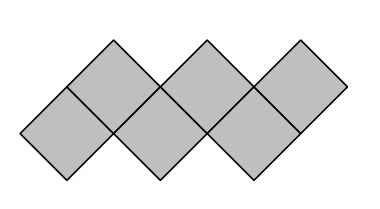
Perimetro decorazione con 2013 piastrelline
\begin{document}
\begin{tikzpicture}[scale=0.5]
  \draw[fill=gray!40] (0,1) -- (1,0) -- (0,-1) -- (-1,0) -- cycle;
  \draw[fill=gray!40] (2,1) -- (3,0) -- (2,-1) -- (1,0) -- cycle;
  \draw[fill=gray!40] (4,1) -- (5,0) -- (4,-1) -- (3,0) -- cycle;
  \draw[fill=gray!40] (6,1) -- (7,0) -- (6,-1) -- (5,0) -- cycle;
  \draw[fill=gray!40] (8,1) -- (9,0) -- (8,-1) -- (7,0) -- cycle;
  \draw[fill=gray!40] (10,1) -- (11,0) -- (10,-1) -- (9,0) -- cycle;
\end{tikzpicture}
\end{document}
Nella figura sono mostrate le prime sei piastrelline quadrate, ciascuna di 1 centimetro di lato, che ho usato per fare una decorazione orizzontale sulle pareti del mio bagno. Se la decorazione prosegue seguendo lo stesso schema e ho posato 2013 piastrelline, di quanti centimetri è il perimetro della decorazione? A) 4024 B)4028 C) 4030 D) 4026 E) 4027
Topic: Geometria piana Metodo: Ricorsione Abilita: Riconoscimento di pattern Area: Geometria Risposta: B Fonte: apri PDF p.3
Perimeter of decoration with 2013 tiles
\begin{document}
\begin{tikzpicture}[scale=0.5]
  \draw[fill=gray!40] (0,1) -- (1,0) -- (0,-1) -- (-1,0) -- cycle;
  \draw[fill=gray!40] (2,1) -- (3,0) -- (2,-1) -- (1,0) -- cycle;
  \draw[fill=gray!40] (4,1) -- (5,0) -- (4,-1) -- (3,0) -- cycle;
  \draw[fill=gray!40] (6,1) -- (7,0) -- (6,-1) -- (5,0) -- cycle;
  \draw[fill=gray!40] (8,1) -- (9,0) -- (8,-1) -- (7,0) -- cycle;
  \draw[fill=gray!40] (10,1) -- (11,0) -- (10,-1) -- (9,0) -- cycle;
\end{tikzpicture}
\end{document}
The figure shows the first six square tiles, each one one centimeter wide, that I used to make a horizontal decoration on the walls of my bathroom. If the decoration continues to follow the same pattern and I’ve laid 2013 tiles, how many centimeters is the perimeter of the decoration? A) 4024 B)4028 C) 4030 D) 4026 E) 4027
Answer: B
Prodotto PQ per RS in esagono regolare
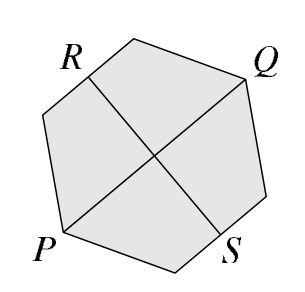
Osserva la figura. I punti P e Q sono vertici opposti di un esagono regolare, i punti R e S sono i punti medi dei due lati opposti paralleli al segmento PQ. L’area dell’esagono è 60 metri quadrati. Quanto vale il prodotto della lunghezza (in metri) di PQ per la lunghezza (in metri) di RS? A) 40 B) 50 C) 60 D) 100 E) Nessuno dei precedenti.
Topic: Geometria piana Abilita: Ragionamento geometrico Area: Geometria Risposta: E Fonte: apri PDF p.3
PQ product for RS in the regular hexagon
Look at the figure. The points P and Q are opposite vertices of a regular hexagon, while the points R and S are the midpoints of the two opposite sides parallel to the PQ segment. The area of the hexagon is 60 square metres. What is the product of the length (in meters) of PQ for the length (in meters) of RS? A) 40 B) 50 C) 60 D) 100 E) None of the above.
Answer: E
Percentuale di ragazze da incremento medie
In una classe, dove vi sono sia ragazzi sia ragazze, è stata svolta una verifica. Se ognuno dei ragazzi avesse ottenuto nella propria prova 3 punti in più, il punteggio medio della classe sarebbe aumentato di 1,2 punti. Quale percentuale di studenti di quella classe è costituita da ragazze? A) 75% B) 60% C) 50% D) 40% E) 25%
Topic: Algebra Abilita: traduzione del testo Area: Algebra e Analisi Risposta: B Fonte: apri PDF p.3
Percentage of girls with average increments
In a classroom, where there are both boys and girls, a test was carried out. If each of the boys had scored three more points in their test, the average class score would have increased by 1.2 points. What percentage of the students in that class are girls? A) 75% B) 60% C) 50% D) 40% E) 25%
Answer: B
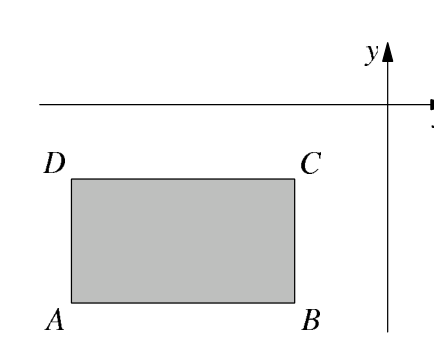
Vertice con rapporto y/x minimo nel rettangolo
\begin{document}
\begin{tikzpicture}[scale=1.2]
  \draw[->] (-3,0) -- (0.8,0) node[right] {$x$};
  \draw[->] (0,-2.5) -- (0,0.6) node[above] {$y$};
  \draw[fill=gray!30] (-2.5,-2) rectangle (-0.5,-0.7);
  \node[below left] at (-2.5,-2) {$A$};
  \node[below right] at (-0.5,-2) {$B$};
  \node[above right] at (-0.5,-0.7) {$C$};
  \node[above left] at (-2.5,-0.7) {$D$};
\end{tikzpicture}
\end{document}
In figura è rappresentato un rettangolo ABCD che • ha lati paralleli agli assi coordinati, • giace “sotto” l’asse x e “a sinistra” dell’asse y. Per ciascuno dei vertici calcoliamo il rapporto tra la sua coordinata y e la sua coordinata x. Per quale dei quattro punti tale rapporto è minimo? A) A
B) B
C) C
D)D
E) Dipende dal rettangolo.
Topic: Geometria analitica Metodo: Metodo delle coordinate Abilita: Ragionamento geometrico Area: Geometria Risposta: D Fonte: apri PDF p.3
Vertex with minimum y/x ratio in the rectangle
\begin{document}
\begin{tikzpicture}[scale=1.2]
  \draw[->] (-3,0) -- (0.8,0) node[right] {$x$};
  \draw[->] (0,-2.5) -- (0,0.6) node[above] {$y$};
  \draw[fill=gray!30] (-2.5,-2) rectangle (-0.5,-0.7);
  \node[below left] at (-2.5,-2) {$A$};
  \node[below right] at (-0.5,-2) {$B$};
  \node[above right] at (-0.5,-0.7) {$C$};
  \node[above left] at (-2.5,-0.7) {$D$};
\end{tikzpicture}
\end{document}
The figure shows an ABCD rectangle which • has sides parallel to the coordinate axes, • lies under the x-axis and to the left of the y-axis. For each of the vertices, we calculate the ratio between its y-coordinate and its x-coordinate. For which of the four points is this ratio the minimum? A) A
B) B
C) C
D)D
E) Depends on the rectangle.
Answer: D
Anno di nascita di mamma Enrica con prodotto età 2013
Oggi è il compleanno di mamma Enrica. Moltiplicando la sua età per quella del suo unico figlio si ottiene 2013. In che anno è nata mamma Enrica? A) 1981 B) 1982 C) 1953 D)1952
E) In nessuno dei precedenti.
Topic: Teoria dei Numeri Metodo: manipolazione algebrica Abilita: Casework accurato Area: Aritmetica e Teoria dei Numeri Risposta: D Fonte: apri PDF p.3
Year of birth of mother Enrica with product age 2013
It’s Mother Enrica’s birthday today. Multiplying her age by that of her only son gets 2013. What year was Mother Enrica born? A) 1981 B) 1982 C) 1953 D) 1952 E) None of the above.
Answer: D
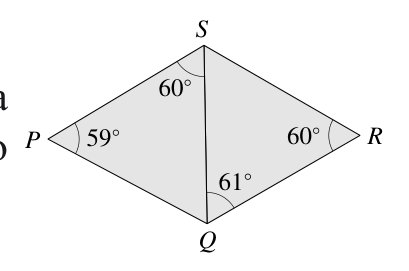
Segmento più lungo tra triangoli con angoli dati
\begin{document}
\begin{tikzpicture}[scale=2.0]
  \coordinate (P) at (-1.1, 0);
  \coordinate (S) at (0, 0.85);
  \coordinate (Q) at (0, -0.85);
  \coordinate (R) at (1.1, 0);
  \draw[fill=gray!20] (P) -- (S) -- (Q) -- cycle;
  \draw[fill=gray!40] (S) -- (Q) -- (R) -- cycle;
  \draw (P) -- (S) -- (R) -- (Q) -- (P);
  \draw (S) -- (Q);
  \node[left] at (P) {$P$};
  \node[above] at (S) {$S$};
  \node[right] at (R) {$R$};
  \node[below] at (Q) {$Q$};
  \node[right, font=\small] at (-0.85, 0) {$59^\circ$};
  \node[below right, font=\small] at (-0.05, 0.65) {$60^\circ$};
  \node[above right, font=\small] at (-0.05, -0.65) {$61^\circ$};
  \node[left, font=\small] at (0.85, 0) {$60^\circ$};
\end{tikzpicture}
\end{document}
Osserva la figura. Nel triangolo PQS, l’angolo SPQ misura 59° e l’angolo PSQ misura 60°; nel triangolo QRS, l’angolo SQR misura 61° e l’angolo QRS misura 60°. Quale dei seguenti segmenti è il più lungo? A) PS
B) RS C) QS D) QR E) PQ
Topic: Geometria piana Abilita: Ragionamento geometrico Area: Geometria Risposta: A Fonte: apri PDF p.3
Longest segment between triangles with data angles
\begin{document}
\begin{tikzpicture}[scale=2.0]
  \coordinate (P) at (-1.1, 0);
  \coordinate (S) at (0, 0.85);
  \coordinate (Q) at (0, -0.85);
  \coordinate (R) at (1.1, 0);
  \draw[fill=gray!20] (P) -- (S) -- (Q) -- cycle;
  \draw[fill=gray!40] (S) -- (Q) -- (R) -- cycle;
  \draw (P) -- (S) -- (R) -- (Q) -- (P);
  \draw (S) -- (Q);
  \node[left] at (P) {$P$};
  \node[above] at (S) {$S$};
  \node[right] at (R) {$R$};
  \node[below] at (Q) {$Q$};
  \node[right, font=\small] at (-0.85, 0) {$59^\circ$};
  \node[below right, font=\small] at (-0.05, 0.65) {$60^\circ$};
  \node[above right, font=\small] at (-0.05, -0.65) {$61^\circ$};
  \node[left, font=\small] at (0.85, 0) {$60^\circ$};
\end{tikzpicture}
\end{document}
Look at the figure. In the PQS triangle, the SPQ angle measures 59° and the PSQ angle measures 60°; in the QRS triangle, the SQR angle measures 61° and the QRS angle measures 60°. Which of the following segments is the longest? A) PS
B) RS C) QS D) QR E) PQ
Answer: A
Quanti insiemi equi di cinque interi consecutivi
Diciamo che un insieme formato da cinque numeri interi positivi consecutivi è equo, se esistono tre di quei numeri la cui somma sia uguale alla somma degli altri due. Quanti diversi insiemi equi esistono? A) 0
B) 1
C) 2
D) 3
E) 4 P Q R S 60° 61° 60° 59°
Topic: Teoria dei Numeri, Combinatoria Metodo: Analisi per casi Abilita: Casework accurato Area: Aritmetica e Teoria dei Numeri, Combinatoria, Logica e Probabilita Risposta: C Fonte: apri PDF p.3
Equal sets of five consecutive integers
Let’s say a set of five consecutive positive integers is fair if there are three of those numbers whose sum is equal to the sum of the other two. How many different fair sets exist? A) 0
B) 1
C) 2
D) 3
E) 4
Answer: C
Quanti cammini da A a B lungo le frecce
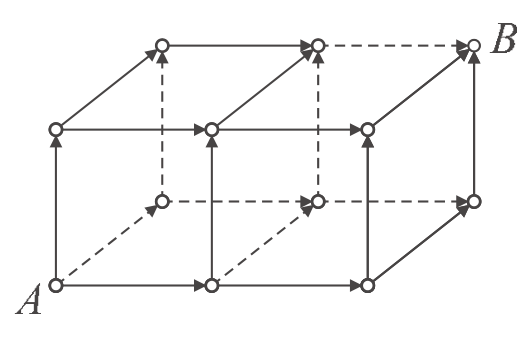
Osserva la figura. Quanti diversi cammini consentono di andare da A a B muovendosi lungo le frecce e rispettandone il verso? A) 6 B) 8 C) 9 D) 10 E) 12
Topic: Combinatoria Metodo: Conteggio combinatorio Abilita: Conteggio sistematico Area: Combinatoria, Logica e Probabilita Risposta: E Fonte: apri PDF p.4
How many paths from A to B along the arrows
Look at the figure. How many different paths allow you to go from A to B by moving along the arrows and respecting their direction? A) 6 B) 8 C) 9 D) 10 E) 12
Answer: E
Affermazione corretta su numero con somma pari e prodotto dispari
Stai cercando un numero di sei cifre con questa proprietà: la somma delle sue cifre è pari e il prodotto le sue cifre è dispari. Quale delle seguenti affermazioni è corretta?
A) Le cifre pari devono essere due o quattro.
B) Un numero cosiffatto non esiste.
C) Le cifre dispari sono in numero dispari.
D) Le sei cifre devono essere tutte diverse fra loro.
E) Nessuna delle precedenti affermazioni è corretta. I quesiti dal N. 21 al N. 30 valgono 5 punti ciascuno
Topic: Teoria dei Numeri Metodo: parita Abilita: Casework accurato Area: Aritmetica e Teoria dei Numeri Risposta: E Fonte: apri PDF p.4
Correct statement on number with equal sum and odd product
You’re looking for a six-digit number with this property: the sum of its digits is even and the product of its digits is odd. Which of the following is correct?
A) The even digits must be two or four.
B) There is no such number.
C) The odd digits are odd in number.
D) The six digits must all be different from each other.
E) None of the above claims are correct.
Answer: E
Resto della divisione per 5 di (somma fattoriali)^2
Per ogni intero n da 1 in poi denotiamo con n ! il prodotto 1 × 2 × 3 × … × (n – 1) × n (viene chiamato fattoriale di n). Dividiamo il numero (1! + 2! + 3! + … + 100!)2 per 5: qual è il resto? A) 0
B) 1
C) 2
D) 3
E) 4
Topic: Teoria dei Numeri Metodo: congruenze Abilita: Manipolazione algebrica Area: Aritmetica e Teoria dei Numeri Risposta: E Fonte: apri PDF p.4
Remainder of the division by 5 of (sum of factorials)^2
For every integer n from 1 onward let us denote by n ! the product 1 × 2 × 3 × … × (n – 1) × n (it is called the factorial of n). We divide the number (1! + 2! + 3! + … + 100!)2 by 5: what is the remainder? A) 0
B) 1
C) 2
D) 3
E) 4
Answer: E
Figura che non può essere ottenuta col tappeto

Un pavimento rivestito di piastrelle quadrate è parzialmente coperto da un tappeto rotondo. Nelle figure seguenti le piastrelle ombreggiate rappresentano tutte e sole le piastrelle che hanno più di un punto coperto dal tappeto. Quale figura non può essere ottenuta? A) B) C) D) E)
Topic: Geometria piana Abilita: Ragionamento geometrico Area: Geometria Risposta: E Fonte: apri PDF p.4
Figure that cannot be obtained with carpet
A floor covered with square tiles is partially covered by a round carpet. In the following figures, the shaded tiles represent all and only the tiles that have more than one point covered by the carpet. What figure cannot be obtained? A) B) C) D) E)
Answer: E
Minimo m con angoli m,2m,3m… attorno a O
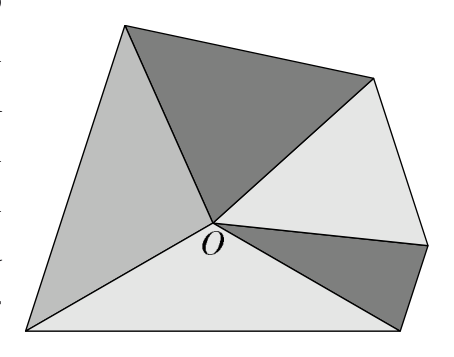
Osserva la figura. Alcuni triangoli (cinque nel nostro caso) hanno il vertice O in comune e per ciascuno di essi vi sono due triangoli adiacenti con i quali esso ha un lato in comune. Al variare dei triangoli, il più piccolo degli angoli in O misura m gradi, dove m è un intero positivo; gli altri angoli misurano 2m, 3m, 4m gradi e così via. Qual è il più piccolo valore di m che consente di realizzare un accostamento di triangoli con tutte queste proprietà? A) 1
B) 2
C) 3
D) 6
E) 8
Topic: Geometria piana Metodo: congruenze Abilita: Casework accurato Area: Geometria Risposta: C Fonte: apri PDF p.4
Minimum m with angles m, 2m, 3m… around O*
Look at the figure. Some triangles (five in our case) have the O vertex in common and for each of them there are two adjacent triangles with which it has a side in common. When triangles vary, the smallest of the angles in O measures m degrees, where m is a positive integer; the other angles measure 2m, 3m, 4m degrees and so on. What’s the smallest value of m that makes it possible to arrange triangles with all these properties? A) 1
B) 2
C) 3
D) 6
E) 8
Answer: C
Cifre a destra della virgola di 1/1024000
Se il numero viene scritto in notazione decimale con il minor numero possibile di cifre, quante cifre ci sono a destra della virgola? A) 10
B) 1024000 C)13 D) 14 E) 1024
Topic: Teoria dei Numeri Abilita: Manipolazione algebrica Area: Aritmetica e Teoria dei Numeri Risposta: C Fonte: apri PDF p.5
Number to the right of the comma of 1/1024000
If the number 1/1024000 is written in decimal notation with the smallest possible number of digits, how many digits are there to the right of the decimal point? A) 10
B) 1024000 C)13 D) 14 E) 1024
Answer: C
Velocità auto in testa alla carovana dopo 100 ore
In uno strano torneo automobilistico di resistenza alla guida è previsto che tutte le auto percorrano una stessa strada in partenza da un punto A. La prima auto parte da A e tiene la velocità costante di 50 Km/h. Da quell’istante, ogni ora parte da A un’auto e ogni auto tiene la velocità costante di 1 Km/h superiore a quella dell’auto precedente. L’ultima auto parte 50 ore dopo la prima (e viaggia dunque a 100 Km/h). Qual è la velocità dell’auto che si trova in testa alla carovana 100 ore dopo la partenza della prima auto? A) 50 km/h
B) 66 km/h
C)75 km/h
D) 84 km/h
E) 100 km/h
Topic: Algebra Metodo: Principio di estremalita Abilita: traduzione del testo Area: Algebra e Analisi Risposta: C Fonte: apri PDF p.5
Car speed at the head of the caravan after 100 hours
In a strange driving resistance competition, all cars are expected to run on the same road starting at point A. The first car starts from A and maintains a constant speed of 50 km/h. From that moment on, every hour a car starts and each car maintains a constant speed of 1 km/h higher than that of the previous car. The last car leaves 50 hours after the first (and therefore travels at 100 km/h). What is the speed of the car that is in front of the caravan 100 hours after the first car leaves? A) 50 km/h
B) 66 km/h
C)75 km/h
D) 84 km/h
E) 100 km/h
Answer: C
Massimo frazioni intere con interi da 1 a 22
Usando una e una sola volta tutti i numeri interi fra 1 e 22 inclusi, ponendone uno a numeratore e un altro a denominatore, si possono formare 11 frazioni. Quante di queste frazioni, al massimo, possono avere un valore intero? A) 7
B) 8
C) 9
D) 10
E) 11
Topic: Teoria dei Numeri, Combinatoria Metodo: Analisi per casi, Conteggio combinatorio Abilita: Casework accurato Area: Aritmetica e Teoria dei Numeri, Combinatoria, Logica e Probabilita Risposta: D Fonte: apri PDF p.5
Maximum whole fractions with integers from 1 to 22
Using each of the integers from 1 to 22 exactly once, placing one as numerator and another as denominator, one can form 11 fractions. At most how many of these fractions can have an integer value? A) 7
B) 8
C) 9
D) 10
E) 11
Answer: D
Massimo del minimo delle somme dei vicini su circonferenza
Ognuno dei numeri interi da 1 a 10 viene scritto su una circonferenza, in ordine del tutto casuale (dunque non seguendo necessariamente un verso di rotazione). Successivamente, ad ognuno dei numeri scritti vengono sommati i due numeri ad esso adiacenti: si ottengono così dieci nuovi numeri. Qual è il più grande valore possibile per il più piccolo di questi numeri? A) 14
B) 15
C) 16
D) 17
E) 18
Topic: Combinatoria Metodo: Principio di estremalita Abilita: Casework accurato Area: Combinatoria, Logica e Probabilita Risposta: B Fonte: apri PDF p.5
Minimum of sums of neighbours on circumference
Each of the integers from 1 to 10 is written on a circle, in a completely random order (therefore not necessarily following a direction of rotation). Then, to each of the numbers written, the two numbers adjacent to it are added, thus obtaining ten new numbers. What is the greatest possible value for the smallest of these numbers? A) 14
B) 15
C) 16
D) 17
E) 18
Answer: B
Quanti insiemi S con unione data uguale a {1..9}
Per quanti insiemi S diversi fra loro è vero che S ∪ {1, 2, 3, 4, 5} = {1, 2, 3, …, 9} ? A) 512 B) 32
C) 256 D) 16
E) 1
Topic: Insiemi e funzioni, Combinatoria Metodo: Conteggio combinatorio Abilita: Conteggio sistematico Area: Algebra e Analisi, Combinatoria, Logica e Probabilita Risposta: B Fonte: apri PDF p.5
How many sets of S with a given union equal to {1.9.}
For how many different sets of S is it true that S ∪ {1, 2, 3, 4, 5} = {1, 2, 3, …, 9} ? A) 512 B) 32
C) 256 D) 16
E) 1
Answer: B
Parte di cubo contenente il centro dopo i tagli
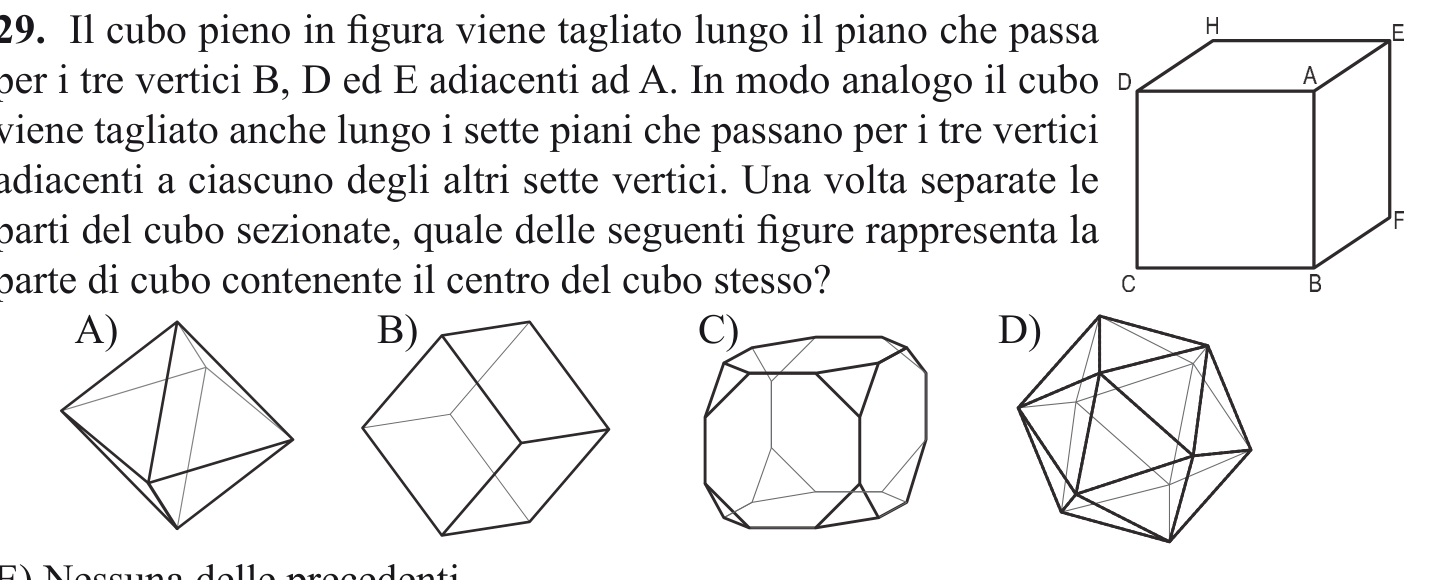
Il cubo pieno in figura viene tagliato lungo il piano che passa per i tre vertici B, D ed E adiacenti ad A. In modo analogo il cubo viene tagliato anche lungo i sette piani che passano per i tre vertici adiacenti a ciascuno degli altri sette vertici. Una volta separate le parti del cubo sezionate, quale delle seguenti figure rappresenta la parte di cubo contenente il centro del cubo stesso? A) B) C) D) E) Nessuna delle precedenti. 1 {{{{{{{{{{{
1024000
Topic: Geometria solida Abilita: Ragionamento geometrico Area: Geometria Risposta: A Fonte: apri PDF p.5
Part of the cube containing the centre after the cuts
The full cube in the figure is cut along the plane passing through the three vertices B, D and E adjacent to A. Similarly, the cube is also cut along the seven planes that pass through the three vertices adjacent to each of the other seven vertices. Once the sectional parts of the cube are separated, which of the following figures represents the cube part containing the center of the cube itself? A) B) C) D) E) None of the above. 1 {{{{{{{{{{{ 1024000
Answer: A
Triangoli contenenti il centro in poligono di 13 lati
Scegliendo tre dei vertici di un poligono regolare si identifica un triangolo. Se il poligono ha 13 lati, quanti dei triangoli che si possono formare in questo modo hanno al proprio interno il centro del poligono (cioè il centro della circonferenza inscritta)? A) 65
B) 85
C) 91
D) 104 E) Un numero diverso dai precedenti.
STRINGA JUNIOR 2013
Topic: Combinatoria, Geometria piana Metodo: Conteggio combinatorio, Sfruttamento della simmetria Abilita: Conteggio sistematico Area: Combinatoria, Logica e Probabilita, Geometria Risposta: C Fonte: apri PDF p.6
Triangles containing the centre in the 13-sided polygon
Choosing three of the vertices of a regular polygon identifies a triangle. If the polygon has 13 sides, how many of the triangles that can be formed in this way have the center of the polygon (i.e. the center of the inscribed circumference) inside them? A) 65
B) 85
C) 91
D) 104 E) A number different from the previous ones.
I’m going to take a look.
Answer: C