Ultima data di marzo per il terzo giovedì
La gara Kangourou della Matematica si svolge ogni anno il terzo giovedì di marzo. Nel corso degli anni, qual è l’ultima data di marzo in cui può cadere una gara Kan gourou della Matematica? A) 14
B) 15
C) 20
D) 21
E) 22
Topic: Teoria dei Numeri Abilita: Lettura attenta del testo Area: Aritmetica e Teoria dei Numeri Risposta: D Fonte: apri PDF p.1
Last date of March for the third Thursday
The Kangourou Mathematics Competition takes place every year on the third Thursday of March. Over the years, what is the last date in March when a mathematics competition can fall? A) 14
B) 15
C) 20
D) 21
E) 22
Answer: D src_kangourou_2014_cadet__Q01
Parola che certamente non compare aggiungendo due lettere a VOLANO
Giorgia ha allineato sul tavolo sei tessere, su ciascuna delle quali è incisa una let tera, in modo da formare la parola VOLANO. Mattia ha aggiunto a quelle di Giorgia due tessere (anch’esse con una lettera ciascuna) non sappiamo dove (possono anche trovarsi una o entrambe all’inizio o alla fine della parola), ma non ha mutato l’ordine delle tessere allineate da Giorgia. Quale delle seguenti parole certamente non compare ora sul tavolo? A) SVOLTANO B) VIOLANDO C) VOGLIANO
D) VOLTARON E) EVOLVANO
Topic: Logica, giochi, strategie Abilita: Casework accurato Area: Combinatoria, Logica e Probabilita Risposta: D Fonte: apri PDF p.1
Word that certainly does not appear by adding two letters to VOLANO
Georgia lined up on the table six tiles, each engraved with a letter, forming the word VOLANO. Mattia added to Georgia’s two cards (also with a letter each) we don’t know where (one or both can also be found at the beginning or end of the word), but he didn’t change the order of the cards aligned by Georgia. Which of the following words certainly does not appear on the table now? (a) Flying B) Flying C) Flying D) Flying E) Flying
Answer: D src_kangourou_2014_cadet__Q02
2014-2014
Qual è il risultato di 2014 × 2014 : 2014 – 2014 ? A) 0
B) 1
C) 2013 D) 2014 E) 4028
Topic: Teoria dei Numeri Abilita: Manipolazione algebrica Area: Aritmetica e Teoria dei Numeri Risposta: A Fonte: apri PDF p.1
2014-2014
What is the result of 2014 × 2014: 2014 2014 ? A) 0
B) 1
C) 2013 D) 2014 E) 4028
Answer: A src_kangourou_2014_cadet__Q03
Metri di filo tra piastrelle in stanza 10x6
Una stanza lunga 10 metri e larga 6 è pavimentata con piastrelle quadrate di 1 metro di lato. Si vuole inserire un filo di plastica di rifinitura tra le singole piastrelle e tra le piastrelle e i muri o le porte, senza lasciare alcun buco. Quanti metri di filo occorrono? A) 100 B) 115 C) 125 D) 136 E) 172
Topic: Geometria piana Abilita: Conteggio sistematico Area: Geometria Risposta: D Fonte: apri PDF p.1
Meter of wire between tiles in room 10x6
A room 10 meters long and 6 meters wide is paved with square tiles of 1 meter on the side. You want to insert a finishing plastic wire between the individual tiles and between the tiles and the walls or doors, leaving no hole. How many yards of wire do you need? A) 100 B) 115 C) 125 D) 136 E) 172
Answer: D src_kangourou_2014_cadet__Q04
Differenza di due interi con prodotto 36 e somma 37
Il prodotto di due numeri interi è 36 mentre la loro somma è 37. Qual è la loro differenza? A) 1
B) 4
C) 10
D) 26
E) 35
Topic: Teoria dei Numeri, Algebra Abilita: Manipolazione algebrica Area: Algebra e Analisi, Aritmetica e Teoria dei Numeri Risposta: E Fonte: apri PDF p.1
Difference of two integers with product 36 and sum 37
The product of two integers is 36 whereas their sum is 37. What’s the difference? A) 1
B) 4
C) 10
D) 26
E) 35
Answer: E src_kangourou_2014_cadet__Q05
Area dell’aquila stilizzata dai ritagli
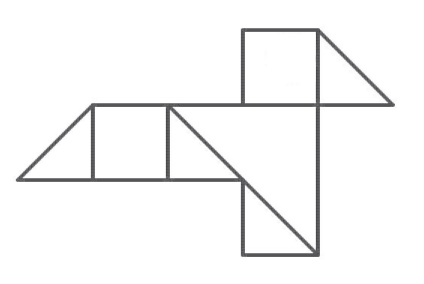
Elisa ha alcuni fogli di carta quadrati di area 4 dm2. Li taglia in modo da formare quadrati e triangoli rettangoli come mostra la figura a sinistra. Poi dispone alcuni di questi pezzi ritagliati in modo da formare un’aquila stilizzata, come nella figura a destra. Qual è, in dm2, l’area dell’aquila? A) 6
B) 5
C) 9/2 D) 4
E) 3
Topic: Geometria piana Abilita: Ragionamento geometrico Area: Geometria Risposta: A Fonte: apri PDF p.1
Area of the eagle stylized by the cuts
Elisa has some square sheets of paper with an area of 4 sqm. He cuts them into squares and rectangular triangles as shown in the figure to the left. He then disposes of some of these pieces carved to form a stylized eagle, as shown in the figure to the right. What is the area of the eagle in dm2? A) 6
B) 5
C) 9/2 D) 4
E) 3
Answer: A src_kangourou_2014_cadet__Q06
Capacità del secchio (mezzo poi tre quarti)
Un secchio era mezzo pieno. Ho aggiunto due litri d’acqua e ora è pieno per tre quarti. Qual è la capacità (in litri) del secchio? A) 10 B) 8
C) 6
D) 4
E) 2
Topic: Algebra Abilita: traduzione del testo Area: Algebra e Analisi Risposta: B Fonte: apri PDF p.2
*Bucket capacity (half and then three quarters) *
A bucket was half full. I added two gallons of water and it’s now three-quarters full. What is the capacity (in litres) of the bucket? A) 10 B) 8
C) 6
D) 4
E) 2
Answer: B src_kangourou_2014_cadet__Q07
Cubetti da aggiungere per cubo di spigolo 3
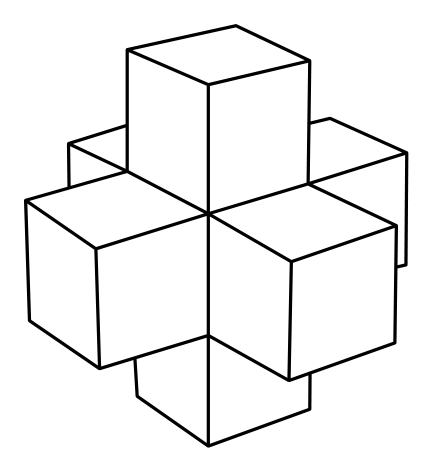
Giorgio ha costruito il solido mostrato nella figura qui a fianco incollando 7 cubetti ciascuno di 1 cm di spigolo. Quanti cubetti identici a questi deve aggiungere per forma re un cubo il cui spigolo sia lungo 3 cm? A) 12
B) 14
C) 16
D) 18
E) 20
Topic: Geometria solida Abilita: Ragionamento geometrico Area: Geometria Risposta: E Fonte: apri PDF p.2
Cubs to be added per cube of bead 3
George constructed the solid shown in the figure next door by gluing 7 cubes each of 1 cm of grain. How many cubes identical to these must he add for a cube whose beam is 3 cm long? A) 12
B) 14
C) 16
D) 18
E) 20
Answer: E src_kangourou_2014_cadet__Q08
Quale prodotto fornisce il risultato maggiore
Quale dei seguenti prodotti fornisce il risultato maggiore? A) 44 × 777
B) 55 × 666
C) 77 × 444
D) 88 × 333
E) 99 × 222
Topic: Teoria dei Numeri Abilita: Manipolazione algebrica Area: Aritmetica e Teoria dei Numeri Risposta: B Fonte: apri PDF p.2
Which product gives the highest result
Which of the following products produces the greatest result? A) 44 × 777
B) 55 × 666
C) 77 × 444
D) 88 × 333
E) 99 × 222
Answer: B src_kangourou_2014_cadet__Q09
Massimo grani bianchi sfilati prima del quinto grigio

Il braccialetto in figura ha grani grigi e grani bianchi. Arianna sfila a uno a uno i grani, scegliendo di volta in volta l’estremità del braccialetto da cui sfilarli. Qual è il massimo numero di grani bianchi che Arianna può sfilare se si ferma appena toglie il quinto grano grigio? A) 4
B) 5
C) 6
D) 7
E) 8 I quesiti dal n. 11 al n. 20 valgono 4 punti ciascuno
Topic: Combinatoria Metodo: Analisi per casi Abilita: Casework accurato Area: Combinatoria, Logica e Probabilita Risposta: D Fonte: apri PDF p.2
Most white grains parched before the fifth gray
The bracelet in the figure has gray and white grains. Arianna slides the grains one by one, choosing from time to time the end of the bracelet from which to slide. What is the maximum number of white grains that Arianna can parade if she stops as soon as she takes out the fifth gray grain? A) 4
B) 5
C) 6
D) 7
(e) 8 Questions from n. 11 al n. 20 is worth 4 points each.
Answer: D src_kangourou_2014_cadet__Q10
Settimane del periodo con 15 lezioni di differenza
Per un certo periodo di tempo Giacomo ha preso lezioni di piano due volte alla settimana e Anna una volta ogni due settimane. Alla fine del periodo risulta che Gia como ha preso 15 lezioni più di Anna. Di quante settimane era formato il periodo considerato? A) 30
B) 25
C) 20
D) 15
E) 10
Topic: Algebra Abilita: traduzione del testo Area: Algebra e Analisi Risposta: E Fonte: apri PDF p.2
Weeks of the period with 15 lessons difference
For a period of time, James took piano lessons twice a week and Anna once every two weeks. By the end of the period, James had taken 15 lessons more than Anna. How many weeks was the period considered? A) 30
B) 25
C) 20
D) 15
E) 10
Answer: E src_kangourou_2014_cadet__Q11
Area regione coperta dai 5 cerchi sovrapposti
\begin{document}
\begin{tikzpicture}
  \foreach \i in {0,1,2,3,4} {
    \draw[thick] (\i*1.5, 0) circle[radius=0.85];
  }
\end{tikzpicture}
\end{document}
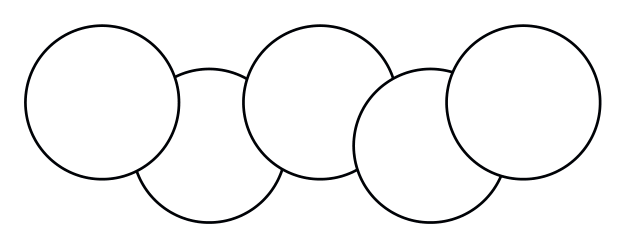
L’area di ciascuno dei cerchi in figura è di 1 cm2; l’area comune a due cerchi sovrapposti è di cm2. Qual è, in centimetri quadrati, l’area della regione coperta dai 5 cerchi? A)
B) 4
C) 35
8 D) 39
8 E) 19
4
9---- 2 1---- 8
Topic: Geometria piana Metodo: Inclusione-esclusione Abilita: Ragionamento geometrico Area: Geometria Risposta: A Fonte: apri PDF p.2
Area region covered by the 5 overlapping circles
\begin{document}
\begin{tikzpicture}
  \foreach \i in {0,1,2,3,4} {
    \draw[thick] (\i*1.5, 0) circle[radius=0.85];
  }
\end{tikzpicture}
\end{document}
The area of each circle in the figure is 1 cm2; the area common to two overlapping circles is 1 cm2. What is the area in square centimetres of the region covered by the five circles? A)
B) 4
C) 35 ------ 8 D) 39 ------ 8 E) 19 ------ 4 9---- 2 1---- 8
Answer: A src_kangourou_2014_cadet__Q12
Età della nipote (potenze di 2 con somma 100)
Quest’anno una mia amica, sua figlia e la figlia di sua figlia hanno tutte età che, in anni, sono potenze di 2 e la somma delle loro età è 100 anni. Quanti anni ha la nipote? A) 1
B) 2
C) 4
D) 8
E) 16
Topic: Teoria dei Numeri Metodo: Analisi per casi Abilita: Casework accurato Area: Aritmetica e Teoria dei Numeri Risposta: C Fonte: apri PDF p.3
*Age of granddaughter (powers of 2 plus 100) *
This year a friend of mine, her daughter and her granddaughter all have ages that, in years, are powers of two and the sum of their ages is 100 years. How old is your granddaughter? A) 1
B) 2
C) 4
D) 8
E) 16
Answer: C src_kangourou_2014_cadet__Q13
Area di ciascun rettangolo in quadrato lato 24
\begin{document}
\begin{tikzpicture}[scale=0.8]
  \draw[very thick] (0,0) rectangle (6,6);
  \draw (0,1) -- (2,1);
  \draw (1,3) -- (4,3);
  \draw (1,4) -- (3,4);
  \draw (3,5) -- (6,5);
  \draw (1,1) -- (1,4);
  \draw (2,0) -- (2,3);
  \draw (3,3) -- (3,5);
  \draw (4,3) -- (4,6);
\end{tikzpicture}
\end{document}
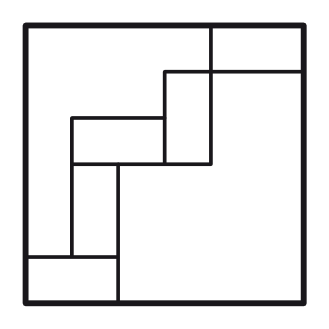
Cinque rettangoli uguali sono posizionati all’interno di un quadrato di lato 24 cm, come mostrato in figura. Qual è l’area in cm2 di ciascun rettangolo? A) 12 B) 16
C) 18
D) 24
E) 32
Topic: Geometria piana Abilita: Ragionamento geometrico Area: Geometria Risposta: E Fonte: apri PDF p.3
Area of each rectangle squared side 24
\begin{document}
\begin{tikzpicture}[scale=0.8]
  \draw[very thick] (0,0) rectangle (6,6);
  \draw (0,1) -- (2,1);
  \draw (1,3) -- (4,3);
  \draw (1,4) -- (3,4);
  \draw (3,5) -- (6,5);
  \draw (1,1) -- (1,4);
  \draw (2,0) -- (2,3);
  \draw (3,3) -- (3,5);
  \draw (4,3) -- (4,6);
\end{tikzpicture}
\end{document}
Five equal rectangles are placed within a 24 cm side square, as shown in the figure. What is the area in cm2 of each rectangle? A) 12 B) 16
C) 18
D) 24
E) 32
Answer: E src_kangourou_2014_cadet__Q14
Quando cuore e freccia coincidono per la prima volta
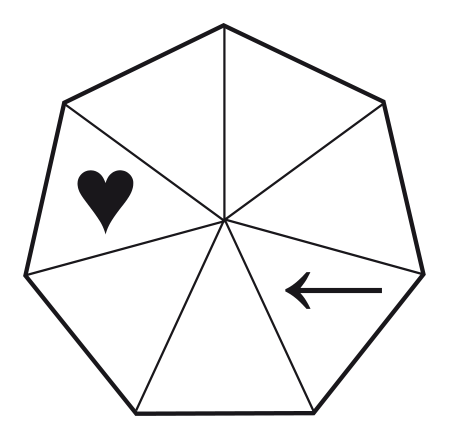
Due pedine a forma di cuore e di freccia sono poste nei triangoli indicati in figura. Iniziano a muoversi nello stesso istante: la freccia si muove di 3 posti in verso ora rio, il cuore di 4 posti in verso antiorario e poi si fermano. La procedura si ripete più volte. Dopo quante attuazioni della procedura il cuore e la freccia si trovano per la prima volta nella stessa regione triangolare? A) 7
B) 8
C) 9
D) Un numero diverso dai tre precedenti.E) Mai.
Topic: Teoria dei Numeri Metodo: congruenze Abilita: Riconoscimento di pattern Area: Aritmetica e Teoria dei Numeri Risposta: E Fonte: apri PDF p.3
When heart and arrow match for the first time
Two heart-shaped and arrow-shaped bases are placed in the triangles shown in the figure. They begin to move at the same moment: the arrow moves 3 places in the direction of the hour, the heart 4 places in the direction of the hour and then they stop. The procedure is repeated several times. After how many operations of the procedure are the heart and arrow found for the first time in the same triangular region? A) 7
B) 8
(C) 9 D) A number different from the previous three.
E) Never.
Answer: E src_kangourou_2014_cadet__Q15
Angolo BAC dato angolo ottuso tra altezza e bisettrice
\begin{document}
\begin{tikzpicture}[scale=1.0]
  \coordinate (A) at (1.0, 3.0);
  \coordinate (B) at (4.0, 0.0);
  \coordinate (C) at (0.0, 0.0);
  \coordinate (H) at (0.4, 1.2);
  \coordinate (D) at (1.708, 0.0);
  \draw[thick] (A) -- (B) -- (C) -- cycle;
  \draw[thin] (B) -- (H);
  \draw[thin] (H) -- ++(0.1136, -0.0379) -- ++(0.0379, 0.1136) -- ++(-0.1136, 0.0379);
  \draw[thin] (A) -- (D);
  \node[above] at (A) {$A$};
  \node[below] at (C) {$C$};
  \node[below right] at (B) {$B$};
  \node[left] at (H) {$H$};
  \node[below] at (D) {$D$};
  \node[below, font=\small] at (0.85, 2.55) {$\alpha$};
  \node[below, font=\small] at (1.15, 2.50) {$\alpha$};
  \node[font=\small] at (2.2, 1.2) {$4\alpha$};
\end{tikzpicture}
\end{document}
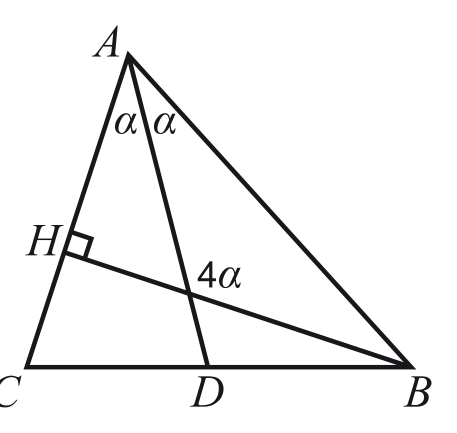
Nel triangolo ABC rappresentato in figura, BH è l’altezza relativa al lato AC mentre AD è la bisettrice dell’angolo in A. La misura dell’angolo ottuso formato da BH e AD è il quadruplo della misura α dell’angolo BAD. Quanti gradi misura l’angolo BAC ? A) 30 B) 45
C) 60
D) 75
E) 90
Topic: Geometria piana Abilita: Ragionamento geometrico Area: Geometria Risposta: C Fonte: apri PDF p.3
BAC angle given the angle between height and width
\begin{document}
\begin{tikzpicture}[scale=1.0]
  \coordinate (A) at (1.0, 3.0);
  \coordinate (B) at (4.0, 0.0);
  \coordinate (C) at (0.0, 0.0);
  \coordinate (H) at (0.4, 1.2);
  \coordinate (D) at (1.708, 0.0);
  \draw[thick] (A) -- (B) -- (C) -- cycle;
  \draw[thin] (B) -- (H);
  \draw[thin] (H) -- ++(0.1136, -0.0379) -- ++(0.0379, 0.1136) -- ++(-0.1136, 0.0379);
  \draw[thin] (A) -- (D);
  \node[above] at (A) {$A$};
  \node[below] at (C) {$C$};
  \node[below right] at (B) {$B$};
  \node[left] at (H) {$H$};
  \node[below] at (D) {$D$};
  \node[below, font=\small] at (0.85, 2.55) {$\alpha$};
  \node[below, font=\small] at (1.15, 2.50) {$\alpha$};
  \node[font=\small] at (2.2, 1.2) {$4\alpha$};
\end{tikzpicture}
\end{document}
In the ABC triangle shown in Figure 1, BH is the height relative to the AC side while AD is the angle bisector in A. The measure of the oblique angle formed by BH and AD is quadrupled by the measure of α of the angle BAD. How many degrees does the angle BAC measure ? A) 30 B) 45
C) 60
D) 75
E) 90
Answer: C src_kangourou_2014_cadet__Q16
Ora minima per finire i due bagni con tempi dati
Sei ragazzi condividono un appartamento con due bagni, che utilizzano ogni mat tina a partire dalle 7:00 in punto. Essi usano i bagni uno alla volta, ognuno il primo bagno che trova libero, ma ciascuno vi si trattiene regolarmente per un tempo diffe rente: 8, 10, 12, 17, 21 e 22 minuti. Se si organizzano in modo opportuno, a che ora, al più presto, potranno avere finito di usare i bagni? A) 7:45 B) 7:46 C) 7:47 D) 7:48 E) 7:50
Topic: Combinatoria Metodo: Principio di estremalita Abilita: Casework accurato Area: Combinatoria, Logica e Probabilita Risposta: B Fonte: apri PDF p.3
Minimum time to finish the two baths with data times
Six children share an apartment with two bathrooms, which they use every morning from 7:00 a.m. onwards. They use the bathrooms one at a time, each the first bathroom they find free, but they each stay there regularly for a different time: 8, 10, 12, 17, 21 and 22 minutes. If they organize themselves properly, at what time, at the earliest, will they be able to finish using the toilets? A) 7:45 B) 7:46 C) 7:47 D) 7:48 E) 7:50
Answer: B src_kangourou_2014_cadet__Q17
Lunghezze delle tre parti dalle bisettrici nel rettangolo
Un rettangolo ha lati di lunghezza 6 cm e 11 cm. Tracciamo le bisettrici degli angoli che hanno il vertice nei due estremi di uno dei due lati maggiori: esse dividono il lato opposto in tre parti. Quali sono le lunghezze in centimetri di queste tre parti? A) 1, 9, 1
B) 2, 7, 2
C) 3, 5, 3 D) 4, 3, 4
E) 5, 1, 5
Topic: Geometria piana Abilita: Ragionamento geometrico Area: Geometria Risposta: E Fonte: apri PDF p.3
Lengths of the three sides from the rectangular beams
A rectangle has sides 6 cm long and 11 cm wide. Let’s plot the angles of the vertices at the two ends of one of the two major sides: they divide the opposite side into three parts. What are the centimeter lengths of these three parts? A) 1, 9, 1
B) 2, 7, 2
C) 3, 5, 3 D) 4, 3, 4
E) 5, 1, 5
Answer: E src_kangourou_2014_cadet__Q18
Quante monete c’erano nel forziere
Una ciurma di pirati ha ripescato un forziere con diverse monete d’oro. Essi si spartiscono il bottino in modo che ognuno abbia lo stesso numero di monete. Se ci fossero quattro pirati in meno ognuno riceverebbe 10 monete in più; invece se ci fossero 50 monete in meno, ognuno riceverebbe 5 monete in meno. Quante monete c’erano nel forziere? A) 80
B) 100 C) 120 D) 150 E) 250
Topic: Algebra Abilita: traduzione del testo Area: Algebra e Analisi Risposta: D Fonte: apri PDF p.4
How many coins were in the fortress
A pack of pirates caught a forcible man with several gold coins. They divide the loot so that each has the same number of coins. If there were four pirates less, each one would get 10 more coins; whereas if there were 50 coins less, each one would get 5 less coins. How many coins were in the fortress? A) 80
B) 100 C) 120 D) 150 E) 250
Answer: D src_kangourou_2014_cadet__Q19
Media dei quattro numeri dalle somme date
Avevo quattro numeri. Ho sommato ciascuno di essi alla media (aritmetica) degli altri tre ottenendo le quattro somme 54, 60, 62 e 76. Qual è la media dei quattro nu meri che avevo? A) 31,5 B) 65
C) 63
D) 44
E) 32,5 I quesiti dal n. 21 al n. 30 valgono 5 punti ciascuno
Topic: Algebra Abilita: Manipolazione algebrica Area: Algebra e Analisi Risposta: A Fonte: apri PDF p.4
Mean of the four numbers from the sums given
I had four numbers. I added each of them to the average (arithmetic) of the other three and got the four sums 54, 60, 62, and 76. What was the average of the four numbers I had? A) 31,5 B) 65
C) 63
D) 44
E) 32.5 Questions from n. 21 al n. 30 is worth 5 points each.
Answer: A src_kangourou_2014_cadet__Q20
Somma dei numeri confinanti con 8 nella tabella 3x3
\begin{document}
\begin{tikzpicture}[scale=1.2]
  \draw[thick] (0,0) grid (3,3);
  \node at (0.5, 2.5) {1};
  \node at (2.5, 2.5) {3};
  \node at (0.5, 0.5) {2};
  \node at (2.5, 0.5) {4};
\end{tikzpicture}
\end{document}
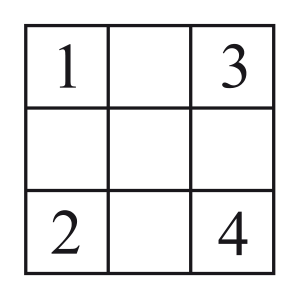
Guglielmo scrive tutti i numeri interi da 1 a 9 inclusi nelle celle di una tabella 3x3, in modo che ogni cella contenga uno e un solo numero: in figura vedi dove ha posto i primi 4 numeri. Egli chiama confinanti due numeri se le celle che li contengono condividono un lato: dopo aver scritto tutti i numeri, nota che la somma di tutti i numeri confinanti con 9 è 15. Qual è la somma dei numeri confinanti con 8? A) 12
B) 18
C) 20
D) 26
E) 27
Topic: Logica, giochi, strategie, Combinatoria Metodo: Analisi per casi Abilita: Casework accurato Area: Combinatoria, Logica e Probabilita Risposta: E Fonte: apri PDF p.4
sum of numbers adjacent to 8 in table 3x3
\begin{document}
\begin{tikzpicture}[scale=1.2]
  \draw[thick] (0,0) grid (3,3);
  \node at (0.5, 2.5) {1};
  \node at (2.5, 2.5) {3};
  \node at (0.5, 0.5) {2};
  \node at (2.5, 0.5) {4};
\end{tikzpicture}
\end{document}
William writes all the integers from 1 to 9 included in the cells of a 3x3 table, so that each cell contains one and only one number: in the figure you can see where he placed the first 4 numbers. He calls adjacent two numbers if the cells that contain them share a side: after writing all the numbers, he notes that the sum of all the numbers adjacent to 9 is 15. What is the sum of the numbers adjacent to 8? A) 12
B) 18
C) 20
D) 26
E) 27
Answer: E src_kangourou_2014_cadet__Q21
Oggetto più pesante dalle pesate (bilancia difettosa)
Una bilancia vecchiotta funziona male: se un oggetto pesa meno di 1000 g, la bilancia indica il peso corretto, ma se l’oggetto pesa 1000 g o di più, la bilancia indica un numero qualunque, ma in ogni caso maggiore di 1000 g. Abbiamo 5 oggetti A, B, C, D e E, ciascuno di peso ignoto inferiore a 1000 g. Denotiamo i loro pesi in grammi rispettivamente con i loro nomi (ad. es. A pesa A grammi). Se pesiamo gli oggetti a coppie, la bilancia indica i seguenti pesi: B + D = 1200, C + E = 2100, B + E = 800, B + C = 900, A + E = 700. Qual è l’oggetto più pesante? A) A
B) B
C) C
D) D
E) E
Topic: Logica, giochi, strategie, Algebra Metodo: Analisi per casi Abilita: Casework accurato Area: Algebra e Analisi, Combinatoria, Logica e Probabilita Risposta: D Fonte: apri PDF p.4
- heavier than weights (defective balance) *
An old scale does not work well: if an object weighs less than 1000 g, the scale indicates the correct weight, but if the object weighs 1000 g or more, the scale indicates any number, but in any case greater than 1000 g. We have five objects A, B, C, D and E, each weighing less than 1,000 grams. We denote their weights in grams, respectively, with their names (ad. es. Weighing in at grams. If we weigh the objects in pairs, the scale indicates the following weights: B + D = 1200, C + E = 2100, B + E = 800, B + C = 900, A + E = 700. What’s the heaviest object? A) A
B) B
C) C
D) D
E) E
Answer: D src_kangourou_2014_cadet__Q22
Area del trapezio dai triangoli delle diagonali
\begin{document}
\begin{tikzpicture}[scale=1.0]
  \coordinate (A) at (0, 3);
  \coordinate (B) at (2, 3);
  \coordinate (C) at (4, 0);
  \coordinate (D) at (0, 0);
  \draw[thick] (A) -- (B) -- (C) -- (D) -- cycle;
  \draw[thin] (A) -- (C);
  \draw[thin] (B) -- (D);
  \node[above left] at (A) {$A$};
  \node[above right] at (B) {$B$};
  \node[below right] at (C) {$C$};
  \node[below left] at (D) {$D$};
  \node[font=\small] at (1.0, 2.6) {$5$};
  \node[font=\small] at (0.4, 1.5) {$10$};
\end{tikzpicture}
\end{document}
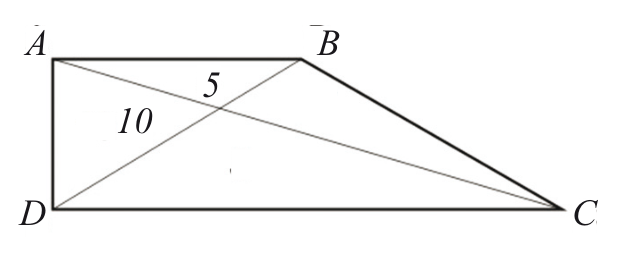
In figura vedi un trapezio rettangolo ABCD. I numeri inseriti in due dei trian goli determinati dalle diagonali del trape zio denotano l’area in metri quadrati dei rispettivi triangoli. Quanto vale, in metri quadrati, l’area del trapezio ABCD ? A) 60
B) 45
C) 40
D) 35
E) 30 A B C D 5 10
Topic: Geometria piana Abilita: Ragionamento geometrico Area: Geometria Risposta: B Fonte: apri PDF p.4
Area of the trapezoid from the triangles of the diagonals
\begin{document}
\begin{tikzpicture}[scale=1.0]
  \coordinate (A) at (0, 3);
  \coordinate (B) at (2, 3);
  \coordinate (C) at (4, 0);
  \coordinate (D) at (0, 0);
  \draw[thick] (A) -- (B) -- (C) -- (D) -- cycle;
  \draw[thin] (A) -- (C);
  \draw[thin] (B) -- (D);
  \node[above left] at (A) {$A$};
  \node[above right] at (B) {$B$};
  \node[below right] at (C) {$C$};
  \node[below left] at (D) {$D$};
  \node[font=\small] at (1.0, 2.6) {$5$};
  \node[font=\small] at (0.4, 1.5) {$10$};
\end{tikzpicture}
\end{document}
In the figure you see an ABCD rectangular trapezoid. The numbers inserted into two of the triangles determined by the trapezoidal diagonals denote the area in square metres of the respective triangles. What is the area of the ABCD trapezoid in square metres? A) 60
B) 45
C) 40
D) 35
E) 30 A B C D 5 10
Answer: B src_kangourou_2014_cadet__Q23
Massimo numeri da 1 a 20 senza maggiore doppio del minore
Tra tutti i numeri interi da 1 a 20 inclusi, Riccardo vuole sceglierne alcuni in modo che, comunque ne estragga due fra quelli scelti, il maggiore non sia il doppio del mi nore. Quanti ne può scegliere al massimo? A) 14
B) 13
C) 12
D) 11
E) 10
Topic: Combinatoria, Teoria dei Numeri Metodo: Principio di estremalita Abilita: Casework accurato Area: Aritmetica e Teoria dei Numeri, Combinatoria, Logica e Probabilita Risposta: A Fonte: apri PDF p.5
Maximum numbers from 1 to 20 with no more than double the minor
Among all integers 1 to 20 included, Riccardo wants to select a few so that, however he extracts two of the selected numbers, the greater is not twice the smaller. How many can you pick at most? A) 14
B) 13
C) 12
D) 11
E) 10
Answer: A src_kangourou_2014_cadet__Q24
Rapporto tra le velocità delle due parti del viaggio
Vincenzo usa andare dal centro del paese al suo orto in bicicletta. Oggi aveva progettato di arrivare alle 15:00 ma, dopo aver coperto i 3/4 della distanza viaggian do a velocità costante, si è accorto di avere impiegato i 2/3 del tempo previsto per il viaggio completo. Da quel punto in poi ha pedalato più adagio, sempre a velocità costante, ed è arrivato all’ora prevista. Qual è il rapporto tra la velocità della prima parte e quella della seconda parte del viaggio? A) 5 : 4 B) 4 : 3 C) 3 : 2 D) 2 : 1 E) 3 : 1
Topic: Algebra Abilita: traduzione del testo Area: Algebra e Analisi Risposta: C Fonte: apri PDF p.5
Ratio between the speeds of the two parts of the journey
Vincenzo used to go from the center of the village to his garden by bicycle. Today he had planned to arrive at 3 p.m. but, after covering 3/4 of the distance travelled at constant speed, he realized that he had taken 2/3 of the time planned for the full journey. From that point on, he rode more smoothly, always at a steady speed, and arrived at the time he had planned. What is the relationship between the speed of the first part and that of the second part of the journey? A) 5 : 4 B) 4 : 3 C) 3 : 2 D) 2 : 1 E) 3 : 1
Answer: C src_kangourou_2014_cadet__Q25
Disegno sulla faccia opposta del parallelepipedo di cubi
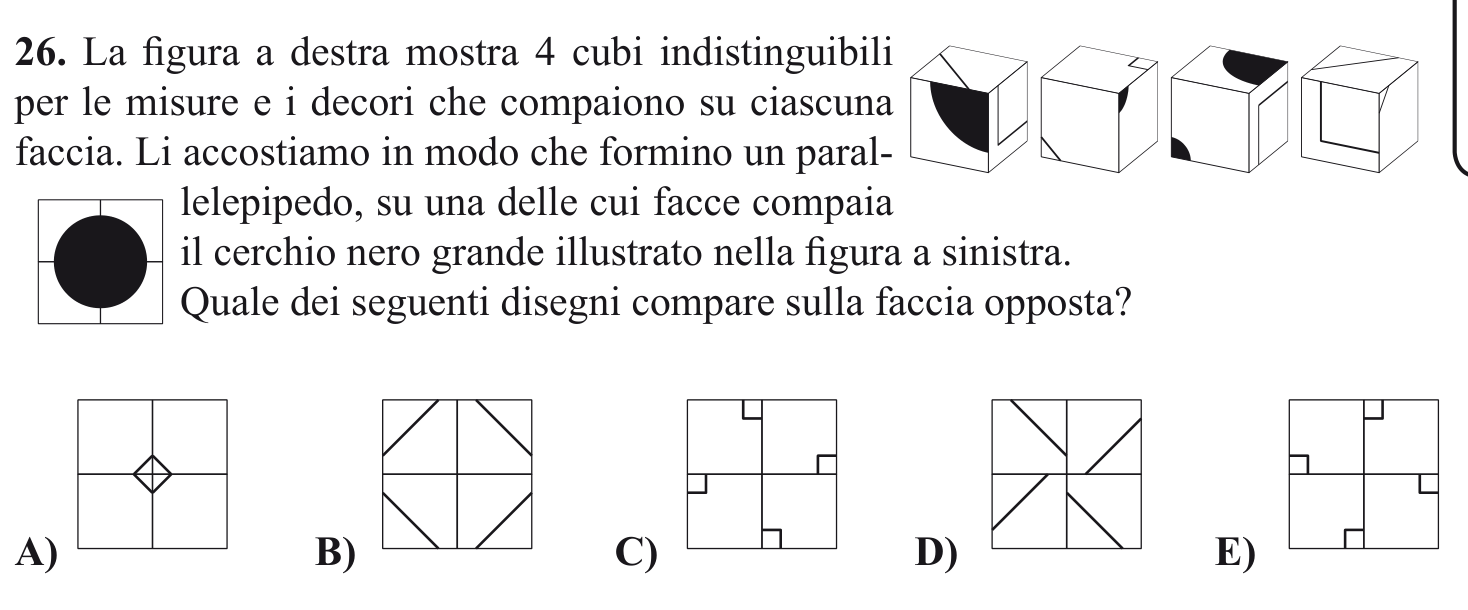
La figura a destra mostra 4 cubi indistinguibili per le misure e i decori che compaiono su ciascuna faccia. Li accostiamo in modo che formino un paral lelepipedo, su una delle cui facce compaia il cerchio nero grande illustrato nella figura a sinistra. Quale dei seguenti disegni compare sulla faccia opposta? A)
B)
C)
D)
E)
Topic: Geometria solida Abilita: Ragionamento geometrico Area: Geometria Risposta: A Fonte: apri PDF p.5
Design on the opposite side of the cube parallel-piped
The figure on the right shows 4 cubes indistinguishable by the dimensions and decorations that appear on each face. We draw them together to form a parallel piped, on one of whose faces appears the large black circle shown in the figure to the left. Which of the following drawings appears on the opposite face? A)
B)
C)
D)
E)
Answer: A src_kangourou_2014_cadet__Q26
Quanti appartengono ai Verdi (Verdi/Rossi/Gialli)
In una stanza ci sono 25 persone ciascuna delle quali appartiene ad una e una sola delle seguenti confraternite: i Verdi, che dicono sempre la verità, i Rossi che mentono sempre e i Gialli che, se a una domanda rispondono il vero, alla successiva mentono e viceversa. A ciascuna di queste persone è stato chiesto nell’ordine: • “Sei dei Verdi? “ e 17 hanno risposto sì, • “Sei dei Gialli?” e 12 hanno risposto sì, • “Sei dei Rossi?” e 8 hanno risposto sì. Quanti sono gli appartenenti ai Verdi? A) 4
B) 5
C) 9
D) 13
E) 17
Topic: Logica, giochi, strategie Metodo: Analisi per casi Abilita: Casework accurato Area: Combinatoria, Logica e Probabilita Risposta: B Fonte: apri PDF p.5
*How many are from the Greens (Green/Red/Yellow) *
In one room there are 25 people, each of whom belongs to one of the following fraternities: the Greens, who always tell the truth, the Reds, who always lie, and the Giants, who, if they answer one question truthfully, lie to the next and vice versa. Each of these people was asked in the order: • Are you Green? and 17 answered yes, • are from Yellow? and 12 answered yes, • are from Red? and 8 answered yes. How many are the Greens? A) 4
B) 5
C) 9
D) 13
E) 17
Answer: B src_kangourou_2014_cadet__Q27
Minimo valore di M con divisibilità per 2 e 13
Sulla lavagna sono stati scritti alcuni numeri interi positivi tutti diversi tra loro. Esattamente due di essi sono divisibili per 2 ed esattamente 13 di essi sono divisibili per 13. Sia M il più grande di questi numeri: qual è il più piccolo valore che può as sumere M? A) 143 B) 260 C) 273 D) 299 E) 325
Topic: Teoria dei Numeri Metodo: congruenze, Principio di estremalita Abilita: Casework accurato Area: Aritmetica e Teoria dei Numeri Risposta: C Fonte: apri PDF p.5
Minimum value of M with divisible by 2 and 13
On the board were written some positive integers all different from each other. Exactly two of them are divisible by 2 and exactly 13 of them are divisible by 13. If M is the largest of these numbers, what is the smallest value that M can sum? A) 143 B) 260 C) 273 D) 299 E) 325
Answer: C src_kangourou_2014_cadet__Q28
Massimo foglie visitabili dalla rana (salti non adiacenti)
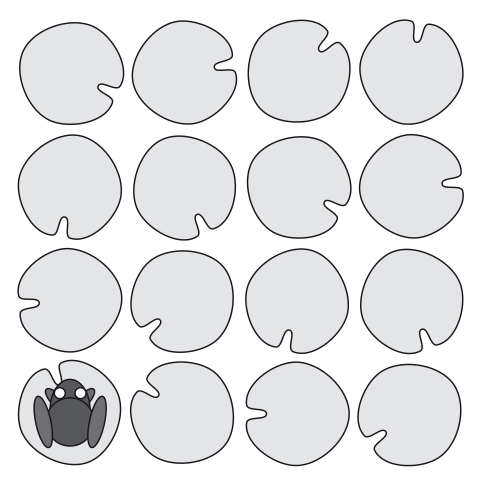
In uno stagno ci sono 16 foglie di ninfea, disposte in uno schema 4×4 come quello mostrato in figura. Una rana siede su una foglia in uno degli angoli. Essa può saltare da una foglia all’altra in direzione orizzontale op pure verticale; inoltre nei suoi salti non può mai atterrare su una foglia adiacente e non può visitare due volte la stessa foglia. Qual è il maggior numero di foglie (inclusa quella di partenza) che la rana può visitare? A) 16
B) 15
C) 14
D) 13
E) 12
Topic: Combinatoria Metodo: parita, Teoria dei grafi Abilita: Casework accurato Area: Combinatoria, Logica e Probabilita Risposta: A Fonte: apri PDF p.6
*Most frog-friendly leaves (non-adjacent leaps) *
In a pond there are 16 leaves of nymph, arranged in a pattern of 4×4 as shown in the figure. A frog sits on a leaf in one of the corners. It can jump from leaf to leaf horizontally or vertically; it can never land on an adjacent leaf and cannot visit the same leaf twice. What is the largest number of leaves (including the starting one) that the frog can visit? A) 16
B) 15
C) 14
D) 13
E) 12
Answer: A src_kangourou_2014_cadet__Q29
Minimo spigoli grigi sul bordo del quadrato piastrellato

\begin{document}
\begin{tikzpicture}[scale=1.5]
  \fill[gray!40] (0,0) rectangle (1,1);
  \fill[black] (0,0) -- (1,0) -- (0.5, 0.5) -- cycle;
  \draw[thick] (0,0) rectangle (1,1);
\end{tikzpicture}
\end{document}
Un quadrato di lato 5 deve essere piastrellato con pia strelle quadrate di lato 1, tutte con lo stesso disegno: quello mostrato in figura. Si vuole che due piastrelle adiacenti ab biano sempre lo spigolo di contatto dello stesso colore, nero o grigio che sia. Sul bordo del quadrato alcune piastrelle si affacceranno con il loro spigolo nero e alcune con uno dei loro spigoli grigi: qual è il più piccolo numero di spigoli grigi che devono necessariamente comparire sul bordo del quadrato? A) 4
B) 5
C) 6
D) 7
E) 8
STRINGA CADET 2014
Topic: Combinatoria Metodo: parita Abilita: Casework accurato Area: Combinatoria, Logica e Probabilita Risposta: B Fonte: apri PDF p.6
Minimum gray spikes on the edge of the tiled square
\begin{document}
\begin{tikzpicture}[scale=1.5]
  \fill[gray!40] (0,0) rectangle (1,1);
  \fill[black] (0,0) -- (1,0) -- (0.5, 0.5) -- cycle;
  \draw[thick] (0,0) rectangle (1,1);
\end{tikzpicture}
\end{document}
A square on side 5 shall be tiled with square square pilasters on side 1, all with the same drawing as shown in Figure 1. It is desirable that two adjacent tiles always have the same colour, black or gray, contact pin. On the edge of the square some tiles will turn out with their black spike and some with one of their gray spike: what is the smallest number of gray spikes that must necessarily appear on the edge of the square? A) 4
B) 5
C) 6
D) 7
E) 8
The Commission shall adopt delegated acts in accordance with Article 21 of this Regulation.
Answer: B src_kangourou_2014_cadet__Q30