Quale pezzo ritagliato dal centro della stella
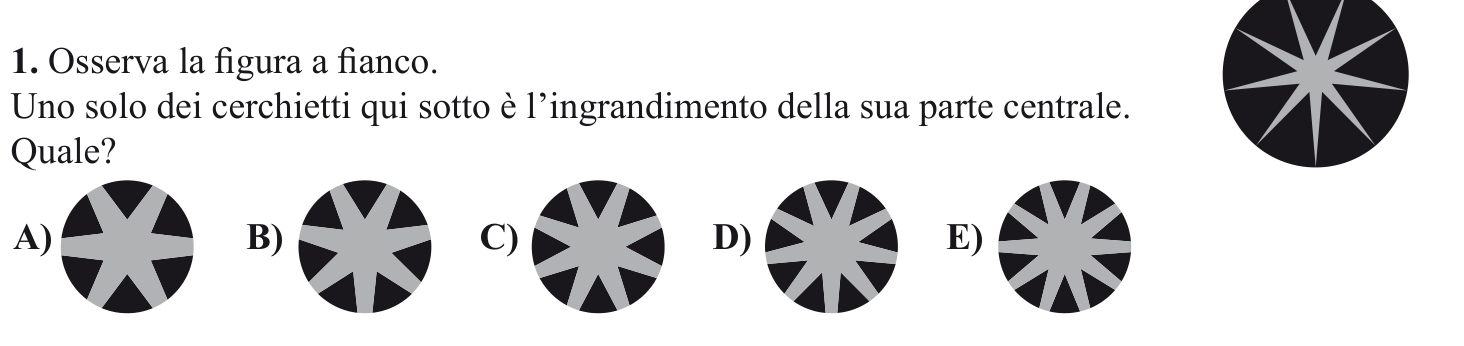
Osserva la figura a fianco. Uno solo dei cerchietti qui sotto è l’ingrandimento della sua parte centrale. Quale?
Topic: Geometria piana Abilita: Ragionamento geometrico Area: Geometria Fonte: apri PDF p.1
Which piece cut from the center of the star
Look at the figure next to me. Only one of the circles below is the enlargement of its central part. What kind?
src_kangourou_2014_ecolier__Q01
Dove inserire il 3 per ottenere il numero piu piccolo
Giacomo vuole trasformare il numero 2014 in un numero di cinque cifre aggiungendo alle cifre già presenti la cifra 3. Se vuole ottenere il numero più piccolo possibile, dove deve collo care la cifra 3? A) All’inizio B) Fra 2 e 0 C) Fra 0 e 1 D) Fra 1 e 4 E) Alla fine
Topic: Teoria dei Numeri Abilita: Riconoscimento di pattern Area: Aritmetica e Teoria dei Numeri Fonte: apri PDF p.1
Where to enter 3 to get the smallest number
Giacomo wants to turn the number 2014 into a five-digit number by adding the number 3 to the already existing numbers. If you want to get the smallest number possible, where should you put the number 3? A) At the beginning B) Between 2 and 0 C) Between 0 and 1 D) Between 1 and 4 E) At the end
src_kangourou_2014_ecolier__Q02
Quali case usano gli stessi blocchi da costruzione
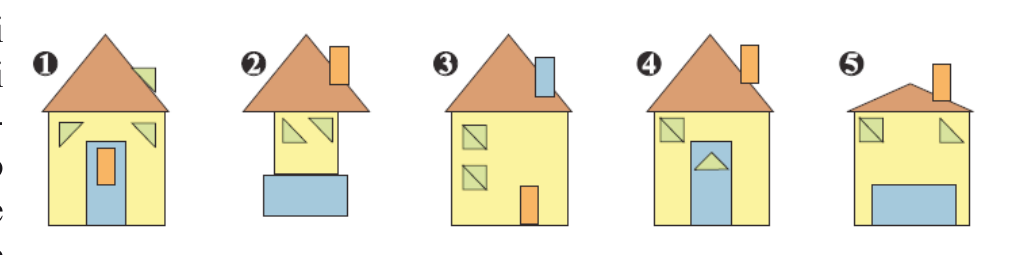
Alcuni rettangoli, fra i quali un quadrato, e alcuni triangoli, sono stati acco stati o sovrapposti in modo da formare le cinque casette che vedi. Per quali fra esse sono stati usati pezzi identici e nella stessa quantità? A) 1 e 4 B) 3 e 4 C) 1, 4 e 5 D) 3, 4 e 5 E) 1, 2, 4 e 5
Topic: Logica, giochi, strategie, Combinatoria Abilita: Ragionamento geometrico Area: Combinatoria, Logica e Probabilita Fonte: apri PDF p.1
Which houses use the same building blocks
Some rectangles, including a square, and some triangles, have been added or superimposed to form the five boxes you see. For which of them were identical pieces and in the same quantity used? A) 1 e 4 B) 3 e 4 C) 1, 4 e 5 D) 3, 4 e 5 E) 1, 2, 4 e 5
src_kangourou_2014_ecolier__Q03
Grammi di foglie mangiate dal koala sveglio
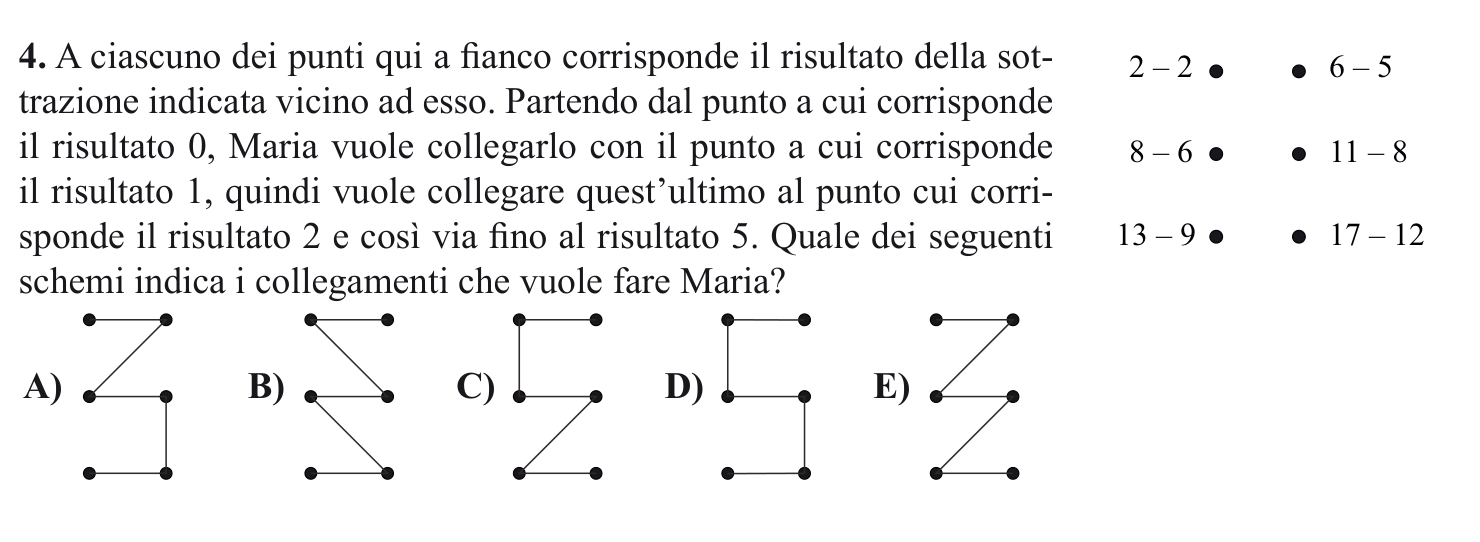
A ciascuno dei punti qui a fianco corrisponde il risultato della sot trazione indicata vicino ad esso. Partendo dal punto a cui corrisponde il risultato 0, Maria vuole collegarlo con il punto a cui corrisponde il risultato 1, quindi vuole collegare quest’ultimo al punto cui corri sponde il risultato 2 e così via fino al risultato 5. Quale dei seguenti schemi indica i collegamenti che vuole fare Maria?
Topic: Teoria dei Numeri Abilita: traduzione del testo Area: Aritmetica e Teoria dei Numeri Fonte: apri PDF p.1
Grams of leaves eaten by the waking koala
The result of the subtraction indicated next to each of the points here is the same. Starting from the point where the result 0 corresponds, Maria wants to link it to the point where the result 1 corresponds, then she wants to link the latter to the point where the result 2 corresponds, and so on until the result 5. Which of the following patterns indicates the connections that Mary wants to make?
src_kangourou_2014_ecolier__Q04
Quale forma unendo i punti delle risposte 0-5
Adamo ha meno caramelle di Martino, ma più di Susanna. Lucia ha più caramelle sia di Adamo sia di Martino. Diana ha più caramelle di Adamo, ma meno di Lucia. Chi di loro ha più caramelle di tutti gli altri? A) Martino B) Adamo C) Susanna D) Diana E) Lucia A) B) C) D) E) 2 – 2 8 – 6 13 – 9 6 – 5 11 – 8 17 – 12 A) B) C) D) E)
Topic: Teoria dei Numeri, Geometria piana Abilita: Ragionamento geometrico Area: Aritmetica e Teoria dei Numeri, Geometria Fonte: apri PDF p.1
What shape by joining the points of the answers 0-5
Adam has less candy than Martino, but more than Susanna. Lucia has more candy than both Adam and Martin. Diana has more candy than Adam, but less than Lucia. Which one of them has more candy than the others? (A) Martin B) Adam C) Susanna D) Diana E) Lucia A) B) C) D) E) 2 2 8 6 13 9 6 5 11 8 17 12 A) B) C) D) E)
src_kangourou_2014_ecolier__Q05
Dove mettere il tassello per formare la sagoma
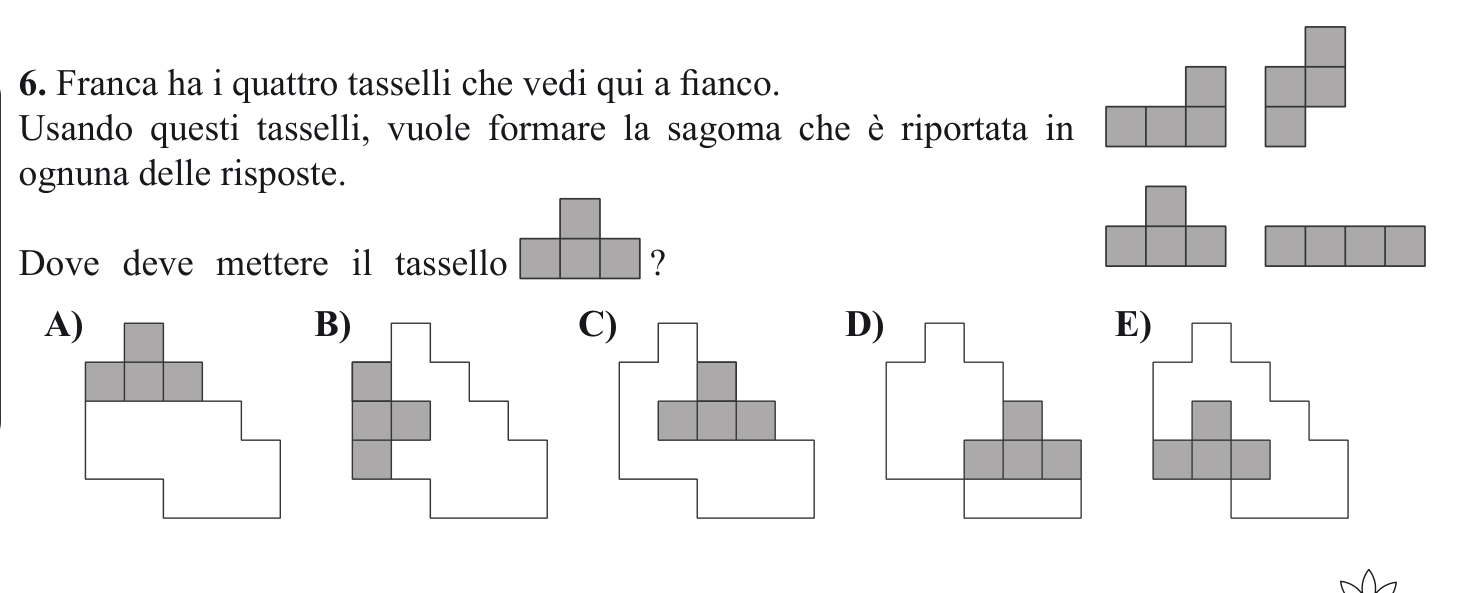
Franca ha i quattro tasselli che vedi qui a fianco. Usando questi tasselli, vuole formare la sagoma che è riportata in ognuna delle risposte. Dove deve mettere il tassello ?
Topic: Geometria piana Abilita: Ragionamento geometrico Area: Geometria Risposta: C Fonte: apri PDF p.2
Where to place the shaft to form the shape
Franca’s got the four tails you see right next to her. Using these scales, he wants to form the shape that is shown in each of the answers. Where do you want to put the bag ?
Answer: C src_kangourou_2014_ecolier__Q06
Come appaiono i fiori visti dall’esterno della vetrina
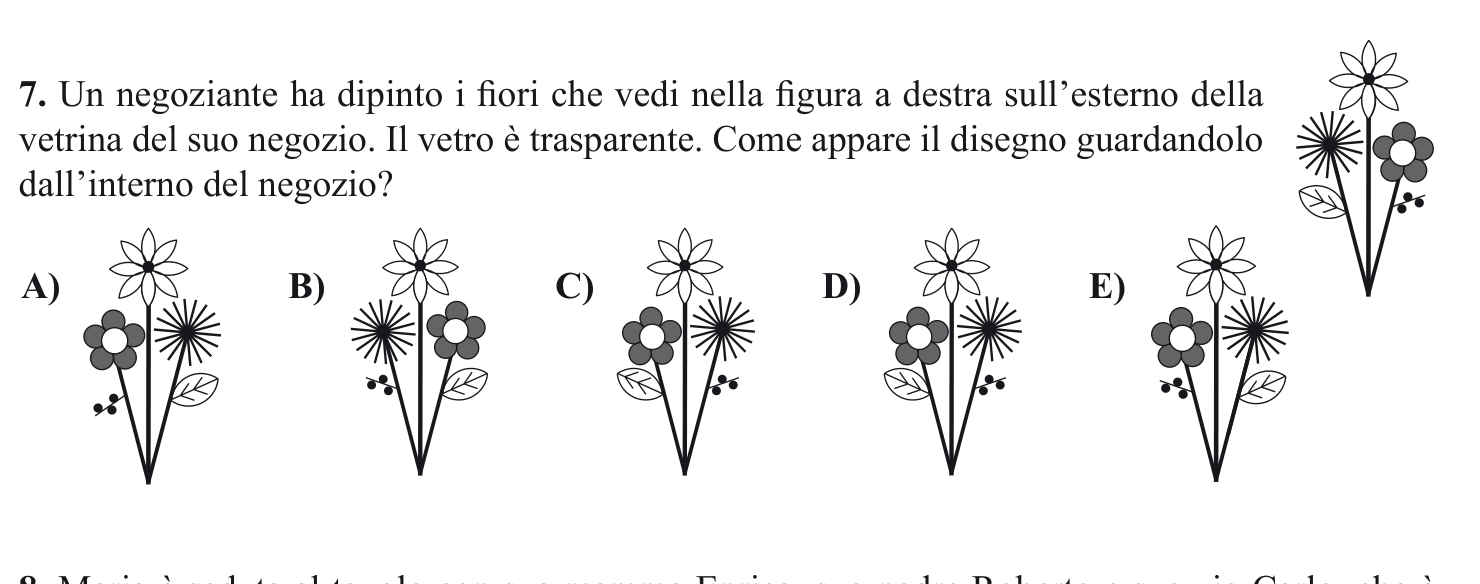
Un negoziante ha dipinto i fiori che vedi nella figura a destra sull’esterno della vetrina del suo negozio. Il vetro è trasparente. Come appare il disegno guardandolo dall’interno del negozio?
Topic: Geometria piana Metodo: Sfruttamento della simmetria Abilita: Ragionamento geometrico Area: Geometria Fonte: apri PDF p.2
What the flowers look like from the outside of the window
A shopkeeper painted the flowers you see in the figure on the right on the outside of his shop window. The glass is transparent. What does the drawing look like from inside the store?
src_kangourou_2014_ecolier__Q07
Quale quadrato rende uguali area bianca e nera
Maria è seduta al tavolo con sua mamma Enrica, suo padre Roberto e suo zio Carlo, che è fratello di Roberto. Chi è la persona più giovane fra loro quattro? A) Enrica B) Maria C) Carlo D) Roberto
E) Non è possibile rispondere senza ulteriori informazioni. I quesiti dal n. 9 al n. 16 valgono 4 punti ciascuno
Topic: Geometria piana Abilita: Ragionamento geometrico Area: Geometria Fonte: apri PDF p.2
Which square equals the black and white area
Maria sits at the table with her mother Enrica, her father Roberto and her uncle Carlo, who is Roberto’s brother. Who is the youngest of the four? A) Enrica B) Maria C) Carlo D) Roberto E) It is not possible to reply without further information. Questions from n. 9 al n. 16 is worth 4 points each.
src_kangourou_2014_ecolier__Q08
Quante caramelle c’erano all’inizio dopo i prelievi
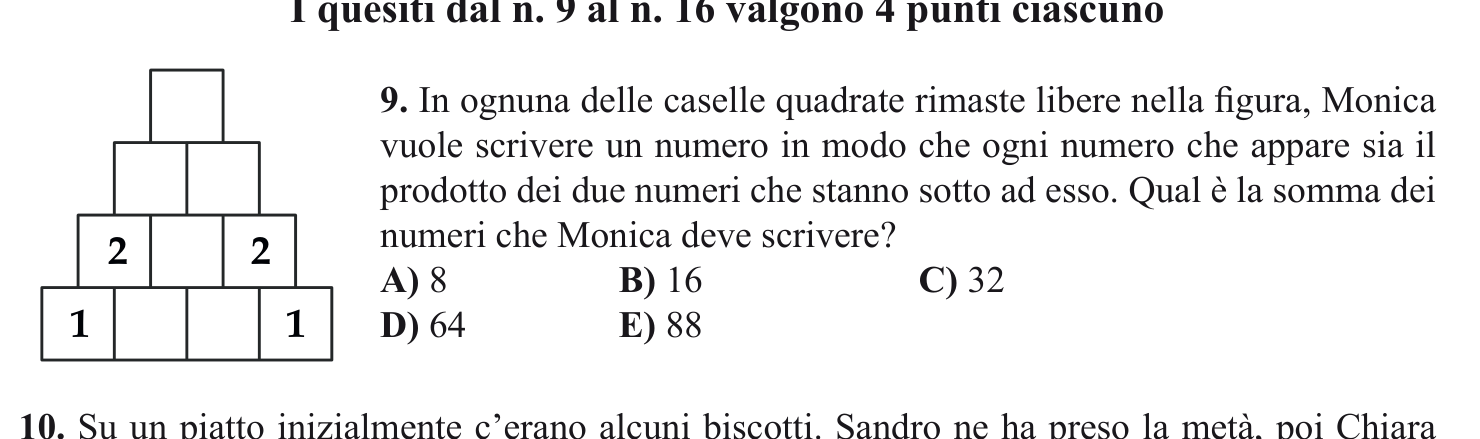
In ognuna delle caselle quadrate rimaste libere nella figura, Monica vuole scrivere un numero in modo che ogni numero che appare sia il prodotto dei due numeri che stanno sotto ad esso. Qual è la somma dei numeri che Monica deve scrivere? A) 8 B) 16
C) 32 D) 64 E) 88
Topic: Algebra Abilita: Manipolazione algebrica Area: Algebra e Analisi Fonte: apri PDF p.2
How many candies were there at the beginning after the withdrawals
In each of the free-standing square boxes in the figure, Monica wants to write a number so that every number that appears is the product of the two numbers that are below it. What’s the sum of the numbers Monica has to write? A) 8 B) 16
C) 32 D) 64 E) 88
src_kangourou_2014_ecolier__Q09
Vista dall’alto del solido di 8 cubi
Su un piatto inizialmente c’erano alcuni biscotti. Sandro ne ha preso la metà, poi Chiara ha preso la metà dei rimanenti e infine Mauro ha preso la metà di quelli lasciati da Chiara. Nel piatto alla fine sono rimasti 6 biscotti. Quanti ce n’erano all’inizio? A) 12
B) 18
C) 20
D) 24
E) 48
Topic: Geometria solida Metodo: Ragionamento all’indietro Abilita: Ragionamento geometrico Area: Geometria Fonte: apri PDF p.2
View from the top of the solid of 8 cubes
On a plate, there were initially some cookies. Sandro took half of it, then Chiara took half the rest and finally Mauro took half the ones Chiara left behind. There’s six cookies left in the final cut. How many were there at the beginning? A) 12
B) 18
C) 20
D) 24
E) 48
src_kangourou_2014_ecolier__Q10
Numero nella cella grigia della piramide moltiplicativa
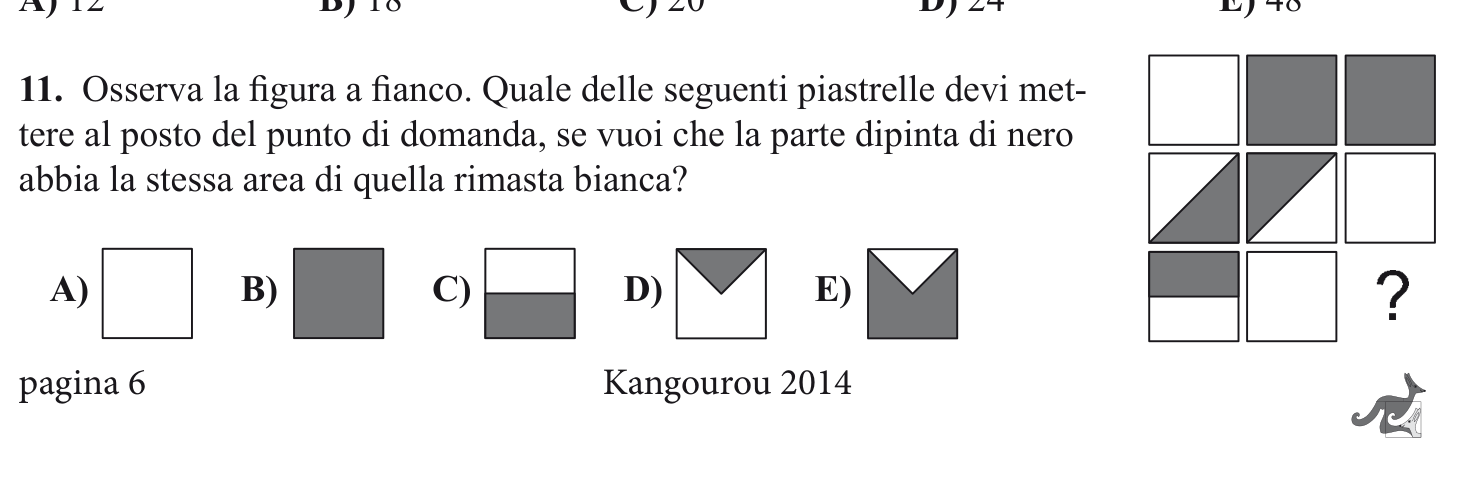
Osserva la figura a fianco. Quale delle seguenti piastrelle devi met tere al posto del punto di domanda, se vuoi che la parte dipinta di nero abbia la stessa area di quella rimasta bianca? A) B) C) D) E) A) B) C) D) E) 1 2 2 1 A) B) C) D) E)
Topic: Teoria dei Numeri, Algebra Abilita: Manipolazione algebrica Area: Algebra e Analisi, Aritmetica e Teoria dei Numeri Fonte: apri PDF p.2
Number in the gray cell of the multiplication pyramid
Look at the figure next to me. Which of the following tiles should you replace the question mark if you want the black part to have the same area as the white part? A) B) C) D) E) A) B) C) D) E) 1 2 2 1 A) B) C) D) E)
src_kangourou_2014_ecolier__Q11
Somma di due punteggi non ottenibile al bersaglio
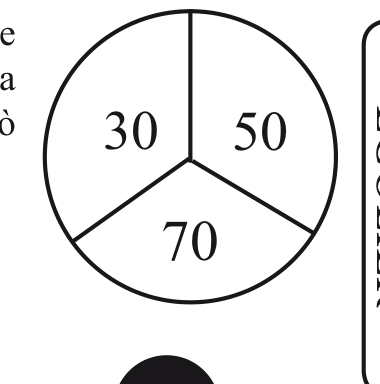
Paolo gioca al tiro al bersaglio. Se non colpisce il bersaglio ottiene 0 punti, se lo colpisce ottiene il punteggio indicato in figura nella zona in cui lo ha colpito. Dopo due lanci, quale dei seguenti numeri non può essere la somma dei due punteggi che ha ottenuto? A) 60
B) 70
C) 80
D) 90
E) 100
Topic: Teoria dei Numeri, Combinatoria Abilita: Conteggio sistematico Area: Aritmetica e Teoria dei Numeri, Combinatoria, Logica e Probabilita Risposta: D Fonte: apri PDF p.3
sum of two scores not achievable at the target
Paul plays the shot at the target. If he doesn’t hit the target he gets 0 points, if he hits it he gets the score shown in the figure in the area where he hit it. After two throws, which of the following numbers cannot be the sum of the two scores he has scored? A) 60
B) 70
C) 80
D) 90
E) 100
Answer: D src_kangourou_2014_ecolier__Q12
In quale disegno copre esattamente la forma coi 4 pezzi
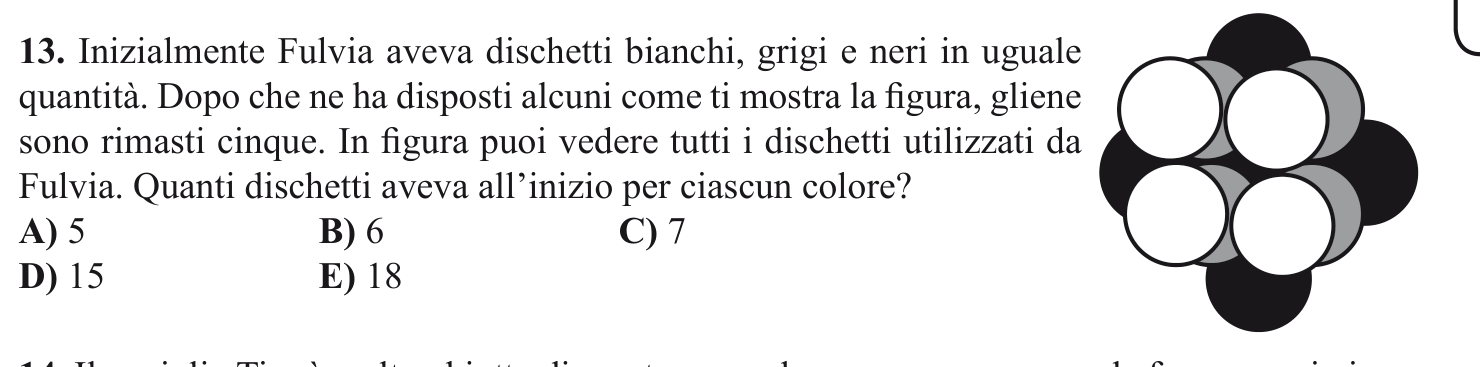
Inizialmente Fulvia aveva dischetti bianchi, grigi e neri in uguale quantità. Dopo che ne ha disposti alcuni come ti mostra la figura, gliene sono rimasti cinque. In figura puoi vedere tutti i dischetti utilizzati da Fulvia. Quanti dischetti aveva all’inizio per ciascun colore? A) 5
B) 6
C) 7 D) 15
E) 18
Topic: Geometria piana Abilita: Ragionamento geometrico Area: Geometria Fonte: apri PDF p.3
Which drawing exactly covers the shape with the four pieces
Initially Fulvia had white, gray and black discs in equal quantity. After he arranged a few of them as you see in the figure, he’s got five left. In the figure you can see all the discs used by Fulvia. How many discs did you have at the beginning for each color? A) 5
B) 6
C) 7 D) 15
E) 18
src_kangourou_2014_ecolier__Q13
Quante pedine nere aveva all’inizio dato che ne avanzano 5
Il coniglio Tim è molto ghiotto di carote e carrube, ma segue una regola ferrea: ogni giorno, a sua scelta, mangia o 9 carote, o 2 carrube, o 1 carruba e 4 carote. Durante una settimana Tim ha mangiato in tutto 30 carote. Quante carrube ha mangiato in tutto in quella settimana? A) 6
B) 7
C) 8
D) 9
E) 10
Topic: Algebra, Teoria dei Numeri Metodo: Analisi per casi Abilita: traduzione del testo Area: Algebra e Analisi, Aritmetica e Teoria dei Numeri Fonte: apri PDF p.3
*How many blackheads did you have at the beginning as you move forward 5 *
The Tim rabbit is very fond of carrots and carrots, but it follows an iron rule: every day, as you choose, it eats either 9 carrots, or 2 carrots, or 1 carrots and 4 carrots. For a week, Tim ate a total of 30 carrots. How many carrots did you eat in all that week? A) 6
B) 7
C) 8
D) 9
E) 10
src_kangourou_2014_ecolier__Q14
Quanti cavoli ha mangiato il coniglio in una settimana
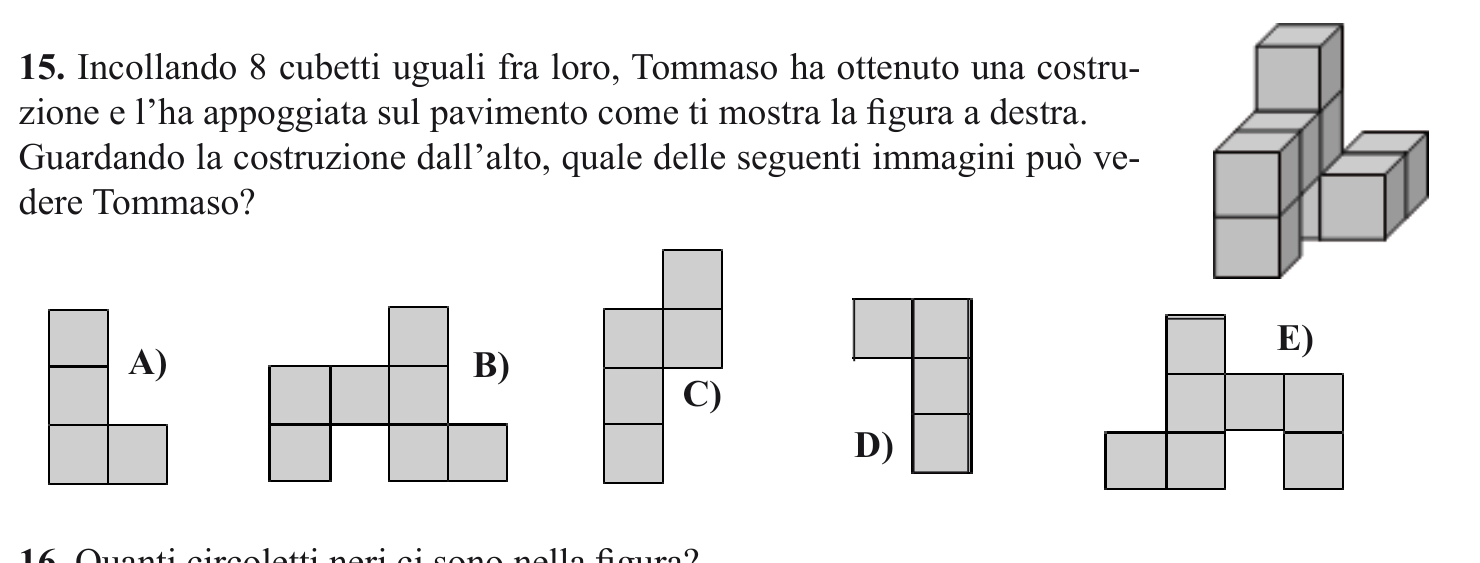
Incollando 8 cubetti uguali fra loro, Tommaso ha ottenuto una costru zione e l’ha appoggiata sul pavimento come ti mostra la figura a destra. Guardando la costruzione dall’alto, quale delle seguenti immagini può ve dere Tommaso?
Topic: Teoria dei Numeri, Combinatoria Abilita: traduzione del testo Area: Aritmetica e Teoria dei Numeri, Combinatoria, Logica e Probabilita Fonte: apri PDF p.3
How many cabbage has the rabbit eaten in a week
By joining eight equal cubes, Thomas obtained a construction and laid it on the floor as shown in the figure to the right. Looking at the construction from above, which of the following images can Thomas see?
src_kangourou_2014_ecolier__Q15
Quanti punti ci sono nell’immagine
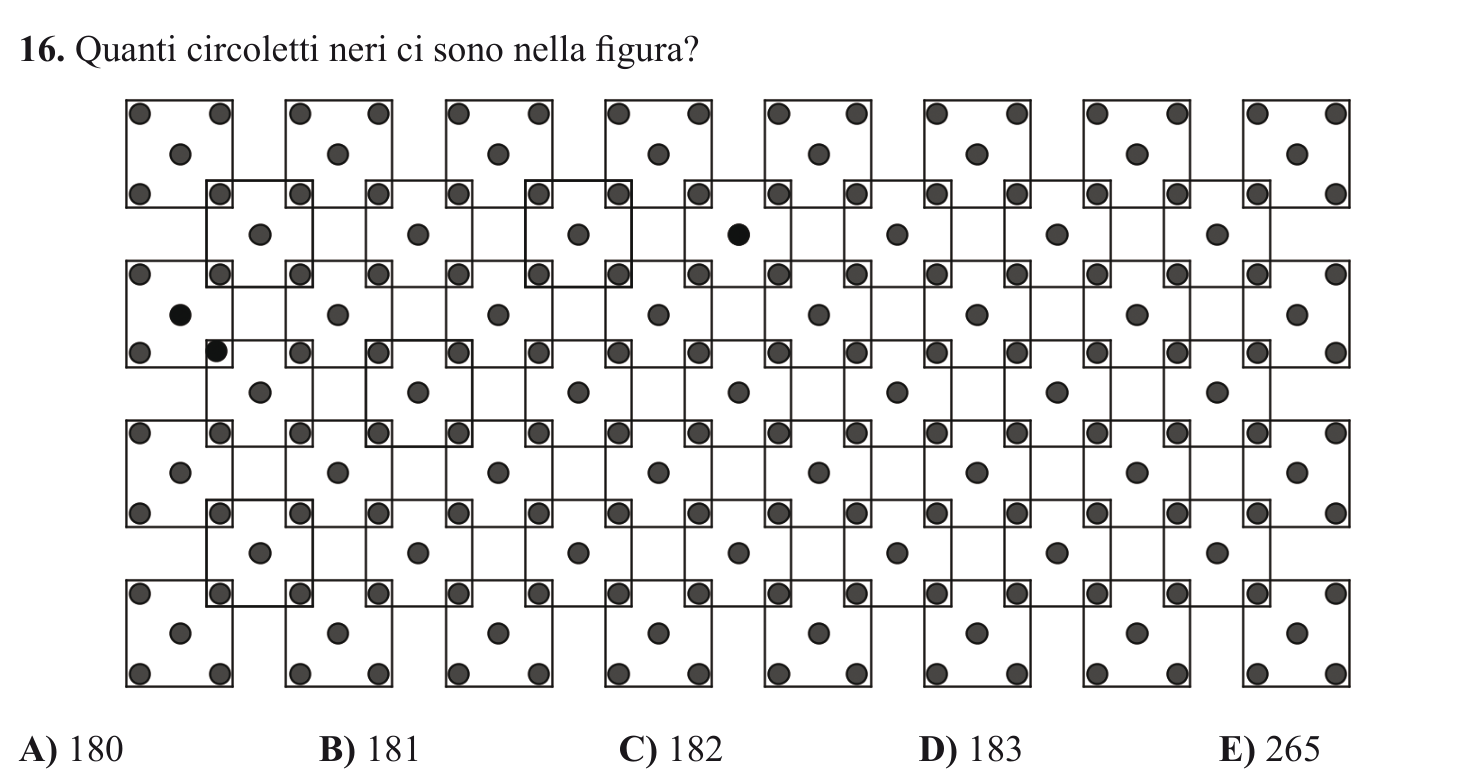
Quanti circoletti neri ci sono nella figura? A) 180
B) 181
C) 182
D) 183
E) 265 A) B) C) D) E) 30 50 70
I quesiti dal n. 17 al n. 24 valgono 5 punti ciascuno
Topic: Teoria dei Numeri Metodo: Conteggio combinatorio Abilita: Conteggio sistematico Area: Aritmetica e Teoria dei Numeri Fonte: apri PDF p.3
How many dots are in the image
How many black circles are in the figure? A) 180
B) 181
C) 182
D) 183
E) 265 A) B) C) D) E) 30 50 70
Questions from n. 17 al n. Twenty-four is worth five points each.
src_kangourou_2014_ecolier__Q16
Pedine che mostrano verde dopo i giri successivi
Enrico ha dieci pedine tutte uguali: ognuna ha una faccia rossa e l’altra verde. Le dispone in fila sul tavolo in modo che tutte mostrino la faccia rossa. Dopo un minuto le gira tutte. Dopo un altro minuto gira solo quelle di posto pari. Dopo un altro minuto gira solo la terza, la sesta e la nona. Dopo un altro minuto gira solo la quarta e l’ottava e così via fino a quando, alla fine, gira solo la decima. A questo punto, quante pedine mostrano la faccia verde? A) 1
B) 3
C) 5
D) 6
E) 7
Topic: Combinatoria Metodo: Conteggio combinatorio Abilita: Riconoscimento di pattern Area: Combinatoria, Logica e Probabilita Risposta: B Fonte: apri PDF p.4
Requests showing green after the next rounds
Henry has ten legs all the same: each face is red and the other green. He’s placing them in a row on the table so they all show their red faces. After a minute, it’s all over. After one more minute, only those of equal rank. After another minute, only the third, sixth and ninth turn. After another minute only the fourth and eighth turn and so on until, in the end, only the tenth turn. At this point, how many pedals show the green face? A) 1
B) 3
C) 5
D) 6
E) 7
Answer: B src_kangourou_2014_ecolier__Q17
Numero di donne attorno al tavolo con vincoli
Sette persone, uomini e donne, sono sedute attorno ad un tavolo ro tondo. Non ci sono due uomini uno a fianco dell’altro e nessuna donna è seduta fra altre due donne. Allora il numero delle donne sedute al tavolo A) è sicuramente 3. B) può essere sia 3 sia 4. C) è sicuramente 4. D) può essere sia 4 sia 5. E) è sicuramente 5.
Topic: Combinatoria, Logica, giochi, strategie Metodo: Analisi per casi Abilita: Casework accurato Area: Combinatoria, Logica e Probabilita Risposta: C Fonte: apri PDF p.4
Number of women around the table with constraints
Seven people, men and women, are sitting around a round table. There are no two men next to each other, and no woman sits between two other women. So the number of women sitting at table A is definitely 3. B) can be either 3 or 4. C) is definitely 4. D) can be either 4 or 5. E) is definitely 5.
Answer: C src_kangourou_2014_ecolier__Q18
Minimo scambi per comporre la parola SEGMENTO
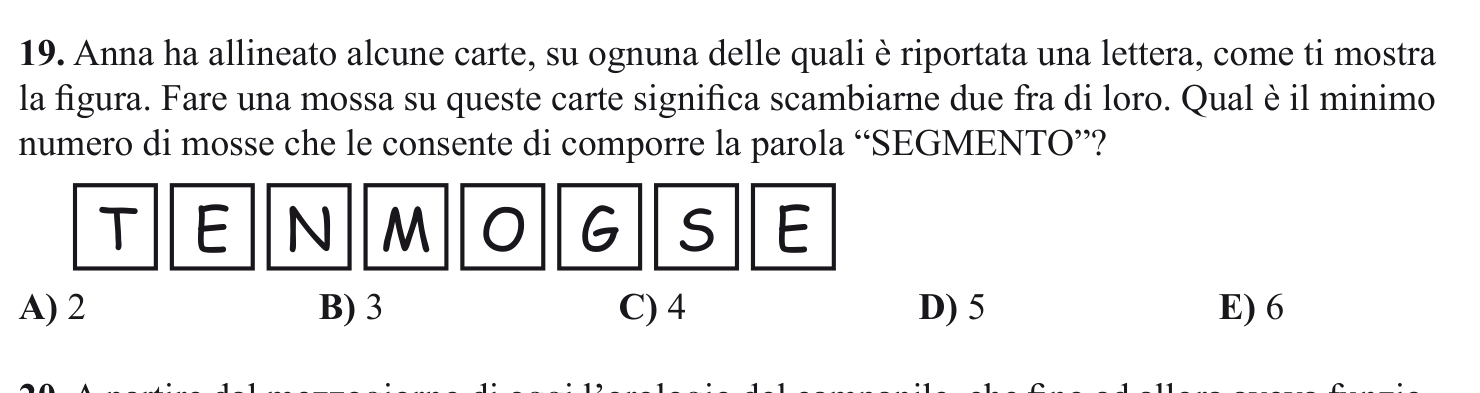
Anna ha allineato alcune carte, su ognuna delle quali è riportata una lettera, come ti mostra la figura. Fare una mossa su queste carte significa scambiarne due fra di loro. Qual è il minimo numero di mosse che le consente di comporre la parola “SEGMENTO”? A) 2
B) 3
C) 4
D) 5
E) 6
Topic: Combinatoria Metodo: Conteggio combinatorio Abilita: Casework accurato Area: Combinatoria, Logica e Probabilita Risposta: B Fonte: apri PDF p.4
Minimum exchanges to compose the word SEGEMENT
Anna has lined up some cards, each with a letter on it, as you can see in the picture. Making a move on these cards means swapping two of them. What is the minimum number of moves that allows you to compose the word SEGMENT? A) 2
B) 3
C) 4
D) 5
E) 6
Answer: B src_kangourou_2014_ecolier__Q19
Quanti rombi neri nel livello 6 dello schema
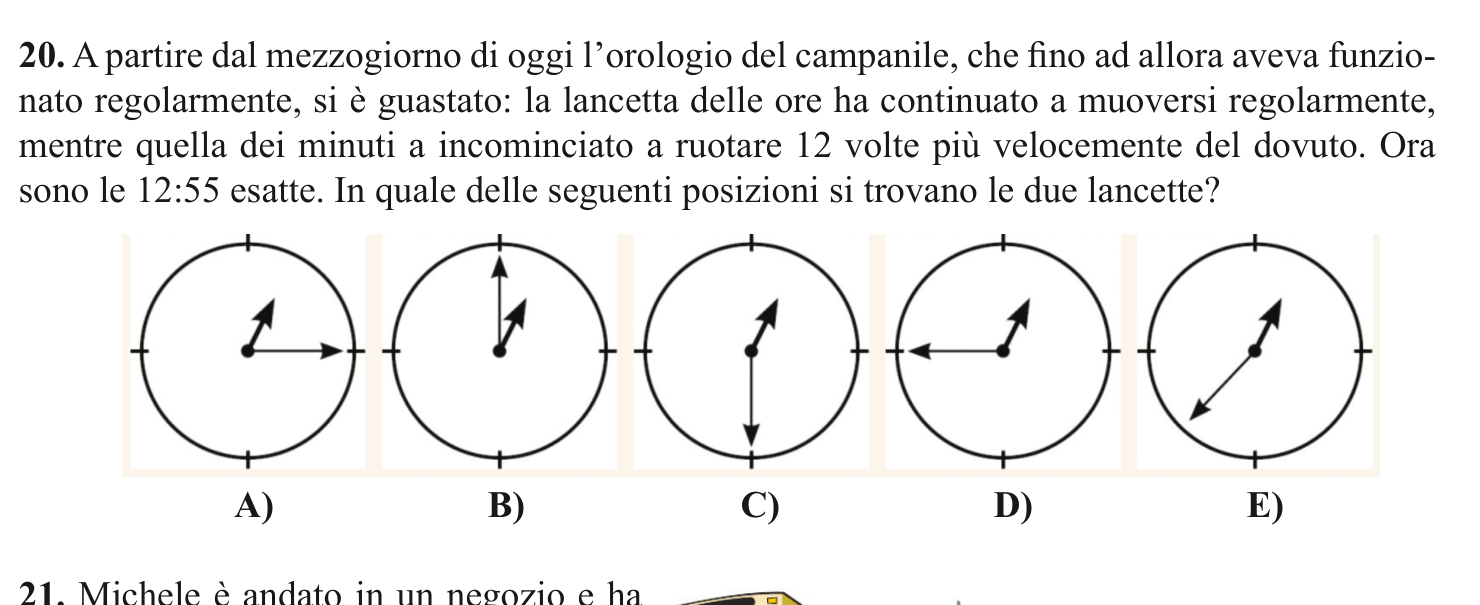
A partire dal mezzogiorno di oggi l’orologio del campanile, che fino ad allora aveva funzio nato regolarmente, si è guastato: la lancetta delle ore ha continuato a muoversi regolarmente, mentre quella dei minuti a incominciato a ruotare 12 volte più velocemente del dovuto. Ora sono le 12:55 esatte. In quale delle seguenti posizioni si trovano le due lancette?
A)B) C) D) E)
Topic: successioni, Combinatoria Abilita: Riconoscimento di pattern Area: Algebra e Analisi, Combinatoria, Logica e Probabilita Fonte: apri PDF p.4
How many black hairs in level 6 of the scheme
As of noon today, the clock on the bell tower, which until then had been running regularly, has failed: the clock has continued to move regularly, while the minute clock has started to rotate 12 times faster than it should. It’s exactly 12:55 now. In which of the following positions are the two handles?
A)
B) C) D) E)
src_kangourou_2014_ecolier__Q20
Quali giocattoli ha portato a casa Heinzi date le monete
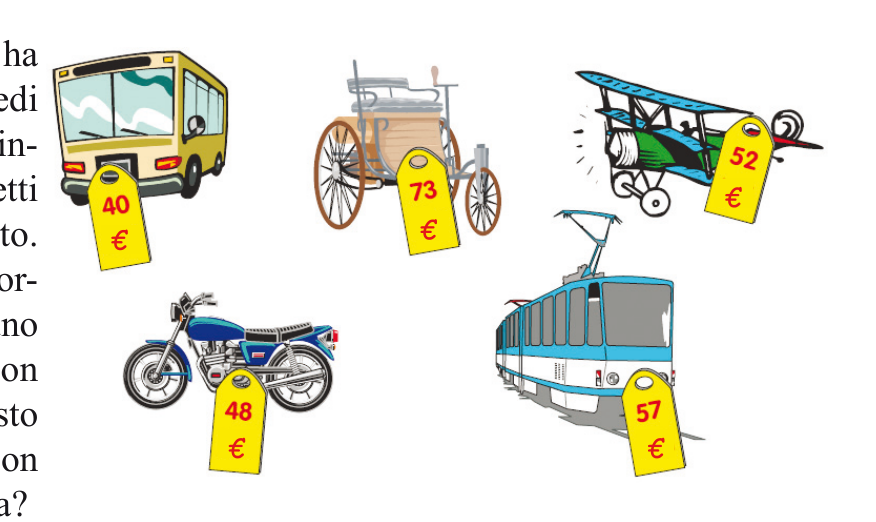
Michele è andato in un negozio e ha acquistato alcuni dei giocattoli che vedi nella figura, per ciascuno dei quali è in dicato il prezzo. Ha pagato con 3 biglietti da 50 euro e ha ottenuto 20 euro di resto. Appena uscito ha cambiato idea ed è tor nato nel negozio facendosi cambiare uno dei giocattoli che aveva acquistato con un altro, anch’esso nella figura: in questo modo ha ricevuto altri 5 euro di resto. Con quali giocattoli è tornato alla fine a casa? A) La carrozza e l’aereo.
B) La carrozza e l’autobus. C) La carrozza e il tram.
D) La moto e il tram. E) L’autobus, la moto e il tram. T E N M O G S E
Topic: Teoria dei Numeri, Logica, giochi, strategie Metodo: Analisi per casi Abilita: traduzione del testo Area: Aritmetica e Teoria dei Numeri, Combinatoria, Logica e Probabilita Fonte: apri PDF p.4
What toys Heinzi brought home given the coins
Michele went to a store and bought some of the toys you see in the picture, each of which is priced. He paid with three 50-euro tickets and got 20 euros left. As soon as he left, he changed his mind and returned to the store, changing one of the toys he had bought with another, also in the figure. What toys did he finally come home with? (a) The carriage and the aircraft.
(b) The carriage and bus. C) The carriage and the tram.
D) The motorcycle and the tram. E) Buses, motorcycles and trams. T E N M O G S E
src_kangourou_2014_ecolier__Q21
Minimo linee per pareggiare i vagoni nelle stazioni
\begin{document}
\begin{tikzpicture}[scale=0.9, every node/.style={circle, fill=black, inner sep=2pt}]
  \node[label=above left:{\small 2}] (n2) at (0, 2.2) {};
  \node[label=below left:{\small 7}] (n7) at (0, 0) {};
  \node[label=above:{\small 6}] (n6) at (1.1, 1.1) {};
  \node[label=above:{\small 1}] (n1) at (2.0, 1.1) {};
  \node[label=right:{\small 4}] (n4) at (3.0, 1.1) {};
  \draw (n2) -- (n6);
  \draw (n2) -- (n1);
  \draw (n2) -- (n4);
  \draw (n2) -- (n7);
  \draw (n6) -- (n4);
  \draw (n7) -- (n6);
  \draw (n7) -- (n1);
  \draw (n7) -- (n4);
\end{tikzpicture}
\end{document}
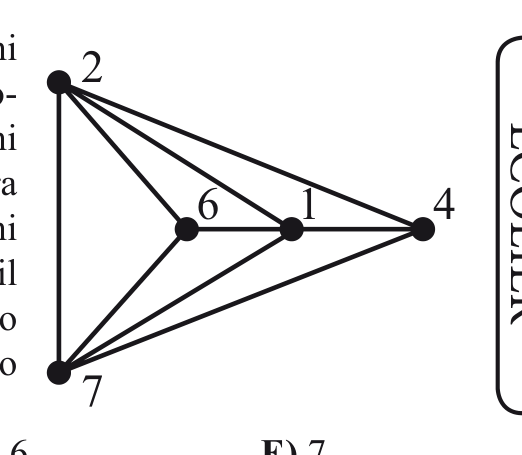
Osserva la figura. I 5 punti rappresentano altrettante stazioni e i segmenti che le collegano rappresentano delle linee ferro viarie. Il numero accanto ad ogni stazione indica quanti vagoni sono presenti in quella stazione. Una locomotiva fa servizio fra le varie stazioni: ad ogni stazione può lasciare o prelevare alcuni vagoni. Se parte dalla stazione dove ci sono più vagoni, qual è il minor numero di linee che le basta percorrere per fare in modo che, al termine dei suoi viaggi, in tutte le stazioni sia presente lo stesso numero di vagoni? A) 3
B) 4
C) 5
D) 6
E) 7
Topic: Combinatoria Metodo: Teoria dei grafi Abilita: Conteggio sistematico Area: Combinatoria, Logica e Probabilita Risposta: A Fonte: apri PDF p.5
Minimum lines for paring wagons at stations
\begin{document}
\begin{tikzpicture}[scale=0.9, every node/.style={circle, fill=black, inner sep=2pt}]
  \node[label=above left:{\small 2}] (n2) at (0, 2.2) {};
  \node[label=below left:{\small 7}] (n7) at (0, 0) {};
  \node[label=above:{\small 6}] (n6) at (1.1, 1.1) {};
  \node[label=above:{\small 1}] (n1) at (2.0, 1.1) {};
  \node[label=right:{\small 4}] (n4) at (3.0, 1.1) {};
  \draw (n2) -- (n6);
  \draw (n2) -- (n1);
  \draw (n2) -- (n4);
  \draw (n2) -- (n7);
  \draw (n6) -- (n4);
  \draw (n7) -- (n6);
  \draw (n7) -- (n1);
  \draw (n7) -- (n4);
\end{tikzpicture}
\end{document}
Look at the figure. The five points represent as many stations and the segments connecting them represent railway lines. The number next to each station indicates how many cars are present at that station. A locomotive serves between the various stations: at each station you can leave or pick up some wagons. If you start from a station where there are more cars, what is the least number of lines you can cross to ensure that at the end of your journey, you have the same number of cars at all stations? A) 3
B) 4
C) 5
D) 6
E) 7
Answer: A src_kangourou_2014_ecolier__Q22
Cifra nella casella grigia dell’addizione con 0..6
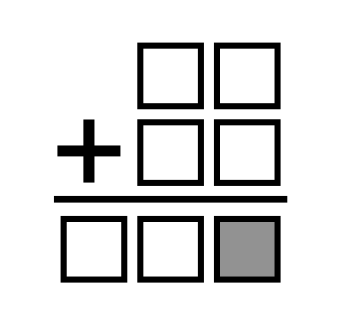
Mettendo in ogni casella una e una sola delle cifre 0, 1, 2, 3, 4, 5, 6, e usandole tutte, si ottiene un’addizione corretta. Che cifra va messa nella casella grigia? A) 2
B) 3
C) 4 D) 5
E) 6
Topic: Teoria dei Numeri Metodo: Analisi per casi Abilita: Casework accurato Area: Aritmetica e Teoria dei Numeri Risposta: D Fonte: apri PDF p.5
Number in the grey box of the addition with 0..6
Putting in each box one and only one of the digits 0, 1, 2, 3, 4, 5, 6 and using them all, you get a correct addition. What number should you put in the grey box? A) 2
B) 3
C) 4 D) 5
E) 6
Answer: D src_kangourou_2014_ecolier__Q23
Massimo quadratini grigi senza quadrato 2x2 grigio
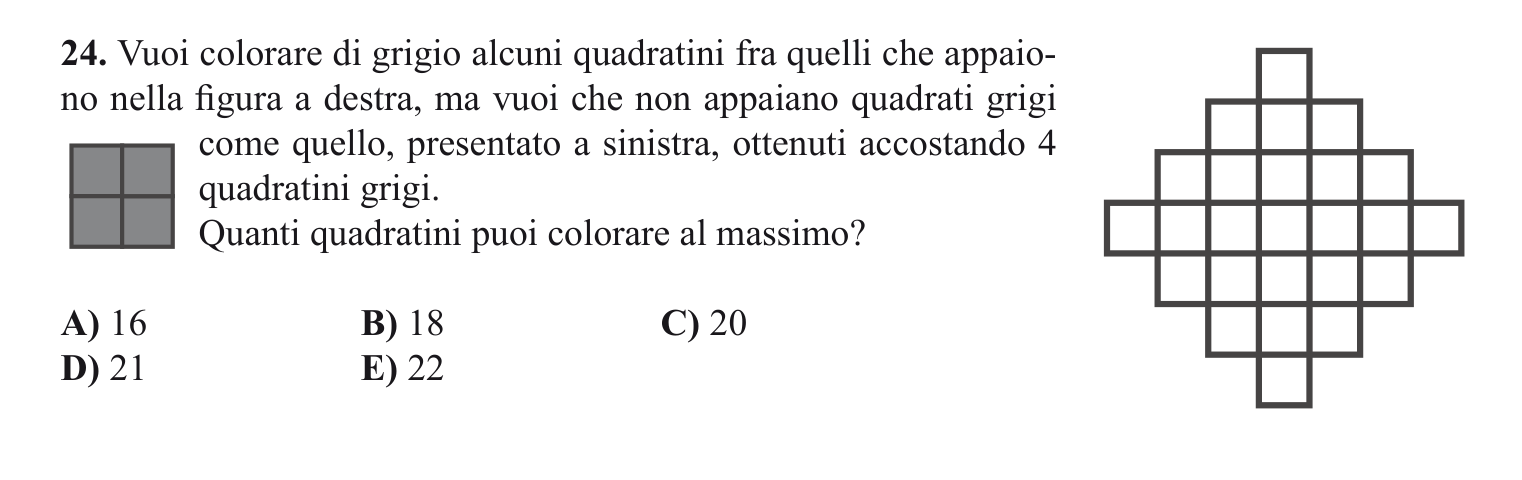
Vuoi colorare di grigio alcuni quadratini fra quelli che appaio no nella figura a destra, ma vuoi che non appaiano quadrati grigi come quello, presentato a sinistra, ottenuti accostando 4 quadratini grigi. Quanti quadratini puoi colorare al massimo? A) 16
B) 18
C) 20 D) 21
E) 22 + 2 4 1 6 7
STRINGA ECOLIER 2014
Topic: Combinatoria Metodo: Principio di estremalita Abilita: Casework accurato Area: Combinatoria, Logica e Probabilita Risposta: D Fonte: apri PDF p.5
Maximum gray squares without 2x2 gray squares
You want to colour some squares in gray among those shown in the figure to the right, but you don’t want to make gray squares like the one shown on the left, obtained by attaching 4 gray squares. How many squares can you color? A) 16
B) 18
C) 20 D) 21
E) 22 + 2 4 1 6 7
This appropriation is intended to cover expenditure on research and technological development in the Member States.
Answer: D src_kangourou_2014_ecolier__Q24