In quale figura l’area ombreggiata e meta del totale
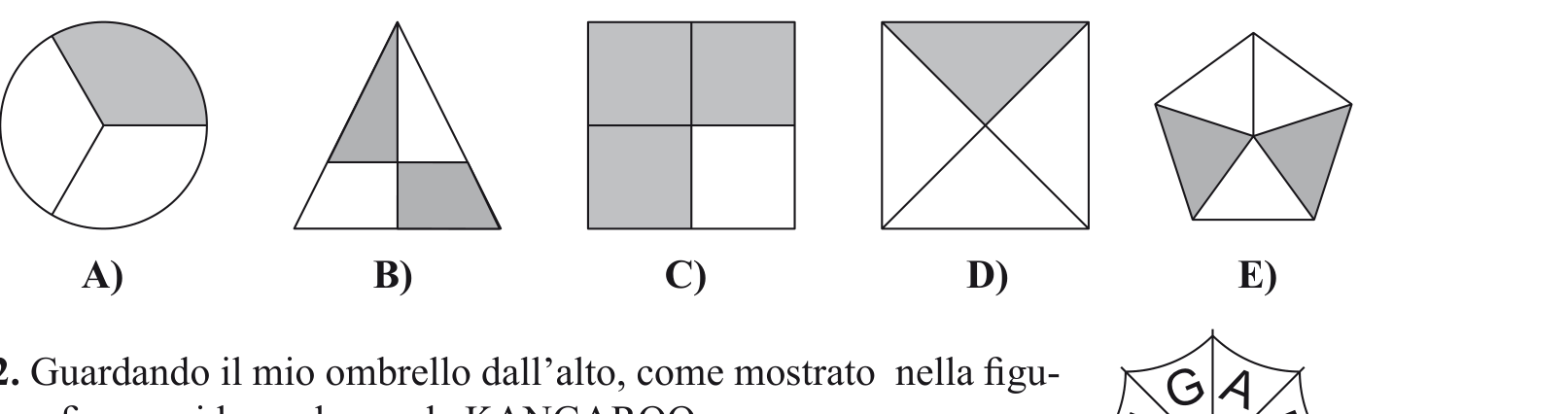
In quale delle figure seguenti l’area della parte ombreggiata è metà dell’area totale? A) B) C) D) E)
Topic: Geometria piana Abilita: Ragionamento geometrico Area: Geometria Risposta: B Fonte: apri PDF p.1
In which the shaded area and the target of the total appear
In which of the following figures is the area of the shaded part half the total area? A) B) C) D) E)
Answer: B src_kangourou_2015_marzo_benjamin__Q01
quale non e il mio
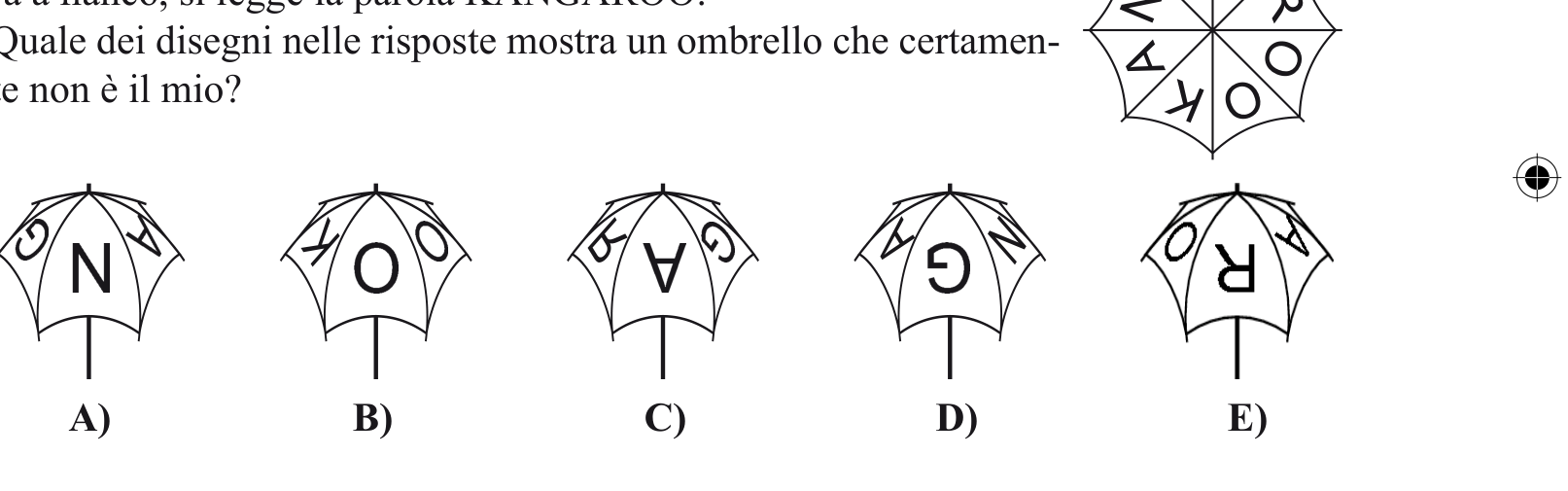
Guardando il mio ombrello dall’alto, come mostrato nella figu ra a fianco, si legge la parola KANGAROO. Quale dei disegni nelle risposte mostra un ombrello che certamen te non è il mio?
A) B) C) D) E)
Topic: Logica, giochi, strategie Abilita: Ragionamento geometrico Area: Combinatoria, Logica e Probabilita Risposta: C Fonte: apri PDF p.1
*which is not my *
Looking at my umbrella from above, as shown in the accompanying figure, you read the word KANGAROO. Which of the drawings in the answers shows an umbrella that is certainly not mine? A) B) C) D) E)
Answer: C src_kangourou_2015_marzo_benjamin__Q02
Min quadratini da riverniciare (no adiacenti uguali)
\begin{document}
\begin{tikzpicture}
  \def\cell#1#2#3{
    \fill[#3] (#1,#2) rectangle (#1+1,#2+1);
    \draw (#1,#2) rectangle (#1+1,#2+1);
  }
  \cell{0}{0}{white}
  \cell{1}{0}{black}
  \cell{2}{0}{black}
  \cell{0}{1}{gray!50}
  \cell{1}{1}{black}
  \cell{2}{1}{white}
  \cell{0}{2}{white}
  \cell{1}{2}{gray!50}
  \cell{2}{2}{gray!50}
\end{tikzpicture}
\end{document}
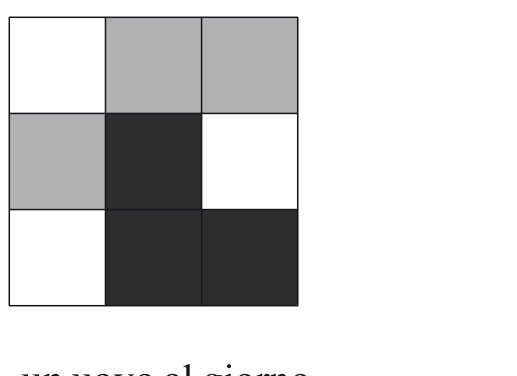
Samuele ha dipinto i nove quadratini in cui è suddiviso il qua drato grande con vernice bianca, grigia e nera come vedi in figura. Ha poi deciso di ridipingerne alcuni in modo che due quadratini verniciati allo stesso modo non abbiano lati in comune. Qual è il numero minimo di quadratini che gli basta riverniciare? A) 2 B) 3 C) 4 D) 5 E) 6
Topic: Combinatoria Metodo: parita Abilita: Casework accurato Area: Combinatoria, Logica e Probabilita Risposta: A Fonte: apri PDF p.1
*Min squares to be repainted (not adjacent to each other) *
\begin{document}
\begin{tikzpicture}
  \def\cell#1#2#3{
    \fill[#3] (#1,#2) rectangle (#1+1,#2+1);
    \draw (#1,#2) rectangle (#1+1,#2+1);
  }
  \cell{0}{0}{white}
  \cell{1}{0}{black}
  \cell{2}{0}{black}
  \cell{0}{1}{gray!50}
  \cell{1}{1}{black}
  \cell{2}{1}{white}
  \cell{0}{2}{white}
  \cell{1}{2}{gray!50}
  \cell{2}{2}{gray!50}
\end{tikzpicture}
\end{document}
Samuel painted the nine squares into which the large square is divided by white, gray and black paint as you can see in the picture. He then decided to repaint some of them so that two squares painted the same way do not have sides in common. What’s the minimum number of squares he can repaint? A) 2 B) 3 C) 4 D) 5 E) 6
Answer: A src_kangourou_2015_marzo_benjamin__Q03
10 galline, uova in 10 giorni
In un pollaio ci sono dieci galline. Cinque di esse fanno, ciascuna, un uovo al giorno mentre ciascuna delle altre fa un uovo a giorni alterni. Quante uova fanno complessi vamente le galline in un periodo di 10 giorni? A) 75
B) 60
C) 50
D) 25
E) 10
Topic: Teoria dei Numeri Abilita: Conteggio sistematico Area: Aritmetica e Teoria dei Numeri Risposta: A Fonte: apri PDF p.1
10 chickens, eggs in 10 days
There are ten chickens in a chicken coop. Five of them each lay one egg a day while the others each lay one egg on alternate days. How many eggs do chickens make in a 10-day period? A) 75
B) 60
C) 50
D) 25
E) 10
Answer: A src_kangourou_2015_marzo_benjamin__Q04
Quale frazione fornisce numero piu piccolo di 2
Quale delle frazioni seguenti fornisce un numero più piccolo di 2 ? A) 19/8 B) 20/9 C) 21/10 D) 22/11 E) 23/12 R A G N A K O O
Topic: Teoria dei Numeri Abilita: Stima e approssimazione Area: Aritmetica e Teoria dei Numeri Risposta: E Fonte: apri PDF p.1
Which fraction gives a number smaller than 2
Which of the following fractions gives a number smaller than 2 ? A) 19/8 B) 20/9 C) 21/10 D) 22/11 E) 23/12 R A G N A K O O
Answer: E src_kangourou_2015_marzo_benjamin__Q05
Lunghezza della linea evidenziata (quadratini 4 cm2)
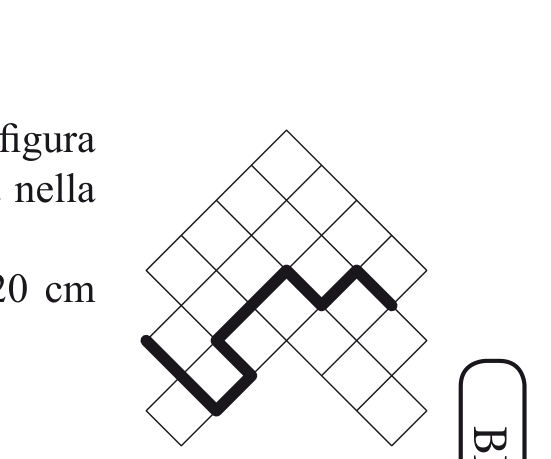
L’area di ciascuno dei quadratini con cui è composta la figura misura 4 cm2. Qual è a lunghezza della linea evidenziata nella figura? A) 16 cm
B) 18 cm
C) 20 cm D) 21 cm
E) 23 cm
Topic: Geometria piana Abilita: Ragionamento geometrico Area: Geometria Risposta: B Fonte: apri PDF p.2
*Length of the highlighted line (4 cm2 squares) *
The area of each of the squares composed of the figure is 4 cm2. What is the length of the line highlighted in the figure? A) 16 cm
B) 18 cm
C) 20 cm D) 21 cm
E) 23 cm
Answer: B src_kangourou_2015_marzo_benjamin__Q06
Quanto pesa Dita (bilance)
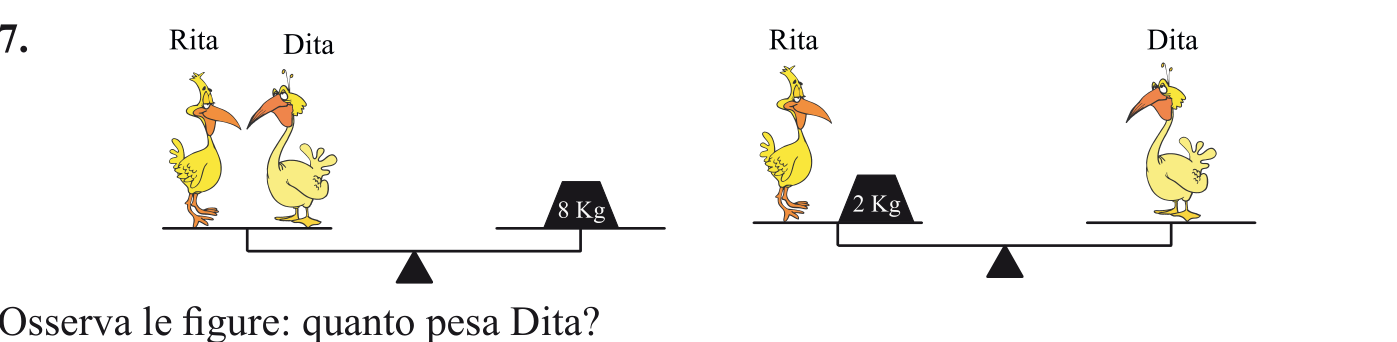
Osserva le figure: quanto pesa Dita? A) 2 kg B) 3 kg C) 4 kg D) 5 kg E) 6 kg
Topic: Algebra Metodo: manipolazione algebrica Abilita: traduzione del testo Area: Algebra e Analisi Risposta: D Fonte: apri PDF p.2
*Weight of thumb (balance sheet) *
Look at the figures: how much does Dita weigh? A) 2 kg B) 3 kg C) 4 kg D) 5 kg E) 6 kg
Answer: D src_kangourou_2015_marzo_benjamin__Q07
Quale immagine non compare mai nella lente
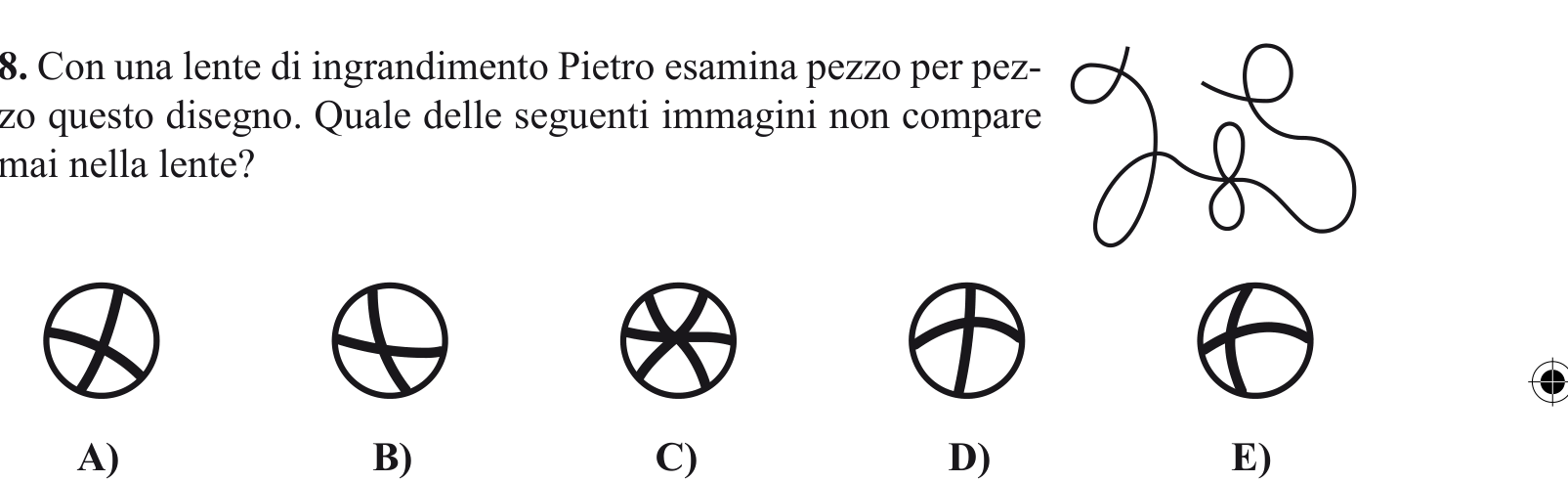
Con una lente di ingrandimento Pietro esamina pezzo per pez zo questo disegno. Quale delle seguenti immagini non compare mai nella lente? A) B) C) D) E)
Topic: Logica, giochi, strategie Abilita: Ragionamento geometrico Area: Combinatoria, Logica e Probabilita Risposta: E Fonte: apri PDF p.2
Which image never appears in the lens
With an enlargement lens, Peter examines this drawing piece by piece. Which of the following images never appears in the lens? A) B) C) D) E)
Answer: E src_kangourou_2015_marzo_benjamin__Q08
quante piante
Nel giardino di Giovanni ci sono solo piante di due tipi: quelle di un tipo hanno 5 foglie, le altre 2 foglie e 1 fiore. Giovanni ha scoperto che ci sono in tutto 32 foglie e 6 fiori. Quante sono in tutto le piante? A) 10 B) 12 C) 13 D) 15 E) 16
Topic: Algebra Metodo: manipolazione algebrica Abilita: traduzione del testo Area: Algebra e Analisi Risposta: A Fonte: apri PDF p.2
how many plants
In John’s garden there are only two types of plants: those of one type have 5 leaves, the other 2 leaves and 1 flower. Giovanni discovered that there are 32 leaves and 6 flowers in all. How many are all over the plants? A) 10 B) 12 C) 13 D) 15 E) 16
Answer: A src_kangourou_2015_marzo_benjamin__Q09
di quanto sovrapporre

Sara ha 4 strisce di carta tutte della stessa lunghezza. Ne incolla insieme due in modo che si sovrappongano per 10 cm ed ottiene un’unica striscia lunga 50 cm. Adesso vuole incollare le altre 2 in modo che esse formino una striscia lunga 56 cm. Di quanti centimetri deve farle sovrapporre? A) 4 cm B) 6 cm C) 7 cm D) 10 cm E) 12 cm 10 cm 10 cm 50 cm
I quesiti dal N. 11 al N. 20 valgono 4 punti ciascuno
Topic: Teoria dei Numeri Abilita: traduzione del testo Area: Aritmetica e Teoria dei Numeri Risposta: A Fonte: apri PDF p.2
- of what is overlapping *
Sara has four strips of paper all the same length. He glues two of them together so that they overlap by 10 cm and gets a single strip 50 cm long. Now he wants to paste the other two together so that they form a 56 cm long strip. How many centimeters does he have to overlay them? A) 4 cm B) 6 cm C) 7 cm D) 10 cm E) 12 cm 10 cm 10 cm 50 cm
The questions from N. 11 al N. 20 is worth 4 points each.
Answer: A src_kangourou_2015_marzo_benjamin__Q10
Perimetro figura con 6 quadrati
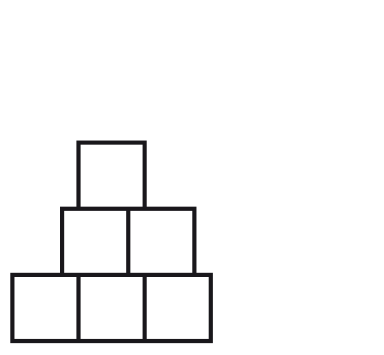
Tommaso accosta 6 quadrati uguali, di lato 1 cm, per formare la figura che vedi nel disegno. Quanti centimetri misura il perimetro della figura costruita da Tommaso?
A) 9 B) 10 C) 11 D) 12 E) 13
Topic: Geometria piana Abilita: Conteggio sistematico Area: Geometria Risposta: D Fonte: apri PDF p.3
Perimeter is shown in 6 squares
Thomas approaches six equal squares, one centimeter on each side, to form the figure you see in the drawing. How many centimeters does the perimeter of the figure built by Thomas measure? A) 9 B) 10 C) 11 D) 12 E) 13
Answer: D src_kangourou_2015_marzo_benjamin__Q11
Massima somma cifre data gg/mm dell’anno
Ogni sera Maria scrive la data del giorno (senza l’anno) in cifre e poi calcola la somma delle cifre scritte. Ad esempio il 19 marzo scrive 19/03 e calcola 1 + 9 + 0 + 3 = 13. Qual è il numero più grande che riesce a scrivere in questo modo durante l’anno? A) 7
B) 13
C) 14
D) 16
E) 20
Topic: Teoria dei Numeri Metodo: Principio di estremalita Abilita: Casework accurato Area: Aritmetica e Teoria dei Numeri Risposta: E Fonte: apri PDF p.3
Maximum number given g/mm for the year
Every evening Mary writes the date of the day (without the year) in numbers and then calculates the sum of the numbers written. For example, on March 19, write 19/03 and calculate 1 + 9 + 0 + 3 = 13. What is the largest number that can write this way during the year? A) 7
B) 13
C) 14
D) 16
E) 20
Answer: E src_kangourou_2015_marzo_benjamin__Q12
AB
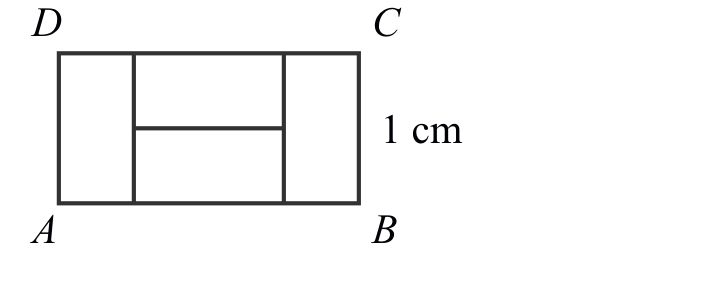
Il rettangolo ABCD in figura è formato accostando 4 rettangoli uguali. Se la lunghezza di BC è 1 cm, quanto è lungo AB ? A) 4 cm B) 3 cm C) 2 cm D) 1 cm E) 0,5 cm
Topic: Geometria piana Abilita: Ragionamento geometrico Area: Geometria Risposta: C Fonte: apri PDF p.3
AB
The ABCD rectangle in the figure is formed by approaching 4 equal rectangles. If the length of BC is 1 cm, how long is AB? A) 4 cm B) 3 cm C) 2 cm D) 1 cm E) 0,5 cm
Answer: C src_kangourou_2015_marzo_benjamin__Q13
Quale sagoma non forma una piramide
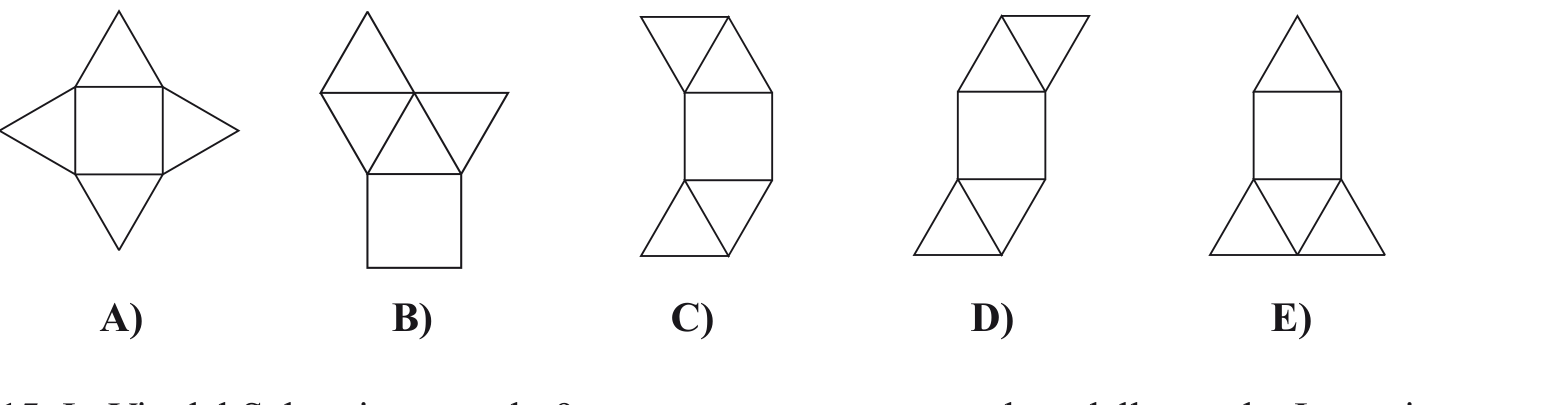
Piegando opportunamente ciascuna di queste sagome di carta lungo i segmenti tracciati all’interno di essa, in un solo caso non si riesce ad ottenere una piramide. Quale? A) B) C) D) E)
Topic: Geometria solida Abilita: Ragionamento geometrico Area: Geometria Risposta: C Fonte: apri PDF p.3
Which shape does not form a pyramid
By folding each of these paper shapes along the segments drawn within it, in one case a pyramid cannot be obtained. What kind? A) B) C) D) E)
Answer: C src_kangourou_2015_marzo_benjamin__Q14
min bottiglie
In Via del Salto ci sono solo 9 case, tutte su uno stesso lato della strada. In ogni casa vive almeno una persona, e il numero totale delle persone che vivono in una coppia di case adiacenti non supera mai 6. Un lattaio deve consegnare una bottiglia di latte per ogni persona che abita in Via del Salto. Qual è il numero minimo di bottiglie che deve mettere sul furgone per essere sicuro di averne abbastanza? A) 23
B) 25
C) 27
D) 28
E) 29
Topic: Combinatoria Metodo: Principio di estremalita Abilita: Casework accurato Area: Combinatoria, Logica e Probabilita Risposta: E Fonte: apri PDF p.3
min bottles
There’s only nine houses on Via del Salto, all on the same side of the road. At least one person lives in each house, and the total number of people living in a pair of adjacent houses never exceeds 6. A milkman must deliver one bottle of milk for every person living in Via del Salto. What’s the minimum number of bottles you have to put on the truck to make sure you have enough? A) 23
B) 25
C) 27
D) 28
E) 29
Answer: E src_kangourou_2015_marzo_benjamin__Q15
Somma anni e eta di Lucia e mamma
Sia Lucia che la sua mamma sono nate in Gennaio. Oggi, 19 Marzo 2015, Lucia somma l’anno di nascita della mamma con l’età della mamma e poi somma al risultato il proprio anno di nascita e la propria età. Che numero ottiene? A) 4028 B) 4029 C) 4030 D) 4031 E) 4032 A B C D 1 cm
Topic: Algebra Abilita: Manipolazione algebrica Area: Algebra e Analisi Risposta: C Fonte: apri PDF p.3
Summary of age and age of Lucia and mother
Both Lucia and her mother were born in January. Today, March 19, 2015, Lucia adds the year of her mother’s birth to her mother’s age and then adds her year of birth and her age to the result. What’s your number? A) 4028 B) 4029 C) 4030 D) 4031 E) 4032 A B C D 1 cm
Answer: C src_kangourou_2015_marzo_benjamin__Q16
perimetro possibile
L’area di un rettangolo è 12 cm2 e le lunghezze (in cm) dei suoi lati sono numeri interi. Quale, tra i valori seguenti, può essere la lunghezza del perimetro del rettan golo? A) 20 cm B) 26 cm C) 28 cm D) 32 cm E) 48 cm
Topic: Teoria dei Numeri Abilita: Casework accurato Area: Aritmetica e Teoria dei Numeri Risposta: B Fonte: apri PDF p.4
perimeter possible
The area of a rectangle is 12 cm2 and the lengths (in cm) of its sides are integers. Which of the following values can be the length of the perimeter of the rectangle? A) 20 cm B) 26 cm C) 28 cm D) 32 cm E) 48 cm
Answer: B src_kangourou_2015_marzo_benjamin__Q17
colore x
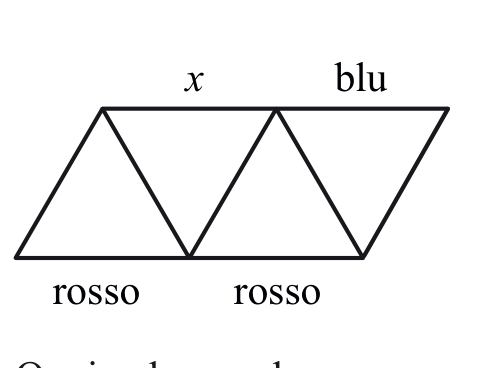
Si deve colorare ognuno dei 9 segmenti in figura scegliendo tra i colori rosso, verde e blu e facendo in modo che, in ciascun triangolo, i 3 lati abbiano colori diversi. Come vedi, in figura sono già stati assegnati i colori a tre segmenti. Di che colore può essere il segmento segnato con x ? A) Solo blu. B) Solo verde. C) Solo rosso. D) Ogni colore va bene.
E) Nessun colore va bene.
Topic: Combinatoria, Logica, giochi, strategie Metodo: Analisi per casi Abilita: Casework accurato Area: Combinatoria, Logica e Probabilita Risposta: C Fonte: apri PDF p.4
color x
Each of the nine segments in the figure must be coloured by choosing between the colours red, green and blue and making sure that, in each triangle, the three sides have different colours. As you can see, three segments have already been assigned colours in the figure. What color can the segment marked with x be ? A) Only blue. B) Only green. C) Only red. D) Any color is fine. E) No color is right.
Answer: C src_kangourou_2015_marzo_benjamin__Q18
quanti frutti per mela e pera stesso colore
In una stanza completamente buia, Simona prende a caso della frutta da un cesto che contiene 3 mele verdi, 5 mele gialle, 7 pere verdi e 2 pere gialle. Quanti frutti deve prendere Simona per essere sicura di avere almeno una mela e una pera dello stesso colore?
A) 9B) 10
C) 11
D) 12
E) 13
Topic: Combinatoria Metodo: Principio dei cassetti Abilita: Casework accurato Area: Combinatoria, Logica e Probabilita Risposta: E Fonte: apri PDF p.4
how many fruits per apple and pear of the same colour
In a completely dark room, Simona randomly picks up the fruit from a basket containing 3 green apples, 5 yellow apples, 7 green pears and 2 yellow pears. How many fruits does Simona need to take to make sure she has at least an apple and a pear of the same color? A) 9
B) 10
C) 11
D) 12
E) 13
Answer: E src_kangourou_2015_marzo_benjamin__Q19
min mosse per raggiungere A
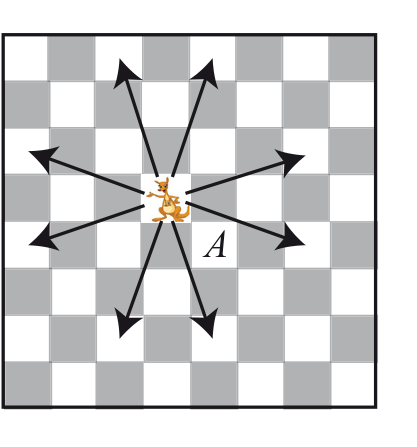
In una nuova versione del gioco degli scacchi esi ste anche un pezzo chiamato “Kang”. Le mosse che “Kang” può fare sono solo due: spostarsi di 3 caselle in verticale e di una 1 in orizzontale, oppure di 3 caselle in orizzontale e di una 1 in verticale, come mostrato in figura. Qual è il numero minimo di mosse che permette a “Kang” di passare dalla casella attuale a quella indi cata con A? A) 2
B) 3
C) 4
D) 5
E) 6 I quesiti dal N. 21 al N. 30 valgono 5 punti ciascuno
Topic: Combinatoria, Logica, giochi, strategie Abilita: Conteggio sistematico Area: Combinatoria, Logica e Probabilita Risposta: B Fonte: apri PDF p.4
min moves to A
In a new version of the game of chess there is also a piece called Kang. The moves that Kang can make are only two: move 3 boxes vertically and 1 horizontally, or 3 boxes horizontally and 1 vertically, as shown in the figure. What is the minimum number of moves that will allow Kang to move from the current box to the one with A? A) 2
B) 3
C) 4
D) 5
E) 6 Questions from N. 21 al N. 30 is worth 5 points each.
Answer: B src_kangourou_2015_marzo_benjamin__Q20
cifra X
Nella somma qui indicata, lettere uguali rappresentano la stessa cifra, e lettere diverse cifre diverse. Quale cifra è rappresentata dalla lettera X ? A) 2 B) 3 C) 4 D) 5 E) 6
Topic: Teoria dei Numeri Metodo: Analisi per casi Abilita: Casework accurato Area: Aritmetica e Teoria dei Numeri Risposta: E Fonte: apri PDF p.4
*number X *
In the sum shown here, the same letters represent the same number, and different letters represent different numbers. What number is represented by the letter X ? A) 2 B) 3 C) 4 D) 5 E) 6
Answer: E src_kangourou_2015_marzo_benjamin__Q21
quanto speso
Giovanna ha comprato 3 giocattoli. Per il primo ha pagato 1 euro più della metà dei soldi che aveva. Aggiungendo 2 euro a metà dei soldi che le erano rimasti ha com prato il secondo giocattolo e aggiungendo 3 euro alla metà di quello che le era rimasto dopo aver acquistato i primi due giocattoli ha comprato il terzo. In questo modo ha speso tutti i soldi che aveva. Quanti euro ha speso in tutto? A) 34
B) 36
C) 45
D) 65
E) 100 rosso rosso blu x A X
XY Y
Z Z Z
Topic: Algebra Metodo: Ragionamento all’indietro Abilita: Manipolazione algebrica Area: Algebra e Analisi Risposta: A Fonte: apri PDF p.4
*how much *
Joan bought three toys. For the first one, he paid a euro more than half of what he had. She bought the second toy by adding 2 euros to half of her remaining money and by adding 3 euros to half of what she had left after buying the first two toys she bought the third. That’s how he spent all his money. How many euros did you spend on everything? A) 34
B) 36
C) 45
D) 65
E) 100 red red blue x A X + X + Y Y ------------- Z Z Z
Answer: A src_kangourou_2015_marzo_benjamin__Q22
quale eliminare
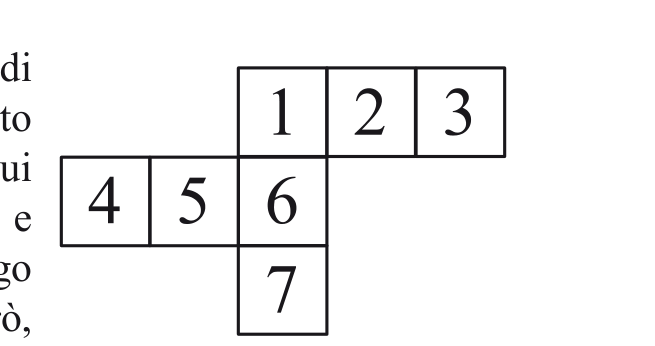
Voglio rivestire di carta una scatola a forma di cubo, senza sovrapposizioni. Per questo ho disegnato su un foglio di carta e ritagliato la figura che vedi qui a fianco (composta da quadrati tutti uguali tra loro e uguali alle facce della scatola), che poi piegherò lungo ciascun lato comune a due quadrati. Per errore, però, ho disegnato 7 quadrati invece di 6. Devo quindi eli minarne uno, ma voglio che il foglio di carta non si spezzi in due e in particolare che non ci sia alcun quadrato unito solo per un vertice ad un altro. Quale quadrato posso eliminare? A) Solo il 4. B) Solo il 7. C) Solo il 3 o il 4. D) Solo il 3 o il 7. E) Il 3, il 4 o il 7.
Topic: Geometria solida Abilita: Ragionamento geometrico Area: Geometria Risposta: D Fonte: apri PDF p.5
which should be deleted
I want to cover a cube-shaped box with paper, no overlapping. So I drew on a piece of paper and cut out the figure you see here next to it (composed of squares all equal to each other and equal to the sides of the box), which I’ll then fold along each side of the box into two squares. But by mistake, I drew 7 squares instead of 6. I must therefore remove one, but I want the paper not to break in two and in particular that there is no square connected only by one vertex to another. Which square can I delete? A) Only four. B) Only 7. C) Only 3 or 4. D) Only 3 or 7. E) Il 3, il 4 o il 7.
Answer: D src_kangourou_2015_marzo_benjamin__Q23
numero scritto
Aster deve indovinare un numero intero scritto da Laura. Laura dice che non ricor da bene come lo ha ottenuto: sa che è partita da 100, poi ha moltiplicato per 2 o per 3, ha aggiunto 1 o 2 e infine ha diviso per 3 o per 4. Qual è il numero scritto da Laura? A) 50
B) 51
C) 67
D) 68 E) Le informazioni non sono sufficienti per determinarlo.
Topic: Teoria dei Numeri Metodo: Analisi per casi Abilita: Casework accurato Area: Aritmetica e Teoria dei Numeri Risposta: C Fonte: apri PDF p.5
written number
Aster must guess a whole number written by Laura. Laura says she doesn’t remember how she got it: she knows she started from 100, then multiplied by 2 or by 3, added 1 or 2 and finally divided by 3 or by 4. What’s the number Laura wrote? A) 50
B) 51
C) 67
D) 68 E) The information is not sufficient to determine this.
Answer: C src_kangourou_2015_marzo_benjamin__Q24
max BD-AC
ABCD è un numero di 4 cifre; le cifre A, B, C e D sono in ordine crescente da sinistra a destra. Considera i due numeri BD e AC: qual è il massimo valore possibile della differenza BD - AC ? A) 86
B) 61
C) 56
D) 50
E) 16
Topic: Teoria dei Numeri Metodo: Principio di estremalita Abilita: Casework accurato Area: Aritmetica e Teoria dei Numeri Risposta: B Fonte: apri PDF p.5
This is the maximum BD-AC *
ABCD is a 4-digit number; the digits A, B, C and D are in increasing order from left to right. Consider the two numbers BD and AC: what is the maximum possible value of the difference BD-AC ? A) 86
B) 61
C) 56
D) 50
E) 16
Answer: B src_kangourou_2015_marzo_benjamin__Q25
vertice F
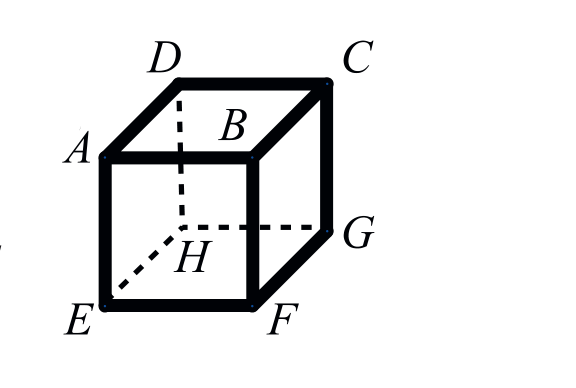
Maria scrive un numero su ogni faccia del cubo in figura. Poi attribuisce ad ogni vertice del cubo la somma dei numeri scritti sulle 3 facce che contengono quel vertice (ad esempio, per il vertice B somma i numeri sulle facce BCDA, BAEF e BFGC). I numeri che Maria ottiene per i vertici C, D ed E sono rispettivamente 14, 16 e 24. Che numero ottiene per il vertice F ? A) 15
B) 19
C) 22
D) 24
E) 26
Topic: Algebra, Geometria solida Metodo: manipolazione algebrica Abilita: Ragionamento geometrico Area: Algebra e Analisi, Geometria Risposta: C Fonte: apri PDF p.5
*top F *
Mary writes a number on each side of the cube in the figure. It then assigns to each vertex of the cube the sum of the numbers written on the 3 faces containing that vertex (e.g., for vertex B it sums the numbers on the faces BCDA, BAEF and BFGC). The numbers that Mary gets for the vertices C, D and E are 14, 16 and 24 respectively. What number do you get for the F-summit ? A) 15
B) 19
C) 22
D) 24
E) 26
Answer: C src_kangourou_2015_marzo_benjamin__Q26
Treno 12 carrozze, scompartimenti per carrozza
Un treno ha 12 carrozze, ciascuna divisa in uno stesso numero di scompartimenti. Michele viaggia sulla terza carrozza, e, contando a partire dal primo dopo il locomoto re, si trova nel 18-simo scompartimento. Sofia siede nella settima carrozza e, sempre contando a partire dal locomotore, il suo scompartimento è il 50-simo. Quanti scompartimenti ci sono in ogni carrozza?
A) 9B) 8
C) 7
D) 6
E) 12
Topic: Teoria dei Numeri Abilita: traduzione del testo Area: Aritmetica e Teoria dei Numeri Risposta: B Fonte: apri PDF p.5
Train 12 carriages, compartments for each carriage
A train has 12 carriages, each divided into the same number of compartments. Michele is travelling on the third carriage and, counting from the first after the locomotive, is in the 18th compartment. Sofia sits in the seventh carriage and, counting from the locomotive, her compartment is the 50th. How many compartments are there in each carriage? A) 9
B) 8
C) 7
D) 6
E) 12
Answer: B src_kangourou_2015_marzo_benjamin__Q27
Modi di mettere 3 canguri in 7 caselle non adiacenti

In quanti modi diversi si possono mettere i tre canguri nelle 7 caselle, non più di uno per casella, se non vogliamo avere 2 canguri in caselle adiacenti? A) 7
B) 8
C) 9
D) 10
E) 11
Topic: Combinatoria Metodo: Conteggio combinatorio Abilita: Conteggio sistematico Area: Combinatoria, Logica e Probabilita Risposta: D Fonte: apri PDF p.6
How to place 3 kangaroos in 7 boxes not adjacent
How many different ways can you put the three kangaroos in seven boxes, no more than one per box, if you don’t want to have two kangaroos in adjacent boxes? A) 7
B) 8
C) 9
D) 10
E) 11
Answer: D src_kangourou_2015_marzo_benjamin__Q28
quella mancante
Alberto ha segnato quattro punti distinti su una retta e ora, per ogni coppia di punti, misura la loro distanza. Dei sei numeri diversi fra loro che ottiene, cinque sono (elen cati in ordine crescente): 2, 3, 11, 12, 14. Quello mancante è minore di 14. Qual è? A) 1
B) 5
C) 6
D) 9
E) Potrebbe essere 1 oppure 9.
Topic: Combinatoria Metodo: Analisi per casi Abilita: Casework accurato Area: Combinatoria, Logica e Probabilita Risposta: E Fonte: apri PDF p.6
the missing one
Alberto scored four distinct points on a straight line and now, for each pair of points, he measures their distance. Of the six different numbers he gets, five are (in increasing order): 2, 3, 11, 12, 14. The missing one is under 14. What is it? A) 1
B) 5
C) 6
D) 9 E) It could be 1 or 9.
Answer: E src_kangourou_2015_marzo_benjamin__Q29
cubetti con rosso e blu
Brando ha usato dei cubetti di lato 1 cm per costruire un cubo di lato 4 cm. Ha poi dipinto di rosso 3 facce del cubo grande e di blu le altre 3. Quando ha finito, si è accorto che nessuno dei cubetti piccoli aveva tre facce rosse. Quanti sono i cubetti che hanno sia facce rosse sia facce blu? A) 0
B) 8
C) 12
D) 24
E) 32
STRINGA BENJAMIN 2015
Topic: Geometria solida Metodo: Conteggio combinatorio Abilita: Ragionamento geometrico Area: Geometria Risposta: D Fonte: apri PDF p.6
- cube with red and blue *
Brando used 1cm side cubes to build a 4cm side cube. He then painted three faces of the large cube red and the other three blue. When he finished, he noticed that none of the little cubes had three red faces. How many cubes have both red and blue faces? A) 0
B) 8
C) 12
D) 24
E) 32
I’m going to take a look.
Answer: D src_kangourou_2015_marzo_benjamin__Q30