quale rappresentazione
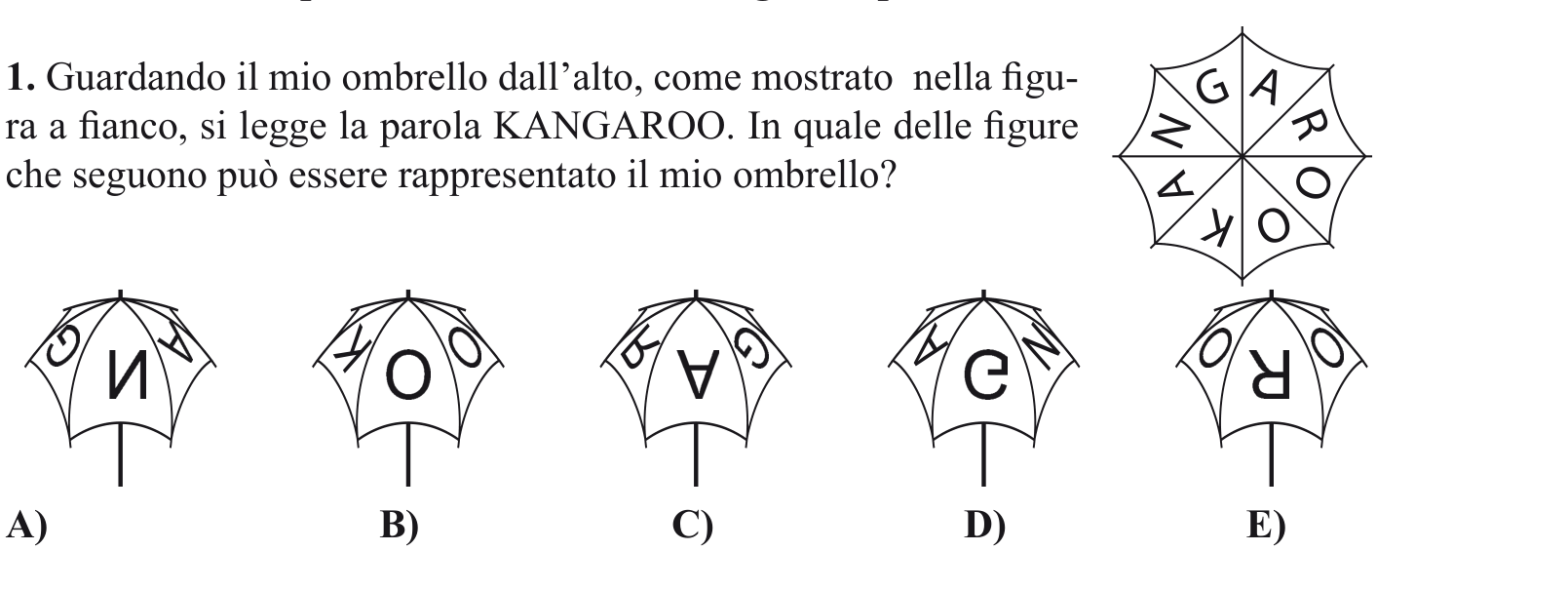
Guardando il mio ombrello dall’alto, come mostrato nella figu ra a fianco, si legge la parola KANGAROO. In quale delle figure che seguono può essere rappresentato il mio ombrello?
A)
    B)
    C)
    D)
   E)
Topic: Logica, giochi, strategie Abilita: Ragionamento geometrico Area: Combinatoria, Logica e Probabilita Risposta: B Fonte: apri PDF p.1
- which representation*
Looking at my umbrella from above, as shown in the figure next to it, you read the word KANGAROO. Which of the following figures may represent my umbrella?
A)
B) C) D) E)
Answer: B src_kangourou_2015_marzo_cadet__Q01
lato maggiore
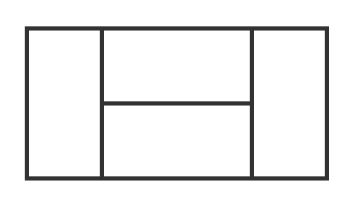
Quattro rettangoli identici, accostati come mostra la figura, formano un rettangolo grande. Se il lato minore del rettango lo grande è lungo 10 cm, quanto è lungo il suo lato maggiore? A) 10 cm B) 20 cm C) 30 cm D) 40 cm E) 50 cm
Topic: Geometria piana Abilita: Ragionamento geometrico Area: Geometria Risposta: B Fonte: apri PDF p.1
major side
Four identical rectangles, joined together as shown in the figure, form a large rectangle. If the smaller side of the large rectangle is 10 cm long, how long is its larger side? A) 10 cm B) 20 cm C) 30 cm D) 40 cm E) 50 cm
Answer: B src_kangourou_2015_marzo_cadet__Q02
Numero piu vicino a 2,015 x 510,2
Quale dei seguenti numeri è più vicino al prodotto 2,015 x 510,2? A) 0,1 B) 1
C) 10 D) 100 E) 1000
Topic: Teoria dei Numeri Abilita: Stima e approssimazione Area: Aritmetica e Teoria dei Numeri Risposta: E Fonte: apri PDF p.1
*Number closest to 2,015 x 510.2 *
Which of the following numbers is closest to the product 2,015 x 510,2? A) 0,1 B) 1
C) 10 D) 100 E) 1000
Answer: E src_kangourou_2015_marzo_cadet__Q03
somme facce opposte
\begin{document}
\begin{tikzpicture}[scale=1.1]
  % Cube net: cross shape with faces labeled 1-6
  % Bottom cell (4): (1,-1)-(2,0)
  \draw (1,-1) rectangle (2,0);
  \node at (1.5,-0.5) {$4$};
  % Main row of 4 faces
  \draw (0,0) rectangle (4,1);
  \draw (1,0) -- (1,1);
  \draw (2,0) -- (2,1);
  \draw (3,0) -- (3,1);
  \node at (0.5,0.5) {$1$};
  \node at (1.5,0.5) {$5$};
  \node at (2.5,0.5) {$3$};
  \node at (3.5,0.5) {$6$};
  % Top cell (2): (1,1)-(2,2)
  \draw (1,1) rectangle (2,2);
  \node at (1.5,1.5) {$2$};
\end{tikzpicture}
\end{document}
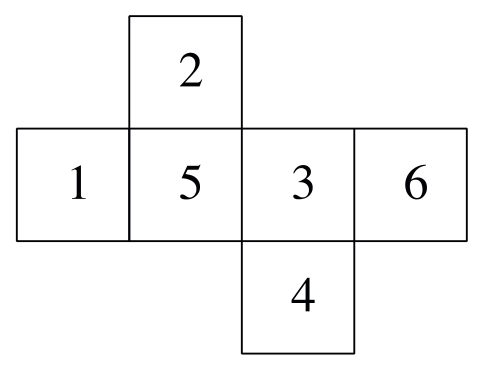
La figura mostra lo sviluppo piano di un cubo con facce numerate. Per ogni coppia di facce opposte, Paolo ha sommato i due numeri che compaiono sulle facce: quali sono le tre somme che ha ottenuto? A) 6, 7, 8 B) 6, 6, 9 C) 5, 6, 10 D) 4, 7, 10 E) 4, 6, 11
Topic: Geometria solida Abilita: Ragionamento geometrico Area: Geometria Risposta: E Fonte: apri PDF p.1
sum of opposite faces
\begin{document}
\begin{tikzpicture}[scale=1.1]
  % Cube net: cross shape with faces labeled 1-6
  % Bottom cell (4): (1,-1)-(2,0)
  \draw (1,-1) rectangle (2,0);
  \node at (1.5,-0.5) {$4$};
  % Main row of 4 faces
  \draw (0,0) rectangle (4,1);
  \draw (1,0) -- (1,1);
  \draw (2,0) -- (2,1);
  \draw (3,0) -- (3,1);
  \node at (0.5,0.5) {$1$};
  \node at (1.5,0.5) {$5$};
  \node at (2.5,0.5) {$3$};
  \node at (3.5,0.5) {$6$};
  % Top cell (2): (1,1)-(2,2)
  \draw (1,1) rectangle (2,2);
  \node at (1.5,1.5) {$2$};
\end{tikzpicture}
\end{document}
The figure shows the plane development of a cube with numbered faces. For each pair of opposite faces, Paul added the two numbers that appear on the faces. What are the three sums he got? A) 6, 7, 8 B) 6, 6, 9 C) 5, 6, 10 D) 4, 7, 10 E) 4, 6, 11
Answer: E src_kangourou_2015_marzo_cadet__Q04
Quale dei numeri non e intero
Quale dei seguenti numeri non è un intero? A)
B)
C)
D)
E) 2011
12012
22013
32014
42015
5
Topic: Teoria dei Numeri Abilita: Manipolazione algebrica Area: Aritmetica e Teoria dei Numeri Risposta: D Fonte: apri PDF p.1
Which of the numbers is not an integer
Which of the following numbers is not an integer? A)
B)
C)
D)
E) 2011 -------- 1 2012 -------- 2 2013 -------- 3 2014 -------- 4 2015 -------- 5
Answer: D src_kangourou_2015_marzo_cadet__Q05
lato
Un triangolo ha lati di lunghezza 6, 10 e 11. Qual è la lunghezza del lato di un trian golo equilatero con lo stesso perimetro? A) 18
B) 11
C) 10 D) 9
E) 6
Topic: Geometria piana Abilita: Manipolazione algebrica Area: Geometria Risposta: D Fonte: apri PDF p.2
The manufacturer shall provide the manufacturer with the following information:
A triangle has sides of length 6, 10 and 11. What is the length of the side of an equilateral triangle with the same perimeter? A) 18
B) 11
C) 10 D) 9
E) 6
Answer: D src_kangourou_2015_marzo_cadet__Q06
spigolo che coincide con UV
\begin{document}
\begin{tikzpicture}[scale=1.0]
  % Triangular prism net: 3 rectangles in a row + top triangle + bottom triangle
  \def\rw{1.5}
  \def\rh{2.0}
  % Three rectangles
  \draw[thick] (0,0) rectangle (\rw,\rh);
  \draw[thick] (\rw,0) rectangle (2*\rw,\rh);
  \draw[thick] (2*\rw,0) rectangle (3*\rw,\rh);
  % Top triangle (apex V)
  \draw[thick] (\rw,\rh) -- (1.5*\rw,\rh+1.2) -- (2*\rw,\rh);
  % Bottom triangle (apex R)
  \draw[thick] (\rw,0) -- (1.5*\rw,-1.2) -- (2*\rw,0);
  % Vertex labels
  \node[above] at (1.5*\rw,\rh+1.2) {$V$};
  \node[above left] at (0,\rh) {$Y$};
  \node[above] at (\rw,\rh) {$X$};
  \node[above] at (2*\rw,\rh) {$W$};
  \node[above right] at (3*\rw,\rh) {$U$};
  \node[below left] at (0,0) {$P$};
  \node[below] at (\rw,0) {$Q$};
  \node[below] at (2*\rw,0) {$S$};
  \node[below right] at (3*\rw,0) {$T$};
  \node[below] at (1.5*\rw,-1.2) {$R$};
\end{tikzpicture}
\end{document}
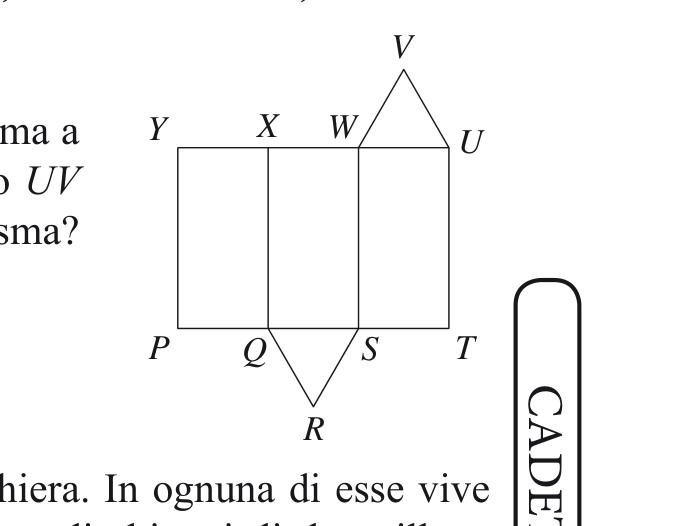
In figura è rappresentato lo sviluppo piano di un prisma a base triangolare. Quale spigolo coincide con lo spigolo UV quando si piega lo sviluppo in modo da ricostruire il prisma? A) WV B) XW C) XY
D) QR E) RS
Topic: Geometria solida Abilita: Ragionamento geometrico Area: Geometria Risposta: C Fonte: apri PDF p.2
- mirror that coincides with UV*
\begin{document}
\begin{tikzpicture}[scale=1.0]
  % Triangular prism net: 3 rectangles in a row + top triangle + bottom triangle
  \def\rw{1.5}
  \def\rh{2.0}
  % Three rectangles
  \draw[thick] (0,0) rectangle (\rw,\rh);
  \draw[thick] (\rw,0) rectangle (2*\rw,\rh);
  \draw[thick] (2*\rw,0) rectangle (3*\rw,\rh);
  % Top triangle (apex V)
  \draw[thick] (\rw,\rh) -- (1.5*\rw,\rh+1.2) -- (2*\rw,\rh);
  % Bottom triangle (apex R)
  \draw[thick] (\rw,0) -- (1.5*\rw,-1.2) -- (2*\rw,0);
  % Vertex labels
  \node[above] at (1.5*\rw,\rh+1.2) {$V$};
  \node[above left] at (0,\rh) {$Y$};
  \node[above] at (\rw,\rh) {$X$};
  \node[above] at (2*\rw,\rh) {$W$};
  \node[above right] at (3*\rw,\rh) {$U$};
  \node[below left] at (0,0) {$P$};
  \node[below] at (\rw,0) {$Q$};
  \node[below] at (2*\rw,0) {$S$};
  \node[below right] at (3*\rw,0) {$T$};
  \node[below] at (1.5*\rw,-1.2) {$R$};
\end{tikzpicture}
\end{document}
The figure shows the plane development of a triangular-based prism. Which beam matches the UV beam when you fold the development to reconstruct the prism? A) WV B) XW C) XY
D) QR E) RS
Answer: C src_kangourou_2015_marzo_cadet__Q07
max abitanti
Via del Salto è composta da 9 villette allineate a schiera. In ognuna di esse vive almeno una persona e ogni volta che si conta il numero di abitanti di due villette confinanti non si supera 6. Allora il numero di persone che possono abitare in via del Salto è al massimo A) 23. B) 25. C) 27. D) 29. E) 31.
Topic: Combinatoria Metodo: Principio di estremalita Abilita: Casework accurato Area: Combinatoria, Logica e Probabilita Risposta: D Fonte: apri PDF p.2
max inhabitants
Via del Salto is made up of 9 villas lined up in a row. At least one person lives in each of them, and the number of inhabitants of two neighbouring villas does not exceed 6. Then the number of people who can live on the Via del Salto is at most A) 23. B) 25. C) 27. D) 29. E) 31.
Answer: D src_kangourou_2015_marzo_cadet__Q08
quale regione
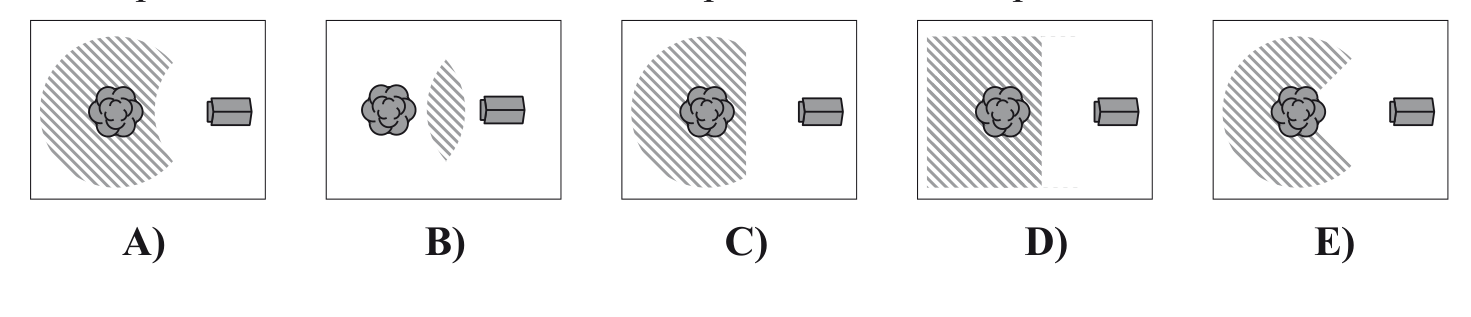
Quando lo scoiattolo Ciop scende al suolo, non si allontana mai più di 5 metri dal tronco del suo albero. Inoltre si tiene sempre a una distanza di almeno 5 metri dalla casetta del cane. Nelle figure che seguono il rettangolo rappresenta la casetta del cane e l’esagono curvilineo l’albero: in quale di esse la regione ombreggiata descrive in modo plausibile la zona del suolo in cui può muoversi Ciop? A) B) C) D) E)
Topic: Geometria piana, Logica, giochi, strategie Abilita: Ragionamento geometrico Area: Combinatoria, Logica e Probabilita, Geometria Risposta: A Fonte: apri PDF p.2
what region
When the Ciop squirrel descends to the ground, it never moves more than five meters from its tree trunk. In addition, it is always kept at a distance of at least five metres from the dog’s cage. In the figures following the rectangle he represents the dog’s cottage and the tree’s curvilinear axis: in which of them does the shaded region plausibly describe the area of the ground where Ciop can move? A) B) C) D) E)
Answer: A src_kangourou_2015_marzo_cadet__Q09
giri in 5 secondi
Un ciclista pedala alla velocità di 5 metri al secondo. La circonferenza di ogni ruota della sua bici è lunga 250 cm. In 5 secondi quanti giri completi fa ogni ruota? A) 2
B) 5
C) 10 D) 20 E) 25 I quesiti dal N. 11 al N. 20 valgono 4 punti ciascuno
Topic: Teoria dei Numeri Abilita: traduzione del testo Area: Aritmetica e Teoria dei Numeri Risposta: C Fonte: apri PDF p.2
spins in 5 seconds
A cyclist pedals at a speed of five meters per second. The circumference of each wheel of his bicycle is 250 cm long. In five seconds, how many complete spins does each wheel make? A) 2
B) 5
(c) 10 D) 20 E) 25 Questions from N. 11 al N. 20 is worth 4 points each.
Answer: C src_kangourou_2015_marzo_cadet__Q10
no due nati stesso giorno/mese: numero allievi
In una classe non ci sono due ragazzi nati nello stesso giorno della settimana né due ragazze nate nello stesso mese. Se si aggiungesse alla classe un altro ragazzo o un’altra ragazza almeno una delle due condizioni non sarebbe più vera. Da quanti allievi è composta la classe? A) 18 B) 19
C) 20 D) 24 E) 25 P Q R S T U V W X Y
Topic: Combinatoria Abilita: Casework accurato Area: Combinatoria, Logica e Probabilita Risposta: B Fonte: apri PDF p.2
not two born on the same day/month: number of pupils
In a classroom, there are no two boys born on the same day of the week or two girls born in the same month. If another boy or girl were added to the class, at least one of the two conditions would no longer be true. How many students is the class? A) 18 B) 19
C) 20 D) 24 E) 25 P Q R S T U V W X Y
Answer: B src_kangourou_2015_marzo_cadet__Q11
area regione grigia
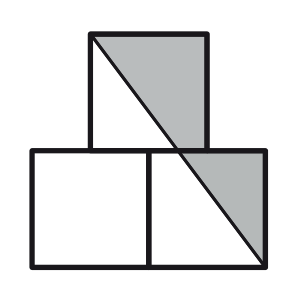
La figura rappresenta tre quadrati di lato 1 ed è simmetrica rispetto alla retta individuata dal lato comune ai due quadrati infe riori. Qual è l’area della regione grigia? A)
B)
C) 1
D)
E)
Topic: Geometria piana Abilita: Ragionamento geometrico Area: Geometria Risposta: C Fonte: apri PDF p.3
grey region area
The figure represents three squares on side 1 and is symmetrical to the straight line found on the common side of the two lower squares. What is the grey area? A)
B)
C) 1
D)
E)
Answer: C src_kangourou_2015_marzo_cadet__Q12
min numero di +
Si vuole sostituire con un + o con un – ogni asterisco nell’uguaglianza 2 * 0 * 1 * 5 * 2 * 0 * 1 * 5 * 2 * 0 * 1 * 5 = 0 in modo che l’uguaglianza risulti corretta. Qual è il minimo numero di asterischi che deve essere sostituita con il segno +? A) 1
B) 2
C) 3
D) 4
E) 5
Topic: Teoria dei Numeri Metodo: Analisi per casi Abilita: Casework accurato Area: Aritmetica e Teoria dei Numeri Risposta: B Fonte: apri PDF p.3
min number of +
Each asterisk in the equation 2 * 0 * 1 * 5 * 2 * 0 * 1 * 5 * 2 * 0 * 1 * 5 = 0 is to be replaced by a + or a so that the equation is corrected. What is the minimum number of asterisks to be replaced by the + sign? A) 1
B) 2
C) 3
D) 4
E) 5
Answer: B src_kangourou_2015_marzo_cadet__Q13
di quanti cm sale il livello piscina
Durante un temporale sono caduti 15 litri d’acqua per metro quadrato. Di quanti centimetri è salito il livello dell’acqua di una piscina all’aperto? A) 150 B) 0,15 C) 15
D) 1,5 E) dipende dalle dimensioni della piscina
Topic: Teoria dei Numeri Abilita: traduzione del testo Area: Aritmetica e Teoria dei Numeri Risposta: D Fonte: apri PDF p.3
- of how many cm rises the pool level*
During a storm, 15 litres of water per square meter fell. How many centimetres has the water level of an outdoor pool risen? A) 150 B) 0,15 C) 15
D) 1.5 E) depends on the size of the pool
Answer: D src_kangourou_2015_marzo_cadet__Q14
foglie possibili
Un cespuglio ha 10 rami; su ogni ramo ci sono 5 foglie oppure 2 foglie e 1 fiore. Quale, tra i seguenti, può essere il numero di foglie del cespuglio? A) 45
B) 39
C) 37 D) 31 E) nessuno dei numeri indicati da A) a D)
Topic: Algebra Abilita: traduzione del testo Area: Algebra e Analisi Risposta: E Fonte: apri PDF p.3
*possible sheets *
A bush has 10 branches; on each branch there are 5 leaves or 2 leaves and 1 flower. Which of the following can be the number of leaves in the bush? A) 45
B) 39
(C) 37 D) 31 E) None of the numbers in A to D
Answer: E src_kangourou_2015_marzo_cadet__Q15
media bocciati
Il punteggio medio degli studenti che hanno sostenuto una prova di matematica è 6. Ha superato la prova esattamente il 60% degli studenti e il loro punteggio medio è 8. Qual è il punteggio medio degli studenti che non hanno superato la prova? A) 1
B) 2
C) 3
D) 4
E) 5
Topic: Algebra Abilita: Manipolazione algebrica Area: Algebra e Analisi Risposta: C Fonte: apri PDF p.3
failed media
The average score of students who passed a math test is 6. He passed the test exactly 60 percent of the students, and their average score is 8. What is the average score of the students who did not pass the test? A) 1
B) 2
C) 3
D) 4
E) 5
Answer: C src_kangourou_2015_marzo_cadet__Q16
area quadrato
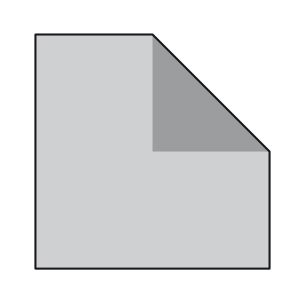
\begin{document}
\begin{tikzpicture}[scale=2]
  % Square with top-right corner folded to the center
  % Square: (0,0),(1,0),(1,1),(0,1); Center: (0.5,0.5)
  % Fold crease: from (0.5,1) to (1,0.5)
  % Pentagon vertices: (0,0),(1,0),(1,0.5),(0.5,1),(0,1)
  % Folded triangle (darker): (0.5,0.5),(0.5,1),(1,0.5)
  \fill[gray!25] (0,0) -- (1,0) -- (1,0.5) -- (0.5,1) -- (0,1) -- cycle;
  \fill[gray!55] (0.5,0.5) -- (0.5,1) -- (1,0.5) -- cycle;
  \draw[thick] (0,0) -- (1,0) -- (1,0.5) -- (0.5,1) -- (0,1) -- cycle;
  \draw[thick] (0.5,1) -- (1,0.5);
  \draw[thick] (0.5,0.5) -- (0.5,1);
  \draw[thick] (0.5,0.5) -- (1,0.5);
\end{tikzpicture}
\end{document}
Uno degli angoli di un quadrato è stato piegato in modo da portare il vertice al centro del quadrato. L’area del pentagono ir regolare così formato (vedi figura) e quella del quadrato sono interi consecutivi. Qual è l’area del quadrato? A) 2
B) 4
C) 8
D) 16
E) 32
Topic: Geometria piana Abilita: Ragionamento geometrico Area: Geometria Risposta: C Fonte: apri PDF p.3
square area
\begin{document}
\begin{tikzpicture}[scale=2]
  % Square with top-right corner folded to the center
  % Square: (0,0),(1,0),(1,1),(0,1); Center: (0.5,0.5)
  % Fold crease: from (0.5,1) to (1,0.5)
  % Pentagon vertices: (0,0),(1,0),(1,0.5),(0.5,1),(0,1)
  % Folded triangle (darker): (0.5,0.5),(0.5,1),(1,0.5)
  \fill[gray!25] (0,0) -- (1,0) -- (1,0.5) -- (0.5,1) -- (0,1) -- cycle;
  \fill[gray!55] (0.5,0.5) -- (0.5,1) -- (1,0.5) -- cycle;
  \draw[thick] (0,0) -- (1,0) -- (1,0.5) -- (0.5,1) -- (0,1) -- cycle;
  \draw[thick] (0.5,1) -- (1,0.5);
  \draw[thick] (0.5,0.5) -- (0.5,1);
  \draw[thick] (0.5,0.5) -- (1,0.5);
\end{tikzpicture}
\end{document}
One of the corners of a square has been folded so as to bring the top to the center of the square. The area of the irregular pentagon thus formed (see figure) and that of the square are consecutive integers. What’s the area of the square? A) 2
B) 4
C) 8
D) 16
E) 32
Answer: C src_kangourou_2015_marzo_cadet__Q17
perimetro
Rita somma le lunghezze di tre lati di un rettangolo e ottiene 44 cm, Marta somma le lunghezze di altri tre lati dello stesso rettangolo e ottiene 40 cm. Quanti centimetri misura il perimetro del rettangolo? A) 42
B) 56
C) 64
D) 84
E) 112 3---- 4 7---- 8 5---- 4 3---- 2
Topic: Geometria piana, Algebra Abilita: Manipolazione algebrica Area: Algebra e Analisi, Geometria Risposta: B Fonte: apri PDF p.3
*perimeter *
Rita sums the lengths of three sides of a rectangle and gets 44 cm, Marta sums the lengths of three other sides of the same rectangle and gets 40 cm. How many centimeters does the perimeter of the rectangle measure? A) 42
B) 56
C) 64
D) 84
E) 112 3---- 4 7---- 8 5---- 4 3---- 2
Answer: B src_kangourou_2015_marzo_cadet__Q18
colore x
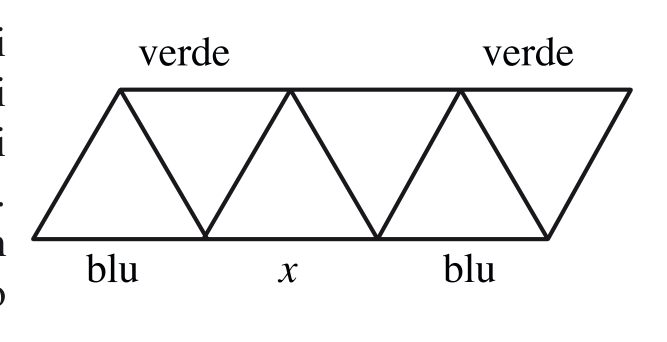
\begin{document}
\begin{tikzpicture}[scale=1.4, font=\small]
  % Row of 4 triangles (alternating up/down) forming a band
  % Outer boundary: parallelogram-like with zigzag interior
  % Bottom points: (0,0),(1,0),(2,0),(3,0),(4,0)
  % Top points: (0.5,1),(1.5,1),(2.5,1),(3.5,1)
  \draw[thick] (0,0) -- (0.5,1) -- (1.5,1) -- (2.5,1) -- (3.5,1) -- (4,0) -- (0,0);
  \draw[thick] (0.5,1) -- (1,0) -- (1.5,1);
  \draw[thick] (1.5,1) -- (2,0) -- (2.5,1);
  \draw[thick] (2.5,1) -- (3,0) -- (3.5,1);
  \draw[thick] (1,0) -- (3,0);
  \node[above left] at (0.25,0.5) {verde};
  \node[above right] at (3.75,0.5) {verde};
  \node[below] at (0.5,0) {blu};
  \node[below] at (2,0) {$x$};
  \node[below] at (3.5,0) {blu};
\end{tikzpicture}
\end{document}
La figura indica come sono stati colorati alcuni dei segmenti unitari che delimitano i triangoli di un disegno. Luigi vuole colorare i restanti segmenti unitari in rosso o verde o blu. Ogni triangolo deve avere un lato di ciascun colore. Come può colorare il segmento segnato con x? A) Solo di verde. B) Solo di rosso. C) Solo di blu. D) Indifferentemente di rosso o di blu. E) Non può realizzare il progetto.
Topic: Combinatoria, Logica, giochi, strategie Metodo: Analisi per casi Abilita: Casework accurato Area: Combinatoria, Logica e Probabilita Risposta: A Fonte: apri PDF p.4
color x
\begin{document}
\begin{tikzpicture}[scale=1.4, font=\small]
  % Row of 4 triangles (alternating up/down) forming a band
  % Outer boundary: parallelogram-like with zigzag interior
  % Bottom points: (0,0),(1,0),(2,0),(3,0),(4,0)
  % Top points: (0.5,1),(1.5,1),(2.5,1),(3.5,1)
  \draw[thick] (0,0) -- (0.5,1) -- (1.5,1) -- (2.5,1) -- (3.5,1) -- (4,0) -- (0,0);
  \draw[thick] (0.5,1) -- (1,0) -- (1.5,1);
  \draw[thick] (1.5,1) -- (2,0) -- (2.5,1);
  \draw[thick] (2.5,1) -- (3,0) -- (3.5,1);
  \draw[thick] (1,0) -- (3,0);
  \node[above left] at (0.25,0.5) {verde};
  \node[above right] at (3.75,0.5) {verde};
  \node[below] at (0.5,0) {blu};
  \node[below] at (2,0) {$x$};
  \node[below] at (3.5,0) {blu};
\end{tikzpicture}
\end{document}
The figure shows how some of the unit segments that delimit the triangles of a drawing have been colored. Luigi wants to colour the remaining unit segments in red or green or blue. Each triangle must have a side of each color. How can you color the x-marked segment? A) Only green. B) Only red. C) Only blue. D) Whether red or blue. E) It cannot carry out the project.
Answer: A src_kangourou_2015_marzo_cadet__Q19
quanti veri
Irene ha chiesto a cinque dei suoi allievi quanti di loro cinque avessero studiato ieri. Aldo ha risposto nessuno, Bianca ha risposto uno solo, Clelia ha risposto esatta mente 2, Diana ha risposto esattamente 3, Enrico ha risposto esattamente 4. Irene sa che gli studenti che non hanno studiato hanno mentito e che quelli che hanno studiato hanno detto la verità. Quanti di questi studenti hanno studiato ieri? A) 0
B) 1
C) 2
D) 3
E) 4 I quesiti dal N. 21 al N. 30 valgono 5 punti ciascuno
Topic: Logica, giochi, strategie Metodo: Analisi per casi Abilita: Casework accurato Area: Combinatoria, Logica e Probabilita Risposta: B Fonte: apri PDF p.4
*how many true *
Irene asked five of her students how many of them had studied yesterday. Aldo answered no one, Bianca answered only one, Clelia answered exactly two, Diana answered exactly three, Henry answered exactly four. Irene knows that students who didn’t study lied and those who studied told the truth. How many of these students studied yesterday? A) 0
B) 1
C) 2
D) 3
E) 4 Questions from N. 21 al N. 30 is worth 5 points each.
Answer: B src_kangourou_2015_marzo_cadet__Q20
numero centrale
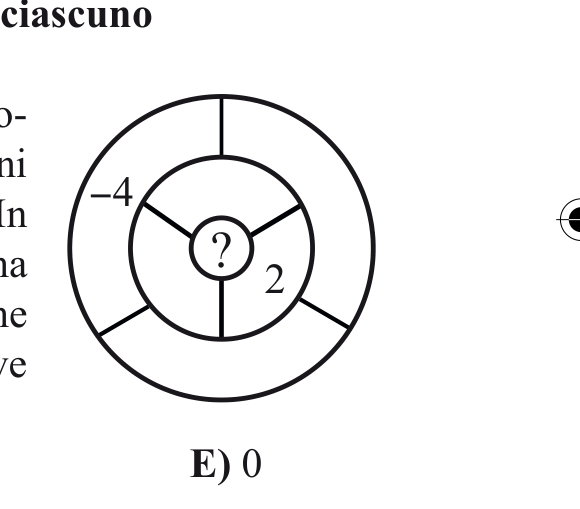
\begin{document}
\begin{tikzpicture}[scale=1.5]
  % Seven regions: center circle + inner ring (3 sectors) + outer ring (3 sectors)
  % Three radial lines at 90, 210, 330 degrees (120 degree spacing)
  \def\ri{0.45}
  \def\ro{1.2}
  \draw[thick] (0,0) circle (\ro);
  \draw[thick] (0,0) circle (\ri);
  \draw[thick] (0,0) -- (0,\ro);
  \draw[thick] (0,0) -- ({-\ro*0.866},{-\ro*0.5});
  \draw[thick] (0,0) -- ({\ro*0.866},{-\ro*0.5});
  \node at (0,0) {$?$};
  \node at (-0.75,0) {$-4$};
  \node at (0.62,-0.35) {$2$};
\end{tikzpicture}
\end{document}
Rosa vuole scrivere un numero in ciascuna delle sette regio ni limitate rappresentate nel disegno. Diciamo che due regioni sono confinanti se hanno una parte del contorno in comune. In ogni regione il numero che viene scritto deve essere la somma di tutti i numeri scritti nelle regioni con essa confinanti. Come si vede, Rosa ha già inserito due numeri. Quale numero deve scrivere nella regione centrale? A) 1
B) - 2
C) 6
D) - 4 E) 0
Topic: Algebra, Logica, giochi, strategie Metodo: manipolazione algebrica Abilita: Manipolazione algebrica Area: Algebra e Analisi, Combinatoria, Logica e Probabilita Risposta: C Fonte: apri PDF p.4
central number
\begin{document}
\begin{tikzpicture}[scale=1.5]
  % Seven regions: center circle + inner ring (3 sectors) + outer ring (3 sectors)
  % Three radial lines at 90, 210, 330 degrees (120 degree spacing)
  \def\ri{0.45}
  \def\ro{1.2}
  \draw[thick] (0,0) circle (\ro);
  \draw[thick] (0,0) circle (\ri);
  \draw[thick] (0,0) -- (0,\ro);
  \draw[thick] (0,0) -- ({-\ro*0.866},{-\ro*0.5});
  \draw[thick] (0,0) -- ({\ro*0.866},{-\ro*0.5});
  \node at (0,0) {$?$};
  \node at (-0.75,0) {$-4$};
  \node at (0.62,-0.35) {$2$};
\end{tikzpicture}
\end{document}
Rosa wants to write a number in each of the seven limited regions in the drawing. Let’s say two regions are neighbouring if they have a part of the contour in common. In each region the number to be written must be the sum of all the numbers written in the regions adjacent to it. As you can see, Rosa has already entered two numbers. What number should you write in the central region? A) 1
B) - 2
C) 6
D) - 4 E) 0
Answer: C src_kangourou_2015_marzo_cadet__Q21
numero maggiore
Su cinque cartoncini sono scritti cinque numeri interi positivi (non necessaria mente tutti diversi). Per ogni coppia di cartoncini, Pietro calcola la somma dei numeri scritti su di essi. I totali diversi che ottiene sono solo tre: 57, 70 e 83. Qual è il numero maggiore tra quelli scritti sui cartoncini? A) 35 B) 42
C) 48 D) 53 E) 82
Topic: Algebra Metodo: manipolazione algebrica Abilita: Casework accurato Area: Algebra e Analisi Risposta: C Fonte: apri PDF p.4
major number
Five positive integers (not necessarily all different) are inscribed on five cards. For each pair of cards, Peter calculates the sum of the numbers written on them. The different totals you get are only three: 57, 70 and 83. What’s the biggest number on the cards? A) 35 B) 42
C) 48 D) 53 E) 82
Answer: C src_kangourou_2015_marzo_cadet__Q22
segmento piu lungo
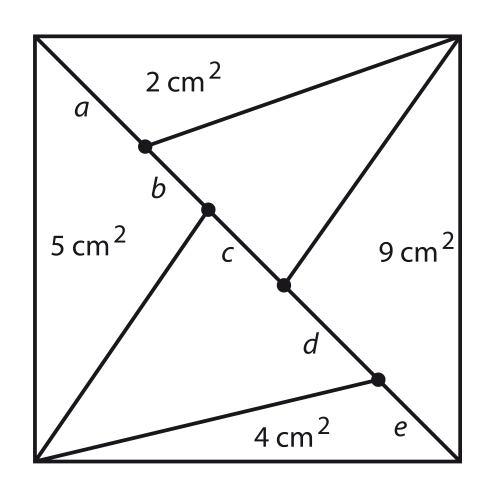
Un quadrato di area 30 cm2 è diviso a metà da una diagonale e poi in triangoli, come indicato in figura, dove sono segnate anche le aree di alcuni dei triangoli. Quale dei cinque segmenti in cui è ripartita la diagonale è il più lungo? A) a
B) b
C) c
D) d
E) e −4 2 ?
Topic: Geometria piana Abilita: Ragionamento geometrico Area: Geometria Risposta: D Fonte: apri PDF p.4
longer segment
A square of 30 cm2 is divided in half by a diagonal and then into triangles, as shown in the figure, where the areas of some of the triangles are also marked. Which of the five segments of the diagonal is the longest? A) a
B) b
C) c
D) d
E) e −4 2 ?
Answer: D src_kangourou_2015_marzo_cadet__Q23
2 leggeri 25%, 3 pesanti 60%: quanti canguri
In un gruppo di canguri il peso dei due canguri più leggeri rappresenta il 25% del peso totale del gruppo. Il peso dei tre canguri più pesanti rappresenta il 60% del peso totale. Quanti canguri ci sono nel gruppo? A) 6
B) 7
C) 8
D) 15
E) 20
Topic: Teoria dei Numeri Abilita: traduzione del testo Area: Aritmetica e Teoria dei Numeri Risposta: A Fonte: apri PDF p.5
2 light 25%, 3 heavy 60%: how many kangaroos
In a group of kangaroos the weight of the two lighter kangaroos accounts for 25% of the total weight of the group. The weight of the three heaviest kangaroos accounts for 60% of the total weight. How many kangaroos are in the group? A) 6
B) 7
C) 8
D) 15
E) 20
Answer: A src_kangourou_2015_marzo_cadet__Q24
min pezzi per traliccio cubico
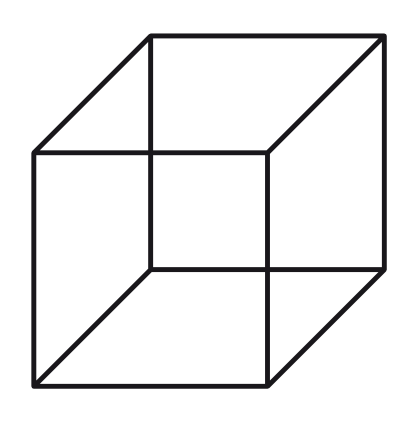
Carlo ha sette pezzi di fil di ferro lunghi rispettivamente 1 cm, 2 cm, 3 cm, 4 cm, 5 cm, 6 cm e 7 cm. Ne vuole usare alcuni per costruire, senza tagliarli né sovrapporli (neppure parzialmente), un traliccio cubico con spigoli di lunghezza
Topic: Geometria solida Abilita: Casework accurato Area: Geometria Risposta: D Fonte: apri PDF p.5
*min pieces per cubic inch *
Charles has seven pieces of iron wire each 1 cm, 2 cm, 3 cm, 4 cm, 5 cm, 6 cm and 7 cm long. He wants to use some of them to build, without cutting them or overlaying them (not even partially), a cubic lattice with long spines
Answer: D src_kangourou_2015_marzo_cadet__Q25
angolo PQR
- In un trapezio PQRS i lati PQ e SR sono paralleli e PQ è il triplo di SR; inoltre SR ^ e SP sono uguali e l’angolo RSP misura 120° (120 gradi). Qual è la misura dell’angolo ^ PQR? A) 15° B) 22°30’ C) 25° D) 30° E) 45°
Topic: Geometria piana Metodo: Tecniche trigonometriche Abilita: Ragionamento geometrico Area: Geometria Risposta: D Fonte: apri PDF p.5
This is the sum of the values of the values of the samples.
- In a PQRS trapezoid the sides PQ and SR are parallel and PQ is triple SR; furthermore SR ^ and SP are equal and the angle RSP measures 120° (120 degrees). What is the dimension of the angle ^ PQR? A) 15° B) 22°30’ C) 25° D) 30° E) 45°
Answer: D src_kangourou_2015_marzo_cadet__Q26
quella mancante
- Alberto ha disegnato cinque punti su una retta e ora, per ogni coppia di punti, mi sura la loro distanza. Dei dieci numeri diversi fra loro che ottiene, nove sono (elencati in ordine crescente): 2, 5, 6, 8, 9, 15, 17, 20 e 22. Quello mancante è minore di 22. Qual è? A)10 B) 11 C) 12 D) 13 E) 14
Topic: Combinatoria Metodo: Analisi per casi Abilita: Casework accurato Area: Combinatoria, Logica e Probabilita Risposta: E Fonte: apri PDF p.5
the missing one
- Alberto drew five points on a straight line and now, for each pair of points, the distance between them. Of the ten different numbers you get, nine are (listed in ascending order): 2, 5, 6, 8, 9, 15, 17, 20, and 22. The missing one is under 22. What is it? A)10 B) 11 C) 12 D) 13 E) 14
Answer: E src_kangourou_2015_marzo_cadet__Q27
max tentativi
- Ieri ho annotato il numero di telefono del mio amico Luca. Il numero che ho scritto ha sei cifre ma ricordo che Luca mi ha detto che il numero è di sette cifre. Non so quale cifra ho dimenticato di annotare, né in che posizione potesse essere. Se voglio riuscire a telefonare a Luca, quanti tentativi dovrò fare al massimo? (Nota: un nume ro di telefono può iniziare con qualunque cifra, incluso 0.) A) 55 B) 60 C) 64 D) 70 E) 80
Topic: Combinatoria Metodo: Conteggio combinatorio Abilita: Conteggio sistematico Area: Combinatoria, Logica e Probabilita Risposta: C Fonte: apri PDF p.5
max attempts
- Yesterday, I wrote down the phone number of my friend Luca. The number I wrote has six digits, but I remember Luke telling me the number is seven digits. I don’t know what number I forgot to write down, or what position it might be in. If I’m going to be able to call Luca, how many attempts do I have to make? (Note: a telephone number may start with any number, including 0.) A) 55 B) 60 C) 64 D) 70 E) 80
Answer: C src_kangourou_2015_marzo_cadet__Q28
resto piu grande
- Maria divide 2015 successivamente per 1, 2, 3 e così via fino a 1000 compreso. Scrive i resti di ciascuna divisione: qual è il resto più grande che trova? A) 15 B) 215 C) 671 D) 1007 E) Nessuno dei precedenti.
Topic: Teoria dei Numeri Metodo: congruenze Abilita: Stima e approssimazione Area: Aritmetica e Teoria dei Numeri Risposta: C Fonte: apri PDF p.5
greater remainder
- Maria divides 2015 subsequently by 1, 2, 3 and so on up to 1000 inclusive. He writes down the remains of each division. What’s the largest remainder he finds? A) 15 B) 215 C) 671 D) 1007 E) None of the above.
Answer: C src_kangourou_2015_marzo_cadet__Q29
quanti modi
- Intendo colorare ciascun numero intero positivo in base alle seguenti tre regole: Ogni numero è o rosso o blu. La somma di due numeri rossi diversi è sempre un numero rosso. La somma di due numeri blu diversi è sempre un numero blu. In quanti modi diversi posso realizzare queste colorazioni? A) 0 B) 2 C) 4 D) 6
Topic: Teoria dei Numeri, Logica, giochi, strategie Metodo: Analisi per casi Abilita: generalizzazione Area: Aritmetica e Teoria dei Numeri, Combinatoria, Logica e Probabilita Risposta: D Fonte: apri PDF p.5
how many ways
- I mean, color each positive integer according to the following three rules: Each number is either red or blue. The sum of two different red numbers is always a red number. The sum of two different blue numbers is always a blue number. How many different ways can I make these colors? A) 0 B) 2 C) 4 D) 6
Answer: D src_kangourou_2015_marzo_cadet__Q30