quale risultato
Uno dei numeri seguenti è il risultato del prodotto 21.649 × 513.239. Quale? A) 11.111.111
B) 111.111.111
C) 1.111.111.111
D) 11.111.111.111 E) 111.111.111.111
Topic: Teoria dei Numeri Abilita: Stima e approssimazione Area: Aritmetica e Teoria dei Numeri Risposta: D Fonte: apri PDF p.1
- which result*
One of the following numbers is the result of product 21.649 × 513.239. What kind? A) 11.111.111
B) 111.111.111
C) 1.111.111.111 D) 11.111.111.111 E) 111.111.111.111
Answer: D src_kangourou_2015_marzo_junior__Q01
quanti fazzoletti
Su una lunga corda in giardino sono stesi ad asciugare alcuni fazzoletti e alcune paia di calze. Fra due fazzoletti c’è sempre almeno una calza e fra due calze c’è sem pre almeno un fazzoletto. I capi stesi ad asciugare sono 29. Quanti sono i fazzoletti? A) 11
B) 13
C) 14
D) 15
E) I dati non sono sufficienti per rispondere
Topic: Combinatoria Abilita: Casework accurato Area: Combinatoria, Logica e Probabilita Risposta: D Fonte: apri PDF p.1
how many handkerchiefs
On a long rope in the garden they lie to dry some handkerchiefs and some pairs of socks. Between two handkerchiefs there is always at least one sock and between two socks there is at least one handkerchief. There are 29 drying heads. How many handkerchiefs are there? A) 11
B) 13
C) 14
D) 15 E) The data are insufficient to answer
Answer: D src_kangourou_2015_marzo_junior__Q02
valore
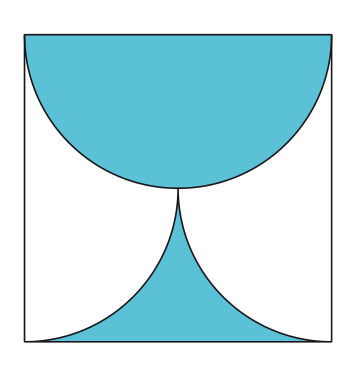
\begin{document}
\begin{tikzpicture}
  % Square side 2, shaded region bounded by semicircle and two quarter-circles
  % Semicircle: center (1,2), radius 1, sweeping downward from (0,2) to (2,2)
  % Quarter circle at bottom-left (0,0): radius 1, from (1,0) to (0,1)
  % Quarter circle at bottom-right (2,0): radius 1, from (2,1) to (1,0)
  \fill[gray!50] (0,2) arc[start angle=180, end angle=0, radius=1] -- cycle;
  \fill[gray!50] (1,0) arc[start angle=0, end angle=90, radius=1] -- cycle;
  \fill[gray!50] (2,1) arc[start angle=90, end angle=180, radius=1] -- cycle;
  \draw[thick] (0,0) rectangle (2,2);
  \draw[thick] (0,2) arc[start angle=180, end angle=0, radius=1];
  \draw[thick] (1,0) arc[start angle=0, end angle=90, radius=1];
  \draw[thick] (2,1) arc[start angle=90, end angle=180, radius=1];
\end{tikzpicture}
\end{document}
La regione all’interno del quadrato che in figura appare om breggiata è delimitata da una semicirconferenza e da due quarti di circonferenza. Il quadrato ha area 1. Quanto vale l’area della regione ombreggiata? A) π/8 B) 1/2
C) π/2 D) 1/4 E) π/4
Topic: Geometria piana Metodo: Sfruttamento della simmetria Abilita: Ragionamento geometrico Area: Geometria Risposta: B Fonte: apri PDF p.1
The value of the underlying asset shall be reported in accordance with the following column:
\begin{document}
\begin{tikzpicture}
  % Square side 2, shaded region bounded by semicircle and two quarter-circles
  % Semicircle: center (1,2), radius 1, sweeping downward from (0,2) to (2,2)
  % Quarter circle at bottom-left (0,0): radius 1, from (1,0) to (0,1)
  % Quarter circle at bottom-right (2,0): radius 1, from (2,1) to (1,0)
  \fill[gray!50] (0,2) arc[start angle=180, end angle=0, radius=1] -- cycle;
  \fill[gray!50] (1,0) arc[start angle=0, end angle=90, radius=1] -- cycle;
  \fill[gray!50] (2,1) arc[start angle=90, end angle=180, radius=1] -- cycle;
  \draw[thick] (0,0) rectangle (2,2);
  \draw[thick] (0,2) arc[start angle=180, end angle=0, radius=1];
  \draw[thick] (1,0) arc[start angle=0, end angle=90, radius=1];
  \draw[thick] (2,1) arc[start angle=90, end angle=180, radius=1];
\end{tikzpicture}
\end{document}
The region within the square shown in the figure is bounded by a semicircle and two quarters of its circumference. The square has area 1. How much is the shaded area worth? A) π/8 B) 1/2
C) π/2 D) 1/4 E) π/4
Answer: B src_kangourou_2015_marzo_junior__Q03
quanti in piu Anna
Anna, Betta e Cinzia hanno comprato una scatola che contiene 30 biscotti: per pa garla, Anna ha fornito 80 centesimi, Betta ne ha forniti 50 e Cinzia 20. Ciascuna ha quindi preso 10 biscotti. Se si fossero spartite i biscotti proporzionalmente a quanto ciascuna ha pagato, quanti ne avrebbe dovuti avere in più Anna? A) 10
B) 9
C) 8
D) 7
E) 6
Topic: Teoria dei Numeri Abilita: traduzione del testo Area: Aritmetica e Teoria dei Numeri Risposta: E Fonte: apri PDF p.1
- how many more Anna*
Anna, Betta and Cinzia purchased a box containing 30 cookies: for the price, Anna provided 80 cents, Betta 50 cents and Cinzia 20. So they each took 10 cookies. If the cookies were divided in proportion to what each one paid, how many more would Anna have had? A) 10
B) 9
C) 8
D) 7
E) 6
Answer: E src_kangourou_2015_marzo_junior__Q04
>=5m dal muro, <=5m dall’albero

Molti anni fa un pirata ha sotterrato un tesoro in un giardino e ora vuole recuperar lo. Il giardino è rimasto com’era, ma lui ricorda solo di avere sotterrato il tesoro ad almeno 5 metri dal muretto di recinzione e a non più di 5 metri da un vecchio albero. Quale delle seguenti figure indica la regione in cui il pirata dovrebbe cercare il tesoro?
Topic: Geometria piana Abilita: Ragionamento geometrico Area: Geometria Risposta: B Fonte: apri PDF p.1
>=5m from the wall, <=5m from the tree
Many years ago a pirate buried a treasure in a garden and now he wants it back. The garden remained intact, but he only remembers having buried the treasure at least five metres from the fence wall and no more than five metres from an old tree. Which of the following figures indicates the region where the pirate should look for the treasure?
Answer: B src_kangourou_2015_marzo_junior__Q05
Cifra delle unita di 2015^2+2015^0+2015^1+2015^5
Quale è la cifra delle unità del numero 20152 + 20150 + 20151 + 20155? A) 1
B) 5
C) 6
D) 7
E) 9 A) B) C) D) E)
Topic: Teoria dei Numeri Metodo: congruenze Abilita: Riconoscimento di pattern Area: Aritmetica e Teoria dei Numeri Risposta: C Fonte: apri PDF p.1
This is the total amount of unemployment over the period considered.
What is the number of units of the number 20152 + 20150 + 20151 + 20155? A) 1
B) 5
C) 6
D) 7
E) 9 A) B) C) D) E)
Answer: C src_kangourou_2015_marzo_junior__Q06
italiano
Una classe è formata da 33 studenti, a ciascuno dei quali piace studiare almeno una delle materie fra Italiano e Matematica. A esattamente 3 di essi piace studiare sia Ma tematica sia Italiano, e gli studenti a cui piace studiare solo Italiano sono il doppio di quelli a cui piace studiare solo Matematica. A quanti studenti piace studiare Italiano? A) 15
B) 18
C) 20
D) 22
E) 23
Topic: Combinatoria Abilita: traduzione del testo Area: Combinatoria, Logica e Probabilita Risposta: E Fonte: apri PDF p.2
The Commission shall adopt delegated acts in accordance with the opinion of the European Parliament and of the Council.
A class is made up of 33 students, each of whom likes to study at least one of the subjects between Italian and Mathematics. Exactly three of them like to study both Mathematics and Italian, and students who like to study only Italian are twice as many as those who like to study only Mathematics. How many students like to study Italian? A) 15
B) 18
C) 20
D) 22
E) 23
Answer: E src_kangourou_2015_marzo_junior__Q07
Quale non e quadrato ne cubo perfetto
Quale dei seguenti numeri interi non è un quadrato perfetto e non è un cubo per fetto? A) 613
B) 512
C) 411
D) 310
E) 29
Topic: Teoria dei Numeri Abilita: Manipolazione algebrica Area: Aritmetica e Teoria dei Numeri Risposta: A Fonte: apri PDF p.2
Which is not square on the perfect cube
Which of the following integers is not a perfect square and is not a perfect cube? A) 613
B) 512
C) 411
D) 310
E) 29
Answer: A src_kangourou_2015_marzo_junior__Q08
giorni totali
Luigi ha comprato 100 candele. Consuma una candela al giorno ma, non appena ha i resti di sette candele, riesce a fabbricarne una nuova. Per quanti giorni gli basteranno le candele che ha comprato? A) 112 B) 114 C) 115 D) 116 E) 117
Topic: Teoria dei Numeri Metodo: Ricorsione Abilita: traduzione del testo Area: Aritmetica e Teoria dei Numeri Risposta: D Fonte: apri PDF p.2
Total days **
Louis bought 100 candles. He consumes one candle a day, but as soon as he has the remains of seven candles, he manages to make a new one. How many days will the candles he bought last? A) 112 B) 114 C) 115 D) 116 E) 117
Answer: D src_kangourou_2015_marzo_junior__Q09
lista valori
Se n è il numero di angoli retti di un generico pentagono convesso, quale fra le seguenti è la lista completa dei valori che n può assumere? (Un poligono si dice con vesso se, ogni volta che contiene due punti, contiene tutto il segmento che li ha come estremi.) A) 1, 2, 3. B) 0, 1, 2, 3, 4. C) 0, 1, 2, 3. D) 0, 1, 2. E) 1, 2. I quesiti dal N. 11 al N. 20 valgono 4 punti ciascuno
Topic: Geometria piana Metodo: Analisi per casi Abilita: Casework accurato Area: Geometria Risposta: C Fonte: apri PDF p.2
The following table shows the values of the values of the values of the values of the values:
If n is the number of right angles of a general convex pentagon, which of the following is the complete list of values that n can assume? (A polygon is said to contain all of the segments that contain two points.) A) 1, 2, 3. B) 0, 1, 2, 3, 4. C) 0, 1, 2, 3. D) 0, 1, 2. E) 1, 2. The questions from N. 11 al N. 20 is worth 4 points each.
Answer: C src_kangourou_2015_marzo_junior__Q10
quante scelte
Stai cercando un numero di tre cifre ABC (A è la cifra delle centinaia, B quella del le decine, C quella delle unità) tali che 1 ≤ A < B < C e la somma dei tre numeri ABC, BCA e CAB sia un numero di tre cifre uguali fra loro (cioè del tipo DDD). Quante sono le tue possibili scelte? A) 3
B) 4
C) 5
D) 6
E) 7
Topic: Teoria dei Numeri Metodo: congruenze, Conteggio combinatorio Abilita: Casework accurato Area: Aritmetica e Teoria dei Numeri Risposta: E Fonte: apri PDF p.2
how many choices
You are looking for a number of three digits ABC (A is the number of hundreds, B is the number of tens, C is the number of units) such that 1 ≤ A < B < C and the sum of the three numbers ABC, BCA and CAB is a number of three digits equal to each other (i.e. of the type DDD). How many choices do you have? A) 3
B) 4
C) 5
D) 6
E) 7
Answer: E src_kangourou_2015_marzo_junior__Q11
percorso minimo
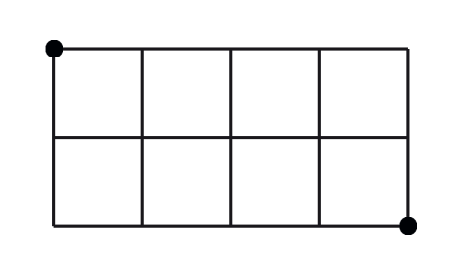
\begin{document}
\begin{tikzpicture}
  % 8 unit squares in a 4x2 grid
  \draw[thick] (0,0) grid (4,2);
  % Mark the two opposite vertices (top-left and bottom-right)
  \filldraw (0,2) circle (3pt);
  \filldraw (4,0) circle (3pt);
\end{tikzpicture}
\end{document}
Il rettangolo in figura è ottenuto accostando 8 quadrati tutti di lato 1. Nel rettangolo ci si può muovere solo lungo i lati o le diagonali dei singoli quadrati. Con questo vincolo, quanto è lungo il percorso più breve che collega due vertici opposti del rettangolo (ad esempio quelli marcati)? A) 2√5 B) √10 + √2 C) 2 + 2√2 D) 4√2 E) 6
Topic: Geometria piana Metodo: Metodo delle coordinate Abilita: Ragionamento geometrico Area: Geometria Risposta: C Fonte: apri PDF p.2
minimum route
\begin{document}
\begin{tikzpicture}
  % 8 unit squares in a 4x2 grid
  \draw[thick] (0,0) grid (4,2);
  % Mark the two opposite vertices (top-left and bottom-right)
  \filldraw (0,2) circle (3pt);
  \filldraw (4,0) circle (3pt);
\end{tikzpicture}
\end{document}
The rectangle in the figure is obtained by approximating 8 squares all on side 1. In a rectangle you can only move along the sides or diagonals of the individual squares. With this constraint, how long is the shortest path connecting two opposite vertices of the rectangle (e.g. those marked)? A) 2√5 B) √10 + √2 C) 2 + 2√2 D) 4√2 E) 6
Answer: C src_kangourou_2015_marzo_junior__Q12
orecchie di Trimi
Ogni abitante di uno strano pianeta ha alcune (eventualmente anche più di due) orecchie. Tre abitanti, Imi, Dimi e Trimi, si incontrano: nessun altro è presente. Imi dice: “Posso vedere 8 orecchie”. Dimi dice: “Io ne posso vedere 7”. Trimi dice: “Che strano! Io ne posso vedere solo 5”. Nessuno di loro può vedere le proprie orecchie, tut ti vedono tutte le orecchie degli altri e tutti dicono la verità. Quante orecchie ha Trimi? A) 2
B) 4
C) 5
D) 6
E) 7
Topic: Logica, giochi, strategie, Algebra Abilita: traduzione del testo Area: Algebra e Analisi, Combinatoria, Logica e Probabilita Risposta: C Fonte: apri PDF p.2
ears of Trimi
Every inhabitant of a strange planet has some (possibly even more than two) ears. Three inhabitants, Imi, Dimi and Trimi, meet; no one else is present. He says, “I can see for eight hours”. Tell me, I can see seven. Trimi says, “How strange! I can only see five. None of them can see their own ears, all of them see the ears of others, and all of them speak the truth. How many ears does Trimi have? A) 2
B) 4
C) 5
D) 6
E) 7
Answer: C src_kangourou_2015_marzo_junior__Q13
altezza h
Un recipiente ha la forma di un prisma rettangolare e la base è un quadrato di lato 10 cm. Nel recipiente viene versata dell’acqua fino all’altezza di h cm; viene quindi immerso un cubetto di pietra di lato 2 cm (che dunque non galleggia e si adagia sul fondo con una delle sue facce). Il cubetto risulta ora circondato dall’acqua e la sua faccia superiore è a pelo d’acqua. Quanto vale h? A) 1,92 B) 1,93 C) 1,90 D) 1,91 E) 1,94
Topic: Geometria solida Abilita: traduzione del testo Area: Geometria Risposta: A Fonte: apri PDF p.3
height h
A container is shaped like a rectangular prism and the base is a square side 10 cm. The water is poured into the container up to a height of 1 cm; a 2 cm side stone cubet is then immersed (which therefore does not float and lies on the bottom with one of its faces). The cube is now surrounded by water and its upper face is water-filled. How much is h worth? A) 1,92 B) 1,93 C) 1,90 D) 1,91 E) 1,94
Answer: A src_kangourou_2015_marzo_junior__Q14
area ombreggiata
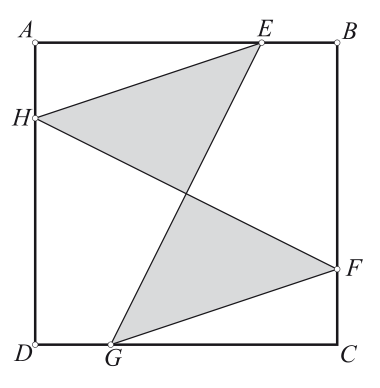
Il quadrato ABCD in figura ha area 80. I punti E, F, G e H stanno ciascuno su un lato del quadrato e i segmenti AE, BF, CG e DH hanno tutti la stessa lunghezza, che è il tri plo di quella del segmento EB. Qual è l’area della regione ombreggiata? A) 20
B) 25
C) 30 D) 35
E) 40
Topic: Geometria piana Metodo: Sfruttamento della simmetria Abilita: Ragionamento geometrico Area: Geometria Risposta: B Fonte: apri PDF p.3
shaded area
The square ABCD in the figure has an area of 80. The points E, F, G and H are each on one side of the square and the segments AE, BF, CG and DH are all the same length, which is three times the length of the EB segment. What is the area of the shaded region? A) 20
B) 25
C) 30 D) 35
E) 40
Answer: B src_kangourou_2015_marzo_junior__Q15
differenza
Oggi è il compleanno di un padre e di suo figlio. Il prodotto delle loro età è 2015. Qual è la differenza fra l’età del padre e quella del figlio? A) 26
B) 29
C) 31
D) 36
E) Un numero diverso dai precedenti.
Topic: Teoria dei Numeri Metodo: manipolazione algebrica Abilita: Casework accurato Area: Aritmetica e Teoria dei Numeri Risposta: E Fonte: apri PDF p.3
This is the difference between the two.
Today is a father and his son’s birthday. The product of their ages is 2015. What is the age difference between the father and the son? A) 26
B) 29
C) 31
D) 36 E) A number different from the previous ones.
Answer: E src_kangourou_2015_marzo_junior__Q16
min n
Il prodotto di n numeri interi positivi consecutivi, ciascuno di due cifre, è divisibi le per 2015. Qual è il valore più piccolo possibile per n ?
A) 3B) 4
C) 6
D) 12
E) 19
Topic: Teoria dei Numeri Metodo: manipolazione algebrica Abilita: Casework accurato Area: Aritmetica e Teoria dei Numeri Risposta: B Fonte: apri PDF p.3
The following table shows the results of the calculations:
The product of n consecutive positive integers, each of two digits, is divided by 2015. What ‘s the smallest possible value for n ? A) 3
B) 4
C) 6
D) 12
E) 19
Answer: B src_kangourou_2015_marzo_junior__Q17
somma cifre di c
Le due soluzioni dell’equazione x2 - 85x + c = 0 sono numeri interi primi. Qual è la somma delle cifre del numero c ? A) 12
B) 13
C) 14
D) 15
E) 21
Topic: Algebra, Teoria dei Numeri Metodo: manipolazione algebrica Abilita: Manipolazione algebrica Area: Algebra e Analisi, Aritmetica e Teoria dei Numeri Risposta: B Fonte: apri PDF p.3
*sum of digits c *
The two solutions to the equation x2 - 85x + c = 0 are prime integers. What is the sum of the digits of the number c ? A) 12
B) 13
C) 14
D) 15
E) 21
Answer: B src_kangourou_2015_marzo_junior__Q18
Interi 3 cifre con cifre adiacenti che differiscono di 3
Quanti numeri interi positivi di tre cifre significative sono tali che, comunque si considerino in ciascuno di essi due cifre adiacenti, esse differiscano di 3? A) 12
B) 14
C) 16
D) 20
E) 27
Topic: Teoria dei Numeri, Combinatoria Metodo: Analisi per casi, Conteggio combinatorio Abilita: Conteggio sistematico Area: Aritmetica e Teoria dei Numeri, Combinatoria, Logica e Probabilita Risposta: D Fonte: apri PDF p.3
Interi 3 digits with adjacent digits that differ by 3
How many positive integers of three significant digits are such that, if two adjacent digits are counted in each of them, they differ by 3? A) 12
B) 14
C) 16
D) 20
E) 27
Answer: D src_kangourou_2015_marzo_junior__Q19
n primo, uno solo di n-2,n+2 primo
L’affermazione “Se n è un numero intero primo, allora uno e uno solo degli interi n - 2 e n + 2 è primo” è falsa. Quale dei seguenti valori di n ne fornisce un controesempio? A) n = 11 B) n = 19 C) n = 21 D) n = 29 E) n = 37 I quesiti dal N. 21 al N. 30 valgono 5 punti ciascuno
Topic: Teoria dei Numeri Abilita: Casework accurato Area: Aritmetica e Teoria dei Numeri Risposta: E Fonte: apri PDF p.4
n first, only one of n-2,n+2 first
The statement If n is a prime integer, then one and only one of the integers n − 2 and n + 2 is prime is false. Which of the following values of n provides a counterexample? A) n = 11 B) n = 19 C) n = 21 D) n = 29 E) n = 37 Questions from N. 21 al N. 30 is worth 5 points each.
Answer: E src_kangourou_2015_marzo_junior__Q20
Numeri 2 cifre come somma di 6 potenze distinte di 2
Quanti numeri di due cifre possono essere rappresentati come somma di esatta mente sei diverse potenze (ad esponente intero non negativo) di 2 (inclusa 20)? A) 0
B) 1
C) 2
D) 3
E) 4
Topic: Teoria dei Numeri Metodo: Conteggio combinatorio Abilita: Casework accurato Area: Aritmetica e Teoria dei Numeri Risposta: C Fonte: apri PDF p.4
Numbers 2 digits as the sum of 6 powers distinct from 2
How many two-digit numbers can be represented as the sum of exactly six different powers (at a nonnegative integer) of 2 (including 20)? A) 0
B) 1
C) 2
D) 3
E) 4
Answer: C src_kangourou_2015_marzo_junior__Q21
allineamenti
Francesca ha tre diversi vocabolari e due diversi atlanti e vuole allinearli tutti su uno scaffale. Se vuole collocare i vocabolari tutti insieme e gli atlanti tutti insieme, tra quanti diversi allineamenti possibili può scegliere? A) 12
B) 24
C) 30
D) 60
E) 120
Topic: Combinatoria Metodo: Conteggio combinatorio Abilita: Conteggio sistematico Area: Combinatoria, Logica e Probabilita Risposta: B Fonte: apri PDF p.4
This is the total amount of allowances that can be allocated to the total allowance.
Francesca has three different vocabularies and two different atlases and wants to align them all on one shelf. If you want to put all the vocabularies together and all the atlantics together, how many different possible alignments can you choose? A) 12
B) 24
C) 30
D) 60
E) 120
Answer: B src_kangourou_2015_marzo_junior__Q22
regione centrale
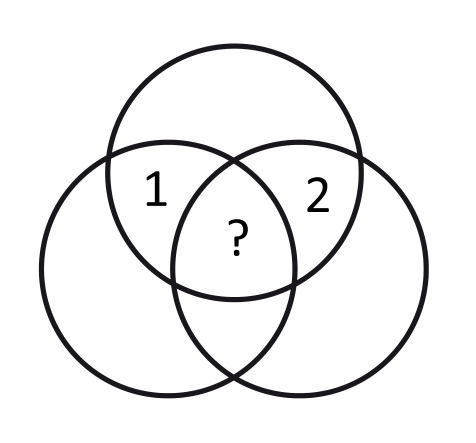
\begin{document}
\begin{tikzpicture}
  % Three circles arranged in a Venn diagram
  % Centers at distance 1.2 from origin at 90, 210, 330 degrees, radius 1.5
  \draw[thick] (90:1.2) circle (1.5);
  \draw[thick] (210:1.2) circle (1.5);
  \draw[thick] (330:1.2) circle (1.5);
  % Label "1" in left petal (overlap of top and bottom-left circles)
  \node at (-0.65,0.3) {$1$};
  % Label "2" in right petal (overlap of top and bottom-right circles)
  \node at (0.65,0.3) {$2$};
  % Label "?" in central region (triple overlap)
  \node at (0,-0.25) {$?$};
\end{tikzpicture}
\end{document}
I tre cerchi in figura individuano sette regioni, ognu na all’interno di almeno uno di essi. In ogni regione va scritto un numero, in modo che sia la somma dei numeri scritti nelle regioni ad essa adiacenti (due regioni sono considerate adiacenti se i loro bordi hanno più di un pun to in comune). In due delle regioni il numero è già stato scritto. Quale numero va scritto nella regione centrale contrassegnata dal punto di domanda? A) 0
B) - 3
C) 3
D) - 6 E) 6
Topic: Algebra, Logica, giochi, strategie Metodo: Ragionamento all’indietro Abilita: Manipolazione algebrica Area: Algebra e Analisi, Combinatoria, Logica e Probabilita Risposta: A Fonte: apri PDF p.4
This appropriation is intended to cover expenditure relating to:
\begin{document}
\begin{tikzpicture}
  % Three circles arranged in a Venn diagram
  % Centers at distance 1.2 from origin at 90, 210, 330 degrees, radius 1.5
  \draw[thick] (90:1.2) circle (1.5);
  \draw[thick] (210:1.2) circle (1.5);
  \draw[thick] (330:1.2) circle (1.5);
  % Label "1" in left petal (overlap of top and bottom-left circles)
  \node at (-0.65,0.3) {$1$};
  % Label "2" in right petal (overlap of top and bottom-right circles)
  \node at (0.65,0.3) {$2$};
  % Label "?" in central region (triple overlap)
  \node at (0,-0.25) {$?$};
\end{tikzpicture}
\end{document}
The three circles in the figure identify seven regions, each within at least one of them. A number must be written in each region, so that it is the sum of the numbers written in the regions adjacent to it (two regions are considered adjacent if their borders have more than one point in common). In two of the regions the number has already been written. What number should be written in the central region marked by the point of application? A) 0
B) - 3
C) 3
D) - 6 E) 6
Answer: A src_kangourou_2015_marzo_junior__Q23
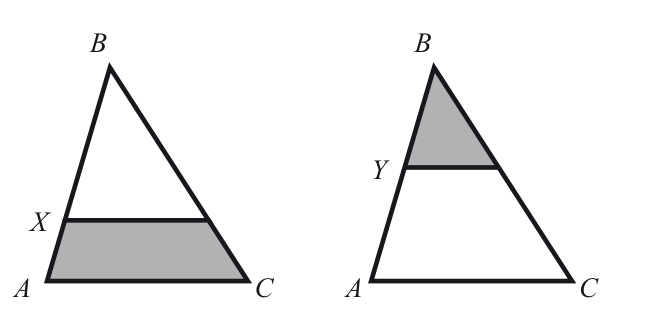
XA=4:1: BY:YA
\begin{document}
\begin{tikzpicture}
  % Left triangle: trapezoid shaded (BX:XA=4:1, so X is 1/5 from A, i.e. 4/5 from B)
  % Triangle ABC: A=(0,0), B=(1.5,3), C=(3,0)
  % X on AB at XA:BX=1:4, so X = A + 1/5*(B-A) = (0.3, 0.6)
  % X' on BC (parallel to AC through X): X' = C + 1/5*(B-C) = (2.7, 0.6)
  % Shaded trapezoid: A, C, X', X
  \begin{scope}[xshift=0cm]
    \fill[gray!40] (0,0) -- (0.3,0.6) -- (2.7,0.6) -- (3,0) -- cycle;
    \draw[thick] (0,0) -- (1.5,3) -- (3,0) -- cycle;
    \draw (0.3,0.6) -- (2.7,0.6);
    \node[below left] at (0,0) {$A$};
    \node[above] at (1.5,3) {$B$};
    \node[below right] at (3,0) {$C$};
    \node[left] at (0.3,0.6) {$X$};
  \end{scope}
  % Right triangle: small triangle at top shaded (Y closer to B)
  % Using an illustrative ratio, say BY:YA = 3:2 (answer D)
  % Y = A + 2/5*(B-A) = (0.6, 1.2), Y' = C + 2/5*(B-C) = (2.4, 1.2)
  \begin{scope}[xshift=4.5cm]
    \fill[gray!40] (0.6,1.2) -- (1.5,3) -- (2.4,1.2) -- cycle;
    \draw[thick] (0,0) -- (1.5,3) -- (3,0) -- cycle;
    \draw (0.6,1.2) -- (2.4,1.2);
    \node[below left] at (0,0) {$A$};
    \node[above] at (1.5,3) {$B$};
    \node[below right] at (3,0) {$C$};
    \node[left] at (0.6,1.2) {$Y$};
  \end{scope}
\end{tikzpicture}
\end{document}
Sul lato AB di un triangolo ABC sono indi viduati due punti X e Y e da ciascuno di essi è tracciato il segmento parallelo al lato AC che va a terminare sul lato BC: la figura evidenzia separatamente le due situazioni. Si sa che le aree delle due regioni ombreggiate così indivi duate (un trapezio e un triangolo) sono uguali e che BX : XA = 4 : 1. Quanto vale BY : YA ? A) 1 : 1 B) 2 : 1 C) 3 : 3 D) 3 : 2 E) 4 : 3
Topic: Geometria piana Metodo: Sfruttamento della simmetria Abilita: Ragionamento geometrico Area: Geometria Risposta: D Fonte: apri PDF p.4
XA=4:1: BY:YA
\begin{document}
\begin{tikzpicture}
  % Left triangle: trapezoid shaded (BX:XA=4:1, so X is 1/5 from A, i.e. 4/5 from B)
  % Triangle ABC: A=(0,0), B=(1.5,3), C=(3,0)
  % X on AB at XA:BX=1:4, so X = A + 1/5*(B-A) = (0.3, 0.6)
  % X' on BC (parallel to AC through X): X' = C + 1/5*(B-C) = (2.7, 0.6)
  % Shaded trapezoid: A, C, X', X
  \begin{scope}[xshift=0cm]
    \fill[gray!40] (0,0) -- (0.3,0.6) -- (2.7,0.6) -- (3,0) -- cycle;
    \draw[thick] (0,0) -- (1.5,3) -- (3,0) -- cycle;
    \draw (0.3,0.6) -- (2.7,0.6);
    \node[below left] at (0,0) {$A$};
    \node[above] at (1.5,3) {$B$};
    \node[below right] at (3,0) {$C$};
    \node[left] at (0.3,0.6) {$X$};
  \end{scope}
  % Right triangle: small triangle at top shaded (Y closer to B)
  % Using an illustrative ratio, say BY:YA = 3:2 (answer D)
  % Y = A + 2/5*(B-A) = (0.6, 1.2), Y' = C + 2/5*(B-C) = (2.4, 1.2)
  \begin{scope}[xshift=4.5cm]
    \fill[gray!40] (0.6,1.2) -- (1.5,3) -- (2.4,1.2) -- cycle;
    \draw[thick] (0,0) -- (1.5,3) -- (3,0) -- cycle;
    \draw (0.6,1.2) -- (2.4,1.2);
    \node[below left] at (0,0) {$A$};
    \node[above] at (1.5,3) {$B$};
    \node[below right] at (3,0) {$C$};
    \node[left] at (0.6,1.2) {$Y$};
  \end{scope}
\end{tikzpicture}
\end{document}
On the AB side of an ABC triangle, two points X and Y are indicated, and the parallel segment to the AC side, which ends on the BC side, is drawn from each of them. It is known that the areas of the two shaded regions thus separated (a trapezoid and a triangle) are equal and that BX: XA = 4: 1. How much is BY: Ya ? A) 1 : 1 B) 2 : 1 C) 3 : 3 D) 3 : 2 E) 4 : 3
Answer: D src_kangourou_2015_marzo_junior__Q24
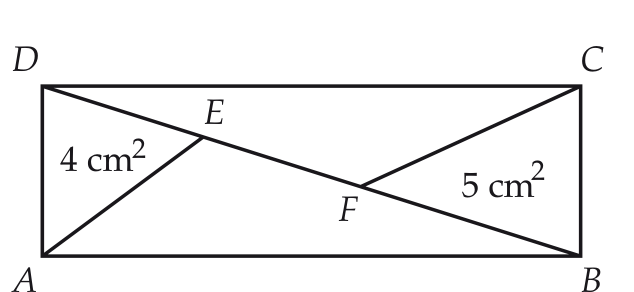
segmento piu corto
\begin{document}
\begin{tikzpicture}
  % Rectangle ABCD: A=(0,0), B=(5,0), C=(5,2), D=(0,2) (indicative, not to scale)
  % Diagonal DB from D=(0,2) to B=(5,0)
  % E on top side DC, F on bottom side AB
  % Segment AE from A=(0,0) to E on DC, Segment CF from C=(5,2) to F on AB
  \coordinate (A) at (0,0);
  \coordinate (B) at (5,0);
  \coordinate (C) at (5,2);
  \coordinate (D) at (0,2);
  \coordinate (E) at (1.8,2);
  \coordinate (F) at (3.5,0);
  \draw[thick] (A) -- (B) -- (C) -- (D) -- cycle;
  \draw (D) -- (B);
  \draw (A) -- (E);
  \draw (C) -- (F);
  \node[below left] at (A) {$A$};
  \node[below right] at (B) {$B$};
  \node[above right] at (C) {$C$};
  \node[above left] at (D) {$D$};
  \node[above] at (E) {$E$};
  \node[below] at (F) {$F$};
  \node at (0.6,1.3) {$4\,\mathrm{cm}^2$};
  \node at (4.2,0.8) {$5\,\mathrm{cm}^2$};
\end{tikzpicture}
\end{document}
Il rettangolo ABCD in figura è ripartito in quattro triangoli mediante la diagonale DB e i segmenti AE e CF. La sua area è 24 cm2, mentre le aree dei triangoli AED e FBC sono rispet tivamente 4 cm2 e 5 cm2. Quale fra i seguenti segmenti è il più corto? (Attenzione: la figura è solo indicativa, non rispetta i dati numerici). A) AE
B) BF
C) CF D) DE E) EF
Topic: Geometria piana Metodo: Metodo delle coordinate Abilita: Ragionamento geometrico Area: Geometria Risposta: E Fonte: apri PDF p.4
*shorter segment *
\begin{document}
\begin{tikzpicture}
  % Rectangle ABCD: A=(0,0), B=(5,0), C=(5,2), D=(0,2) (indicative, not to scale)
  % Diagonal DB from D=(0,2) to B=(5,0)
  % E on top side DC, F on bottom side AB
  % Segment AE from A=(0,0) to E on DC, Segment CF from C=(5,2) to F on AB
  \coordinate (A) at (0,0);
  \coordinate (B) at (5,0);
  \coordinate (C) at (5,2);
  \coordinate (D) at (0,2);
  \coordinate (E) at (1.8,2);
  \coordinate (F) at (3.5,0);
  \draw[thick] (A) -- (B) -- (C) -- (D) -- cycle;
  \draw (D) -- (B);
  \draw (A) -- (E);
  \draw (C) -- (F);
  \node[below left] at (A) {$A$};
  \node[below right] at (B) {$B$};
  \node[above right] at (C) {$C$};
  \node[above left] at (D) {$D$};
  \node[above] at (E) {$E$};
  \node[below] at (F) {$F$};
  \node at (0.6,1.3) {$4\,\mathrm{cm}^2$};
  \node at (4.2,0.8) {$5\,\mathrm{cm}^2$};
\end{tikzpicture}
\end{document}
The ABCD rectangle in the figure is divided into four triangles by the DB diagonal and the AE and CF segments. Its area is 24 cm2, while the areas of the AED and FBC triangles are 4 cm2 and 5 cm2 respectively. Which of the following segments is shorter? (Note: the figure is indicative only, it does not respect the numerical data). A) AE
B) BF
C) CF D) DE E) EF
Answer: E src_kangourou_2015_marzo_junior__Q25
Quante terne cifre A,B,C con AB<BC<CA
Nella formulazione di questo quesito una scrittura del tipo AB indica il numero di due cifre significative, non necessariamente distinte fra loro, nel quale A è la cifra delle decine e B quella delle unità. In quanti diversi modi è possibile scegliere tre cifre A, B e C se si vuole avere AB < BC < CA? A) 84
B) 120 C) 125 D) 201 E) 502 A B C X A B C Y A B C D E F 4 cm 5 cm 2 2
Topic: Combinatoria Metodo: Conteggio per casi Abilita: Conteggio sistematico Area: Combinatoria, Logica e Probabilita Risposta: B Fonte: apri PDF p.4
How many prime numbers A,B,C with AB<BC<CA
In the formulation of this question a type AB writing indicates the number of two significant digits, not necessarily distinct from each other, in which A is the number of decimal places and B is the number of units. How many different ways can you choose three digits A, B and C if you want to have AB < BC < CA? A) 84
B) 120 C) 125 D) 201 E) 502 A B C X A B C Y A B C D E F 4 cm 5 cm 2 2
Answer: B src_kangourou_2015_marzo_junior__Q26
numero eliminato
Per un certo numero intero positivo n accade che, dopo avere eliminato uno dei numeri 1, 2, 3, …, n - 1, n, la media aritmetica dei numeri rimanenti è 4,75. Che numero è stato eliminato? A) 5
B) 7
C) 8
D) 9
E) I dati non sono sufficienti per rispondere
Topic: Teoria dei Numeri, Algebra Abilita: Manipolazione algebrica Area: Algebra e Analisi, Aritmetica e Teoria dei Numeri Risposta: B Fonte: apri PDF p.5
number deleted
For a positive integer n, after eliminating one of the numbers 1, 2, 3, …, n - 1, n, the arithmetic mean of the remaining numbers is 4.75. What number was deleted? A) 5
B) 7
C) 8
D) 9 E) The data are insufficient to answer
Answer: B src_kangourou_2015_marzo_junior__Q27
percorsi minimi
Un cubo ha i lati di lunghezza 1. Partendo da uno dei vertici, una formica vuole ritornarvi camminando solo lungo gli spigoli del cubo e percorrendoli tutti almeno una volta. Quanto sono lunghi i percorsi più brevi che può compiere? A) 12
B) 14
C) 15
D) 16
E) 20
Topic: Geometria solida, Combinatoria Metodo: Teoria dei grafi Abilita: Casework accurato Area: Combinatoria, Logica e Probabilita, Geometria Risposta: D Fonte: apri PDF p.5
minimum routes
A cube has sides of length 1. Starting from one of the peaks, an ant wants to return to you by walking only along the cube’s tips and walking all of them at least once. How long are the shortest routes he can take? A) 12
B) 14
C) 15
D) 16
E) 20
Answer: D src_kangourou_2015_marzo_junior__Q28
max
Sulla lavagna sono scritti dieci numeri tutti diversi fra loro. Fra questi, sono stati sottolineati tutti e soli quelli che sono esprimibili come prodotto dei rimanenti nove. Quanti numeri possono essere stati sottolineati al massimo? A) 1
B) 2
C) 3
D) 9
E) 10
Topic: Teoria dei Numeri, Logica, giochi, strategie Metodo: Analisi per casi Abilita: generalizzazione Area: Aritmetica e Teoria dei Numeri, Combinatoria, Logica e Probabilita Risposta: B Fonte: apri PDF p.5
The value of all the materials used shall be the sum of all the materials used.
There are ten numbers written on the board, all different from each other. Of these, only those which are expressed as a product of the remaining nine were highlighted. How many numbers can be highlighted at most? A) 1
B) 2
C) 3
D) 9
E) 10
Answer: B src_kangourou_2015_marzo_junior__Q29
quanti punti
Su una retta sono stati marcati alcuni punti, tutti diversi fra loro: A e B sono due di essi. Contando tutti i segmenti che hanno come estremi due dei punti marcati diversi da A e che contengono A, si ottiene 80. Contando tutti i segmenti che hanno come estremi due dei punti marcati diversi da B e che contengono B, si ottiene 90. Quanti sono i punti marcati sulla retta? A) 20
B) 22
C) 80
D) 90 E) Le informazioni sono insufficienti per rispondere
STRINGA JUNIOR 2015
Topic: Combinatoria Metodo: Conteggio combinatorio Abilita: Casework accurato Area: Combinatoria, Logica e Probabilita Risposta: B Fonte: apri PDF p.5
*how many points *
On a line are marked points, all different from each other: A and B are two of them. Counting all the segments that have as their extremes two of the points marked different from A and that contain A, you get 80. Counting all the segments that have as extremes two of the points marked different from B and that contain B, you get 90. How many dots are marked on the rectum? A) 20
B) 22
C) 80
D) 90 E) Information is insufficient to answer
I’m not sure I’m going to make it.
Answer: B src_kangourou_2015_marzo_junior__Q30