Comprare gelato da 2 kang con 2 euro, minimo cambi
La moneta di Kanglandia è il kang. A Kangcity il cambio euro–kang funziona così: si ottiene 1 kang pagando 1,20 euro, si ottiene 1 euro pagando 1 kang e proporzionalmente se si cambiano monete di valore inferiore. In entrambe le valute la moneta di valore minimo è quella da un centesimo; si può cambiare qualunque quantità di denaro e il risultato del cambio, se non è esprimibile con un numero intero di centesimi, viene arrotondato al centesimo per eccesso. Sono a Kangcity e ho solo euro. Esiste un modo (lecito) di acquistare un gelato che costa 2 kang spendendo solo 2 euro? In caso affermativo, qual è il minimo numero di cambi che mi consente di farlo?
Topic: Teoria dei Numeri Abilita: traduzione del testo Area: Aritmetica e Teoria dei Numeri Risposta: si, 40 Fonte: apri PDF p.1
Buy ice cream from 2 kang for 2 euros, minimum change
The currency of Kangland is the kang. In Kangcity, the eurokang exchange rate works like this: you get 1 kang by paying 1.20 euros, you get 1 euro by paying 1 kang and proportionally if you exchange lower-value coins. In both currencies, the minimum value coin is that of a cent; any amount of money can be changed and the result of the change, if not expressed by an integer of cents, is rounded up to the nearest cent. I’m in Kangcity and I only have euros. Is there a (legal) way to buy an ice cream that costs 2 kang with just 2 euros? If yes, what is the minimum number of exchanges that I can make?
Answer: yes, 40
Busta A o B con al massimo un errore
L’alunno Fox per essere promosso deve sostenere, commettendo al massimo un errore, una prova a risposta chiusa. Può scegliere tra due buste:
- la busta A che contiene 7 quesiti, ciascuno con 2 risposte,
- la busta B che contiene 3 quesiti, ciascuno con 6 risposte.
Fox è impreparato e pensa di rispondere a caso ai quesiti. Se vuole essere promosso, gli conviene scegliere la busta A o la B?
Topic: Probabilita e statistica Abilita: Conteggio sistematico Area: Combinatoria, Logica e Probabilita Risposta: la busta B Fonte: apri PDF p.1
Bust A or B with no more than one error
The Fox student must, to be promoted, make a maximum of one mistake and take a closed-ended test. He can choose between two envelopes:
- envelope A containing 7 questions, each with 2 answers, - envelope B containing 3 questions, each with 6 answers.
Fox is unprepared and thinks he’s answering questions at random. If he wants a promotion, should he choose envelope A or envelope B?
Answer: envelope B
Diametro moneta B che rotola due giri attorno ad A
\begin{document}
\begin{tikzpicture}
  \draw (0,0) circle (1.3);
  \node at (0.45,-0.3) {$A$};
  \draw (0,2.1) circle (0.8);
  \node at (0,2.1) {$B$};
\end{tikzpicture}
\end{document}
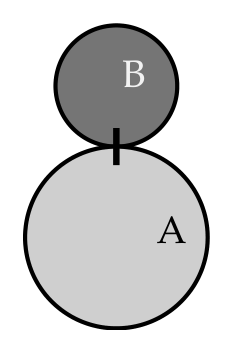
In figura sono schematizzate due monete circolari sul bordo di ciascuna delle quali c’è una tacca; le due monete si toccano in corrispondenza delle tacche. Il diametro della moneta A, la più grande, misura 18 mm. Se la moneta B inizia a ruotare attorno alla moneta A, rimanendole sempre a contatto, deve compiere esattamente due giri attorno alla A perché si ripresenti per la prima volta la situazione in figura (cioè le due monete vengano a toccarsi ancora in corrispondenza delle tacche). Sapendo che anche il diametro della moneta B misura un numero intero di millimetri, che cosa si può dire di tale lunghezza? (vedi figura)
Topic: Geometria piana, Teoria dei Numeri Abilita: Ragionamento geometrico Area: Aritmetica e Teoria dei Numeri, Geometria Risposta: 4 o 12 mm Fonte: apri PDF p.1
Diameter coin B rolling two rounds around A
\begin{document}
\begin{tikzpicture}
  \draw (0,0) circle (1.3);
  \node at (0.45,-0.3) {$A$};
  \draw (0,2.1) circle (0.8);
  \node at (0,2.1) {$B$};
\end{tikzpicture}
\end{document}
In the figure, two circular coins are outlined on the edge of each of which there is a notch; the two coins touch each other at the notches. The diameter of coin A, the largest, is 18 mm. If the coin B starts to spin around the coin A, and remains in contact with it at all times, it must make exactly two revolutions around the coin A so that the situation in the figure is repeated for the first time (i.e. the two coins touch again at the notches). Knowing that the diameter of coin B is also an integer of millimeters, what can be said about that length? (see figure)
Answer: 4 or 12 mm
Giorni festivi in piu aggiungendo i ponti, anno 3000 giorni
Nella strana repubblica di Kang gli anni durano 3000 giorni, numerati da 1 a 3000. I giorni festivi sono quelli il cui numero è divisibile per 6 oppure è un numero primo: gli altri sono giorni lavorativi. Se venisse aggiunto ai giorni festivi anche ogni giorno di «ponte», cioè giorno lavorativo preceduto e seguito da un giorno festivo, quanti giorni festivi in più ci sarebbero in ogni anno?
Topic: Teoria dei Numeri Abilita: Casework accurato Area: Aritmetica e Teoria dei Numeri Risposta: 2 Fonte: apri PDF p.1
Additional holidays by adding bridges, year 3000 days
In the strange republic of Kang, years last 3,000 days, numbered from 1 to 3,000. Holidays are those whose number is divisible by 6 or is a prime number; the others are working days. If the holidays were to be added to each bridge day, that is, a working day preceded and followed by a holiday, how many more holidays would there be in each year?
Answer: 2
Coordinate di un vertice del cubo dati tre vertici
Rispetto a un sistema assegnato di assi cartesiani ortogonali nello spazio, le coordinate di tre dei vertici di un cubo sono , e . Determina, nel modo più veloce in cui riesci a farlo, le coordinate (rispetto allo stesso sistema) di uno dei rimanenti vertici del cubo.
Topic: Geometria analitica, Geometria solida Metodo: Metodo delle coordinate Abilita: Ragionamento geometrico Area: Geometria Risposta: (0,4,7) Fonte: apri PDF p.1
Coordinates of one vertex of the cube given three vertices
With respect to an assigned system of orthogonal Cartesian axes in space, the coordinates of three vertices of a cube are , and . Determine, as quickly as you can, the coordinates (with respect to the same system) of one of the remaining vertices of the cube.
Answer: (0,4,7)
Massimo rapporto area parallelogramma su esagono regolare
\begin{document}
\begin{tikzpicture}
  \coordinate (A) at (-0.5,0.866);
  \coordinate (F) at (0.5,0.866);
  \coordinate (B) at (-1,0);
  \coordinate (E) at (1,0);
  \coordinate (C) at (-0.5,-0.866);
  \coordinate (D) at (0.5,-0.866);
  \draw (A)--(F)--(E)--(D)--(C)--(B)--cycle;
  \draw[dashed] (A)--(C)--(D)--(F)--cycle;
  \draw[dotted] (C)--(F);
  \node[above left] at (A) {$A$};
  \node[above right] at (F) {$F$};
  \node[left] at (B) {$B$};
  \node[right] at (E) {$E$};
  \node[below left] at (C) {$C$};
  \node[below right] at (D) {$D$};
\end{tikzpicture}
\end{document}
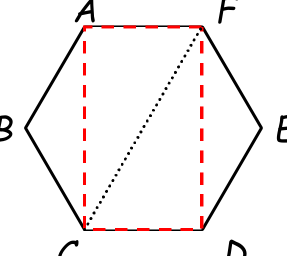
Un parallelogramma è inscritto in un esagono regolare (cioè i suoi vertici sono punti di qualche lato dell’esagono) e i centri (di simmetria) dei due poligoni coincidono. Quanto può valere, al massimo, il rapporto fra l’area del parallelogramma e l’area dell’esagono?
Topic: Geometria piana Metodo: Sfruttamento della simmetria Abilita: Ragionamento geometrico Area: Geometria Risposta: 2/3 Fonte: apri PDF p.1
Most parallelogram area ratio over regular hexagon
\begin{document}
\begin{tikzpicture}
  \coordinate (A) at (-0.5,0.866);
  \coordinate (F) at (0.5,0.866);
  \coordinate (B) at (-1,0);
  \coordinate (E) at (1,0);
  \coordinate (C) at (-0.5,-0.866);
  \coordinate (D) at (0.5,-0.866);
  \draw (A)--(F)--(E)--(D)--(C)--(B)--cycle;
  \draw[dashed] (A)--(C)--(D)--(F)--cycle;
  \draw[dotted] (C)--(F);
  \node[above left] at (A) {$A$};
  \node[above right] at (F) {$F$};
  \node[left] at (B) {$B$};
  \node[right] at (E) {$E$};
  \node[below left] at (C) {$C$};
  \node[below right] at (D) {$D$};
\end{tikzpicture}
\end{document}
A parallelogram is inscribed in a regular hexagon (i.e. its vertices are points on some side of the hexagon) and the centers (of symmetry) of the two polygons coincide. What is the maximum value of the ratio between the area of the parallelogram and the area of the hexagon?
Answer: 2/3