Allineamento non ottenibile scambiando due carte
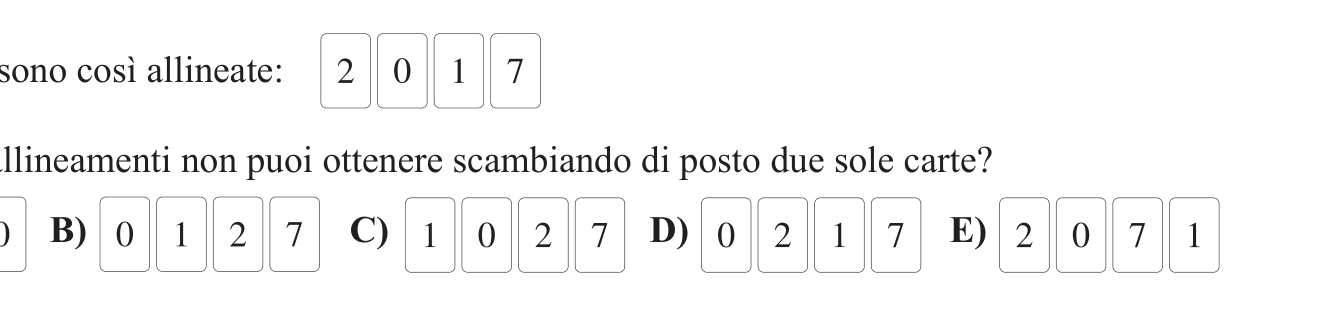
Quattro carte sono così allineate: Quale di questi allineamenti non puoi ottenere scambiando di posto due sole carte? A) B)
C)
D)
E)
Topic: Combinatoria, Logica, giochi, strategie Abilita: Casework accurato Area: Combinatoria, Logica e Probabilita Risposta: B Fonte: apri PDF p.1
Alignment not obtained by exchanging two cards
Four cards are aligned like this: Which of these alignments can’t you get by swapping the positions of just two cards? A) B)
C)
D)
E)
Answer: B
3 mosche e 2 ragni come 9 canarini e gatti
Una mosca ha 6 zampe, un ragno ne ha 8. Tutti insieme, 3 mosche e 2 ragni hanno tante zampe quante ne hanno 9 canarini e … A) 2 gatti B) 3 gatti C) 4 gatti D) 5 gatti E) 6 gatti
Topic: Algebra Abilita: traduzione del testo Area: Algebra e Analisi Risposta: C Fonte: apri PDF p.1
3 flies and 2 spiders such as 9 canaries and cats
A fly has six legs, a spider has eight. All together, three flies and two spiders have as many legs as nine canaries and… A) Two cats B) Three cats C) Four cats D) Five cats E) Six cats
Answer: C
Figura non componibile con 4 sagome uguali
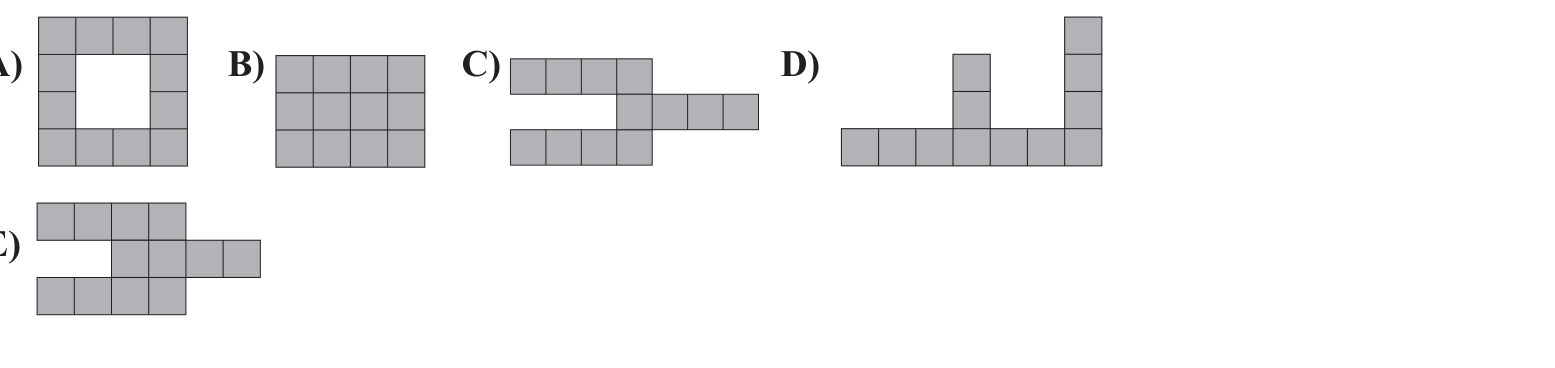
Alice ha 4 sagome di cartone di questa forma: . Quale figura non può comporre con queste 4 sagome? A) B) C)
D)E)
Topic: Geometria piana Abilita: Ragionamento geometrico Area: Geometria Risposta: E Fonte: apri PDF p.1
Figure not composable with 4 equal shapes
Alice has four cardboard shapes like this: What figure can’t compose with these four shapes? A) B) C)
D)
E)
Answer: E
Valore di 1111x3333 dato 1111x1111
Ti dico che 1111 × 1111 = 1234321. Allora quanto vale 1111 × 3333? A) 3692963 B) 3698963 C) 3456543 D) 3579753 E) 3702963
Topic: Teoria dei Numeri Abilita: Riconoscimento di pattern Area: Aritmetica e Teoria dei Numeri Risposta: E Fonte: apri PDF p.1
Value of 1111x3333 given 1111x1111
I tell you that 1111 × 1111 = 1234321. Then what is 1111 × 3333? A) 3692963 B) 3698963 C) 3456543 D) 3579753 E) 3702963
Answer: E
Minimo ponti da chiudere per separare isole A e B
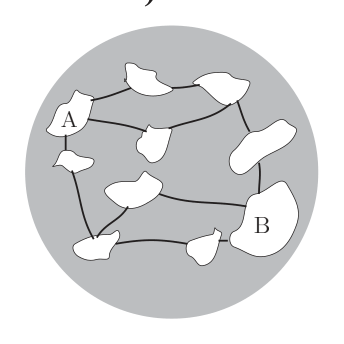
In un arcipelago ci sono 10 isole e 12 ponti che le collegano come mostra la figura. Al momento tutti i ponti sono aperti al traffico. Qual è il minimo numero di ponti che occorre e basta chiudere per fermare il traffico tra l’isola A e l’isola B? A) 1
B) 2
C) 3
D) 4
E) 5
Topic: Combinatoria, Logica, giochi, strategie Metodo: Teoria dei grafi Abilita: Conteggio sistematico Area: Combinatoria, Logica e Probabilita Risposta: B Fonte: apri PDF p.1
Minimum bridges to be closed to separate islands A and B
In an archipelago there are 10 islands and 12 bridges that connect them as shown in the figure. All bridges are currently open to traffic. What is the minimum number of bridges that need to be closed to stop traffic between Island A and Island B? A) 1
B) 2
C) 3
D) 4
E) 5
Answer: B
Euro che Giovanna da a ciascuna sorella per pareggiare
Giovanna ha 20 euro. Ognuna delle sue quattro sorelle ha 10 euro. Quanti sono gli euro che Giovanna deve dare a ciascuna delle sue sorelle perché ognuna delle cinque ragazze abbia la stessa quantità di denaro? A) 2
B) 4
C) 5
D) 8
E) 10
Topic: Algebra Abilita: traduzione del testo Area: Algebra e Analisi Risposta: A Fonte: apri PDF p.1
€ € € € € € € € € € € € € € € € € € € € € € € € € € € € € € € € € € € € € € € €
Joan has 20 euros. Each of her four sisters has 10 euros. How many euros does Joan have to give to each of her sisters so that each of the five girls has the same amount of money? A) 2
B) 4
C) 5
D) 8
E) 10
Answer: A
fratelli/sorelle di Maria e Martino
Maria ha lo stesso numero di fratelli e di sorelle; suo fratello Martino ha un numero di sorelle doppio del numero di fratelli. Quanti figli ci sono nella loro famiglia? A) 4
B) 6
C) 7
D) 8
E) 9
Topic: Algebra, Logica, giochi, strategie Abilita: traduzione del testo Area: Algebra e Analisi, Combinatoria, Logica e Probabilita Risposta: C Fonte: apri PDF p.1
brothers/sisters of Maria and Martino
Maria has the same number of brothers and sisters; her brother Martino has twice as many sisters as brothers. How many children are there in their family? A) 4
B) 6
C) 7
D) 8
E) 9
Answer: C
Ordine corretto dei tre rinoceronti per peso
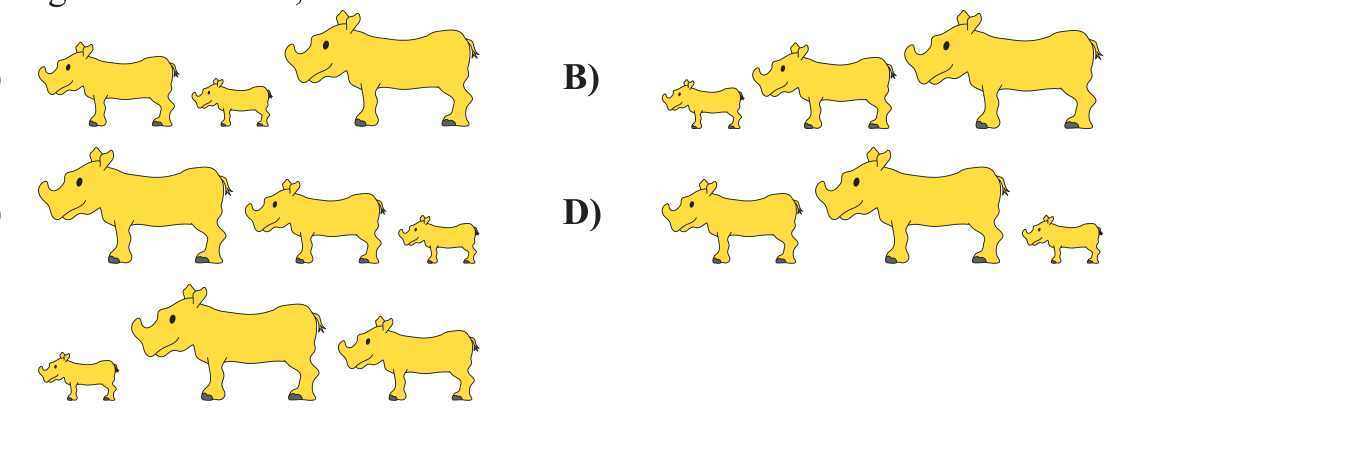
Tre rinoceronti, Jane, Kate e Leila vanno in giro nella savana. Jane cammina davanti, Leila cammina nel mezzo e Kate chiude la fila. Jane pesa 500 kg più di Kate. Kate pesa 1000 kg meno di Leila. Se le dimensioni delle figure danno un’idea del peso degli animali, quale delle seguenti immagini mostra Jane, Kate and Leila nell’ordine corretto? A)
B) C)
D) E)
Topic: Logica, giochi, strategie Abilita: Casework accurato Area: Combinatoria, Logica e Probabilita Risposta: D Fonte: apri PDF p.2
Correct order of the three rhinos by weight
Three rhinoceroses, Jane, Kate and Leila, are wandering the savannah. Jane walks in front, Leila walks in the middle, and Kate closes the line. Jane weighs 500 kg more than Kate. Kate weighs 1,000 kg less than Leila. If the size of the figures gives an idea of the weight of the animals, which of the following pictures shows Jane, Kate and Leila in the correct order? A)
B) C)
D) E)
Answer: D
Quanti quesiti in piu ha risolto Nino rispetto a Piero
Nello stesso tempo in cui Piero risolve due quesiti della gara “Kangourou”, Nino riesce a risolverne tre. A fine gara i due ragazzi hanno risolto in tutto 30 quesiti. Quanti quesiti più di Piero ha risolto Nino? A) 5
B) 6
C) 7
D) 8
E) 9
Topic: Algebra Abilita: traduzione del testo Area: Algebra e Analisi Risposta: B Fonte: apri PDF p.2
How many more questions has Nino solved than Piero
At the same time that Piero solves two questions in the Kangourou race, Nino manages to solve three. At the end of the race, the two boys solved a total of 30 questions. How many more questions has Nino solved than Piero? A) 5
B) 6
C) 7
D) 8
E) 9
Answer: B
Come Beppe aveva piegato il foglio dato il foro
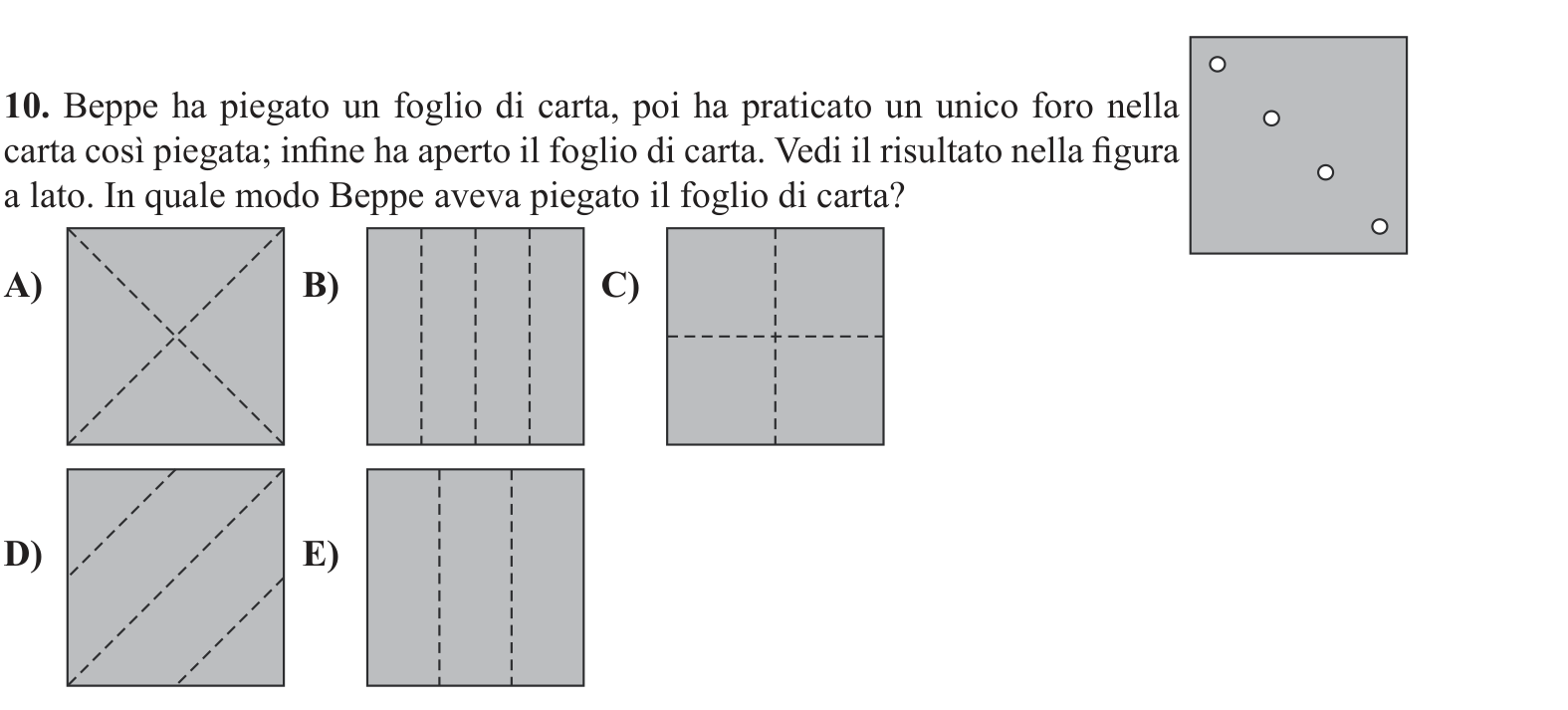
Beppe ha piegato un foglio di carta, poi ha praticato un unico foro nella carta così piegata; infine ha aperto il foglio di carta. Vedi il risultato nella figura a lato. In quale modo Beppe aveva piegato il foglio di carta? A)
B)
C)
D)
E) I quesiti dal N. 11 al N. 20 valgono 4 punti ciascuno
Topic: Geometria piana, Logica, giochi, strategie Abilita: Ragionamento geometrico Area: Combinatoria, Logica e Probabilita, Geometria Risposta: D Fonte: apri PDF p.2
How Beppe had folded the sheet given the hole
Beppe folded a sheet of paper, then drilled a single hole in the paper so folded; finally, he opened the sheet of paper. You can see the result in the figure on the side. How did Beppe fold the paper? A)
B)
C)
D)
E) Questions from N. 11 to N. 20 is worth 4 points each.
Answer: D
Sesta faccia del dado con somme opposte uguali
Un dado speciale riporta un numero su ogni faccia. Le somme dei numeri su facce opposte sono tutte uguali. Cinque dei sei numeri sono 5, 6, 9, 11 e 14. Quale è il numero sulla sesta faccia? A) 4
B) 7
C) 8
D) 13
E) 15
Topic: Teoria dei Numeri Abilita: Manipolazione algebrica Area: Aritmetica e Teoria dei Numeri Risposta: E Fonte: apri PDF p.2
Sixth face of the dice with equal opposite sums
A special die has a number on each face. The sums of the numbers on opposite faces are all the same. Five of the six numbers are 5, 6, 9, 11, and 14. What’s the number on the sixth face? A) 4
B) 7
C) 8
D) 13
E) 15
Answer: E
Pezzi di spago tagliando in punti da 9 e 8 parti
Simone ha intenzione di suddividere un pezzo di spago in nove pezzi della stessa lunghezza e segna i punti in cui deve tagliarlo con un pennarello blu. Barbara ha intenzione di suddividere lo stesso pezzo di spago in otto pezzi della stessa lunghez za e, a sua volta, segna i punti in cui deve tagliarlo con un pennarello rosso. Arriva Carlo e taglia lo spago in tutti i punti in cui trova dei segni di pennarello. Quanti pezzi di spago ottiene Carlo? A) 15
B) 16
C) 17
D) 18
E) 19
Topic: Teoria dei Numeri, Combinatoria Abilita: Conteggio sistematico Area: Aritmetica e Teoria dei Numeri, Combinatoria, Logica e Probabilita Risposta: B Fonte: apri PDF p.2
Pieces of string by cutting at points into 9 and 8 parts
Simone intends to divide a piece of string into nine pieces of the same length and marks the points where he must cut it with a blue marker. Barbara intends to divide the same piece of string into eight pieces of the same length and, in turn, marks the points where she must cut it with a red marker. Carlo arrives and cuts the string at all the points where he finds marker marks. How many pieces of string does Carlo obtain? A) 15
B) 16
C) 17
D) 18
E) 19
Answer: B
Larghezza poltrona dati divani da 2 e 3 posti
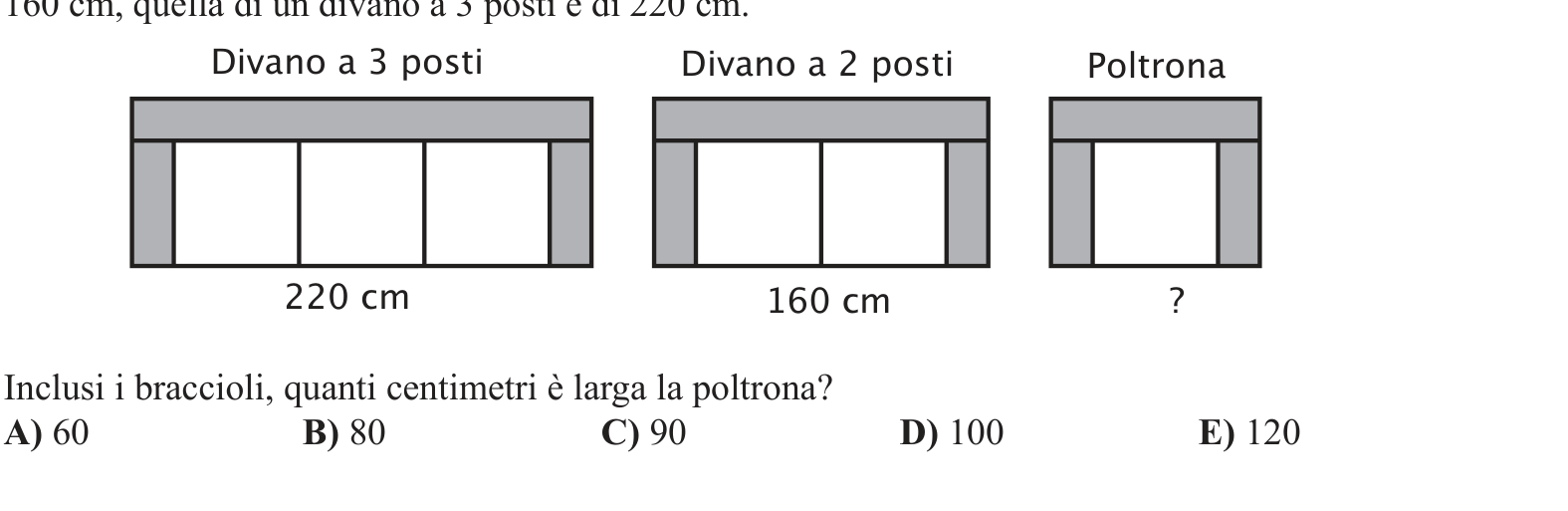
Il magazzino Mobili Moderni vende poltrone e divani a 2 e 3 posti fatti degli stessi elementi modulari, come mostra la figura. Inclusi i braccioli, la larghezza di un divano a due posti è di 160 cm, quella di un divano a 3 posti è di 220 cm. Inclusi i braccioli, quanti centimetri è larga la poltrona? A) 60
B) 80
C) 90
D) 100
E) 120
Topic: Algebra Abilita: traduzione del testo Area: Algebra e Analisi Risposta: D Fonte: apri PDF p.3
Armchair width given 2 and 3 seat sofas
The Modern Mobili store sells armchairs and 2 and 3 seat sofas made of the same modular elements, as shown in the figure. Including the arms, the width of a two-seater sofa is 160 cm, that of a three-seater sofa is 220 cm. Including the arms, how many centimeters wide is the armchair? A) 60
B) 80
C) 90
D) 100
E) 120
Answer: D
Misure della scatola piu piccola per la costruzione
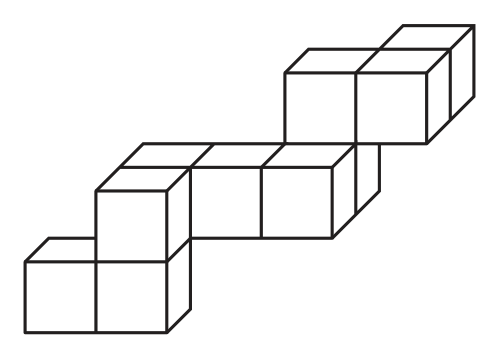
Milena ha fatto la costruzione che vedi a fianco incollan do dei cubetti di lato 1 dm e ora vuole metterla in una scatola a facce rettangolari. Quali tra le seguenti sono le misure in dm della scatola più piccola che può usare? A) 3 × 4 × 4 B) 3 × 5 × 5 C) 3 × 4 × 5 D) 4 × 4 × 4 E) 4 × 4 × 5
Topic: Geometria solida Abilita: Ragionamento geometrico Area: Geometria Risposta: C Fonte: apri PDF p.3
Smaller box sizes for construction
Milena made the construction you see next to it by gluing 1 dm side cubes and now wants to put it in a box with rectangular faces. Which of the following are the dimensions of the smallest box you can use? A) 3 × 4 × 4 B) 3 × 5 × 5 C) 3 × 4 × 5 D) 4 × 4 × 4 E) 4 × 4 × 5
Answer: C
Numero massimo a 7 cifre cancellando 24 cifre
Tom scrive tutti i numeri da 1 a 20 su una stessa riga e ottiene il numero di 31 cifre: 1234567891011121314151617181920. Poi cancella 24 delle 31 cifre in modo che il numero che rimane scritto (lasciando le cifre nell’ordine in cui si trovano) sia il più grande possibile. Di che numero si tratta? A) 9671819 B) 9567892 C) 9781920 D) 9912345 E) 9818192
Topic: Combinatoria, Teoria dei Numeri Metodo: Principio di estremalita Abilita: Conteggio sistematico Area: Aritmetica e Teoria dei Numeri, Combinatoria, Logica e Probabilita Risposta: C Fonte: apri PDF p.3
Maximum number of 7 digits by deleting 24 digits
Tom writes all the numbers from 1 to 20 on the same line and gets the 31-digit number: 1234567891011121314151617181920. Then he deletes 24 of the 31 digits so that the number that remains written (leaving the digits in the order in which they are) is as large as possible. What number is this? A) 9671819 B) 9567892 C) 9781920 D) 9912345 E) 9818192
Answer: C
Numero sull’ultima chiave (criptaritmo lettera-cifra)
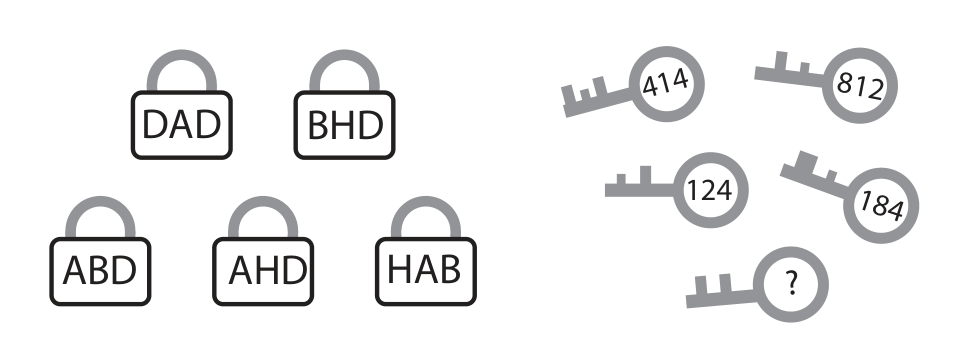
Ogni lucchetto può essere aperto da una sola delle cinque chiavi: quella il cui numero è ottenuto sostituendo (nello stesso ordine) ogni lettera del lucchetto con una cifra, in modo che a lettere uguali, anche su lucchetti diversi, corrispondano cifre uguali. Qual è il numero scritto sull’ultima chiave? A) 382
B) 282
C) 284
D) 823
E) 824
Topic: Teoria dei Numeri, Logica, giochi, strategie Abilita: Casework accurato Area: Aritmetica e Teoria dei Numeri, Combinatoria, Logica e Probabilita Risposta: C Fonte: apri PDF p.3
Number on the last key (letter-digit encryption)
Each lock can be opened by only one of the five keys: the one whose number is obtained by replacing (in the same order) each letter of the lock with a digit, so that the same letters, even on different locks, correspond to the same numbers. What’s the number written on the last key? A) 382
B) 282
C) 284
D) 823
E) 824
Answer: C
Km percorsi giovedi, 2 km in piu al giorno, totale 70
Paolo è partito al lunedì per un’escursione di 5 giorni in montagna. Ogni giorno dal lunedì al venerdì ha camminato 2 km in più del giorno precedente, percorrendo in tutto 70 km. Quanti chilometri ha percorso giovedì? A) 12
B) 13
C) 14
D) 15
E) 16 Divano a 3 posti Divano a 2 posti Poltrona 220 cm 160 cm ? DAD BHD ABD AHD HAB 414 124 ? 812 184
Topic: Algebra Abilita: traduzione del testo Area: Algebra e Analisi Risposta: E Fonte: apri PDF p.3
Km travelled on Thursday, 2 km more each day, total 70
Paolo left on Monday for a 5-day hiking trip in the mountains. Every day from Monday to Friday he walked 2 km more than the previous day, covering a total of 70 km. How many kilometres did he travel on Thursday? A) 12
B) 13
C) 14
D) 15
E) 16 3-seater sofa 2-seater sofa Armchair 220 cm 160 cm ? DAD BHD ABD AHD HAB 414 124 ? 812 184
Answer: E
Affermazione vera su lettere/numeri con somme riga-colonna
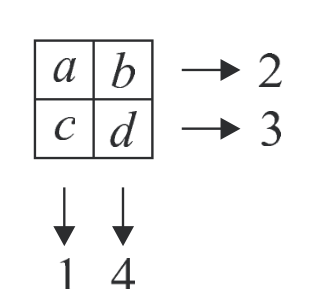
Le lettere in figura rappresentano numeri interi maggiori o uguali a zero. Sommando i numeri rappresentati in ciascuna riga e in ciascuna co lonna si hanno i risultati mostrati in figura. Quale delle seguenti afferma zioni è vera? A) b è uguale a c. B) a è minore di d. C) a è maggiore di d. D) c è maggiore di b. E) Nessuna delle precedenti.
Topic: Algebra Abilita: Manipolazione algebrica Area: Algebra e Analisi Risposta: B Fonte: apri PDF p.4
True statement on letters/numbers with row-column sums
The letters in the figure represent integers greater than or equal to zero. Adding the numbers represented in each row and in each column gives the results shown in the figure. Which of the following is true? A) b is equal to c. B) a is less than d. C) a is greater than d. D) c is greater than b. E) None of the above.
Answer: B
Ordine bacchette A,T,R per massima somma di denaro
Adriano ha una somma di denaro e 3 bacchette magiche: • la bacchetta A aggiunge 1 euro alla somma; • la bacchetta T toglie 1 euro alla somma; • la bacchetta R raddoppia la somma. Deve usarle tutte, ciascuna una sola volta. In quale ordine deve usarle per ottenere la maggior quantità possibile di denaro? A) R, A, T B) A, T, R C) R, T, A D) A, R, T E) T, A, R
Topic: Algebra Abilita: Riconoscimento di pattern Area: Algebra e Analisi Risposta: D Fonte: apri PDF p.4
Orders of A,T,R sticks for maximum amount of money
Adriano has a sum of money and 3 magic sticks: • the A stick adds 1 euro to the sum; • the T stick takes 1 euro from the sum; • the R stick doubles the sum. You have to use them all, one at a time. In what order should you use them to get as much money as possible? A) R, A, T B) A, T, R C) R, T, A D) A, R, T E) T, A, R
Answer: D
Area figura di tre quadrati sovrapposti 2,4,6 cm
\begin{document}
\begin{tikzpicture}
  % Square 1: side 2cm, top-left at (0,4)
  \fill[gray!40] (0,4) rectangle (2,2);
  \draw (0,4) rectangle (2,2);
  % Square 2: side 4cm, top-left vertex at center of square 1 = (1,3)
  \fill[gray!40] (1,3) rectangle (5,-1);
  \draw (1,3) rectangle (5,-1);
  % Re-draw square 1 on top to show overlap
  \fill[gray!40] (0,4) rectangle (2,2);
  \draw (0,4) rectangle (2,2);
  % Square 3: side 6cm, top-left vertex at center of square 2 = (3,1)
  \fill[gray!40] (3,1) rectangle (9,-5);
  \draw (3,1) rectangle (9,-5);
  % Re-draw square 2 on top
  \fill[gray!40] (1,3) rectangle (5,-1);
  \draw (1,3) rectangle (5,-1);
  % Re-draw square 1 on top
  \fill[gray!40] (0,4) rectangle (2,2);
  \draw (0,4) rectangle (2,2);
\end{tikzpicture}
\end{document}
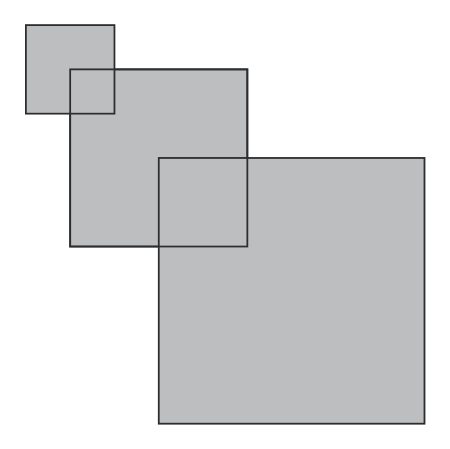
Nell’immagine vedi una figura formata sovrapponendo tre quadrati in modo che le parti sovrapposte siano quadrate. Il pri mo ha lato lungo 2 cm, il secondo ha lato lungo 4 cm e un vertice nel centro del primo quadrato, l’ultimo ha lato lungo 6 cm e un vertice nel centro del secondo quadrato. Quanti centimetri qua drati misura l’area della figura? A) 32
B) 51
C) 40
D) 56
E) 48 I quesiti dal N. 21 al N. 30 valgono 5 punti ciascuno
Topic: Geometria piana Metodo: Inclusione-esclusione Abilita: Ragionamento geometrico Area: Geometria Risposta: B Fonte: apri PDF p.4
Figure area of three squares overlaid by 2,4,6 cm
\begin{document}
\begin{tikzpicture}
  % Square 1: side 2cm, top-left at (0,4)
  \fill[gray!40] (0,4) rectangle (2,2);
  \draw (0,4) rectangle (2,2);
  % Square 2: side 4cm, top-left vertex at center of square 1 = (1,3)
  \fill[gray!40] (1,3) rectangle (5,-1);
  \draw (1,3) rectangle (5,-1);
  % Re-draw square 1 on top to show overlap
  \fill[gray!40] (0,4) rectangle (2,2);
  \draw (0,4) rectangle (2,2);
  % Square 3: side 6cm, top-left vertex at center of square 2 = (3,1)
  \fill[gray!40] (3,1) rectangle (9,-5);
  \draw (3,1) rectangle (9,-5);
  % Re-draw square 2 on top
  \fill[gray!40] (1,3) rectangle (5,-1);
  \draw (1,3) rectangle (5,-1);
  % Re-draw square 1 on top
  \fill[gray!40] (0,4) rectangle (2,2);
  \draw (0,4) rectangle (2,2);
\end{tikzpicture}
\end{document}
In the image you see a figure formed by overlapping three squares so that the overlapping parts are square. The first has a side of length 2 cm, the second has a side of length 4 cm and a vertex in the centre of the first square, the last has a side of length 6 cm and a vertex in the centre of the second square. How many square centimetres is the area of the figure? A) 32
B) 51
C) 40
D) 56
E) 48 Questions from N. 21 to N. 30 are worth 5 points each.
Answer: B
Solido costruibile con 9 barrette 2 grigi 1 bianco

Raffaele ha delle barrette, ciascuna formata da 2 cubi grigi e uno bianco incollati insieme, come quella mostrata dalla figura. Quale dei seguenti solidi può costruire con 9 di tali barrette? A) B) ….. C) …. D) E)
Topic: Geometria solida Abilita: Ragionamento geometrico Area: Geometria Risposta: A Fonte: apri PDF p.4
Solid constructible with 9 bars 2 gray 1 white
Raffaele has some bars, each made of 2 gray cubes and one white cube glued together, like the one shown in the figure. Which of the following solids can he build with 9 of these bars? A) B) ….. C) …. D) E)
Answer: A
Modi di inserire 1..5 con regole maggiore sotto/destra
\begin{document}
\begin{tikzpicture}
  % Top row: 3 cells
  \draw (0,1) rectangle (1,2);
  \draw (1,1) rectangle (2,2);
  \draw (2,1) rectangle (3,2);
  % Below the leftmost: 2 cells
  \draw (0,0) rectangle (1,1);
  \draw (0,-1) rectangle (1,0);
\end{tikzpicture}
\end{document}
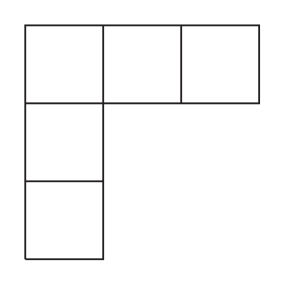
Voglio inserire nelle cinque celle della figura a lato i numeri 1, 2, 3, 4, 5, seguendo le seguenti regole: • se un numero si trova sotto un altro numero deve essere più grande di questo; • se un numero è a destra di un altro numero, deve essere più grande di questo. In quanti modi diversi posso farlo? A) 3
B) 4
C) 5
D) 6
E) 8
Topic: Combinatoria Metodo: Conteggio combinatorio Abilita: Conteggio sistematico Area: Combinatoria, Logica e Probabilita Risposta: D Fonte: apri PDF p.4
Ways to insert 1..5 with greater-than rules below/right
\begin{document}
\begin{tikzpicture}
  % Top row: 3 cells
  \draw (0,1) rectangle (1,2);
  \draw (1,1) rectangle (2,2);
  \draw (2,1) rectangle (3,2);
  % Below the leftmost: 2 cells
  \draw (0,0) rectangle (1,1);
  \draw (0,-1) rectangle (1,0);
\end{tikzpicture}
\end{document}
I want to insert the numbers 1, 2, 3, 4, 5 into the five cells of the figure next to me, following the following rules: • if a number is below another number it must be larger than this; • if a number is to the right of another number it must be larger than this. How many different ways can I do this? A) 3
B) 4
C) 5
D) 6
E) 8
Answer: D
Immagine del canguro nel triangolo grigio per simmetrie
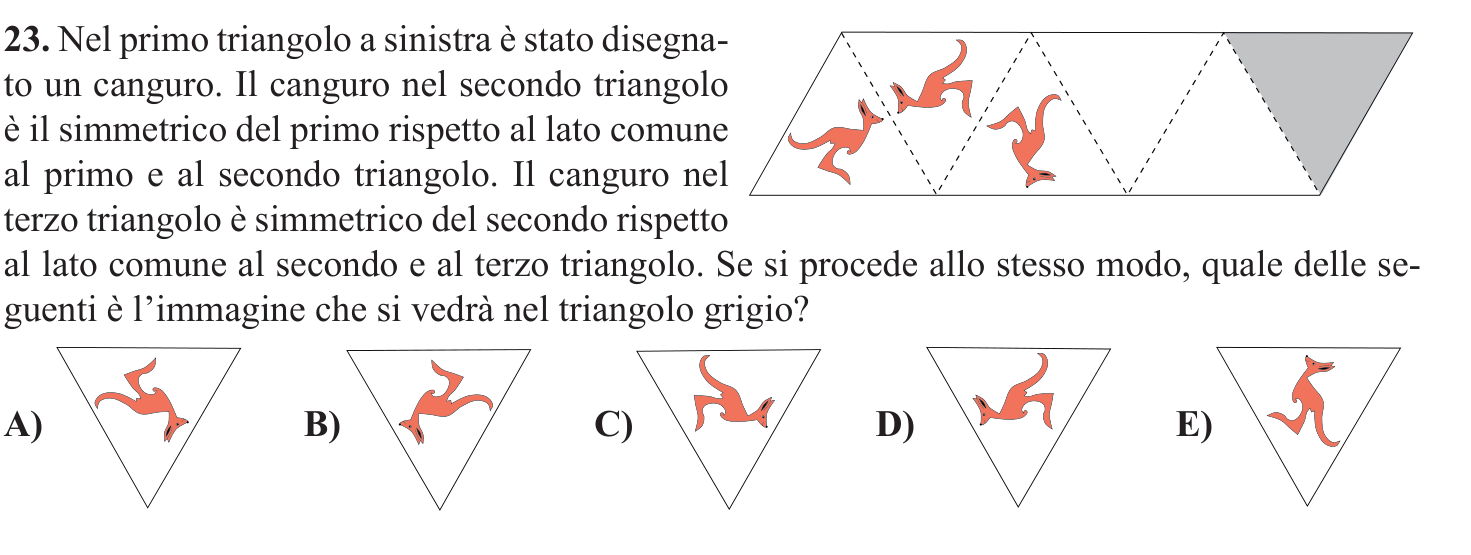
Nel primo triangolo a sinistra è stato disegna to un canguro. Il canguro nel secondo triangolo è il simmetrico del primo rispetto al lato comune al primo e al secondo triangolo. Il canguro nel terzo triangolo è simmetrico del secondo rispetto al lato comune al secondo e al terzo triangolo. Se si procede allo stesso modo, quale delle se guenti è l’immagine che si vedrà nel triangolo grigio? A) B) C) D) E)
Topic: Geometria piana Metodo: Sfruttamento della simmetria Abilita: Ragionamento geometrico Area: Geometria Risposta: E Fonte: apri PDF p.5
Image of the kangaroo in the grey triangle by symmetry
In the first left triangle a kangaroo was drawn. The kangaroo in the second triangle is the first’s symmetry to the common side of the first and second triangles. The kangaroo in the third triangle is symmetrical to the second relative to the side common to the second and third triangles. If the same is done, which of the following is the image shown in the grey triangle? A) B) C) D) E)
Answer: E
Minimo risultati diversi moltiplicando 5 numeri per 2 o 3
Monica deve scegliere 5 numeri diversi in modo che, se ne moltiplica alcuni per 2 e gli altri per 3, i risultati diversi che ottiene siano nel minor numero possibile. Qual è questo numero? A) 1
B) 2
C) 3
D) 4
E) 5
Topic: Teoria dei Numeri, Combinatoria Metodo: Analisi per casi Abilita: Riconoscimento di pattern Area: Aritmetica e Teoria dei Numeri, Combinatoria, Logica e Probabilita Risposta: C Fonte: apri PDF p.5
Minimum different results by multiplying 5 numbers by 2 or 3
Monica has to choose 5 different numbers so that, if you multiply some by 2 and the others by 3, the different results you get are as few as possible. What’s this number? A) 1
B) 2
C) 3
D) 4
E) 5
Answer: C
Mosse di scambio di canguri che si guardano in faccia

Un videogioco inizia con otto canguri messi in fila come mostra la figura: A ogni mossa, Angelo può scambiare di posto due canguri vicini, ma solo se questi due canguri si guardano in faccia. Il gioco prosegue fino a quando Angelo non può fare altri scambi. Quante mosse farà Angelo? A) 2
B) 10
C) 12
D) 13
E) 16
Topic: Combinatoria, Logica, giochi, strategie Metodo: Conteggio combinatorio Abilita: Casework accurato Area: Combinatoria, Logica e Probabilita Risposta: D Fonte: apri PDF p.5
Exchange moves of kangaroos looking at each other
A video game begins with eight kangaroos lined up as shown in the figure: At each move, Angelo can switch places between two neighboring kangaroos, but only if these two kangaroos look each other in the face. The game goes on until Angelo can make no more swaps. How many moves will Angelo make? A) 2
B) 10
C) 12
D) 13
E) 16
Answer: D
5 con un rosso, 6 con un blu
Un sacchetto contiene solo gettoni rossi e gettoni blu. In qualunque modo estraiamo 5 getto ni almeno uno è rosso; in qualunque modo ne estraiamo 6 almeno uno è blu. Qual è il massimo numero di gettoni che possono essere contenuti nel sacchetto? A) 11
B) 10
C) 9
D) 8
E) 7
Topic: Combinatoria Metodo: Principio dei cassetti Abilita: Casework accurato Area: Combinatoria, Logica e Probabilita Risposta: C Fonte: apri PDF p.5
5 with a red, 6 with a blue
A bag contains only red and blue tokens. Any way we extract 5 tokens at least one is red; any way we extract 6 at least one is blue. What is the maximum number of tokens that can be contained in the bag? A) 11
B) 10
C) 9
D) 8
E) 7
Answer: C
Minimo piastrelle da scambiare per simmetria 4 direzioni
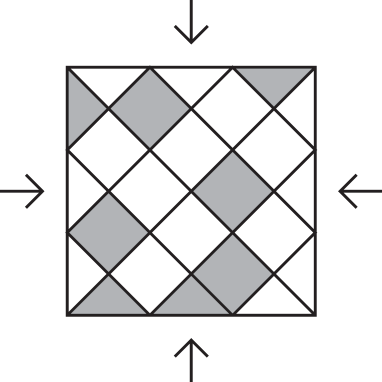
Il pavimento quadrato in figura è coperto con piastrelle triangolari e quadrate, alcune grigie, altre bianche. Qual è il minimo numero di piastrelle grigie che è sufficiente scambiare di posto con piastrelle bianche se vogliamo che la decorazione appaia uguale da ciascuna delle quattro direzioni evidenziate? A) Una triangolare, una quadrata B) Una triangolare, tre quadrate C) Tre triangolari, una quadrata D) Tre triangolari, tre quadrate E) Tre triangolari, due quadrate
Topic: Geometria piana, Combinatoria Metodo: Sfruttamento della simmetria Abilita: Ragionamento geometrico Area: Combinatoria, Logica e Probabilita, Geometria Risposta: A Fonte: apri PDF p.5
Minimum tiles to be exchanged for 4-way symmetry
The square floor in the figure is covered with triangular and square tiles, some grey, others white. What is the minimum number of gray tiles that is enough to swap places with white tiles if we want the decoration to look the same from each of the four highlighted directions? A) One triangle, one square B) One triangle, three squares C) Three triangles, one square D) Three triangles, three squares E) Three triangles, two squares
Answer: A
Ordine in cui le tre ragazze prendono le biglie
Alice ama i numeri pari, Bianca ama i numeri divisibili per 3, Clelia ama i numeri divisibili per 5. Un cestino contiene 8 biglie su ciascuna delle quali è scritto un numero: ognuna delle tre ragazze vi passa davanti in tempi diversi e, tra le biglie ancora presenti, prende tutte quelle con i numeri che ama. Alla fine Alice ha collezionato le biglie con i numeri 32 e 52, Bianca quelle con i numeri 24, 33 e 45 e Clelia quelle con i numeri 20, 25 e 35. In quale ordine le tre ragazze sono passate dal cestino? A) Alice, Clelia, Bianca B) Clelia, Bianca, Alice
C) Bianca, Alice, Clelia D) Bianca, Clelia, AliceE) Clelia, Alice, Bianca
Topic: Logica, giochi, strategie, Teoria dei Numeri Metodo: Analisi per casi Abilita: Casework accurato Area: Aritmetica e Teoria dei Numeri, Combinatoria, Logica e Probabilita Risposta: D Fonte: apri PDF p.6
Order in which the three girls take the marbles
Alice loves even numbers, Bianca loves numbers divisible by 3, Clelia loves numbers divisible by 5. A basket contains 8 marbles on each of which a number is written: each of the three girls passes by it at different times and, among the marbles still present, takes all those with the numbers she loves. In the end Alice has collected the marbles with the numbers 32 and 52, Bianca those with the numbers 24, 33 and 45 and Clelia those with the numbers 20, 25 and 35. In what order did the three girls pass by the basket? A) Alice, Clelia, Bianca B) Clelia, Bianca, Alice C) Bianca, Alice, Clelia D) Bianca, Clelia, Alice
E) Clelia, Alice, Bianca
Answer: D
Massimo numeri dispari nella piramide di somme
\begin{document}
\begin{tikzpicture}
  % Row 1 (bottom): 4 boxes
  \draw (0,0) rectangle (1.5,0.8);
  \draw (1.5,0) rectangle (3.0,0.8);
  \draw (3.0,0) rectangle (4.5,0.8);
  \draw (4.5,0) rectangle (6.0,0.8);
  % Row 2: 3 boxes (offset by 0.75)
  \draw (0.75,0.8) rectangle (2.25,1.6);
  \draw (2.25,0.8) rectangle (3.75,1.6);
  \draw (3.75,0.8) rectangle (5.25,1.6);
  % Row 3: 2 boxes
  \draw (1.5,1.6) rectangle (3.0,2.4);
  \draw (3.0,1.6) rectangle (4.5,2.4);
  % Row 4 (top): 1 box
  \draw (2.25,2.4) rectangle (3.75,3.2);
\end{tikzpicture}
\end{document}
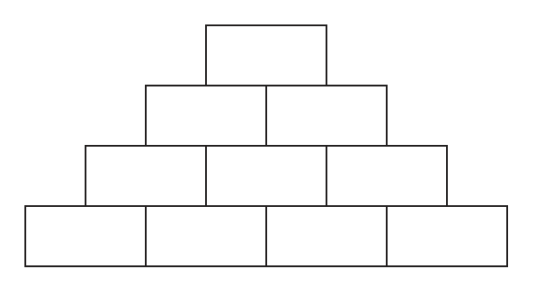
Sara vuole scrivere un numero intero positivo in ogni casella del disegno in modo che ogni numero al di sopra della riga inferiore sia la somma dei due numeri nelle ca selle immediatamente sotto a esso. Quanti numeri dispari può scrivere al massimo Sara? A) 4
B) 5
C) 6 D) 7
E) 8
Topic: Combinatoria, Teoria dei Numeri Metodo: parita Abilita: Casework accurato Area: Aritmetica e Teoria dei Numeri, Combinatoria, Logica e Probabilita Risposta: D Fonte: apri PDF p.6
Most odd numbers in the sum pyramid
\begin{document}
\begin{tikzpicture}
  % Row 1 (bottom): 4 boxes
  \draw (0,0) rectangle (1.5,0.8);
  \draw (1.5,0) rectangle (3.0,0.8);
  \draw (3.0,0) rectangle (4.5,0.8);
  \draw (4.5,0) rectangle (6.0,0.8);
  % Row 2: 3 boxes (offset by 0.75)
  \draw (0.75,0.8) rectangle (2.25,1.6);
  \draw (2.25,0.8) rectangle (3.75,1.6);
  \draw (3.75,0.8) rectangle (5.25,1.6);
  % Row 3: 2 boxes
  \draw (1.5,1.6) rectangle (3.0,2.4);
  \draw (3.0,1.6) rectangle (4.5,2.4);
  % Row 4 (top): 1 box
  \draw (2.25,2.4) rectangle (3.75,3.2);
\end{tikzpicture}
\end{document}
Sara wants to write a positive integer in each box of the drawing so that each number above the bottom line is the sum of the two numbers in the boxes immediately below it. How many odd numbers can Sara write at most? A) 4
B) 5
C) 6 D) 7
E) 8
Answer: D
Modi di colorare mappa di 4 regioni con 4 colori
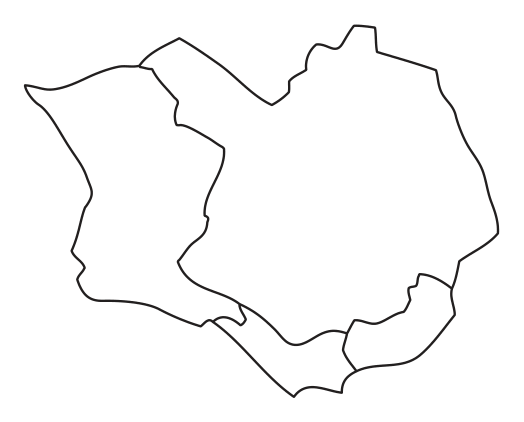
Giulia ha quattro matite di colori diversi e vuole usar le (tutte o una parte) per colorare la mappa di un’isola di visa in quattro regioni, come mostra la figura. Non vuole che due regioni confinanti abbiano lo stesso colore. In quanti modi può colorare la mappa dell’isola? A) 12
B) 18
C) 24
D) 36
E) 48
Topic: Combinatoria Metodo: Conteggio combinatorio Abilita: Conteggio sistematico Area: Combinatoria, Logica e Probabilita Risposta: E Fonte: apri PDF p.6
How to colour a map of 4 regions with 4 colours
Giulia has four pencils of different colours and wants to use them (all or part) to colour the map of an island divided into four regions, as shown in the figure. She doesn’t want two neighboring regions to be the same color. How many ways can you color the map of the island? A) 12
B) 18
C) 24
D) 36
E) 48
Answer: E