Tassello da inserire per due uguaglianze soddisfatte

Quale tra i seguenti tasselli può essere inserito tra i tasselli che vedi qui sopra in modo che le due uguaglianze siano entrambe soddisfatte? A)
B)
C)
D)
E)
Topic: Teoria dei Numeri, Logica, giochi, strategie Abilita: Casework accurato Area: Aritmetica e Teoria dei Numeri, Combinatoria, Logica e Probabilita Risposta: E Fonte: apri PDF p.1
Tile to be inserted for two satisfied equalities
Which of the following tiles can be inserted between the tiles you see above so that the two equations are both satisfied? A)
B)
C)
D)
E)
Answer: E
Quanti canguri nel parco, Gianni ne vede meta
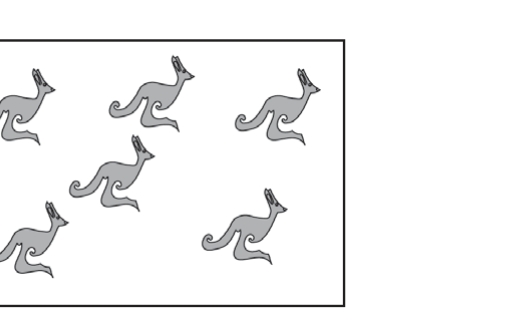
Gianni guarda fuori dalla finestra (osserva la figura!) e vede metà dei canguri che abitano nel parco. Quanti canguri abitano nel parco? A) 3 B) 10 C) 12 D) 15 E) 18
Topic: Teoria dei Numeri Abilita: traduzione del testo Area: Aritmetica e Teoria dei Numeri Risposta: C Fonte: apri PDF p.1
How many kangaroos are in the park, Gianni sees half.
Gianni looks out the window (see the figure!) and sees half the kangaroos living in the park. How many kangaroos live in the park? A) 3 B) 10 C) 12 D) 15 E) 18
Answer: C
Unico numero visibile sovrapponendo i due fogli
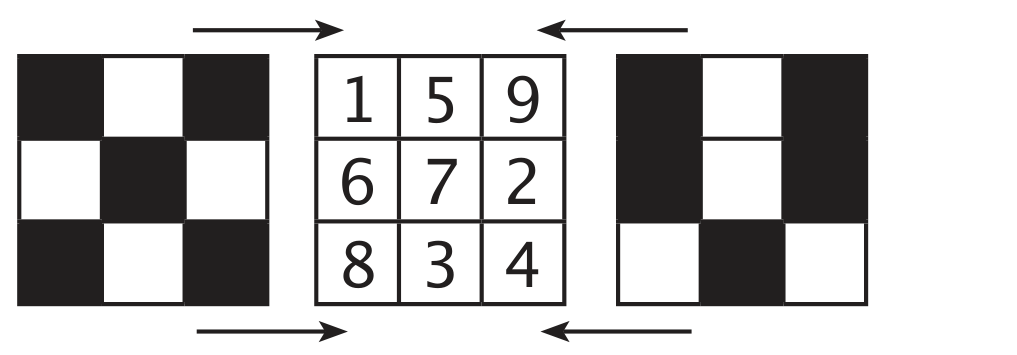
Su due fogli quadrettati di carta trasparente alcuni qua dretti sono stati anneriti, come mostra la figura. Se i due fogli vengono sovrapposti alla tavola numerica mostrata al centro, i numeri sotto i quadretti anneriti non possono essere visti. Sovrapponendoli entrambi alla tavola si riesce a vedere ancora un solo numero: quale? A) 9
B) 7
C) 4
D) 8
E) 5
Topic: Logica, giochi, strategie Abilita: Ragionamento geometrico Area: Combinatoria, Logica e Probabilita Risposta: E Fonte: apri PDF p.1
One visible number overlapping the two sheets
On two square sheets of transparent paper some areas have been blackened, as shown in the figure. If the two sheets are overlapped with the number table shown in the centre, the numbers below the blackened squares cannot be seen. If you overlay both of them on the table, you can still see only one number: which one? A) 9
B) 7
C) 4
D) 8
E) 5
Answer: E
Numero coperto dal muso del panda

Quale numero è coperto dal muso del panda? A) 16
B) 18
C) 20
D) 24
E) 28 8–3 =2 =5 5–1 =3 4–2 =5 1+2 =4 5–3 =5 1+1 1 5 9 6 7 2 8 3 4 aa
Topic: Teoria dei Numeri Abilita: Riconoscimento di pattern Area: Aritmetica e Teoria dei Numeri Risposta: A Fonte: apri PDF p.1
Number covered by the panda’s nose
What number is covered by the panda’s nose? A) 16
B) 18
C) 20
D) 24
E) 28 8–3 =2 =5 5–1 =3 4–2 =5 1+2 =4 5–3 =5 1+1 1 5 9 6 7 2 8 3 4 aa
Answer: A
Somma dei due numeri coperti dalla macchia (addizione)
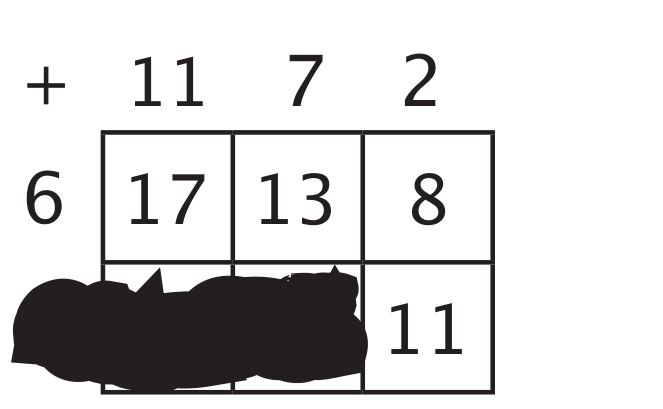
La figura mostra una tabella di addizione in cui le somme sono state svolte correttamente. La tabella è stata macchiata. Qual è la somma dei due numeri che si trovano nelle celle coperte dalla macchia? A) 30
B) 32
C) 33 D) 34
E) 36
Topic: Teoria dei Numeri Metodo: Sfruttamento della simmetria Abilita: Manipolazione algebrica Area: Aritmetica e Teoria dei Numeri Risposta: E Fonte: apri PDF p.2
sum of the two numbers covered by the stain (addition)
The figure shows an addition table in which the sums were done correctly. The chart has been stained. What is the sum of the two numbers in the cells covered by the stain? A) 30
B) 32
C) 33 D) 34
E) 36
Answer: E
Quanti pezzi di specchio hanno esattamente quattro lati
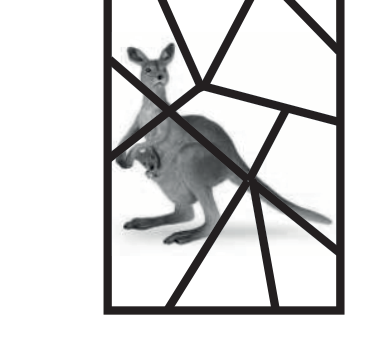
Quel monello di Kangoo ha picchiato troppo forte sullo specchio che si è rotto in tanti pezzi. Quanti di essi hanno esattamente quattro lati?
A) 2
B) 4
C) 6
D) 5
E) 3
Topic: Geometria piana Abilita: Ragionamento geometrico Area: Geometria Risposta: B Fonte: apri PDF p.2
How many mirror pieces have exactly four sides?
That naughty Kangoo hit the mirror too hard and it broke into many pieces. How many of them have exactly four sides?
A) 2
B) 4
C) 6
D) 5
E) 3
Answer: B
Figura del retro della casa di Anna
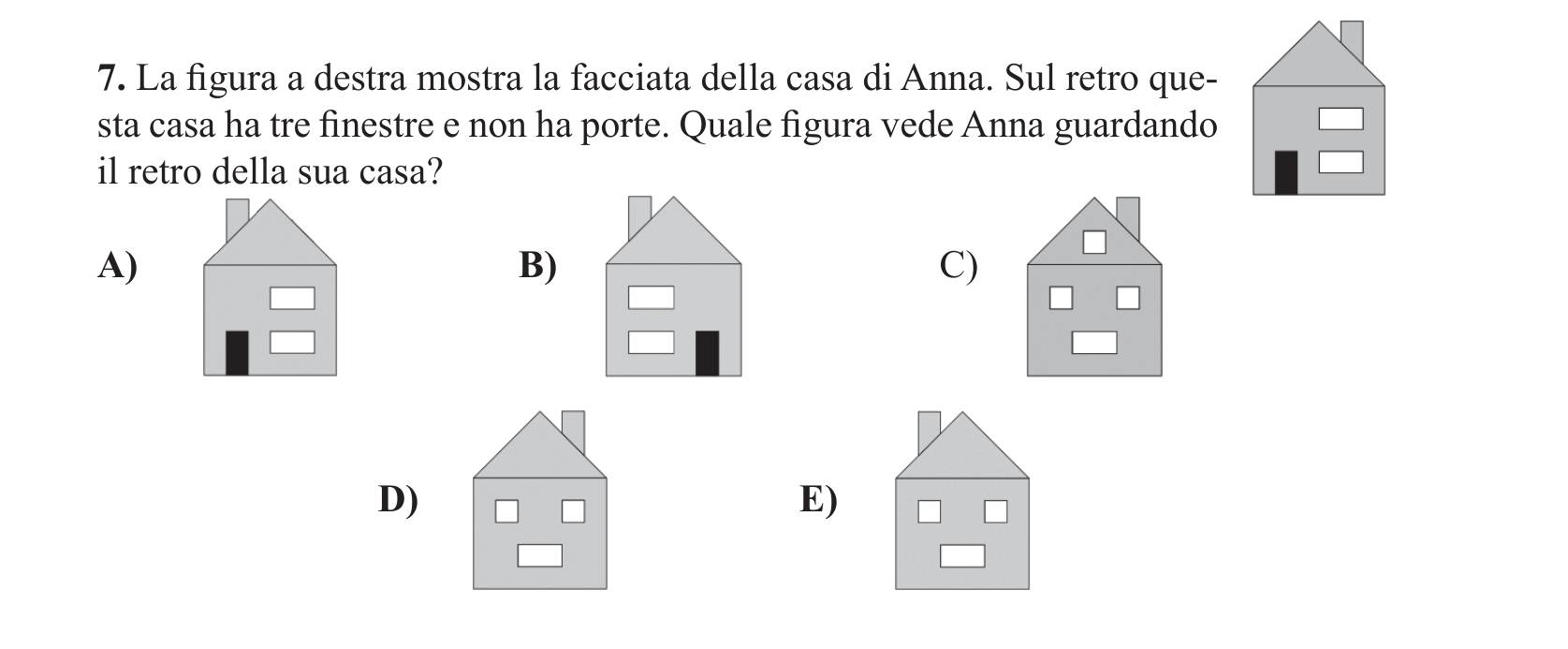
La figura a destra mostra la facciata della casa di Anna. Sul retro que sta casa ha tre finestre e non ha porte. Quale figura vede Anna guardando il retro della sua casa? A)
B)
C)
D)
E)
Topic: Geometria piana Abilita: Ragionamento geometrico Area: Geometria Risposta: E Fonte: apri PDF p.2
The picture of the back of Anna’s house
The figure on the right shows the facade of Anna’s house. At the back of this house there are three windows and no doors. What figure does Anna see looking at the back of her house? A)
B)
C)
D)
E)
Answer: E
Uguaglianza vera tra le opzioni date
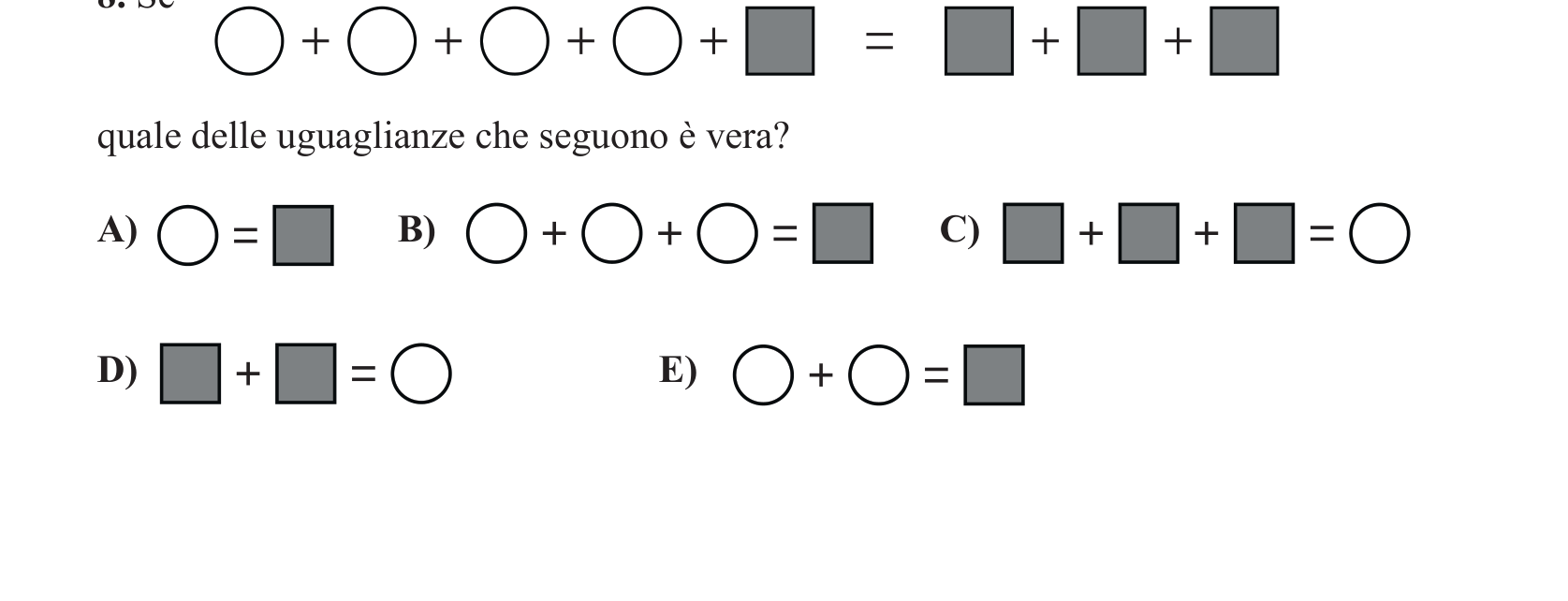
Se quale delle uguaglianze che seguono è vera? A)
B)
C) D)
E) 17 13 8 11
- 11 7 2 6
I quesiti dal N. 9 al N. 16 valgono 4 punti ciascuno
Topic: Teoria dei Numeri Abilita: Manipolazione algebrica Area: Aritmetica e Teoria dei Numeri Risposta: E Fonte: apri PDF p.2
True equality between the options given
Which of the following equations is true? A)
B)
C) D)
E) 17 13 8 11 + 11 7 2 6
The questions from N. 9 to N. 16 are worth 4 points each.
Answer: E
Collana equivalente a quella con sei perle
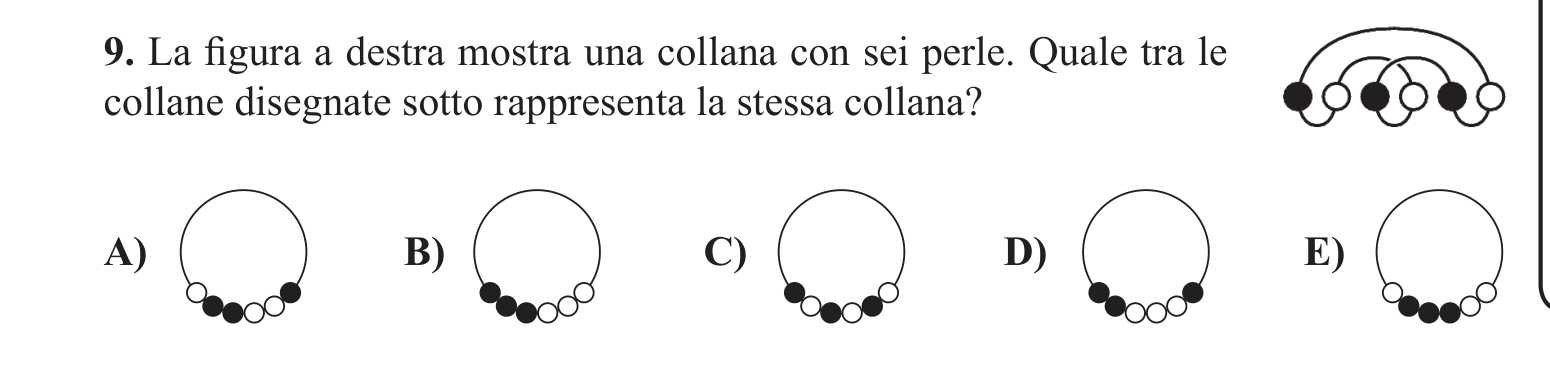
La figura a destra mostra una collana con sei perle. Quale tra le collane disegnate sotto rappresenta la stessa collana? A)
B)
C)
D)
E)
Topic: Geometria piana, Combinatoria Metodo: Sfruttamento della simmetria Abilita: Ragionamento geometrico Area: Combinatoria, Logica e Probabilita, Geometria Risposta: A Fonte: apri PDF p.3
Necklace equivalent to that of six pearls
The figure on the right shows a necklace with six pearls. Which of the necklaces below represents the same necklace? A)
B)
C)
D)
E)
Answer: A
Minimo buste per 70 palloncini (5,10,25)
I palloncini sono in vendita in buste da 5, 10 e 25 pezzi. Mario acquista esatta mente 70 palloncini. Qual è il più piccolo numero di buste che può aver acquistato? A) 3
B) 4
C) 5
D) 6
E) 7
Topic: Teoria dei Numeri Metodo: Analisi per casi Abilita: Conteggio sistematico Area: Aritmetica e Teoria dei Numeri Risposta: B Fonte: apri PDF p.3
Minimum packets for 70 balloons (5,10,25)
The balloons are for sale in packets of 5, 10 and 25. Mario purchases exactly 70 balloons. What’s the smallest number of packets he can buy? A) 3
B) 4
C) 5
D) 6
E) 7
Answer: B
Come Roby aveva piegato il foglio dato il foro
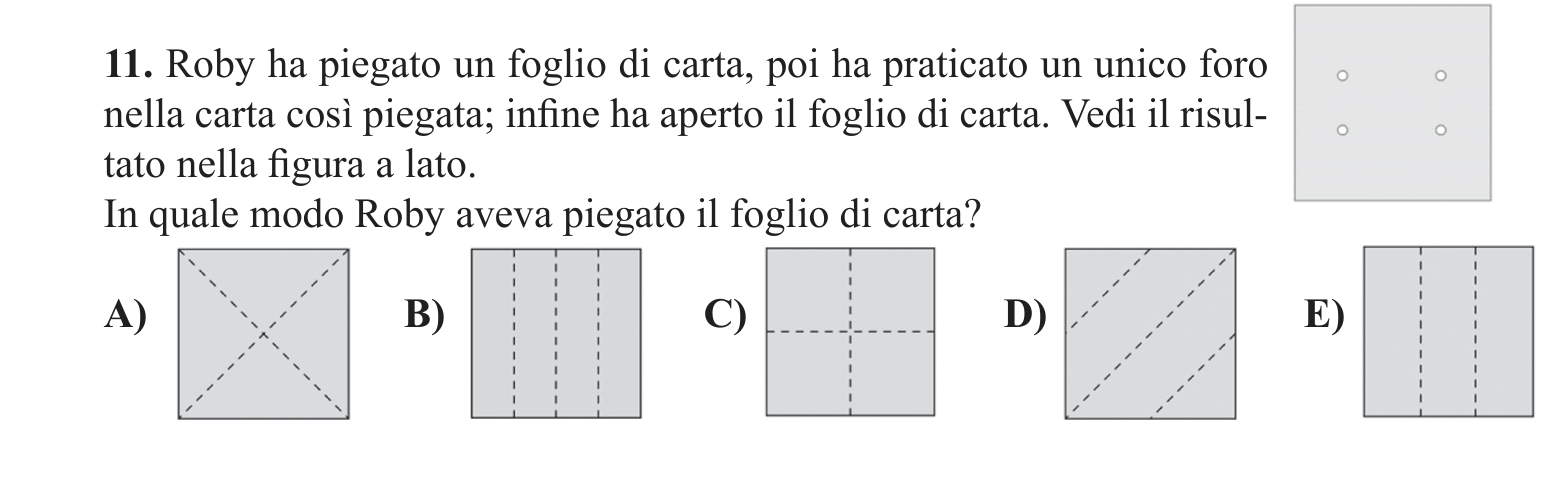
Roby ha piegato un foglio di carta, poi ha praticato un unico foro nella carta così piegata; infine ha aperto il foglio di carta. Vedi il risul tato nella figura a lato. In quale modo Roby aveva piegato il foglio di carta? A)
B)
C)
D)
E)
Topic: Geometria piana Abilita: Ragionamento geometrico Area: Geometria Risposta: C Fonte: apri PDF p.3
How Roby had folded the sheet given the hole.
Roby folded a sheet of paper, then made a single hole in the paper folded in this way; finally, he opened the sheet of paper. See the result in the figure below. How did Roby fold the paper? A)
B)
C)
D)
E)
Answer: C
Minimo ragazzi da iscrivere per sei squadre uguali
Una piscina ha organizzato un torneo a squadre. Prima si sono iscritti 13 ragazzi, poi altri 19. Per il torneo servono sei squadre, tutte con lo stesso numero di membri. Se si vogliono far partecipare tutti i ragazzi già iscritti, qual è il minimo numero di ragazzi che devono iscriversi ancora perché si possano formare le sei squadre? A) 1
B) 2
C) 3
D) 4
E) 5
Topic: Teoria dei Numeri Metodo: congruenze Abilita: traduzione del testo Area: Aritmetica e Teoria dei Numeri Risposta: D Fonte: apri PDF p.3
Minimum boys to sign up for six equal teams
A pool has organized a team tournament. First, 13 boys enrolled, then 19 more. Six teams are needed for the tournament, all with the same number of members. If you want all the boys already enrolled to participate, what is the minimum number of boys who still need to sign up so that the six teams can be formed? A) 1
B) 2
C) 3
D) 4
E) 5
Answer: D
Massima somma di un quadrato 2x2 nella griglia 4x4
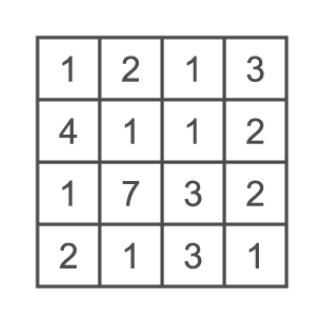
\begin{document}
\begin{tikzpicture}
  \draw[thick] (0,0) grid (4,4);
  \node at (0.5,3.5) {1};
  \node at (1.5,3.5) {2};
  \node at (2.5,3.5) {1};
  \node at (3.5,3.5) {3};
  \node at (0.5,2.5) {4};
  \node at (1.5,2.5) {1};
  \node at (2.5,2.5) {1};
  \node at (3.5,2.5) {2};
  \node at (0.5,1.5) {1};
  \node at (1.5,1.5) {7};
  \node at (2.5,1.5) {3};
  \node at (3.5,1.5) {2};
  \node at (0.5,0.5) {2};
  \node at (1.5,0.5) {1};
  \node at (2.5,0.5) {3};
  \node at (3.5,0.5) {1};
\end{tikzpicture}
\end{document}
La figura mostra una griglia quadrata 434: in ogni sua cella sono stati inseriti dei numeri. Cerca in tale griglia il quadrato 232 tale che la somma dei numeri nelle sue quattro celle sia la più grande possibile. Quanto vale tale somma? A) 11
B) 12
C) 13
D) 14
E) 15
Topic: Combinatoria, Teoria dei Numeri Metodo: Principio di estremalita Abilita: Conteggio sistematico Area: Aritmetica e Teoria dei Numeri, Combinatoria, Logica e Probabilita Risposta: D Fonte: apri PDF p.3
Maximum sum of a 2x2 square in the 4x4 grid
\begin{document}
\begin{tikzpicture}
  \draw[thick] (0,0) grid (4,4);
  \node at (0.5,3.5) {1};
  \node at (1.5,3.5) {2};
  \node at (2.5,3.5) {1};
  \node at (3.5,3.5) {3};
  \node at (0.5,2.5) {4};
  \node at (1.5,2.5) {1};
  \node at (2.5,2.5) {1};
  \node at (3.5,2.5) {2};
  \node at (0.5,1.5) {1};
  \node at (1.5,1.5) {7};
  \node at (2.5,1.5) {3};
  \node at (3.5,1.5) {2};
  \node at (0.5,0.5) {2};
  \node at (1.5,0.5) {1};
  \node at (2.5,0.5) {3};
  \node at (3.5,0.5) {1};
\end{tikzpicture}
\end{document}
The figure shows a 4x4 grid: numbers were inserted into each cell. Look in that grid for a 2x2 square so that the sum of the numbers in its four cells is as large as possible. How much is that? A) 11
B) 12
C) 13
D) 14
E) 15
Answer: D
Minimo minuti per cuocere 5 vivande su due fornelli
Davide vuol cuocere 5 vivande e ha a disposizione solo due fornelli. Ciascuna vivanda ha un tempo di cottura diverso da tutte le altre: 40, 15, 35, 10 e 45 minuti. Qual è il minimo numero di minuti che servono a Davide per finire il lavoro? Tieni presente che Davide non può togliere una vivanda dal fuoco se non è trascorso l’intero tempo di cottura. A) 60
B) 70
C) 75
D) 80
E) 85
Topic: Combinatoria, Logica, giochi, strategie Metodo: Analisi per casi Abilita: Casework accurato Area: Combinatoria, Logica e Probabilita Risposta: C Fonte: apri PDF p.3
Minimum minutes to cook 5 dishes on two ovens
David wants to cook five dishes and has only two ovens. Each meal has a different cooking time: 40, 15, 35, 10 and 45 minutes. What is the minimum number of minutes David needs to finish the job? Note that David cannot take a dish off the heat unless the whole cooking time has elapsed. A) 60
B) 70
C) 75
D) 80
E) 85
Answer: C
Numero nel cerchio col punto di domanda (catena operazioni)
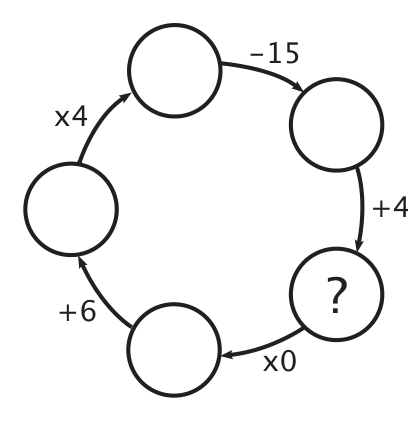
Quale numero deve essere scritto nel cerchio conte nente il punto di domanda? A) 10
B) 11
C) 12
D) 13
E) 14
Topic: Algebra Metodo: Ragionamento all’indietro Abilita: Manipolazione algebrica Area: Algebra e Analisi Risposta: D Fonte: apri PDF p.4
Number in the circle with the question mark (operation chain)
What number must be written in the circle containing the question mark? A) 10
B) 11
C) 12
D) 13
E) 14
Answer: D
Somma dei numeri sotto le due macchie sulla pianta
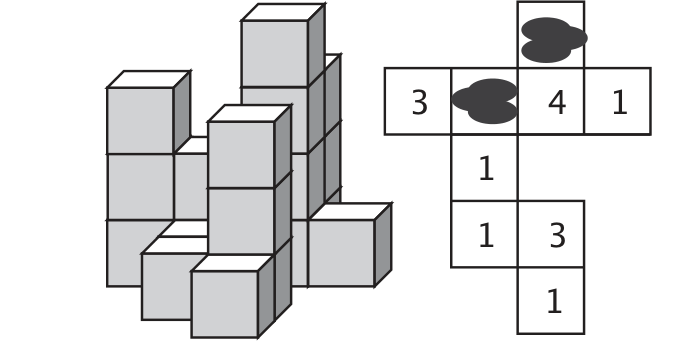
La figura mostra una costruzione fatta con cubi di legno sovrapposti e accostati e una pian ta della stessa costruzione. Per ogni quadrato della pianta, il numero che vi compare indica quanti cubi si trovano sopra quel quadrato. Due macchie di inchiostro sono cadute sulla pianta. Qual è la somma dei numeri sotto le macchie? A) 5
B) 4
C) 6
D) 3
E) 7 I quesiti dal N. 17 al N. 24 valgono 5 punti ciascuno
Topic: Geometria solida Abilita: Ragionamento geometrico Area: Geometria Risposta: A Fonte: apri PDF p.4
sum of numbers under the two spots on the plan
The figure shows a construction made of overlapping wooden cubes and a plan of the same construction. For every square of the plan, the number that appears indicates how many cubes are above that square. Two ink stains fell on the plan. What’s the sum of the numbers under the stains? A) 5
B) 4
C) 6
D) 3
E) 7 Questions from N. 17 to N. 24 are worth five points each.
Answer: A
Quadrati per raddoppiare il perimetro di un rettangolo 1x10

\begin{document}
\begin{tikzpicture}
  \draw[thick] (0,0) rectangle (10,1);
  \foreach \x in {1,2,...,9} {
    \draw[thick] (\x,0) -- (\x,1);
  }
\end{tikzpicture}
\end{document}
Un rettangolo ha lati lunghi 1 cm e 10 cm (come suggerito dalla figura). Di quanti quadrati di lato 1 cm lo si deve prolungare per ottenere un rettangolo di perimetro doppio? A) 9
B) 10
C) 11
D) 12
E) 20
Topic: Geometria piana Abilita: Manipolazione algebrica Area: Geometria Risposta: C Fonte: apri PDF p.4
Squares for doubling the perimeter of a rectangle 1x10
\begin{document}
\begin{tikzpicture}
  \draw[thick] (0,0) rectangle (10,1);
  \foreach \x in {1,2,...,9} {
    \draw[thick] (\x,0) -- (\x,1);
  }
\end{tikzpicture}
\end{document}
A rectangle has sides 1 cm and 10 cm long (as suggested by the figure). By how many squares of side 1 cm must it be extended to obtain a rectangle with double the perimeter? A) 9
B) 10
C) 11
D) 12
E) 20
Answer: C
Quanti metri e lungo il treno (340 m e 110 m)

Quanti metri è lungo il treno? A) 55
B) 115 C) 170 D) 220 E) 230
Topic: Algebra Abilita: traduzione del testo Area: Algebra e Analisi Risposta: B Fonte: apri PDF p.4
How many metres is the train long? (340 m and 110 m)
How long is the train? A) 55
B) 115 C) 170 D) 220 E) 230
Answer: B
Ora limite per lasciare casa e arrivare in orario al coro
Le prove del coro iniziano alle 5 del pomeriggio e, per andarci, Giorgio deve prendere l’autobus. Sa che: • gli servono 5 minuti per andare da casa sua alla fermata dell’autobus; • dalle 6:15 del mattino in poi, l’autobus passa da tale fermata ogni 10 minuti; • il percorso in autobus dura 15 minuti; • gli servono altri 5 minuti per andare dalla fermata dell’autobus alla sede del coro. A che ora, al più tardi, deve lasciare casa sua per essere sicuro di arrivare in orario alle prove? A) 16:20 B) 16:25 C) 16:30 D) 16:35 E) 16:45 ? +4 -15
x4 x0 +6 3 4 1 1 3 1 1 340 m 110 m
Topic: Logica, giochi, strategie, Teoria dei Numeri Metodo: Ragionamento all’indietro Abilita: traduzione del testo Area: Aritmetica e Teoria dei Numeri, Combinatoria, Logica e Probabilita Risposta: C Fonte: apri PDF p.4
Time limit to leave home and arrive at the choir on time
The choir rehearsals begin at 5 p.m. and, to get there, Giorgio has to take the bus. He knows that: • he needs 5 minutes to get from his home to the bus stop; • from 6:15 a.m. onwards, the bus passes through that stop every 10 minutes; • the bus journey takes 15 minutes; • he needs another 5 minutes to get from the bus stop to the choir. At what time, at the latest, must he leave his home to be sure to arrive on time for the rehearsal? A) 16:20 B) 16:25 C) 16:30 D) 16:35 E) 16:45 ? +4 -15
x4 x0 +6 3 4 1 1 3 1 1 340 m 110 m
Answer: C
Modi di vedere due neonati senza iniziare dal leone
Allo zoo sono nati da poco una giraffa, un elefante, un leone e un orso. Susanna ha poco tempo, ma vuole andare a vedere due diversi neonati, senza però iniziare dal leone. In quanti modi diversi può procedere? A) 3
B) 7
C) 8
D) 9
E) 12
Topic: Combinatoria Metodo: Conteggio combinatorio Abilita: Conteggio sistematico Area: Combinatoria, Logica e Probabilita Risposta: D Fonte: apri PDF p.5
How to see two newborns without starting with the lion
A giraffe, an elephant, a lion and a bear were born recently at the zoo. Susanna has little time, but she wants to go see two different babies, but not start with the lion. How many different ways can you proceed? A) 3
B) 7
C) 8
D) 9
E) 12
Answer: D
Pizzette del ragazzo che ne ha mangiato di piu
Quattro fratelli hanno mangiato in tutto 11 pizzette. Ognuno di essi ne ha mangiato almeno una e nessuno di loro ha mangiato lo stesso numero di pizzette. Tre di loro hanno mangiato in tutto 9 pizzette e uno di loro ha mangiato esattamente 3 pizzette. Quante pizzette sono state mangiate dal ragazzo che ne ha mangiato il maggior nu mero? A) 3
B) 4
C) 5
D) 6
E) 7
Topic: Teoria dei Numeri, Logica, giochi, strategie Abilita: Casework accurato Area: Aritmetica e Teoria dei Numeri, Combinatoria, Logica e Probabilita Risposta: C Fonte: apri PDF p.5
The guy who ate the most small pizzas.
Four brothers ate a total of 11 small pizzas. Each of them ate at least one and none of them ate the same number of small pizzas. Three of them ate a total of nine small pizzas and one of them ate exactly three small pizzas. How many small pizzas did the boy who ate the most eat? A) 3
B) 4
C) 5
D) 6
E) 7
Answer: C
Quante faccine ha nascosto Lilli (celle confinanti)
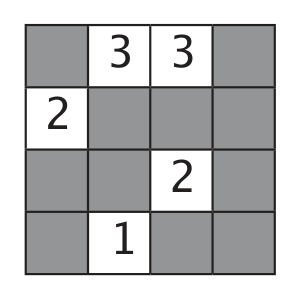
\begin{document}
\begin{tikzpicture}
  \fill[gray!50] (0,3) rectangle (1,4);
  \node at (1.5,3.5) {3};
  \node at (2.5,3.5) {3};
  \fill[gray!50] (3,3) rectangle (4,4);
  \node at (0.5,2.5) {2};
  \fill[gray!50] (1,2) rectangle (4,3);
  \fill[gray!50] (0,1) rectangle (2,2);
  \node at (2.5,1.5) {2};
  \fill[gray!50] (3,1) rectangle (4,2);
  \fill[gray!50] (0,0) rectangle (1,1);
  \node at (1.5,0.5) {1};
  \fill[gray!50] (2,0) rectangle (4,1);
  \draw[thick] (0,0) grid (4,4);
\end{tikzpicture}
\end{document}
In figura vedi una tabella suddivisa in celle: se hanno in comune un lato o anche solo un vertice diremo che le due celle sono confi nanti. In alcune delle celle Lilli ha disegnato una faccina e in alcune delle altre celle ha scritto il numero totale di faccine che stan no nelle celle confinanti. Poi ha coperto con dei cartoncini tutte le celle che non contengono numeri. Quante faccine ha nascosto Lilli? A) 4
B) 5
C) 7
D) 8
E) 11
Topic: Combinatoria, Logica, giochi, strategie Abilita: Casework accurato Area: Combinatoria, Logica e Probabilita Risposta: B Fonte: apri PDF p.5
How many smileys did Lilli hide (neighboring cells)
\begin{document}
\begin{tikzpicture}
  \fill[gray!50] (0,3) rectangle (1,4);
  \node at (1.5,3.5) {3};
  \node at (2.5,3.5) {3};
  \fill[gray!50] (3,3) rectangle (4,4);
  \node at (0.5,2.5) {2};
  \fill[gray!50] (1,2) rectangle (4,3);
  \fill[gray!50] (0,1) rectangle (2,2);
  \node at (2.5,1.5) {2};
  \fill[gray!50] (3,1) rectangle (4,2);
  \fill[gray!50] (0,0) rectangle (1,1);
  \node at (1.5,0.5) {1};
  \fill[gray!50] (2,0) rectangle (4,1);
  \draw[thick] (0,0) grid (4,4);
\end{tikzpicture}
\end{document}
In the figure you see a table divided into cells: if they have in common a side or even just a vertex we will say that the two cells are neigh boring. In some of the cells Lilli drew a smiley and in some of the other cells she wrote the total number of smileys that are in the neighboring cells. Then she covered with small cards all the cells that do not contain numbers. How many smileys did Lilli hide? A) 4
B) 5
C) 7
D) 8
E) 11
Answer: B
Monete toccate a Enzo (sacchetti da 1 a 10)
Sul tavolo c’erano dieci sacchetti: ognuno conteneva un diverso numero di monete di cioccolato, da 1 a 10. A ciascuno dei cinque nipotini la nonna ha dato due sacchetti di monete. Ad Alex sono così toccate 5 monete, a Ben 7, a Claudio 9 e a Dario 15. Quante monete di cioccolato sono toccate a Enzo? A) 9
B) 11
C) 13
D) 17
E) 19
Topic: Teoria dei Numeri, Combinatoria Abilita: Casework accurato Area: Aritmetica e Teoria dei Numeri, Combinatoria, Logica e Probabilita Risposta: E Fonte: apri PDF p.5
Coins received by Enzo (sacks 1 to 10)
There were ten bags on the table, each containing a different number of chocolate coins, from 1 to 10. Grandma gave each of the five grandchildren two bags of coins. Alex has five coins, Ben 7, Claudius 9, and Darius 15. How many chocolate coins did Enzo receive? A) 9
B) 11
C) 13
D) 17
E) 19
Answer: E
Quante terze sagome possibili per il rettangolo 12 quadratini
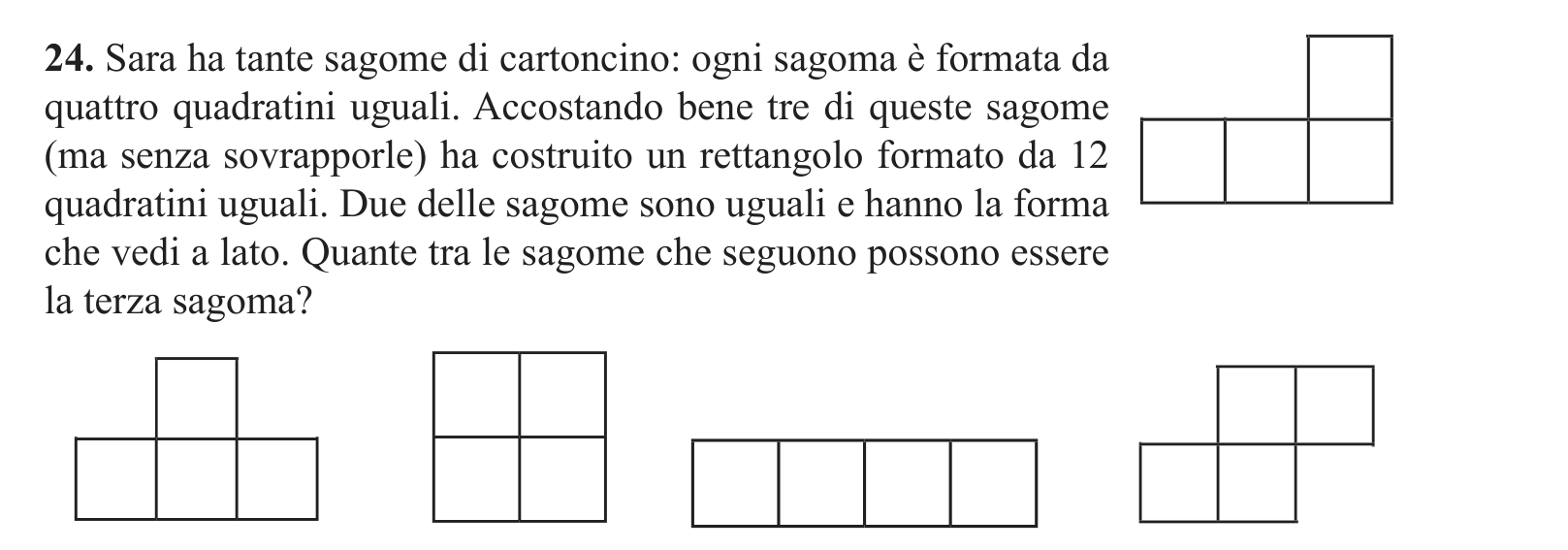
Sara ha tante sagome di cartoncino: ogni sagoma è formata da quattro quadratini uguali. Accostando bene tre di queste sagome (ma senza sovrapporle) ha costruito un rettangolo formato da 12 quadratini uguali. Due delle sagome sono uguali e hanno la forma che vedi a lato. Quante tra le sagome che seguono possono essere la terza sagoma? A) nessuna B) una C) due D) tre
E) tutte 3 3 2 2 1
Topic: Geometria piana, Combinatoria Metodo: Analisi per casi Abilita: Ragionamento geometrico Area: Combinatoria, Logica e Probabilita, Geometria Risposta: D Fonte: apri PDF p.5
How many possible third shapes for the rectangle 12 squares
Sarah has so many cardboard shapes: each shape is made up of four equal squares. By closely matching three of these shapes (but without overlaps) she constructed a rectangle formed by 12 equal squares. Two of the shapes are the same and have the shape you see on the side. How many of the following shapes can be the third shape? A) none B) one C) two D) three
E) all 3 3 2 2 1
Answer: D