Peso del camion vuoto da tre viaggi con 5 t di sabbia
Un mucchio di sabbia pesa tonnellate. Un camion riesce a trasportare tutta la sabbia in viaggi: nel primo viaggio il camion carico pesa kg; nel secondo viaggio pesa kg; nel terzo viaggio pesa kg. Quanti chilogrammi pesa il camion vuoto?
Topic: Teoria dei Numeri Abilita: traduzione del testo Area: Aritmetica e Teoria dei Numeri Risposta: 1950 Fonte: apri PDF p.1
Weight of the empty truck from three trips with 5 t of sand
A pile of sand weighs tons. A truck can transport all the sand in trips: on the first trip the loaded truck weighs kg; on the second trip it weighs kg; on the third trip it weighs kg. How many kilograms does the empty truck weigh?
Answer: 1950
Quoziente (2015+…+2021):2018 nel modo più veloce
Chiama il risultato dell’addizione Quale è, secondo te, il modo più veloce per calcolare il quoziente e qual è il risultato?
Topic: Teoria dei Numeri Metodo: Sfruttamento della simmetria Abilita: Riconoscimento di pattern Area: Aritmetica e Teoria dei Numeri Risposta: 7 Fonte: apri PDF p.1
Quotient (2015+…+2021):2018 in the fastest way
Call the result of the addition What do you think is the fastest way to compute the quotient and what is the result?
Answer: 7
Resto più frequente dividendo per 11 i numeri da 1 a 10000
Matteo ha eseguito la divisione per di ciascuno dei numeri interi da a inclusi: qualche volta ha ottenuto resto , altre volte no. Qual è il resto che ha ottenuto più volte?
Topic: Teoria dei Numeri Metodo: congruenze Abilita: Conteggio sistematico Area: Aritmetica e Teoria dei Numeri Risposta: 1 Fonte: apri PDF p.1
Most frequent remainder when dividing numbers from 1 to 10000 by 11
Matteo divided each of the integers from to inclusive by : sometimes he got remainder , other times not. What is the remainder he got most often?
Answer: 1
Giri della ruota da 20 denti perché le tacche tornino insieme
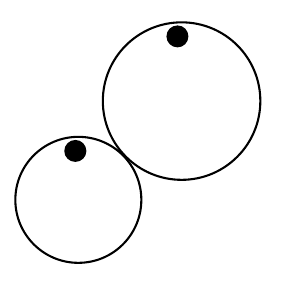
Un ingranaggio è composto da due ruote dentate: una ha denti, l’altra ne ha . Come suggerisce la figura, le due ruote sono a contatto, cioè i denti dell’una agganciano i denti dell’altra ed entrambe hanno una tacca. In questo istante l’ingranaggio si mette in moto: quanti giri dovrà fare la ruota che ha denti prima che le due tacche ritornino contemporaneamente, per la prima volta, nella posizione attuale?
Topic: Teoria dei Numeri Abilita: traduzione del testo Area: Aritmetica e Teoria dei Numeri Risposta: 4 Fonte: apri PDF p.1
Turns of the 20-tooth wheel for the marks to come together again
A gear consists of two toothed wheels: one has teeth, the other has . As the figure suggests, the two wheels are in contact, that is, the teeth of one engage the teeth of the other, and both have a mark. At this instant the gear starts moving: how many turns must the wheel with teeth make before the two marks return simultaneously, for the first time, to their current position?
Answer: 4
Auto nei quattro gruppi meno numerosi per somma cifre della targa
A Kanglandia circolano esattamente mille auto. Le loro targhe, tutte diverse tra loro, hanno tre cifre: i numeri sono dunque compresi fra e . Per ogni auto si sommano le cifre della targa e si ripartiscono le auto in gruppi, in modo che tutte le auto di uno stesso gruppo forniscano la stessa somma e gruppi diversi siano relativi a somme diverse. Quante auto hanno complessivamente i quattro gruppi meno numerosi?
Topic: Combinatoria Metodo: Conteggio combinatorio Abilita: Conteggio sistematico Area: Combinatoria, Logica e Probabilita Risposta: 8 Fonte: apri PDF p.1
Cars in the four least numerous groups by sum of digits of the license plate
In Kangland there are exactly one thousand cars. Their license plates, all different from each other, have three digits: the numbers are therefore between and . For each car, the digits of the license plate are summed and the cars are divided into groups, so that all cars in the same group give the same sum and different groups correspond to different sums. How many cars do the four least numerous groups have in total?
Answer: 8
Giorni per risparmiare 1000 euro con le mance di nonno e zio
Enrico vorrebbe acquistare una bici che costa euro e per avere i soldi necessari pensa di risparmiare, da oggi in poi, tutte le mance che riceve dal nonno e dallo zio. Il nonno ogni settimana gli regala euro, mentre suo zio gli regala euro ogni dieci giorni: oggi ha ricevuto la mancia da entrambi. Quanti giorni basta che trascorrano da oggi perché Enrico possa andare ad acquistare l’agognata bicicletta?
Topic: Teoria dei Numeri Abilita: traduzione del testo Area: Aritmetica e Teoria dei Numeri Risposta: 336 Fonte: apri PDF p.1
Days to save 1000 euros with grandpa’s and uncle’s pocket money
Enrico would like to buy a bike that costs euros and to get the necessary money he plans to save, from today onwards, all the pocket money he receives from his grandpa and his uncle. His grandpa gives him euros every week, while his uncle gives him euros every ten days: today he received pocket money from both. How many days must pass from today for Enrico to be able to go and buy the bike he longs for?
Answer: 336