Spartizione equa di 8 euro a testa o croce interrotta sul 5 a 3
Antonia e Luca si giocano a testa o croce la cifra di euro, lanciando una moneta non truccata. Decidono che la cifra sarà intascata dal primo di loro che avrà avuto lanci a proprio favore. Quando sono sul punteggio di per Antonia e per Luca, sono però costretti ad interrompere il gioco e discutono su come spartirsi gli euro (che nessuno finora ha vinto). Qual è il modo equo di spartirli (cioè il modo che tiene conto della probabilità di vittoria che ognuno dei due ha al momento dell’interruzione)?
Topic: Probabilita e statistica Metodo: Analisi per casi Abilita: traduzione del testo Area: Combinatoria, Logica e Probabilita Risposta: 7 euro ad Antonia e 1 a Luca Fonte: apri PDF p.1
Fair split of 8 euros in a heads-or-tails game interrupted at 5 to 3
Antonia and Luca are playing heads or tails for the sum of euros, tossing a fair coin. They decide that the sum will be pocketed by the first of them to have had tosses in their favor. When they are at the score of for Antonia and for Luca, however, they are forced to interrupt the game and discuss how to split the euros (which neither has won so far). What is the fair way to split them (that is, the way that takes into account the probability of victory that each of the two has at the moment of the interruption)?
Answer: 7 euros to Antonia and 1 to Luca
Area massima di un quadrilatero di lati 1, 4, 7, 8
I lati di un quadrilatero misurano , , , . Quanto può essere la sua area, al massimo?
Topic: Geometria piana Metodo: Principio di estremalita Abilita: Ragionamento geometrico Area: Geometria Risposta: 18 Fonte: apri PDF p.1
Maximum area of a quadrilateral with sides 1, 4, 7, 8
The sides of a quadrilateral measure , , , . What can its area be, at most?
Answer: 18
Carte scartate se P(quattro assi) = 1/1001
Da un mazzo standard di carte, Chiara ha scartato alcune carte, assicurandosi che nel mazzo residuo restassero tutti e quattro gli assi. Ora estrae quattro carte a caso da questo mazzo ridotto. Se la probabilità di estrarre esattamente i quattro assi è , quante carte ha buttato via?
Topic: Probabilita e statistica, Combinatoria Metodo: Conteggio combinatorio Abilita: Manipolazione algebrica Area: Combinatoria, Logica e Probabilita Risposta: 38 Fonte: apri PDF p.1
Discarded cards if P(four aces) = 1/1001
From a standard deck of cards, Chiara discarded some cards, making sure that all four aces remained in the remaining deck. Now she draws four cards at random from this reduced deck. If the probability of drawing exactly the four aces is , how many cards did she throw away?
Answer: 38
Area di B in funzione di A nel pentagono regolare con diagonali
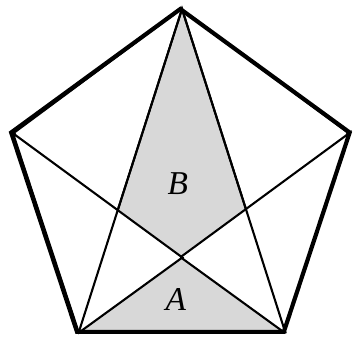
In figura vedi un pentagono regolare di cui sono state tracciate quattro diagonali che individuano due regioni ombreggiate e . Esprimi l’area di in dipendenza dall’area di .
Topic: Geometria piana Abilita: Ragionamento geometrico Area: Geometria Risposta: l’area di B è il doppio di quella di A Fonte: apri PDF p.1
Area of B as a function of A in the regular pentagon with diagonals
In the figure you see a regular pentagon in which four diagonals have been drawn that identify two shaded regions and . Express the area of as a function of the area of .
Answer: the area of B is twice that of A
Dimostrare che la soluzione di x^5+x=10 e irrazionale
Considera già dimostrato il fatto che l’equazione ammette un’unica soluzione (reale positiva). Dimostra che tale soluzione non è un numero razionale (cioè non può essere espressa come quoziente di due numeri interi).
Topic: Algebra, Teoria dei Numeri Metodo: congruenze Abilita: Manipolazione algebrica Area: Algebra e Analisi, Aritmetica e Teoria dei Numeri Risposta: irrazionale (dim.) Fonte: apri PDF p.4
Show that the solution of x^5+x=10 is irrational
Consider as already proven that the equation admits only one solution (real positive). Show that such a solution is not a rational number (i.e. it cannot be expressed as a quotient of two integers).
Answer: irrational (proof)
Dimostrare che esiste un cerchio con esattamente n nodi del reticolo
Immagina il piano come un foglio a quadretti (tutti dello stesso lato) illimitato in ogni direzione e chiama nodo ogni vertice di ogni quadrato. Dimostra che per ogni esiste un cerchio contenente all’interno esattamente nodi.
Topic: Geometria analitica, Teoria dei Numeri Metodo: Metodo delle coordinate Abilita: generalizzazione Area: Aritmetica e Teoria dei Numeri, Geometria Fonte: apri PDF p.1
Prove that there exists a circle with exactly n lattice nodes
Imagine the plane as a sheet of graph paper (all squares of the same side) unlimited in every direction and call node every vertex of every square. Prove that for every there exists a circle containing inside it exactly nodes.