In quanti angoli identici a epsilon si ripartisce il piano
(Punti 2) Tracciando in un piano 5 semirette aventi tutte origine in uno stesso punto O, abbiamo ripartito il piano stesso in 5 angoli α, β, γ, δ, ε, tutti diversi tra loro. Altre ripartizioni del piano possono essere ottenute accostando (con vertice nel punto O) 3 angoli identici ad α, oppure 4 identici a β, oppure 5 identici a γ, oppu re 6 identici a δ. In quanti angoli identici a ε può essere ripartito il piano? A) 12 B) 15 C) 18 D) 20 E) 24
Topic: Geometria piana, Teoria dei Numeri Metodo: congruenze Abilita: Manipolazione algebrica Area: Aritmetica e Teoria dei Numeri, Geometria Risposta: D Fonte: apri PDF p.1
In how many angles identical to epsilon the plane is distributed
(Points 2) Drawing in a plane 5 semicircles all originating in the same point O, we split the plane itself into 5 angles α, β, γ, δ, ε, all different from each other. Other plane distributions can be obtained by approximating (with vertices at point O) 3 angles identical to α, or 4 identical to β, or 5 identical to γ, or 6 identical to δ. In how many angles identical to ε can the plan be divided? A) 12 B) 15 C) 18 D) 20 E) 24
Answer: D src_kangourou_2019_cadet_semif__Q01
Quale poligono non si puo staccare con un taglio
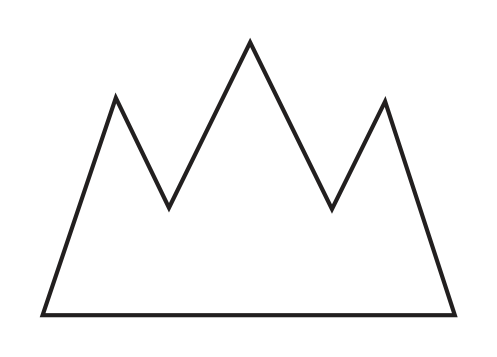
(Punti 3) Da un cartoncino abbiamo ritagliato un poligono di 7 lati come quello rappresentato in figura. Ora, con un solo taglio rettilineo, vogliamo staccare da que sto poligono un altro poligono (come questo, non regolare e neppure convesso) con un diverso numero di lati. Quale dei seguenti poligoni non possiamo staccare? A) Un pentagono
B) Un esagono
C) Un ottagono
D) Un decagono
E) Nessuna delle precedenti risposte è corretta
Topic: Geometria piana, Combinatoria Metodo: Analisi per casi Abilita: Ragionamento geometrico Area: Combinatoria, Logica e Probabilita, Geometria Risposta: E Fonte: apri PDF p.1
Which polygon cannot be detached with a cut
(Points 3) From a cardboard we cut a seven-sided polygon like the one shown in the figure. Now, with a single straight cut, we want to separate from this polygon another polygon (like this one, not regular or even convex) with a different number of sides. Which of the following polygons can’t be detached? A) A pentagon
(b) A hexagon
C) One octagon
D) A decagon
E) None of the above answers is correct
Answer: E src_kangourou_2019_cadet_semif__Q02
Quanti valori di A+B con A869B divisibile per 12
(Punti 3) A e B sono due cifre tali che il numero intero A869B sia divisibile per 12. Quanti possono essere i diversi valori della somma A + B? A) 4
B) 6
C) 8
D) 10 E) 12
Topic: Teoria dei Numeri Metodo: congruenze Abilita: Casework accurato Area: Aritmetica e Teoria dei Numeri Risposta: A Fonte: apri PDF p.1
How many A+B values with A869B divisible by 12
(Points 3) A and B are two digits such that the integer A869B is divisible by 12. How many different values of the sum A + B can be? A) 4
B) 6
C) 8
D) 10 E) 12
Answer: A src_kangourou_2019_cadet_semif__Q03
Quanti giorni minimo per cui la seconda proposta conviene
(Punti 4) Maria è in cerca di lavoro e deve valutare due diverse proposte salariali: la prima proposta preve de un salario giornaliero fisso di 100 euro per ogni giorno di lavoro; la seconda prevede un salario che cresce di 10 euro a ogni giornata di lavoro, incominciando il primo giorno con 50 euro e proseguendo il secondo con 60 euro e così via. Quanti giorni come minimo basta che lavori perché la seconda proposta diventi più vantaggiosa? A) 9
B) 10 C) 11 D) 12 E) 20
Topic: Algebra Abilita: traduzione del testo Area: Algebra e Analisi Risposta: D Fonte: apri PDF p.1
Minimum number of days for which the second proposal is suitable
(Points 4) Maria is looking for work and has to consider two different salary proposals: the first proposal for a fixed daily salary of EUR 100 per working day; the second proposal for a salary that increases by EUR 10 per working day, starting the first day with EUR 50 and continuing the second with EUR 60 and so on. How many days at least do you have to work for the second proposal to be more advantageous? A) 9
B) 10 C) 11 D) 12 E) 20
Answer: D src_kangourou_2019_cadet_semif__Q04
Quale uguaglianza tra b (prodotto divisori di 1024) e a
(Punti 4) Se a = 1024 e b è il prodotto di tutti i divisori (interi positivi) di a, quale delle seguenti uguaglianze è vera? A) b = a4 B) b2 = a11 C) b = a5 D) b3 = a10 E) b = a6
Topic: Teoria dei Numeri Metodo: manipolazione algebrica Abilita: Manipolazione algebrica Area: Aritmetica e Teoria dei Numeri Risposta: B Fonte: apri PDF p.1
What is the equality between b (product of divisors of 1024) and a
(Points 4) If a = 1024 and b is the product of all positive integers of a, which of the following equations is true? A) b = a4 B) b2 = a11 C) b = a5 D) b3 = a10 E) b = a6
Answer: B src_kangourou_2019_cadet_semif__Q05
Numero al terzo posto con somme di consecutivi quadrati
(Punti 4) I numeri interi da 1 a 17 inclusi sono stati allineati in modo che la somma di due numeri con secutivi sia sempre un quadrato perfetto, che il numero al primo posto sia maggiore di quello all’ultimo (e ovviamente nell’allineamento ognuno compaia una e una sola volta). Che numero si trova nel terzo posto dell’allineamento? A) 14 B) 13 C) 4
D) 3
E) 1
Topic: Combinatoria, Teoria dei Numeri Metodo: Analisi per casi Abilita: Casework accurato Area: Aritmetica e Teoria dei Numeri, Combinatoria, Logica e Probabilita Risposta: E Fonte: apri PDF p.1
Number in third place with sums of consecutive squares
The integers 1 to 17 included have been aligned so that the sum of two consecutive numbers is always a perfect square, and the number in the first place is greater than the number in the last (and of course in the alignment each one appears only once). What number is in the third position of the alignment? A) 14 B) 13 C) 4
D) 3
E) 1
Answer: E src_kangourou_2019_cadet_semif__Q06
Quanti diversi decori di esagoni con triangolini colorati
\begin{document}
\begin{tikzpicture}[scale=2]
  \coordinate (A) at (0,0);
  \coordinate (B) at (2,0);
  \coordinate (C) at (1,1.732);
  \coordinate (M) at (1,0.577);
  \fill[gray!50] (A) -- (C) -- (M) -- cycle;
  \fill[gray!50] (B) -- (C) -- (M) -- cycle;
  \fill[white] (A) -- (B) -- (M) -- cycle;
  \draw[thick] (A) -- (B) -- (C) -- cycle;
  \draw[thick] (A) -- (M);
  \draw[thick] (B) -- (M);
  \draw[thick] (C) -- (M);
\end{tikzpicture}
\end{document}
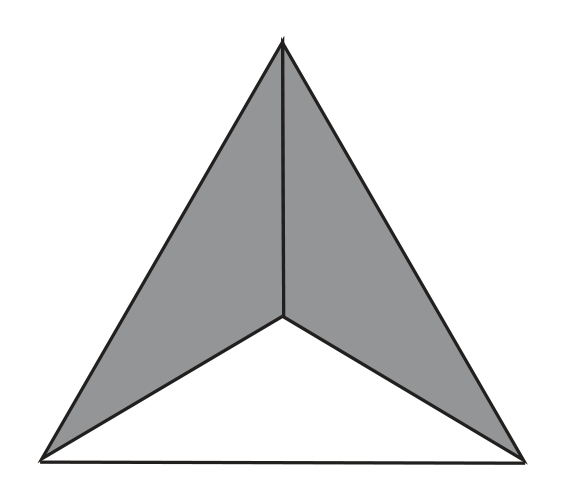
(Punti 5) Accostando sei triangoli equilateri uguali si ottiene un esagono rego lare. Supponi che i triangoli equilateri di partenza siano ripartiti ciascuno in tre triangolini (uguali) con un vertice nel centro del triangolo equilatero, di cui due grigi e uno bianco (vedi figura). Supponi di accostarli in modo che lungo ciascu no dei lati di congiunzione dei triangoli equilateri compaiano sempre triangolini di ugual colore. Quanti diversi “decori” di esagoni potresti ottenere? A) 6
B) 5
C) 4
D) 3
E) 2
Topic: Combinatoria Metodo: Conteggio combinatorio, Sfruttamento della simmetria Abilita: Conteggio sistematico Area: Combinatoria, Logica e Probabilita Risposta: B Fonte: apri PDF p.1
How many different hexagonal decoration with coloured triangles
\begin{document}
\begin{tikzpicture}[scale=2]
  \coordinate (A) at (0,0);
  \coordinate (B) at (2,0);
  \coordinate (C) at (1,1.732);
  \coordinate (M) at (1,0.577);
  \fill[gray!50] (A) -- (C) -- (M) -- cycle;
  \fill[gray!50] (B) -- (C) -- (M) -- cycle;
  \fill[white] (A) -- (B) -- (M) -- cycle;
  \draw[thick] (A) -- (B) -- (C) -- cycle;
  \draw[thick] (A) -- (M);
  \draw[thick] (B) -- (M);
  \draw[thick] (C) -- (M);
\end{tikzpicture}
\end{document}
(Points 5) Approaching six equilateral triangles equals a regular hexagon. Assume that the starting equilateral triangles are each divided into three triangles (equal) with one vertex in the center of the equilateral triangle, of which two are grey and one is white (see figure). Suppose that they are brought together so that along each of the conjunction sides of the equilateral triangles there are always triangles of equal colour. How many different hexagonal decorations could you get? A) 6
B) 5
C) 4
D) 3
E) 2
Answer: B src_kangourou_2019_cadet_semif__Q07
Somma del piu piccolo e piu grande di 1009 consecutivi
(Punti 5) La somma di 1009 interi consecutivi è 20182019. Quanto vale la somma del più piccolo e del più grande di questi numeri? A) 4 × 20182018 B) 10092019
C) 4 × 10092019 D) 20181010
E) 20182019 - 1.
Topic: Teoria dei Numeri, Algebra Abilita: Manipolazione algebrica Area: Algebra e Analisi, Aritmetica e Teoria dei Numeri Risposta: A Fonte: apri PDF p.1
*sum of the smallest and largest of 1009 consecutive *
(Points 5) The sum of 1009 consecutive integers is 2018-2019. How much is the sum of the smallest and largest of these numbers? A) 4 × 20182018 B) 10092019
C) 4 × 10092019 D) 20181010
E) 20182019 - 1.
Answer: A src_kangourou_2019_cadet_semif__Q08
Ultima cifra di 2019N dati i divisori di 2N e 3N*
(Punti 6) Il doppio di un numero intero positivo N ha 6 diversi divisori interi; invece il triplo di N ha 4 diversi divisori interi. Qual è l’ultima cifra del numero 2019×N ? Nota: tra i divisori di un numero sono compresi 1 e il numero stesso. A) 1
B) 3
C) 8
D) 9
E) È impossibile stabilirlo
Quesiti a risposta aperta
Topic: Teoria dei Numeri Metodo: manipolazione algebrica Abilita: Casework accurato Area: Aritmetica e Teoria dei Numeri Risposta: A Fonte: apri PDF p.1
Last figure for 2019N data for the 2N and 3N dividers*
(Points 6) The double of a positive integer N has 6 different integer divisors; whereas the triple of N has 4 different integer divisors. What is the last digit of the number 2019×N? Note: The divisors of a number include 1 and the number itself. A) 1
B) 3
C) 8
D) 9
E) It is impossible to establish
Open-ended questions
Answer: A src_kangourou_2019_cadet_semif__Q09
Valore di M numero a due cifre con Mk=2331*
(Punti 4) Davide ha scritto un numero intero positivo M di due cifre (significative). Ha notato che, molti plicandolo per un altro intero positivo minore di M, ottiene il numero 2331. Quanto vale M?
Topic: Teoria dei Numeri Metodo: manipolazione algebrica Abilita: Manipolazione algebrica Area: Aritmetica e Teoria dei Numeri Risposta: 63 Fonte: apri PDF p.2
M value is a two digit number with Mk=2331*
David wrote a two-digit positive integer M (significant). He noted that, when many people ask for another positive integer less than M, he gets the number 2331. How much is M?
Answer: 63 src_kangourou_2019_cadet_semif__Q10
Quanti minuti per riempire il serbatoio con 10 rubinetti
(Punti 5) Un serbatoio può essere riempito con 10 rubinetti. Uno di essi può riempirlo in 1 giorno; due dei rimanenti lo possono riempire ciascuno in 12 ore, 3 dei rimanenti lo possono riempire ciascuno in 8 ore e i rimanenti 4 lo possono riempire ciascuno in 6 ore. Se tutti i rubinetti vengono aperti simultaneamente, quanti minuti sono necessari (e sufficienti) per riempire il serbatoio?
Topic: Teoria dei Numeri, Algebra Abilita: traduzione del testo Area: Algebra e Analisi, Aritmetica e Teoria dei Numeri Risposta: 48 Fonte: apri PDF p.2
How many minutes to fill the tank with 10 taps
(Points 5) A tank can be filled with 10 taps. One of them can fill it in 1 day; two of the remaining can fill it each in 12 hours, three of the remaining can fill it each in 8 hours and the remaining 4 can fill it each in 6 hours. If all the taps are opened simultaneously, how many minutes (and enough) are needed to fill the tank?
Answer: 48 src_kangourou_2019_cadet_semif__Q11
Quale carta non e stata pescata (resti mod 3,4,5)
(Punti 5) Da uno stesso mazzo di 7 sette carte, ognuna numerata con un diverso numero da 1 a 7, Alice, Bianca e Carla prendono ciascuna due carte. Scoprono che entrambe le carte pescate da Alice danno lo stesso resto quando divise per 3, entrambe quelle pescate da Bianca danno lo stesso resto quando divise per 4 ed entrambe quelle pescate da Carla danno lo stesso resto quando divise per 5. Quale carta non è stata pescata? Date come risposta 9999 se pensate che non sia possibile stabilirlo con certezza.
Topic: Teoria dei Numeri, Combinatoria Metodo: Analisi per casi, congruenze Abilita: Casework accurato Area: Aritmetica e Teoria dei Numeri, Combinatoria, Logica e Probabilita Risposta: 4 Fonte: apri PDF p.2
*Which paper has not been fished (residues mod 3.4,5) *
(Points 5) From the same deck of seven cards, each numbered with a different number from 1 to 7, Alice, Bianca, and Carla each take two cards. They find that both of Alice’s cards give the same remainder when she divides by 3, both of Bianca’s cards give the same remainder when she divides by 4, and both of Carla’s cards give the same remainder when she divides by 5. What paper hasn’t been caught? Give 9999 as an answer if you think it’s impossible to establish for sure.
Answer: 4 src_kangourou_2019_cadet_semif__Q12
Perimetro del rettangolo R diviso in 4 rettangoli
(Punti 6) Un rettangolo R è ripartito da due rette in 4 rettangoli. Si sa che tre dei perimetri di tali rettan goli sono 11 cm, 16 cm e 19 cm e che il perimetro del quarto non è né il più piccolo né il più grande. Quanti centimetri misura il perimetro del rettangolo R ?
Topic: Geometria piana, Algebra Abilita: Manipolazione algebrica Area: Algebra e Analisi, Geometria Risposta: 30 Fonte: apri PDF p.2
Perimeter of rectangle R divided by 4 rectangles
(Points 6) A rectangle R is divided by two lines into 4 rectangles. It is known that three of the perimeter of these rectangles are 11 cm, 16 cm and 19 cm and that the perimeter of the fourth is neither the smallest nor the largest. How many centimeters does the perimeter of the R rectangle measure ?
Answer: 30 src_kangourou_2019_cadet_semif__Q13
Massimo pedine sul 21-agono con distanze tutte diverse
\begin{document}
\begin{tikzpicture}
  \draw[thick] (0.0000,2.0000) -- (-0.5895,1.9111);
  \draw[thick] (-0.5895,1.9111) -- (-1.1266,1.6525);
  \draw[thick] (-1.1266,1.6525) -- (-1.5637,1.2470);
  \draw[thick] (-1.5637,1.2470) -- (-1.8617,0.7307);
  \draw[thick] (-1.8617,0.7307) -- (-1.9944,0.1495);
  \draw[thick] (-1.9944,0.1495) -- (-1.9499,-0.4450);
  \draw[thick] (-1.9499,-0.4450) -- (-1.7321,-1.0000);
  \draw[thick] (-1.7321,-1.0000) -- (-1.3603,-1.4661);
  \draw[thick] (-1.3603,-1.4661) -- (-0.8678,-1.8019);
  \draw[thick] (-0.8678,-1.8019) -- (-0.2981,-1.9777);
  \draw[thick] (-0.2981,-1.9777) -- (0.2981,-1.9777);
  \draw[thick] (0.2981,-1.9777) -- (0.8678,-1.8019);
  \draw[thick] (0.8678,-1.8019) -- (1.3603,-1.4661);
  \draw[thick] (1.3603,-1.4661) -- (1.7321,-1.0000);
  \draw[thick] (1.7321,-1.0000) -- (1.9499,-0.4450);
  \draw[thick] (1.9499,-0.4450) -- (1.9944,0.1495);
  \draw[thick] (1.9944,0.1495) -- (1.8617,0.7307);
  \draw[thick] (1.8617,0.7307) -- (1.5637,1.2470);
  \draw[thick] (1.5637,1.2470) -- (1.1266,1.6525);
  \draw[thick] (1.1266,1.6525) -- (0.5895,1.9111);
  \draw[thick] (0.5895,1.9111) -- (0.0000,2.0000);
  \draw[fill=white] (0.0000,2.0000) circle (0.1);
  \draw[fill=white] (-0.5895,1.9111) circle (0.1);
  \draw[fill=white] (-1.1266,1.6525) circle (0.1);
  \draw[fill=white] (-1.5637,1.2470) circle (0.1);
  \draw[fill=white] (-1.8617,0.7307) circle (0.1);
  \draw[fill=white] (-1.9944,0.1495) circle (0.1);
  \draw[fill=white] (-1.9499,-0.4450) circle (0.1);
  \draw[fill=white] (-1.7321,-1.0000) circle (0.1);
  \draw[fill=white] (-1.3603,-1.4661) circle (0.1);
  \draw[fill=white] (-0.8678,-1.8019) circle (0.1);
  \draw[fill=white] (-0.2981,-1.9777) circle (0.1);
  \draw[fill=white] (0.2981,-1.9777) circle (0.1);
  \draw[fill=white] (0.8678,-1.8019) circle (0.1);
  \draw[fill=white] (1.3603,-1.4661) circle (0.1);
  \draw[fill=white] (1.7321,-1.0000) circle (0.1);
  \draw[fill=white] (1.9499,-0.4450) circle (0.1);
  \draw[fill=white] (1.9944,0.1495) circle (0.1);
  \draw[fill=white] (1.8617,0.7307) circle (0.1);
  \draw[fill=white] (1.5637,1.2470) circle (0.1);
  \draw[fill=white] (1.1266,1.6525) circle (0.1);
  \draw[fill=white] (0.5895,1.9111) circle (0.1);
\end{tikzpicture}
\end{document}
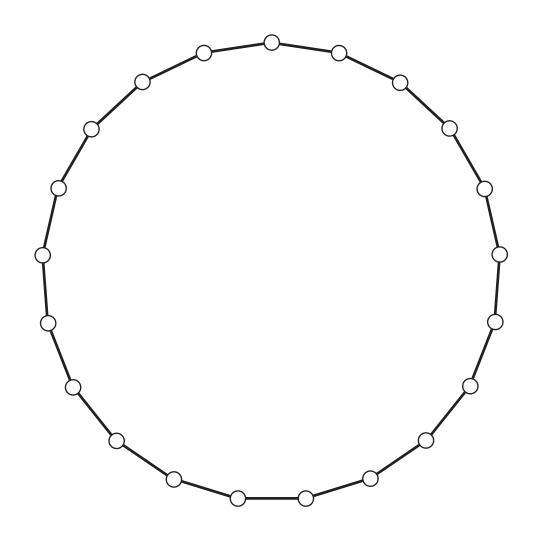
(Punti 6) In figura vedi un poligono regolare di 21 lati. Andrea ha molte pedine che vuole disporre sui vertici di tale poligono in modo tale che, per ogni coppia di vertici coperti da pedine, le distanze tra i vertici siano tutte differenti. Quante pedine al massimo può posizionare?
Topic: Combinatoria, Geometria piana Metodo: Principio di estremalita Abilita: generalizzazione Area: Combinatoria, Logica e Probabilita, Geometria Risposta: 5 Fonte: apri PDF p.2
Major pedals on the 21-axle with all different distances
\begin{document}
\begin{tikzpicture}
  \draw[thick] (0.0000,2.0000) -- (-0.5895,1.9111);
  \draw[thick] (-0.5895,1.9111) -- (-1.1266,1.6525);
  \draw[thick] (-1.1266,1.6525) -- (-1.5637,1.2470);
  \draw[thick] (-1.5637,1.2470) -- (-1.8617,0.7307);
  \draw[thick] (-1.8617,0.7307) -- (-1.9944,0.1495);
  \draw[thick] (-1.9944,0.1495) -- (-1.9499,-0.4450);
  \draw[thick] (-1.9499,-0.4450) -- (-1.7321,-1.0000);
  \draw[thick] (-1.7321,-1.0000) -- (-1.3603,-1.4661);
  \draw[thick] (-1.3603,-1.4661) -- (-0.8678,-1.8019);
  \draw[thick] (-0.8678,-1.8019) -- (-0.2981,-1.9777);
  \draw[thick] (-0.2981,-1.9777) -- (0.2981,-1.9777);
  \draw[thick] (0.2981,-1.9777) -- (0.8678,-1.8019);
  \draw[thick] (0.8678,-1.8019) -- (1.3603,-1.4661);
  \draw[thick] (1.3603,-1.4661) -- (1.7321,-1.0000);
  \draw[thick] (1.7321,-1.0000) -- (1.9499,-0.4450);
  \draw[thick] (1.9499,-0.4450) -- (1.9944,0.1495);
  \draw[thick] (1.9944,0.1495) -- (1.8617,0.7307);
  \draw[thick] (1.8617,0.7307) -- (1.5637,1.2470);
  \draw[thick] (1.5637,1.2470) -- (1.1266,1.6525);
  \draw[thick] (1.1266,1.6525) -- (0.5895,1.9111);
  \draw[thick] (0.5895,1.9111) -- (0.0000,2.0000);
  \draw[fill=white] (0.0000,2.0000) circle (0.1);
  \draw[fill=white] (-0.5895,1.9111) circle (0.1);
  \draw[fill=white] (-1.1266,1.6525) circle (0.1);
  \draw[fill=white] (-1.5637,1.2470) circle (0.1);
  \draw[fill=white] (-1.8617,0.7307) circle (0.1);
  \draw[fill=white] (-1.9944,0.1495) circle (0.1);
  \draw[fill=white] (-1.9499,-0.4450) circle (0.1);
  \draw[fill=white] (-1.7321,-1.0000) circle (0.1);
  \draw[fill=white] (-1.3603,-1.4661) circle (0.1);
  \draw[fill=white] (-0.8678,-1.8019) circle (0.1);
  \draw[fill=white] (-0.2981,-1.9777) circle (0.1);
  \draw[fill=white] (0.2981,-1.9777) circle (0.1);
  \draw[fill=white] (0.8678,-1.8019) circle (0.1);
  \draw[fill=white] (1.3603,-1.4661) circle (0.1);
  \draw[fill=white] (1.7321,-1.0000) circle (0.1);
  \draw[fill=white] (1.9499,-0.4450) circle (0.1);
  \draw[fill=white] (1.9944,0.1495) circle (0.1);
  \draw[fill=white] (1.8617,0.7307) circle (0.1);
  \draw[fill=white] (1.5637,1.2470) circle (0.1);
  \draw[fill=white] (1.1266,1.6525) circle (0.1);
  \draw[fill=white] (0.5895,1.9111) circle (0.1);
\end{tikzpicture}
\end{document}
(Points 6) In the figure you see a regular polygon of 21 sides. Andrea has a lot of pedals that she wants to place on the vertices of this polygon so that, for each pair of pedal-covered vertices, the distances between the vertices are all different. How many pedals can he place?
Answer: 5 src_kangourou_2019_cadet_semif__Q14
In quanti modi scegliere n con percentuale rossa intera
(Punti 6) Chiara vuole colorare di rosso oppure di blu ogni quadretto di una griglia 6×10. Vuole che en trambi i colori siano presenti e che la percentuale della superficie che risulterà rossa dopo la colorazione sia n%, con n numero intero. In quanti modi diversi può scegliere n ?
Topic: Teoria dei Numeri, Combinatoria Metodo: congruenze Abilita: Conteggio sistematico Area: Aritmetica e Teoria dei Numeri, Combinatoria, Logica e Probabilita Risposta: 19 Fonte: apri PDF p.2
How many ways to choose n with whole red percentage
(Points 6) Clear wants to colour each square of a grid 6×10 in red or blue. It requires that both colours are present and that the percentage of the surface which will be red after colouring is n%, with n being an integer. How many different ways can you choose n ?
Answer: 19 src_kangourou_2019_cadet_semif__Q15
Rapporto eta mamma/Mara tra lo stesso numero di anni
(Punti 7) Oggi è il compleanno di Mara e di sua mamma: l’età della mamma è il quintuplo di quella di Mara e un certo numero di anni fa era addirittura sette volte l’età di Mara. Tra lo stesso numero di anni, divi dendo l’età della mamma per quella di Mara che numero si otterrà?
Topic: Algebra, Teoria dei Numeri Abilita: Manipolazione algebrica Area: Algebra e Analisi, Aritmetica e Teoria dei Numeri Risposta: 4 Fonte: apri PDF p.2
*Mother/Mother ratio between the same number of years *
Today is the birthday of Mara and her mother: her mother’s age is five times that of Mara and some years ago she was seven times her age. Between the same number of years, dividing the age of the mother by that of Mara, what number will be obtained?
Answer: 4 src_kangourou_2019_cadet_semif__Q16
Quanti allievi presenti date le differenze di eta media
(Punti 7) Un professore è in un’aula con alcuni suoi allievi. L’età del professore supera di 24 anni l’età media dei suoi allievi presenti e di 20 anni l’età media di tutti i presenti, professore e allievi. Quanti sono gli allievi presenti?
Topic: Algebra Abilita: Manipolazione algebrica Area: Algebra e Analisi Risposta: 5 Fonte: apri PDF p.2
How many pupils are present given the differences in middle age
(Points 7) A teacher is in a classroom with some of his pupils. The average age of the teacher is 24 years above the average age of his pupils and 20 years above the average age of all present, teachers and pupils. How many students are there?
Answer: 5 src_kangourou_2019_cadet_semif__Q17
Quanti vertici nel poligono con angoli alternati 120 e 150
(Punti 8) In un poligono convesso gli angoli misurano, alternatamente, 120 gradi e 150 gradi. Quanti ver tici ha il poligono?
0063 0048 0004 0030 0005 0019 0004 0005 0008
Topic: Geometria piana Abilita: Manipolazione algebrica Area: Geometria Risposta: 8 Fonte: apri PDF p.2
Numbers of vertices in the polygon with alternating angles 120 and 150
(Points 8) In a convex polygon the angles measure, alternately, 120 degrees and 150 degrees. How many vertices does the polygon have?
0063 0048 0004 0030 0005 0019 0004 0005 0008
Answer: 8 src_kangourou_2019_cadet_semif__Q18