Mele verdi nella cassetta se tre a caso ne contengono sempre una verde
In una cassetta ci sono mele: alcune sono verdi e le rimanenti sono rosse. Ti hanno detto che, se ne prendi tre a caso, sicuramente almeno una è verde. Marco ne ha appena prese e due di queste sono rosse. Quante mele verdi ci sono nella cassetta?
Topic: Logica, giochi, strategie, Combinatoria Metodo: Principio dei cassetti Abilita: Lettura attenta del testo Area: Combinatoria, Logica e Probabilita Risposta: 22 Fonte: apri PDF p.1
Green apples in the crate if three at random always contain at least one green
In a crate there are apples: some are green and the remaining ones are red. You have been told that, if you take three at random, surely at least one is green. Marco has just taken and two of these are red. How many green apples are there in the crate?
Answer: 22
Lati interi dei quadrati per una cornice attorno a un quadrato di lato 6
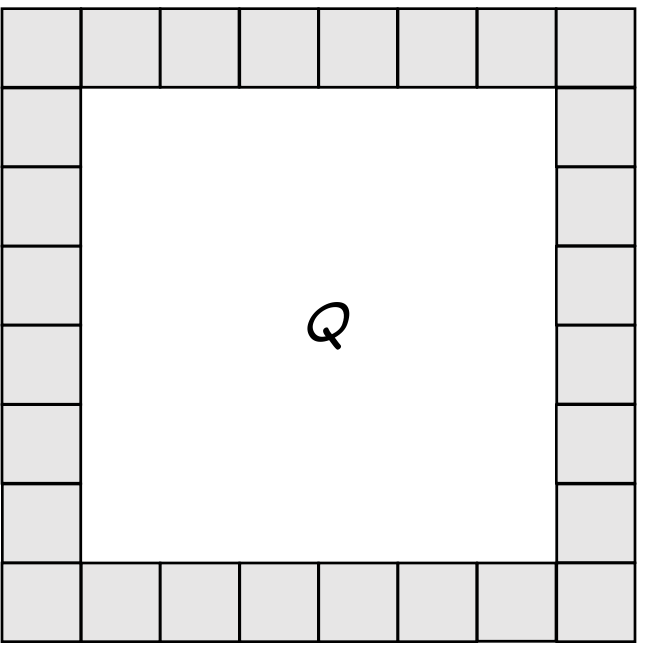
Ho un quadrato di cm di lato. Voglio ottenere un nuovo quadrato contornandolo con quadrati tutti uguali fra loro e voglio che i lati di questi quadrati misurino un numero intero di centimetri. Quali possono essere le misure dei lati dei quadrati da usare come contorno? La figura ti mostra per esempio che cosa posso fare con quadrati di lato cm.
Topic: Geometria piana, Teoria dei Numeri Abilita: Ragionamento geometrico Area: Aritmetica e Teoria dei Numeri, Geometria Risposta: 1 cm, 2 cm, 3 cm, 6 cm Fonte: apri PDF p.1
Integer sides of the squares for a frame around a square with side 6
I have a square with a side of cm. I want to obtain a new square by surrounding it with squares that are all equal to each other, and I want the sides of these squares to measure an integer number of centimeters. What can the side lengths of the squares used as the frame be? The figure shows you, for example, what I can do with squares with a side of cm.
Answer: 1 cm, 2 cm, 3 cm, 6 cm
Minuti per riempire il primo recipiente di amebe
Le amebe sono protozoi che si riproducono in tre minuti, cioè ogni 3 minuti ogni ameba ne genera un’altra identica. Nessuna ameba muore finché ha spazio per riprodursi. Due recipienti di uguale capacità contengono inizialmente il primo un’ameba, il secondo 8 amebe. Il secondo recipiente si trova pieno di amebe dopo esattamente 3 ore. Quanti minuti impiega a riempirsi il primo recipiente?
Topic: Teoria dei Numeri, successioni Abilita: traduzione del testo Area: Algebra e Analisi, Aritmetica e Teoria dei Numeri Risposta: 189 Fonte: apri PDF p.2
Minutes to fill the first container of amoeba
Amoebas are protozoa that reproduce in three minutes, that is, every 3 minutes each amoeba generates another identical one. No amoeba dies as long as it has space to reproduce. Two containers of equal capacity initially contain, the first one amoeba, the second 8 amoebas. The second container is found full of amoebas after exactly 3 hours. How many minutes does it take to fill the first container?
Answer: 189
Correggere 25x2=211 con +1/-1 sulle cifre
L’uguaglianza 25 × 2 = 211 è falsa, ma la puoi trasformare in un’uguaglianza corretta aggiungendo 1 ad alcune sue cifre e togliendo 1 alle altre. Scrivi questa nuova uguaglianza corretta, motivando.
Topic: Teoria dei Numeri Metodo: Analisi per casi Abilita: Manipolazione algebrica Area: Aritmetica e Teoria dei Numeri Risposta: 34x3=102 Fonte: apri PDF p.2
Correct 25x2=211 with +1/-1 on the digits
The equality 25 × 2 = 211 is false, but you can turn it into a correct equality by adding 1 to some of its digits and subtracting 1 from the others. Write this new correct equality, giving reasons.
Answer: 34x3=102
Zeri finali del prodotto dei pari tra 1 e 101
Immagina di avere moltiplicato fra loro tutti i numeri interi pari compresi fra 1 e 101. Con quante cifre 0 termina il prodotto?
Topic: Teoria dei Numeri Metodo: congruenze Abilita: Conteggio sistematico Area: Aritmetica e Teoria dei Numeri Risposta: 12 Fonte: apri PDF p.2
Final zeros of the product of even numbers between 1 and 101
Imagine you have multiplied together all the even integers between 1 and 101. With how many digits 0 does the product end?
Answer: 12
Rendere uguali 5 numeri aggiungendo 1 a coppie adiacenti
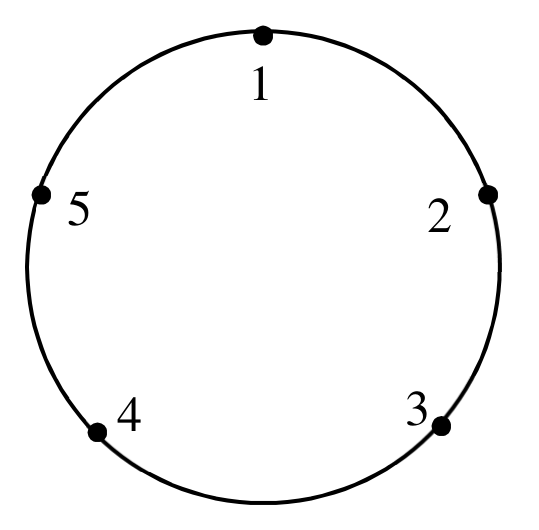
\begin{document}
\begin{tikzpicture}
  \def\R{2}
  \draw (0,0) circle (\R);
  \fill (90:\R) circle (2.5pt) node[above=2pt] {1};
  \fill (18:\R) circle (2.5pt) node[right=2pt] {2};
  \fill (-54:\R) circle (2.5pt) node[right=2pt] {3};
  \fill (-126:\R) circle (2.5pt) node[left=2pt] {4};
  \fill (162:\R) circle (2.5pt) node[left=2pt] {5};
\end{tikzpicture}
\end{document}
In figura vedi i numeri da a disposti in senso orario su una circonferenza. Puoi modificarli quante volte vuoi, ma ogni volta solo aggiungendo a due numeri che si trovino in posizioni adiacenti (per es. puoi aggiungere a e , facendoli dunque diventare e ; successivamente a e facendoli diventare e ). Spiega come è possibile, rispettando questa regola, arrivare ad avere cinque numeri tutti uguali.
Topic: Combinatoria, Logica, giochi, strategie Metodo: monovarianti Abilita: Casework accurato Area: Combinatoria, Logica e Probabilita Fonte: apri PDF p.2
Getting 5 numbers equal by adding 1 to adjacent pairs
\begin{document}
\begin{tikzpicture}
  \def\R{2}
  \draw (0,0) circle (\R);
  \fill (90:\R) circle (2.5pt) node[above=2pt] {1};
  \fill (18:\R) circle (2.5pt) node[right=2pt] {2};
  \fill (-54:\R) circle (2.5pt) node[right=2pt] {3};
  \fill (-126:\R) circle (2.5pt) node[left=2pt] {4};
  \fill (162:\R) circle (2.5pt) node[left=2pt] {5};
\end{tikzpicture}
\end{document}
In the figure you see the numbers from to arranged clockwise on a circle. You can modify them as many times as you want, but each time only by adding to two numbers that are in adjacent positions (for example, you can add to and , thus making them become and ; then to and , making them become and ). Explain how it is possible, while respecting this rule, to end up with five numbers that are all equal.