Max stanze visitabili nel triangolo di 9 stanze
\begin{document}
\begin{tikzpicture}[scale=2]
  \draw[thick] (0,0) -- (3,0) -- (1.5,2.598) -- cycle;
  \draw[thick] (0.5,0.866) -- (2.5,0.866);
  \draw[thick] (1.0,1.732) -- (2.0,1.732);
  \draw[thick] (1,0) -- (1.5,0.866);
  \draw[thick] (2,0) -- (2.5,0.866);
  \draw[thick] (0.5,0.866) -- (1.0,1.732);
  \draw[thick] (1.5,0.866) -- (2.0,1.732);
  \draw[thick] (1,0) -- (0.5,0.866);
  \draw[thick] (2,0) -- (1.5,0.866);
  \draw[thick] (1.5,0.866) -- (1.0,1.732);
  \draw[thick] (2.5,0.866) -- (2.0,1.732);
  \draw[thick] (1.46,1.692) -- (1.54,1.772);
  \draw[thick] (0.96,0.826) -- (1.04,0.906);
  \draw[thick] (1.96,0.826) -- (2.04,0.906);
  \draw[thick] (0.70,1.249) -- (0.80,1.349);
  \draw[thick] (0.70,1.349) -- (0.80,1.249);
  \draw[thick] (1.20,1.249) -- (1.30,1.349);
  \draw[thick] (1.20,1.349) -- (1.30,1.249);
  \draw[thick] (0.70,0.383) -- (0.80,0.483);
  \draw[thick] (0.70,0.483) -- (0.80,0.383);
  \draw[thick] (1.20,0.383) -- (1.30,0.483);
  \draw[thick] (1.20,0.483) -- (1.30,0.383);
  \draw[thick] (1.70,0.383) -- (1.80,0.483);
  \draw[thick] (1.70,0.483) -- (1.80,0.383);
  \draw[thick] (2.20,0.383) -- (2.30,0.483);
  \draw[thick] (2.20,0.483) -- (2.30,0.383);
\end{tikzpicture}
\end{document}
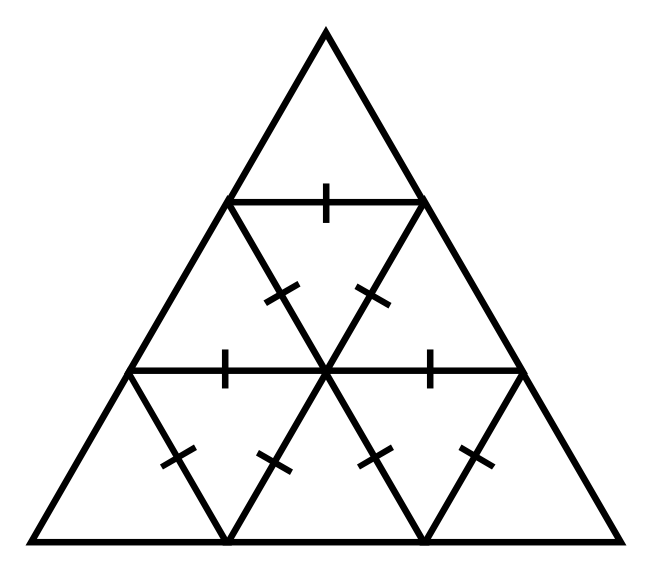
(2 punti) In figura vedi un triangolo grande ripartito in 9 triangoli piccoli. Immagina che ogni triangolo piccolo rappresenti una stanza e che le sbarrette sui suoi lati rappresentino altrettante porte che permettono di passare da una stanza a quelle adiacenti. Partendo dalla stanza in alto, quante stanze puoi visitare al massimo passando una sola volta da ogni stanza che visiti?
A) 3B) 4
C) 5
D) 6
E) 7
Topic: Combinatoria, Logica, giochi, strategie Metodo: Teoria dei grafi Abilita: Ragionamento geometrico Area: Combinatoria, Logica e Probabilita Risposta: E Fonte: apri PDF p.1
Max rooms to be visited in the triangle of 9 rooms
\begin{document}
\begin{tikzpicture}[scale=2]
  \draw[thick] (0,0) -- (3,0) -- (1.5,2.598) -- cycle;
  \draw[thick] (0.5,0.866) -- (2.5,0.866);
  \draw[thick] (1.0,1.732) -- (2.0,1.732);
  \draw[thick] (1,0) -- (1.5,0.866);
  \draw[thick] (2,0) -- (2.5,0.866);
  \draw[thick] (0.5,0.866) -- (1.0,1.732);
  \draw[thick] (1.5,0.866) -- (2.0,1.732);
  \draw[thick] (1,0) -- (0.5,0.866);
  \draw[thick] (2,0) -- (1.5,0.866);
  \draw[thick] (1.5,0.866) -- (1.0,1.732);
  \draw[thick] (2.5,0.866) -- (2.0,1.732);
  \draw[thick] (1.46,1.692) -- (1.54,1.772);
  \draw[thick] (0.96,0.826) -- (1.04,0.906);
  \draw[thick] (1.96,0.826) -- (2.04,0.906);
  \draw[thick] (0.70,1.249) -- (0.80,1.349);
  \draw[thick] (0.70,1.349) -- (0.80,1.249);
  \draw[thick] (1.20,1.249) -- (1.30,1.349);
  \draw[thick] (1.20,1.349) -- (1.30,1.249);
  \draw[thick] (0.70,0.383) -- (0.80,0.483);
  \draw[thick] (0.70,0.483) -- (0.80,0.383);
  \draw[thick] (1.20,0.383) -- (1.30,0.483);
  \draw[thick] (1.20,0.483) -- (1.30,0.383);
  \draw[thick] (1.70,0.383) -- (1.80,0.483);
  \draw[thick] (1.70,0.483) -- (1.80,0.383);
  \draw[thick] (2.20,0.383) -- (2.30,0.483);
  \draw[thick] (2.20,0.483) -- (2.30,0.383);
\end{tikzpicture}
\end{document}
(2 points) In the figure you see a large triangle divided into 9 small triangles. Imagine that each small triangle represents a room and that the bars on its sides represent as many doors allowing passage from one room to the adjacent ones. Starting from the room at the top, how many rooms can you visit at most by passing once through each room you visit? A) 3
B) 4
C) 5
D) 6
E) 7
Answer: E
Piastrelle gialle nel pavimento con diagonali rosse
(3 punti) Un pavimento quadrato è piastrellato con piastrelle quadrate tutte della stessa misura. Le 9 piastrelle lungo le diagonali sono rosse, le altre gialle. Quante sono le piastrelle gialle? A) 10
B) 12
C) 14
D) 16
E) 18
Topic: Geometria piana, Combinatoria Metodo: Conteggio combinatorio Abilita: Conteggio sistematico Area: Combinatoria, Logica e Probabilita, Geometria Risposta: D Fonte: apri PDF p.1
Yellow tiles on the floor with red diagonals
(3 points) A square floor is tiled with square tiles all of the same size. The nine tiles along the diagonals are red, the others yellow. How many yellow tiles are there? A) 10
B) 12 C) 14 D) 16 E) 18
Answer: D
Somma dei quattro numeri invisibili nel diagramma
\begin{document}
\begin{tikzpicture}[scale=1.2, >=latex, thick]
  \draw (0.6,3.4) rectangle (1.4,4.2);
  \draw (-0.9,1.6) rectangle (-0.1,2.4);
  \node at (-0.5,2.0) {\textbf{8}};
  \draw (0.6,1.6) rectangle (1.4,2.4);
  \draw (2.1,1.6) rectangle (2.9,2.4);
  \draw (-0.9,-0.4) rectangle (-0.1,0.4);
  \node at (-0.5,0.0) {\textbf{3}};
  \draw (0.6,-0.4) rectangle (1.4,0.4);
  \draw (2.1,-0.4) rectangle (2.9,0.4);
  \node at (2.5,0.0) {\textbf{2}};
  \draw[->] (0.6,3.4) -- (-0.1,2.4);
  \draw[->] (1.4,3.4) -- (2.1,2.4);
  \draw[->] (-0.1,2.0) -- (0.6,2.0);
  \draw[->] (2.1,2.0) -- (1.4,2.0);
  \draw[->] (1.0,1.6) -- (1.0,0.4);
  \draw[->] (0.6,0.0) -- (-0.1,0.0);
  \draw[->] (1.4,0.0) -- (2.1,0.0);
\end{tikzpicture}
\end{document}
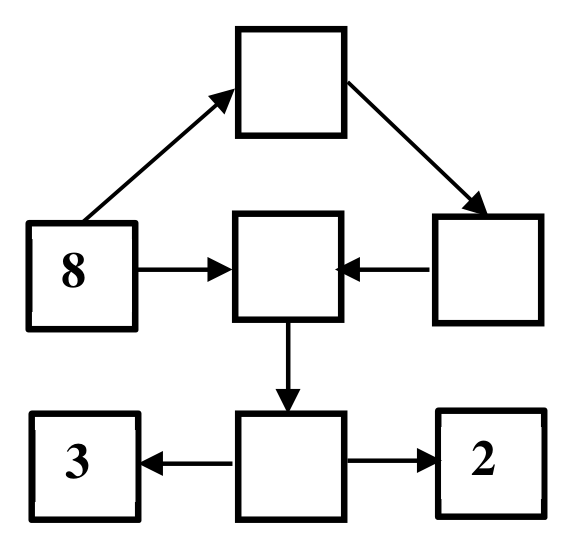
(3 punti) In questo diagramma ogni quadrato contiene un numero intero diverso da tutti quelli contenuti negli altri, ma in quattro quadrati il numero è invisibile. Le frecce presenti tra due quadrati sono dirette dal quadrato contenente il numero più grande a quello contenente il più piccolo. Qual è la somma dei numeri invisibili?
A) 30B) 28
C) 22
D) 16
E) 14
Topic: Logica, giochi, strategie, Combinatoria Abilita: Casework accurato Area: Combinatoria, Logica e Probabilita Risposta: C Fonte: apri PDF p.1
Sum of the four invisible numbers in the diagram
\begin{document}
\begin{tikzpicture}[scale=1.2, >=latex, thick]
  \draw (0.6,3.4) rectangle (1.4,4.2);
  \draw (-0.9,1.6) rectangle (-0.1,2.4);
  \node at (-0.5,2.0) {\textbf{8}};
  \draw (0.6,1.6) rectangle (1.4,2.4);
  \draw (2.1,1.6) rectangle (2.9,2.4);
  \draw (-0.9,-0.4) rectangle (-0.1,0.4);
  \node at (-0.5,0.0) {\textbf{3}};
  \draw (0.6,-0.4) rectangle (1.4,0.4);
  \draw (2.1,-0.4) rectangle (2.9,0.4);
  \node at (2.5,0.0) {\textbf{2}};
  \draw[->] (0.6,3.4) -- (-0.1,2.4);
  \draw[->] (1.4,3.4) -- (2.1,2.4);
  \draw[->] (-0.1,2.0) -- (0.6,2.0);
  \draw[->] (2.1,2.0) -- (1.4,2.0);
  \draw[->] (1.0,1.6) -- (1.0,0.4);
  \draw[->] (0.6,0.0) -- (-0.1,0.0);
  \draw[->] (1.4,0.0) -- (2.1,0.0);
\end{tikzpicture}
\end{document}
(3 points) In this diagram each square contains an integer number different from all the others, but in four squares the number is invisible. The arrows between two squares are directed from the square containing the largest number to the square containing the smallest number. What’s the sum of the invisible numbers? A) 30
B) 28 C) 22 D) 16 E) 14
Answer: C
Numeri di 4 cifre da 337337 cancellandone due
(4 punti) Quanti numeri diversi di quattro cifre si possono ottenere da 337337 cancellandone due cifre? A) 6
B) 7
C) 8
D) 9
E) 10
Topic: Combinatoria Metodo: Conteggio combinatorio Abilita: Conteggio sistematico Area: Combinatoria, Logica e Probabilita Risposta: B Fonte: apri PDF p.1
Four-digit numbers from 337337 by deleting two
(4 points) How many different four-digit numbers can be obtained from 337337 by deleting two digits? A) 6
B) 7
C) 8
D) 9
E) 10
Answer: B
Posizione di 3142 tra le 24 permutazioni ordinate
(4 punti) Utilizzando ciascuna delle cifre 1, 2, 3, 4, ognuna una e una sola volta, si possono costruire 24 numeri diversi (tutti di 4 cifre). Se si mettono in ordine questi 24 numeri dal più piccolo al più grande (e quindi il più piccolo è in posizione 1, il più grande in posizione 24) in quale posizione si trova il numero 3142?
A) 12B) 13
C) 14
D) 16
E) 17
Topic: Combinatoria Metodo: Conteggio combinatorio Abilita: Conteggio sistematico Area: Combinatoria, Logica e Probabilita Risposta: C Fonte: apri PDF p.1
Position of 3142 among the 24 ordered permutations
(4 points) Using each of the digits 1, 2, 3, 4, each one and only once, you can construct 24 different numbers (all of 4 digits). If you put these 24 numbers in order from smallest to largest (and so the smallest is in position 1, the largest is in position 24) in which position is the number 3142? A) 12
B) 13 C) 14 D) 16 E) 17
Answer: C
Quanti conigli mangiano carote oggi
(4 punti) Bianca ha 20 conigli: a 9 dà da mangiare carote tutti i giorni, agli altri solo un giorno sì e uno no, non necessariamente a tutti lo stesso giorno. Ieri hanno mangiato carote 16 conigli. Quanti conigli mangeranno carote oggi? A) 9
B) 13
C) 14
D) 15
E) Le informazioni sono insufficienti.3 2 8
Topic: Logica, giochi, strategie, Combinatoria Metodo: Analisi per casi Abilita: Casework accurato Area: Combinatoria, Logica e Probabilita Risposta: B Fonte: apri PDF p.1
How many rabbits eat carrots today?
(4 points) Bianca has 20 rabbits: 9 of them eat carrots every day, the others only one day yes and one no, not necessarily all on the same day. Yesterday 16 rabbits ate carrots. How many rabbits will eat carrots today? A) 9 B) 13 C) 14 D) 15 E) The information is insufficient.
3 2 8
Answer: B
Modi di sommare numeri 1..8 per ottenere 30
(5 punti) Devi sommare alcuni degli otto numeri naturali da 1 a 8 in modo da ottenere come somma 30. Se ogni numero non può essere utilizzato più di una volta, in quanti modi diversi puoi soddisfare la richiesta? (Sommare gli stessi addendi in ordine diverso non deve essere considerato un modo diverso).
A) 4B) 6
C) 8
D)10
E) 12
Topic: Combinatoria Metodo: Conteggio combinatorio Abilita: Conteggio sistematico Area: Combinatoria, Logica e Probabilita Risposta: A Fonte: apri PDF p.2
How to add numbers 1..8 to get 30
(5 points) You have to add up some of the eight natural numbers from 1 to 8 so you get 30. If each number cannot be used more than once, how many different ways can you meet the request? (The addition of the same addends in a different order should not be considered as a different way). A) 4
B) 6
C) 8
D)10 E) 12
Answer: A
Max cifre 1 nelle prime 15 cifre dell allineamento
(5 punti) Ada ha 10.000 cartoncini, su ciascuno dei quali è riportato un diverso numero da 1 a 10.000 inclusi. Li allinea (non necessariamente in un ordine prestabilito) e poi legge le prime 15 cifre dell’allineamento come se fossero un unico numero N. Quante cifre 1 può contenere al massimo tale numero N? A) 11
B) 12
C) 13
D) 14
E) 15
Topic: Combinatoria, Teoria dei Numeri Metodo: Principio di estremalita Abilita: Conteggio sistematico Area: Aritmetica e Teoria dei Numeri, Combinatoria, Logica e Probabilita Risposta: D Fonte: apri PDF p.2
Max 1s in the first 15 digits of the alignment
(5 points) Ada has 10,000 cards, each containing a different number from 1 to 10,000 included. She arranges them (not necessarily in a preset order) and then reads the first 15 digits of the alignment as if they were a single number N. At most how many digits 1 can that number N contain? A) 11
B) 12 C) 13 D) 14 E) 15
Answer: D
Affermazione sicuramente falsa (euro di Lisa)
(6 punti) Se delle seguenti tre affermazioni a) “Lisa ha più di 2021 euro” b) “Lisa ha meno di 2021 euro” c) “Lisa ha almeno 1 euro” una e una sola è vera, quale delle seguenti affermazioni è sicuramente falsa? A) Lisa ha 2021 euro.
B) Lisa non ha alcun euro.
C) Lisa ha 1000 euro.
D) L’affermazione c) è falsa.
E) L’affermazione c) è quella vera.Quesiti a risposta aperta
Topic: Logica, giochi, strategie Metodo: Analisi per casi Abilita: Lettura attenta del testo Area: Combinatoria, Logica e Probabilita Risposta: C Fonte: apri PDF p.2
Certainly false claim (Lisa’s euro)
(6 points) If of the following three statements a) Lisa has more than 2021 euros b) Lisa has less than 2021 euros c) Lisa has at least 1 euro one and only one is true, which of the following statements is definitely false? A) Lisa has 2021 euros.
B) Lisa has no euro.
C) Lisa has a thousand euros. (D) Claim (c) is false. E) The statement c) is true.
Open-ended questions
Answer: C
Altri anni del 21 secolo con somma cifre 5
(4 punti) La somma delle cifre di 2021 è 5. Nel 21-esimo secolo (cioè dal 2001 al 2100) quanti altri anni hanno la stessa proprietà?
Topic: Teoria dei Numeri, Combinatoria Metodo: Conteggio combinatorio Abilita: Conteggio sistematico Area: Aritmetica e Teoria dei Numeri, Combinatoria, Logica e Probabilita Risposta: 3 Fonte: apri PDF p.2
Other years of the 21st century with digit sum 5
(4 points) The sum of the digits of 2021 is 5. In the 21st century (i.e. 2001 to 2100) how many other years have the same property?
Answer: 3
Peso di un anguria in etti (3 chili meno di tre angurie)
(4 punti) Un’anguria pesa 3 chili meno di tre angurie. Tutte le angurie hanno lo stesso peso: quale è, in etti?
Topic: Algebra Abilita: Manipolazione algebrica Area: Algebra e Analisi Risposta: 15 Fonte: apri PDF p.2
Weight of one watermelon in hectograms (3 kg less than three watermelons)
(4 points) One watermelon weighs 3 kg less than three watermelons. All watermelons have the same weight. Which is it, in hectograms?
Answer: 15
Partite vinte da Edoardo nel gioco di carte
(6 punti) Edoardo, Susanna e Teresa giocano a carte. Al termine di ogni partita non ci sono pari-merito: il vincitore guadagna 3 punti, il secondo classificato 1 punto mentre il terzo classificato non guadagna punti. Dopo quattro partite Susanna ha 4 punti e Teresa 3. Quante partite ha vinto Edoardo?
Topic: Logica, giochi, strategie, Teoria dei Numeri Abilita: Casework accurato Area: Aritmetica e Teoria dei Numeri, Combinatoria, Logica e Probabilita Risposta: 3 Fonte: apri PDF p.2
Matches won by Edward in the card game
(6 points) Edward, Susanna and Teresa play cards. At the end of each match, there are no ties: the winner earns 3 points, the second-placed 1 point while the third-placed does not earn points. After four games, Susanna has 4 points and Teresa has 3. How many games has Edward won?
Answer: 3
Minimo marziani per averne due dello stesso tipo
(6 punti) Non tutti i marziani hanno lo stesso numero di mani e non tutti hanno lo stesso numero di piedi: le mani possono essere da 3 a 6, i piedi da 2 a 7. Quanti marziani al minimo devono entrare in una navetta spaziale perché ce ne siano sicuramente almeno due dello stesso tipo?
Topic: Combinatoria, Logica, giochi, strategie Metodo: Principio dei cassetti Abilita: Casework accurato Area: Combinatoria, Logica e Probabilita Risposta: 25 Fonte: apri PDF p.2
Minimum number of Martians to have two of the same type
(6 points) Not all Martians have the same number of hands and not all have the same number of feet: hands can be 3 to 6, feet 2 to 7. How many Martians do you have to get on a space shuttle to make sure there’s at least two of the same type?
Answer: 25
Anni dall ultimo anno = due interi consecutivi accostati
(8 punti) Il numero 2021 è formato accostando due numeri interi consecutivi in ordine crescente. Quanti anni sono trascorsi dall’ultima volta in cui ciò è successo?
Topic: Teoria dei Numeri Abilita: Riconoscimento di pattern Area: Aritmetica e Teoria dei Numeri Risposta: 101 Fonte: apri PDF p.2
Years since the last year = two consecutive integers placed side by side
(8 points) The 2021 number is formed by joining two consecutive integers in increasing order. How many years have passed since the last time this happened?
Answer: 101
Minuti minimi per attraversare il ponte tibetano
(8 punti) Di ritorno da un’escursione, Anna, Bob, Carla e Doris devono attraversare un fiume su un ponte tibetano, su cui possono transitare al massimo due persone alla volta; è buio e quindi per l’attraversamento è necessaria una pila, ma ne hanno una sola che può bastare per due persone e non se la possono lanciare da una parte all’altra del fiume. Quanti minuti impiegheranno al minimo per passare tutti sull’altra riva se per l’attraversamento Anna impiega 10 minuti, Bob 5, Carla 2 e Doris 1 minuto e, ovviamente, se due amici attraversano insieme, lo fanno alla velocità del più lento?
Risposte 0003 0015 0003 0025 0101 0017
Topic: Logica, giochi, strategie, Combinatoria Metodo: Ragionamento all’indietro Abilita: Casework accurato Area: Combinatoria, Logica e Probabilita Risposta: 17 Fonte: apri PDF p.2
Minimum minutes to cross the Tibetan bridge
(8 points) Returning from a hike, Anna, Bob, Carla and Doris must cross a river on a suspension bridge, on which at most two people can cross at a time; it is dark and therefore for the crossing a flashlight is needed, but they have only one that can be enough for two people and they cannot throw it from one side of the river to the other. How many minutes will they need at minimum to all get to the other bank if for the crossing Anna takes 10 minutes, Bob 5, Carla 2 and Doris 1 minute and, obviously, if two friends cross together, they do so at the speed of the slower one?
Answers 0003 0015 0003 0025 0101 0017
Answer: 17