Minimo mosse per uniformare i 9 gettoni bicolori
\begin{document}
\begin{tikzpicture}
  \filldraw[fill=black, draw=black] (0,0) circle (0.45);
  \filldraw[fill=white, draw=black, thick] (1.2,0) circle (0.45);
  \filldraw[fill=black, draw=black] (2.4,0) circle (0.45);
  \filldraw[fill=white, draw=black, thick] (0,-1.2) circle (0.45);
  \filldraw[fill=white, draw=black, thick] (1.2,-1.2) circle (0.45);
  \filldraw[fill=white, draw=black, thick] (2.4,-1.2) circle (0.45);
  \filldraw[fill=black, draw=black] (0,-2.4) circle (0.45);
  \filldraw[fill=white, draw=black, thick] (1.2,-2.4) circle (0.45);
  \filldraw[fill=black, draw=black] (2.4,-2.4) circle (0.45);
\end{tikzpicture}
\end{document}
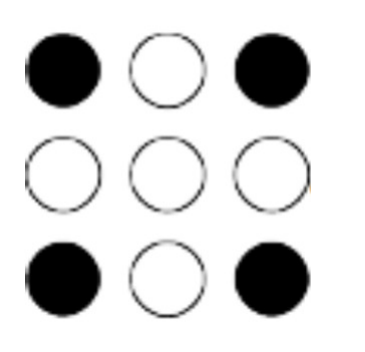
Su un tavolo ci sono 9 gettoni, colorati di bianco su una faccia e di nero sull’altra. I gettoni sono disposti a quadrato su tre file e mostrano le loro facce come indica la figura. Un gioco consiste nel tentare di ottenere che tutti i gettoni mostrino le facce dello stesso colore, bianco o nero, eseguendo solo mosse che consistono nel capovolgere tutti i tre gettoni di una stessa riga o di una stessa colonna o di una stessa diagonale, potendo scegliere da mossa a mossa. Qual è il più piccolo numero di mosse che consente di terminare il gioco? (vedi figura)
Topic: Combinatoria, Logica, giochi, strategie Abilita: Casework accurato Area: Combinatoria, Logica e Probabilita Risposta: 2 Fonte: apri PDF p.1
Minimum moves to unify the 9 bicolor tokens
\begin{document}
\begin{tikzpicture}
  \filldraw[fill=black, draw=black] (0,0) circle (0.45);
  \filldraw[fill=white, draw=black, thick] (1.2,0) circle (0.45);
  \filldraw[fill=black, draw=black] (2.4,0) circle (0.45);
  \filldraw[fill=white, draw=black, thick] (0,-1.2) circle (0.45);
  \filldraw[fill=white, draw=black, thick] (1.2,-1.2) circle (0.45);
  \filldraw[fill=white, draw=black, thick] (2.4,-1.2) circle (0.45);
  \filldraw[fill=black, draw=black] (0,-2.4) circle (0.45);
  \filldraw[fill=white, draw=black, thick] (1.2,-2.4) circle (0.45);
  \filldraw[fill=black, draw=black] (2.4,-2.4) circle (0.45);
\end{tikzpicture}
\end{document}
On a table, there are nine tokens, white on one face and black on the other. The tokens are arranged in a square over three rows and show their faces as shown in the figure. A game consists of trying to get all the tokens to show the same colour, white or black faces, performing only moves that consist of flipping all three tokens of the same row or column or diagonal, and being able to choose from move to move. What’s the smallest number of moves to finish the game? (see figure)
Answer: 2
Tempo da A a B nuotando con stessa energia del controcorrente
Un fiume è attraversato da un ponte A e da un ponte B e il fiume scorre da A verso B. Stefano entra nel fiume in corrispondenza del ponte A e si lascia trasportare passivamente dalla corrente fino al ponte B, che raggiunge in 6 minuti; poi dal ponte B, nuotando contro-corrente, raggiunge il ponte A, ancora in 6 minuti. Se Stefano nuotasse dal ponte A al ponte B consumando la stessa energia utilizzata nel suo tragitto contro-corrente, quanto impiegherebbe per raggiungere il ponte B partendo dal ponte A?
Topic: Algebra Abilita: traduzione del testo Area: Algebra e Analisi Risposta: 2 minuti Fonte: apri PDF p.1
Time from A to B swimming with the same energy as the counter current
A river is crossed by a bridge A and a bridge B and the river flows from A to B. Stefano enters the river in correspondence with bridge A and is passively carried by the current to bridge B, which he reaches in 6 minutes; then from bridge B, swimming against the current, he reaches bridge A, again in 6 minutes. If Stefano swam from bridge A to bridge B consuming the same energy used in his countercurrent route, how long would it take to reach bridge B from bridge A?
Answer: 2 minutes
Posizione di Sara a meta classifica con Gino e Pino
A una gara di marcia campestre partecipano tre studenti per ogni classe della scuola. Nella classifica finale, Sara risulta esattamente a metà classifica (cioè vi è lo stesso numero di partecipanti che la precedono e che la seguono), mentre Gino la segue al 19-esimo posto e Pino la segue al 28-esimo posto. Sapendo che non ci sono stati pari-merito, quale posto occupa Sara?
Topic: Teoria dei Numeri, Logica, giochi, strategie Abilita: Casework accurato Area: Aritmetica e Teoria dei Numeri, Combinatoria, Logica e Probabilita Risposta: 17 Fonte: apri PDF p.2
Sarah’s position at the classification goal with Gino and Pino
Three students per class of the school participate in a cross-country race. In the final ranking, Sara is exactly in the middle of the ranking (i.e. there is the same number of participants who precede and follow her), while Gino follows her to 19th place and Pino follows her to 28th place. Knowing there were no ties, what place does Sara occupy?
Answer: 17
Quali cassette contengono banane dai pesi
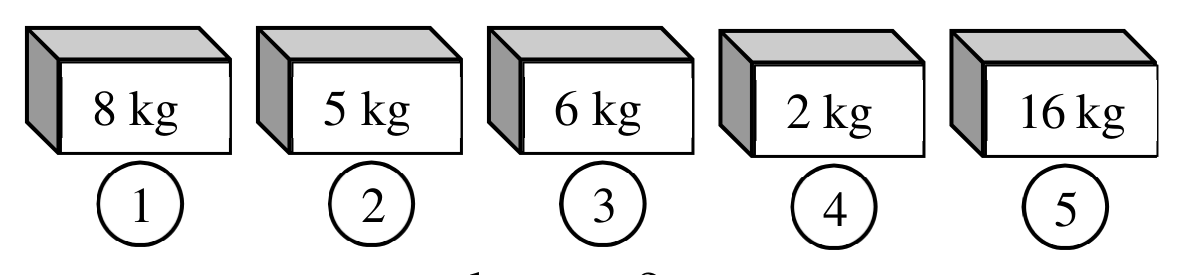
Un fruttivendolo vende solo mele, banane e arance. Ha ricevuto l’ordine di comporre 5 cassette, nessuna delle quali contenga sia mele sia banane. Ha usato complessivamente 4 arance, ciascuna del peso di due etti e mezzo; il peso complessivo delle mele che ha usato è tre volte quello delle banane che ha usato. Ecco il peso del contenuto delle 5 cassette: cassetta 1: 8 kg, cassetta 2: 5 kg, cassetta 3: 6 kg, cassetta 4: 2 kg, cassetta 5: 16 kg. Quale o quali cassette contengono banane?
Topic: Teoria dei Numeri, Logica, giochi, strategie Abilita: Casework accurato Area: Aritmetica e Teoria dei Numeri, Combinatoria, Logica e Probabilita Risposta: la 1 e la 4 Fonte: apri PDF p.2
Which boxes contain bananas by weight
A greengrocer sells only apples, bananas and oranges. He received an order to compose 5 boxes, none of which contains both apples and bananas. He used a total of 4 oranges, each weighing two and a half hectograms; the total weight of the apples he used is three times that of the bananas he used. Here is the weight of the contents of the 5 boxes: box 1: 8 kg, box 2: 5 kg, box 3: 6 kg, box 4: 2 kg, box 5: 16 kg. Which box or boxes contain bananas?
Answer: boxes 1 and 4
Numero possibile di domeniche in tre mesi consecutivi
Giulia ha calcolato senza sbagliare quante domeniche possono esserci complessivamente in tre mesi consecutivi. Quali sono i possibili risultati che ha ottenuto?
Topic: Teoria dei Numeri Metodo: Analisi per casi Abilita: Casework accurato Area: Aritmetica e Teoria dei Numeri Risposta: 12 o 13 o 14 Fonte: apri PDF p.3
Possible number of Sundays in three consecutive months
Giulia has calculated correctly how many Sundays there can be in three consecutive months. What are the possible outcomes?
Answer: 12 or 13 or 14
Quanti ciclisti almeno hanno mentito se somma e 36
10 ciclisti terminano una gara con tempi di arrivo tutti diversi fra loro. Dopo qualche tempo, un giornalista chiede a ciascuno di loro di comunicargli il proprio ordine di arrivo in quella gara, ovviamente con un numero compreso fra 1 e 10. Il giornalista somma le risposte fornitegli ed ottiene 36. Ne deduce che certamente alcuni hanno mentito: quanti, almeno?
Topic: Teoria dei Numeri, Combinatoria Metodo: Analisi per casi Abilita: Casework accurato Area: Aritmetica e Teoria dei Numeri, Combinatoria, Logica e Probabilita Risposta: 3 Fonte: apri PDF p.3
How many cyclists have at least lied if the sum is 36
Ten cyclists finish a race with different arrival times. After a while, a reporter asks each of them to tell him their order of arrival in that race, obviously with a number between 1 and 10. The reporter sums up the answers given to him and gets 36. He concludes that some certainly lied - how many, at least?
Answer: 3