Quale scatola contiene più triangoli
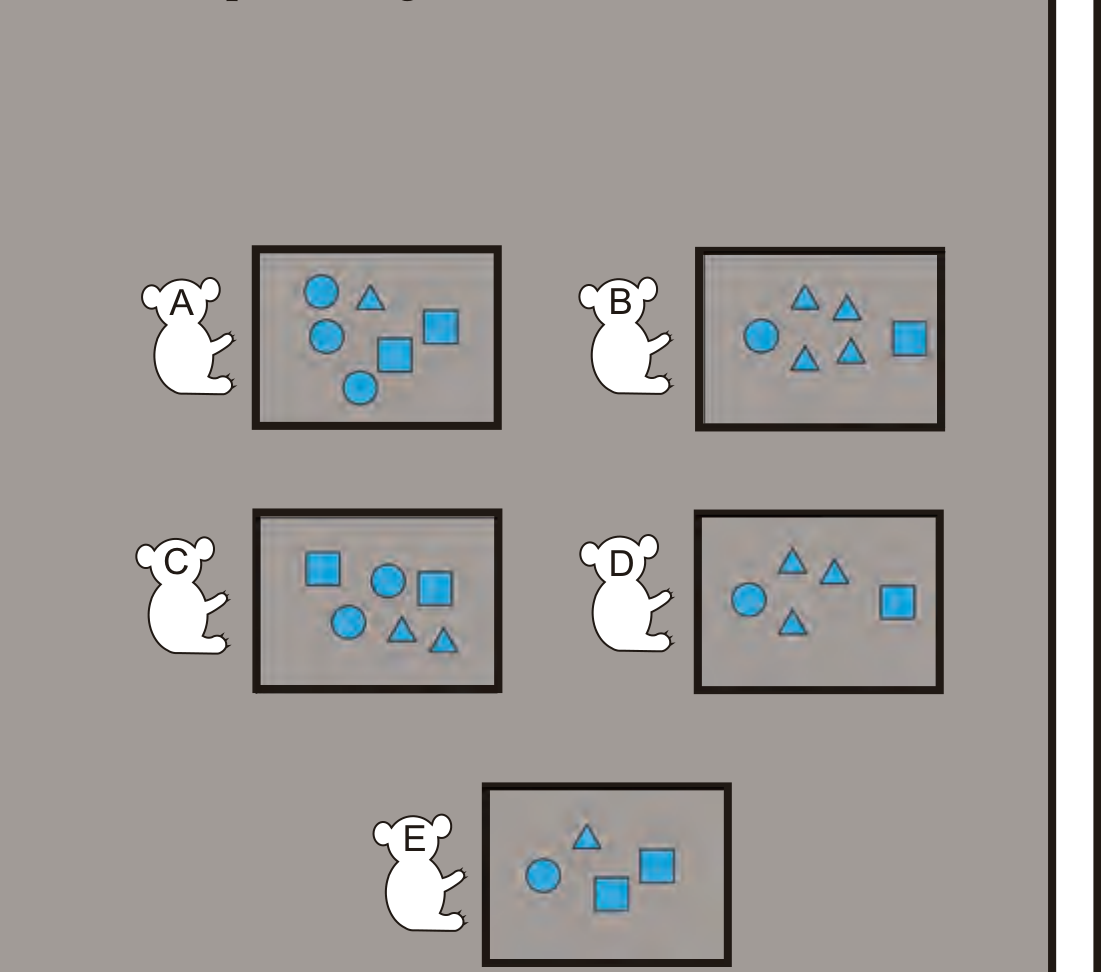
Quale di queste 5 scatole contiene più triangoli di tutte le altre? (vedi figura)
Topic: Geometria piana Abilita: Conteggio sistematico Area: Geometria Risposta: B Fonte: apri PDF p.1
Which box contains more triangles
Which of these five boxes contains more triangles than all the others? (see figure)
Answer: B
ultima casella
\begin{document}
\begin{tikzpicture}[scale=1.0]
  \draw[thick] (0,0) grid (4,4);
  \filldraw[fill=orange!30,draw=black] (0.5,3.5) circle (0.38);
  \filldraw[fill=orange!30,draw=black] (1.5,3.5) circle (0.38);
  \filldraw[fill=orange!30,draw=black] (1.5,2.5) circle (0.38);
  \filldraw[fill=orange!30,draw=black] (3.5,2.5) circle (0.38);
  \filldraw[fill=orange!30,draw=black] (0.5,1.5) circle (0.38);
  \filldraw[fill=orange!30,draw=black] (2.5,0.5) circle (0.38);
  \filldraw[fill=orange!30,draw=black] (3.5,0.5) circle (0.38);
  \node at (3.5,3.5) {B};
  \node at (0.5,2.5) {A};
  \node at (2.5,2.5) {C};
  \node at (2.5,1.5) {D};
  \node at (0.5,0.5) {E};
\end{tikzpicture}
\end{document}
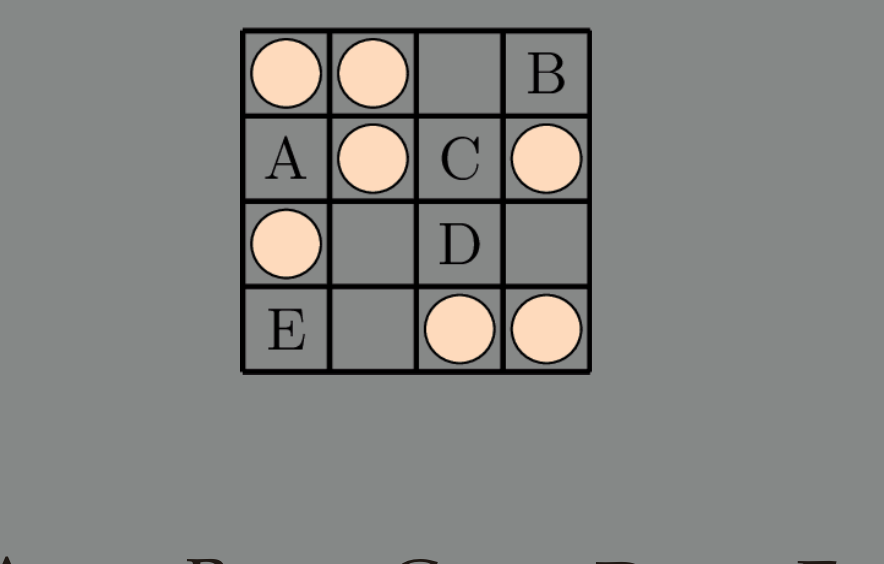
Voglio che su ogni riga e ogni colonna di questa scacchiera ci siano 2 gettoni e non più di 2. Ho già messo 7 gettoni sulla scacchiera: in quale casella devo mettere l’ultimo gettone? (vedi figura)
Topic: Logica, giochi, strategie Abilita: Casework accurato Area: Combinatoria, Logica e Probabilita Risposta: D Fonte: apri PDF p.1
last box
\begin{document}
\begin{tikzpicture}[scale=1.0]
  \draw[thick] (0,0) grid (4,4);
  \filldraw[fill=orange!30,draw=black] (0.5,3.5) circle (0.38);
  \filldraw[fill=orange!30,draw=black] (1.5,3.5) circle (0.38);
  \filldraw[fill=orange!30,draw=black] (1.5,2.5) circle (0.38);
  \filldraw[fill=orange!30,draw=black] (3.5,2.5) circle (0.38);
  \filldraw[fill=orange!30,draw=black] (0.5,1.5) circle (0.38);
  \filldraw[fill=orange!30,draw=black] (2.5,0.5) circle (0.38);
  \filldraw[fill=orange!30,draw=black] (3.5,0.5) circle (0.38);
  \node at (3.5,3.5) {B};
  \node at (0.5,2.5) {A};
  \node at (2.5,2.5) {C};
  \node at (2.5,1.5) {D};
  \node at (0.5,0.5) {E};
\end{tikzpicture}
\end{document}
I want every line and every column on this chessboard to have 2 tokens and no more than 2. I’ve already put seven tokens on the chessboard. In which box should I put the last token? (see figure)
Answer: D
quale risultato
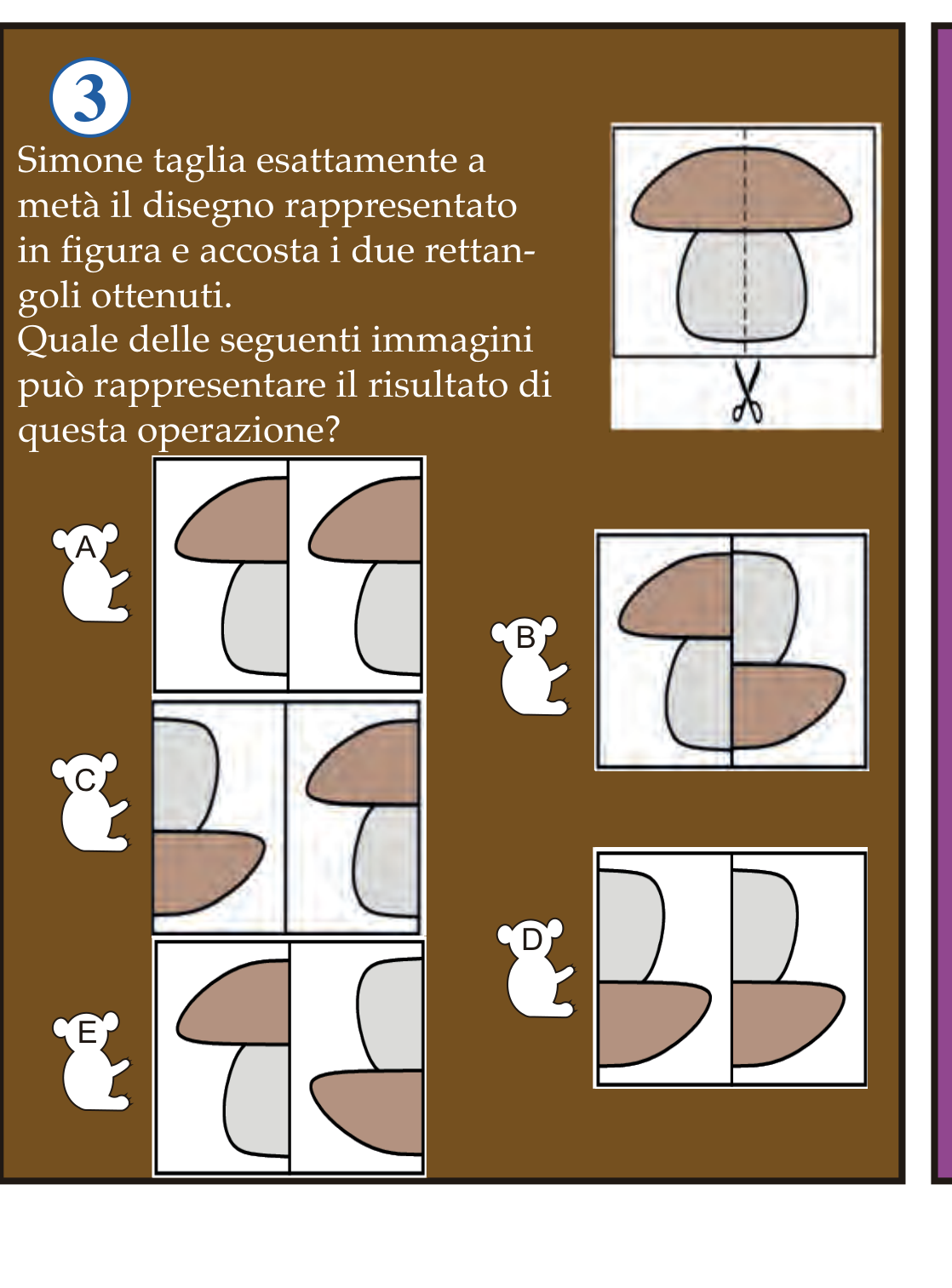
Simone taglia esattamente a metà il disegno rappresentato in figura e accosta i due rettangoli ottenuti. Quale delle seguenti immagini può rappresentare il risultato di questa operazione? (vedi figura)
Topic: Geometria piana Abilita: Ragionamento geometrico Area: Geometria Risposta: E Fonte: apri PDF p.1
which result
Simone cuts the drawing in the figure exactly in half and adjoins the two rectangles obtained. Which of the following images may represent the result of this operation? (see figure)
Answer: E
quanti accostati ad esattamente tre altri
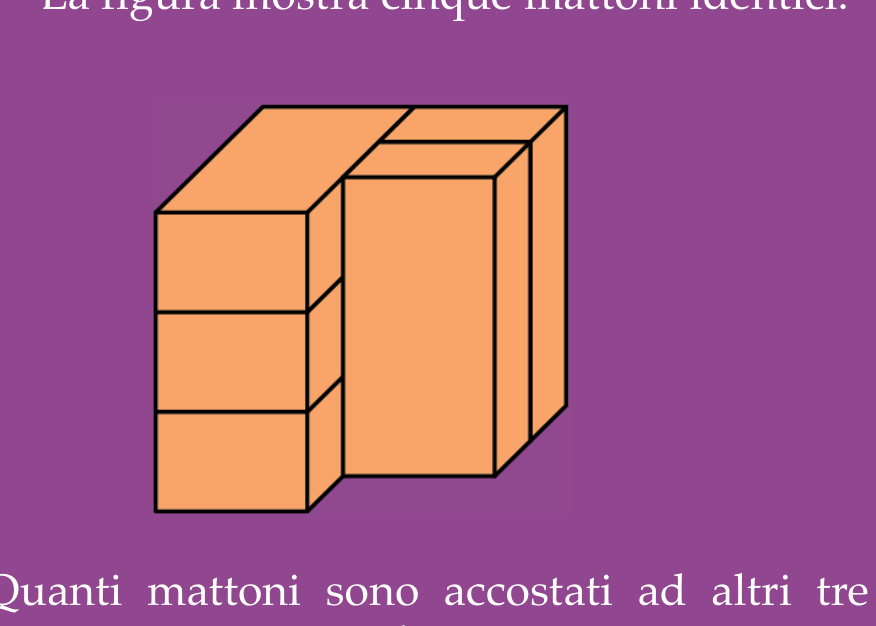
La figura mostra cinque mattoni identici. Quanti mattoni sono accostati ad altri tre mattoni e a non più di tre mattoni? (vedi figura)
Topic: Logica, giochi, strategie Abilita: Ragionamento geometrico Area: Combinatoria, Logica e Probabilita Risposta: B Fonte: apri PDF p.1
how many adjacent to exactly three others
The figure shows five identical bricks. How many bricks have been joined to three other bricks and not more than three bricks? (see figure)
Answer: B
Pezzo strappato dalla mappa del tesoro
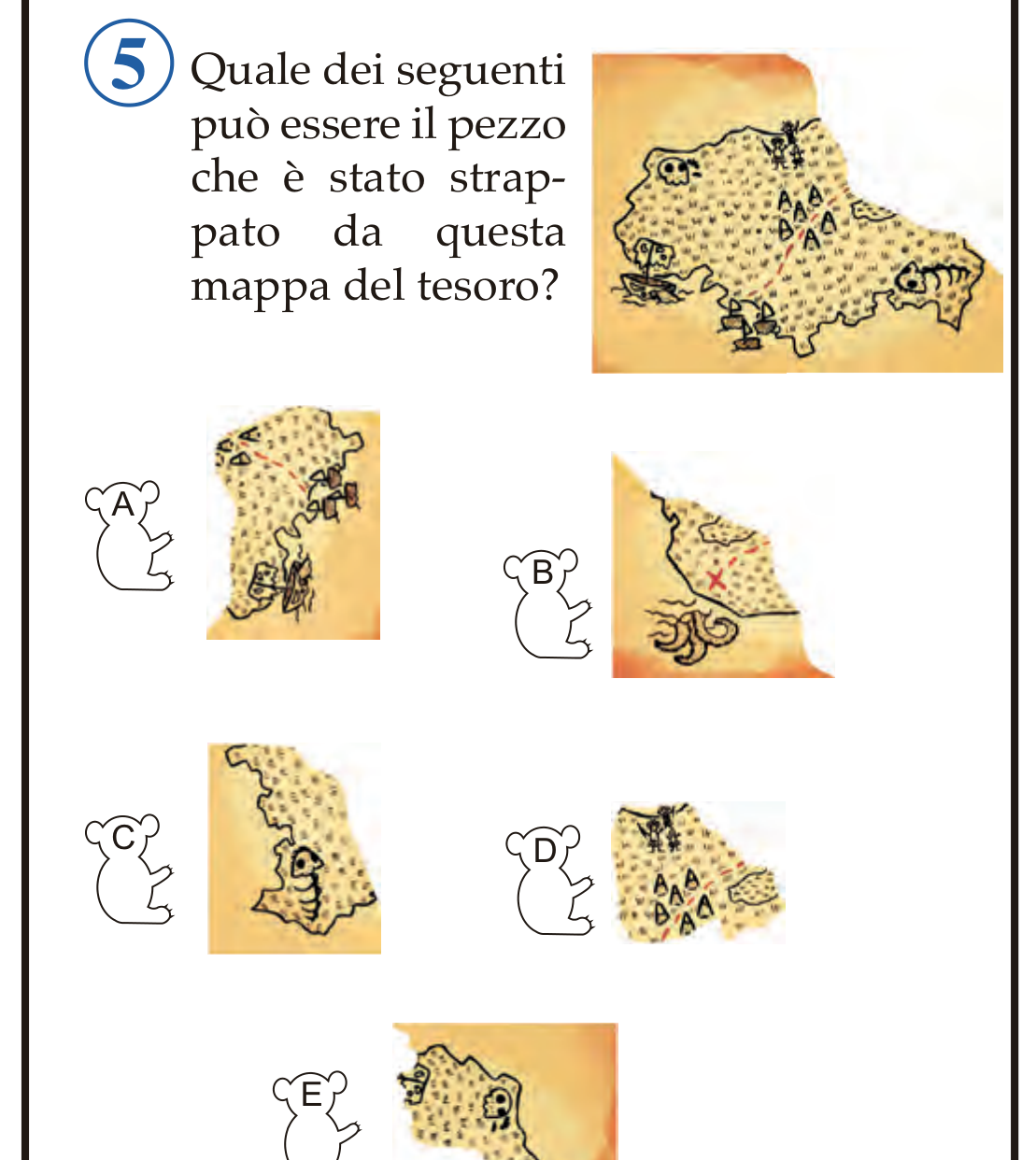
Quale dei seguenti pezzi può essere il pezzo che è stato strappato da questa mappa del tesoro? (vedi figura)
Topic: Geometria piana Abilita: Ragionamento geometrico Area: Geometria Risposta: B Fonte: apri PDF p.2
Piece ripped from the treasure map
Which of the following pieces could be the piece that was torn off this treasure map? (see figure)
Answer: B
Quattro tessere che formano un quadrato
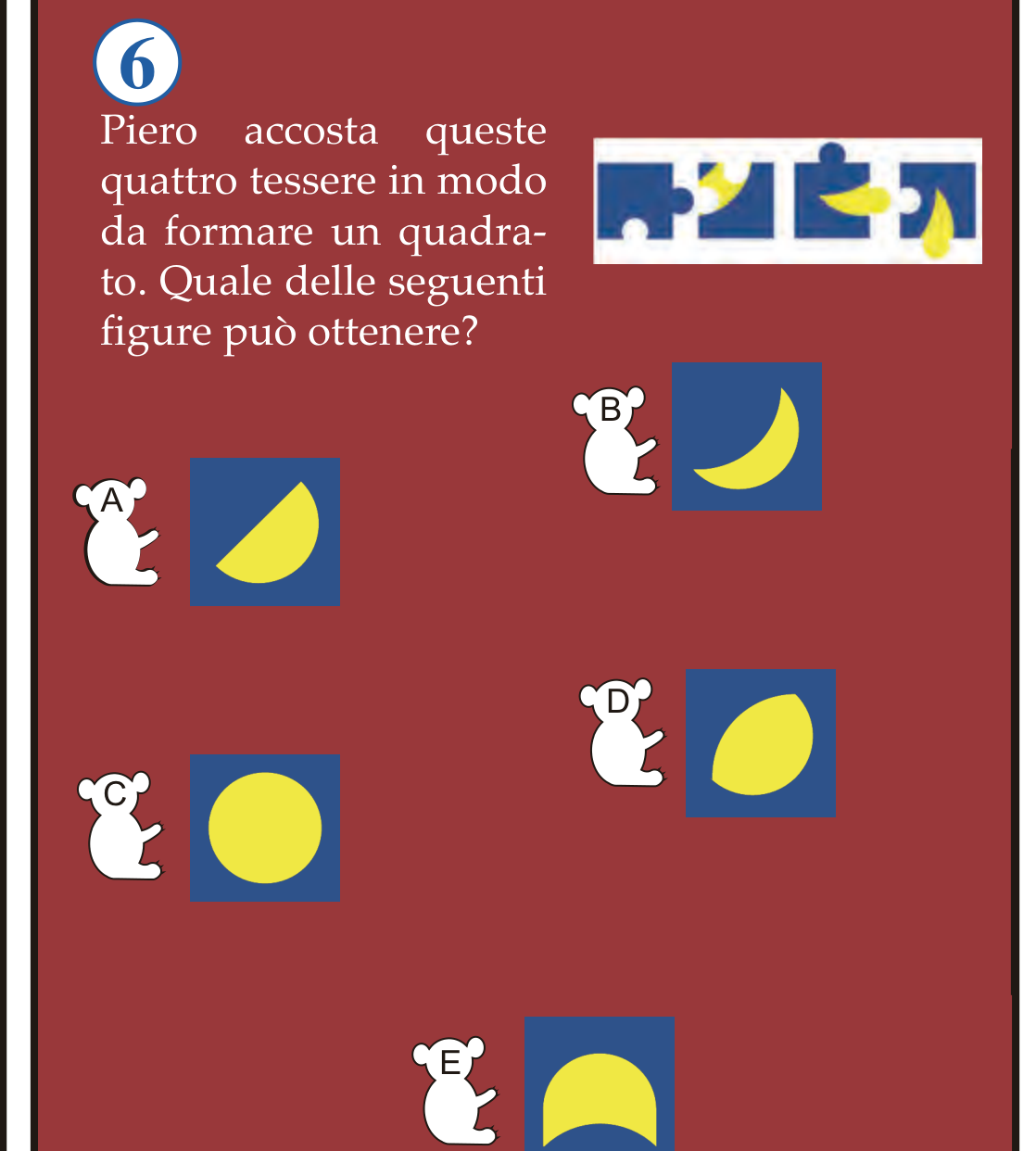
Pietro accosta queste quattro tessere in modo da formare un quadrato. Quale delle seguenti figure può ottenersi? (vedi figura)
Topic: Geometria piana Abilita: Ragionamento geometrico Area: Geometria Risposta: B Fonte: apri PDF p.2
Four cards forming a square
Peter places these four tiles together to form a square. Which of the following figures can be obtained? (see figure)
Answer: B
quanti quadretti macchiati
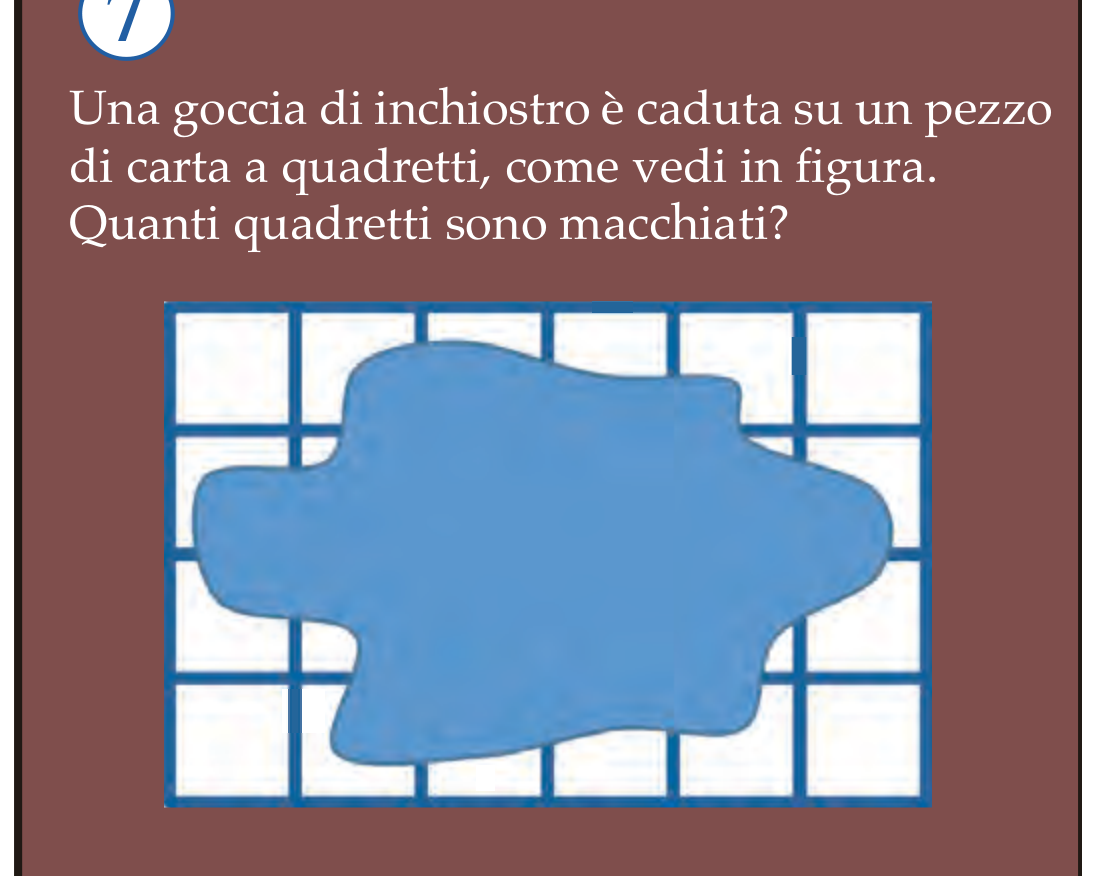
Una goccia di inchiostro è caduta su un pezzo di carta a quadretti, come vedi in figura. Quanti quadretti sono macchiati? (vedi figura)
Topic: Geometria piana Abilita: Conteggio sistematico Area: Geometria Risposta: E Fonte: apri PDF p.2
how many squares are stained
A drop of ink fell on a piece of squared paper, as you can see in the picture. How many squares are stained? (see figure)
Answer: E
costo del tramezzino
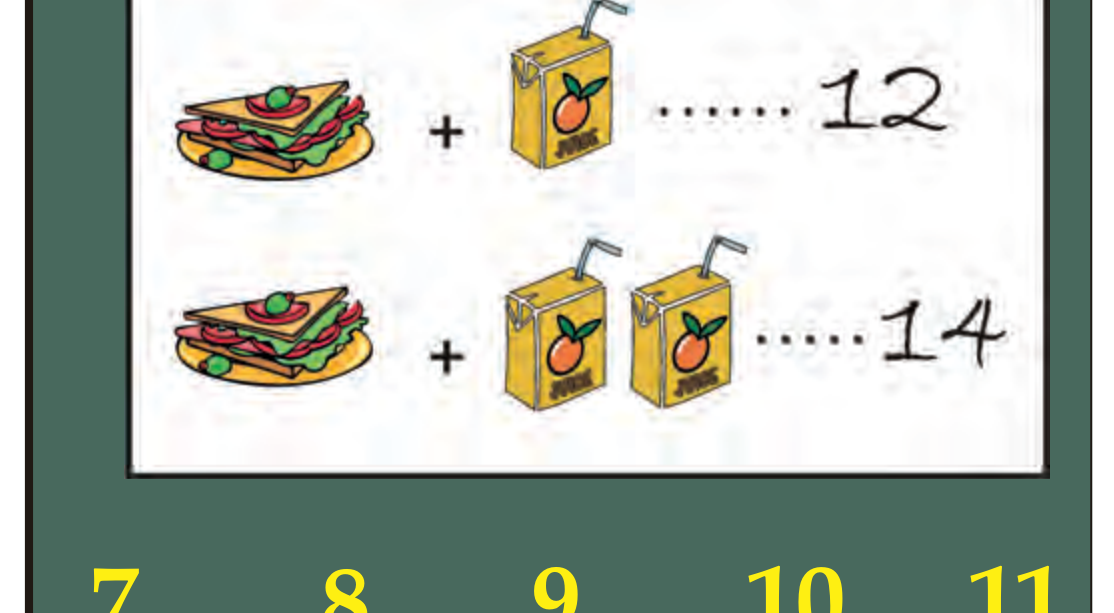
Alice ed Emma sono al bar. Alice paga 12 euro per un tramezzino e un succo di frutta. Emma paga 14 euro per un tramezzino e due succhi di frutta. Quanto costa un tramezzino?
Topic: Algebra Abilita: traduzione del testo Area: Algebra e Analisi Risposta: D Fonte: apri PDF p.2
cost of the sandwich
Alice and Emma are at the café. Alice pays 12 euros for a sandwich and a fruit juice. Emma pays 14 euros for a sandwich and two fruit juices. How much does a sandwich cost?
Answer: D
cifre uguali sotto formine uguali
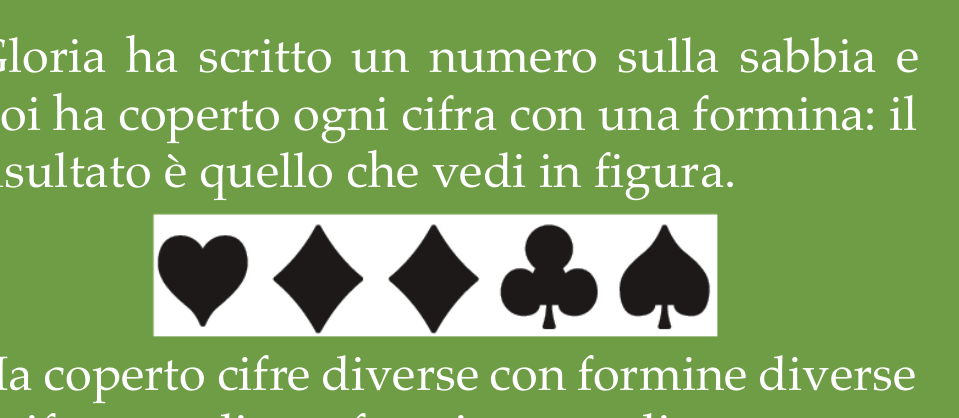
Gloria ha scritto un numero sulla sabbia e poi ha coperto ogni cifra con una formica: il risultato è quello che vedi in figura. Ha coperto cifre diverse con formiche diverse e cifre uguali con formiche uguali. Quale dei seguenti numeri può essere il numero scritto da Gloria? (vedi figura)
Topic: Logica, giochi, strategie Abilita: Casework accurato Area: Combinatoria, Logica e Probabilita Risposta: A Fonte: apri PDF p.3
equal numbers under the same form
Gloria wrote a number on the sand and then covered each digit with an ant. The result is what you see in the figure. She covered different digits with different ants and the same digits with the same ants. Which of the following numbers could be Gloria’s number? (see figure)
Answer: A
Canguro verso koala evitando macchie azzurre
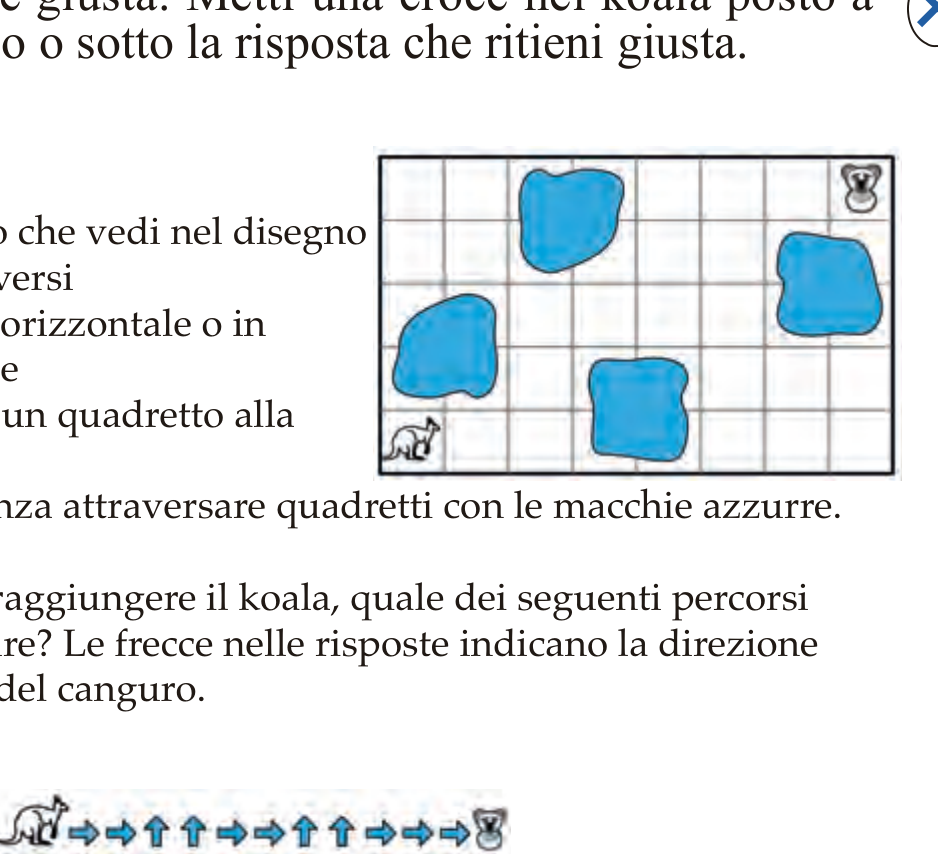
Il canguro che vedi nel disegno può muoversi:
- solo in orizzontale o verticale
- solo di un quadratto alla volta
- solo senza attraversare quadretti con le macchie azzurre. Se vuole raggiungere il koala, qual è il percorso più lungo? Le frecce nelle risposte indicano la direzione dei passi del canguro. (vedi figura)
Topic: Logica, giochi, strategie Abilita: Ragionamento geometrico Area: Combinatoria, Logica e Probabilita Risposta: A Fonte: apri PDF p.3
Kangaroo to koala by avoiding blue spots
The kangaroo you see in the drawing can move: - only horizontally or vertically - only one square at a time - only without crossing blue-spotted squares. If it wants to reach the koala, what’s the longest route? The arrows in the answers indicate the direction of the kangaroo’s steps. (see figure)
Answer: A
Forma geometrica assente nelle altre immagini
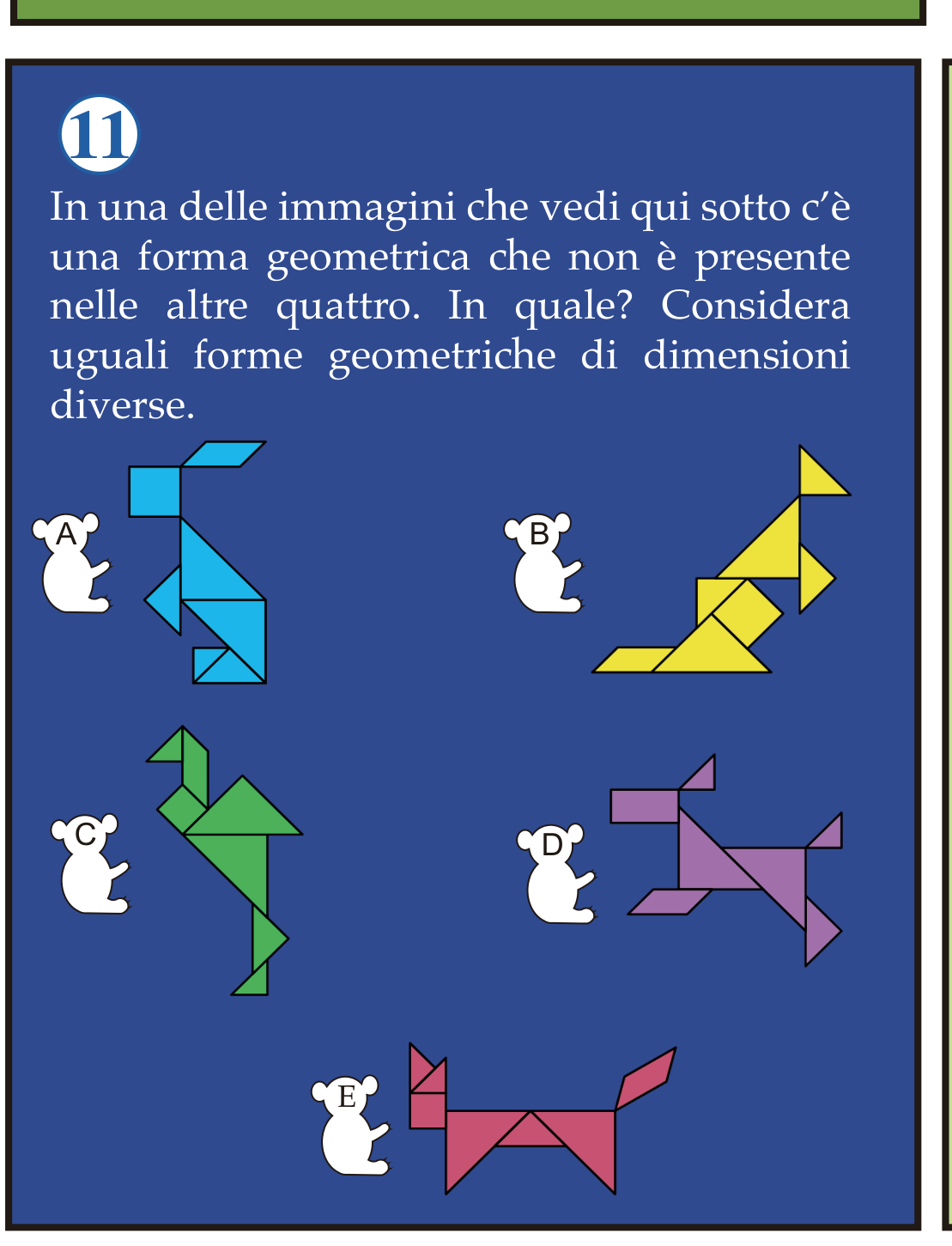
In una delle immagini che vedi qui sotto c’è una forma geometrica che non è presente nelle altre quattro. In quale? Considera uguali forme geometriche di dimensioni diverse. (vedi figura)
Topic: Geometria piana Abilita: Ragionamento geometrico Area: Geometria Risposta: D Fonte: apri PDF p.3
Geometric shape missing from the other images
In one of the images you see below there’s a geometric shape that’s not present in the other four. In which one? Consider the same geometric shapes of different sizes. (see figure)
Answer: D
Pila di dischi vista dall’alto
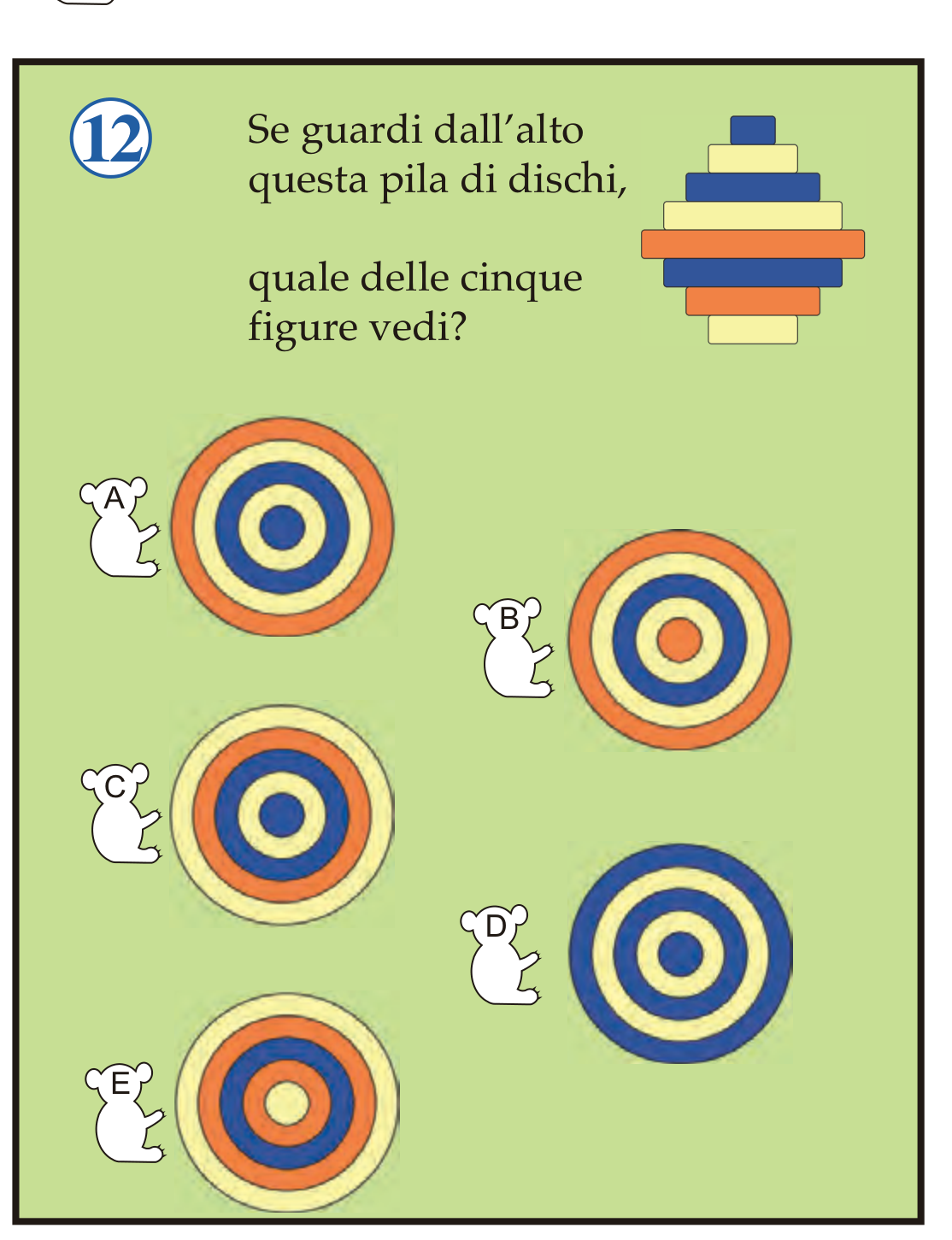
Se guardi dall’alto questa pila di dischi, quale delle cinque figure vedi? (vedi figura)
Topic: Geometria solida Abilita: Ragionamento geometrico Area: Geometria Risposta: A Fonte: apri PDF p.3
Stack of disks from above
If you look at this pile of discs from above, which of the five figures do you see? (see figure)
Answer: A
quale immagine si ottiene
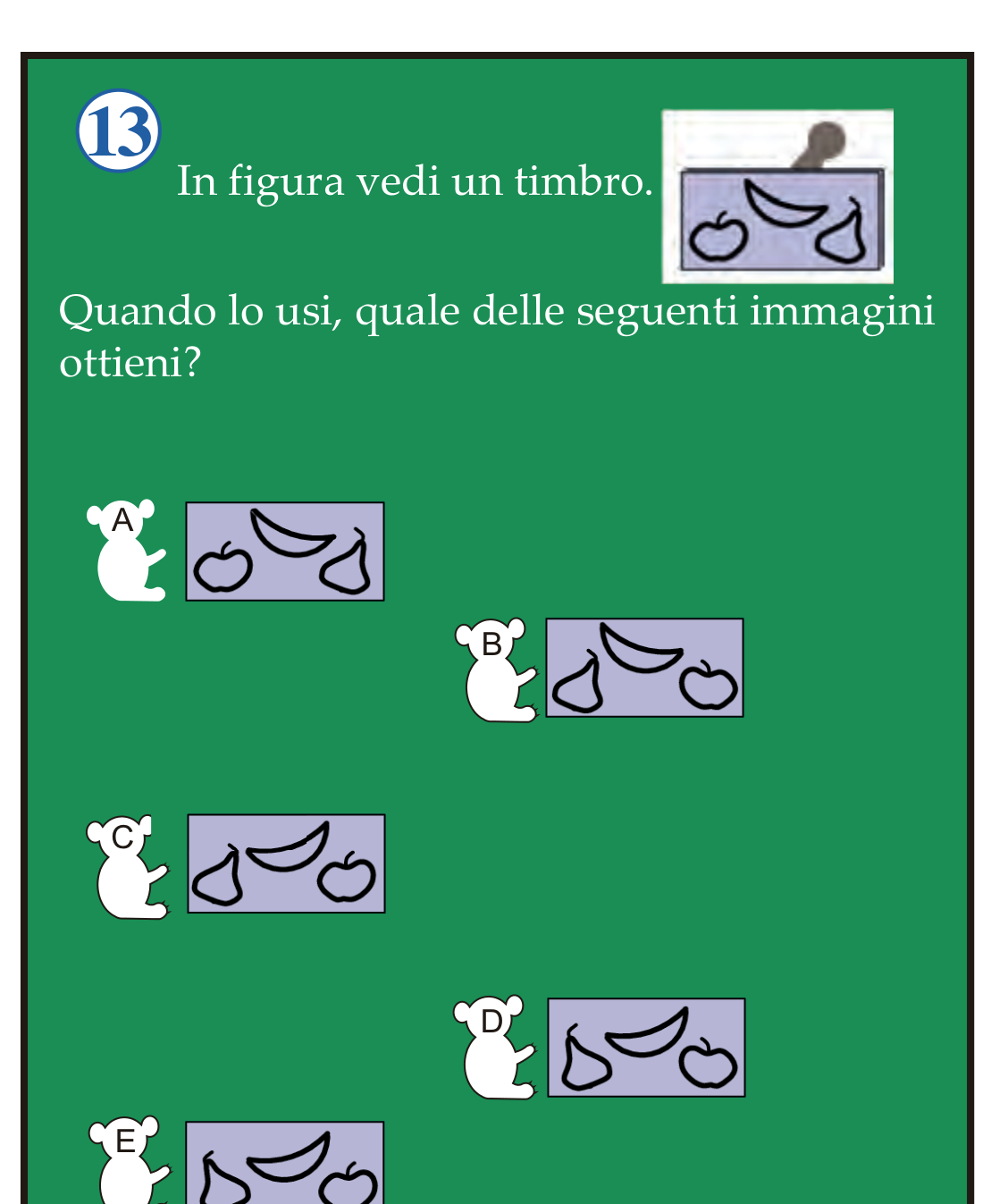
In figura vedi un timbro. Quando lo usi, quale delle seguenti immagini ottieni? (vedi figura)
Topic: Geometria piana Abilita: Ragionamento geometrico Area: Geometria Risposta: D Fonte: apri PDF p.4
what image is obtained
In the picture, you see a stamp. When you use it, which of the following images do you get? (see figure)
Answer: D
Tessere per orlare quadrato di lato 5
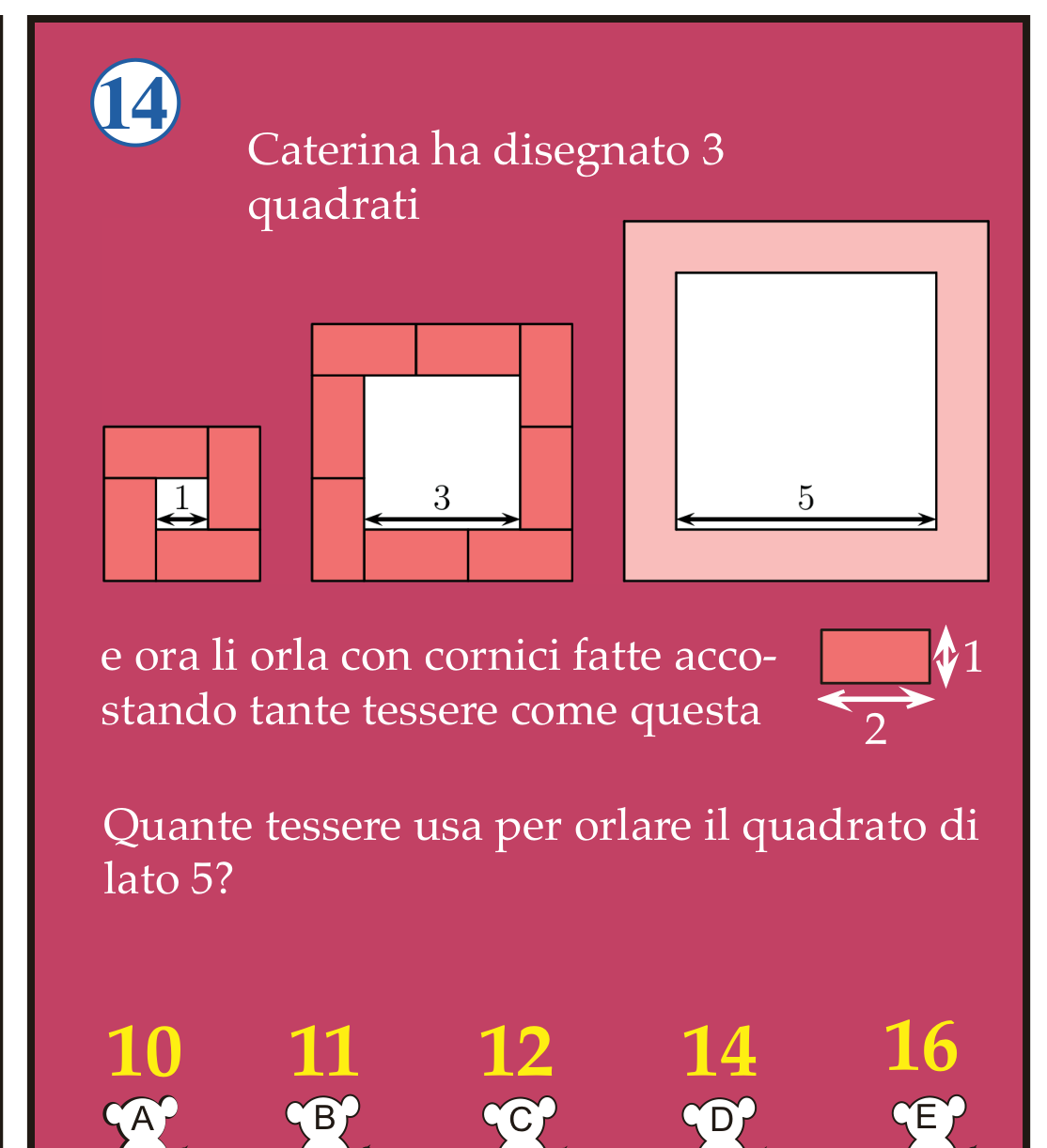
Caterina ha disegnato 3 quadrati e ora li orla con cornici fatte accostando tante tessere come questa (di lato ). Quante tessere usa per orlare il quadrato di lato 5? (vedi figura)
Topic: Geometria piana Abilita: Riconoscimento di pattern Area: Geometria Risposta: C Fonte: apri PDF p.4
Tiles to border a square with side 5
Caterina has drawn 3 squares and now she borders them with frames made by placing many tiles like this one (with side ). How many tiles does she use to border the square with side 5? (see figure)
Answer: C
stella dopo quadrato prima di triangolo
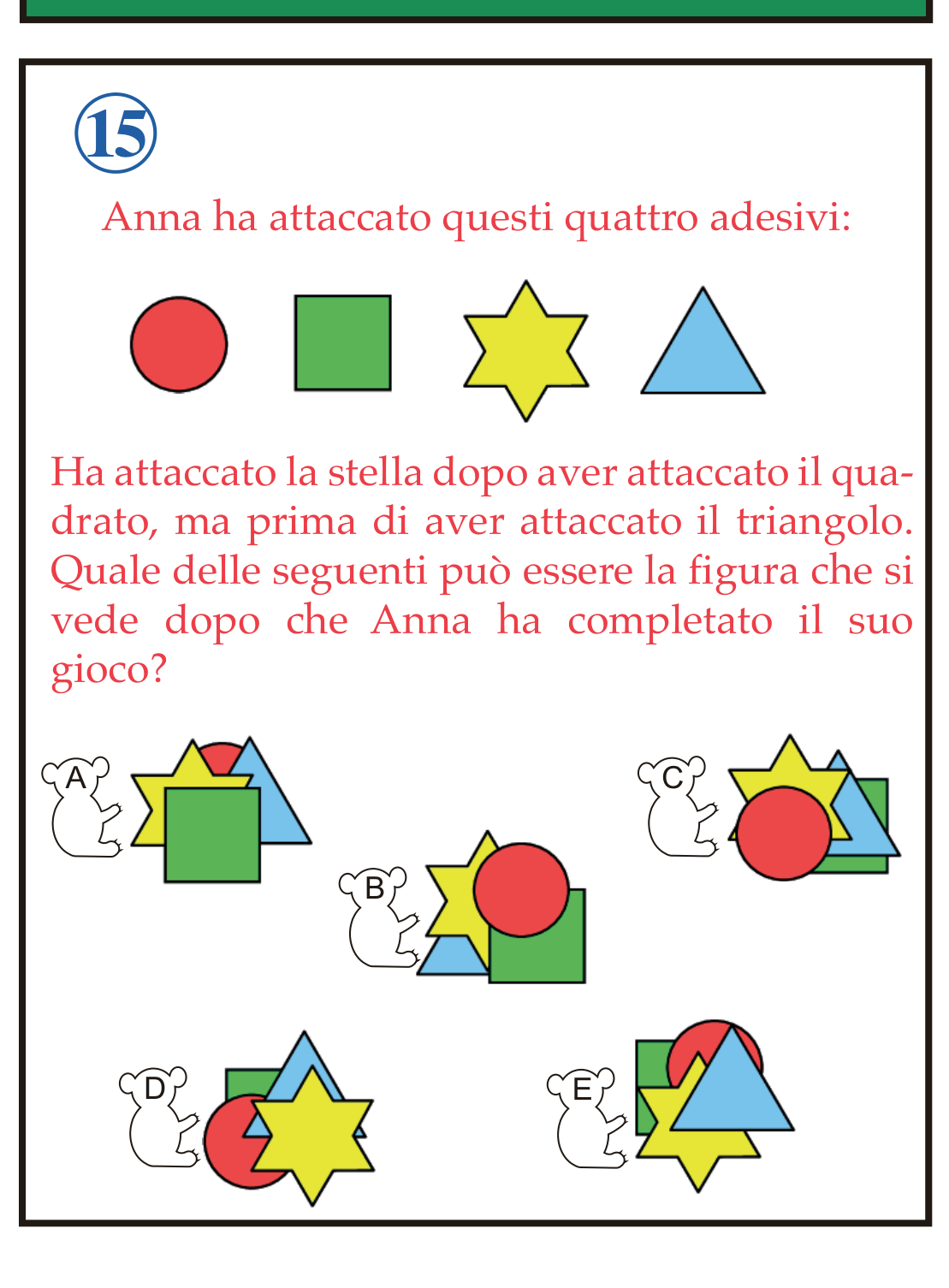
Anna ha attaccato questi quattro adesivi. Ha attaccato la stella dopo aver attaccato il quadrato, ma prima di aver attaccato il triangolo. Quale delle seguenti può essere la figura che si vede dopo che Anna ha completato il suo gioco? (vedi figura)
Topic: Logica, giochi, strategie Abilita: Casework accurato Area: Combinatoria, Logica e Probabilita Risposta: E Fonte: apri PDF p.4
star after square before triangle
Anna attached these four stickers. She attached the star after attaching the square, but before attaching the triangle. Which of the following may be the figure you see after Anna completes her play? (see figure)
Answer: E
quante figure si sovrappongono
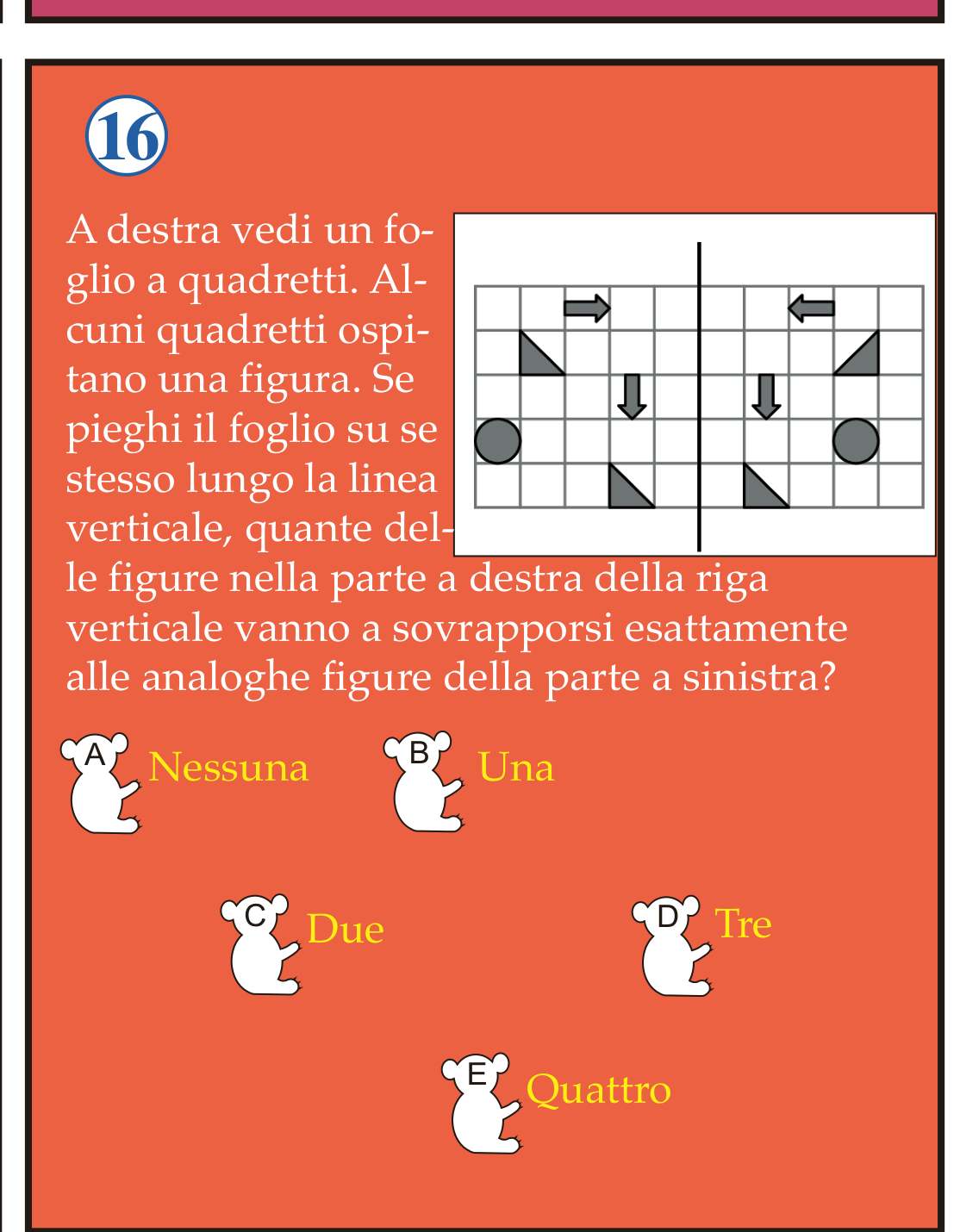
A destra vedi un foglio a quadretti. Alcuni quadretti ospitano una figura. Se pieghi il foglio so stesso lungo la linea verticale, quante delle figure nella parte a destra della riga verticale vanno a sovrapporsi esattamente alle analoghe figure della parte a sinistra? (vedi figura)
Topic: Geometria piana Abilita: Ragionamento geometrico Area: Geometria Risposta: D Fonte: apri PDF p.4
how many figures overlap
On the right you see a sheet of grid paper. Some squares contain a figure. If you fold the same sheet along the vertical line, how many of the figures on the right side of the vertical line overlap exactly with the similar figures on the left side? (see figure)
Answer: D
numero per uguagliare le due somme
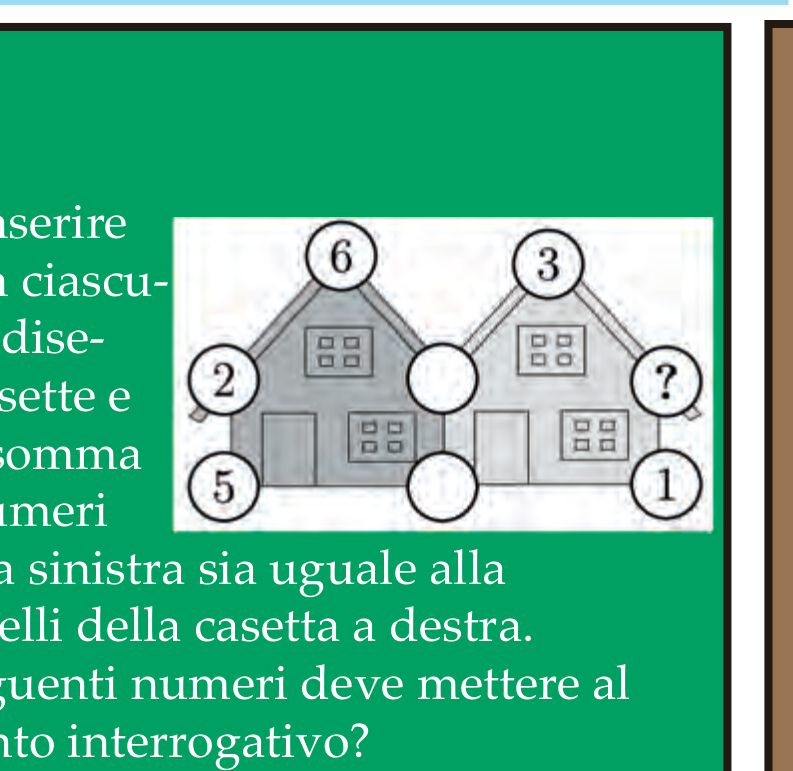
Luca vuole inserire un numero in ciascuno dei cerchi disegnati nelle casette e vuole che la somma dei cinque numeri della casetta a sinistra sia uguale alla somma di quelli della casetta a destra. Quale dei seguenti numeri deve mettere al posto del punto interrogativo? (vedi figura)
Topic: Algebra Abilita: Manipolazione algebrica Area: Algebra e Analisi Risposta: D Fonte: apri PDF p.5
number to equal the two sums
Luke wants to insert a number into each of the circles drawn in the boxes and wants the sum of the five numbers in the box on the left to be equal to the sum of the numbers in the box on the right. Which of the following numbers should replace the question mark? (see figure)
Answer: D
Aiuola con la superficie più piccola
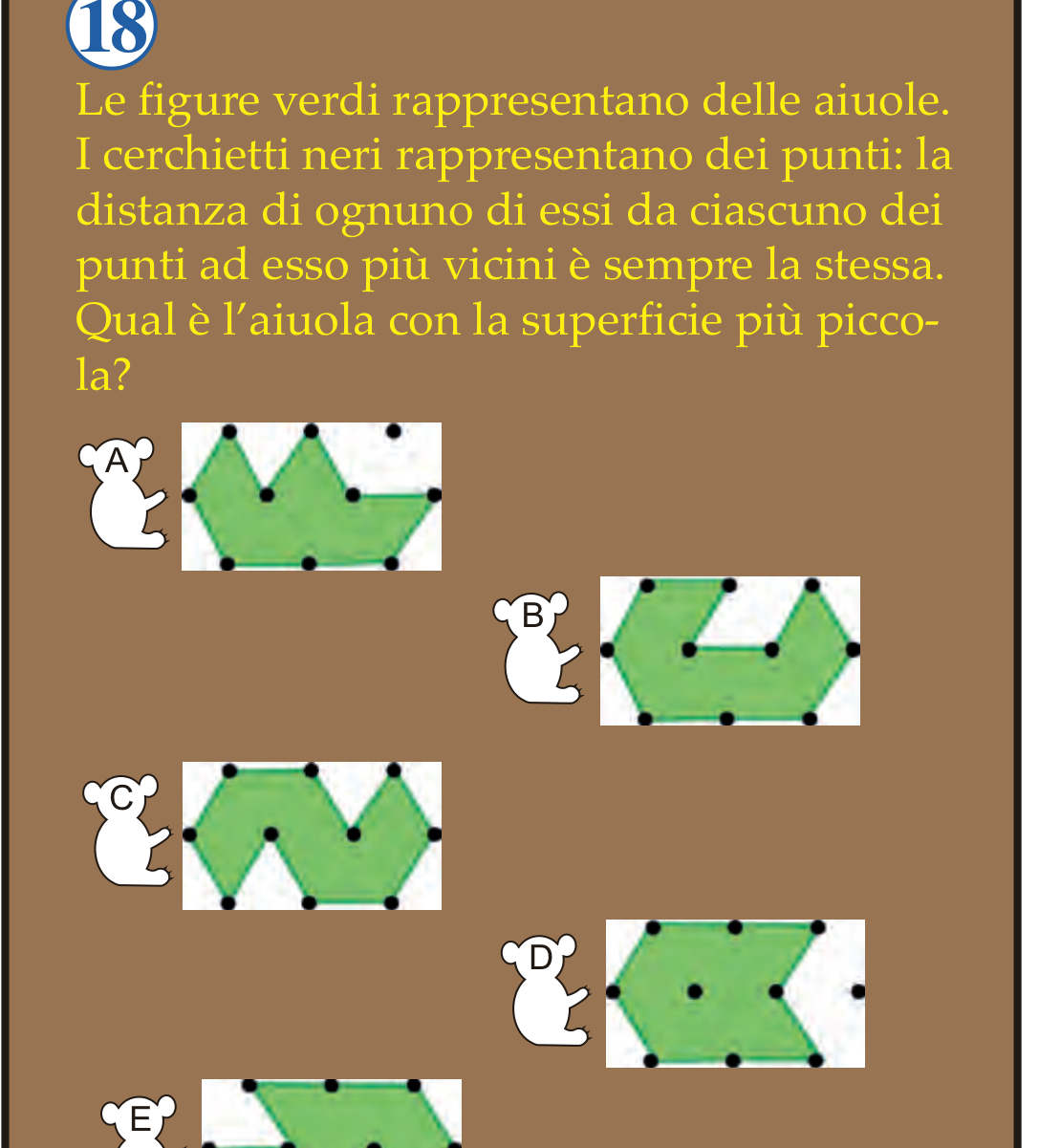
Le figure verdi rappresentano delle aiuole. I cerchietti neri rappresentano dei punti: la distanza di ognuno di essi da ciascuno dei punti ad esso più vicini è sempre la stessa. Qual è l’aiuola con la superficie più piccola? (vedi figura)
Topic: Geometria piana Abilita: Stima e approssimazione Area: Geometria Risposta: A Fonte: apri PDF p.5
Flowerbed with the smallest area
The green figures represent flowerbeds. The small black circles represent points: the distance of each of them from each of the points closest to it is always the same. Which is the flowerbed with the smallest area? (see figure)
Answer: A
Orsacchiotti regalo cumulativi dopo sesto compleanno
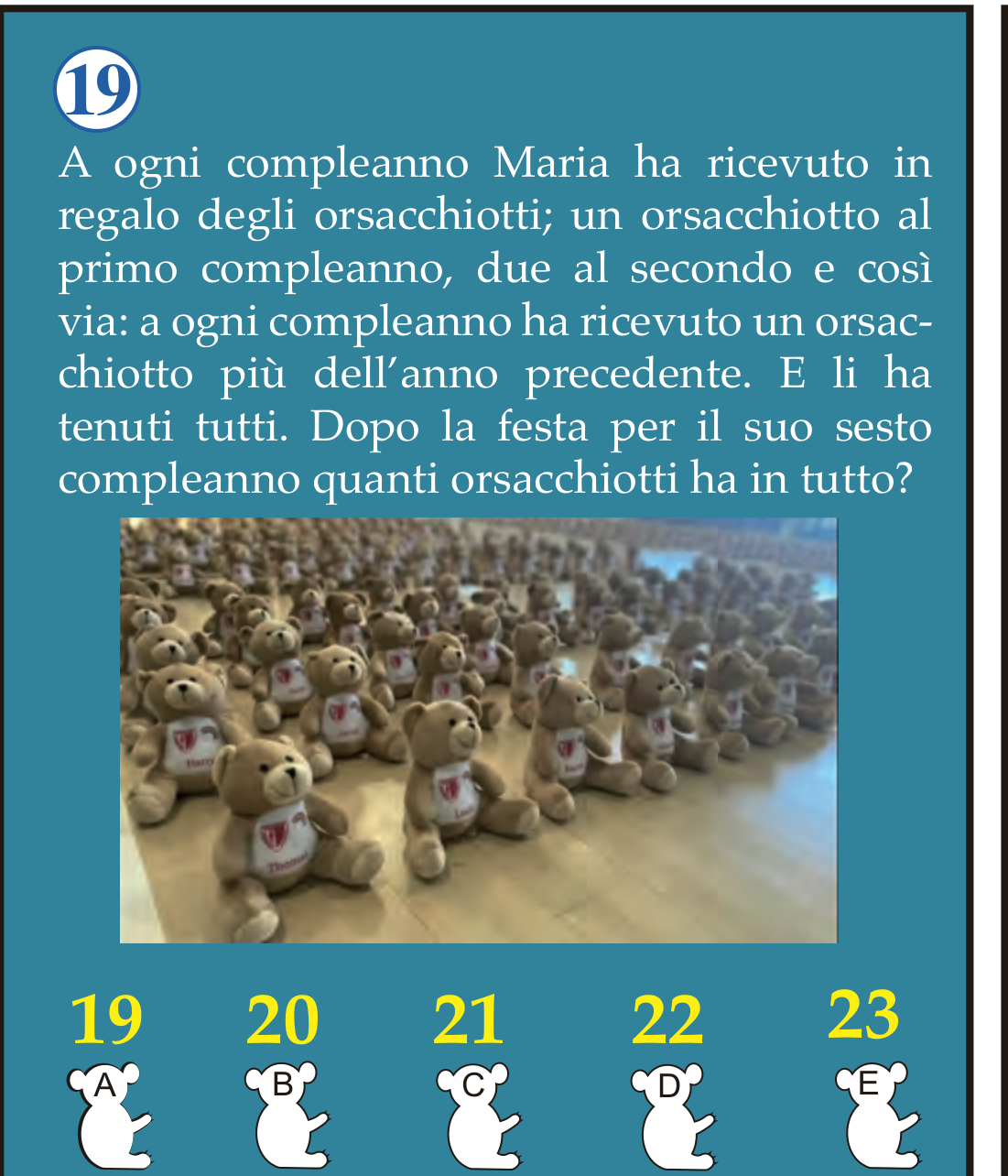
A ogni compleanno Maria ha ricevuto in regalo degli orsacchiotti: un orsacchiotto al primo compleanno, due al secondo e così via, a ogni compleanno ha ricevuto un orsacchiotto più dell’anno precedente. E li ha tenuti tutti. Dopo la festa per il suo sesto compleanno quanti orsacchiotti ha in tutto?
Topic: Teoria dei Numeri Abilita: Conteggio sistematico Area: Aritmetica e Teoria dei Numeri Risposta: C Fonte: apri PDF p.5
Cumulative gift bears after sixth birthday
Every birthday Mary received a gift of teddy bears: a teddy bear on her first birthday, two on her second birthday, and so on, every birthday she received one more teddy bear than the previous year. And she kept them all. After the party for her sixth birthday, how many bears does she have in all?
Answer: C
somma più alta dei numeri
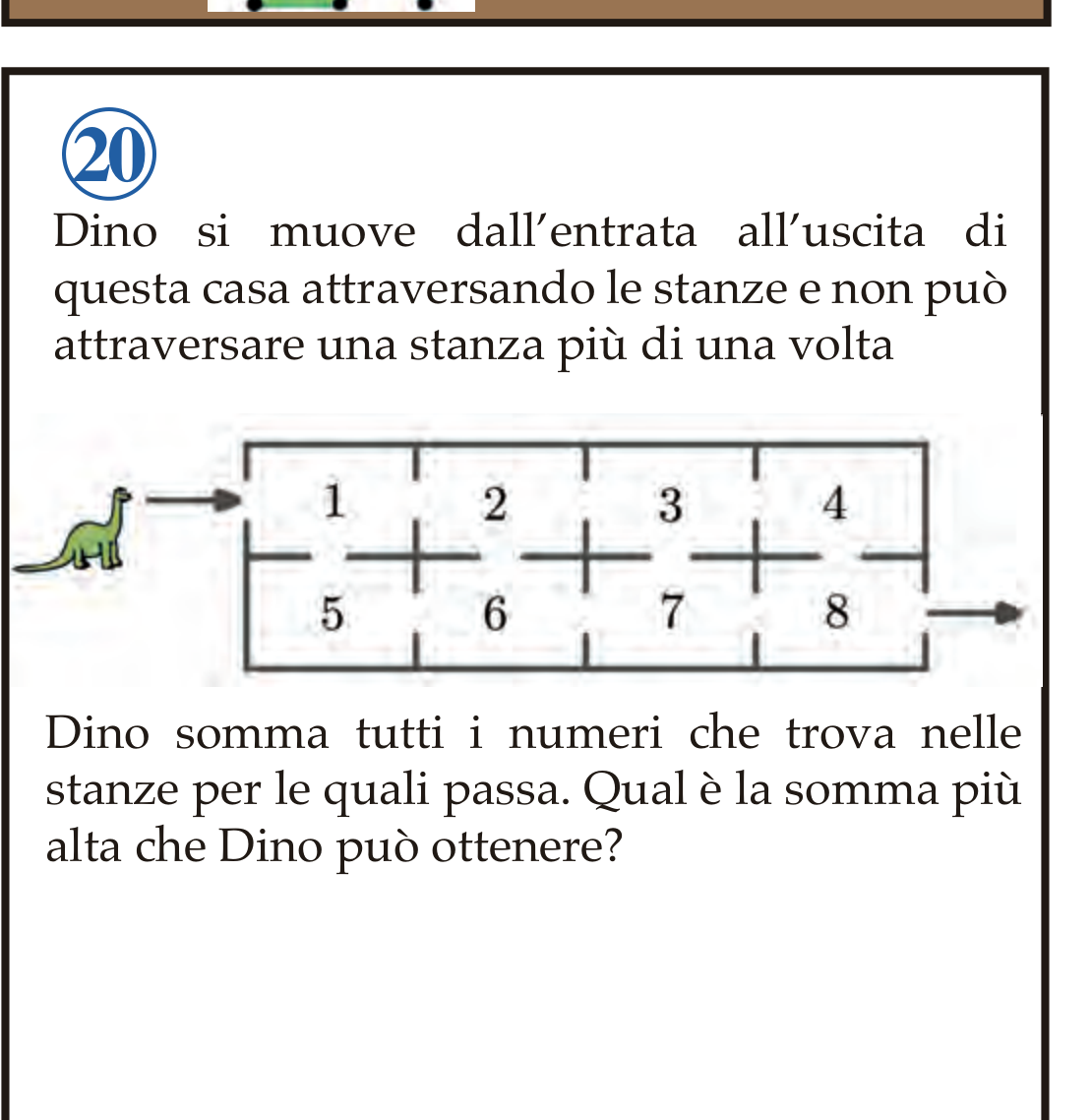
Dino si muove dall’entrata all’uscita di questa casa attraversando le stanze e non può attraversare una stanza più di una volta. Dino somma tutti i numeri che trova nelle stanze per le quali passa. Qual è la somma più alta che Dino può ottenere? (vedi figura)
Topic: Logica, giochi, strategie Abilita: Casework accurato Area: Combinatoria, Logica e Probabilita Risposta: D Fonte: apri PDF p.5
highest sum of the numbers
Dino moves from the entrance to the exit of this house through the rooms and can’t go through a room more than once. Dino sums up all the numbers he finds in the rooms he’s going through. What’s the highest sum Dino can get? (see figure)
Answer: D
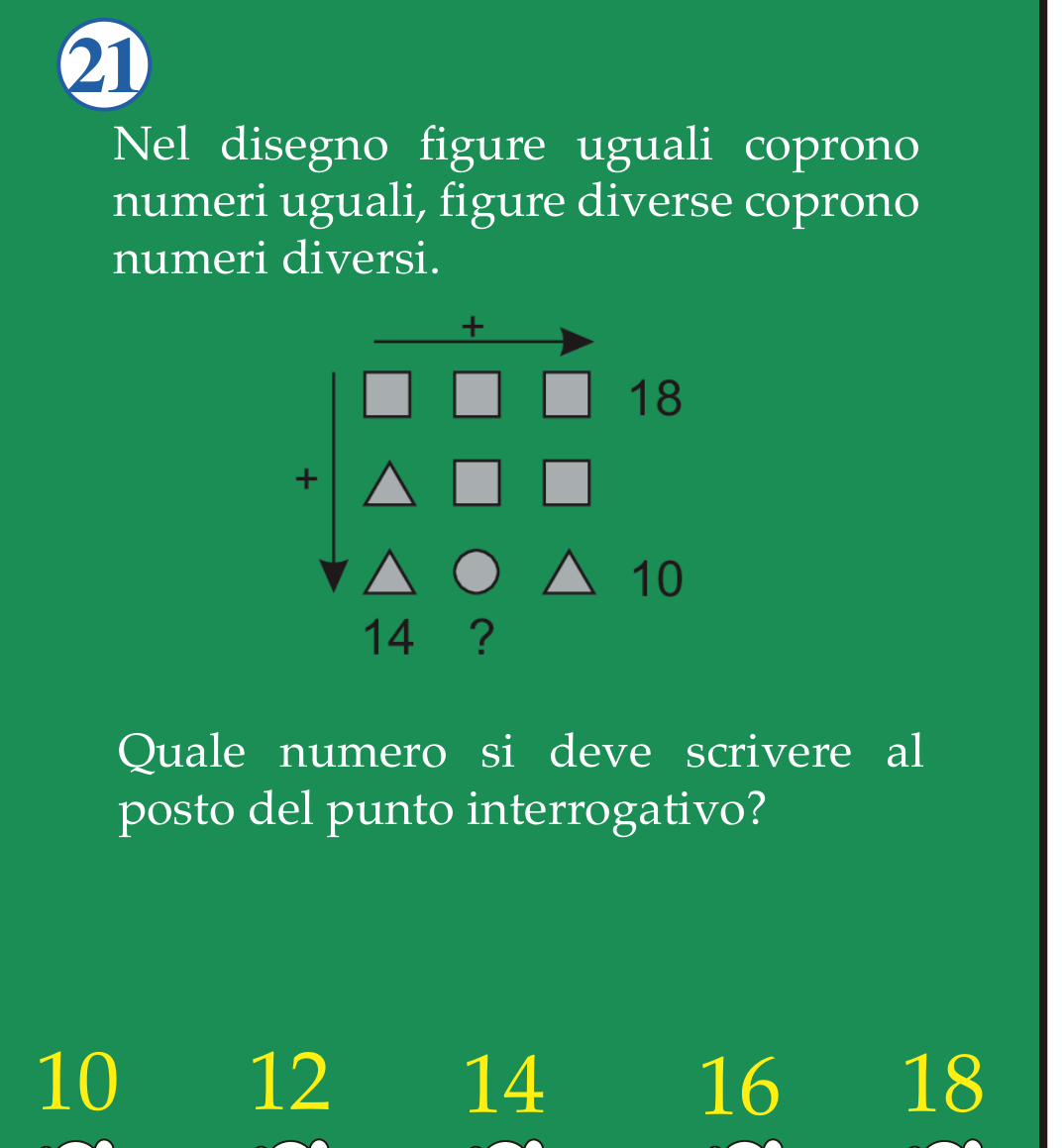
punto interrogativo
\begin{document}
\begin{tikzpicture}[scale=1.2]
  \draw[->,thick] (0.5,3.5) -- (3.7,3.5) node[right] {+};
  \draw[->,thick] (0.3,3.5) -- (0.3,0.5);
  \node at (-0.1,2.0) {+};
  \draw[fill=gray!50] (0.6,2.6) rectangle (1.4,3.4);
  \draw[fill=gray!50] (1.6,2.6) rectangle (2.4,3.4);
  \draw[fill=gray!50] (2.6,2.6) rectangle (3.4,3.4);
  \draw[fill=gray!50] (0.7,1.7) -- (1.3,1.7) -- (1.0,2.3) -- cycle;
  \draw[fill=gray!50] (1.6,1.6) rectangle (2.4,2.4);
  \draw[fill=gray!50] (2.6,1.6) rectangle (3.4,2.4);
  \draw[fill=gray!50] (0.7,0.7) -- (1.3,0.7) -- (1.0,1.3) -- cycle;
  \draw[fill=gray!50] (2.0,1.0) circle (0.35);
  \draw[fill=gray!50] (2.7,0.7) -- (3.3,0.7) -- (3.0,1.3) -- cycle;
  \node at (3.8,3.0) {18};
  \node at (3.8,1.0) {10};
  \node at (1.0,-0.2) {14};
  \node at (2.0,-0.2) {?};
\end{tikzpicture}
\end{document}
Nel disegno figure uguali coprono numeri uguali, figure diverse coprono numeri diversi. Quale numero si deve scrivere al posto del punto interrogativo? (vedi figura)
Topic: Logica, giochi, strategie Abilita: Casework accurato Area: Combinatoria, Logica e Probabilita Risposta: C Fonte: apri PDF p.6
?
\begin{document}
\begin{tikzpicture}[scale=1.2]
  \draw[->,thick] (0.5,3.5) -- (3.7,3.5) node[right] {+};
  \draw[->,thick] (0.3,3.5) -- (0.3,0.5);
  \node at (-0.1,2.0) {+};
  \draw[fill=gray!50] (0.6,2.6) rectangle (1.4,3.4);
  \draw[fill=gray!50] (1.6,2.6) rectangle (2.4,3.4);
  \draw[fill=gray!50] (2.6,2.6) rectangle (3.4,3.4);
  \draw[fill=gray!50] (0.7,1.7) -- (1.3,1.7) -- (1.0,2.3) -- cycle;
  \draw[fill=gray!50] (1.6,1.6) rectangle (2.4,2.4);
  \draw[fill=gray!50] (2.6,1.6) rectangle (3.4,2.4);
  \draw[fill=gray!50] (0.7,0.7) -- (1.3,0.7) -- (1.0,1.3) -- cycle;
  \draw[fill=gray!50] (2.0,1.0) circle (0.35);
  \draw[fill=gray!50] (2.7,0.7) -- (3.3,0.7) -- (3.0,1.3) -- cycle;
  \node at (3.8,3.0) {18};
  \node at (3.8,1.0) {10};
  \node at (1.0,-0.2) {14};
  \node at (2.0,-0.2) {?};
\end{tikzpicture}
\end{document}
In the diagram, equal shapes cover equal numbers, and different shapes cover different numbers. Which number should be written in place of the question mark? (See figure)
Answer: C
quale strada percorre
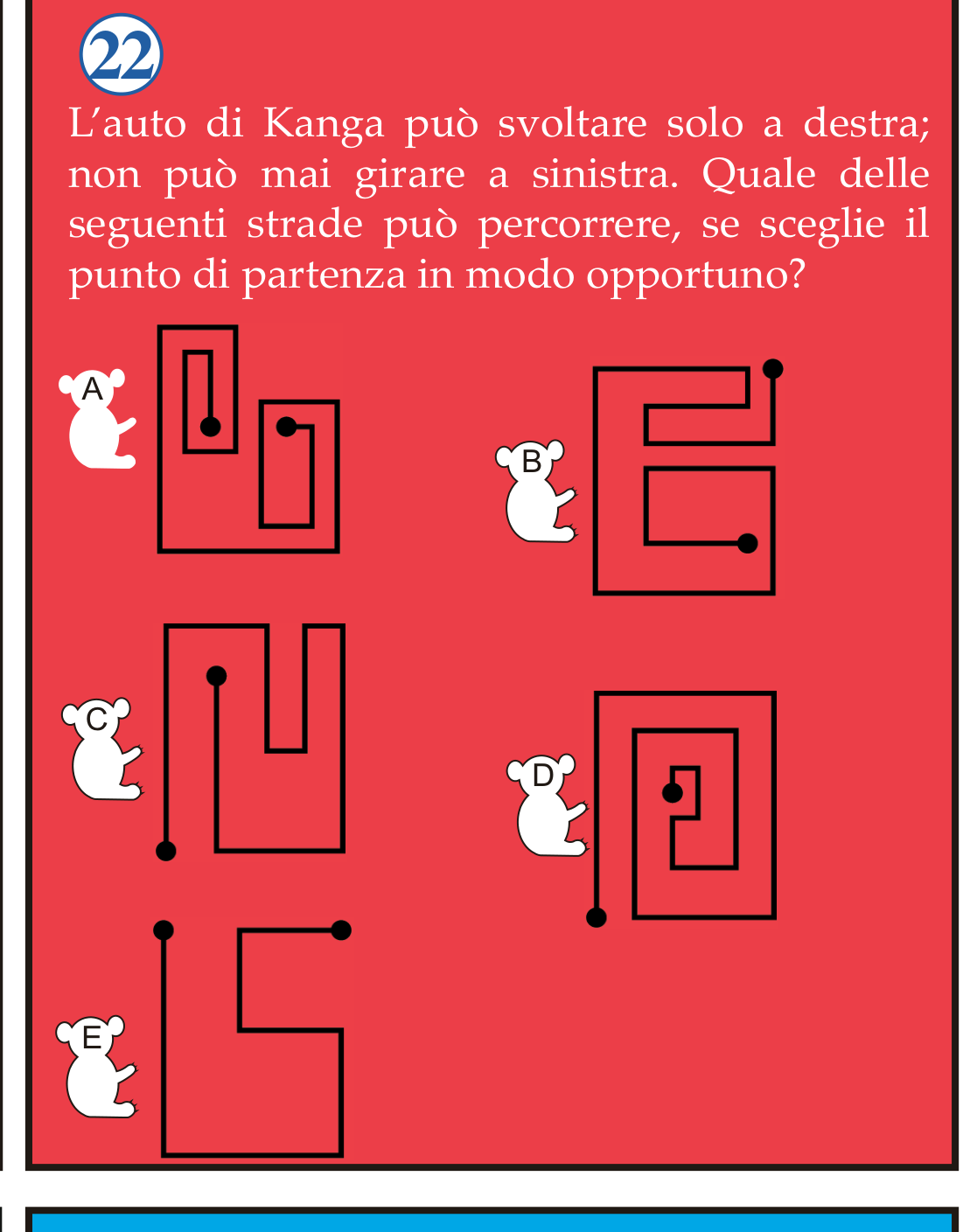
L’auto di Kanga può svoltare solo a destra; non può mai girare a sinistra. Quale delle seguenti strade può percorrere, se sceglie il punto di partenza in modo opportuno? (vedi figura)
Topic: Logica, giochi, strategie Abilita: Ragionamento geometrico Area: Combinatoria, Logica e Probabilita Risposta: A Fonte: apri PDF p.6
which road it takes
Kanga’s car can only turn right; it can never turn left. Which of the following roads can it take, if you choose the starting point appropriately? (see figure)
Answer: A
quanti bambini
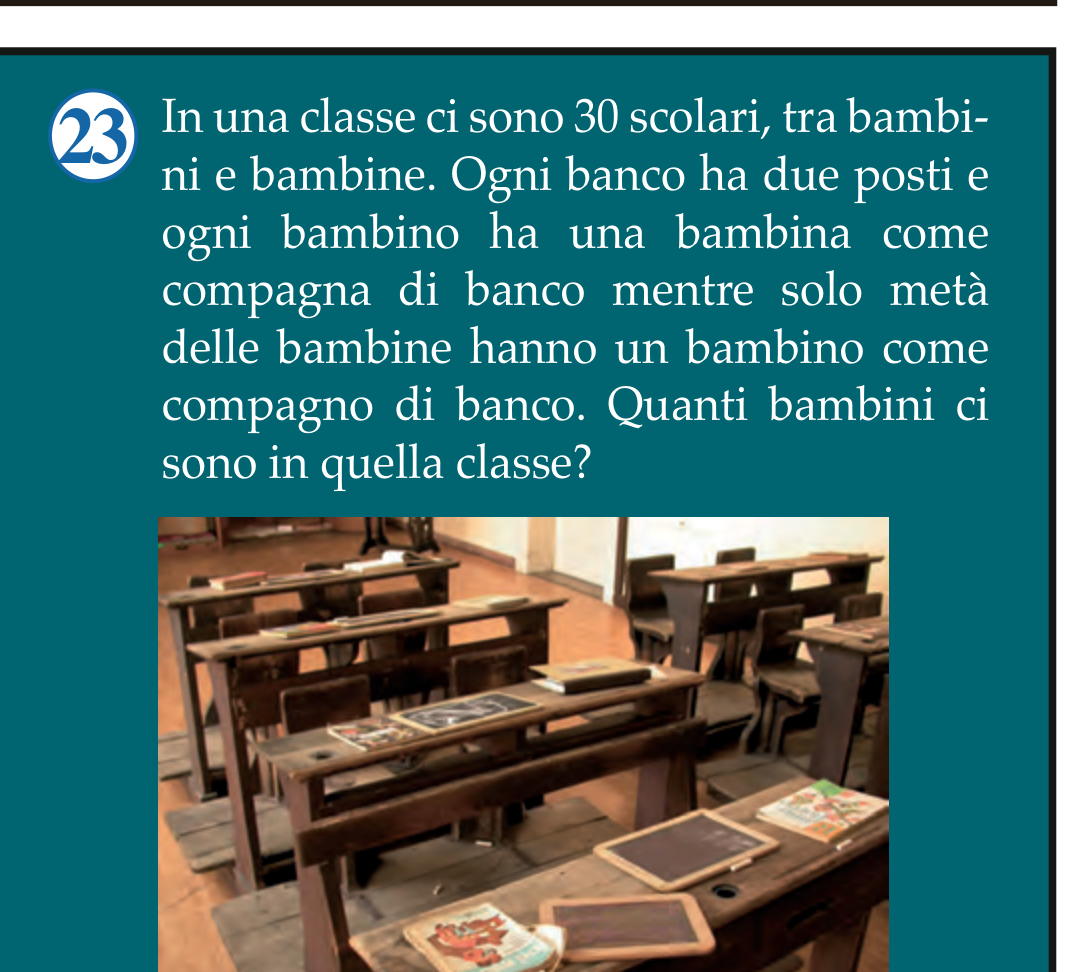
In una classe ci sono 30 scolari, tra bambini e bambine. Ogni banco ha due posti e ogni bambino ha una bambina come compagna di banco. Tuttavia solo metà delle bambine hanno un bambino come compagno di banco. Quanti bambini ci sono in quella classe?
Topic: Algebra Abilita: traduzione del testo Area: Algebra e Analisi Risposta: A Fonte: apri PDF p.6
how many children
There are 30 schoolchildren in a classroom, boys and girls. Each bench has two seats and each child has a girl as a bench partner. However, only half of the girls have a boy as a partner. How many kids are in that class?
Answer: A
minimo scambi per ordine crescente
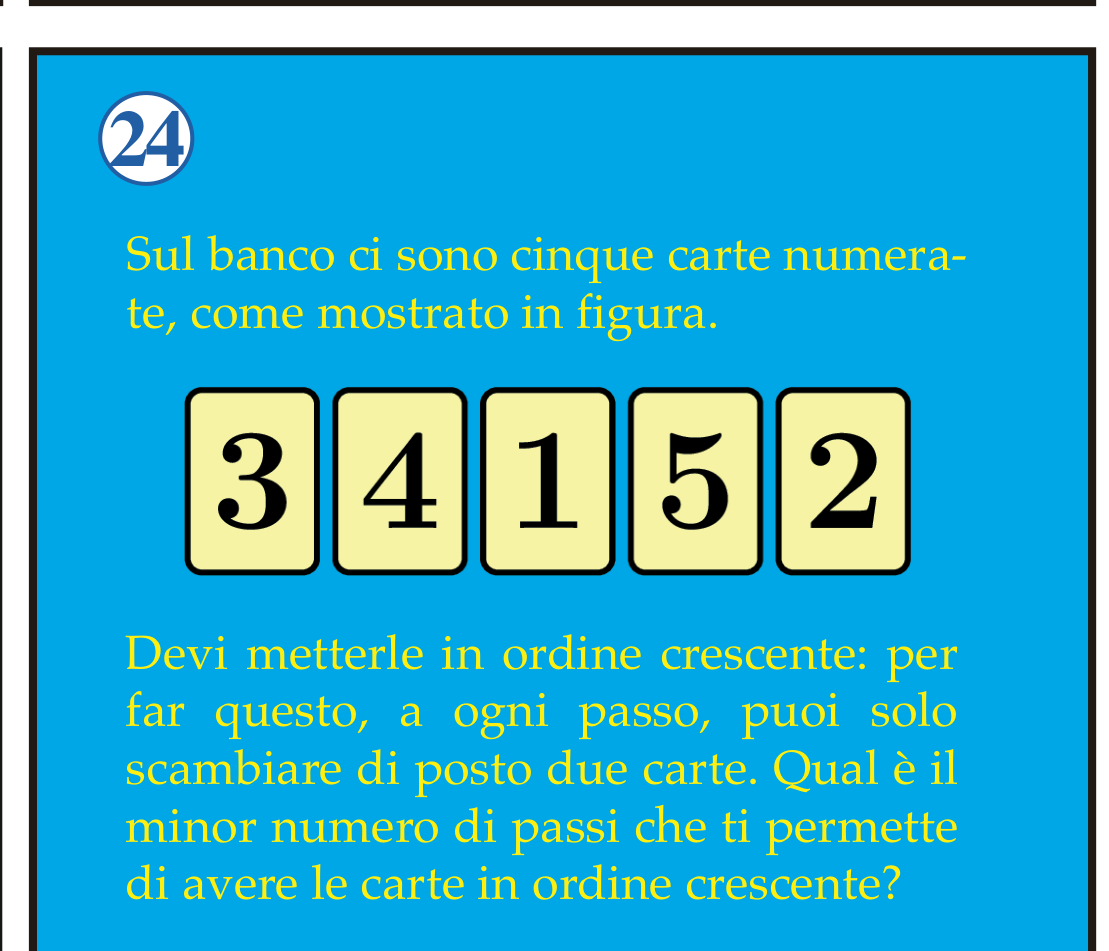
Sul banco ci sono cinque carte numerate, come mostrato in figura. Devi metterle in ordine crescente per farne una fila; a ogni passo, puoi solo scambiare di posto due carte. Qual è il minor numero di passi che ti permette di avere le carte in ordine crescente? (vedi figura)
Topic: Combinatoria Abilita: Conteggio sistematico Area: Combinatoria, Logica e Probabilita Risposta: C Fonte: apri PDF p.6
minimum exchanges for increasing order
There are five numbered cards on the counter, as shown in the figure. You have to put them in increasing order to make a row; at each step, you can only swap two cards in place. What’s the least number of steps that allows you to have the cards in increasing order? (see figure)
Answer: C